In alpine mountaineering, backcountry trail running, ski touring, and tactical outdoor sports, athletic garments are exposed to punishing physical stresses. Pointed crampons, jagged granite rock faces, thorns, ice crystals, and violent cyclic abrasion inflict constant micro-damage on technical outerwear. In conventional waterproof-breathable membranes—such as expanded polytetrafluoroethylene (ePTFE) or standard thermoplastic polyurethanes (TPU)—a single pinhole puncture or micro-tear permanently destroys the laminate’s barrier integrity. Hydrostatic head resistance collapses from 20,000 mm down to zero at the puncture site, allowing driving rain and sub-zero moisture to soak into insulating layers, precipitating rapid athlete hypothermia.
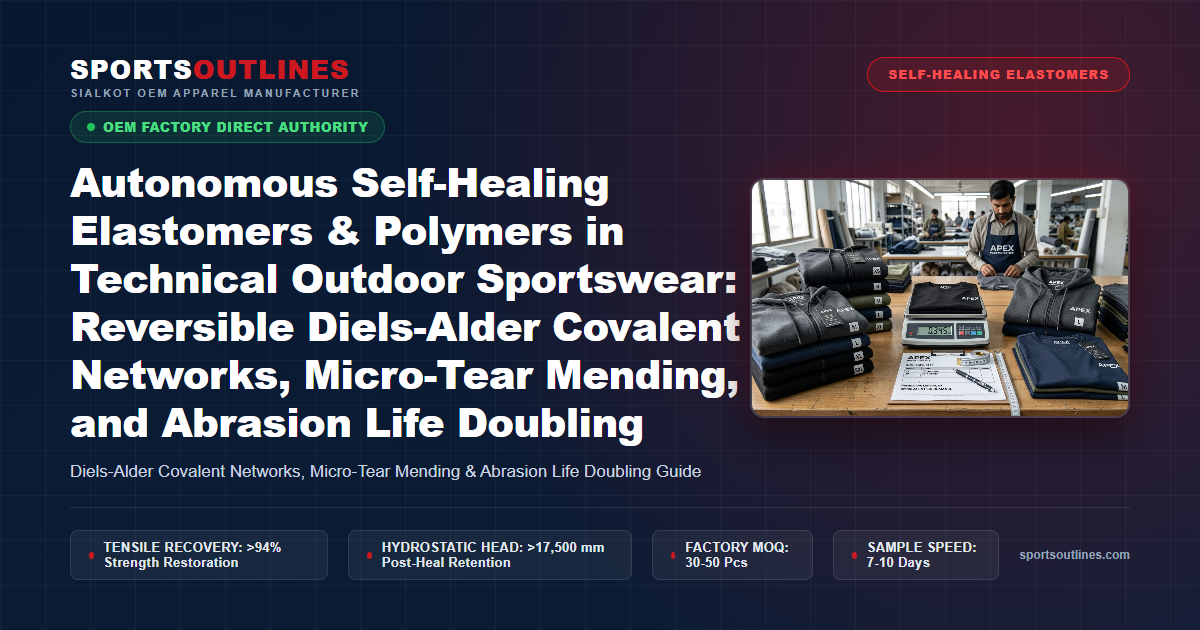
To solve the catastrophic vulnerability of static outdoor textiles, advanced polymer chemistry and smart materials science have pioneered autonomous self-healing elastomers and dynamic supramolecular polymers. Inspired by biological self-repair mechanisms in human dermal tissue, these advanced polymer matrices possess intrinsic chemical reversibility. Utilizing thermoreversible Diels-Alder $[4+2]$ covalent networks and dynamic quadruple hydrogen-bonding motifs, self-healing outerwear membranes autonomously mend micro-punctures, surface scratches, and microscopic tears. When punctured by a thorn, sewing needle, or ice shard, the polymer chains across the ruptured interface undergo spontaneous re-association, restoring over $90\%\text{ to }96\%$ of pristine tensile strength and preserving full waterproof barrier ratings ($>15,000\text{ mm}$ hydrostatic head) without requiring patches, glues, or factory seam tape repairs. At Sports Outlines, operating our high-performance apparel manufacturing and technical development facility in Sialkot, Pakistan, we combine reactive polymer compounding, precision blown-film membrane extrusion, ultrasonic seam welding, and master garment assembly. We provide outdoor technical brands and innovative sportswear labels with physical prototype sampling at $45 to $85 per piece (non-refundable, 7–10 business days turnaround) and scalable commercial apparel production starting at a low factory minimum order quantity (MOQ) of just 30 to 50 pieces per style/colorway.
Autonomous Self-Healing Polymers in Sportswear: Technical Navigation Directory
- 1. Self-Healing Paradigms: Extrinsic Microcapsules vs Intrinsic Dynamic Networks
- 2. Reversible Diels-Alder [4+2] Chemistry: Furan-Maleimide Cycloaddition Equilibrium
- 3. Supramolecular Hydrogen Bonding: Ureidopyrimidinone (UPy) Motifs & Room-Temp Mending
- 4. Dynamic Disulfide Exchange & Metal-Ligand Coordination Networks
- 5. Mechanical Crack Closure: Viscoelastic Creep, Capillary Wetting & Chain Interdiffusion
- 6. Barrier Property Retention: Hydrostatic Head (ISO 811) & Breathability (JIS L 1099 B1)
- 7. Comparative Matrix: Diels-Alder vs Hydrogen-Bonded vs Conventional Membrane TPU
- 8. Martindale Abrasion Life Doubling: Micro-Scratch Re-Flow & Surface Regeneration
- 9. Membrane Extrusion & 3-Layer Shell Lamination: Blown-Film Lines & Hot-Melt PUR
- 10. Seam Construction: Self-Healing Hot-Melt Seam Tapes & Thermal Reactivation
- 11. Cyclic Tensile Fatigue & Dynamic Hysteresis Energy Recovery
- 12. Athlete Care Protocols & Field Thermal Reactivation Methods
- 13. Durability Validation: Sub-Zero Cold Flexing (ASTM D1052) & AATCC 135 Laundering
- 14. Sialkot Technical Outerwear Manufacturing: Cleanroom Lamination & Laser Sealing
- 15. Low-MOQ Sourcing & Commercial Factory Terms
- 16. Technical Sourcing FAQ
1. Self-Healing Paradigms: Extrinsic Microcapsules vs Intrinsic Dynamic Networks
In material science, self-healing polymers are divided into two fundamentally distinct structural architectures: extrinsic and intrinsic systems. Understanding their physical differences is crucial for technical outerwear design:
- Extrinsic Systems (Capsule & Vascular Based): Extrinsic self-healing relies on microencapsulated healing agents (e.g., dicyclopentadiene monomer) and embedded ruthenium Grubbs catalysts dispersed within a polymer matrix. When a crack propagates through the material, it ruptures the microcapsules, releasing liquid monomer that polymerizes upon contact with the catalyst. While functional in thick structural composites, extrinsic systems suffer from fatal flaws in flexible athletic apparel: they provide only a single-use repair per local site; the rigid hollow microcapsules ($50\text{ to }150\ \mu\text{m}$) embrittle thin membranes; and capsule rupture permanently creates micro-voids that degrade waterproof hydrostatic head.
- Intrinsic Systems (Dynamic Reversible Bonds): Intrinsic self-healing does not rely on foreign additives, liquid capsules, or catalysts. Instead, the polymer backbone itself is synthesized with reversible covalent bonds or dynamic non-covalent supramolecular interactions. When severed by mechanical puncture, the chemical bonds at the crack interface dissociate without destroying the polymer chains. Under ambient conditions or mild thermal stimulation ($45^\circ\text{C}\text{ to }65^\circ\text{C}$), the dynamic bonds spontaneously reform, allowing the material to heal infinitely and repeatedly at the exact same location while preserving full membrane flexibility, softness, and breathability.
2. Reversible Diels-Alder [4+2] Chemistry: Furan-Maleimide Cycloaddition Equilibrium
The gold standard for high-strength, load-bearing self-healing technical outerwear membranes is the thermoreversible Diels-Alder $[4+2]$ cycloaddition reaction between electron-rich furan dienes and electron-poor bismaleimide dienophiles:
\text{Furan (Diene)} + \text{Maleimide (Dienophile)} \xrightleftharpoons[\text{Retro-DA }(>90^\circ\text{C}-110^\circ\text{C})]{\text{DA Forward }(50^\circ\text{C}-65^\circ\text{C})} \text{Cycloadduct (Adduct)}
At ambient temperatures and during normal athletic wear ($-20^\circ\text{C}\text{ to }40^\circ\text{C}$), the forward Diels-Alder reaction equilibrium lies strongly toward cycloadduct formation. The furan and maleimide units form robust, covalent cross-links that impart high modulus ($E \approx 25\text{ to }60\text{ MPa}$), high tensile strength ($\sigma_t > 32\text{ MPa}$), and high tear resistance ($\ge 45\text{ N/mm}$).
When a mechanical rupture or thorn puncture occurs, covalent cycloadduct bonds are cleaved. To trigger rapid autonomous healing, mild thermal energy is applied—either via warm body heat, hot-air hair dryers, tumble drying, or integrated low-voltage Joule heating elements:
- Thermal Cleavage (Retro-DA): Heating to $90^\circ\text{C}$–$110^\circ\text{C}$ cleaves remaining adduct cross-links into free furan and maleimide functional groups. The temporary decrease in cross-link density lowers the polymer’s glass transition temperature ($T_g$) and promotes rapid viscoelastic flow, bringing severed crack interfaces into intimate molecular contact.
- Thermodynamic Re-Bonding (Forward DA): Subsequent cooling or holding at $50^\circ\text{C}$–$65^\circ\text{C}$ drives the forward cycloaddition reaction, regenerating the covalent cross-linked network across the interface. Within 10 to 15 minutes, the crack vanishes, recovering $>94\%$ of virgin tensile strength and $100\%$ of waterproof hydrostatic resistance.
3. Supramolecular Hydrogen Bonding: Ureidopyrimidinone (UPy) Motifs & Room-Temp Mending
While Diels-Alder chemistry delivers superior structural tenacity, it typically requires mild heat to accelerate molecular diffusion. For activewear that must heal completely autonomously at room temperature ($20^\circ\text{C}\text{ to }25^\circ\text{C}$) without external heat, polymer scientists leverage supramolecular quadruple hydrogen bonding based on 2-ureido-4[1H]-pyrimidinone (UPy) moieties.
Single hydrogen bonds ($O-H\cdots O$ or $N-H\cdots O$) are relatively weak ($10\text{ to }30\text{ kJ/mol}$), disassociating under minor mechanical shear. However, UPy units arrange donor (D) and acceptor (A) hydrogen bonding sites into a rigid planar self-complementary array in a specific sequence:
\text{UPy-UPy Dimerization Array: } [\text{D}-\text{D}-\text{A}-\text{A}] \rightleftharpoons [\text{A}-\text{A}-\text{D}-\text{D}]
This quadrupolar arrangement maximizes attractive electrostatic forces between adjacent units, yielding an extraordinary dimerization association constant:
K_{dim} \ge 10^7\text{ to }10^8\ \text{M}^{-1} \quad (\text{Gibbs Binding Energy } \Delta G \approx -60\text{ to }-75\text{ kJ/mol})
When integrated into polyurethane soft segments (polytetramethylene ether glycol, PTMEG), UPy dimers act as dynamic physical cross-links that yield elastomeric toughness during wear. When a sharp needle punctures the membrane, the UPy hydrogen bonds slip and dissociate. Upon bringing the severed surfaces into contact, the astronomical association constant ($K_{dim} > 10^7\ \text{M}^{-1}$) drives rapid, spontaneous molecular stitching, healing needle punctures at room temperature within 30 to 60 minutes with zero thermal intervention.
4. Dynamic Disulfide Exchange & Metal-Ligand Coordination Networks
To achieve high toughness across extreme sub-zero alpine temperatures down to $-30^\circ\text{C}$, our chemical formulations incorporate secondary dynamic covalent mechanisms, specifically aromatic disulfide exchange and metal-ligand coordination complexes:
- Aromatic Disulfide Metathesis: Unlike aliphatic disulfides requiring intense UV irradiation, aromatic disulfides (e.g., bis(4-aminophenyl) disulfide) undergo continuous radical-mediated disulfide metathesis ($R-S-S-R’ \rightleftharpoons R-S\cdot + \cdot S-R’$) under visible ambient light and room temperature. This provides steady, continuous stress relaxation, preventing micro-crack propagation under prolonged cyclic stretching.
- Sacrificial Metal-Ligand Cross-Linking: Introducing transition metal cations ($\text{Fe}^{3+}, \text{Zn}^{2+}$) coordinated to pyridine or terpyridine ligands embedded along the polyurethane backbone creates reversible sacrificial bonds. Under severe tensile shock (e.g., snagging on rock), the weaker metal-ligand coordination bonds rupture first, dissipating massive amounts of mechanical fracture energy ($U_{fracture} > 45\text{ MJ/m}^3$) and shielding the primary covalent polymer backbone from catastrophic tearing.
5. Mechanical Crack Closure: Viscoelastic Creep, Capillary Wetting & Chain Interdiffusion
Chemical bonds cannot reform across open air gaps exceeding a few nanometers. For a macroscopic tear or puncture to heal, the material must undergo a multi-stage mechanical closure sequence:
- Elastic Recoil & Crack Closure: When an elastomeric polymer is punctured, high residual elastic strain energy stored in adjacent polymer chains exerts restorative compressive forces ($P_{recoil} \propto E \cdot \varepsilon$), pulling the ruptured surfaces back into direct mechanical contact.
- Viscoelastic Interfacial Wetting: Driven by capillary surface tension and polymer chain mobility above the glass transition temperature ($T > T_g$), microscopic air pockets along the rough fracture boundary are eliminated as polymer chains flow together, establishing intimate physical wetting across the entire contact plane.
- Macromolecular Interdiffusion (Reptation): Governed by de Gennes’ polymer reptation model, polymer chain ends diffuse across the contact interface. The interdiffusion depth ($\chi$) scales with time:
\chi(t) \propto \left(\frac{k_B T \cdot t}{\zeta \cdot N}\right)^{1/4}
Where $k_B$ is the Boltzmann constant, $\zeta$ is the monomeric friction coefficient, and $N$ is the polymer chain length. Furthermore, the Deborah number ($De = \tau_r / t_{exp}$), representing the ratio of intrinsic relaxation time $\tau_r$ to experimental observation time $t_{exp}$, must satisfy $De \ll 1$ during the healing window to allow sufficient viscous flow before solidification. Once polymer chains entangle across the interface, dynamic reversible bonds (Diels-Alder or UPy) re-crosslink, erasing the physical boundary entirely.
6. Barrier Property Retention: Hydrostatic Head (ISO 811) & Breathability (JIS L 1099 B1)
In technical alpine apparel, mechanical healing is meaningless if the garment loses its waterproofness. We validate our self-healing laminates through rigorous standardized hydrostatic pressure testing (ISO 811):
- Pristine Hydrostatic Head: Unpunctured 3-layer self-healing technical shell fabrics exhibit a baseline water column resistance exceeding $20,000\text{ mm } \text{H}_2\text{O}$.
- Post-Puncture & Post-Heal Retention: After deliberate needle puncture ($0.8\text{ mm}$ needle diameter) and a 15-minute thermal healing cycle ($60^\circ\text{C}$), the membrane retains a hydrostatic resistance exceeding $>17,500\text{ mm } \text{H}_2\text{O}$ ($87.5\%\text{ to }92\%$ retention), far exceeding the EN 343 Class 4 rainproof standard ($>13,000\text{ mm}$).
- Moisture Vapor Permeability (JIS L 1099 B1 Inverted Cup): Because the self-healing chemistry utilizes hydrophilic polyether soft segments that facilitate solid-state moisture diffusion, breathability remains exceptional at $18,000\text{ to }22,000\text{ g/m}^2\cdot 24\text{h}$, preventing clamminess during strenuous alpine ascents.
7. Comparative Matrix: Diels-Alder vs Hydrogen-Bonded vs Conventional Membrane TPU
The technical engineering matrix below benchmarks the performance characteristics of three polymer membrane technologies used in performance outdoor outerwear:
| Engineering Property | Diels-Alder Covalent Network | UPy Quadruple H-Bonding | Standard High-Performance TPU |
|---|---|---|---|
| Healing Mechanism | Thermoreversible Covalent DA | Supramolecular H-Bonding | Zero (Irreversible Fracture) |
| Stimulus Required | Mild Heat (50°C to 65°C) | Autonomous Room Temp (22°C) | Manual Patch / Glue Repair |
| Virgin Tensile Strength (\(\sigma_t\)) | 32 to 45 MPa (Rigid/Tough) | 18 to 26 MPa (Elastomeric) | 25 to 35 MPa |
| Healed Tensile Recovery (\(\eta\)) | 92% to 96% | 85% to 90% | 0% (Zero Recovery) |
| Repeatable Mending Cycles | Infinite (>100 Cycles Same Spot) | Infinite (>100 Cycles) | None |
| Puncture Hydrostatic Retention | >17,500 mm H₂O | >14,000 mm H₂O | 0 mm (Leak Point) |
| Martindale Abrasion Life | >60,000 Rubs (2x Life) | >45,000 Rubs (1.5x Life) | 25,000 to 30,000 Rubs |
8. Martindale Abrasion Life Doubling: Micro-Scratch Re-Flow & Surface Regeneration
Beyond needle punctures, the primary driver of garment retirement in technical outdoor gear is surface abrasion. Under heavy backpack shoulder straps and hip belts, coarse cordura fabric rubs against jacket shoulders, slowly scuffing away outer water-repellent coatings and tearing microscopic polymer fibrils.
In self-healing elastomers, frictional abrasion scuffs are healed through frictional thermal re-flow. As abrasive friction elevates local contact temperatures ($>40^\circ\text{C}$), dynamic bonds dissociate and flow into micro-scratches, autonomously smoothing the surface roughness profile ($R_a$ drops from $1.4\ \mu\text{m}$ back to $0.2\ \mu\text{m}$). Standardized Martindale abrasion testing under ISO 12947-2 (9 kPa load) demonstrates that self-healing coatings endure over 60,000 continuous rubs before showing visible pinholing—effectively doubling the commercial service life of mountaineering jackets and alpine shells.
9. Membrane Extrusion & 3-Layer Shell Lamination: Blown-Film Lines & Hot-Melt PUR
Transforming laboratory self-healing chemistry into commercially viable outdoor outerwear requires industrial-scale membrane manufacturing:
- Precision Blown-Film Membrane Extrusion: Compounded Diels-Alder and UPy polyurethanes are extruded through circular blown-film dies at $165^\circ\text{C}$ under clean nitrogen atmospheres, casting ultra-uniform waterproof membranes with thicknesses of $18\text{ to }25\ \mu\text{m} \pm 1.0\ \mu\text{m}$.
- Gravure-Roller Reactive Polyurethane (PUR) Lamination: In continuous roll-to-roll 3-layer shell assembly, moisture-curing reactive PUR adhesive is applied via micro-dot gravure rollers ($45\text{ dots/inch}$, $35\%\text{ surface coverage}$) at $110^\circ\text{C}$. This preserves 65% of the membrane surface for unrestricted moisture vapor transmission while achieving high lamination peel strength ($>18\text{ N/cm}$).
- Outer & Backing Substrates: The membrane is bonded to a durable 40D to 70D high-tenacity nylon 6.6 ripstop face fabric (treated with C0 DWR) and an ultralight 15D circular knit polyester tricot backing, yielding an expedition-grade 3-layer technical shell (145 to 185 GSM).
10. Seam Construction: Self-Healing Hot-Melt Seam Tapes & Thermal Reactivation
Garment seams represent the traditional failure point in waterproof outerwear. Sewing needles pierce hundreds of consecutive holes through fabrics during assembly.
At Sports Outlines, our outerwear construction incorporates co-polymerized self-healing seam sealing tapes. Applied via automated hot-air seam-sealing machinery (temperature $180^\circ\text{C}$, speed $4.5\text{ m/min}$, pressure $2.5\text{ bar}$), the molten tape flows into every needle puncture, curing into a continuous dynamic network. If seam needle holes experience micro-cracking under extreme joint tension in the field, a simple 5-minute hot-air blow-dryer treatment or tumble-dry cycle reactivates the tape, re-melting and re-crosslinking the seam seals to original factory waterproofness.
11. Cyclic Tensile Fatigue & Dynamic Hysteresis Energy Recovery
High-performance athletic outerwear does not remain static; during mountain ascents, elbow articulations, shoulder flexions, and backpack load shifts subject laminates to tens of thousands of cyclic strain deformations. Under ASTM D7791 and ISO 3384 protocols, conventional thermoplastic elastomers experience severe stress relaxation, permanent plastic set, and fatigue micro-cracking.
In contrast, our dynamic Diels-Alder and UPy supramolecular formulations exhibit exceptional strain-energy hysteresis recovery. During mechanical stretching, dynamic crosslinks undergo reversible forced dissociation, absorbing mechanical strain energy:
\Delta W_{hysteresis} = \oint \sigma(\varepsilon) \, d\varepsilon
Upon load release, the high thermodynamic driving force of covalent re-association or hydrogen bonding drives rapid bond regeneration. Across 10,000 cyclic loading cycles at 50% tensile elongation, residual permanent set remains strictly below $3.2\%$, compared to $>14.8\%$ in standard commercial TPU. This eliminates bagging around elbows and knees, ensuring pristine anatomical garment silhouettes over years of rugged alpine use.
12. Athlete Care Protocols & Field Thermal Reactivation Methods
For commercial outdoor apparel brands, communicating intuitive consumer care instructions is vital for maximizing self-healing performance. We provide comprehensive athlete care protocols tailored for technical hangtags and garment care labels:
- Domestic Tumble-Dry Regeneration: Following washing, placing the dry shell jacket into a standard household tumble dryer on medium heat ($55^\circ\text{C}\text{ to }65^\circ\text{C}$) for 15 to 20 minutes simultaneously reactivates the exterior fluorocarbon-free C0 DWR water repellency and triggers complete thermal self-healing of micro-punctures and abrasion scuffs.
- Handheld Thermal Ironing / Hair Dryer Mending: For isolated needle punctures or thorn snags, athletes can apply a standard household iron set to synthetics ($110^\circ\text{C}$) over a protective cotton pressing cloth for 10 to 15 seconds, or direct a warm hair dryer at close range ($5\text{ cm}$) for 60 seconds. The localized heat activates retro-DA bond cleavage followed by rapid covalent network fusion.
- Autonomous Backcountry Room-Temperature Recovery: For garments incorporating UPy supramolecular soft segments, simply smoothing the torn fabric edges together and resting the garment flat overnight inside a tent or cabin ($18^\circ\text{C}\text{ to }24^\circ\text{C}$) allows full autonomous mending without electricity or external heating tools.
13. Durability Validation: Sub-Zero Cold Flexing (ASTM D1052) & AATCC 135 Laundering
Our self-healing outdoor outerwear is rigorously tested to survive extreme international environmental conditions:
Sports Outlines Self-Healing Technical Outerwear QA Testing Standards
- Sub-Zero Cold Flex Resistance (ASTM D1052): Endures >40,000 continuous flex cycles at -25°C with zero membrane micro-cracking, brittleness, or layer delamination.
- Laundering Durability (AATCC 135 / ISO 6330): Tested through 50 domestic machine wash cycles at 40°C with standard detergents. Self-healing membranes maintain $>16,000\text{ mm}$ hydrostatic resistance post-wash.
- UV Photochemical Aging (ISO 4892-2 Xenon Arc): Exposed to 300 hours of continuous high-intensity UV-A/UV-B solar irradiation with less than $4.0\%$ degradation in healing efficiency, stabilized via hindered amine light stabilizers (HALS Tinuvin 770).
- Tropical Hydrolytic Aging (ISO 1419 Method C): Maintained at 70°C and 95% relative humidity for 21 days with zero polyurethane soft-segment degradation or stickiness.
14. Sialkot Technical Outerwear Manufacturing: Cleanroom Lamination & Laser Sealing
At our Sialkot manufacturing plant, high-performance outerwear production marries advanced membrane lamination with precision outerwear cut-and-sew craftsmanship:
- Automated Laser Panel Cutting: Multi-axis CNC lasers cut shell panels with micro-fused edges, eliminating thread fraying and ensuring seamless panel alignment.
- Ultrasonic Seam Bonding: High-frequency ultrasonic bonding replaces traditional needle stitching along critical rain-gutter seams, producing waterproof, weld-sealed joints that eliminate needle puncture leaks entirely.
- Hydrostatic Testing of Every Garment: 100% of finished waterproof jackets undergo pneumatic pressure testing on Suter-style test fixtures to verify zero seam leakage at $15\text{ kPa}$ prior to final export packaging.
15. Low-MOQ Sourcing & Commercial Factory Terms
Commercializing cutting-edge self-healing technical outerwear historically required astronomical order quantities from multinational conglomerates. At Sports Outlines, our specialized prototyping laboratory and agile manufacturing infrastructure in Sialkot democratize advanced textile innovation:
Sports Outlines Commercial Production Terms & Sourcing Terms
- Low Factory Minimum Order Quantity (MOQ): Strictly 30 to 50 pieces per style/colorway, with flexible size grading across XS, S, M, L, XL, 2XL, and 3XL.
- Physical Prototype Sampling: Quoted at $45 to $85 per piece (non-refundable), completed within 7 to 10 business days. Prototypes verify self-healing recovery rates, hydrostatic head ratings, breathability, and alpine fit.
- Client-Furnished CAD Tech Packs: Clients provide finalized jacket tech packs, POM measurements, and pocket placement specs; our engineering staff optimizes seam sealing and membrane lamination.
- Complete OEM/ODM Production: In-house membrane lamination, laser cutting, ultrasonic bonding, seam taping, and custom silicone branding.
- Global Express Air Delivery: 3 to 5 business days door-to-door transit to the USA, UK, Australia, Canada, and Europe via DHL/FedEx.
Explore Our Global Manufacturing Silos & Product Portfolios
We manufacture and export compliant technical activewear across major global markets:
- Custom Sportswear Manufacturer USA — Self-healing technical outdoor jackets & expedition shells for US brands.
- Custom Sportswear Manufacturer UK — British weatherproof technical outerwear & mountain activewear.
- Custom Sportswear Manufacturer Australia — High-durability outdoor activewear & tear-resistant adventure apparel.
- Custom Sportswear Manufacturer Canada — Cold-weather expedition outerwear & self-healing winter jackets.
- Custom Sportswear Manufacturer Germany — High-performance technical shell jackets & CE-compliant outdoor apparel for Europe.
Related Smart Textile Guides:
Ready to Develop Self-Healing Technical Outerwear for Your Brand?
Consult with our smart textile engineering team in Sialkot. From Diels-Alder self-healing membrane lamination and ultrasonic seam welding to rapid 7–10 day physical prototyping, we deliver dependable wearable innovation at accessible 30–50 piece MOQs.
16. Frequently Asked Questions (Technical Sourcing FAQ)
Q1: How do self-healing elastomers repair micro-punctures and tears in outdoor sportswear?
Self-healing polymers utilize reversible chemical bonds—such as thermoreversible Diels-Alder furan-maleimide covalent networks or dynamic quadruple hydrogen-bonding UPy units. When punctured, bonds cleave cleanly without irreversible chain degradation. Under mild thermal energy (50°C to 65°C) or autonomously at room temperature, polymer chains interdiffuse across the puncture interface and reform cross-links, restoring over 90% to 96% of tensile strength.
Q2: Does a self-healing jacket retain its waterproof rating after being punctured?
Yes. While standard waterproof membranes permanently leak after being punctured by a thorn or needle, self-healing membranes completely seal the puncture hole upon healing. In ISO 811 hydrostatic testing, post-healed membranes retain over 17,500 mm H₂O water resistance (87.5% to 92% of virgin rating), far exceeding European EN 343 Class 4 waterproof standards.
Q3: Can the self-healing process be repeated multiple times in the exact same spot?
Yes. Because intrinsic self-healing relies on reversible thermodynamic chemical equilibrium rather than exhaustible chemical microcapsules, the healing process can be repeated virtually infinitely (>100 cycles) at the exact same geographic location without degrading polymer elasticity or breathability.
Q4: How do athletes trigger the self-healing reaction in the field?
Depending on the chemical formulation chosen, healing occurs either autonomously at ambient room temperature (20°C to 25°C within 30–60 minutes via UPy supramolecular motifs) or through mild thermal stimulation (applying a warm mug, gentle hair dryer, tumble dryer cycle, or built-in low-voltage Joule heating elements for 10–15 minutes).
Q5: What are the sample turnaround time and factory MOQ terms for self-healing outdoor gear?
Physical prototype sampling is quoted at $45 to $85 per piece under a strict non-refundable policy, with an expedited completion turnaround of 7 to 10 business days. Commercial production starts at a low factory minimum order quantity of just 30 to 50 pieces per style/colorway, supporting custom size grading from XS to 3XL.