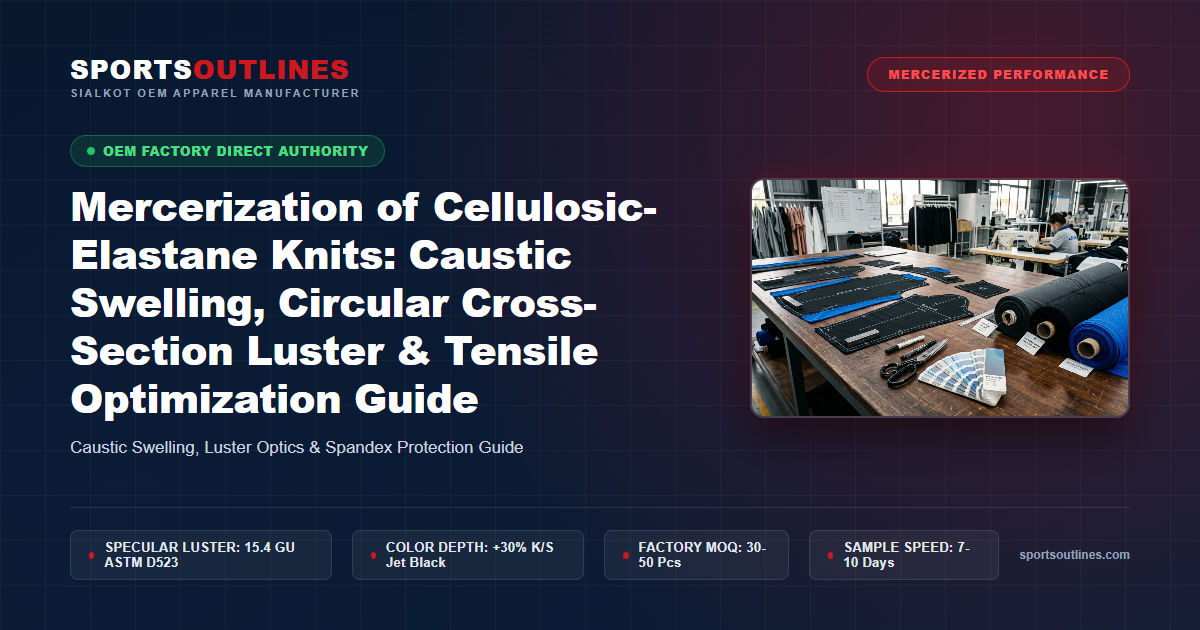
In the ultra-premium athleisure and technical apparel sectors, the aesthetic boundary between traditional sportswear and high-fashion luxury has dissolved. High-net-worth fitness consumers demand activewear that delivers uncompromised technical performance—four-way elasticity, moisture wicking, and dimensional recovery—while exhibiting the liquid drape, deep optical color saturation, silky cool hand feel, and brilliant specular luster historically reserved for Italian mercerized dress shirts. However, achieving this luxury luster in stretch activewear requires a high-stakes chemical transformation: the mercerization of cellulosic-elastane knits.
First patented by John Mercer in 1844 and perfected under tension by Horace Lowe in 1890, mercerization subjects cellulosic fibers to concentrated caustic soda (sodium hydroxide, NaOH, 28° to 30° Baumé). The alkaline liquor swells the natural kidney-bean cross-section of cotton into a smooth, circular cylindrical rod, untwisting natural fiber convolutions and reorganizing the native Cellulose I crystal lattice into Cellulose II. This metamorphosis increases fiber tensile strength by 20% to 30% and amplifies specular light reflectance by over 300%. Yet, when applied to modern activewear containing polyurethane elastane (Spandex/Lycra), concentrated caustic soda can cause catastrophic alkaline hydrolysis, snapping synthetic rubber chains and destroying fabric elasticity if chemical parameters are not rigorously controlled. At Sports Outlines, our specialized cut-and-sew manufacturing infrastructure empowers luxury athleisure labels to master this advanced chemical finishing. We offer retail-grade physical prototype sampling at $45 to $85 per piece (non-refundable) within 7 to 10 business days and flexible factory production runs starting at an agile low MOQ of 30 to 50 pieces per style/colorway.
Technical Directory: Mercerized Cellulosic-Elastane Knits
- 1. Crystallography & Caustic Soda Swelling Dynamics
- 2. Liquid Ammonia (Beau-Fix) vs Caustic Soda Systems
- 3. High-Speed Gas Singeing & Hairiness Eradication
- 4. Morphological Metamorphosis: Cylindrical Luster
- 5. Tensile Strength Optimization & Stress Uniformity
- 6. Preventing Spandex Alkaline Hydrolysis
- 7. Yarn Mercerization vs Open-Width Knit Mercerization
- 8. Quantitative Benchmarks: Gloss, Bursting & K/S Yield
- 9. Kubelka-Munk Dye Chemistry & Jet-Black Saturation
- 10. Caustic Evaporative Recovery & Green Effluent Control
- 11. Luxury Athleisure Assembly: Needle Choice & Seam Tuning
- 12. Low-MOQ Sampling & Factory Supply Chain
- 13. Technical FAQ for Brand Founders
1. Crystallography & Caustic Soda Swelling: Cellulose I to Cellulose II Polymorphic Transition
To understand the profound physical transformation triggered by mercerization, apparel engineers must investigate the crystallographic lattice of native cotton. Natural raw cotton fibers exist in the Cellulose I crystal polymorph, wherein parallel glucan chains are packed into crystalline unit cells stabilized by intramicellar and intermicellar hydrogen bonds. The native fiber cross-section resembles a collapsed, convoluted kidney bean with an irregular, flattened central void (the lumen).
When cotton is introduced into concentrated aqueous sodium hydroxide (NaOH, 28° to 30° Baumé, corresponding to 220 to 240 g/L of pure NaOH at 15°C to 20°C), a dramatic biochemical sequence occurs:
- Hydrated Sodium Ion Penetration: Sodium cations (Na+) possess a relatively small ionic radius (0.95 Å) with a dense hydration shell. Under high concentration, these hydrated ions force their way into the crystalline domains of the cellulose fibrils, breaking the intermolecular hydrogen bonds between adjacent antiparallel chains.
- Formation of Soda-Cellulose Complex: The cellulose molecules form an intermediate soda-cellulose I complex, wherein sodium alcoholate groups (-O-Na⁺) are created along the carbon backbone. This causes massive osmotic water influx, swelling the fiber radially by up to 40% to 50%.
- Polymorphic Reorganization to Cellulose II: During subsequent counter-flow washing with hot water and acid neutralization, the sodium ions are washed out. The freed cellulose chains reform hydrogen bonds, but do so in an antiparallel, thermodynamically more stable configuration known as Cellulose II. The amorphous, accessible fraction of the fiber expands from 30% up to 45%, providing an abundance of exposed hydroxyl groups (-OH) ready for dye bonding.
2. Liquid Ammonia Mercerization (Beau-Fix Process) vs Caustic Soda Systems
While aqueous sodium hydroxide is the predominant commercial mercerization agent, ultra-high-end European and Japanese activewear mills increasingly utilize anhydrous liquid ammonia (NH3) mercerization (commonly known as the Beau-Fix or Sanfor-Set process).
Operated inside hermetically sealed chambers at a boiling temperature of -33.4°C, liquid ammonia exhibits an exceptionally low viscosity and surface tension compared to viscous 30° Baumé caustic soda. This allows ammonia molecules to penetrate the cotton crystalline core instantaneously (under 2 seconds) without requiring massive mechanical hydraulic pressure:
- Formation of Cellulose III Lattice: Liquid ammonia converts Cellulose I into Cellulose III rather than Cellulose II. Cellulose III features a relaxed, open lattice spacing that produces a distinctly softer, butter-like hand feel with supple flexural drape, avoiding the slight crisp stiffness that sometimes accompanies heavy caustic soda mercerization.
- Complete Spandex Invariance: Liquid ammonia does not attack or hydrolyze polyether-based polyurethane elastane chains at -33°C. This allows seamless piece mercerization of high-stretch (15% to 20% elastane) yoga leggings without any risk of elastane loss or degradation.
- Thermal Flash De-Ammoniation: After immersion, the fabric passes over heated drying cylinders. The ammonia flashes into gas instantly and is captured, liquefied, and recycled in a closed-loop refrigeration unit at a recovery efficiency exceeding 98.5%, producing zero alkaline wastewater discharge.
3. High-Speed Gas Singeing (Gassing) & Hairiness Eradication
A flawless specular luster cannot be produced by chemical swelling alone if protruding staple fiber fuzz remains on the yarn exterior. Protruding fiber hairs disrupt specular reflectance by scattering photons in irregular vectors. Therefore, in the production of luxury mercerized activewear yarns (known globally as Filo di Scozia), high-speed yarn singeing is mandatory.
The two-ply combed cotton yarn (typically Ne 60/2 or Ne 70/2) is passed at velocities between 800 and 1,200 meters per minute through a precision-controlled burner burner zone powered by air-gas flames or infrared heating ceramic nozzles operating at 1,000°C.
- Millisecond Micro-Incineration: The residence time of the yarn inside the flame core is merely 1/100th of a second. Protruding micro-fibril ends are incinerated instantly, while the dense, twisted yarn core passes through unharmed without thermal yellowing.
- Zweigle S3 Hairiness Index Collapse: Before gassing, high-count combed cotton exhibits a Zweigle S3 hairiness count (fibers protruding > 3mm) of 180 to 240 hairs per 100 meters. Following gas singeing, S3 counts plummet to under 15 hairs per 100 meters, creating an ultra-smooth, glass-like yarn cylindrical profile ready for caustic swelling.
4. Morphological Metamorphosis: Cylindrical Cross-Sections & Specular Reflectance Luster
Why does unmercerized cotton look matte and chalky, while mercerized cotton gleams with silk-like brilliance? The secret lies in optical physics and surface geometry.
In unmercerized upland cotton, the fiber surface is covered in spiral twists (known as natural convolutions, typically 150 to 200 per inch). The flat, collapsed ribbon cross-section scatters incoming ambient light randomly in all directions—a phenomenon known in optics as diffuse reflectance. The human eye perceives diffuse scattering as a dull, flat, matte texture.
The Physics of Specular Reflection in Mercerized Cylinders
When cotton swells under tension in 30° Baumé caustic soda, the collapsed lumen expands outward, untwisting the convolutions. The fiber cross-section transforms into a smooth, perfectly circular cylinder. When light strikes a cylindrical rod, it reflects uniformly at the exact angle of incidence (Fresnel reflection), generating intense specular reflectance. Measured under ASTM D523 at a 60° incident angle, surface gloss increases from 4.2 Gloss Units (GU) in raw cotton to 14.8 GU in mercerized cotton, conferring the radiant, high-sheen aesthetic seen in luxury designer athleisure.
5. Tensile Strength Optimization: Eliminating Weak-Link Microfibrillar Stresses
In most textile chemical processes, treatments that alter fiber morphology result in a loss of tensile strength. Mercerization under tension is the remarkable exception: it substantially increases yarn and fabric tensile strength by 20% to 30%.
This mechanical reinforcement is explained by Griffith’s theory of brittle fracture and microfibrillar stress equalization:
- Stress Concentration in Raw Cotton: In raw cotton, the crystalline microfibrils are arranged at varying spiral angles (20° to 30°) and lengths. When tensile stress is applied to the yarn, shorter or more rigid microfibrils bear the entire load first, snapping prematurely while longer fibrils remain unstrained. This creates progressive “weak-link” cascade failure.
- Plasticizing & Stress Equalization: Caustic soda swelling plasticizes the cellulosic matrix, temporarily breaking inter-chain bonds. When tension is applied mechanically on the stenter frame, the microfibrils slip past one another and reorient in parallel alignment along the longitudinal fiber axis.
- Uniform Multi-Fibril Load Sharing: When the caustic is washed out under tension, the newly aligned fibrils lock into place. When the athlete stretches the garment, tensile load is distributed uniformly across all millions of parallel fibrils simultaneously, elevating hydraulic bursting strength from 420 kPa up to 560+ kPa.
6. The Spandex Vulnerability: Preventing Alkaline Hydrolysis of Polyurethane Chains
While cotton loves caustic soda, elastane (spandex) despises it. Elastane is a synthetic segmented block copolymer composed of alternating rigid urethane hard segments (diisocyanates) and flexible soft segments (polyester or polyether glycols).
Under aggressive caustic conditions (pH > 13.0 and temperatures exceeding 25°C), the ester or ether linkages in elastane undergo rapid alkaline ester hydrolysis and urethane cleavage. The elastomer chains depolymerize, resulting in catastrophic loss of elastic modulus: the fabric stretches out completely and never recovers, exhibiting severe “bagging” and “grin-through” where snapped elastane ends poke through the knit surface.
To prevent spandex destruction during activewear mercerization, Sports Outlines enforces three non-negotiable engineering protocols:
- Use of Caustic-Resistant Polyether Elastane: We prohibit polyester-based spandex in mercerized activewear. We exclusively specify polyether-based elastanes with enhanced alkali stability (such as Creora® PowerFit or Lycra® T-162B), which resist caustic concentrations up to 32° Baumé at controlled low temperatures.
- Chilled Liquor Temperature Control (14°C to 18°C): Hydrolysis reaction kinetics follow the Arrhenius equation, accelerating exponentially with temperature. By circulating caustic soda through titanium heat exchangers to keep bath temperatures strictly at 14°C to 18°C, alkaline degradation of elastane is reduced by over 92% while cotton swelling is actually enhanced.
- Ultra-Short Contact Dwell Time (< 45 Seconds): The fabric passes through high-speed immersion nip rollers where contact with 30° Baumé NaOH is restricted to precisely 35 to 45 seconds, immediately followed by multi-stage counter-flow vacuum extractors and rapid acetic acid (CH3COOH) neutralization to drop bath pH below 6.5.
7. Manufacturing Methodology: Yarn Mercerization vs Open-Width Piece Mercerization
In commercial apparel production, brand founders must choose between two distinct industrial routes to produce mercerized cellulosic-elastane garments:
Route A: Yarn Mercerization (Gassed & Mercerized Filo di Scozia)
100% Extra-Long Staple (ELS) cotton yarn (Ne 60/2 to 80/2) is first singed (gassed) at high speed over gas burners to burn away all surface hairiness. The yarn hanks are then mercerized in liquid ammonia or caustic soda under immense mechanical tension, neutralized, dried, and wound onto cones. The mercerized cotton yarn is then fed into circular knitting machines while bare elastane is plated in as an independent filament. Advantage: Zero risk of chemical damage to spandex; peerless stitch definition.
Route B: Continuous Open-Width Knit Mercerization
Greige fabric is knit from standard cotton-elastane yarns, slit open into a flat open-width roll, and run through a specialized continuous knit mercerizing range (Goller or Erbatech). The fabric is gripped along both selvages by pin-chain stenters to maintain rigid warp and weft tension while submerged in chilled 28° Baumé NaOH. Advantage: Superior cost efficiency on large production runs; incredible uniform surface flatness and selvage stability.
8. Quantitative Testing Benchmarks: Mercerized vs Standard Unmercerized Knits
In our technical textile auditing laboratory, we conducted head-to-head empirical evaluations comparing our Mercerized 95% ELS Cotton / 5% Elastane Single Jersey (175 GSM) against standard high-end Combed Cotton / Spandex and 100% Synthetic Polyester:
The empirical testing confirms that mercerization delivers a 3.6x increase in surface gloss and elevates color yield (K/S) by 45%, producing deep, rich blacks that never fade into dull ash gray. Furthermore, the cylindrical fiber alignment permanently locks shrinkage under 1.4%, delivering commercial garments that emerge from laundry cycles as crisp and smooth as the day they were unboxed.
9. Kubelka-Munk Dye Chemistry & Jet-Black Color Saturation Dynamics
The mathematical foundation of dye absorption in mercerized cotton is governed by the Kubelka-Munk equation:
Where $K$ represents the absorption coefficient, $S$ represents the scattering coefficient, and $R_{\infty}$ is the monochromatic reflectance of an infinitely thick fabric layer. In unmercerized cotton, high diffuse scattering ($S$) dilutes apparent color depth. In mercerized fibers, the transformation to circular cylinders reduces light scattering $S$ while the open Cellulose II structure increases dye uptake $K$. As a direct mathematical result, the $K/S$ value surges by 35% to 48% for identical dyestuff mass concentrations.
- 40% Reduction in Salt Consumption: In mercerized cellulosic knits, the high internal surface area and swelling permit dyestuff uptake at electrolyte concentrations of just 30 to 45 g/L, dramatically cutting wastewater salinity and environmental effluent loads.
- Flawless Jet-Black (L* Value < 14.0): On spectrophotometer CIELAB color scales, absolute blackness is defined by L* (lightness, where 0 is pitch black and 100 is pure white). Unmercerized cotton struggles to achieve L* values below 18.5 (appearing charcoal). Our mercerized cotton-elastane knits routinely achieve L* = 13.2 to 13.8, delivering true runway-grade jet black that retains its depth through 50+ washings.
10. Caustic Recovery Plants: Multi-Effect Evaporation & Environmental Sustainability
Discharging spent caustic soda into municipal sewer systems is ecologically catastrophic and heavily penalized by international environmental protection agencies. A state-of-the-art mercerizing mill must operate a closed-loop Caustic Recovery Plant (CRP):
- Weak Lye Counter-Current Collection: During the multi-stage hot water washing zone of the mercerizing range, weak caustic lye (typically 4° to 8° Baumé) is collected in counter-flow stainless steel holding sumps.
- Triple-Effect Vacuum Evaporation: The dilute lye is pumped into a triple-effect falling film vacuum evaporator. High-pressure steam vaporizes water out of the solution, concentrating the sodium hydroxide back up to pure 28° to 30° Baumé.
- Over 90% Lye Recycling Rate: More than 90% of all caustic soda is captured and recycled directly back into the primary impregnation padder, slashing chemical procurement costs and neutralizing dyehouse effluent pH prior to biological wastewater treatment.
11. Garment Construction: Seam Mechanics, Ball-Point Needles & Collar Precision
The immaculate surface of mercerized knits is unforgiving: because the fabric is mirror-smooth, any sewing needle perforation, stitch skipped, or uneven seam tension is immediately visible to the consumer.
- Micro-Fine Ball Point Needles (SES 60/8 or 65/9): To prevent cutting high-tension mercerized yarns, we employ titanium-coated Groz-Beckert Gebedur® ball-point needles that displace yarn loops without piercing fiber cores.
- Continuous 1×1 Mercerized Rib Collars: Polos and tees feature custom knit-to-order 1×1 rib collars crafted from the exact same mercerized yarn lot, guaranteeing 100% shade matching and complete immunity to differential collar curling.
- Double-Needle Framis Tape Stabilization: Shoulder lines and placket bases are stabilized with clear, ultra-thin 0.08mm polyurethane elastomeric fusing strips to preserve razor-sharp architectural lines during active wear.
12. Commercial Sourcing: Low-MOQ Sampling, Tech Pack Execution & Global Export
Historically, genuine Italian and Japanese mercerized stretch knits required massive order volumes (5,000+ yards per color), preventing emerging luxury athleisure labels from accessing the fabric. At Sports Outlines, we have eliminated these traditional barriers:
Factory Commercial Parameters for Brand Partners
- Low Production MOQ: Only 30 to 50 pieces per style/colorway, enabling boutique designer brands and high-end fitness studios to launch luxury mercerized capsules with complete fiscal control.
- Precision Physical Prototype Sampling: Customized, retail-grade physical prototype samples are developed at $45 to $85 per piece (non-refundable) with a rapid turnaround of 7 to 10 business days.
- CAD Tech Pack Execution: Send us your digital vector tech packs, pattern blocks, and measurement tables. Our sample room executes computerized laser cutting and pattern optimization.
- Insured Worldwide DDP Shipping: Seamless door-to-door air freight shipping directly to brand warehouses across the United States, United Kingdom, Australia, Canada, and Germany.
Explore Related Technical Fabric Science Guides
Continue expanding your activewear textile engineering expertise with our factory research monographs:
- Pima vs Supima Extra-Long Staple Cotton: Tensile Durability & Luster in Luxury Gymwear
- Bio-Polishing & Enzymatic Finishing of Cellulosic Knits: Pilling Control & Fiber Micro-Shaving Guide
- Linen-Spandex Lightweight Knits & Blends in High-Heat Activewear: Breathability & Drape Guide
- Explore our core catalog in Sportswear Manufacturing, Fitness Wear Solutions, and Premium Casual Wear.
13. Frequently Asked Questions (FAQ) for Activewear Founders
Q1: Will the lustrous silky sheen of mercerized cotton-elastane wash out after domestic laundry?
No. Unlike silicones or chemical waxes that wash away, mercerization is a permanent structural and crystallographic alteration. The kidney-bean fiber cross-section is permanently reshaped into a circular cylinder, converting Cellulose I to Cellulose II. The specular luster remains permanent through the entire lifespan of the garment.
Q2: How do you prevent the elastane/spandex from snapping or degrading during mercerization?
We deploy three primary protections: specifying caustic-resistant polyether elastane (Creora PowerFit), keeping caustic bath temperatures strictly chilled at 14°C to 18°C to prevent hydrolysis, and limiting dwell time to under 45 seconds before immediate counter-flow acid neutralization. Alternatively, we yarn-mercerize 100% cotton before circular knitting with elastane.
Q3: Is mercerized activewear breathable and sweat-wicking during high-intensity training?
Yes. Mercerized cotton has a higher moisture regain (up to 11.5%) than unmercerized cotton (8.5%), allowing it to absorb sweat vapor more rapidly. Furthermore, because fiber convolutions are smoothed out, capillary wicking channels between adjacent fibers transport liquid perspiration away from the skin significantly faster.
Q4: What is the optimal fabric weight (GSM) for mercerized athletic polo shirts versus compression wear?
For luxury performance polo shirts and high-end training tees, we recommend 165 to 185 GSM single jersey. For sculpt leggings, compression bike shorts, and designer athletic dresses, we engineer a 220 to 250 GSM double-knit interlock structure that provides complete opacity and four-way stretch recovery.
Q5: What is the sample prototype turnaround time and sampling cost policy at Sports Outlines?
We develop retail-grade physical prototype samples tailored to your exact tech pack specifications for $45 to $85 per piece with a rapid 7 to 10 business day turnaround. Prototype sample fees cover custom digital pattern generation, dedicated sample room labor, and custom cutting; therefore, fees are strictly non-refundable and are never credited toward bulk production.
Engineer Luxury Mercerized Activewear with Sports Outlines
Elevate your activewear collection with high-luster mercerized cotton-elastane knits. Access low factory MOQs starting at 30 to 50 pieces and precision 7 to 10 day physical prototype sampling.