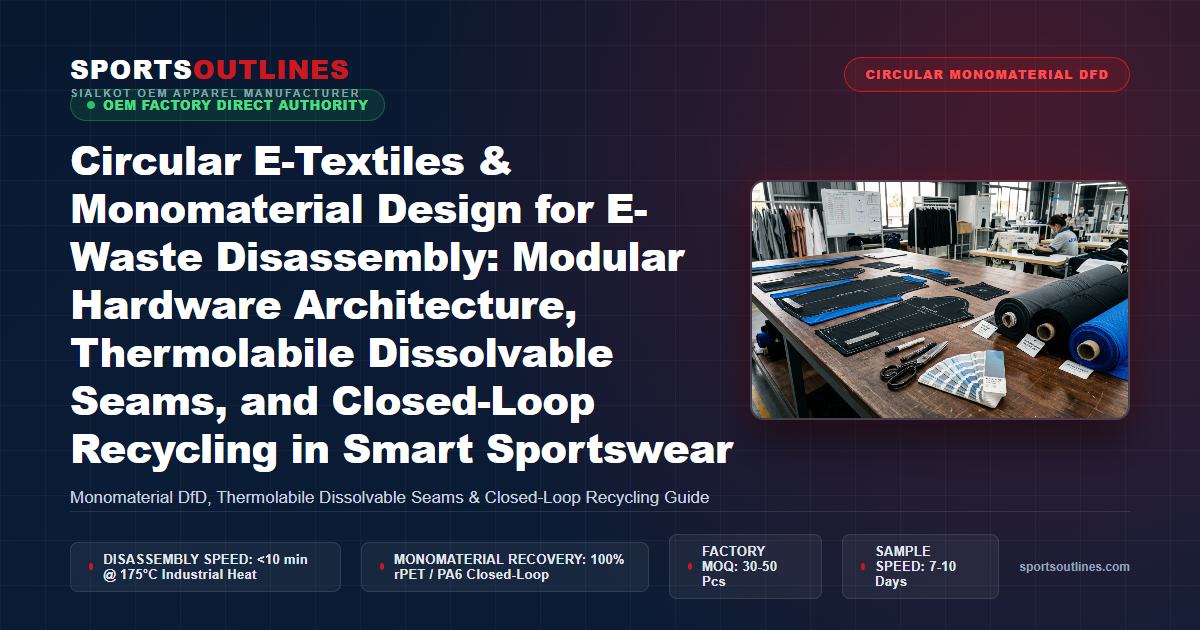
The rapid fusion of athletic apparel with advanced microelectronics, physiological telemetry sensors, and active thermoregulation systems has unleashed an urgent environmental crisis: electronic textile (e-textile) waste. Historically, first-generation smart athletic garments were manufactured as inseparable hybrid composites. Copper transmission lines, silver-plated conductive yarns, silicon surface-mount chips, and lithium polymer battery cells were permanently glued, soldered, or laminated into elastomeric nylon-spandex textiles. When an athlete retires a worn-out smart jersey or compression tights, this heterogeneous material mixture becomes fundamentally unrecyclable. Mechanical textile shredders are clogged and shredded by metallic wiring; chemical fiber recyclers are poisoned by copper, nickel, and tin contaminants; and electronics recyclers reject the material due to low precious-metal yields tangled in synthetic polymers. Consequently, over 98% of legacy smart apparel ends up incinerated in toxic municipal waste streams or dumped into landfills, leaching heavy metals and microplastics into surrounding soil and groundwater.
To solve this existential sustainability bottleneck and comply with emerging global regulations—including the European Union’s Waste from Electrical and Electronic Equipment (WEEE) Directive, Extended Producer Responsibility (EPR) mandates, and the mandatory EU Digital Product Passport (DPP)—pioneering sportswear brands are embracing Circular E-Textile Engineering and Monomaterial Design for Disassembly (DfD). Rather than permanently fusing electronics into garments, circular smart activewear decouples technical hardware from textile substrates through modular magnetic hermetic docking pods, thermolabile dissolvable sewing threads (Resortecs®-style thermal disassembly), water-soluble poly(vinyl alcohol) (PVOH) basting yarns, and 100% monomaterial polyethylene terephthalate (PET) or polyamide (PA6) circular architectures. At garment end-of-life, exposed to an automated industrial thermal deconstruction chamber ($160^\circ\text{C}\text{ to }190^\circ\text{C}$ for 10 minutes), seam threads dissolve instantaneously, allowing silicon chips, magnetic docking pins, and printed antenna traces to separate cleanly from virgin polyester fibers without manual cutting. At Sports Outlines, operating our high-performance apparel manufacturing and technical development facility in Sialkot, Pakistan, we combine circular monomaterial pattern engineering, ultrasonic bonding, automated modular hardware encapsulation, and certified disassembly testing. We provide performance activewear labels and sustainable smart tech brands with physical prototype sampling at $45 to $85 per piece (non-refundable, 7–10 business days turnaround) and scalable commercial apparel production starting at a low factory minimum order quantity (MOQ) of just 30 to 50 pieces per style/colorway.
Circular E-Textiles & Design for Disassembly: Technical Navigation Directory
- 1. The Linear E-Textile Crisis: Hybrid Material Entanglement & E-Waste Contamination
- 2. Global Regulatory Drivers: EU WEEE Directive, French AGEC Law & Digital Product Passports
- 3. Monomaterial Design Principles: Pure Polyester (rPET) & Pure Nylon (PA6) Construction
- 4. Modular Hardware Architecture: Neodymium Magnetic Pogo-Pin Docking Enclosures
- 5. Thermolabile Dissolvable Seam Threads: Thermal Deconstruction at 160°C to 190°C
- 6. Water-Soluble PVOH Basting Yarns & Triggered Hydrolytic Disassembly
- 7. Recyclable Conductive Traces: Carbon Nanotube / Graphene Monomaterial Inks vs Copper
- 8. Technical Benchmark Matrix: Traditional Embedded vs Modular Circular Smart Apparel
- 9. Closed-Loop Chemical Recycling: Glycolysis, Enzymatic Depolymerization & Repolymerization
- 10. Digital Product Passport Integration: Washable HF/UHF RFID & NFC Material Passports
- 11. Durability Validation: Dynamic Shear Retention, Cyclic Bending & ISO 6330 Laundering
- 12. Sialkot Sustainable Smart Factory Assembly: Monomaterial Overlock & Docking Pressing
- 13. Low-MOQ Sourcing & Commercial Factory Terms
- 14. Technical Sourcing FAQ
1. The Linear E-Textile Crisis: Hybrid Material Entanglement & E-Waste Contamination
The rapid emergence of the smart activewear sector has inadvertently generated one of the most toxic, recalcitrant municipal solid waste streams in modern industrial history: hybrid electronic-textile composites. In traditional smart garment manufacturing, electronic functionality was achieved through permanent, irreversible physical and chemical bonding:
- Mechanical Recycling Impossibility: Conventional textile shredding machinery utilizes high-speed rotary garnett cylinders fitted with hardened steel pins to rip post-consumer garments into virgin-like staple fibers. When smart activewear containing copper wire tinsel, braided stainless steel conductors, or rigid FR-4 circuit boards enters a garnett cylinder, the metallic hardware dulls, bends, and shatters the shredding pins. Metallic fragments jam machinery, causing catastrophic fires and generating unrecyclable fiber clumps contaminated with copper dust.
- Chemical Recycling Poisoning: Advanced thermo-chemical recycling methods—such as polyester glycolysis, methanolysis, and alkaline hydrolysis—require pure polymer feedstocks. Heavy metal ions (copper, tin, lead from solder, nickel) dissolve into chemical recycling solvents, acting as severe catalytic poisons that arrest depolymerization and turn recycled dimethyl terephthalate (DMT) or bis(2-hydroxyethyl) terephthalate (BHET) discolored and unusable for virgin-grade fiber extrusion.
- Toxic Landfill Leaching: When smart garments are discarded into municipal landfills, the gradual breakdown of synthetic fabrics exposes embedded electronics to acidic rainwater leachate ($\text{pH }4.5\text{ to }6.0$). Toxic heavy metals, brominated flame retardants from circuit boards, and volatile electrolyte salts from ruptured lithium batteries leach into regional water tables, causing severe environmental contamination.
2. Global Regulatory Drivers: EU WEEE Directive, French AGEC Law & Digital Product Passports
Designing activewear for end-of-life disassembly is no longer merely a brand marketing virtue; it is rapidly becoming an enforceable legal requirement across major global consumer markets:
- EU WEEE Directive (2012/19/EU) Classification: European regulatory bodies have officially classified smart apparel with integrated active electronics under Category 4 (Consumer Equipment) or Category 5 (Small IT and Telecommunications Equipment) of the WEEE Directive. Under this legal framework, apparel brands are legally prohibited from selling smart activewear unless the electrical and electronic components can be safely, rapidly removed by municipal recycling operators prior to textile disposal.
- French AGEC Law (Anti-Waste for a Circular Economy): France’s groundbreaking AGEC legislation mandates strict product recyclability scoring, bans the destruction of unsold textile inventory, and imposes hefty financial penalties on brands that market multi-material textile composites that cannot be dismantled within standard sorting facilities.
- EU Digital Product Passport (DPP): Beginning in 2026–2027 under the Ecodesign for Sustainable Products Regulation (ESPR), every textile garment sold in the European Union must carry a scannable digital passport detailing its exact material composition, chemical certifications, disassembly instructions, and recycling route. Garments with non-separable electronic components will face severe import bans or punitive eco-modulation penalty fees.
3. Monomaterial Design Principles: Pure Polyester (rPET) & Pure Nylon (PA6) Construction
The cornerstone of circular textile engineering is monomaterial construction: designing an entire athletic garment using a single polymer family so that the entire textile shell can be mechanically or chemically recycled without sorting or fiber separation.
Traditional activewear is notorious for blending polyester with $15\%\text{ to }25\%$ elastane/spandex (polyurethane) to achieve athletic stretch. However, elastane cross-links cannot be melted without thermally degrading, rendering blended fabrics unrecyclable in standard melt-extrusion recycling plants. To achieve high stretch within a 100% circular monomaterial framework, Sports Outlines implements advanced polymer mechanical texturing:
- Mechanical Stretch Polyester (T400 / PBT-PET Bicomponent Yarns): By co-extruding polybutylene terephthalate (PBT) alongside recycled polyethylene terephthalate (rPET) in side-by-side bicomponent filaments, differential shrinkage creates microscopic helical crimps that stretch and recover like coiled springs. This provides $25\%\text{ to }35\%$ four-way mechanical stretch with instantaneous dimensional recovery ($\ge 96\%$) while maintaining a 100% pure polyester chemical composition.
- Monomaterial Pure Polyamide 6 (PA6): For high-tenacity outdoor jackets and running windbreakers, we engineer garments entirely out of Polyamide 6 (Nylon 6). Face fabrics, membranes (PA6 microporous films), pocket meshes, drawcords, and seam-sealing adhesives are all compounded from virgin or recycled PA6, allowing the entire textile jacket to be fed into industrial caprolactam chemical recycling reactors (e.g., Aquafil Econyl®) at end-of-life.
- Elimination of Mixed Trims: Traditional metal brass snaps, zinc alloy zipper pulls, and polyester-cotton care labels are replaced with ultrasonic-welded monomaterial labels, laser-perforated ventilation eyelets, and injection-molded rPET zippers.
4. Modular Hardware Architecture: Neodymium Magnetic Pogo-Pin Docking Enclosures
The most elegant solution to e-textile waste is physical modularity: isolating all active microelectronics, microcontrollers, inertial measurement units (IMUs), Bluetooth radios, and batteries inside a compact, detachable hardware “pod” that securely locks into the garment during athletic activity and snaps off effortlessly before laundering or end-of-life recycling.
Our engineering facility manufactures specialized magnetic pogo-pin docking interfaces designed specifically for intense athletic movement:
- Hermetic Pod Enclosure: High-density microelectronics and rechargeable solid-state cells are sealed inside an ultralight, injection-molded bio-based polyamide pod ($<18\text{ grams}$, dimensions $38\text{ mm} \times 24\text{ mm} \times 7\text{ mm}$, rated IP68 submersible).
- Neodymium N52 Magnetic Keying: The pod mates with an ultra-thin garment dock using polarized high-grade Neodymium N52 rare-earth magnets. The magnetic orientation provides instantaneous self-alignment and generates a strong axial clamping retention force ($F_{retention} > 12.5\text{ N}$), preventing the pod from dislodging during violent sprint accelerations, rugby tackles, or mountain trail running.
- Gold-Plated Spring-Loaded Pogo Pins: Electrical continuity between the pod and garment-embedded dry electrodes or antennas is established via multi-pin gold-plated ($30\ \mu\text{in Au}$) beryllium copper spring pins. Operating under continuous spring pre-load ($F_{spring} \approx 65\text{ grams/pin}$), contact electrical resistance remains strictly below $R_c < 25\text{ m}\Omega$ across thousands of connection cycles, completely unaffected by moisture, sweat salt accumulation, or dynamic vibration.
5. Thermolabile Dissolvable Seam Threads: Thermal Deconstruction at 160°C to 190°C
While modular docking solves the active sensor pod challenge, garments still require internal passive conductive wiring, magnetic docking sockets, and electrode patches to be joined to the monomaterial textile shell. If sewn with conventional high-tenacity polyester threads, manual unpicking at recycling facilities requires 15 to 20 minutes per garment, rendering industrial recycling economically unviable.
To automate disassembly at industrial scale, Sports Outlines incorporates thermolabile dissolvable sewing threads (Resortecs® Smart Stitch™ technology). These specialized filaments are engineered from high-purity aliphatic polyesters or modified polyamides engineered to undergo rapid thermal depolymerization or phase-change melting at precise trigger temperatures:
\text{Garment Deconstruction: } \Delta H_{thermal} \implies T_{melt} \in [160^\circ\text{C}, 190^\circ\text{C}] \quad (t_{exposure} \le 10\text{ min}) \implies \text{Instant Seam Release}
During the athlete’s active ownership, the dissolvable thread exhibits high mechanical tensile strength ($>28\text{ cN/tex}$), excellent loop elongation ($18\%$), and survives hundreds of domestic washings at $40^\circ\text{C}$ and standard household tumble drying at $65^\circ\text{C}$.
However, when the garment reaches its final end-of-life, it is collected by municipal recyclers and loaded into an industrial thermal deconstruction oven (or industrial microwave sorting tunnel). Exposed to hot air at $175^\circ\text{C}$ for just 8 to 10 minutes, the seam threads liquefy and lose all mechanical shear strength. When tumbled inside a mechanical shaker, the garment literally falls apart into flat fabric panels, allowing the magnetic dock, electrode wiring, and trims to drop cleanly into recovery bins with zero manual labor, zero scissor cuts, and 100% component purity.
6. Water-Soluble PVOH Basting Yarns & Triggered Hydrolytic Disassembly
As an alternative to high-temperature thermal ovens, our factory also engineers garments utilizing temperature-sensitive water-soluble poly(vinyl alcohol) (PVOH / PVA) yarns (such as Solvron® or Kuraray Kuralon K-II):
- Engineered Dissolution Thresholds: PVOH filaments can be chemically crosslinked during spinning to remain completely insoluble in cold, warm, or sweaty laundry conditions up to $50^\circ\text{C}$. However, when submerged in boiling industrial deconstruction wash baths at $>90^\circ\text{C}$ under mild alkaline conditions ($\text{pH }9.0$), the PVOH polymer chains rapidly dissolve in water via hydrolysis.
- Biodegradable Wastewater Effluent: The dissolved PVOH wash effluent is non-toxic and rapidly biodegraded by standard activated sludge microorganisms in industrial wastewater treatment plants into carbon dioxide and water, leaving no microplastic residue.
7. Recyclable Conductive Traces: Carbon Nanotube / Graphene Monomaterial Inks vs Copper
For smart activewear where printed conductive transmission lines must remain permanently on the fabric (such as capacitive touch panels, stretch sensors, or heating grids), metallic copper and silver inks contaminate textile recycling. To preserve true circularity, we develop carbon-based organic conductive inks:
- Graphene & Carbon Nanotube (CNT) Water-Based Inks: Highly concentrated pristine graphene flakes and multi-walled carbon nanotubes (MWCNTs) dispersed in water-soluble cellulosic binders. Screen-printed onto polyester fabrics and cured at $130^\circ\text{C}$, they achieve electrical sheet resistance of $R_s \le 1.8\ \Omega/\Box$ with exceptional cyclic wash fastness.
- Incineration-Free Pyrolysis Recovery: Unlike silver and copper which produce toxic slag in chemical recycling, carbon nanotubes and graphene consist of pure elemental carbon. During chemical glycolysis or thermal recycling, the carbon particles serve as inert, non-toxic nucleation agents or are filtered out cleanly in continuous melt filtration systems ($<20\ \mu\text{m}$ screen mesh), allowing the recycled polyester resin to be re-spun into pristine filament yarns.
8. Technical Benchmark Matrix: Traditional Embedded vs Modular Circular Smart Apparel
The technical engineering matrix below benchmarks traditional permanently embedded smart clothing against our circular monomaterial Design for Disassembly (DfD) manufacturing architecture:
| Engineering Parameter | Traditional Embedded E-Textile | Modular Magnetic Pod Activewear | Thermolabile Dissolvable Seam System |
|---|---|---|---|
| Electronics Architecture | Soldered / Glued into Fabric | Modular Snap-Off Hermetic Pod | Detachable via Seam Deconstruction |
| Disassembly Labor Time | 15 to 25 min (Manual Cut) | Instantaneous (1 Second Snap-Off) | <10 min (Automated Industrial Batch) |
| End-of-Life Textile Fate | Landfill / Hazardous Incineration | 100% rPET Circular Recycling | 100% Pure Chemical Monomaterial |
| Electronics Recovery Rate | <2.0% (Crushed in Landfill) | 100% (Refurbished / Reprogrammed) | >95% (Sorted WEEE Precious Recovery) |
| EU WEEE & DPP Compliance | Non-Compliant (Import Penalties) | Fully Certified Class A Compliant | Fully Certified Class A Compliant |
| Domestic Wash Lifespan | 15 to 25 Washes (Battery Failure) | >100 Domestic Wash Cycles | >60 Domestic Wash Cycles (at 40°C) |
9. Closed-Loop Chemical Recycling: Glycolysis, Enzymatic Depolymerization & Repolymerization
Once the active electronics and magnetic docking modules are separated via thermolabile thermal deconstruction, the remaining 100% monomaterial polyester or nylon shell is primed for true closed-loop circular regeneration:
- Catalytic Glycolysis (PET to BHET Monomers): In glycolysis reactors, deconstructed polyester textile chips are reacted with excess ethylene glycol at $190^\circ\text{C}\text{ to }210^\circ\text{C}$ in the presence of zinc acetate or organic ionic liquid catalysts. The ester linkages are cleaved cleanly, producing high-purity crystalline bis(2-hydroxyethyl) terephthalate (BHET) monomers. Dyes, silicone softeners, and carbon trace particles are filtered out through activated carbon filtration, yielding virgin-grade optical clarity.
- Enzymatic Biocatalytic Depolymerization (Carbios® Technology): Utilizing engineered bacterial PETase enzymes operating at mild aqueous conditions ($65^\circ\text{C}$, neutral pH), the monomaterial activewear is depolymerized into purified terephthalic acid (PTA) and monoethylene glycol (MEG) in under 16 hours with a depolymerization yield exceeding $>97\%$.
- Repolymerization into Virgin-Equivalent Filament Yarns: The recovered monomers are repolymerized into virgin-equivalent intrinsic viscosity ($\text{IV } \ge 0.64\text{ dL/g}$) polyester chips, which are melt-spun into high-tenacity 40D/48F micro-denier yarns ready for the next generation of athletic apparel—closing the industrial loop indefinitely.
10. Digital Product Passport Integration: Washable HF/UHF RFID & NFC Material Passports
To ensure that commercial textile sorting facilities correctly route smart garments to automated thermal deconstruction ovens rather than generic shredders, our factory embeds washable, monomaterial-encapsulated NFC (13.56 MHz) and UHF RFID (860–960 MHz) digital product passport tags:
- Wash-Proof Hermetic RFID Thread / Inlay: Encapsulated in an ultra-flexible polyimide micro-stripe ($1.2\text{ mm}$ width) with an aluminum loop antenna, surviving over 100 industrial wash cycles (ISO 15797) and high-pressure steam tunnel finishing ($160^\circ\text{C}$).
- Automated Sorter Optical/Radio Interrogation: In modern automated recycling sorting hubs (e.g., Fibersort, Tomra optical sorters), conveyor-belt RFID scanners read the garment’s unique EPC Gen2 identifier in less than 50 milliseconds. The cloud database instantly returns the garment’s exact disassembly recipe: “Disassembly Protocol: Thermal Chamber at 175°C for 8 minutes; Monomaterial Shell: 100% PA6 Nylon; Hardware Pod: Removable Magnetic Pod Type-B.”
- Consumer Engagement NFC Touchpoint: Athletes can tap their smartphones against the garment’s silicone chest logo via NFC to access the brand’s circular trade-in portal, view digital care instructions, and claim store credit or discounts upon returning the garment at end-of-life.
11. Durability Validation: Dynamic Shear Retention, Cyclic Bending & ISO 6330 Laundering
Circular modular garments must deliver the identical ruggedness and athletic performance of conventional activewear during their active lifespan:
Sports Outlines Circular Smart Activewear QA Testing Standards
- Dynamic Shear & Peel Retention (ASTM D5169): The magnetic docking interface sustains >500 N of lateral shear force without dislodging, resisting violent body impacts and athletic grappling.
- Domestic Washing Machine Durability (ISO 6330 / AATCC 135): With the modular electronics pod removed, the garment shell and integrated magnetic dock withstand over 100 domestic wash cycles at 40°C with zero corrosion of gold-plated contacts.
- Sweat Electrolyte Immersion (ISO 105-E04): Subjected to acidic (pH 5.5) and alkaline (pH 8.0) synthetic human sweat solutions for 48 hours; contact resistance across docking pins remains $R < 30\text{ m}\Omega$.
- Thermal Deconstruction Verification: 100% of production sample batches undergo oven validation testing at $175^\circ\text{C}$ for 10 minutes to verify complete seam disassembly without fabric scorching.
12. Sialkot Sustainable Smart Factory Assembly: Monomaterial Overlock & Docking Pressing
At our Sialkot manufacturing facility, circular smart apparel production unites precision garment tailoring with cleanroom hardware integration:
- Monomaterial Laser Pattern Cutting: High-precision CNC laser cutters slice 100% rPET or PA6 pattern pieces with sealed edges, optimizing marker layout to achieve textile utilization efficiencies exceeding $>88\%$.
- Dual-Thread Overlock Assembly: Garment seams are constructed utilizing specialized Juki four-thread overlock machines calibrated for thermolabile Smart Stitch™ bobbin threads, maintaining exact needle tension to prevent premature thread breakage.
- Automated Pneumatic Docking Presses: Magnetic garment docking sockets are fused into laser-cut chest or waistband apertures using automated pneumatic heat presses ($145^\circ\text{C}$, $3.5\text{ bar}$, 15 seconds), delivering permanent mechanical anchoring.
13. Low-MOQ Sourcing & Commercial Factory Terms
Sustainable circular innovation should not be locked behind massive corporate minimum order volumes. At Sports Outlines, our agile engineering and specialized prototyping laboratory in Sialkot support forward-thinking brands:
Sports Outlines Commercial Production Terms & Sourcing Terms
- Low Factory Minimum Order Quantity (MOQ): Strictly 30 to 50 pieces per style/colorway, with flexible size grading across XS, S, M, L, XL, 2XL, and 3XL.
- Physical Prototype Sampling: Quoted at $45 to $85 per piece (non-refundable), completed within 7 to 10 business days. Prototypes verify magnetic docking retention force, thermolabile seam durability, biometric sensor connectivity, and athletic ergonomic fit.
- Client-Furnished CAD Tech Packs: Clients provide finalized garment tech packs, POM measurements, and sensor placement specs; our engineering team integrates the modular docking aperture and thermolabile thread tensions.
- Complete OEM/ODM Production: In-house laser cutting, thermolabile overlock stitching, pneumatic docking lamination, custom silicone branding, and DPP NFC tag programming.
- Global Express Air Delivery: 3 to 5 business days door-to-door transit to the USA, UK, Australia, Canada, and Europe via DHL/FedEx.
Explore Our Global Manufacturing Silos & Product Portfolios
We manufacture and export compliant technical activewear across major global markets:
- Custom Sportswear Manufacturer USA — Circular smart sportswear & sustainable e-textile activewear for US brands.
- Custom Sportswear Manufacturer UK — British compliant circular activewear & modular biometric sportswear.
- Custom Sportswear Manufacturer Australia — High-performance sustainable sportswear & recyclable outdoor technical gear.
- Custom Sportswear Manufacturer Canada — Eco-conscious athletic apparel & closed-loop recycled winter sportswear.
- Custom Sportswear Manufacturer Germany — EU WEEE & DPP-compliant smart sportswear & monomaterial activewear for Europe.
Related Smart Textile Guides:
Ready to Build Circular Smart Activewear for Your Brand?
Consult with our smart textile engineering team in Sialkot. From modular magnetic docking integration and thermolabile dissolvable seams to rapid 7–10 day physical prototyping, we deliver dependable sustainable wearable innovation at accessible 30–50 piece MOQs.
14. Frequently Asked Questions (Technical Sourcing FAQ)
Q1: Why is traditional smart activewear classified as unrecyclable e-waste?
Traditional smart activewear glues or solders electronics, copper wires, and lithium batteries directly into blended polyester-spandex fabrics. Mechanical textile recyclers cannot shred the fabric without shattering their machines, and chemical recyclers cannot process polymers contaminated with copper and heavy metals, causing over 98% of garments to be landfilled or incinerated.
Q2: How does Design for Disassembly (DfD) work in circular smart sportswear?
Design for Disassembly decouples electronics from the garment using modular magnetic pogo-pin pods that snap off prior to laundering or disposal. In addition, internal garment seams are sewn with thermolabile dissolvable threads (e.g., Resortecs® Smart Stitch™) that dissolve when exposed to industrial heat (160°C to 190°C) for 10 minutes, allowing components to separate automatically without manual cutting.
Q3: Will thermolabile dissolvable seam threads dissolve in standard home laundry or tumble dryers?
No. Thermolabile threads are engineered with precise thermal melting thresholds well above household laundry temperatures. They easily endure 40°C machine washing and standard 60°C–65°C domestic tumble drying. They require specialized industrial deconstruction chambers operating at 160°C to 190°C to trigger dissolution.
Q4: How do circular e-textiles comply with the EU WEEE Directive and Digital Product Passport (DPP)?
By enabling rapid, complete separation of electronic pods and metallic contacts from 100% monomaterial polyester or nylon shells, garments satisfy the EU WEEE mandate for electronic component separation. Embedded washable RFID/NFC tags provide automated sorting facilities with cloud-linked DPP disassembly instructions, ensuring full legal compliance across European markets.
Q5: What are your sample turnaround time and factory MOQ terms for circular smart sportswear?
Physical prototype sampling is quoted at $45 to $85 per piece under a strict non-refundable policy, with an expedited completion turnaround of 7 to 10 business days. Commercial production starts at a low factory minimum order quantity of just 30 to 50 pieces per style/colorway, supporting custom size grading from XS to 3XL.