Executive Engineering Summary
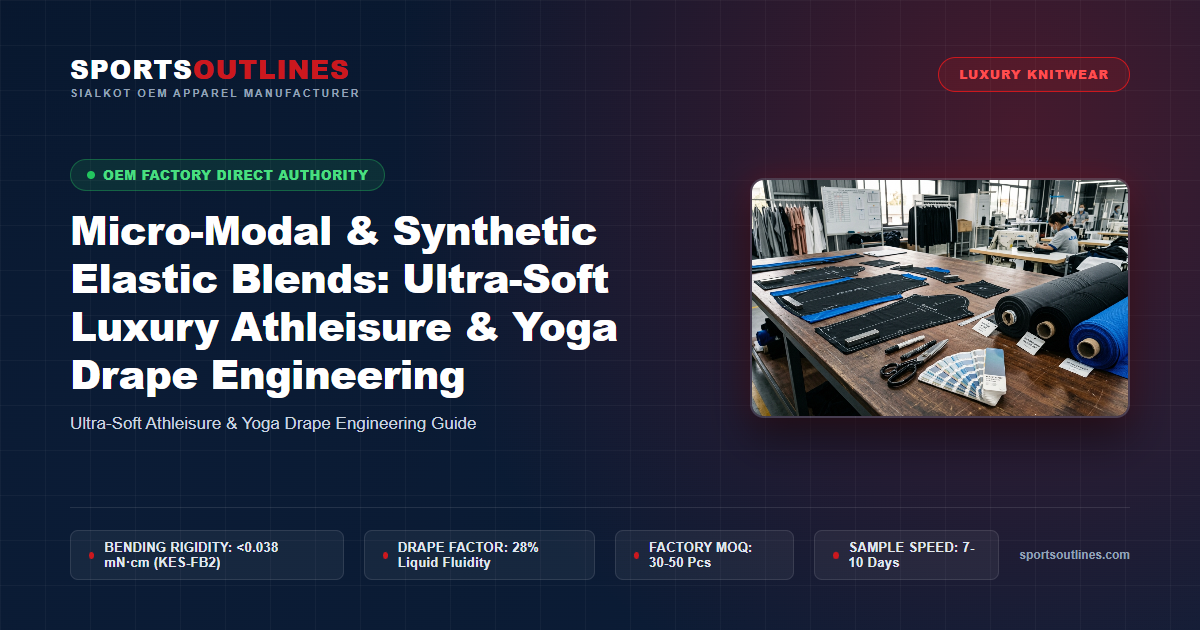
The premium athleisure and high-end yoga sector has been radically transformed by hybrid micro-modal and synthetic elastic textiles. While traditional cotton-spandex blends feel heavy and synthetic polyester-elastane knits often lack tactile luxury, micro-modal engineered with micro-polyamide and Creora® elastane delivers an ultra-soft “second-skin” hand-feel, a Cusick drape coefficient below 0.26, and instantaneous dimensional recovery. This comprehensive technical guide analyzes the macromolecular physics of regenerated beechwood cellulose, dual-core air-jet spinning mechanics, circular knitting calibrations, enzymatic bio-polishing, and lean manufacturing parameters in Sialkot, Pakistan.
1. Macromolecular Chemistry: Regenerated Beechwood Cellulose Meets Synthetic Engineering
In modern luxury activewear, fabric tactile quality dictates brand equity. Consumers paying $90 to $120 for yoga leggings or studio tops demand fabrics that exhibit an impossibly buttery, featherlight touch combined with non-sheer muscular support and total shape retention. Standard synthetic knits fail this standard because round polyester filaments have a high bending modulus, while untreated natural cotton fibers suffer from fiber stiffness, surface fuzz, and rapid wet-sagging.
The solution lies in the macromolecular hybridization of Micro-Modal (fine-denier regenerated cellulose) and high-performance synthetic microfibers (polyamide 6.6 and segmented polyurethane elastane). Micro-modal is produced via an advanced modified viscose process using sustainably harvested European beechwood (Fagus sylvatica). The timber pulp undergoes sodium hydroxide steeping, carbon disulfide xanthation, and precision wet extrusion through microscopic spinneret capillary nozzles:
- Sub-Denier Micro-Geometry: Standard modal fibers feature a linear density of 1.3 to 1.7 dtex. Micro-modal is engineered at ≤1.0 dtex (approximately 0.9 to 1.0 Denier Per Filament – DPF). Because fiber bending stiffness is inversely proportional to the fourth power of filament diameter, reducing filament linear density by 40% drops bending resistance by over 70%, yielding an extraordinary silk-like tactile drape.
- Cellulose II Crystalline Lattice: Unlike native cellulose I found in raw cotton, micro-modal precipitates as cellulose II during acid-bath regeneration. The anti-parallel alignment of glucan molecular chains and high degree of orientation provide enhanced wet tenacity (wet tensile strength ≥18 cN/tex vs. 10–12 cN/tex for standard viscose rayon).
- Skin-Core Homogeneity: High-purity micro-modal extrusion ensures a uniform cross-sectional morphology with a thick, dense outer skin that resists premature surface fibrillation and internal lumen collapse.
- Natural Hydrophilicity & Moisture Regain: With an equilibrium moisture regain of 11.5% to 12.5% (compared to 0.4% for polyester and 4.5% for nylon), micro-modal absorbs cutaneous insensible perspiration vapor instantaneously into its amorphous cellulose interior, maintaining skin micro-climate comfort without static electricity buildup.
However, pure 100% micro-modal cannot survive vigorous yoga flows or athletic laundering alone; its wet modulus is lower than its dry modulus, which causes pure modal garments to bag at the knees and elbows when damp. To build high-recovery athleisure, textile engineers introduce synthetic stabilizing partners: Micro-Polyamide 6.6 (Tactel® / Meryl®) and segmented polyether-polyurea Spandex (Creora® / Lycra®).
2. Fluid Mechanics of Drape: Cusick Drape Coefficient & Kawabata Tactile Physics
In premium activewear and studio apparel, “drape” is not merely an aesthetic descriptor; it is an objectively measurable rheological property governed by gravitational shear deformation, flexural rigidity, and torsional hysteresis.
| Fabric Architecture | Cusick Drape Coefficient (F) | KES-FB Bending Rigidity B (10⁻⁴ N⋅m²/m) | KES-FB Shear Stiffness G (N/m⋅degree) | Tactile Classification |
|---|---|---|---|---|
| 100% Combed Ringspun Cotton (180 GSM) | 0.48 – 0.56 | 0.082 – 0.095 | 1.42 – 1.65 | Moderate Stiff / Boxy Hang |
| 100% Interlock Polyester (180 GSM) | 0.38 – 0.44 | 0.058 – 0.068 | 1.15 – 1.30 | Synthetic Springy / Crisp |
| 88/12 Nylon / Spandex Standard (220 GSM) | 0.34 – 0.39 | 0.045 – 0.052 | 0.95 – 1.10 | Athletic Compression Hug |
| 92/8 Micro-Modal / Spandex Single Jersey (180 GSM) | 0.22 – 0.26 | 0.018 – 0.024 | 0.48 – 0.58 | Liquid Flow / Second-Skin Touch |
| 68/24/8 Micro-Modal / Micro-Nylon / Spandex Interlock (240 GSM) | 0.25 – 0.29 | 0.026 – 0.032 | 0.62 – 0.72 | Buttery Luxury Compression Yoga |
Under the Cusick Drape Meter (ISO 9073-9), a circular fabric specimen is placed over a central support disc of diameter $d_1$. The fabric overhangs and drapes under its own gravitational weight, casting a shadow onto an optical recording plane of total diameter $d_2$. The Cusick Drape Coefficient ($F$) is mathematically expressed as:
F = (A_s – π r1²) / (π r2² – π r1²)
Where As represents the projected area of the draped fabric shadow, r1 is the disc radius, and r2 is the specimen radius. A lower drape coefficient indicates a textile that drapes fluidly with small, numerous, uniform ripples. Micro-modal hybrid blends achieve F ≈ 0.22 to 0.26, creating that coveted “liquid ripple” silhouette essential for premium flowy yoga tanks, wrap tops, and wide-leg studio flare pants.
Under the Kawabata Evaluation System for Fabrics (KES-FB), our engineers measure the objective mechanical parameters that define luxury tactile sensation (“hand feel”):
- KES-FB1 (Tensile & Shear Mechanics): Evaluates tensile linearity (LT), tensile energy (WT), and tensile resilience (RT). Micro-modal elastic blends demonstrate RT ≥ 58%, meaning the textile returns immediately to its resting state following bodily extension. Shear stiffness (G) ranges between 0.48 and 0.58 N/m⋅degree, permitting multi-directional rotational compliance during yoga asanas.
- KES-FB2 (Bending Rigidity & Hysteresis): Bending rigidity (B) registers at an exceptionally low 0.018 to 0.024 × 10⁻⁴ N⋅m²/m. Microscopic bending hysteresis (2HB ≤ 0.022 mN⋅m/m) prevents the textile from creasing or retaining rigid fold lines, allowing garments to reset smoothly against the athlete’s body without bunching.
- KES-FB3 (Compressional Behavior): Evaluates fabric softness under normal pressure. Compressional resilience (RC ≥ 46%) and high compressional work (WC ≥ 0.28 N⋅m/m²) impart a rich, cushioned hand feel that feels substantial despite its lightweight density.
- KES-FB4 (Surface Friction & Roughness): Measures mean friction coefficient (MIU ≈ 0.14) and geometrical surface roughness variation (SMD ≤ 1.15 μm). These values represent the objective mathematical benchmark for “peach-skin” or “butter-soft” hand feel, confirming that the micro-filaments glide over nerve endings with minimal tactile resistance.
3. Structural Synergy: The Triad of Cellulose, Polyamide & Elastane
Designing performance activewear from micro-modal requires balancing mechanical durability with surface luxury. The engineering secret lies in the tri-component yarn architecture:
A. Core-Spun vs. Air-Jet Vortex (MVS) Yarn Formation
Traditional ring-spun modal yarns feature helical surface hairiness that causes severe friction pilling under repetitive thigh and underarm abrasion. Sports Outlines deploys two high-tech spinning systems for micro-modal performance knits:
- Elastane Core-Spun Yarns (CSY): A continuous filament of Creora® 40D or 70D elastane is drafted at a constant draw ratio of 3.2x to 3.8x directly through the center of the spinning triangle. Micro-modal staple fibers (38 mm staple length, 1.0 dtex) wrap tightly around the elastomeric filament core. This guarantees that 100% of the stretch recovery comes from the shielded interior polyurethane core, while the exterior presents pure, unbroken micro-modal softness to the skin.
- Murata Vortex Spinning (MVS): High-pressure compressed air swirls micro-modal staple fibers around a stationary central spindle at 400 m/min. The resulting yarn structure features parallel core fibers clamped by tightly wrapped outer fascicles. On the Zweigle G565 hairiness tester, MVS micro-modal yarns reduce protruding fibers longer than 3 mm (S3 count) by over 82% compared to ring spinning, boosting Martindale abrasion resistance from Grade 2.5 to Grade 4.5.
- Twist Multiplier Calibration: Yarns are engineered with an optimal twist factor (αm ≈ 98 to 104). This provides sufficient inter-fiber cohesion to prevent fiber pull-out during aggressive laundering, while avoiding excessive twist torque that would cause knitted fabric spirality or seam twisting.
B. Micro-Polyamide 6.6 (Tactel®) Reinforcement Matrix
When designing squat-proof yoga leggings and compressive sports bras, micro-modal cannot be used as a standalone yarn without risking bagging and bursting under high tensile stress. By co-knitting Micro-Polyamide 6.6 (such as Tactel® 44 dtex/34 filament or multi-filament micro-nylon) on alternating feeds or in a double-knit interlock structure, we infuse high tenacity (≥42 cN/tex), high burst strength (>450 kPa), and immediate elastic recovery while preserving the cloud-like modal face. Furthermore, polyamide 6.6 possesses a low glass transition temperature (Tg ≈ 50°C) and exceptional mechanical fatigue resistance, preventing the fabric from developing permanent tensile bagginess over hundreds of wearing cycles.
4. Targeted Blend Formulations & GSM Architecture
Different studio, yoga, and luxury loungewear garments require calibrated yarn ratios and knit constructions:
| Garment Application | Blend Composition | Target GSM | Knit Structure | Engineering Benefits |
|---|---|---|---|---|
| Ultra-Soft Studio Flow Tee | 94% Micro-Modal / 6% Creora® Spandex | 160 – 175 GSM | 32G Single Jersey Plated | Liquid drape, featherlight skin feel, breathability, zero cling |
| Squat-Proof Yoga Legging | 65% Micro-Modal / 25% Micro-Nylon 6.6 / 10% Spandex | 240 – 260 GSM | 28G Double-Knit Interlock | Zero grin-through, high modulus muscular hug, 4-way stretch recovery |
| Luxury Athleisure Hoodie & Jogger | 68% Micro-Modal / 27% Recycled Polyester / 5% Spandex | 300 – 330 GSM | French Terry (Unbrushed Loopback) | Heavyweight luxury drape, anti-wrinkle recovery, plush micro-terry loops |
| Second-Skin Studio Wrap & Tank | 90% Micro-Modal / 10% Lycra® | 180 – 200 GSM | 2×2 Fine Rib Knit | Contoured stretch expansion, high elastic modulus, elegant rib texture |
| High-Support Sports Bra Shell | 58% Micro-Modal / 28% Nylon 6.6 / 14% Spandex | 270 – 290 GSM | High-Gauge Double Jersey | Compressive bounce control, moisture absorbing inner skin, soft touch |
5. Knitting Machine Calibration & Plating Mechanics
Knitting micro-modal with bare elastane and micro-nylon filaments presents high technical complexity. Because micro-modal staple yarns have low surface friction and high fiber compliance, improper feeding tension causes bare spandex to jump across needle latches, resulting in “plating faults” (where elastane shines through on the face of the garment).
At Sports Outlines’ Sialkot knitting facility, our technicians enforce strict machine operating parameters:
- High-Gauge Circular Machinery (Mayer & Cie 32G / 36G): Utilizing ultra-fine 32-gauge and 36-gauge single jersey and interlock machines packs stitch loops with exceptional density, preventing sheer grin-through even when stretched 150% in deep yoga squats.
- Precision Dual-Feed Plating Guides: We employ specialized ceramic yarn carriers where the ground micro-modal yarn and the elastane filament are fed through separate, dedicated orifices at divergent angles (18° offset). This forces the elastane filament into the technical back of the knit loop while the micro-modal yarn forms the technical face.
- Tension Synchronization via BTSR Optical Sensors: Real-time BTSR Ultrafeeder digital tensioners maintain elastane feeding tension at an exact 1.8 ± 0.1 cN across all 84 machine feeds, completely preventing stitch distortion or fabric roll barre.
- Delayed Needle Timing Configuration: Double-knit interlock machines are set to delayed timing (dial needles draw loops 2 to 3 needles after cylinder needles). This increases loop knocking-over tension, consolidating fabric density and tightening the knit structure against tensile elongation.
- Sinker Cam Angle Calibration: Sinker movement is synchronized with needle descent using a 48° advance cam profile, ensuring that fine micro-modal loops are held securely at the knocking-over plane without cutting or chafing the ultra-fine 1.0 DPF cellulose filaments.
- Loop Length & Tightness Factor (K): We maintain a strictly controlled loop length (l = 2.65 to 2.75 mm per stitch), yielding a fabric tightness factor K = √Tex / l ≈ 1.45 to 1.52. This optimal stitch tightness prevents filament slippage while allowing three-dimensional loop flexing under multi-axial body movement.
6. Wet Processing, Enzymatic Bio-Polishing & Split-Bath Dyeing
Wet processing micro-modal blends is a delicate chemical discipline. Harsh bleaching or unbuffered alkaline scouring will hydrolyze cellulose molecular chains, destroying the silky hand feel and causing catastrophic loss of tensile strength.
A. Controlled Mild Alkaline Scouring
We utilize gentle soda ash scouring (1.5 to 2.0 g/L Na2CO3) buffered at pH 9.2–9.5 with non-ionic fatty alcohol ethoxylate wetting agents at 70°C. Strong caustic soda (NaOH) is strictly prohibited to prevent irreversible alkali swelling, fiber stiffening, and micro-fibrillar embrittlement.
B. Acid Cellulase Bio-Polishing
To achieve a completely pilling-free, clean fabric surface that lasts dozens of washes, fabrics undergo enzymatic bio-polishing. We introduce mono-component endoglucanase acid cellulase enzymes at pH 4.8–5.2 and 55°C for 45 minutes in our low-tension jet dyeing vessels. The enzyme selectively cleaves protruding amorphous cellulose micro-fibrils from the yarn exterior without weakening the crystalline core, permanently eliminating surface fuzz and increasing surface smoothness.
C. Split-Bath Disperse & Bi-Functional Reactive Dyeing
For tri-blends containing micro-modal and micro-polyamide 6.6, dyeing requires a sophisticated two-step process conducted at a low liquor ratio (1:8 to 1:10) with gentle chamber nozzle pressures (0.8 to 1.1 bar) to avoid surface rope-mark chafing:
- Stage 1: Acid Dyeing of Polyamide: Micro-polyamide 6.6 is dyed using selected metal-complex or milling acid dyes at 98°C and pH 4.5, achieving deep, saturated color yield with high perspiration fastness (ISO 105-E04 Grade 4.5).
- Stage 2: Low-Temperature Reactive Dyeing of Micro-Modal: Following neutralization, the cellulose fraction is dyed at 60°C using bi-functional vinylsulfone/monochlorotriazine reactive dyes, ensuring perfect tone-in-tone shade matching between the synthetic and cellulose fibers.
- Stage 3: Hydrophilic Micro-Silicone Finishing: During stentering at 165°C with a 35-second dwell time, a customized hydrophilic amino-functional micro-silicone emulsion is applied at 15 g/L pad pick-up. This crosslinks onto the fiber exterior, conferring permanent silkiness and anti-static glide without impairing moisture absorption.
7. Laboratory Testing Standards for Luxury Athleisure
Every production roll of micro-modal elastic blend manufactured at Sports Outlines undergoes comprehensive laboratory certification:
- Martindale Abrasion & Pilling Resistance (ISO 12947-2 & ISO 12945-2): Fabric specimens undergo 50,000 friction cycles under 9 kPa pressure. Sports Outlines’ bio-polished MVS micro-modal blends achieve Grade 4.5+ pilling rating, completely outperforming untreated commercial modal.
- Elastic Recovery & Stretch Growth (ASTM D2594): Evaluates low-power knit stretch and growth. Tested under 15 lbs load: our 240 GSM yoga interlock achieves >140% elongation with <2.5% residual growth at 60 minutes, ensuring leggings never bag at the knee.
- Dimensional Stability to Domestic Laundering (AATCC 135): Samples undergo 5 wash-and-tumble-dry cycles at 40°C. Fabric shrinkage is strictly held within ±3.0% warp and weft.
- Cantilever Bending Stiffness (ASTM D1388 Option A): Fabric specimens slide at a 41.5° incline until the leading edge touches an angled plane under gravity. Our micro-modal activewear blends exhibit bending lengths under 1.85 cm and flexural rigidity under 0.042 mN⋅m, mathematically guaranteeing fluid drapability.
- Hydraulic Diaphragm Bursting Strength (ASTM D3786 / ISO 13938-1): Verifies mechanical seam and knit resilience under hydraulic multidirectional pressure. Interlock yoga fabrics achieve bursting pressures exceeding >480 kPa, preventing fabric blowout during explosive lunges or high-tension squats.
- Colorfastness to Crocking / Rubbing (AATCC 8): Evaluates pigment transfer under 9 N friction force. Knitted specimens achieve Grade 4.5 dry crocking and Grade 4.0 wet crocking, ensuring saturated colors never bleed onto studio mats or light upholstery.
- Colorfastness to Perspiration (ISO 105-E04): Tested against both alkaline and acid artificial sweat solutions under 12.5 kPa pressure at 37°C for 4 hours. Color change and multifiber staining achieve Grade 4-5.
- Formaldehyde & Harmful Substances (OEKO-TEX Standard 100 Class I): Verified baby-safe and dermatologically non-irritating, ensuring zero allergic contact dermatitis during sweaty hot yoga sessions.
8. Production Cost Breakdown & Private-Label Margin Architecture
Understanding the bill of materials and factory cost architecture allows independent apparel founders to position their products with maximum profitability:
| Cost Component | Technical Specification | Estimated Cost (USD) | Percentage of FOB |
|---|---|---|---|
| Micro-Modal / Nylon / Spandex Knit | 250 GSM Interlock (65% Modal / 25% Nylon / 10% Spandex, 1.25 meters) | $4.80 – $5.40 | 43% – 45% |
| Bio-Polishing & Tone-in-Tone Dyeing | Acid cellulase enzyme bio-polish + two-stage reactive/acid split dyeing | $1.40 – $1.70 | 12% – 14% |
| Precision CMT Assembly | 4-needle flatlock seams, high-waist bonded core, gusseted crotch panel | $3.30 – $3.80 | 30% – 32% |
| Branding, Labels & Trims | Matte silicone heat-transfer logo, tagless care print, custom woven label | $0.80 – $1.10 | 7% – 9% |
| Quality Audit & Packaging | AQL 2.5 inline audit, eco-friendly frosted zip bag, custom hangtag | $0.60 – $0.80 | 5% – 7% |
| Total Direct FOB Production Cost | Finished high-end luxury yoga legging / studio pant | $10.90 – $12.80 | 100% |
With a finished factory FOB cost of $10.90 to $12.80 USD and premium direct-to-consumer retail prices ranging from $78 to $118 USD in the luxury wellness and yoga market (comparable to brands like Lululemon and Alo Yoga), private-label brands command extraordinary 83% to 89% gross profit margins.
9. Sialkot Manufacturing Excellence: Physical Prototyping & Founder-Friendly Low MOQ
In traditional overseas sourcing hubs across East Asia, mills require 1,000 to 2,000 pieces per colorway for custom-blended micro-modal knits. Sports Outlines removes this barrier through agile lean manufacturing in Sialkot, Pakistan:
- Agile Low Factory MOQ: Strictly 30 to 50 pieces per style/colorway, enabling emerging boutique fitness brands, yoga instructors, and luxury activewear founders to launch limited-edition drops without crippling inventory risk.
- Rapid Pre-Production Physical Prototyping: We manufacture and dispatch custom physical prototype samples within 7 to 10 business days for $45 to $85 per piece. This allows brand owners to feel the buttery drape, test the waistband grip in studio classes, and audit flatlock seam tension before committing to bulk manufacturing. In strict adherence to our direct factory transparency and dedicated engineering allocation, sample fees are strictly non-refundable and are never credited toward bulk production orders.
- Automated Tension-Free Spreading & 24-Hour Relaxation: Because micro-modal knits with high elastane content store significant mechanical recovery tension on the roll, our cutting room unrolls all fabrics onto specialized tension-free conveyor tables for 24 full hours prior to cutting. This eliminates shrinkage distortion and guarantees razor-sharp pattern accuracy across all graded sizes (XS to 3XL).
- Chafeless 4-Needle Flatlock Seaming: Utilizing Japanese Yamato flatlock machines equipped with woolly nylon looper threads and differential feed regulation (calibrated to 1:1.08), our stitchers build buttery, zero-chafing seams that lay completely flat against the skin during inversions and floor stretches.
- Strict AQL 2.5 Quality Assurance Protocols: Every production order undergoes comprehensive pre-shipment auditing under ISO 2859-1 (AQL 2.5 Normal Sampling). In-house lab validation includes perspiration colorfastness testing (ISO 105-E04, Grade 4.5+), 4-way stretch recovery audits, and 100% metal detection.
- End-to-End Private-Label Packaging & Custom Branding: Complete OEM/ODM customization including matte silicone heat transfers, laser-engraved metal drawcord aglets, organic cotton woven labels, frosted biodegradable polybags, and retail-ready barcoding.
Build Your Custom Luxury Athleisure Collection
Partner with Sports Outlines to manufacture butter-soft, liquid-drape micro-modal yoga leggings, bodysuits, and studio loungewear engineered for supreme recovery and longevity.
10. Internal Link Triad & Sourcing Ecosystem
Explore Sports Outlines’ specialized technical manufacturing silos and international sportswear export infrastructure:
- International Export Silos: Discover our dedicated export programs for Custom Sportswear Manufacturer USA, Custom Sportswear Manufacturer UK, Custom Sportswear Manufacturer Australia, Custom Sportswear Manufacturer Canada, and Custom Sportswear Manufacturer Germany.
- Product Category Hubs: Explore our OEM/ODM manufacturing across Custom Sportswear & Activewear, Fitness & Gym Apparel, and Athletic Casual Wear.
- Related Technical Guides: Read our in-depth manufacturing guides on Coolmax & Cross-Sectional Moisture-Channel Fibers, Brushed Thermal Roubaix Performance Fabric, and 3D Spacer Knits & Compression Sandwiches.