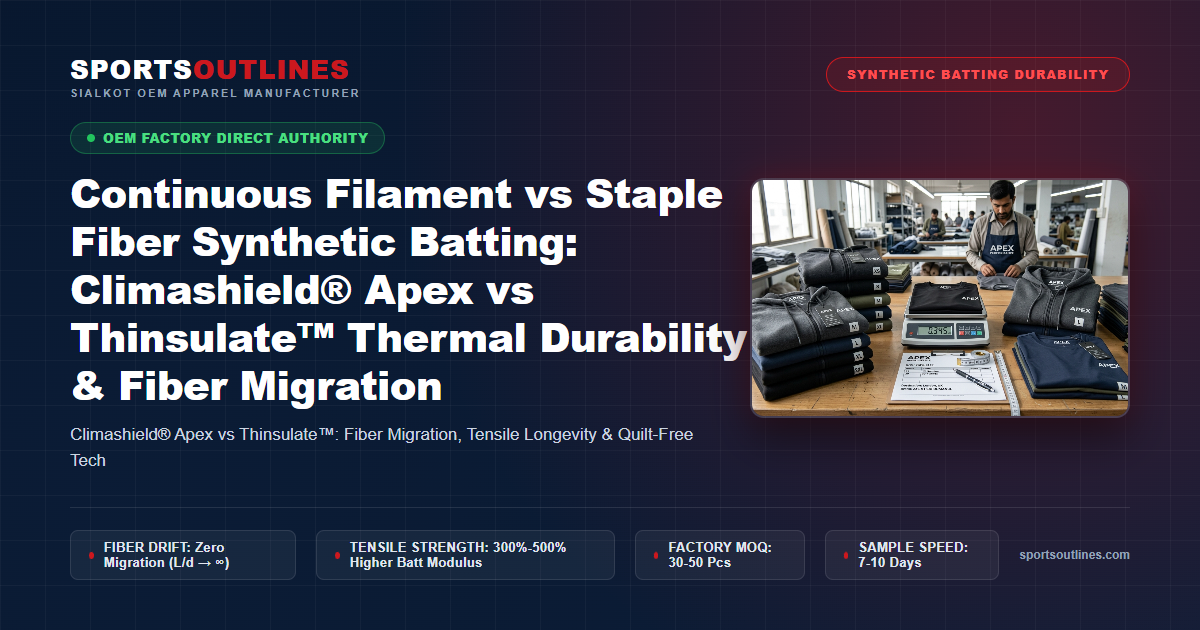
In the technical specification of insulated outerwear, sleeping bags, and tactical extreme-cold uniforms, synthetic battings are frequently grouped into a single broad category: “polyester insulation.” However, underneath the surface of technical shell fabrics lies a profound structural divide that dictates garment lifespan, thermal durability, and construction architecture: the divide between Continuous Filament Insulation (exemplified by Climashield® Apex) and Short Staple Fiber Batting (exemplified by classic 3M™ Thinsulate™ and standard blown or carded microfibers).
While short staple fiber batts achieve high initial softness and excellent initial Clo ratings by packing millions of discrete 30 mm to 60 mm chopped fibers together, they are inherently prone to fiber migration (the notorious phenomenon termed “bearding,” where sharp fiber ends poke through lining and face fabrics) and structural fragmentation under repeated laundering and cyclic pack-compression. In contrast, continuous filament technology utilizes uninterrupted, endless polyester polymers extruded into multi-denier three-dimensional webs. Because continuous filaments possess zero discrete fiber ends, they eliminate fiber migration, tolerate rough industrial wash cycles, and empower apparel designers to engineer completely quilt-free outerwear without internal stabilizing baffles.
At Sports Outlines in Sialkot, Pakistan, our technical outerwear production lines handle both continuous filament rolls and short staple non-woven battings on specialized automated cutting and assembly lines. We engineer bespoke insulated jackets, alpine midlayers, and extreme weather parkas for international outdoor and tactical apparel brands. Our commercial terms are built for agile brand growth: physical prototype sampling at $45 to $85 per piece (non-refundable, 7–10 business days turnaround) and scalable factory production with low minimums starting at strictly 30 to 50 pieces per style/colorway with complete size grading from XS to 3XL.
Continuous Filament vs Staple Fiber Batting: Technical Directory
- 1. Polymer Extrusion & Fiber Morphology Differences
- 2. Fiber Migration (Bearding) Mechanics & Scrims
- 3. Tensile & Shear Mechanics Under Athletic Strain
- 4. Cyclic Compression & Clo Value Degradation Curves
- 5. Climashield® Apex vs 3M™ Thinsulate™ Matrix
- 6. Quilt-Free Jacket Engineering & Thermal Bridging
- 7. Cutting Room Marker Laying & Handling Protocols
- 8. Needle Transport & Assembly Machine Calibration
- 9. Tactical Military & Polar Field Performance
- 10. Sialkot Technical Outerwear Quality Assurance
- 11. Storage Viscoelasticity & Creep Recovery
- 12. Low-MOQ Contract Manufacturing & Prototyping Terms
- 13. Technical Sourcing FAQ
1. Polymer Extrusion & Fiber Morphology Differences
The fundamental distinction between continuous filament batting and short staple batting originates at the chemical melt spinning spinneret. In short staple manufacturing (used across conventional non-woven battings and blown micro-clusters), polyethylene terephthalate (PET) resin is melt-extruded through multi-hole spinneret dies, drawn to induce molecular crystallization, texturized with a mechanical stuffer-box crimp, and subsequently chopped into discrete short lengths measuring between 25 mm and 60 mm (1.0 to 2.5 inches).
These chopped fibers are carded or air-laid into a loose batt. To hold the mass together, manufacturers either spray chemical resin binders (acrylic or vinyl acetate emulsions) or blend 15% to 25% low-melt bicomponent sheath-core fibers (e.g., CoPET sheath over PET core) that are thermo-bonded in a hot-air oven. Consequently, a single square meter of 100 GSM staple fiber batting contains billions of individual, disconnected fiber segments with free, severed tips.
In stark contrast, continuous filament insulation (such as Climashield® Apex) is produced through an advanced spunlaid or continuous tow-spreading process. Molten PET is extruded through specialized spinnerets and laid directly into an unbroken, interlocking web where individual polymer strands stretch for kilometers in continuous length.
- Continuous Filament (Climashield® Apex): Monofilaments have an infinite aspect ratio ($L/d \to \infty$). Fibers are mechanically entangled without resin binders, forming an elastic three-dimensional spring network that resists tensile separation in all planar directions.
- Short Staple Microfibers (3M™ Thinsulate™ / Standard Batting): High surface area with low filament diameters ($1.0\text{ to }3.0\text{ }\mu\text{m}$). The finite aspect ratio ($L/d \approx 1,000\text{ to }3,000$) relies on surface-to-surface friction and chemical binder points. When binders break under wash fatigue, the batt separates into loose clumps.
2. Fiber Migration (Bearding) Mechanics & Scrim Fabrics
One of the most persistent failure modes in technical outerwear manufacturing is fiber migration—colloquially termed “bearding.” This defect occurs when individual synthetic fibers penetrate through the microscopic inter-yarn apertures of the shell or lining fabrics, creating an unsightly fuzz on the garment exterior and causing rapid insulation thinning.
Fiber migration is governed by the physical interaction between fiber geometry and fabric air permeability:
F_{\text{drag}} = 3 \pi \mu d_{\text{fiber}} v_{\text{air}} \quad \text{and} \quad P_{\text{migration}} \propto \frac{N_{\text{fiber ends}} \cdot \text{CFM}_{\text{fabric}}}{E_{\text{fiber bending}}}
When an athlete flexes their arms or compresses their torso, positive air pressure builds inside the garment cavity, forcing air through the shell. In staple fiber batts, the billions of discrete, cut fiber ends act as microscopic arrows. Air displacement forces these needle-sharp 15 μm ends into the weave pores of 20D or 30D fabrics. Once a fiber tip protrudes past the yarn surface, external friction pulls the rest of the fiber through.
To prevent bearding when using short staple batting, outerwear engineers are forced to take defensive measures:
- Scrim Layer Lamination: The batting must be manufactured with a spunbond polypropylene or polyester scrim (10 to 15 GSM) thermally bonded to one or both faces. This adds 20 to 30 GSM of dead, uninsulated weight to the jacket, increases garment stiffness (drape resistance), and impedes breathability.
- Heavy Fabric Ciré Finishes: Shell and lining fabrics must undergo high-pressure hot calendering to crush fabric pores below 5 μm, which drops air permeability ($<1.0\text{ CFM}$) and can create a noisy, crinkly hand-feel.
Because continuous filament insulation possesses zero discrete fiber ends, bearding is physically impossible! Apparel designers can pair Climashield® Apex directly with lightweight, uncalendered, highly air-permeable shell and lining fabrics (e.g., 20D ripstop with 10 to 25 CFM) without scrims, delivering unmatched next-to-skin softness, moisture vapor venting, and zero fiber leakage.
3. Tensile & Shear Mechanics Under Athletic Strain
When an athlete climbs an alpine peak, hikes with a heavy external-frame backpack, or executes aggressive skiing turns, outerwear panels experience dynamic multi-axial tensile and shear forces. Elbows flex repeatedly across 120° angles, shoulder yokes undergo continuous downward tension from pack straps ($>30\text{ N}$ per strap), and torso side panels endure torsional twisting.
In short staple batts, tensile strength relies on chemical binder adhesion and fiber-to-fiber inter-friction. Under dynamic cyclic strain, binder points fatigue and fracture. Once binders fail, fibers slip past one another, leading to internal batt thinning: insulation pulls away from high-stress zones (such as the upper shoulders and elbow peaks), leaving uninsulated hollow spots where cold penetrates directly to the body.
Continuous filament insulation functions as a coherent, structural elastomeric network. Because each filament spans wide distances across the garment panel, tensile stresses are distributed evenly across millions of interconnected loops. In standardized Grab Tensile Testing (ASTM D5034), continuous filament batting exhibits 300% to 500% higher tensile strength and tear resistance than equal-weight staple fiber batts. Even when violently stretched, the continuous fibers spring back to their original loft and distribution upon relaxation.
4. Cyclic Compression & Clo Value Degradation Curves
In backcountry mountaineering and military deployments, an insulated jacket is repeatedly stuffed into a compression drybag, unpacked at camp, worn during freezing nights, and restuffed the following dawn. Evaluating insulation longevity requires tracking the Clo Value Retention Curve as a function of compression cycles ($N$) and commercial laundering washes ($W$).
Thermal resistance degradation can be mathematically expressed via an empirical exponential decay model:
I_{cl}(N, W) = I_{cl,0} \cdot e^{-(\kappa_c \cdot N + \kappa_w \cdot W)}
Where:
- I_{cl,0} is the initial uncompressed thermal resistance (Clo).
- N is the number of high-pressure stuffing compression cycles (e.g., 20 kPa stuff sack loads).
- W is the number of industrial laundry washing cycles (ISO 6330).
- \kappa_c and \kappa_w are material-specific decay coefficients.
For staple fiber batts with chemical binders, decay constants are high ($\kappa_c \approx 0.0035$, $\kappa_w \approx 0.015$). After 50 compression cycles and 10 washes, staple batting loses 35% to 45% of its initial loft and Clo value due to fiber breakage and binder disintegration.
For continuous filament Climashield® Apex, decay coefficients are exceptionally low ($\kappa_c \approx 0.0006$, $\kappa_w \approx 0.002$). Even after 100 compression cycles and 20 wash cycles, continuous filament batting retains over 88% to 92% of its original thickness and thermal insulation!
5. Climashield® Apex vs 3M™ Thinsulate™ vs Standard Polyfill Matrix
To assist technical outerwear sourcing directors and pattern designers in selecting the optimal insulation batting for their specific commercial programs, the engineering table below compares key structural, mechanical, and performance metrics across the three primary synthetic batting architectures:
| Engineering Parameter | Climashield® Apex (Continuous) | 3M™ Thinsulate™ (Staple Microfiber) | Generic Carded Polyfill (Staple) |
|---|---|---|---|
| Filament Length | Continuous (Infinite Tow) | 30 – 50 mm Short Staple | 38 – 64 mm Cut Staple |
| Dry Clo / oz / yd² | 0.82 – 0.86 Clo/oz | 0.85 – 0.92 Clo/oz | 0.50 – 0.65 Clo/oz |
| Fiber Migration (Bearding) | Zero (No Free Ends) | High (Requires Scrim / Ciré) | Very High (Severe Migration) |
| Max Unquilted Span | Entire Garment Panel (No Limit) | 4 to 6 inches (100–150 mm) | 2 to 4 inches (50–100 mm) |
| Wash Durability (20 Cycles) | >90% Loft Retention | 65% – 75% Loft Retention | <50% (Severe Clumping) |
| Scrim Requirement | None Needed | Mandatory 10–15 GSM Scrim | Mandatory Double Scrim |
| Primary Apparel Segment | Ultralight Alpine, Military ECWCS | Skiwear, Gloves, Slim Parkas | Budget Casual Outerwear |
6. Quilt-Free Jacket Engineering & Thermal Bridging Elimination
The most transformative architectural advantage of continuous filament batting is the capability to construct completely Quilt-Free Outerwear. In conventional puffer jackets insulated with down or staple battings, quilting lines are an unavoidable structural necessity. Without baffles sewn every 50 to 100 mm, loose down clusters or staple fibers drift downward under gravity, collecting at the bottom hem and leaving the upper chest and shoulders uninsulated.
However, every quilted seam represents a catastrophic thermal liability:
Q_{\text{bridge}} = k_{\text{compressed}} \cdot \frac{A_{\text{seam}}}{d_{\text{seam}}} \cdot \Delta T \quad \text{where} \quad d_{\text{seam}} \to 0
Along a quilted stitch line, the needle thread compresses the loft from 25 mm down to less than 1.0 mm. Thermal resistance along that seam line drops by over 90% to 95%. In thermal imaging (FLIR thermography), every quilt stitch appears as a blazing yellow-red heat leak. Furthermore, high winds generate dynamic pressure ($P_{\text{wind}} = \frac{1}{2}\rho v^2$) that drives cold air through the needle puncture holes, degrading jacket warmth by an additional 25% to 35%.
Because continuous filament Climashield® Apex is an uninterrupted structural web, it can be suspended inside an entire jacket torso panel—from shoulder to hem—anchored only at the perimeter seams (collar, armholes, side seams, and waist). With zero internal quilt lines:
- Uniform, Unbroken Thermal Envelope: 100% of the torso area retains uniform thickness, completely eliminating cold spot thermal bridges.
- Enhanced Weather Resistance: Eliminating hundreds of needle punctures preserves the windproof and water-resistant integrity of the outer face fabric.
- Dramatic Labor & Weight Savings: Cutting out quilting reduces factory sewing time (SAM) by 35% to 45% and eliminates several grams of thread mass.
7. Cutting Room Marker Laying & Handling Protocols
While continuous filament batting offers exceptional finished product benefits, processing it in high-volume garment manufacturing demands specialized cutting room protocols. Unlike high-density woven fabrics that lie flat and rigid on cutting tables, high-loft continuous filament rolls are springy, compressible, and tension-sensitive.
At Sports Outlines in Sialkot, our cutting teams enforce strict material handling standards:
- Tension-Free Roll Relaxation Quarantine: Prior to pattern cutting, continuous filament rolls must be unrolled onto flat staging tables and allowed to relax for a minimum of 12 to 24 hours. Unrolling under tension stretches the filament loops; if cut immediately, pattern pieces will shrink significantly once the internal tension relaxes, causing severe measurement deviations across finished jackets.
- Vacuum Compression Multi-Ply Cutting: When cutting high plies (e.g., 8 to 16 layers of batting), our CNC automated cutting systems apply a calibrated polythene overlay film and dynamic vacuum table suction. Vacuum compression compacts the lofty batting into a dense, solid block, preventing blade deflection and ensuring that top and bottom plies match CAD pattern tolerances within ±1.0 mm.
- Rotary Ultrasonic Slitting: For single-ply or low-ply precision cutting, we utilize 35 kHz ultrasonic cutting wheels. The localized acoustic friction cuts the endless filaments while fusing their microscopic extremities along the perimeter, producing a clean, stabilized edge that handles easily on the sewing floor.
8. Needle Transport & Assembly Machine Calibration
During garment assembly, joining high-loft continuous batting to ultra-fine 10D or 20D shell textiles introduces differential friction. If a standard drop-feed single-needle sewing machine is utilized, the steel feed dog pulls the lower fabric layer while the presser foot drags against the top layer. Because the batting is lofty and compressible, this differential drag creates severe seam puckering, uneven pattern alignment, and skipped stitches.
To ensure flawless seam execution, our Sialkot manufacturing floor calibrates sewing stations with the following technical settings:
- Transport Mechanism: Computerized Synchronized Walking-Foot (compound unison feed) or Differential Top-and-Bottom Belt Feed machines (Juki LU-2810 / Pfaff 1245). The presser foot and feed dog move synchronously with the needle, advancing all plies simultaneously without layer slippage.
- Needle Selection: Groz-Beckert SAN 6 or GEBEDUR® titanium-coated needles, size #10 to #12 (70 to 80 metric) with light ball point (SES) tips. Ball points deflect between continuous filaments rather than severing them.
- Presser Foot Pressure: Calibrated to the minimum pneumatic pressure required to advance the fabric (0.15 to 0.25 MPa), preventing permanent crush lines across the batting loft.
- Perimeter Basting: Batting panels are anchored to the lining panels via a long 5.0 mm basting stitch placed 3.0 mm inside the final seam allowance, locking the sandwich before final zipper and collar insertion.
9. Tactical Military & Polar Field Performance Validation
The ultimate validation of continuous filament insulation is its dominance in elite military cold-weather programs, such as the US Special Operations Command (SOCOM) Protective Combat Uniform (PCU) Level 7 and severe alpine bivouac gear. In extreme combat and arctic expeditions, equipment failure is not an inconvenience—it is life-threatening.
Soldiers and polar mountaineers cannot pamper their insulation. Garments are compressed into rough rucksacks with crampons and ice axes, soaked in freezing fjord spray, subjected to rough field laundering in chlorinated water, and worn during strenuous combat patrols. Under these punishing conditions, short staple batts disintegrate within weeks, while down collapses into wet clumps.
Continuous filament Climashield® Apex maintains its structural integrity through years of severe abuse. Even when torn by shrapnel or rock snags, the continuous fibers do not leak out of the tear hole. Furthermore, continuous filament batting retains its hydrophobic properties and loft even when 100% saturated with water, allowing an operative’s body heat to drive moisture out of the system while preserving critical survival warmth.
10. Sialkot Technical Outerwear Quality Assurance & Laboratory Audits
At Sports Outlines in Sialkot, Pakistan, our outerwear manufacturing division is engineered around rigorous quality control protocols. Every production lot of synthetic insulated outerwear undergoes a multi-step auditing regime in our climate-controlled testing suites:
- Rotating Box Bearding Audit (EN 12132-1): We test assembled fabric-and-batting mockups inside an automated rotating box containing silicone rubber balls for 2,000 revolutions. The fabric surface is inspected under stereomicroscopy, mandating a Grade 5 rating (zero protruding fiber ends).
- Cyclic Compression Loft Recovery (ASTM D3575): Swatches are compressed under 20 kPa loads for 24 hours, followed by 1-hour unconstrained recovery. We verify that continuous filament lots achieve greater than 90% immediate thickness rebound.
- Accelerated Laundering Trials (ISO 6330): Production pilot samples undergo 10 consecutive machine wash-and-tumble-dry cycles, verifying zero internal batting separation, bunching, or dimensional shrinkage.
11. Storage Viscoelasticity & Long-Term Compression Creep Recovery
A critical operational factor frequently overlooked by outerwear brands is the viscoelastic behavior of synthetic battings during extended supply chain warehousing. Garments manufactured in offshore factories are tightly folded, packed into master cartons, and stacked under pallet loads exerting sustained compressive pressures of 25 to 50 kPa for 60 to 120 days during ocean transit and distribution center storage.
Under prolonged static load, synthetic polymers exhibit time-dependent viscoelastic creep deformation, modeled through the generalized Kelvin-Voigt compliance framework:
J(t) = \frac{\varepsilon(t)}{\sigma_0} = J_0 + \sum_{i=1}^n J_i \left(1 – e^{-t/\tau_i}\right) + \frac{t}{\eta_0}
Where:
- J(t) is the total creep compliance over storage time $t$.
- J_0 is the instantaneous elastic compliance.
- \tau_i are retardation time constants governing polymer chain relaxation.
- \eta_0 is the steady-state viscous flow parameter.
In short staple fiber batts bonded with chemical resins, sustained pressure drives viscous polymer flow and micro-crack formation at binder bridges. When unboxed at retail, staple batting exhibits significant permanent set, failing to recover more than 70% to 75% of its initial catalog thickness without aggressive tumbling.
In continuous filament Climashield® Apex, the continuous structural loops distribute compressive stress without chemical binder stress risers. The elastic recovery ($h(t) = h_{\infty} – (h_{\infty} – h_0) e^{-t/\tau}$) proceeds rapidly, with the garment springing back to over 94% of its original design loft within 15 minutes of carton opening.
To guarantee that finished garments arrive on retail shelves with 100% of their intended loft and aesthetic drape, Sports Outlines incorporates specialized post-assembly finishing protocols:
- Continuous Hot-Air Tunnel Re-Lofting: Completed jackets pass through an automated convective hot-air tunnel (65°C for 45 seconds) that relieves residual sewing stresses and expands polyester filament crimp to maximum theoretical volume.
- Controlled Carton Packing Ratios: We engineer custom export carton dimensions with strict volumetric packing densities ($<180\text{ kg/m}^3$), ensuring jackets are never subjected to crush loads exceeding 5 kPa during air freight or sea container shipping.
12. Low-MOQ Contract Manufacturing & Prototyping Terms
Sourcing premium technical battings like Climashield® Apex has traditionally been difficult for boutique outdoor brands and independent tactical designers due to massive minimum roll quantities and restrictive factory tiers in Asia. Sports Outlines eliminates these supply chain barriers through direct manufacturer collaboration in Sialkot.
Commercial Production Terms: Continuous Filament Outerwear
- Physical Prototype Sampling: Quoted at strictly $45 to $85 per piece depending on shell lamination specifications, batting areal density (GSM), and pocket configuration. Prototyping lead times range between 7 to 10 business days. Prototype fees cover raw material consumption, specialized CAD marker development, and manual pilot line assembly under our transparent, non-refundable sampling policy.
- Low Factory Production MOQs: Bulk production starts at strictly 30 to 50 pieces per style/colorway with flexible sizing distributions from XS through 3XL, enabling performance brands to introduce quilt-free insulated jackets without capital-draining inventory risk.
- Global Export Infrastructure: Direct export via Sialkot International Airport (SIAL) with bonded air freight logistics delivering direct to brand warehouses across the USA, UK, Australia, Canada, and Germany.
Browse our full performance catalog covering Technical Sportswear and Performance Outerwear & Jackets, or connect directly with our engineering team via WhatsApp at +92 316 7932595.
13. Technical Sourcing FAQ: Continuous vs Staple Synthetic Batting
Q1: Why is Climashield® Apex preferred over short staple batting in sleeping bags and bivouac parkas?
Sleeping bags and alpine bivouac jackets experience continuous, aggressive compression into ultra-compact stuff sacks. Short staple batts suffer internal binder fractures under repeated compression, causing fibers to separate and thin into patchy cold spots. Continuous filament Climashield® Apex does not rely on binders; its endless filament network recovers its full loft immediately upon unpacking, ensuring consistent thermal protection across seasons of heavy use.
Q2: Can continuous filament batting be used in lightweight, breathable active midlayers?
Yes! Because continuous filament batting produces zero fiber migration (no bearding), it does not require an airtight ciré calendering finish or protective scrim lining. Apparel designers can sandwich Climashield® Apex between high-CFM (15 to 40 CFM) air-permeable stretch shell and lining fabrics, creating ultra-breathable “active insulation” jackets that vent sweat during aerobic ascents while keeping the climber warm at rest.
Q3: Does eliminating quilt lines make a jacket less durable or more prone to sagging?
No, provided continuous filament batting is used. Unlike short staple battings that tear and sag under their own weight when unsupported, continuous filament webs possess high multi-directional tensile tenacity. Anchoring the batting solely along perimeter seams (collar, armholes, side seams, and hem) is completely sufficient to maintain full loft and position over the garment’s operational lifespan.
Q4: How does 3M™ Thinsulate™ compare in terms of low-bulk warmth?
3M™ Thinsulate™ utilizes ultra-fine microfibers (approx. 15 μm diameter) that create high surface area per unit volume, delivering excellent initial Clo/thickness efficiency for low-profile applications like ski gloves and dress coats. However, it requires scrim lamination to prevent bearding, requires tight quilting spans (under 6 inches) to prevent sagging, and exhibits higher loft loss under repeated machine washings compared to continuous filament batting.
Q5: What areal densities (GSM) are typically specified for alpine outerwear?
In technical alpine layering: 60 to 67 GSM is standard for active midlayers and ski touring hoodies (approx. 1.5 to 1.8 Clo); 100 GSM is the benchmark for all-round alpine belay jackets and winter ski shells (approx. 2.4 to 2.6 Clo); and 133 to 167 GSM (or double layers of 100 GSM) is specified for sub-zero expedition parkas, polar military gear, and high-altitude bivouac suits (3.2+ Clo).