During high-output alpine ascents, technical mountaineering pushes human physiology to its thermodynamic limits. An athlete skinning up a 35-degree couloir or breaking trail through deep snowpack generates between $700\text{ and }1,100\text{ Watts}$ of metabolic heat energy, exuding upwards of $800\text{ to }1,400\text{ grams of perspiration vapor per hour}$. Even the most advanced microporous or hydrophilic 3-layer waterproof membranes—boasting moisture vapor transmission rates (MVTR) exceeding $25,000\text{ g/m}^2/24\text{h}$ under JIS L 1099 B1 inverted cup protocols—can only physically evacuate a fraction of this active sweat volume through molecular diffusion alone.
When metabolic moisture generation exceeds membrane diffusion capacity, condensation occurs rapidly inside the garment microclimate, wetting out technical base layers and plunging the climber into severe conductive hypothermia the moment exertion ceases. The ultimate thermodynamic release valve in high-performance alpine outerwear is the underarm pit zip venting system. By introducing direct mechanical air exchange into the axillary zone—the body’s primary convective heat and sweat concentration center—pit zips exploit atmospheric convection and the chimney effect, evacuating up to $1,800\text{ liters of humid air per hour}$ without requiring the wearer to expose their core torso to driving precipitation.
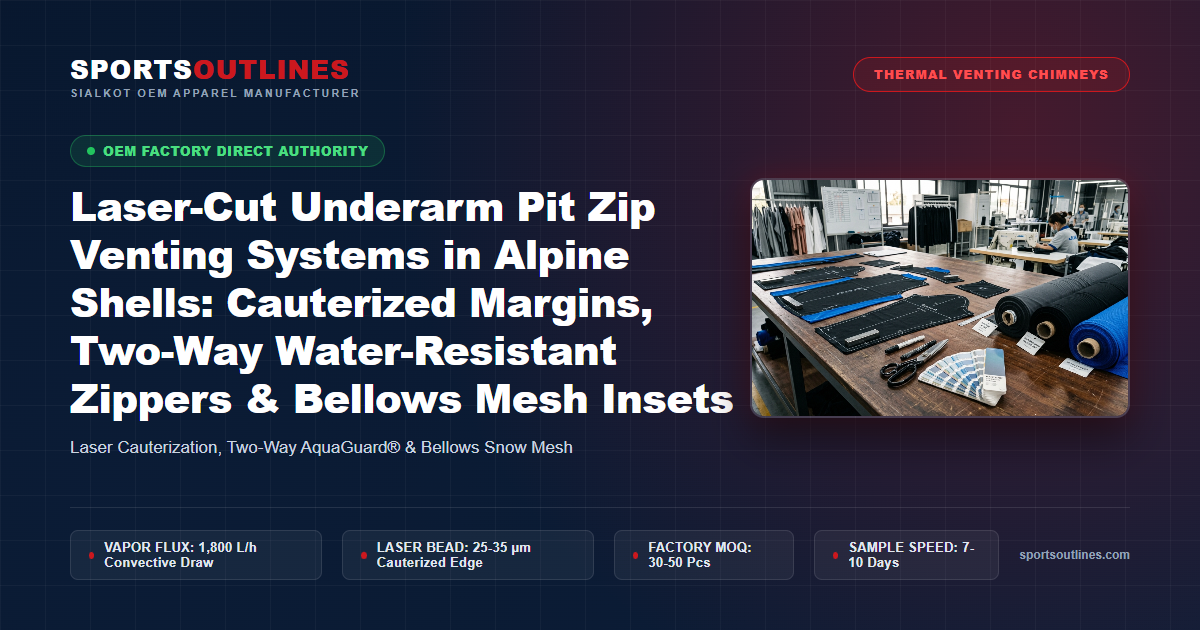
However, engineering a functional, bombproof underarm vent is one of the most difficult challenges in technical apparel manufacturing. The axillary junction is an anatomical nexus of extreme three-dimensional articulation, complex 4-way seam intersections, and severe shear stresses. At Sports Outlines in Sialkot, Pakistan, we manufacture expedition-grade hardshell jackets for leading international alpine brands, utilizing computer-controlled CO2 Galvo laser cutting, ultrasonic edge cauterization, two-way reverse-coil water-resistant zippers, hydrophobic bellows mesh insets, and specialized post-bed hot-air seam taping. We offer accessible commercial development: full physical prototype sampling at $45 to $85 per piece (non-refundable, 7–10 business days turnaround) and scalable factory production starting at strictly 30 to 50 pieces per style/colorway with comprehensive CAD size grading from XS to 3XL.
Underarm Pit Zip Venting Systems: Technical Directory
- 1. Axillary Thermodynamics: Convection, Chimney Effect & Vapor Flux
- 2. CNC Galvo Laser Cutting: Cauterized Margins & Slit Precision
- 3. Zipper Hardware Selection: YKK #3 vs #5 AquaGuard® Reverse-Coil
- 4. Hydrophobic Bellows Mesh Insets vs. Open-Void Apertures
- 5. 3D Underarm Gusset Ergonomics: Eliminating Hem Lift & Binding
- 6. The Axillary Seam Intersection: 4-Way Seam Taping & Bemis Welts
- 7. Zipper Garages & Glove-Friendly Corded Pull Hardware
- 8. Technical Pit Zip Configuration & Performance Matrix
- 9. Dynamic Flex & Suter Hydrostatic Quality Control Testing
- 10. Direct Sialkot Factory Parameters: $45–$85 Samples & 30–50 Piece MOQs
- 11. Alpine Pit Zip Engineering & Sourcing FAQ
1. Axillary Thermodynamics: Convection, Chimney Effect & Vapor Flux
During vigorous aerobic mountain travel, the human body dissipates heat through four fundamental thermodynamic pathways: radiation, conduction, convection, and evaporation. In an encapsulated waterproof hardshell jacket, radiative and conductive heat losses are heavily restricted by insulation and shell layers. Consequently, evaporative heat loss (the phase transition of liquid sweat into vapor consuming $2.43\text{ kJ/g}$) and convective heat transfer must carry over $85\%$ of the total cooling burden.
The Chimney Convection Phenomenon ($\Delta P_{\text{chimney}}$)
The human axillary fossa (armpit) contains the highest concentration of eccrine sweat glands on the upper torso and sits adjacent to major vascular trunks (axillary artery and vein), generating intense localized thermal output. When a pit zipper is opened, it initiates natural buoyant convection—commonly known as the chimney effect—governed by the fluid pressure difference between warm interior microclimate air and cold ambient mountain air:
Where $\rho_{\text{ambient}}$ is ambient air density, $g$ is gravity, $h$ is vertical distance between hem and vent, $T_{\text{internal}}$ is jacket internal temperature in Kelvin ($\approx 308\text{ K}$ or $35^\circ\text{C}$), and $T_{\text{ambient}}$ is outside temperature ($\approx 268\text{ K}$ or $-5^\circ\text{C}$). This buoyant pressure differential drives warm, saturated microclimate air upwards and outwards through the pit zip opening at speeds of $0.3\text{ to }0.8\text{ m/s}$, drawing in cool, drier air through the lower hem or wrist openings. This mechanical air displacement achieves a cooling rate equivalent to $250\text{ to }400\text{ Watts}$ of instantaneous thermal relief, preventing base layer saturation.
Dynamic Pumping Effect During Arm Oscillation
When ski touring or mountaineering with trekking poles, the rhythmic forward-and-backward swinging of the arms creates a mechanical bellows action. During the forward swing, the chest expands and the underarm aperture dilates, creating a low-pressure pulse that ingests fresh air. During the rearward pole plant, the arm compresses the thoracic wall, forcing out up to $150\text{ mL}$ of humid air per stride cycle. This dynamic pumping action accelerates convective vapor flux by an additional $60\%\text{ to }80\%$ compared to static standing postures.
2. CNC Galvo Laser Cutting: Cauterized Margins & Slit Precision
In traditional garment factories, pit zip openings were cut using manual rotary knives, straight shears, or steel clicker dies. However, on technical 3-layer hardshell laminates composed of tight 40D, 70D, or 100D high-tenacity nylon woven face fabrics, mechanical knife cutting leaves raw yarn ends exposed. Under the cyclic tensile strain of arm-lifting and pack-strap abrasion, these unbonded yarn margins fray, micro-yarns unravel, and the subsequent adhesive seam tape fails to establish an airtight seal, resulting in delamination and water ingress.
At Sports Outlines, all underarm vent apertures are cut using advanced CNC CO2 Galvo laser cutting systems:
Key Engineering Advantages of Laser Cauterization:
- Edge Cauterization Bead ($25\text{ to }35\text{ µm}$): The high-energy laser beam vaporizes the polymer matrix while simultaneously melting the cut fiber ends into a continuous, microscopic fused thermoplastic bead. This cauterized edge is $100\%$ immune to fraying, unraveling, or fiber slippage under high peel loads.
- Precision Keyhole Radii ($R = 3.0\text{ mm}$): A sharp 90-degree corner or straight slit termination acts as a stress concentration point, creating a notch effect where repeated arm flexing will initiate a tear. Our CAD cutting patterns incorporate circular stress-relief keyholes ($3.0\text{ mm}$ radius) at both ends of the zipper aperture, distributing tensile stresses evenly across the surrounding laminate matrix.
- Zero Dimensional Distortion: Non-contact laser processing applies zero mechanical drag force to the slippery, silicone-coated or DWR-treated fabric surface. Aperture width tolerances are maintained within strictly $\pm 0.2\text{ mm}$ along the entire $30\text{ to }45\text{ cm}$ vent path.
3. Zipper Hardware Selection: YKK #3 vs #5 AquaGuard® Reverse-Coil
Selecting the correct zipper specification for underarm venting is a critical engineering trade-off balancing water resistance, flexibility, sliding friction, and weight:
Comparison: YKK #3 vs. YKK #5 AquaGuard®
-
YKK #3 AquaGuard® (Matte Polyurethane Film):
- Weight: Approximately $14.2\text{ g/meter}$ (roughly $40\%$ lighter than #5).
- Flexibility: Exceptionally supple drape. Conforms naturally to the concave axillary curve without creating rigid, stiff bulges that press into the ribcage when arms are lowered.
- Limitation: Smaller tooth profile has higher operational friction when wet or iced up; demands careful two-handed alignment if cut too tight.
- Best Application: Fast-and-light alpine shells, ultra-light running waterproofs, and technical ski touring jackets ($<400\text{ g}$ total garment weight).
-
YKK #5 AquaGuard® (Heavy-Duty Reverse-Coil or VISLON®):
- Weight: Approximately $24.8\text{ g/meter}$.
- Mechanical Robustness: Crosswise chain strength $>600\text{ N}$. The larger coil teeth glide effortlessly even when encrusted in verglas ice or sub-zero powder snow. Offers effortless one-handed sliding operation with thick gloves.
- Best Application: Expedition mountaineering parkas, freeride ski shells, and heavy commercial workwear shells ($>550\text{ g}$ total garment weight).
The Mandatory Two-Way Slider Configuration
A single-slider pit zip is a critical ergonomic failure in mountain apparel. High-altitude athletes wear heavy climbing harnesses or backpack hip-belts with padded lumbar wings. When an alpine shell is worn over a harness, a single slider operating from the torso upward cannot be accessed beneath the pack strap.
A two-way dual-slider system allows the user to open the vent from either direction:
- Upper Slider: Pulls forward along the sleeve bicep to vent hot air from the upper arm.
- Lower Slider: Pulls downward along the lateral torso wall, clearing backpack shoulder straps without disrupting the waist seal.
- Micro-Baffle Opening: Both sliders can be positioned centrally to create a calibrated $10\text{ cm}$ micro-vent directly beneath the armpit apex while keeping the bicep and lower torso completely sealed against driving wind.
4. Hydrophobic Bellows Mesh Insets vs. Open-Void Apertures
Outerwear designers face a classic dichotomy when designing pit zips: should the vent open directly to the bare underlayer (open void), or should it incorporate an internal expanding mesh bellows?
A. Open-Void Pit Vents (Alpinism & Ice Climbing)
In pure alpine climbing and high-altitude mountaineering, maximum airflow is paramount. An open-void vent eliminates all air restriction, providing $100\%$ unobstructed convective exchange. It reduces weight by eliminating mesh yardage and allows the climber to reach through the unzipped vent to adjust inner beacon harness straps or access chest pockets on mid-layers. The risk, however, is that during deep-powder ski falls or blowing spindrift, snow can enter directly through the open hole.
B. Hydrophobic Bellows Mesh Insets (Freeride Skiing & Snowboarding)
For freeride ski shells and snowboard outerwear, falling into waist-deep powder snow is routine. An open pit zip in powder snow acts as an open funnel, packing cold snow directly against the wearer’s thermal base layer.
Integrating an internal bellows mesh inset solves this completely:
- Material Specification: Warp-knit polyester micro-mesh ($65\text{ to }85\text{ GSM}$) treated with a durable C0 fluorocarbon-free hydrophobic finish. Aperture size is calibrated to strictly $0.5\text{ to }0.8\text{ mm}$.
- Snow Barrier Physics: Water droplet surface tension and crystal geometry prevent powder snow from penetrating the micro-pores, while permitting high air permeability ($85\text{ to }120\text{ CFM}$).
- 3D Diamond Bellows Fold: The mesh is cut with an expanding center inverted pleat. When the zipper is closed, the mesh folds flat without bunching; when unzipped, it expands to a $60\text{ mm}$ width, maintaining full jacket structural silhouette without exposing skin.
5. 3D Underarm Gusset Ergonomics: Eliminating Hem Lift & Binding
In poorly drafted outerwear patterns, adding a long pit zipper along the standard sleeve-to-torso side seam severely restricts arm elevation. Because a zipper chain is inherently non-stretch ($<1\%$ longitudinal elongation), placing it along a high-stretch anatomical shear line creates a rigid structural bridge. When the climber raises their ice axe overhead, the rigid zipper pulls upward on the jacket hem, causing the waist to ride up out of the climbing harness and exposing the lumbar region to cold air.
To prevent hem lift, Sports Outlines implements an engineered 3D Diamond Underarm Gusset:
Kinematic Drafting Rules for Zero-Hem-Lift Pit Zips:
- Diamond Gusset Integration: A 4-point rhomboid gusset ($120\text{ mm} \times 80\text{ mm}$) is spliced into the axillary apex, providing $180\text{ degrees}$ of overhead arm rotation without transferring vertical tension to the bottom hem.
- Offset Zipper Axis: Rather than centering the zipper directly along the high-compression fold of the armpit, the zipper trajectory is angled $15\text{ degrees}$ forward onto the anterior tricep and lateral ribcage. This places the zipper in a neutral shear plane where arm flexion does not pinch the coil.
- Bicep-to-Torso Length Split: On a $38\text{ cm}$ total vent aperture, the optimal split is $18\text{ cm}$ along the sleeve bicep and $20\text{ cm}$ down the lateral torso wall, maximizing convection across the lateral thoracic wall.
- Size Grading Scaling Factors: In CAD pattern digitization (Gerber / Lectra), the pit zip length is dynamically scaled across sizes: $32\text{ cm}$ for XS/S, $38\text{ cm}$ for M/L, and $42\text{ cm}$ for XL–3XL, maintaining proportional chimney convection across varying chest circumferences.
6. The Axillary Seam Intersection: 4-Way Seam Taping & Bemis Welts
The underarm junction is the most failure-prone seam taping zone in any waterproof garment. At the axillary nexus, up to four distinct structural seams converge: the sleeve underarm seam, the body side seam, the raglan or set-in shoulder seam, and the newly inserted pit zip perimeter seam. When standard hot-air seam tape is applied across this 4-way intersection, the overlapping fabric steps create steep height differentials ($1.2\text{ to }2.0\text{ mm}$ thickness jumps). Standard flat sealing rollers cannot compress into these steps, leaving microscopic air tunnels—known in factory QA as tape bridging—where pressurized water readily leaks through under testing.
Sports Outlines 4-Stage Seam Sealing Protocol for Axillary Intersections:
- Step Skiving & Ultrasonic Shaving: Fabric seam allowances at the 4-way intersection are skived down by $50\%$ using ultrasonic trimming blades, eliminating steep thickness cliffs before taping.
- Pre-Sealing Bemis Overlay Discs: A circular laser-cut reinforcement disc ($25\text{ mm}$ diameter) made from 3-ply membrane tape or polyurethane film (Bemis ST-306) is thermally pre-pressed directly over the 4-way convergence point using a pneumatic spot sealer at $150^\circ\text{C}$ for $6\text{ seconds}$. This anchors the junction and seals cross-seam pinholes.
- Articulated Post-Bed Hot-Air Taping: The linear seams are sealed using high-precision post-bed machines (such as PFAFF 8320 or Ardmel Sheffield) fitted with narrow $13\text{ mm}$ segmented silicone rollers. The roller conforms flexibly over the pre-sealed disc at a controlled thermal dwell rate of $3.2\text{ m/min}$ and $410^\circ\text{C}$ nozzle temperature.
- Perimeter Zipper Welting: The outer zipper tape is thermally welded to the laser-cut shell aperture using a $15\text{ mm}$ Bemis double-sided polyurethane adhesive film, followed by internal 3-ply seam tape coverage, ensuring a dual-barrier hermetic seal rated to $>22,000\text{ mm } H_2O$.
Thermal Bonding Pressing Parameters & Temperature Control
Achieving a durable bond between the reverse-coil zipper tape and the 3L membrane requires precision pneumatic press settings. Standard iron pressing fails because manual pressure is uneven, causing localized adhesive starvation. At our Sialkot manufacturing plant, flatbed pneumatic presses are calibrated with digital thermal probes:
- Upper Platen Temperature: Strictly $148^\circ\text{C} \pm 2^\circ\text{C}$.
- Lower Platen Temperature: Preheated to $65^\circ\text{C}$ to prevent thermal shock and differential shrinkage in the nylon shell fabric.
- Pneumatic Clamping Pressure: $3.4\text{ bar}$ ($340\text{ kPa}$), ensuring the melted TPU adhesive flows completely around the zipper coil base threads.
- Dwell Time: $14\text{ seconds}$ under continuous pressure, followed by an immediate $5\text{-second}$ cold air blast to freeze the polymer crystallization.
7. Zipper Garages & Glove-Friendly Corded Pull Hardware
Even with water-resistant zippers, the slider body and top/bottom stops represent open entry points where liquid water can seep in when the zipper is fully closed. To achieve total weather sealing, both terminations must dock into precision-engineered zipper garages (slider hoods).
A. 3D Thermoformed Hypalon Zipper Garages
Rather than folding a flat flap of shell fabric over the slider (which collapses when wet), Sports Outlines manufactures 3D molded zipper garages using 1.0 mm Hypalon (CSPE) or die-cut TPU film:
- The garage features a permanent three-dimensional canopy pocket that stays open, allowing the zipper slider to glide smoothly into the dock without snagging fabric.
- The internal pocket has an integrated downward drainage weep hole, discharging any moisture blown into the hood during storms.
- Hypalon’s extreme abrasion resistance prevents the sharp metal edges of the zipper slider from cutting into the shell fabric during thousands of cycles.
B. Glove-Friendly Corded Pull Loops
Operating an underarm zipper behind one’s back while wearing bulky 3-finger mountaineering mittens is notoriously awkward. Tiny metal slider tabs slip out of frozen gloves. We equip all pit zip sliders with high-visibility $2.0\text{ mm}$ Dyneema® or UHMWPE corded pulls terminated with injection-molded textured TPU thumb-grips ($55\text{ mm}$ total loop length). The cord is non-absorbent (preventing ice freeze-up) and provides positive tactile leverage even when operating blindly behind the shoulder.
8. Technical Pit Zip Configuration & Performance Matrix
Below is our comprehensive engineering matrix detailing the hardware specifications, vent geometries, seam sealing architectures, and thermal performance metrics across four distinct pit zip configurations manufactured at Sports Outlines:
| Vent Configuration | Zipper Model & Sliders | Internal Inset Style | Aperture Length & Cut | Airflow & Heat Exchange | Target Garment Class |
|---|---|---|---|---|---|
| 1. Pure Alpine Minimalist (Open Void) | YKK #3 AquaGuard® reverse-coil (2-way) | Open void (no mesh); 100% unrestricted flow | 32cm length; CNC laser keyhole cut | Max convective exchange (>350 W thermal dump) | Ultralight mountaineering & ice climbing shells |
| 2. Freeride Powder Bellows Mesh | YKK #5 AquaGuard® reverse-coil (2-way) | Hydrophobic C0 warp-knit micro-mesh (70 GSM) | 38cm length; 60mm expanding bellows | High airflow (95 CFM) + 100% powder snow block | Big mountain ski shells & snowboard jackets |
| 3. Expedition Extended Dual-Chimney | YKK #5 AquaGuard® VISLON® (2-way molded) | Hybrid micro-mesh bicep + open torso access | 45cm extended length (elbow to waist) | Extreme high-velocity stack venting | Polar expedition parkas & high-altitude 8,000m shells |
| 4. Pack-Optimized Anterior Angled | YKK #3 AquaGuard® matte coil (2-way) | Open void with bonded internal draft lip | 28cm anterior curved trajectory | Moderate airflow; zero harness strap interference | Technical ski mountaineering & fastpack shells |
9. Dynamic Flex & Suter Hydrostatic Quality Control Testing
Because the axillary junction experiences continuous twisting, shear, and compression during athletic movement, factory quality control must go far beyond simple visual inspection:
A. Bally Sub-Zero Flexometer Testing (ISO 5402-1 at $-30^\circ\text{C}$)
Sample seam-taped pit zip assemblies are conditioned in our sub-zero test chamber down to $-30^\circ\text{C}$ and flexed continuously for 20,000 cycles on a motorized Bally flexometer. Following cold fatigue, the samples are inspected under $10\times$ optical magnification for adhesive crazing, tape edge peeling, or PU film micro-cracks. Zero micro-delamination is accepted.
B. Suter Hydrostatic Burst Testing (ISO 811 / ASTM D751)
The taped zipper welds and 4-way seam junctions are clamped into a Suter hydrostatic head tester, subjecting the closed seam to pressurized water rising at $60\text{ cm } H_2O/\text{min}$. Our factory QA standard requires zero droplet formation at $>20,000\text{ mm } H_2O$ across both the taped seams and the zipper garage dock points.
C. Crosswise Tensile Chain Pull (ASTM D2061)
The bonded zipper welt attachment to the shell laminate is pulled perpendicularly on an Instron tensile tester. The bond line must sustain a minimum crosswise tensile load of $>450\text{ N}$ without fiber delamination or weld failure, ensuring the pit zip can withstand severe snagging or sudden falls without tearing out.
D. Industrial Wash-Cycle Peel Durability (ISO 6330 Method 4N)
Technical outerwear frequently experiences premature failure not on the mountain, but inside the washing machine. At Sports Outlines, all seam-taped and thermally welded underarm samples undergo 30 consecutive industrial wash cycles at $40^\circ\text{C}$ followed by low-temperature tumble drying at $55^\circ\text{C}$. To pass, the adhesive bond line must retain $\ge 85\%$ of its original peel strength (minimum $24\text{ N/25 mm}$), and the hydrophobic C0 finish on the bellows mesh must maintain a spray rating of $\ge 90$ points under AATCC 22 protocols.
10. Direct Sialkot Factory Parameters: $45–$85 Samples & 30–50 Piece MOQs
Many technical outdoor apparel startups and boutique ski brands struggle to find manufacturing partners capable of executing cleanroom-grade seam taping, laser cutting, and waterproof pit zips without imposing insurmountable order minimums (such as 1,000+ units per color).
At Sports Outlines in Sialkot, Pakistan, we have structured our production floor with dedicated modular agile cells designed specifically to support technical apparel innovators across the United States, United Kingdom, Canada, Germany, and Australia. We bridge the gap between boutique design and high-volume industrial manufacturing with transparent, non-restrictive commercial terms:
Sports Outlines Technical Outerwear Commercial Terms:
- Prototype Sampling Fee: Strictly $45 to $85 per piece (non-refundable development fee covering CAD pattern digitization, laser-cut tooling calibration, ultrasonic horn setup, and cleanroom seam sealing).
- Sample Lead Time: Fast-track physical turnaround of 7 to 10 business days from confirmed tech pack and fabric specification.
- Minimum Order Quantity (MOQ): Scalable bulk production starting at strictly 30 to 50 pieces per style/colorway.
- Comprehensive Size Grading: Full CAD grading across standard size distributions from XS to 3XL, with custom European or North American athletic fit profiles.
- Global Export Logistics: Direct bonded freight through Sialkot Dry Port Trust (SDPT) and Sialkot International Airport (SKT), with DDP, FOB, and air courier dispatch to international brands in the US, UK, Canada, Australia, and the EU.
Whether you are expanding your line through our custom clothing manufacturers USA network, our custom clothing manufacturers UK distribution channels, or our specialized custom waterproof jacket manufacturing lines, our engineering team ensures that every garment meets uncompromising technical standards.
11. Alpine Pit Zip Engineering & Sourcing FAQ
Why are two-way zippers mandatory for underarm pit vents in technical outerwear?
Two-way sliders allow the wearer to open the vent from either direction without being obstructed by backpack shoulder straps or climbing harness waist belts. The user can pull the top slider forward onto the bicep or pull the bottom slider downward on the torso, or position both sliders centrally to create a calibrated micro-aperture directly under the armpit while keeping the rest of the jacket sealed.
How does CNC laser cutting prevent pit zip seam delamination?
CNC CO2 Galvo lasers cut with non-contact precision and cauterize the woven nylon fabric edges with a 25–35 µm fused thermoplastic bead. This eliminates yarn fraying, unraveling, and fiber slippage along the zipper aperture, allowing the hot-air seam tape and thermal bonding film to form an impervious, structural bond that withstands heavy shear and wash cycles.
What is the advantage of a hydrophobic bellows mesh inset over an open-void vent?
For freeride ski shells and snowboard jackets, a hydrophobic bellows mesh inset allows high air permeability (85–120 CFM) for convective sweat evacuation while preventing blowing powder snow and spindrift from entering the garment microclimate during deep snow falls. Open-void vents provide maximum airflow for alpine climbing but offer zero snow barrier.
How do you prevent the 4-way axillary seam intersection from leaking?
We enforce a 4-stage assembly protocol: ultrasonic skiving to reduce fabric thickness steps by 50%, thermal application of a 25 mm circular Bemis reinforcement disc over the convergence point, articulated post-bed hot-air seam taping with segmented silicone rollers, and perimeter zipper thermal welting, ensuring hydrostatic integrity exceeding 20,000 mm H2O.
What are your factory sample lead times and minimum order quantities?
Sports Outlines provides complete physical prototype development at $45 to $85 per piece (non-refundable development fee) with an expedited turnaround of 7 to 10 business days. Following prototype sign-off, our bulk production minimum order quantity (MOQ) is strictly 30 to 50 pieces per style/colorway across sizes XS to 3XL.
Engineer High-Performance Alpine Shells with Sports Outlines
Partner with Sports Outlines to manufacture precision 3-layer hardshell jackets featuring laser-cut pit zips, 3D underarm diamond gussets, and laboratory-certified seam sealing. Fast-track prototyping at $45–$85 per piece with flexible 30–50 piece bulk MOQs.
Explore Our Global Technical Sourcing Hubs:
USA Alpine Shell Manufacturing |
UK Technical Outerwear Sourcing |
Canada Mountaineering Apparel |
Germany Outdoor Outerwear Sourcing |
Australia Hardshell Production
Related Technical Outerwear Engineering Guides:
Storm Flap Drainage Channels Guide (#346) |
Lycra Snow Cuffs & Thumbhole Gaiters (#348) |
Sports Outlines Technical Outerwear Catalog