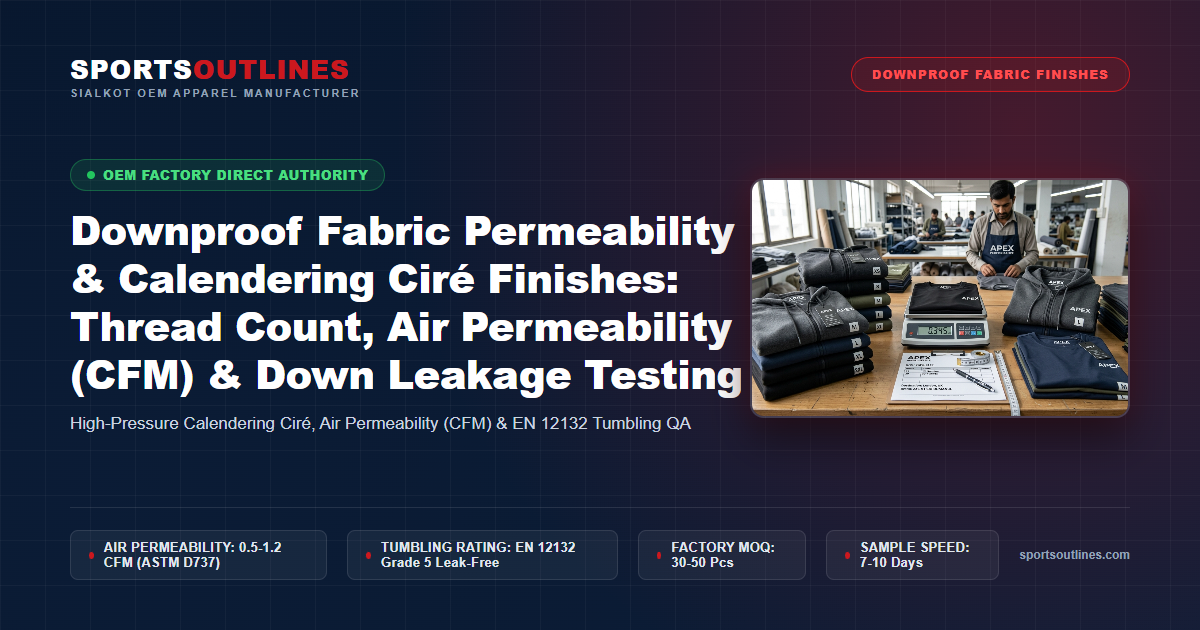
In ultra-lightweight alpine apparel and performance outerwear, the insulation power of 800 to 950+ Fill Power goose down depends entirely on the microscopic pore architecture of the shell and lining textiles that contain it. A down jacket can feature the most pristine mature goose plumules, an advanced 3D box-wall baffle structure, and hermetically sealed seams; however, if the containment fabric possesses interstitial pore apertures larger than the diameter of feather quill shafts or plumule barbule nodes, the garment will suffer from progressive Down Leakage (Down Migration). Escaping down fibers destroy aesthetic appeal, generate consumer warranty returns, and steadily degrade the garment’s intrinsic thermal resistance over repeated compression cycles.
Preventing down fiber leakage requires a delicate physical compromise between yarn denier, weave density, thermomechanical finishing, and gas permeability. If an apparel mill coats the fabric with an impermeable polyurethane film to lock in fibers, the shell traps internal air, causing the jacket to “balloon” during compression, crackle stiffly at −20°C, and trap wearer perspiration vapor into a damp thermal swamp. Conversely, if the textile is left loosely woven for breathability, down plumules puncture through the warp and weft intersections with every arm swing. The engineering solution is Downproof Micro-Weaving and Precision Ciré Calendering, achieving an exact air permeability window of 0.5 to 1.2 CFM (Cubic Feet per Minute) under ASTM D737.
At Sports Outlines in Sialkot, Pakistan, our outerwear fabric lab and technical manufacturing units engineer downproof shells using micro-denier Polyamide 6.6 (7D to 20D), high-density weaves (380T to 460T), and multi-stage heated calender rolls. We support international mountaineering labels, ski brands, and private apparel creators with transparent commercial terms: physical prototype sampling at $45 to $85 per piece (non-refundable, 7–10 business days turnaround) and scalable production with low factory minimums starting at strictly 30 to 50 pieces per style/colorway across standard sizing XS to 3XL.
Downproof Fabric Permeability & Calendering: Technical Directory
- 1. Micro-Denier Fiber Physics: 7D, 10D & 20D Polyamide 6.6
- 2. Weave Density & Thread Count (380T to 460T Ripstop)
- 3. Ciré Calendering: Temperature, Nip Pressure & Roll Speeds
- 4. Pore Geometry: Interstitial Aperture vs Barbule Diameters
- 5. The Air Permeability Balance: 0.5 to 1.2 CFM (ASTM D737)
- 6. Down Leakage Testing: EN 12132-1 Rotating Box Tumbler
- 7. Mechanical Friction: EN 12132-2 Rubbing Test & IDFB 12
- 8. Sewing Needle Friction, Ball-Point SES & Seam Leakage
- 9. Electrostatic Physics & Anti-Static Yarn Finishing
- 10. C0 Fluorine-Free DWR Application vs Ciré Durability
- 11. Sialkot Fabric Laboratory Quality Benchmarks
- 12. Contract Manufacturing Terms & Low MOQ Prototyping
- 13. Technical Sourcing FAQ
1. Micro-Denier Fiber Physics: 7D, 10D & 20D Polyamide 6.6
The foundation of modern ultra-lightweight downproof fabric is the synthesis of continuous micro-denier filament yarns. Denier ($D$) is defined as the mass in grams of 9,000 meters of individual yarn:
In alpine expedition apparel, conventional 40D or 50D outerwear fabrics (weighing 75 to 110 GSM) add excessive dead weight. Technical outerwear engineers utilize high-tenacity Polyamide 6.6 (Nylon 6.6) micro-filaments ranging from 7-denier up to 20-denier. Polyamide 6.6 is chosen over standard Polyamide 6 (Nylon 6) or Polyester because of its tighter crystalline hydrogen bonding, higher melting point ($260^\circ\text{C}$ vs $215^\circ\text{C}$), superior tensile recovery, and higher tenacity ($\ge 6.5\text{ to }7.5\text{ cN/dtex}$).
A single 10-denier yarn is not a monofilament wire; it is composed of multiple microscopic sub-filaments (e.g., 10D/10F or 10D/12F, where 10 or 12 individual filaments constitute the single thread). Each sub-filament has an individual fiber diameter of approximately 3.2 to 4.5 micrometers ($\mu\text{m}$). When twisted and woven under high loom tension, these ultra-fine sub-filaments flatten against one another, creating a dense, micro-textured yarn ribbon that physically blocks down plumule migration while presenting an ultra-soft, silent drape.
2. Weave Density & Thread Count (380T to 460T Ripstop)
Yarn fineness alone cannot prevent down leakage without exceptional loom packing density. In textile manufacturing, fabric density is measured in Thread Count ($T$), representing the combined sum of warp ends ($E$) and weft picks ($P$) per square inch of woven textile:
Standard shirting or lining textiles operate at 190T to 210T. At this loose density, the gaps between crossing yarns measure between 45 and 85 $\mu\text{m}$—vast open highways through which down plumules and feather quills freely escape. For downproof performance, textile mills utilize high-speed water-jet or air-jet looms equipped with electronic tension controllers to achieve ultra-high densities from 380T to 460T.
| Fabric Classification | Yarn Denier & Type | Thread Count (T) | Areal Weight (GSM) | Tensile Strength (Warp/Weft) | Primary Outerwear Role |
|---|---|---|---|---|---|
| Ultralight Featherweight | 7D / 10F Nylon 6.6 Full Dull | 430T to 460T Ripstop | 19 to 24 GSM | 180 N / 165 N (ISO 13934-1) | Alpine race vests, summit windshirts, ultralight 900+ FP liners |
| Technical Alpine Shell | 10D / 12F Nylon 6.6 Micro-Ripstop | 400T to 420T Ripstop | 26 to 30 GSM | 240 N / 225 N (ISO 13934-1) | Mountaineering belay jackets, packable alpine puffers (850 FP) |
| Expedition Heavy-Duty | 20D / 24F Nylon 6.6 Double-Ripstop | 380T to 400T Ripstop | 35 to 42 GSM | 380 N / 350 N (ISO 13934-1) | Sub-zero expedition parkas, polar suits, ski freeride outerwear |
| Calendered Taffeta Lining | 15D / 14F Nylon 6.6 Plain Weave | 390T Plain Taffeta | 28 to 32 GSM | 260 N / 240 N (ISO 13934-1) | Silky, anti-cling internal down chamber linings & baffles |
To prevent localized tears from propagating across high-density textiles, fabrics are woven in a Grid Ripstop Architecture. Thicker reinforcing threads (such as 20D or 30D high-tenacity yarns) are interwoven in a crisscross grid pattern at 1.0 to 2.5 mm intervals. If a crampon point, ice axe pick, or sharp rock nicks the shell, the tear is arrested instantly by the ripstop grid box, preserving the integrity of the down chamber.
3. Ciré Calendering: Temperature, Nip Pressure & Roll Speeds
Even at 400T density, a raw “greige” or dyed woven fabric still contains micro-voids between warp and weft intersections. To achieve true downproofness without adding heavy chemical coatings, the textile must undergo Thermomechanical Calendering (Ciré Finishing).
In a multi-roll industrial calender, the fabric passes through a high-pressure “nip” formed between a mirror-polished, electrically heated chrome-plated steel roll and a resilient composite-fiber or cotton bowl roll. Under the simultaneous application of intense heat ($175^\circ\text{C}\text{ to }195^\circ\text{C}$) and hydraulic line pressure ($40\text{ to }65\text{ N/mm}^2$), the synthetic thermoplastic nylon filaments reach their glass transition and surface softening temperatures.
The mechanical pressure flattens the cylindrical synthetic filaments into oval ribbons, fusing adjacent filament boundaries together at yarn intersections. This process seals up to 85% of interstitial voids. Depending on the garment design, calender finishing is configured in two distinct modes:
- Single-Side Back-Calendering (Internal Ciré): The heated roll contacts only the technical back (inner face) of the shell fabric. This creates a completely sealed, downproof inner barrier that faces the down plumules, while preserving the natural matte texture, soft drape, and low-sheen aesthetics of the outer garment exterior.
- Double-Side Calendering (High-Gloss Ciré): Both faces of the fabric are calendered, producing an ultra-glossy, high-reflectance lacquer finish popularized in modern alpine streetwear and high-visibility mountain rescue parkas. Double-side calendering achieves the lowest possible air permeability ($0.3\text{ to }0.6\text{ CFM}$), but increases fabric stiffness slightly at sub-zero temperatures.
4. Pore Geometry: Interstitial Aperture vs Barbule Diameters
To model downproofness mathematically, textile engineers compare the pore aperture distribution ($d_{\text{pore}}$) of calendered fabrics against the physical anatomical dimensions of goose and duck down plumage:
- Plumule Barbule Diameter: Microscopic branched filaments radiating from central plumule bars measure between $2.5\text{ and }5.0\ \mu\text{m}$ in thickness, terminating in micro-hook nodes measuring $8.0\text{ to }12.0\ \mu\text{m}$.
- Down Fiber Fragments: Broken plumule filaments shed during mechanical tumble washing measure $3.0\text{ to }6.0\ \mu\text{m}$ in width and $0.5\text{ to }3.0\text{ mm}$ in length.
- Feather Quill Calamus: The rigid tubular quill shaft of small feathers (present in 90/10 or 80/20 blends) measures between $150\text{ and }450\ \mu\text{m}$ in shaft diameter, with a sharp needle-pointed tip capable of puncturing through fabric under $15\text{ to }25\text{ MPa}$ localized stress.
Following precision ciré calendering, capillary flow porometry demonstrates that the mean flow pore size ($MFP$) of a 410T Nylon 6.6 shell collapses from an uncalendered $38\ \mu\text{m}$ down to strictly $8.5\text{ to }13.5\ \mu\text{m}$, with maximum bubble point pores below $18\ \mu\text{m}$. Because the largest pores ($<18\ \mu\text{m}$) are significantly smaller than quill shafts and plumule node clusters, down clusters are mechanically trapped within the chamber.
5. The Air Permeability Balance: 0.5 to 1.2 CFM (ASTM D737)
Air permeability is measured under standardized differential pressure (typically 125 Pa or 0.5 inches of water head) in accordance with ASTM D737 or ISO 9237, expressed in Cubic Feet per Minute per square foot of fabric ($\text{CFM}$) or liters per square meter per second ($\text{L/m}^2/\text{s}$, where $1\text{ CFM} \approx 5.08\text{ L/m}^2/\text{s}$).
Operating outside the calibrated permeability envelope produces severe garment defects:
| Air Permeability Range (ASTM D737) | ISO 9237 Metric (L/m²/s) | Downproof Integrity | Garment Breathability & Ergonomics | Engineering Assessment |
|---|---|---|---|---|
| < 0.3 CFM (Hermetic) | < 1.5 L/m²/s | 100% Leak-Proof | Severe Ballooning & Condensation | Defective for active wear. Trapped air prevents rapid stuff-sack packing; wearer sweat vapor condenses against lining, wetting down. |
| 0.5 to 1.2 CFM (The Golden Window) | 2.5 to 6.1 L/m²/s | Grade 5 Certified (≤5 fibers) | Optimal Decompression & Vapor Release | Sports Outlines standard for technical alpine parkas. Air vents smoothly during compression; zero down leakage over 2,700 tumble cycles. |
| 1.8 to 3.5 CFM (High Air-Flow) | 9.1 to 17.8 L/m²/s | Moderate Leakage (Grade 3) | High Breathability | Permissible only with continuous filament synthetic battings (Climashield®). Unacceptable for natural down fills. |
| > 4.0 CFM (Porous) | > 20.3 L/m²/s | Severe Leakage (Grade 1-2) | Maximum Breathability | Complete down migration failure. Feathers and plumule fibers poke through fabric constantly during normal movement. |
6. Down Leakage Testing: EN 12132-1 Rotating Box Tumbler
To qualify downproof textiles quantitatively before cutting and bulk manufacturing, Sports Outlines executes standardized down penetration testing under EN 12132-1 (Textiles – Determination of the downproof properties of fabrics – Part 1: Rotating box test).
The test protocol follows a rigorous laboratory procedure:
- A fabric pillow specimen measuring exactly $140\text{ mm} \times 140\text{ mm}$ is sewn using the exact needle gauge (65/9 ball-point), thread type, and stitch density (12 SPI) specified for production.
- The pillow is filled with exactly 10.0 grams (±0.1g) of certified 850 FP goose down plumage and hermetically edge-stitched.
- The pillow is placed inside a tumbling box containing eight solid silicone-rubber impact balls (each measuring 24 mm in diameter and weighing 14.5g).
- The box is rotated for 2,700 complete revolutions at 48 RPM inside a climate-controlled room at $20^\circ\text{C}$ and 65% Relative Humidity.
- Upon completion, the pillow is extracted, and laboratory technicians use high-magnification optical counters to enumerate all penetrating down plumules, feather quills, and down fiber fragments protruding from or completely separated from the fabric.
| EN 12132-1 Rating | Total Penetrating Down / Feather Count | Commercial Classification | Compliance Standard |
|---|---|---|---|
| Grade 5 (Superior) | ≤ 5 particles | Expedition Alpine Masterpiece | Pass (Sports Outlines Mandatory Standard) |
| Grade 4 (Good) | 6 to 15 particles | Commercial Outdoor Standard | Pass (Mass-Market Outerwear) |
| Grade 3 (Moderate) | 16 to 30 particles | Borderline Performance | Reject for Technical Outerwear |
| Grade 2 to 1 (Failure) | > 31 to 50+ particles | Severe Migration Failure | Fail (Immediate Lot Quarantine) |
7. Mechanical Friction: EN 12132-2 Rubbing Test & IDFB 12
While the rotating box test simulates impact and pressure changes, real-world outerwear undergoes intense localized mechanical friction—such as the underarm sleeves rubbing against the torso or heavy backpack hip belts grinding against lumbar baffles.
To assess down leakage under shear friction, our lab executes EN 12132-2 (Rubbing Test) alongside IDFB Part 12 (Downproofness of Fabric). A test specimen containing down is mounted on a reciprocating mechanical rub apparatus. Two fabric surfaces rub against each other under a calibrated vertical load of 2.0 to 5.0 N across 5,000 to 10,000 double strokes.
This test reveals whether surface ciré calendering is merely a superficial glazed film that abrades away under friction, or a deeply bonded thermomechanical deformation. If calendering is poorly executed with insufficient temperature or excessive roll speed, surface fibrils abrade off after 2,000 rub cycles, causing pore apertures to widen and down fibers to leak profusely.
8. Sewing Needle Friction, Ball-Point SES & Seam Leakage
In more than 70% of reported down leakage incidents in technical outerwear, plumules do not escape through the continuous fabric face; they escape through sewing needle puncture holes along baffle seams.
When an industrial sewing needle pierces an ultra-high-density 400T fabric, three critical failure modes can occur:
- Filament Severing (Needle Cutting): Sharp cutting-point needles (such as regular R or acute points) cut straight through the microscopic 10D nylon filaments, creating permanent tears that enlarge under tension.
- Needle Heat Friction Fusion: Sewing at high speeds (4,000+ RPM) heats needle tips to over $180^\circ\text{C}$ due to friction, melting the thermoplastic nylon filaments and causing brittle hole edges.
- Yarn Displacement Gaps: Overly thick needles (e.g., size 90/14 or 100/16) force warp and weft yarns apart, leaving residual hole clearances exceeding $120\ \mu\text{m}$.
To eliminate seam leakage, Sports Outlines enforces a strict manufacturing protocol:
- Light Ball-Point Needles (SES / J Ball): We utilize Groz-Beckert Gebedur® titanium-nitride coated light ball-point needles in ultra-fine sizes 60/8 or 65/9. The rounded ball point deflects between warp and weft filaments without cutting fibers.
- High-Tenacity Hydrophobic Core-Spun Threads: We sew exclusively with fine ticket 120 or 150 Coats Epic or Gral threads. Upon stitch relaxation, the elastomeric recovery of the 400T fabric closes tightly around the fine thread shank, eliminating needle-hole voids.
- Needle Air Cooling Blowers: Micro-pneumatic cold-air nozzles directed at the needle eye prevent thermal buildup during long baffle sewing runs.
9. Electrostatic Physics & Anti-Static Yarn Finishing
Down plumules are composed of keratin protein, an organic polymer naturally prone to carrying electrostatic positive charges under low relative humidity ($<30\%$ RH). Polyamide and polyester synthetic textiles, by contrast, accumulate high triboelectric negative charges when rubbed against human skin or mid-layer fleeces.
This Coulombic electrostatic attraction draws charged down plumules straight toward the fabric surface. If micro-punctures exist along seam lines, electrostatic force acts like a microscopic vacuum, pulling plumule barbs through needle holes.
Sports Outlines counteracts electrostatic attraction through two technical methods:
- Permanent Carbon/Conductive Yarn Filaments: Ultra-fine conductive filaments (0.5% carbon core) are interwoven at 20 mm intervals in the lining textile, dissipating surface static voltage ($V_{\text{static}} < 100\text{ V}$).
- Quaternary Ammonium Anti-Static Bath: Fabrics undergo an exhaustion pad-bath treatment with durable cationic conductive polymers during jet dyeing, lowering fabric surface resistivity below $10^9\ \Omega/\text{sq}$ per AATCC 76.
10. C0 Fluorine-Free DWR Application vs Ciré Durability
Applying durable water repellent (DWR) chemistries to calendered downproof textiles requires strict chemical sequencing. Under modern environmental compliance regulations (EU REACH, OEKO-TEX® Standard 100, and US EPA rules), legacy C8 and C6 fluorocarbon chemistries are prohibited, requiring C0 Fluorine-Free DWR formulations based on bio-based hydrocarbons, dendrimers, or modified silicones.
The sequencing dilemma: If DWR is applied before calendering, the heated calender rolls ($185^\circ\text{C}$) can degrade wax-based C0 water repellent polymers, while chemical residue deposits on the mirror-finish steel roll, causing uneven pressure streaks. Conversely, if DWR is applied after calendering, passing the fabric through an aqueous padding bath and curing stenter can re-swell compressed yarns, partially opening the compacted pores and increasing air permeability above 1.5 CFM.
Sports Outlines utilizes a proprietary Two-Stage Precision Finishing Route:
- Fabric is padded with a low-viscosity C0 organosilane nano-emulsion and cured on an 8-chamber pin stenter at $160^\circ\text{C}$ to crosslink the hydrophobic barrier (Spray Rating 90–100 per AATCC 22).
- The treated textile is immediately transferred to our chilled calender line, where temperature is controlled at exactly $178^\circ\text{C}$ with $48\text{ N/mm}^2$ nip pressure. The silicone chemistry acts as a dry lubricant, allowing yarns to compact smoothly into pore-free geometries without thermal degradation of the hydrophobic finish.
11. Sialkot Fabric Laboratory Quality Benchmarks
Every lot of downproof shell and lining textile entering the Sports Outlines production facility in Sialkot is quarantined until it clears five standardized laboratory tests:
| Laboratory Test Metric | International Test Standard | Acceptance Tolerance | Inspection Sampling Frequency |
|---|---|---|---|
| Air Permeability | ASTM D737 (125 Pa pressure) | 0.50 to 1.20 CFM (±0.1 CFM) | Every roll (Head, Center, Tail) |
| Down Penetration (Tumble) | EN 12132-1 (2,700 revs @ 48 RPM) | Grade 5 (≤ 5 particles total) | 1 test per 1,000 meters |
| Friction Rubbing Test | EN 12132-2 / IDFB Part 12 | ≤ 8 migrating fibers after 5,000 rubs | 1 test per fabric dye batch |
| Hydrophobic Water Repellency | AATCC 22 (Spray Test) | Initial 95–100; 80+ after 20 washes | Every production dye lot |
| Tear Strength (Tongue Tear) | ASTM D2261 (Instron Tensile Tester) | ≥ 14.0 N Warp / ≥ 12.5 N Weft | 3 specimens per fabric roll |
12. Contract Manufacturing Terms & Low MOQ Prototyping
Sourcing certified downproof micro-ripstop fabrics typically requires textile mill minimums of 2,000 to 3,000 meters per colorway, presenting an insurmountable cash flow barrier for emerging outdoor apparel brands. Sports Outlines eliminates these barriers through our strategic fabric inventory program and agile contract manufacturing in Sialkot, Pakistan.
Commercial Outerwear Production Terms: Downproof Apparel
- Physical Prototype Sampling: Quoted at strictly $45 to $85 per piece depending on shell denier (7D ultralight vs 20D ripstop), baffle architecture (stitch-through vs 3D box-wall), and down fill grade (700 to 950+ FP). Prototype turnaround averages 7 to 10 business days. Prototype fees cover fabric allocation, precision laser cutting, cleanroom down weighing, and lab air-permeability verification under our transparent, non-refundable sampling policy.
- Low Factory Production MOQs: Bulk production orders start at strictly 30 to 50 pieces per style/colorway with comprehensive size grading from XS through 3XL, enabling technical outdoor brands to introduce commercial expedition down jackets without capital-draining inventory risk.
- Global Export Logistics: Fast customs clearance and direct export via Sialkot International Airport (SIAL) with bonded air freight logistics delivering direct to brand warehouses across the USA, UK, Australia, Canada, and Germany.
Explore our technical manufacturing capabilities across Technical Sportswear and Performance Outerwear & Jackets, or contact our engineering desk via WhatsApp at +92 316 7932595.
13. Technical Sourcing FAQ: Downproof Fabric & Calendering
Q1: What is the difference between downproof fabric and standard windproof fabric?
Standard windproof fabrics are engineered to stop bulk air movement (typically 3 to 10 CFM) and often utilize looser 210T to 280T weaves that leave microscopic pores between 40 and 80 micrometers wide. Downproof fabrics combine ultra-high thread counts (380T to 460T) with precision thermomechanical ciré calendering to compact pore sizes strictly below 15 micrometers and reduce air permeability to 0.5 to 1.2 CFM. This prevents sharp feather quills and microscopic plumule barbules from poking through, while still allowing the jacket to compress and decompress smoothly.
Q2: Why is calendering ciré finishing preferred over polyurethane coatings for down shells?
Polyurethane (PU) or acrylic back-coatings add 15 to 30 GSM of dead weight, make the fabric stiff and crinkly at sub-zero temperatures, and reduce air permeability to zero (0.0 CFM). This hermetic seal causes the jacket to “balloon” during packing and traps wearer sweat vapor inside the down chambers, wetting plumules and collapsing thermal loft. Ciré calendering uses heat and pressure to deform the nylon filaments themselves, achieving complete down containment without adding chemical weight, maintaining a soft, quiet drape, and preserving critical moisture vapor diffusion.
Q3: How does the EN 12132-1 rotating box test evaluate downproofness?
In the EN 12132-1 test, a 140×140 mm sewn fabric cushion filled with 10.0 grams of down is tumbled inside a rotating box with eight solid silicone rubber impact balls for 2,700 revolutions at 48 RPM. This simulates intense long-term mechanical compression and abrasion. Technicians then count the number of escaping plumules and fibers. A Grade 5 rating (fewer than 5 penetrating particles) represents superior downproof performance and is the mandatory standard for technical outerwear at Sports Outlines.
Q4: What needle types and stitch densities prevent down leakage along seams?
To prevent needle-puncture seam leakage, outerwear manufacturers must use ultra-fine light ball-point needles (Groz-Beckert SES size 60/8 or 65/9) rather than sharp cutting needles. The ball point pushes filaments aside without severing them. Seams should be sewn at 12 to 14 stitches per inch (SPI) using fine ticket 120 or 150 hydrophobic core-spun polyester thread. The elastic recovery of the micro-denier fabric closes tightly around the thread, sealing the needle puncture hole completely.
Q5: What are Sports Outlines’ commercial terms for sampling and production of downproof apparel?
Sports Outlines provides physical prototype sampling at strictly $45 to $85 per piece (non-refundable, 7–10 business days turnaround) covering technical pattern grading, laser cutting, cleanroom down injection, and laboratory EN 12132-1 verification. Factory production orders start at strictly 30 to 50 pieces per style/colorway across sizing from XS to 3XL, enabling outdoor brands to access high-grade technical outerwear manufacturing without massive inventory risk.
Related Technical Down & Outerwear Engineering Guides
- Down-to-Feather Ratios (90/10 vs 85/15 vs 80/20): Quill-Shaft Content & Turbidity Testing
- Box-Wall Baffle Engineering & Mathematical Loft Modeling: Chamber Height & Spacer Mesh
- Goose Down Fill Power Engineering (650 to 950+ cu in/oz): Lorch Testing & Density Curves
- Hydrophobic Down Treatments & Water-Resistance Baffles: Organosilane Nano-Coatings
- PrimaLoft® Gold Cross Core Aerogel Insulation: Silica Aerogel & Clo/oz Performance