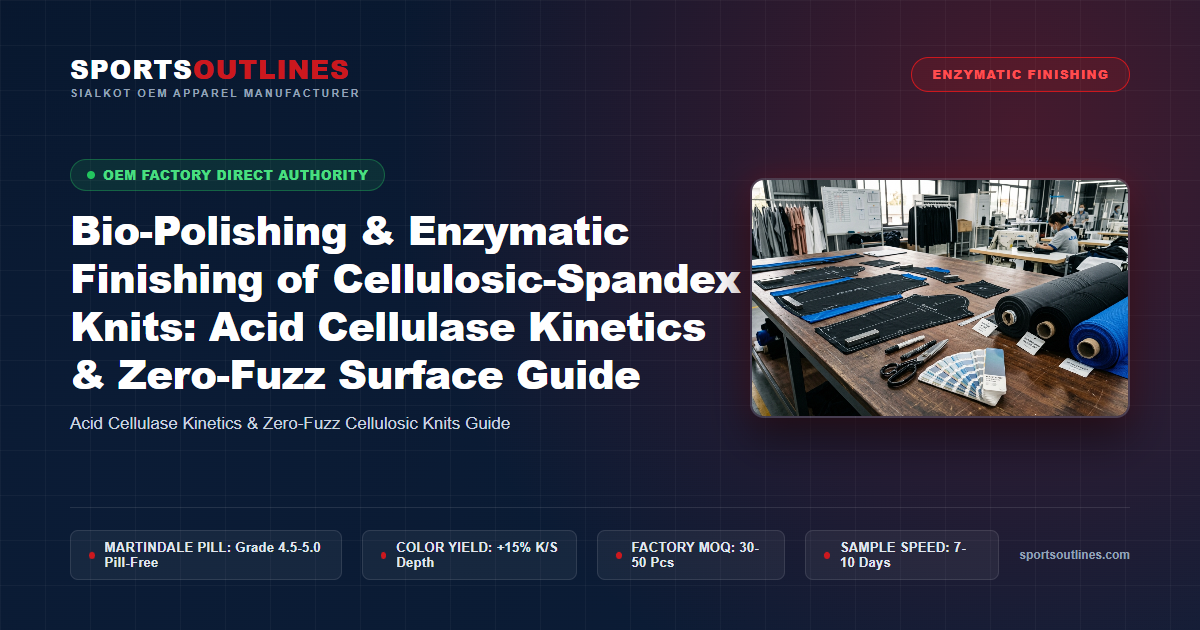
In premium athleisure, high-end yoga wear, and luxury performance activewear, surface aesthetics and tactile drape are paramount. Discerning athletic consumers expect a butter-soft, cool-to-touch hand feel, elegant fluid drape, and deep, saturated color brilliance. However, regenerated cellulosic fibers (such as Modal, MicroModal, Tencel™ Lyocell, and Bamboo viscose) combined with elastane (spandex) suffer from an inherent physical vulnerability: mechanical friction during spinning, knitting, and repetitive laundering causes short staple fibers to loosen from the yarn core. These loose fibers accumulate on the textile surface as micro-fibril fuzz, which rapidly tangles into unsightly surface pills (fuzzballs), giving high-end garments a worn, faded appearance after only a few wash cycles. Traditional mechanical singeing scorches delicate elastane filaments, while heavy synthetic resin coatings wash out and compromise fabric breathability. The gold standard for achieving a permanent, mirror-smooth, pill-resistant surface is bio polishing cellulosic fabric activewear manufacturing utilizing precision enzymatic finishing.
Bio-polishing is an advanced biocatalytic wet-processing technique wherein specialized cellulase enzyme complexes selectively hydrolyze and sever the micro-fibrils protruding from yarn surfaces, leaving the core structural yarns intact. At Sports Outlines, an agile OEM/ODM custom performance apparel manufacturer based in Sialkot, Pakistan, we integrate computerized enzymatic bio-polishing directly into our soft-flow jet dyeing and fabric finishing workflows. This comprehensive technical engineering guide analyzes enzyme biochemistry, Michaelis-Menten reaction kinetics, acid vs. neutral cellulase selection, spandex core protection, spectrophotometric color enhancement, and our transparent low-MOQ manufacturing framework for global performance apparel brands.
1. Biocatalytic Mechanisms: Cellulase Enzyme Complex & Hydrolytic Cleavage Kinetics
Cellulase is not a single enzyme, but a synergistic multi-component enzyme system produced primarily through fermentation of non-pathogenic fungi such as Trichoderma reesei or Humicola insolens. Cellulase complexes operate through three distinct catalytic enzymes working in concert to cleave the β-1,4-glucosidic bonds of cellulose polymers:
- Endo-β-1,4-glucanases (EGs): These enzymes randomly attack and cleave internal β-1,4-glucosidic linkages within amorphous (non-crystalline) regions of the cellulose chain. This internal cleaving rapidly reduces the degree of polymerization (DP) of exposed surface micro-fibrils without releasing large amounts of free glucose. By targeting amorphous regions, EGs create free chain ends along protruding fuzz fibers.
- Exo-β-1,4-cellobiohydrolases (CBHs / Cellobiohydrolases): Once endo-glucanases create accessible chain ends, CBHs attack the ends of the crystalline and amorphous cellulose chains progressively, releasing cellobiose disaccharide units from either the non-reducing or reducing terminus. CBH I and CBH II peel micro-fibrillar layers from the fiber exterior, weakening the base of the protruding fuzz fiber.
- β-Glucosidases (Cellobiases): These enzymes hydrolyze soluble cellobiose disaccharides into individual glucose units in the aqueous liquor bath. This prevents cellobiose accumulation, which would otherwise competitively inhibit the catalytic activity of CBHs and EGs.
- Synergistic Mechanical-Enzymatic Shearing: The chemical hydrolysis performed by cellulase weakens the structural integrity of protruding micro-fibrils at their junction with the yarn body. However, enzymatic action alone does not dissolve entire fibers. In industrial jet dyeing machines, the hydrodynamic liquor flow and continuous mechanical impact against the jet nozzle provide shear stress that snaps the enzymatically weakened fibrils cleanly off the fabric surface, rinsing them away in the bath.
| Enzyme Component | Catalytic Site of Action | Primary Reaction Product | Role in Bio-Polishing |
|---|---|---|---|
| Endo-Glucanase (EG I, EG II) | Amorphous internal β-1,4 bonds | Shorter cellulose oligomers | Initiates structural weakening of fuzz |
| Exo-Cellobiohydrolase (CBH I, CBH II) | Chain ends of crystalline cellulose | Cellobiose disaccharides | Peels micro-fibril layers toward root |
| β-Glucosidase (BGL) | Soluble cellobiose molecules | D-Glucose monomers | Eliminates end-product feedback inhibition |
2. Michaelis-Menten Enzyme Kinetics & Substrate Accessibility Modeling
To optimize industrial bio-polishing without compromising the mechanical tensile strength of activewear knits, the enzymatic hydrolysis reaction is governed by classical heterogeneous Michaelis-Menten biocatalytic kinetics. The rate of substrate cleavage ($v$) is expressed mathematically as:
v = (V_max × [S]) / (K_m + [S])
Where $[S]$ represents the concentration of accessible surface cellulose chains, $V_{max}$ is the maximum catalytic velocity at enzyme saturation, and $K_m$ is the Michaelis constant representing the enzyme’s binding affinity toward cellulose. In heterogeneous textile finishing, several critical biochemical factors govern this kinetic equilibrium:
- Substrate Accessibility & Pore Diffusion Limitations: Unlike liquid enzymes acting upon dissolved sugars, the cellulose substrate is a solid, semi-crystalline polymer. Cellulase enzymes are bulky macromolecular globular proteins with molecular weights ranging from 45 to 65 kDa and hydrodynamic diameters of 3.5 to 5.2 nanometers. The internal pores of regenerated cellulosic fibers (such as modal and lyocell) measure approximately 2.0 to 4.0 nanometers in diameter. Consequently, the enzyme molecules are physically excluded from penetrating the dense interior of the yarn core. Hydrolysis is naturally restricted to the protruding surface micro-fibrils, preventing catastrophic loss of structural yarn strength.
- Lineweaver-Burk Kinetic Inactivation: During extended enzymatic processing, accumulating cellobiose acts as a competitive inhibitor, binding to the active catalytic site of CBH enzymes and shifting the apparent $K_m$ upward. In our computerized finishing vessels, we monitor bath sugar Brix levels to ensure reaction velocity remains within the optimal linear phase ($t = 30$ to 45 minutes).
- Controlled Mass Loss Dynamics: In industrial practice, the kinetic reaction is terminated when total fabric mass loss reaches exactly 2.0% to 3.5%. Below 2.0% mass loss, micro-fibril removal is incomplete, leaving residual fuzz that can re-pill. Above 4.0% mass loss, the enzymes begin to hydrolyze the outer sheath of the structural knit loop, causing bursting strength losses exceeding 15%.
3. Acid Cellulase vs. Neutral Cellulase: Kinetic Profiles & Fiber Specificity
Textile finishing chemists choose between two primary classes of commercial cellulase enzymes, each possessing distinct pH optima, temperature sensitivity, reaction kinetics, and fiber aggression profiles:
- Acid Cellulase (Fungal origin – Trichoderma reesei): Acid cellulases operate with an optimal pH range of 4.5 to 5.2 and an operating temperature of 50°C to 55°C. Acid cellulase exhibits rapid enzymatic reaction kinetics, achieving complete surface de-fuzzing within 30 to 45 minutes of processing time. However, due to its aggressive catalytic rate, acid cellulase carries a higher risk of structural weight loss (typically 3.0% to 5.5%) and fabric bursting strength reduction (10% to 15%) if process parameters are not strictly monitored. It is ideal for heavy 100% cotton and modal knits where maximum de-pilling is required.
- Neutral Cellulase (Bacterial / Fungal origin – Humicola insolens / genetically engineered): Neutral cellulases operate at a milder pH of 6.5 to 7.5 and an operating temperature of 55°C to 60°C. Neutral cellulase possesses significantly slower, more controlled reaction kinetics. It selectively hydrolyzes protruding surface fibrils with minimal penetration into the yarn core, resulting in a modest weight loss of only 1.5% to 3.0% and a negligible bursting strength drop (under 5% to 7%). Neutral cellulase is the premier choice for delicate micro-modal knits, lyocell blends, and elastane-containing activewear fabrics where color back-staining and elastane preservation are critical.
- Monocomponent Engineered Cellulases: Modern bio-polishing technology utilizes recombinant DNA biotechnology to produce “monocomponent” endo-glucanases. By isolating specific EG enzymes and removing aggressive cellobiohydrolases, these engineered enzymes target only the loose, disordered amorphous fuzz fibers without degrading the crystalline core of the yarn, yielding zero-fuzz surfaces with near-zero tensile loss.
| Process Parameter | Acid Cellulase (Trichoderma) | Neutral Cellulase (Humicola) | Monocomponent Endo-Glucanase |
|---|---|---|---|
| Optimal pH Range | 4.5 – 5.2 | 6.5 – 7.5 | 5.5 – 6.5 |
| Optimal Temperature | 50°C – 55°C | 55°C – 60°C | 52°C – 58°C |
| Processing Duration | 30 – 45 Minutes (Fast) | 50 – 70 Minutes | 40 – 50 Minutes |
| Fabric Weight Loss (%) | 3.5% – 5.5% | 1.8% – 3.0% | 1.2% – 2.2% (Minimal) |
| Bursting Strength Retention | 85% – 90% | 93% – 96% | 96% – 98% (Superior) |
| Color Back-Staining Risk | Moderate (Requires Rinse) | Low / Negligible | Very Low |
4. Protecting Elastane (Spandex) Integrity: Core Shielding & Thermal Control
In performance activewear, cellulosic fibers (modal, bamboo, cotton, lyocell) are rarely knitted alone; they are plated or core-spun with 4% to 15% elastane (spandex / Lycra®) to provide 4-way stretch, form fitting compression, and shape recovery. Cellulase enzymes are chemically inert toward synthetic segmented polyurethane (elastane chains contain no glycosidic bonds). However, bio-polishing cellulosic-spandex knits presents severe physical risks if improperly executed:
- Preventing Spandex “Grin-Through”: If cellulase hydrolyzes too much of the cellulosic sheath surrounding core-spun elastane yarns, the bare synthetic elastane filament is exposed to the fabric surface. Under tension, exposed elastane glints in the light—a defect known in the trade as “spandex grin-through.” Sports Outlines utilizes Siro-compact spinning and dual-core spinning methods where double helices of modal or lyocell fibers securely trap the 20D to 40D elastane filament, ensuring the enzyme shears only surface fuzz without baring the core.
- Mechanical Tension & Creasing Control: Spandex knits are highly sensitive to thermal setting and longitudinal rope tension in dyeing vessels. High mechanical friction combined with elevated temperatures (>65°C) can cause permanent rope marks, crow’s-feet creasing, and loss of elastane modulus. We utilize specialized soft-flow aerodynamic jet dyeing machines (such as Thies Eco-Soft) running at gentle nozzle pressures (0.8 to 1.2 bar) and high fabric circulation speeds (280 to 350 m/min) to prevent rope tension during bio-polishing.
- Strict Temperature & Heat History Monitoring: Spandex begins to lose its elastic recovery if subjected to prolonged wet processing above 65°C. Our bio-polishing temperature is strictly thermostatted to 52°C ± 1°C. Once the desired depilling cycle is achieved, enzyme deactivation is performed via pH shock rather than excessive thermal boiling, preserving the full modulus and recovery power of the elastane yarn.
Direct Manufacturer Sourcing Answer: Bio-Polished Activewear Knits
Sports Outlines manufactures custom premium activewear using bio-polished modal, lyocell, bamboo, and combed cotton knits with Creora® elastane. Our enzymatic finishing achieves Grade 4.5+ Martindale pilling resistance and butter-soft peach skin hand feel.
- Low Production MOQ: Strictly 30 to 50 pieces per style/colorway across sizes XS to 3XL.
- Physical Prototype Sampling: Dispatched in 7 to 10 business days ($45 to $85 per piece, non-refundable).
- Direct Sourcing Contact: WhatsApp factory management directly at +92 316 7932595 or submit your tech pack via our Contact Portal.
5. Processing Kinetics & Industrial Jet Dyeing Machine Recipe
Achieving consistent, repeatable bio-polishing across production dye lots requires strict adherence to standardized wet-processing formulation protocols. Sports Outlines executes bio-polishing according to the following validated factory engineering cycle:
- Stage 1: Pre-Conditioning & Bath Preparation: Fabric is loaded into the soft-flow jet machine with softened demineralized water at a low liquor ratio of 1:8 to 1:10. Acetic acid buffer (0.8 to 1.2 g/L) is dosed to adjust the bath pH precisely to 4.8 to 5.0 (for acid cellulase) or 6.5 to 6.8 (for neutral cellulase). An enzyme-compatible non-ionic wetting agent (0.5 g/L) is added to ensure rapid, uniform liquor penetration throughout the fabric rope.
- Stage 2: Enzyme Dosing & Incubation: Liquid cellulase enzyme is dosed into the machine at a concentration of 0.8% to 1.5% on-weight-of-fabric (o.w.f.). The machine bath temperature is ramped up at 1.5°C per minute to 52°C. The fabric circulates continuously for 35 to 45 minutes under controlled mechanical nozzle tumbling. Continuous monitoring ensures that total fabric weight loss does not exceed 3.0%.
- Stage 3: Enzyme Deactivation (The Kill Step): Once the target surface smoothness is achieved, the enzymatic reaction must be completely and irreversibly terminated to prevent ongoing cellulose degradation during subsequent washing or storage. Deactivation is achieved via alkaline shock: soda ash (sodium carbonate, 1.5 to 2.0 g/L) is injected to elevate the bath pH to 9.5 to 10.0, combined with raising the bath temperature to 75°C for 10 minutes. This dual chemical-thermal shock denatures the enzyme protein tertiary structure permanently.
- Stage 4: Post-Rinsing & Bio-Softening: The bath is drained, and the fabric undergoes two hot rinses (60°C and 40°C) with fresh water to purge all sheared micro-fibril fragments and enzyme residues. In the final rinse, a micro-emulsion amino-silicone softener (1.0% o.w.f.) is applied at pH 5.5 to impart a silky, non-greasy peach-skin surface handle.
6. Surface Tribology & Depilling Characterization: Martindale, ICI Pilling Box & Spectrophotometry
To scientifically verify the efficacy of bio-polishing, Sports Outlines subjects all treated fabrics to rigorous physical textile laboratory testing against untreated control specimens:
- Martindale Pilling Resistance (ISO 12945-2): Circular fabric specimens are abraded against standard wool fabric in a Lissajous motion under a light pressure of 415 cN. Untreated 95/5 modal-spandex knits develop moderate fuzzing at 500 cycles and severe pilling (Grade 2.0) at 2,000 cycles. Bio-polished specimens achieve a flawless Grade 4.5 to 5.0 (virtually zero pilling) even after 5,000 continuous abrasion cycles.
- Random Tumble Pilling Tester (ASTM D3512): Fabric specimens are tumbled inside an impeller chamber lined with cork gaskets and injected with a small quantity of cotton lint for 30 minutes. Bio-polished knits score Grade 4.5, proving that the absence of surface fuzz prevents the entrapment of airborne lint.
- Spectrophotometric Color Yield & Depth of Shade (CIE L*a*b*): Surface fuzz acts as a microscopic diffuser, scattering incident light in all directions and causing dyed knits to appear hazy, whitish, and desaturated. By cleanly shearing off protruding fibrils, bio-polishing creates a smooth optical plane that maximizes specular light reflection. On Datacolor spectrophotometer testing, bio-polished black and navy fabrics demonstrate a 12% to 18% increase in color depth (K/S value) and a lower lightness index ($L^*$), producing richer, deeper, and more lustrous coloration without adding extra dyestuff.
- Wash Fastness & Surface Longevity (ISO 105-C06): After 25 consecutive home laundering cycles at 40°C, bio-polished garments retain their original surface luster and hand feel, whereas untreated cellulosic garments become fuzzy, faded, and pilled.
| Performance Metric | Untreated Cellulosic-Spandex | Traditional Gas Singeing | Acid Cellulase Bio-Polished | Neutral Cellulase Bio-Polished |
|---|---|---|---|---|
| Martindale Pilling (2,000 cycles) | Grade 2.0 – 2.5 (Severe Pilling) | Grade 3.5 – 4.0 | Grade 4.5 – 5.0 (Pill-Free) | Grade 4.5 – 5.0 (Pill-Free) |
| Impact on Spandex Elasticity | No Damage (100% Retained) | High Thermal Risk / Melting | Safe (No Spandex Reaction) | Safe (No Spandex Reaction) |
| Tactile Hand Feel | Slightly Rough / Fuzzy | Stiff / Melted Bead Drops | Ultra-Soft, Fluid Drape | Butter-Soft Peach Skin |
| Color Saturation (K/S Value) | Baseline (Light Scatter Haze) | +6% Moderate Increase | +15% Deep Saturated Tone | +12% Clean Visual Clarity |
| Durability After 25 Washes | Excessive Fuzz & Dullness | Pills Regrow Rapidly | Permanent Pill-Free Finish | Permanent Pill-Free Finish |
7. Comparing Bio-Polishing with Alternative Textile Finishing Technologies
To understand why enzymatic bio-polishing represents the pinnacle of modern sustainable activewear finishing, it must be evaluated against competing mechanical and chemical finishing methods:
- Gas Singeing: Singeing passes fabric over an open natural gas flame at high speed (80 to 120 m/min) to burn off surface fuzz. While effective on 100% stable cotton wovens, singeing is disastrous for elastane-plated circular knits. The intense radiant heat melts exposed polyurethane microfilaments, forming hard, bead-like polymer droplets that create a scratchy surface feel and permanently ruin elastane stretch elasticity. Bio-polishing replaces flame with biocatalysis at mild 52°C temperatures, preserving 100% of elastane integrity.
- Synthetic Resin Finishing (Formaldehyde Cross-Linkers): Traditional anti-pilling resins (DMDHEU or melamine resins) chemically bond loose fibrils to the yarn body. However, resin finishing releases hazardous free formaldehyde vapors, stiffens fabric drape, causes yellowing under heat, and drastically reduces fabric moisture absorption. Bio-polishing uses 100% biodegradable natural enzymes, leaving zero chemical residues and preserving natural moisture management.
- Caustic Mercerization: Treating cotton or cellulosic fabrics with concentrated sodium hydroxide (20% to 24% NaOH) swells fibers and rounds cross-sections, increasing luster. However, high-caustic baths can degrade delicate regenerated cellulosics like modal and lyocell, causing fiber tenderization. Bio-polishing offers a gentle, targeted alternative that cleans the surface without high alkaline chemical burdens.
8. Sustainable Eco-Chemistry & ZDHC Zero Discharge Compliance
Modern performance apparel brands face stringent environmental scrutiny regarding wet-processing effluents and hazardous chemical discharge. Bio-polishing stands as one of the cleanest green-chemistry innovations in modern textile wet processing:
- 100% Biological Biodegradability: Cellulase enzymes are natural protein catalysts. Unlike persistent synthetic fluorocarbons, silicones, or chemical cross-linkers, cellulases readily biodegrade in biological wastewater treatment plants within hours, breaking down into harmless amino acids.
- ZDHC MRSL Level 3 & OEKO-TEX Standard 100: Sports Outlines formulates all bio-polishing recipes using enzymes certified compliant with the Zero Discharge of Hazardous Chemicals (ZDHC) Manufacturing Restricted Substances List (MRSL) Level 3 and OEKO-TEX Standard 100 Class I (safe for infant skin contact). Our processes contain zero alkylphenol ethoxylates (APEOs), heavy metals, or organohalogens.
- Water & Energy Efficiency via One-Bath Processing: By utilizing advanced neutral cellulases that function effectively at near-neutral pH (6.5), we can combine bio-polishing and reactive dye rinsing into a streamlined one-bath finishing cycle. This eliminates two entire water drop-and-fill cycles, reducing fresh water consumption by 22% and lowering steam boiler energy expenditure by 18% per metric ton of fabric processed.
9. Garment Silhouette Applications: From Yoga Leggings to Butter-Soft Hoodies
Bio-polished cellulosic-spandex knits unlock premium tactile performance across a wide spectrum of technical athletic silhouettes:
- High-Waisted Yoga Leggings & Bike Shorts (240 to 280 GSM Interlock): Constructed from 88% Tencel™ Lyocell and 12% Creora® elastane. Bio-polishing eliminates inner-thigh friction pilling caused by stride rubbing, while the non-chafing, cool-to-touch surface glides smoothly across the skin during deep stretches.
- Luxury Athleisure Pullovers & Zip Hoodies (320 to 380 GSM French Terry): Engineered with an 85% MicroModal / 15% elastane loopback structure. The exterior jersey face is bio-polished to a clean, silky sheen that resists abrading against outerwear coats, while the inner French terry loops provide plush warmth.
- Second-Skin Athletic Tops & Long Sleeves (180 to 220 GSM Single Jersey): Crafted from 95% Organic Bamboo Viscose and 5% Spandex. The bio-polished jersey drapes gracefully over the torso without clinging static, maintaining a crisp, non-fuzzy silhouette from high-intensity workouts to casual street styling.
- Seamless Sports Bras & Layering Camisoles (200 to 240 GSM Rib): 2×2 ribbed modal-spandex blends engineered for gentle hold. Bio-polishing ensures the rib channels remain sharply defined with zero fuzz bridging across the wales.
| Garment Category | Substrate & Blend | Weight Tier | Enzymatic Protocol | Key Tactical Benefit |
|---|---|---|---|---|
| Performance Yoga Tights | 88/12 Lyocell / Spandex Interlock | 260 – 280 GSM | Neutral Cellulase (1.2% o.w.f.) | Zero inner-thigh friction pilling & opaque squat-proof stretch |
| Luxury Pullover Hoodie | 85/15 Modal / Spandex French Terry | 340 – 360 GSM | Acid Cellulase + Softener | Mirror-smooth face drape with rich loopback comfort |
| High-Performance Crew Tee | 95/5 Bamboo / Spandex Single Jersey | 180 – 200 GSM | Neutral Cellulase (0.8% o.w.f.) | Fluid body drape & enhanced color depth (L* reduction) |
| Athletic Ribbed Tank | 92/8 MicroModal / Spandex 2×2 Rib | 220 – 240 GSM | Monocomponent Endo-Glucanase | Crisp rib wale definition with zero bridging fuzz |
10. Low MOQ Sourcing Economics & Physical Prototype Sampling Program
For emerging athleisure labels, independent fitness designers, and scaling activewear brands, procuring custom bio-polished fabrics has historically been difficult. Most commercial dye houses require minimum dyeing lots of 500 to 1,000 kilograms per color before running specialized enzymatic recipes. Sports Outlines solves this inventory bottleneck with our flexible, low-MOQ manufacturing infrastructure:
- Agile Low Factory Production MOQ: We offer a true factory production MOQ of strictly 30 to 50 pieces per style/colorway with complete custom sizing distributions (XS to 3XL). By maintaining dedicated small-batch soft-flow jet machines and continuous supplies of high-grade cellulosic yarns, we allow boutique brands to launch ultra-premium activewear collections without tying up cash in hundreds of unsold units.
- Physical Prototype Sampling Program ($45 to $85 per piece): The sublime hand feel, drape, and pilling resistance of bio-polished activewear cannot be assessed through digital mockups. Sports Outlines produces and dispatches fully finished pre-production physical prototype samples within 7 to 10 business days for $45 to $85 per piece (plus international courier). This prototype lets you audit the fit, 4-way stretch recovery, wash durability, and tactile surface before placing bulk orders. In strict compliance with our transparent factory operations and dedicated materials allocation, sample fees are strictly non-refundable and are never credited toward bulk production orders.
- Comprehensive Private Label Branding: We customize every garment with high-density silicone heat transfers, tagless neck prints, woven hem labels, custom engraved drawcord aglets, and biodegradable polybags.
- Global Logistics & Territorial Trade Compliance: We provide door-to-door DDP (Delivered Duty Paid) air freight logistics directly to your fulfillment warehouse across the globe. Explore our territorial sourcing hubs for localized trade details:
USA Sportswear Manufacturer Hub,
UK Activewear Sourcing Hub,
Australia Activewear Hub,
Canada Sportswear Hub, and
Germany Sourcing Hub. - Product Category Hubs: Explore our specialized production lines across Custom Sportswear & Activewear, Fitness & Gym Apparel, and Athletic Casual Wear.
- Inter-Cluster Technical Knowledge Base: Deepen your understanding of advanced textile finishing across our activewear library: discover high-tenacity hybrids in our Hemp-Recycled Nylon Outerwear Guide, explore luxury luster in our Pima vs Supima Cotton Guide, and study thermal base layer mechanics in our Lyocell-Merino Base Layer Guide.
Launch Your Bio-Polished Premium Activewear Collection
Partner directly with Sialkot’s master athletic apparel manufacturer. Experience pill-free modal, lyocell, and bamboo knits with low 30–50 pcs factory MOQs and fast 7–10 day physical prototyping.