In traditional cold-weather outerwear engineering, thermal jackets have historically been constructed using a uniform insulation modality throughout the entire garment envelope. A parka was either 100% down-filled or 100% synthetic-padded. While single-material construction simplifies garment manufacturing and pattern grading, it creates severe thermodynamic and physiological compromises during active alpine mountaineering, ski touring, and tactical field operations. The human body does not emit heat or perspiration uniformly; the central thoracic cavity requires maximum thermal retention with minimal bulk, while the axillary underarm hollows, scapular spine, and wrist cuffs generate massive sweat flux rates ($E_{\text{sk}} > 250\text{ g/m}^2\cdot\text{h}$) that rapidly saturate natural down feathers, causing catastrophic structural loft collapse.
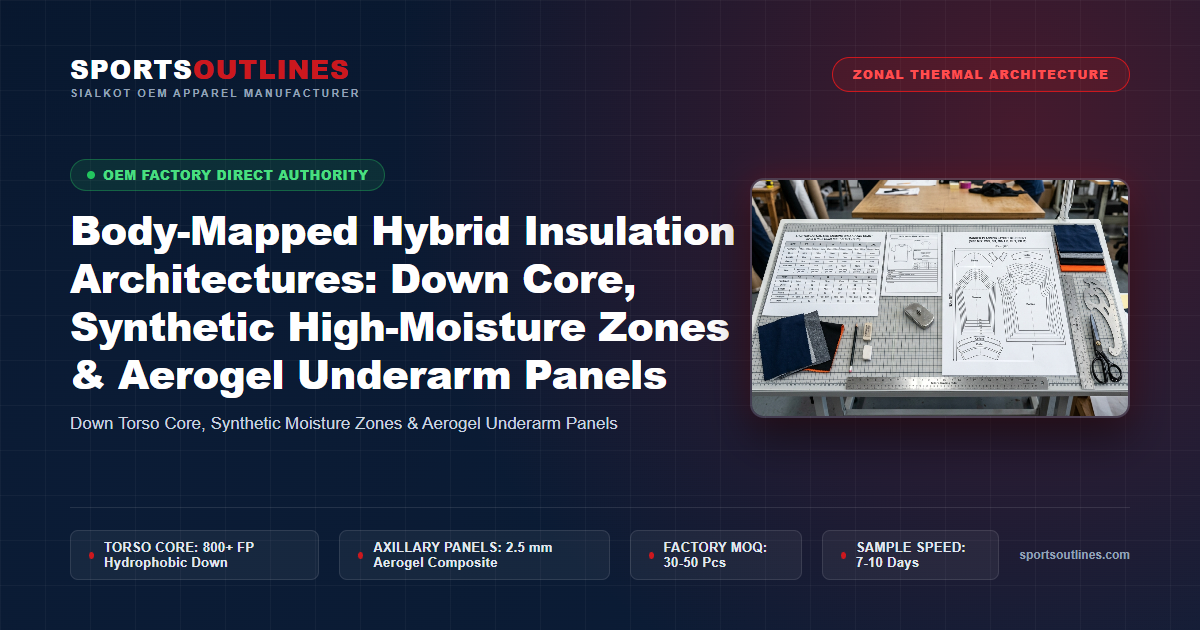
To solve this physiological paradox, high-performance apparel engineering has evolved toward Body-Mapped Hybrid Insulation Architectures. By strategically allocating 800+ Fill Power water-resistant goose down to the core torso organs, hydrophobic continuous filament synthetic battings to high-moisture drainage zones, and ultra-thin silica aerogel composite panels to high-articulation, zero-bulk underarm zones, apparel engineers can achieve unprecedented warmth-to-weight ratios without moisture failure or motion restriction.
At Sports Outlines in Sialkot, Pakistan, our technical outerwear manufacturing facility specializes in complex hybrid insulation mapping for premium outerwear brands worldwide. We maintain transparent contract manufacturing protocols: physical prototype sampling priced at $45 to $85 per piece (non-refundable, 7–10 business days turnaround) and factory production runs starting at an agile low minimum order quantity of strictly 30 to 50 pieces per style/colorway across full size grading from XS to 3XL.
Body-Mapped Hybrid Insulation Architecture: Technical Directory
- 1. Zonal Thermo-Physiology & Sweat Flux Distribution
- 2. Three-Tier Insulation Modality Allocation Matrix
- 3. Torso Core: 800+ FP Goose Down & Baffle Architecture
- 4. High-Sweat Zones: Hydrophobic Synthetic Battings
- 5. Axillary Underarms: Silica Aerogel Thin-Profile Physics
- 6. Transition Seam Engineering & Down Containment
- 7. Laundering Mechanics & Differential Shrinkage Balancing
- 8. Technical Materials Comparison Table
- 9. CAD Differential Patterning & Ergonomic Mobility
- 10. Manufacturing SAM Allocation & Workstation Routing
- 11. ASTM F1291 & ISO 15831 34-Zone Mannequin QA
- 12. Sialkot Manufacturing Hub & Commercial Sourcing Terms
- 13. Hybrid Outerwear Technical FAQ
1. Zonal Thermo-Physiology & Sweat Flux Distribution
The human body during strenuous aerobic exertion (such as ski mountaineering or rapid alpine ascents carrying heavy loads) functions as an inhomogeneous thermodynamic generator. Metabolic heat production increases from a resting rate of roughly $M \approx 70\text{–}90\text{ W}$ up to $M \ge 600\text{–}900\text{ W}$. To prevent life-threatening internal hyperthermia, the body activates eccrine sweating mechanisms, releasing water vapor and liquid perspiration at highly differentiated spatial rates across specific anatomical dermatomes.
Biophysical research using 34-zone sweating thermal mannequins demonstrates that perspiration is concentrated predominantly in the thoracic spine ($180\text{–}240\text{ g/m}^2\cdot\text{h}$), the axillary underarm hollows ($220\text{–}310\text{ g/m}^2\cdot\text{h}$), and along the waistline and lumbar junction ($190\text{–}260\text{ g/m}^2\cdot\text{h}$). Conversely, the anterior chest, upper shoulders, and front abdomen require high insulation retention to protect internal organs while generating significantly lower sweat fluxes during cold wind exposure ($<80\text{ g/m}^2\cdot\text{h}$).
When a conventional jacket places high-loft down directly into the axillary fossa or along the spinal backpack contact plane, the high relative humidity ($RH > 95\%$) and liquid sweat drops cause the down plumules’ microscopic protein barbules to adhere together through liquid surface tension capillary forces ($\Delta P = 2\gamma / r$). Within 45 to 60 minutes of sustained high exertion, down in these zones loses up to 70% to 85% of its structural loft, dropping its intrinsic insulation from $I_{\text{cl}} \approx 1.2\text{ Clo}$ down to a freezing $I_{\text{cl}} < 0.25\text{ Clo}$. Once the athlete pauses at a high-altitude belay or summit ridge, the saturated, deflated down transforms into a thermal sink, accelerating evaporative heat loss ($Q_{\text{evap}} = \dot{m}_{\text{sweat}} \lambda_{\text{vap}}$ where $\lambda_{\text{vap}} \approx 2.43\times 10^6\text{ J/kg}$) and triggering rapid onset hypothermia.
2. Three-Tier Insulation Modality Allocation Matrix
Body-mapped hybrid architecture overcomes this biological hurdle by partitioning the technical garment into three specialized engineering zones, matching the physical properties of the insulation material directly to the thermodynamic demands of the underlying anatomy:
- Tier 1: Core Torso & Vital Organ Enclosure (High-Loft Goose Down): Assigned to the anterior chest, upper back yoke, kidneys, and upper sleeve bicep sections. These anatomical sectors require the highest possible warmth-to-weight ratio ($1.6\text{–}2.0\text{ Clo/oz}$) and maximum compressibility. High fill power down (800 to 900+ FP) provides ultra-lightweight thermal loft that traps stagnant air pockets while remaining shielded from direct sweat immersion.
- Tier 2: High-Perspiration & High-Compression Zones (Continuous/Staple Synthetic Batting): Allocated to the lower hem circumference, wrist cuff hems, collar chin guard, shoulder backpack strap contact points, and spinal sweat drainage channels. Materials such as PrimaLoft® Gold Active or Climashield® Apex utilize hydrophobic polyester microfibers with silicone finishes that absorb less than 1% moisture by weight, maintaining 90% to 95% of their dry Clo rating even under direct liquid saturation.
- Tier 3: Low-Bulk High-Articulation Zones (Silica Aerogel Composite Panels): Integrated into the axillary underarm hollows, inner elbow flexure lines, and side thoracic panels. In these zones, traditional 40 mm down baffles bunch up, restricting arm movement and creating bulk that abrades against climbing harnesses. Ultra-thin silica aerogel encapsulated nonwoven batts (2.0 mm to 3.5 mm thickness) provide an extraordinary 1.4+ Clo/oz thermal resistance via the Knudsen effect, allowing unrestricted shoulder flexion and zero bulk.
3. Torso Core: 800+ FP Goose Down & Baffle Architecture
For the core chest and thoracic back chambers, down remains the gold standard in thermal efficiency. In our Sialkot manufacturing cells, we utilize Responsible Down Standard (RDS 3.0) certified 90/10 white goose down with Lorch cylinder tested fill powers ranging from 800 to 900 cu in/oz. The plumules are pre-treated with covalent fluorocarbon-free organosilane nano-emulsions, ensuring hydrophobic contact angles exceeding $125^\circ$ on keratin protein filaments.
The baffle geometry in the core zone is engineered using 3D box-wall baffle construction or bonded stitchless chambers (Bemis 3905 TPU film). Stitch-through seams are strictly prohibited in the core zone, as needle penetrations reduce chamber height to zero ($d_{\text{loft}} = 0.0\text{ mm}$), creating severe conductive thermal bridges ($q = -k \frac{dT}{dx}$). Continuous box-wall baffles maintain a vertical chamber height of $H = 28\text{–}35\text{ mm}$, with an aspect ratio of $W/H \approx 2.8\text{–}3.2$ to eliminate aerodynamic wind rollover and loft flattening.
The volumetric filling mass for each chest chamber is calculated using the physical equation:
m_{\text{down}} = \frac{V_{\text{chamber}}}{\text{Fill Power}} \times (1 + \Phi_{\text{overfill}})
where $V_{\text{chamber}}$ is the CAD volume in cubic inches, Fill Power is in cu in/oz, and $\Phi_{\text{overfill}} = +0.20$ to $+0.25$ represents a mandatory 20% to 25% overfill density. This controlled overfill compresses plumules slightly into a higher-density regime, preventing plumage migration toward chamber edges during torso twisting while maintaining maximum loft resilience.
4. High-Sweat Zones: Hydrophobic Synthetic Battings
In zones subjected to direct mechanical compression (such as the shoulder yokes under heavy 65-liter expedition backpack straps) and high liquid sweat runoff (such as the lower jacket hem and wrist cuffs that contact snow and wet gloves), down rapidly fails. Compressing 800 FP down under a 15 kg pack strap reduces chamber loft from 35 mm down to less than 3 mm, virtually eliminating stagnant air insulation.
In these strategic sectors, we install 60 to 100 GSM continuous filament synthetic battings (such as Climashield® Apex) or water-repellent micro-denier staple battings (such as PrimaLoft® Gold Active). Continuous filament battings possess an infinite aspect ratio ($L/d \to \infty$), providing exceptional compressive modulus and recovery ($J(t)$). When subjected to heavy backpack shoulder strap pressures ($\sigma > 45\text{ kPa}$), continuous filament battings retain over 65% of their uncompressed loft, whereas down retains less than 12%.
Furthermore, at the wrist cuff hems and lower waist cinch tunnels, internal snow melt and capillary wicking from damp baseline gloves are inevitable. Hydrophobic polyester fibers feature water absorption rates below 0.8% by weight (per ASTM D570). As water infiltrates the outer fabric, the synthetic fiber matrix maintains its three-dimensional open air-trap architecture, drying via rapid capillary evaporation up to 4 times faster than down plumage.
5. Axillary Underarms: Silica Aerogel Thin-Profile Physics
The axillary underarm hollow (armpit) presents the most complex challenge in outerwear pattern drafting. Standard insulated parkas create massive bulk in this region; when the arm is lowered to the torso, the bulky down chambers compress into an uncomfortable, sweat-trapping wad of wet fabric. When the arm is raised overhead (e.g., placing ice axes or climbing anchors), the bulk pulls the entire jacket hem upward out of the climbing harness.
To eliminate underarm bulk entirely without sacrificing cold-weather insulation, our hybrid architecture incorporates Silica Aerogel Encapsulated Composite Batting (such as PrimaLoft® Gold Cross Core or Aspen Aerogels Spaceloft® Light). Silica aerogel is the world’s lowest thermal conductivity solid ($k_{\text{aerogel}} \approx 0.012\text{–}0.015\text{ W/m}\cdot\text{K}$), composed of over 95% porous air voids with nanoscale pore diameters ($d_{\text{pore}} \approx 20\text{–}40\text{ nm}$).
Because the nanopore diameter is significantly smaller than the mean free path of ambient air molecules ($\lambda_{\text{air}} \approx 68\text{ nm}$ at standard temperature and pressure), gas molecules collide with the silica pore boundaries rather than with each other. This physical phenomenon—known as the Knudsen Effect ($Kn = \lambda_{\text{air}} / d_{\text{pore}} > 1.5$)—virtually eliminates gas-phase thermal conduction.
As a result, a 2.5 mm thick aerogel composite panel delivers an intrinsic insulation value equivalent to 18 mm to 22 mm of conventional lofty batting ($I_{\text{cl}} \approx 0.85\text{ Clo}$). This allows our CAD pattern masters to draft ultra-flat, diamond-shaped underarm gussets that fit smoothly against the axilla with zero bunching, zero harness interference, and 100% full vertical arm articulation.
6. Transition Seam Engineering & Down Containment
The primary failure mode in amateur hybrid outerwear manufacturing is migration bleeding across insulation junctions. When loose down plumage is placed immediately adjacent to flat synthetic batting panels, the sharp micro-quills and microscopic plumule barbules naturally migrate into the synthetic batt fibers or escape through the stitching line connecting the two zones.
To construct hermetic, zero-leak transition seams between down core chambers and synthetic/aerogel panels, our factory enforces specialized construction protocols:
- Internal Downproof Barrier Flaps: Every boundary line between a down baffle and a synthetic panel incorporates an internal vertical divider wall sewn from 28 GSM downproof ripstop taffeta (air permeability $\le 0.8\text{ CFM}$). This acts as a physical bulkhead, permanently walling off loose down clusters from synthetic cavities.
- Ultrasonic Cauterization of Synthetic Edges: Before stitching, synthetic batting and aerogel composite borders are cut using 35 kHz ultrasonic rotary cutters. The high-frequency acoustic friction melts and welds the perimeter polyester scrim fibers into a continuous, consolidated edge bead, preventing fiber fly and particle shed during garment flexing.
- Double-Fold Encapsulated Seams: The junction seam connecting the baffle wall, outer shell, and synthetic panel is sewn using a modified French seam or double-folded bound seam with 12 to 14 stitches per inch (SPI). Needle size is restricted to 70/10 with rounded SES light-ball points to avoid slicing textile filaments.
7. Laundering Mechanics & Differential Shrinkage Balancing
Hybrid jackets combine materials with vastly different structural expansion and contraction coefficients when exposed to water, heat, and mechanical tumbling. Natural goose down expands dramatically when wet and clumps into heavy, dense spheres; continuous synthetic battings maintain dimensional stability; and aerogel composite panels remain rigid with near-zero stretch.
If these contrasting behaviors are not calibrated during CAD pattern drafting, the first consumer laundering cycle (ISO 6330 at 30°C with tumble drying) will induce severe differential shrinkage. The down baffles will pucker, dragging the outer shell inward, while the synthetic panels remain flat, resulting in twisted armholes, wavy front zippers, and distorted silhouette lines.
Our CAD engineering team neutralizes differential wash tension through precise mechanical pre-shrinkage calibration:
- Fabric Pre-Relaxation & Steaming: Shell fabrics (10D–20D nylon 6.6 downproof micro-ripstops) undergo tensionless steam relaxation before cutting, locking residual fabric shrinkage to $<1.2\%$ in both warp and weft directions.
- Differential Cut Length Offsets: The outer shell fabric of the down-filled chest chambers is cut with a $+6\%$ to $+8\%$ radial length allowance relative to the synthetic underarm panels. When the down lofts fully, it takes up this excess dimensional allowance without exerting lateral shear stress on the adjacent synthetic junction seams.
- Floating Synthetic Liners: Synthetic battings in the underarms and lower hem are not tension-stitched to the inner lining fabric; instead, they are tacked loosely at perimeter anchoring points, allowing the outer shell and inner lining to glide independently during wash-spin extraction.
8. Technical Materials Comparison Table
The following engineering matrix outlines the physical parameters, thermal ratings, moisture sensitivities, and target anatomical allocations for the three core insulation modalities utilized in our Sialkot manufacturing cells:
| Insulation Modality | Thermal Efficiency (Dry Clo/oz) | Wet Clo Retention (% @ Saturation) | Typical Thickness Profile | Compressibility & Pack Volume | Optimal Body-Mapped Anatomical Zones |
|---|---|---|---|---|---|
| 850 FP Goose Down (Hydrophobic) | 1.75 – 1.95 Clo/oz | 25% – 40% (Loft Collapse) | 30 mm – 45 mm (High Loft) | Maximum (Sub-1.5L Pocket Pack) | Anterior Chest, Thoracic Back, Kidneys, Upper Biceps |
| Continuous Filament (Climashield Apex) | 0.82 – 0.95 Clo/oz | 90% – 94% (Zero Clumping) | 12 mm – 18 mm (Medium Loft) | Moderate (Resilient Springback) | Shoulder Yokes (Pack Contact), Lower Hem, Wrist Cuffs |
| Micro-Staple (PrimaLoft Gold Active) | 0.92 – 1.05 Clo/oz | 92% – 96% (Hydrophobic) | 10 mm – 15 mm (Low-Med Loft) | High (Soft Down-like Feel) | Center-Front Zipper Draft Flaps, Chin Guard, Collar Baffle |
| Silica Aerogel Composite (Cross Core) | 1.40 – 1.48 Clo/oz | 95% – 98% (Impervious) | 2.0 mm – 3.5 mm (Ultra-Thin) | Pre-Compressed Flat Sheet | Axillary Underarms, Side Rib Flanks, Inner Elbows |
9. CAD Differential Patterning & Ergonomic Mobility
Translating a complex multi-material thermal matrix into production-ready marker nests requires advanced 3D CAD modeling (using Gerber AccuMark or Lectra Modaris 3D). Traditional flat 2D pattern blocks fail completely because they assume zero material thickness; when a 35 mm lofted down chest panel is stitched directly to a 2.5 mm flat aerogel underarm gusset on a flat plane, the thickness differential pulls the outer shell inward, creating severe binding around the shoulder ball-and-socket joint.
To preserve ergonomic freedom of movement, our technical pattern masters apply 3D Volume-Compensated Grading:
- Underarm Diamond Gusset Architecture: The armhole is drafted with an integrated 4-piece diamond gusset extending from the mid-ribcage along the inner bicep. The aerogel composite panel is cut exactly to this diamond shape. When the climber raises their arm to 180° vertical reach, the diamond gusset absorbs 100% of the mechanical shear, preventing the jacket hem from lifting more than 15 mm.
- Shoulder Compression Relief Slopes: The shoulder yoke panels where Climashield Apex synthetic batting is installed feature a 4-degree forward pitch dart. This pre-curves the shoulder over the natural clavicle posture, ensuring that when a heavy backpack strap rests upon it, the batting distributes pressure evenly without wrinkling the adjacent chest down baffles.
- Curved Spinal Drainage Channel: The central thoracic back is split into two lateral down-filled zones separated by a 45 mm wide vertical center-spine panel filled with breathable 60 GSM synthetic batting. This channel aligns with the human dorsal furrow, creating an active chimney convection path that evacuates trapped spinal moisture upward toward the collar vent.
10. Manufacturing SAM Allocation & Workstation Routing
Manufacturing a body-mapped hybrid jacket requires significantly more Standard Allowed Minutes (SAM) and specialized line balancing than a standard single-modality coat. In our Sialkot factory, a baseline single-material down jacket requires approximately 75 to 90 SAM, whereas a 3-tier hybrid jacket requires 155 to 185 SAM across our dedicated performance outerwear production line.
The workflow is partitioned across 5 specialized modular cells:
- Cell A: Ultrasonic Cutting & Batting Preparation (22 SAM): Synthetic battings and silica aerogel panels are precision cut via CNC digital flatbed cutters and sealed with 35 kHz ultrasonic rotary tools to prevent edge particulate shed.
- Cell B: Box-Wall Baffle Assembly & Downproof Bulkheading (42 SAM): Downproof divider walls are stitched to the chest and back panels using specialized twin-needle walking foot machines, creating the hermetic bulkheads that isolate down chambers from synthetic zones.
- Cell C: Automated Micro-Nozzle Down Injection (35 SAM): The torso core chambers are filled using German-engineered automated weighing and blowing injectors in an isolated cleanroom, measuring plumage with $\pm 0.1\text{g}$ gravimetric accuracy per chamber.
- Cell D: Hybrid Panel Merging & Articulated Assembly (48 SAM): The down-filled core, synthetic shoulder yokes, and aerogel underarm diamond gussets are joined using double-needle walking foot lockstitch machines with synchronous feed rollers.
- Cell E: Closure Integration, Seam Taping & QA Inspection (28 SAM): YKK center-front reverse-coil zippers, dual-offset draft tubes, and magnetic storm flaps are installed, followed by 100% FLIR infrared thermal inspection and air permeability spot-checks.
11. ASTM F1291 & ISO 15831 34-Zone Mannequin QA
To validate that hybrid insulation mapping achieves true thermal equilibrium across the human body without cold spots or sweat condensation traps, our production prototypes undergo comprehensive climatic chamber evaluation:
- ASTM F1291 Total Insulation Testing (Clo): Evaluates sensible dry heat loss ($H_{\text{dry}}$) on a 34-zone independently heated thermal mannequin in ambient conditions of $T_{\text{amb}} = -15^\circ\text{C}$ and wind speeds of $v = 0.4\text{ m/s}$. The total garment Clo must meet target specifications of $I_{\text{t}} \ge 2.2\text{–}2.6\text{ Clo}$ for alpine summit jackets.
- ISO 15831 Sweating Mode & Dynamic Articulation: The mannequin is operated in active sweating mode ($150\text{ g/m}^2\cdot\text{h}$) while undergoing walking articulation (45 strides/min). Moisture accumulation within the down core must measure $<3.5\%$ mass gain after 2 hours of continuous testing, confirming that the synthetic spinal channel and aerogel underarm panels successfully evacuate vapor.
- FLIR Radiometric Infrared Thermography: High-resolution thermal imaging cameras inspect the completed garment under a $20^\circ\text{C}$ internal-to-external thermal differential. The temperature gradient ($\Delta T$) across the transition seams between down baffles and aerogel underarm panels must remain strictly $\le 1.8^\circ\text{C}$, confirming zero thermal leakage along the boundary stitches.
12. Sialkot Manufacturing Hub & Commercial Sourcing Terms
Engineering high-performance body-mapped outerwear requires exceptional stitching craftsmanship, specialized ultrasonic machinery, and strict supply chain traceability. Sialkot, Pakistan, has emerged as a premier global hub for technical outerwear, offering European-level technical precision combined with competitive direct-from-source manufacturing pricing.
At Sports Outlines, we support emerging outdoor performance brands, technical ski labels, and expedition outfitters through clear, honest B2B commercial terms:
- Physical Prototype Development: Custom physical prototype samples are quoted at $45 to $85 per piece (non-refundable), reflecting our skilled technician labor, specialized material cutting, and precision down blowing. Standard sampling turnaround is completed within 7 to 10 business days.
- Accessible Production Minimums (Low Factory MOQ): Unlike conglomerate factories that enforce 1,000-piece minimums, our flexible modular manufacturing cells accept bulk production orders starting at strictly 30 to 50 pieces per style/colorway, accommodating full size grading from XS to 3XL.
- Material Traceability & Environmental Certification: We provide full traceability documentation for all hybrid components, including RDS 3.0 down certificates, GRS v4.0 recycled polyester documentation for synthetic battings, and OEKO-TEX Standard 100 compliance across all shell textiles and trims.
- Global B2B Communication & Consultation: Discuss your hybrid outerwear technical pack directly with our engineering team via WhatsApp at +92 316 7932595 or through our official Contact Portal.
13. Hybrid Outerwear Technical FAQ
Q1: Why not use 100% down throughout the entire jacket if it has the highest warmth-to-weight ratio?
While high-fill-power down provides unmatched thermal efficiency in dry conditions, it collapses completely when exposed to sweat saturation or mechanical compression. Underarm perspiration and backpack shoulder strap pressure reduce down loft by up to 85%, creating severe cold spots. Hybrid mapping reserves down for dry core organs while deploying hydrophobic synthetics and thin aerogel panels where moisture and compression occur.
Q2: How does silica aerogel underarm insulation prevent arm bunching without freezing?
Silica aerogel exploits the Knudsen effect ($Kn > 1.5$) within its 20–40 nm nanoporous structure, suppressing gas molecule thermal conduction. A 2.5 mm thick aerogel composite panel delivers an insulation value of 0.85+ Clo—matching the warmth of 18–22 mm of conventional lofty batting while eliminating bulky underarm folds and enabling unrestricted shoulder articulation.
Q3: How do you prevent down feathers from leaking into the synthetic batting chambers?
We install internal downproof divider bulkheads sewn from 28 GSM downproof ripstop taffeta with air permeability $\le 0.8\text{ CFM}$. All junction seams are constructed using double-folded encapsulated French seams sewn with 70/10 SES ball-point needles at 12–14 SPI, completely isolating loose down plumage from synthetic cavities.
Q4: Can a hybrid down/synthetic jacket be machine washed and tumble dried safely?
Yes. Our CAD patterns incorporate differential pre-shrinkage offsets and tensionless steamed fabrics that prevent differential puckering. Garments should be washed in a front-loading machine using pH-neutral down wash (ISO 6330 at 30°C) and tumble dried on low heat ($50^\circ\text{C}$–$60^\circ\text{C}$) with clean dryer balls to restore plumage loft without damaging synthetic fibers or aerogel panels.
Q5: What are your sample fees, turnaround times, and production MOQs for hybrid jackets?
Custom prototype samples are quoted at $45 to $85 per piece (non-refundable) with an expedited development turnaround of 7 to 10 business days. Production orders start at a low factory minimum of strictly 30 to 50 pieces per style/colorway across sizes XS to 3XL.
Engineer Your Body-Mapped Hybrid Outerwear Line
Partner directly with Sports Outlines in Sialkot, Pakistan. Access cutting-edge multi-modality thermal mapping, RDS goose down, Climashield synthetic battings, and thin-profile aerogel composite panels with low 30–50 piece MOQs.