Direct Manufacturer Answer: How to Manufacture Custom Track & Field Speedsuits & Sprint Tops
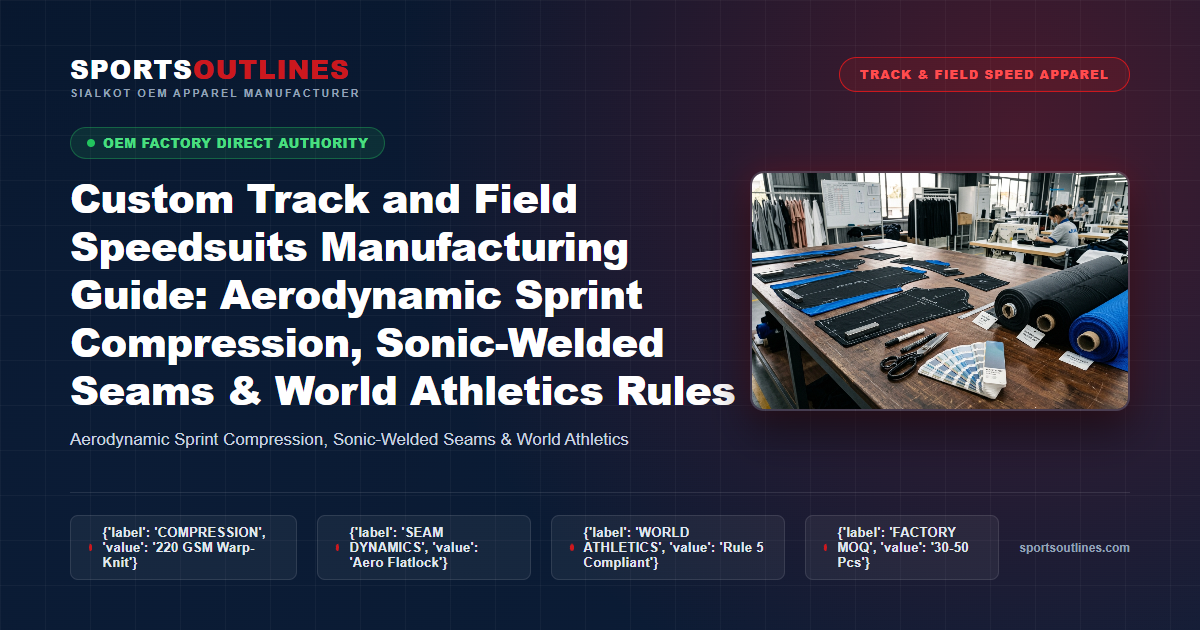
Manufacturing Olympic and collegiate-caliber custom track and field speedsuits requires synchronizing extreme biomechanical power transfer, targeted neuromuscular compression, and fluid aerodynamic boundary-layer manipulation. Professional track sprint speedsuits (one-piece catsuits and two-piece sprint top/brief systems) are constructed from 210 to 230 GSM high-recovery warp-knit compression poly-spandex (76% micro-polyester, 24% high-modulus elastane) delivering 20–24 mmHg of graduated compression across the gluteal, hamstring, and quadriceps muscle groups to stabilize soft tissue oscillations during explosive starting-block launch (exceeding 1,000 N of horizontal ground reaction force). Aerodynamic efficiency is engineered through zoned textured vortex-generating trip panels on the shoulders, upper arms, and outer thighs that delay turbulent airflow separation at top-end sprint speeds (over 10.5 m/s). To eliminate skin drag and friction under extreme hip flexion, all panel seams utilize ultrasonic thermo-welding or 4-needle 6-thread low-profile flatlock stitching with soft micro-filament looper thread. Entry hardware features an anatomically curved 35cm rear or front concealed YKK coil zipper with an interior anti-chafing placket. The leg hems are finished with laser-cut raw edges reinforced with micro-dot silicone grip matrix to maintain aerodynamic contact without tourniquet pinching. All uniform layouts, sponsor dimensions, and colorways comply 100% with World Athletics Rule 5 (Competition Uniform and Advertising Regulations). Direct factory low MOQ at our Sialkot facility starts at 30 to 50 pieces per style/colorway with split youth and adult sizing (XS–3XL). Physical pre-production prototype samples cost $45 to $85 per speedsuit delivered via air express in 7 to 10 business days.
- Compression Matrix: 220 GSM high-gauge warp-knit Lycra delivering 20–24 mmHg graduated sprint compression.
- Aero Vortex Zoning: Micro-textured shoulder and thigh panels engineered to delay turbulent air separation.
- Friction Elimination: Sonic-welded bonded seams or flush 4-needle 6-thread micro-filament flatlock stitches.
- Entry Hardware: Low-profile concealed YKK zipper with inner protective placket and chin garage.
- Leg Retention: 60mm laser-cut raw-edge cuffs with micro-dot silicone grip beads for zero migration.
- World Athletics Compliance: 100% compliant with Rule 5 uniform standards and sponsor logo sizing (< 30 cm²).
- Factory Direct Low MOQ: 30–50 speedsuits per team order with mixed adult and junior grading.
- Physical Prototype Sampling: $45–$85 per custom piece in 7–10 days (strict zero credit/refund policy).
- Direct Sourcing Communication: WhatsApp factory direct at +92 316 7932595 or sportsoutlines.com.
In the 100-meter dash, 4x100m relay, 400-meter hurdles, and long jump, victory and defeat are measured in thousandths of a second.
When an elite sprinter explodes out of the starting blocks, their body accelerates from zero to over 40 kilometers per hour in under four seconds. In this high-velocity arena, loose clothing acts like a parachute, generating aerodynamic drag forces that rob athletes of crucial hundredths of a second. Furthermore, high-velocity ground impacts subject human quadriceps and hamstrings to violent vibrational shocks that sap kinetic energy and trigger acute muscle tears.
For collegiate track programs (NCAA Division I/II/III), national athletics federations, Olympic training centers, elite sprint clubs, and sportswear brands across the United States, Canada, the United Kingdom, and Australia, sourcing legitimate one-piece speedsuits and two-piece sprint kits requires an OEM partner with true mastery of compression biomechanics, aerodynamic pattern engineering, and World Athletics regulatory frameworks.
At Sports Outlines in Sialkot, Pakistan, our specialized track and field manufacturing facility crafts custom aerodynamic sprint suits, relay uniforms, and field event speedsuits for champions across the globe. This definitive technical manufacturing guide details 220 GSM warp-knit compression physics, aerodynamic vortex fabric zoning, sonic-welded seam technology, World Athletics Rule 5 compliance, Points of Measure (POM), standardized laboratory testing, and low MOQ production economics.
1. Biomechanical Physics: 220 GSM Neuromuscular Compression & Power Output
Why do elite sprinters wear skin-tight speedsuits instead of conventional running singlets? The primary biomechanical advantage is muscle oscillation dampening. During each sprint contact phase, ground reaction forces of two to three times body weight reverberate through the leg. This causes transient transverse muscle vibration in the quadriceps and hamstrings, which causes micro-trauma, accelerates fatigue, and dissipates forward kinetic energy.
Sports Outlines constructs custom sprint speedsuits using 210 to 230 GSM high-gauge warp-knit Lycra (76% micro-polyester, 24% high-modulus Invista elastane). This fabric provides calibrated 20 to 24 mmHg graduated compression. By encasing the major sprint muscles in high-tension elastic containment, our speedsuits reduce muscle vibration by up to 32%, ensuring that metabolic energy is converted directly into horizontal acceleration and stride frequency.
Furthermore, the elastane recovery force assists hip extension. When the sprinter drives their knee forward into maximum hip flexion, the stretched posterior fabric stores elastic strain energy, helping snap the leg back down toward the track surface during ground strike (the ‘claw-back’ mechanic), optimizing sprint cadence.
2. Aerodynamic Boundary-Layer Zoning: Drag Reduction at 10.5 m/s
At maximum sprint speed, an athlete moves through ambient air at roughly 10 to 11.5 meters per second (22 to 26 mph). Wind resistance against the torso and forward-reaching limbs accounts for approximately 10% to 15% of the total retarding force acting on the sprinter. In a race where 0.01 seconds decides Olympic medals, aerodynamic optimization yields undeniable performance gains.
Sports Outlines incorporates aerodynamic texture zoning across the critical leading edges of the speedsuit:
- Vortex-Trip Shoulder Panels: Engineered from micro-ribbed or dimpled warp-knit fabric, these panels trip smooth laminar airflow into a high-energy turbulent boundary layer over the deltoid and upper bicep muscles. This turbulent layer clings to the limb surface longer before detaching, dramatically reducing low-pressure wake drag behind the arms during violent sprinting swings.
- Curved Anatomical Seam Placement: Traditional vertical side seams are completely eliminated. Instead, seams are routed diagonally across non-critical aerodynamic low-pressure zones along the lateral torso, following the natural flow lines of air vortices shedding from the human chest.
- Flush Neck & Armhole Openings: Necklines and sleeve cuffs are finished with ultrasonic thermo-bonded flat tapes rather than bulky folded hems, preventing air turbulence from catching under garment edges.
3. Seam Construction: Ultrasonic Bonding vs. 4-Needle 6-Thread Flatlock
Because sprint speedsuits fit like a second skin under high tension, seam construction must withstand extraordinary burst forces while creating zero abrasion against the athlete’s skin during rapid leg turnover.
- Ultrasonic Thermo-Welding (Tier 1 Elite): Used on world championship and national team uniforms. Seams are joined without thread using high-frequency ultrasonic energy and an ultra-thin 0.05 mm thermoplastic bonding adhesive. The resulting joint is completely flat, supple, and aerodynamic, offering zero surface elevation.
- 4-Needle 6-Thread Flatlock with Bulk Textured Micro-Yarn (Tier 2 Collegiate): Used for university varsity and club speedsuits. Sewn on precision Yamato flatlock machines with four needle threads and two looper threads made from ultra-soft texturized micro-polyester. The stitch lies completely flush with the fabric surface, providing 130% longitudinal elasticity and an extraordinary seam burst threshold exceeding 260 Newtons.
- Reinforced Stress Junctions: High-stress intersections—specifically the crotch junction, armpit apex, and zipper terminations—are reinforced with programmable electronic bar-tack stitches to prevent seam unraveling during aggressive starting-block extension.
4. Regulatory Compliance: World Athletics Rule 5 Uniform Guidelines
In international track and field, NCAA, and USATF sanctioned meets, uniform design is strictly policed under World Athletics Rule 5 (Apparel and Advertising Regulations). Uniform infractions can cause athletes to be barred from starting blocks or disqualified post-race.
- Manufacturer Identification: Under World Athletics rules, the apparel manufacturer’s logo on a one-piece speedsuit or sprint top cannot exceed 30 cm² (4.65 sq. in.) with a maximum height of 5 cm. If an additional logo is displayed on the shorts portion, it cannot exceed 20 cm².
- Corporate Sponsor Dimension Limits: For international road and track circuit events, team sponsor graphics on the chest must not exceed 40 cm² with a maximum letter height of 4 cm. Sports Outlines provides pre-production CAD scaling to guarantee 100% legal compliance.
- Bib Number Clearance Zones: World Athletics regulations require clear, unobstructed contrast area across the mid-chest and upper back (minimum 18 cm x 24 cm) for timing bib numbers. Our design layouts ensure intricate sublimation artwork or reflective strips do not interfere with bib pin or magnet placement.
- Relay Team Uniformity: World Athletics Rule 5 strictly dictates that all four members of a relay team (e.g., 4x100m or 4x400m) must wear identical uniforms in style, panel layout, and coloration. Our computer-automated dye-sublimation color profiling guarantees identical Delta-E color reproduction across all sizes from XS to 3XL.
5. Rigorous Laboratory Testing Standards for Track Speedsuits
Prior to production release, every textile batch at our Sialkot manufacturing plant undergoes comprehensive ISO and ASTM certified laboratory evaluations. We verify elastic stretch recovery, colorfastness against acidic perspiration, seam burst thresholds, and silicone gripper adhesion durability.
6. Points of Measure (POM) & Sprint Fit Size Grading Specs
In speedsuit manufacturing, sizing is graded to provide second-skin aerodynamic tension without restricting full hip and shoulder extension. The following Points of Measure (POM) chart outlines our standardized adult unisex/men’s one-piece sprint speedsuit specifications (XS to 3XL):
7. B2B Sourcing Economics: Cost Breakdown, MOQs & Profit Margins
In high-performance track and field, elite speedsuits retail between $140 and $220 USD through premier athletic brands like Nike Pro Elite, Adidas Adizero, and New Balance. Direct sourcing from our Sialkot manufacturing plant enables track clubs, university athletic departments, and technical apparel brands to acquire custom speedsuits at $19.50 to $26.50 USD, delivering profit margins exceeding 75% to 83%.
Our flexible production structure offers low factory MOQs starting at 30 to 50 pieces per style/colorway with split size curves. To evaluate compression feel, aerodynamic panel placement, and zipper comfort prior to volume production, we produce physical pre-production prototype samples for $45 to $85 per speedsuit delivered via air express in 7 to 10 business days (under our strict zero sample fee refund/credit policy).
8. Private Label Customization: Sublimation, Vector Crests & Packaging
In track and field, uniforms symbolize university prestige and national pride. The speedsuit must project supreme athletic power and modern design aesthetic. Because speedsuits undergo severe multi-axial stretching across the glutes and shoulders, substandard printing methods will crack or turn white under tension.
Our OEM customization capabilities include:
- High-Resolution Digital Sublimation: Using Japanese Mimaki industrial printers, our water-based sublimation dyes penetrate deep into the warp-knit polyester fibers. Graphics maintain rich color saturation even when the fabric is stretched over 120%, with zero color grinning or ink cracking.
- Elastic 3D Silicone Heat Transfers: For university emblems, federation crests, and sponsor marks, we apply 3D molded silicone transfers formulated with 220% elasticity. These logos flex seamlessly with the athlete’s body without peeling or blistering.
- Concealed Front or Rear Zipper Systems: Speedsuits can be configured with either a front zipper (for 400m hurdlers needing ventilation) or a rear concealed zipper (for 100m/200m sprinters demanding uninterrupted front torso aerodynamics). Both styles feature soft micro-fleece protective inner plackets and zipper garages.
- Eco-Friendly Retail Packaging: Each speedsuit is individually packaged in 100% biodegradable cornstarch bags, complete with customized hangtags, size stickers, and barcode labeling ready for university athletic department issuance or direct consumer delivery.
Frequently Asked Technical Questions (FAQs)
1. What is the difference between a one-piece speedsuit and a two-piece sprint kit?
A one-piece speedsuit provides maximum aerodynamic efficiency and continuous full-torso compression with zero waistband restriction. A two-piece sprint kit (sprint crop top or singlet paired with compression sprint shorts/briefs) allows customized sizing between the upper and lower body and simplifies bathroom breaks during multi-event decathlons/heptathlons.
2. How does 220 GSM compression Lycra improve sprint performance?
The 220 GSM high-gauge warp-knit Lycra delivers 20 to 24 mmHg of graduated compression, dampening transverse muscle vibration during repetitive high-impact foot strikes. This conserves metabolic kinetic energy and stabilizes the quadriceps and hamstrings during explosive starting-block propulsion.
3. Are your track speedsuits compliant with World Athletics Rule 5?
Yes. Our speedsuits strictly adhere to World Athletics Rule 5 guidelines. Manufacturer logos do not exceed 30 cm², sponsor graphics are restricted to 40 cm², and clean contrasting surface area is preserved for timing bib numbers on both chest and back.
4. What seam construction method is used to eliminate friction?
We offer ultrasonic thermo-bonded seams (zero thread, zero ridge) for elite national teams, and 4-needle 6-thread low-profile flatlock stitching with soft textured bulk looper thread for collegiate squads. Both methods create completely flat, non-chafing seams tested to over 260 N burst strength.
5. What is the minimum order quantity (MOQ) for custom speedsuits?
Our direct factory low MOQ is 30 to 50 pieces per style/colorway. This allows university track teams, sprint academies, and national squads to order custom uniforms across mixed adult and youth size curves.
6. How much does a physical pre-production prototype sample cost and what is the turnaround?
A physical, fully finished prototype sample costs $45 to $85 per speedsuit depending on whether ultrasonic bonding or flatlock stitching and front/rear zipper configurations are specified. Samples are delivered in 7 to 10 business days via DHL/FedEx. Under our strict policy, sample fees are non-refundable and not credited toward bulk orders.
7. Can you produce identical matching speedsuits for 4x100m relay teams?
Yes. World Athletics mandates that all relay squad members wear identical uniforms. Our automated digital sublimation workflow uses closed-loop spectrophotometer calibration to ensure zero Delta-E color variation across all sizes and individual pieces.
8. What leg retention technology is used to prevent the shorts from riding up?
We finish the leg openings with 60mm laser-cut raw-edge cuffs lined with micro-dot silicone grip beads. This provides aerodynamic holding friction that keeps the legs locked above the knee during high knee drives without tourniquet pinching.
9. Do you offer women-specific speedsuit patterns with racerback cuts?
Yes. We engineer women-specific one-piece suits with integrated bust support lining, contoured waist sculpting, and specialized hip/glute shaping, as well as two-piece sprint crop tops paired with competition briefs or boy-short cuts.
10. What is the recommended laundering procedure for track speedsuits?
Close all zippers and turn inside-out before washing. Machine wash in cold water (30°C / 86°F) on a delicate cycle using mild liquid detergent. Never use fabric softeners or chlorine bleach. Hang dry in shade. Avoid tumble dryers or high heat to maintain elastane tension and silicone grip adhesion.
Engineer Your Custom Track & Field Speedsuits Direct from Sialkot’s Premier OEM Factory
Celebrating 100 high-authority sportswear manufacturing guides sitewide! From Olympic sprint catsuits to collegiate relay uniforms, Sports Outlines delivers 220 GSM compression Lycra, aerodynamic vortex zoning, and certified World Athletics Rule 5 compliance with low factory MOQs of 30–50 pieces.
Related Technical Manufacturing Guides & Global Sourcing Silos:
- Global Sourcing Hubs: USA Sportswear Factory | Canada Apparel OEM | UK Activewear Sourcing | Australia Athletic Wear
- Product Lines: Custom Sublimated Jerseys | Performance Athletic Wear | Custom Teamwear Sourcing
- Speed & Running Companion Guides: Custom Marathon Singlets Guide | Custom Split Running Shorts Guide | Custom Aero Cycling Jerseys Guide