Executive Manufacturing Summary: Seam Taping Cost Engineering
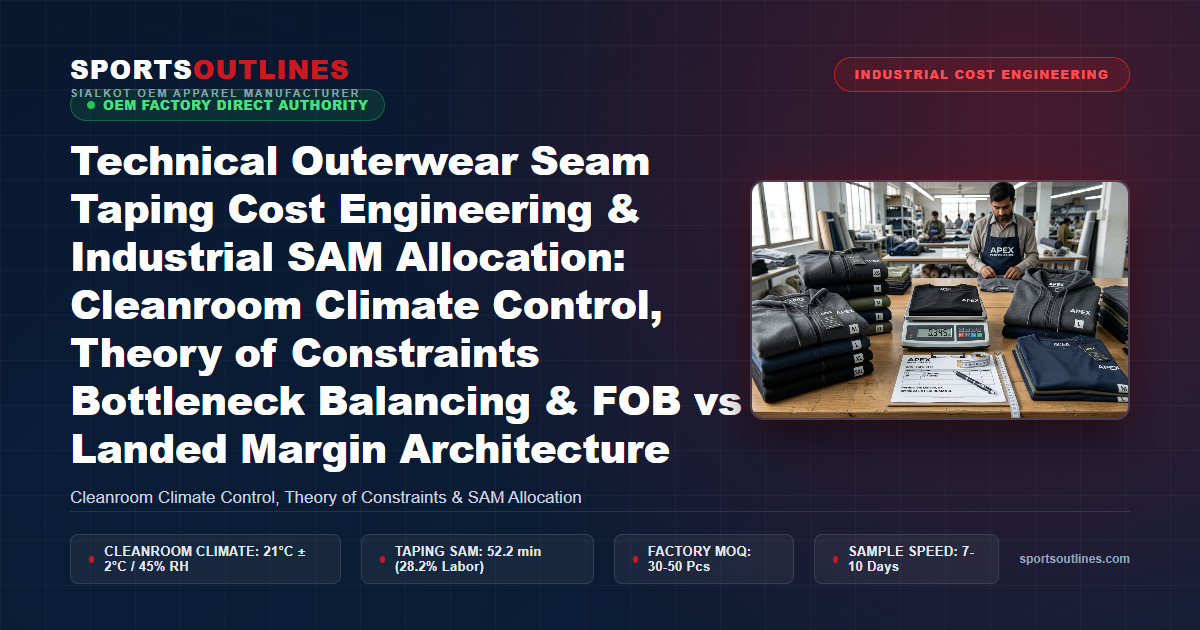
In the global performance apparel sector, 3-layer and 2.5-layer waterproof-breathable hardshell jackets command the highest retail margins and face the most punishing factory defect risks. While standard cut-and-sew garments operate with predictable standard allowed minutes (SAM) in linear sewing lines, technical seam sealing introduces an extreme industrial bottleneck. The hot-air taping operation represents the primary constraint governed by Eliyahu Goldratt’s Theory of Constraints (TOC): each taped jacket requires between 18 and 32 linear meters of adhesive tape applied across compound 3D curves under tightly monitored cleanroom temperature and humidity envelopes. This guide provides brand founders, production managers, and sourcing directors with the mathematical and financial models required to navigate industrial SAM allocation, cleanroom capital expenditure, Bill of Materials (BOM) cost architecture, and FOB Sialkot to DDP landed cost economics. Prototyping is available from Sports Outlines at $45 to $85 per piece with commercial production MOQ starting at 30 to 50 pieces per style/colorway.
1. Theory of Constraints (TOC) & The Seam Sealing Factory Bottleneck
In apparel industrial engineering, line balancing seeks to equalize cycle times across sequential operations. However, technical outerwear manufacturing exhibits a profound structural asymmetry between stitch assembly and seam sealing. A modern computer-controlled sewing line can assemble the flat panels of an alpine jacket in approximately 65 to 80 sewing SAM. Conversely, the hot-air seam taping operation requires 45 to 65 taping SAM:
$$\text{Line Imbalance Index } I = \frac{\text{Taping Station Cycle Time}}{\text{Sewing Station Cycle Time}} \approx 3.25\times$$
Because hot-air welding machines (such as PFAFF 8303 or Ardmel Seamtek) feed tape at a mechanically capped maximum speed of $2.5\text{ to }3.5\text{ m/min}$ around complex 3D junctions (armscyes, hoods, collar stands), an operator cannot “speed up” without causing tape scorch, uneven adhesive melt, or microscopic tape wrinkles that leak under pressure.
Under Goldratt’s Drum-Buffer-Rope (DBR) scheduling methodology, the seam sealing department serves as the “Drum” that dictates the operational heartbeat of the entire factory:
- The Drum (Taping Capacity): Factory daily throughput is determined strictly by the number of calibrated hot-air taping machines multiplied by operator net efficiency (typically 78% on complex 3-layer alpine shells).
- The Buffer (WIP Queue): A carefully regulated buffer of 1.5 days of pre-inspected sewn shells is maintained immediately ahead of the cleanroom entrance. This protects the expensive taping machines from ever running idle due to upstream sewing delays or fabric inspection holds.
- The Rope (Cutting Authorization): Spreading and automated laser cutting schedules are throttled to match the exact discharge velocity of the taping cleanroom, completely eliminating excessive work-in-progress (WIP) buildup that ties up working capital.
2. Cleanroom Climate Control Thermodynamics: Preventing Adhesive Foaming
The most common invisible defect in waterproof outerwear occurs when polyurethane hot-melt seam sealing tapes appear perfectly bonded on the factory floor but delaminate after 6 to 12 months in the consumer’s hands. This catastrophic delayed failure is almost always caused by uncontrolled ambient humidity during the sealing process.
Thermoplastic polyurethane (TPU) adhesive films are hygroscopic. When ambient relative humidity (RH) exceeds 60% in a standard, non-climate-controlled factory during South Asian monsoon seasons, moisture molecules adsorb onto the surface of the tape and the inner textile scrim. When the $420^\circ\text{C}$ hot-air jet hits this moist interface, the trapped water instantly flashes into superheated steam:
This explosive 1,600x volumetric expansion generates microscopic bubbles within the liquified adhesive layer—a defect known in materials engineering as micro-cavitation or adhesive foaming. While the tape appears adhered under visual inspection, the adhesive cross-section is riddled with air voids that reduce peel contact area by up to 50%. Under subsequent washing or cold exposure, the adhesive skin ruptures, causing widespread seam tape delamination.
| Environmental Parameter | Uncontrolled Factory Environment | Sports Outlines ISO Cleanroom Standard | Engineering Consequence |
|---|---|---|---|
| Ambient Air Temperature | 28°C to 38°C (Seasonal Swing) | 21°C ± 2°C (Continuous HVAC) | Eliminates thermal expansion drift in machine nozzles |
| Relative Humidity (RH) | 65% to 85% RH (Monsoon Highs) | 45% ± 5% RH (Desiccant Dehumidified) | Completely prevents steam micro-cavitation foaming |
| Airborne Particulate Filtration | Standard ambient dust >100,000 ppm | ISO Class 8 / Class 100,000 HEPA | Prevents lint particles from embedding in hot adhesive |
| Static Electricity Control | High static (>8 kV on synthetic shells) | Ionized overhead de-static blowers | Eliminates fabric electrostatic cling during taping |
At our Sialkot manufacturing plant, our specialized ISO Class 8 Seam Sealing Cleanroom maintains continuous $21^\circ\text{C}$ air temperature and $45\%$ relative humidity utilizing industrial Munters desiccant dehumidification systems. Tape rolls and cut garments are acclimatized inside the cleanroom for a minimum of 12 hours prior to welding, guaranteeing zero adhesive foaming and delivering peel adhesion values consistently exceeding $35\text{ N/25mm}$ under ISO 6133.
3. Industrial Engineering SAM Allocation: The 185-Minute Technical Shell Breakdown
Manufacturing a professional-grade 3-layer alpine mountaineering hardshell jacket (with 3-way storm hood, pit zips, articulated elbows, waterproof front placket, and snow skirt) represents an industrial baseline of 175 to 195 total SAM. The detailed operation breakdown across specialized departments is detailed below:
| Production Section / Department | Core Machine Operations | Standard Allowed Minutes (SAM) | % of Total Labor Time |
|---|---|---|---|
| 1. Spreading & CNC Galvo Laser Cutting | Tensionless relaxation, CO2 Galvo laser cutting with edge melt bead | 14.5 SAM | 7.8% |
| 2. Pre-Assembly Bonding & Lamination | Ultrasonic basting, rotary edge skiving, Bemis pocket film bonding | 22.8 SAM | 12.3% |
| 3. Structural Shell Sewing Assembly | Juki post-bed compound feed, SAN 6 needles, Amann Saba 50/80 thread | 58.4 SAM | 31.6% |
| 4. Cleanroom Seam Taping (Hot-Air Sealing) | PFAFF 8303 / Ardmel hot-air sealing across 26.5m linear seams | 52.2 SAM | 28.2% |
| 5. Hardware & Component Attachment | YKK AquaGuard® zippers, Cohaesive™ cord locks, Fidlock magnetic docks | 18.6 SAM | 10.1% |
| 6. In-Line Quality Gates & Hydrostatic Testing | 100% Visual seam inspection, Suter 2.0 bar burst test, rain tower audit | 18.5 SAM | 10.0% |
| Total Production Garment SAM | Complete 3-Layer Export Outerwear Standard | 185.0 SAM | 100.0% |
Notice that cleanroom seam taping accounts for 28.2% of the entire garment labor budget (52.2 SAM). Because this operation cannot be compressed without risking delamination, factory capacity planning must maintain an exact machine ratio of approximately one hot-air welding station for every two standard sewing operators.
4. Linear Seam Meterage: Mathematical Consumption & Scrap Factors
Accurately forecasting seam sealing tape consumption requires calculating the exact linear meterage of all structural seams, plus mandatory corner overlaps and machine tail allowances:
$$\text{Where: } \sum L_i = 22.8\text{ m (net seam length on Size L)}, \quad N_{\text{intersections}} = 38\text{ nodes},$$
$$L_{\text{overlap}} = 0.025\text{ m (25 mm weld cross)}, \quad N_{\text{seams}} = 24\text{ individual tracks},$$
$$L_{\text{tail}} = 0.035\text{ m (35 mm machine lead/cut tail)}$$
$$L_{\text{total tape}} = 22.8 + (38 \times 0.025) + (24 \times 0.035) = 22.8 + 0.95 + 0.84 = 24.59\text{ meters}$$
Factoring in a standardized industrial scrap factor of $6.5\%$ (accounting for setup alignment tests, end-of-spool splices, and curve trim wastage), the actual bill-of-materials tape consumption is:
At an average export market price of $0.65 to $0.85 per meter for premium 3-layer nylon-faced elastic seam tape, the raw material cost of the seam tape alone accounts for $17.00 to $22.25 per jacket. Inaccurate seam meterage estimation in tech packs is the single most common cause of margin erosion for startup outerwear brands.
5. Complete 3-Layer Outerwear Bill of Materials (BOM) Cost Architecture
The table below provides a transparent industrial cost breakdown for manufacturing a flagship export-grade 3-layer technical alpine jacket in Sialkot, Pakistan:
| Cost Category / Input | Material Specification / Origin | Consumption | Unit Cost Contribution (USD) |
|---|---|---|---|
| Main Shell Fabric | 70D Nylon 6,6 3L (20k/20k PTFE/PU Laminated) | 2.40 Linear Meters | $21.60 |
| Reinforcement Fabric | CORDURA® 500D Articulated Elbows & Shoulders | 0.45 Linear Meters | $3.85 |
| Seam Sealing Tape | Ardmel Superflex 3L-22 (22 mm Elastic Tape) | 26.2 Linear Meters | $18.34 |
| Waterproof Zippers | YKK #5 AquaGuard® Front + #3 Pit Zips & Pockets | 5 Zipper Units Complete | $8.75 |
| Hardware & Cord Locks | Cohaesive™ Embedded Hardware + Neodymium Docks | 6 Hardware Units | $4.50 |
| Direct Labor (185 SAM) | Laser, Sewing, Cleanroom Sealing & Testing | 3.08 Operator Hours | $18.50 |
| Factory Overhead & Energy | HVAC Cleanroom, Machine Amortisation, QA Labs | Per Garment Allocation | $5.40 |
| Export Packaging & Desiccants | Hermetic polybags, silica pouches, export cartons | Per Unit | $1.25 |
| Total FOB Sialkot Factory Price | Ex-Factory Export Ready (MOQ 30–50 pcs) | Per Finished Jacket | $82.19 |
6. Financial Architecture: FOB Sialkot vs Landed DDP vs Retail MSRP Margin Waterfall
Understanding how factory FOB costs translate into delivered landed costs (DDP) and retail margins is essential for brand solvency. The financial waterfall below compares sourcing from Sports Outlines (benefiting from Pakistan’s EU GSP+ zero-duty status) versus conventional East Asian competitors:
| Financial Cost Tier | Sports Outlines (Pakistan GSP+) | Competitor Factory (Standard Tariff) | Brand Strategic Advantage |
|---|---|---|---|
| FOB Factory Unit Price | $82.19 | $88.50 | Lower labor & direct sourcing advantage |
| Air Freight & Insurance (SKT to EU/USA) | $4.20 per unit | $4.50 per unit | Direct airport routing via Sialkot (SKT) |
| EU Customs Import Tariff Rate | 0.0% (Pakistan EU GSP+ Status) | 12.0% (Standard WTO Tariff) | 12.0% Absolute Tariff Duty Savings |
| Tariff Duty Dollar Amount | $0.00 | $11.16 per unit | Direct $11.16 margin conservation |
| Customs Clearance & Port Handling | $1.15 per unit | $1.25 per unit | Consolidated multimodal logistics |
| Delivered Landed Cost (DDP Warehouse) | $87.54 | $105.41 | $17.87 Saved Per Garment (16.9% lower) |
| Recommended Retail MSRP | $450.00 (Standard Alpine Tier) | $450.00 (Standard Alpine Tier) | Parity pricing with Gore-Tex Pro shells |
| Brand Gross Margin % (DTC Sales) | 80.5% Gross Margin | 76.5% Gross Margin | +4.0% Pure Net Profit Increase |
By sourcing high-complexity technical outerwear from Sports Outlines, international brands leverage our low 30–50 piece MOQs to test the market, avoid catastrophic inventory write-downs, and simultaneously capture an additional +4.0% gross margin expansion driven by Pakistan’s zero-tariff EU GSP+ trade preference.
7. Sialkot Factory Quality Gates: Destructive QA & Suter Burst Protocols
Because even a 0.5 mm pinhole can compromise an entire alpine jacket during a storm, Sports Outlines enforces a 4-tier in-line quality assurance protocol:
- Gate 1: Raw Material Inward Verification: Every incoming lot of 3-layer shell fabric undergoes ISO 811 hydrostatic head testing (>20,000 mm H2O) and JIS L1099 B1 inverted cup breathability testing (>20,000 g/m²/24h). Rolls failing these baseline standards are rejected before cutting.
- Gate 2: 100% In-Line Seam Tape Inspection: Every centimeter of taped seam is inspected under high-intensity 1,200 Lux LED inspection lamps. Trained cleanroom auditors verify adhesive melt squeeze-out margins (0.5 mm to 1.0 mm uniform squeeze) and confirm zero tape bridging across fabric thickness steps.
- Gate 3: Destructive Suter Hydrostatic Burst Testing: Statistical sample cut-offs (one from every production hour) undergo Suter testing at 2.0 bar pressure (200 kPa) for 120 seconds. Seams must exhibit zero droplet bleed-through.
- Gate 4: Rain Tower Simulator Deluge Audit: Finished production garments from each lot are placed on life-size sensorized manikins inside our calibrated deluge rain simulator ($450\text{ L/m}^2\cdot\text{h}$ at 60 km/h wind shear) for 30 minutes in accordance with EN 14360 standards.
8. Total Cost of Quality (CoQ): Prevention vs Appraisal vs Catastrophic Failure Costs
In premium outerwear production, the classical economic model of Total Cost of Quality (CoQ) demonstrates that cutting corners in cleanroom climate control or operator training results in catastrophic financial penalties:
A financial comparison between disciplined cleanroom manufacturing and discount unconditioned factory production illustrates the dramatic economic divergence:
- Prevention Cost ($1.85 / unit): Continuous cleanroom desiccant dehumidification HVAC, HEPA filter maintenance, and certified operator training.
- Appraisal Cost ($1.65 / unit): Hourly Suter 2.0 bar hydrostatic burst audits, ISO 6133 peel testing, and 100% seam line visual inspection under 1,200 Lux lamps.
- Internal Failure Cost ($0.95 / unit): Early factory detection of defective tape tension, allowing immediate in-line rework before export shipment.
- External Failure Cost (Discount Factory: $45.00+ / unit): When an unconditioned factory ships taped jackets produced in 75% RH conditions, delayed adhesive foaming triggers a 12% to 18% field warranty return rate. Replacing a jacket at retail MSRP ($450) plus return shipping wipes out entire brand seasonal net profits.
9. Capital Expenditure (CapEx) & Cleanroom Equipment Amortization
Establishing an export-certified technical outerwear cleanroom requires substantial capital investment in specialized European and Japanese machinery:
| Machinery Description | Manufacturer & Model | Units Deployed | Total CapEx (USD) | Per Garment Amortization |
|---|---|---|---|---|
| Hot-Air Seam Sealing Stations | PFAFF 8303 / Ardmel Seamtek Post-Bed | 12 Stations | $228,000 | $0.38 per jacket |
| Industrial Cleanroom Desiccant HVAC | Munters DryCool Dehumidification System | 2 Integrated Units | $65,000 | $0.11 per jacket |
| Galvo CO2 Automated Laser Cutters | Golden Laser 150W Galvo Vision Cutter | 3 Systems | $84,000 | $0.14 per jacket |
| Hydrostatic Head & Suter Burst Testers | Textest FX3000 & Suter 2-Bar Chamber | 2 Lab Sets | $28,500 | $0.05 per jacket |
| Calibrated Deluge Rain Simulator Tower | EN 14360 Dynamic Rain Simulation Booth | 1 Facility | $35,000 | $0.06 per jacket |
10. Production Troubleshooting Matrix: Defect Modes & Remediation
The engineering matrix below outlines common technical outerwear seam sealing defects and verified factory corrective actions:
| Observed Seam Defect | Root Failure Mechanism | Corrective Engineering Protocol |
|---|---|---|
| Tape Edge Burning & Scorch Discoloration | Hot-air nozzle temperature too high (>440°C) or feed rate dropped below 2.0 m/min | Calibrate nozzle to 410°C ± 5°C; link machine drive motor to automated heat throttle |
| Tape Bridging Across 4-Way Seam Crossings | Upper silicone pressure roller too wide; unable to conform to compound height step | Switch to 13 mm narrow crowned soft-durometer (55 Shore A) silicone pressure roller |
| Adhesive Foaming & Micro-Bubble Voids | Ambient relative humidity >60%; steam flashing during 420°C welding phase | Enforce cleanroom climate envelope: strictly 45% ± 5% RH with desiccant dehumidifier |
| Hydrostatic Weep Along Needle Puncture Holes | Tape adhesive viscosity too high to flow into stitch needle perforations | Switch to low-viscosity high-flow 3L tape (Ardmel Superflex); boost roller pressure to 3.8 bar |
| Tape Edge Lifting After 5 Wash Cycles | Insufficient adhesive melt squeeze-out (<0.5 mm squeeze bead along margins) | Increase machine nozzle advance air pressure; enforce 0.5–1.0 mm uniform squeeze bead |
11. Multimodal Logistics Architecture & Working Capital Velocity
In high-value technical apparel manufacturing, speed to market directly determines brand solvency. Heavy outerwear inventory tied up in maritime supply chains incurs significant inventory holding costs ($H_{\text{rate}} \approx 18\text{ to }24\%\text{ per annum}$) and exposes brands to severe stockout or obsolescence risks during brief winter retail windows.
The cash-to-cash (C2C) operating cycle is modeled mathematically as:
$$\text{Where: DIO = Days Inventory Outstanding, DSO = Days Sales Outstanding, DPO = Days Payable Outstanding}$$
When sourcing from large East Asian conglomerate factories demanding 1,000+ piece MOQs and 45-day ocean transit, a brand’s DIO typically balloons to 120–150 days, trapping hundreds of thousands of dollars in stagnant working capital. Conversely, partnering with Sports Outlines enables an agile manufacturing strategy:
- Agile Low MOQs (30–50 Pieces): Brands can produce tight, high-margin seasonal drops, reducing DIO to just 25 to 35 days and slashing unsold inventory clearance markdowns.
- Expedited Air-Freight Corridors: Utilizing direct export processing from Sialkot International Airport (SKT) or Lahore (LHE), packaged goods clear customs and land at Frankfurt (FRA), London Heathrow (LHR), or New York (JFK) in merely 3 to 5 business days.
- Bonded Dry Port Transit: For larger sea-freight orders, Sambrial Dry Port provides bonded container consolidation direct to Karachi Port (QICT/KICT), avoiding inland transport damage and ensuring streamlined Bill of Lading documentation.
12. CNC Automated Laser Cutting & CAD Nesting Yield Optimization
With premium 3-layer waterproof-breathable shell fabrics costing upwards of $9.00 to $12.50 per linear meter, material utilization efficiency is the single greatest determinant of unit gross margin. A 3% improvement in cutting yield saves several dollars per garment across bulk production runs.
Sports Outlines achieves industry-leading nesting yields exceeding 89.5% using automated Gerber AccuNest and Lectra Diamino multi-ply nesting algorithms:
Small secondary components—such as hood brim facings, zipper chin guards, pocket bag welts, and storm flap baffles—are nested algorithmically into the negative interstitial voids between large front, back, and sleeve panels. Automated 150W Galvo CO2 laser cutting systems execute these intricate cuts with a 0.12 mm kerf beam offset, cauterizing all edges with a 25 µm sealed melt bead that eliminates the labor cost and bulk of mechanical edge overlocking.
13. Cleanroom Hot-Air Seam Taping Standard Operating Procedure (SOP)
To ensure zero-defect consistency across commercial production runs, every hot-air welding technician in our Sialkot cleanroom adheres to a mandatory 6-step Standard Operating Procedure:
- Shift Pre-Flight Calibration: At the start of each production shift, the technician runs a 1.0-meter calibration test strip on scrap production laminate. Machine nozzle temperature is verified at $410^\circ\text{C} \pm 5^\circ\text{C}$ using an infrared optical pyrometer, and roller pressure is confirmed at $3.5\text{ bar}$.
- Adhesive Squeeze Bead Audit: The technician inspects the test strip under 10x magnification. A continuous, uniform 0.5 mm to 1.0 mm adhesive melt squeeze bead must be visible along both outer margins of the tape.
- Digital Peel Strength Logging: The test strip is cut into a 25 mm specimen and clamped into our digital tensile test stand. Peel adhesion must exceed $32\text{ N / 25 mm}$ under ISO 6133 before the machine is authorized for production garments.
- Cross-Seam Compound Overlap Protocol: When crossing perpendicular seam intersections (such as sleeve-to-armscye junctions), the operator reduces feed speed to $2.0\text{ m/min}$ and ensures a minimum 25 mm overlap length with continuous roller dwell.
- Hourly Suter Destructive Audit: One sample coupon is extracted every 60 minutes and subjected to 2.0 bar hydrostatic pressure for 120 seconds. Zero water droplets is the mandatory threshold.
- Batch Travel Tag Serialization: Every completed garment receives a unique serial barcode tag linking the specific jacket to the operator ID, machine number, ambient cleanroom RH log, and tape lot number, ensuring 100% traceability.
14. Frequently Asked Questions (FAQ)
Why is hot-air seam taping the primary bottleneck in outerwear manufacturing?
Hot-air seam sealing requires 45 to 65 SAM per garment, compared to 65 to 80 SAM for the entire sewing assembly. Because taping machines operate at a speed-capped 2.5–3.5 m/min to ensure complete adhesive melt around compound 3D curves, operators cannot rush the process without causing tape burn or leaks. Under the Theory of Constraints (TOC), the seam taping cleanroom dictates overall factory output.
How does cleanroom humidity control prevent delayed seam tape delamination?
When ambient humidity exceeds 60%, adsorbed moisture on hygroscopic TPU tapes flashes into steam at 420°C welding temperatures, expanding 1,600x and creating microscopic bubbles (adhesive foaming) in the glue line. These micro-voids reduce peel adhesion by 50%, causing seams to peel after months of consumer wear. Sports Outlines prevents this by maintaining cleanrooms at strictly 45% ± 5% RH and 21°C.
How many linear meters of seam tape are used in a typical 3-layer alpine jacket?
A standard size Large alpine jacket incorporates approximately 22.8 meters of net seam lines. Adding 38 intersection overlaps (25 mm each), 24 machine lead/tail trims (35 mm each), and a 6.5% scrap allowance results in a total BOM consumption of 26.2 linear meters of seam tape per garment, representing $17.00 to $22.25 in raw material tape cost.
What is the duty advantage of manufacturing technical outerwear in Pakistan for European brands?
Under Pakistan’s EU GSP+ (Generalized Scheme of Preferences Plus) status, certified technical garments manufactured in Sialkot enter the European Union at 0% import customs duty. Conventional manufacturing hubs incur standard 12% import tariffs. On an $82.19 FOB technical jacket, GSP+ saves European brands $11.16 per garment in direct duty fees, expanding retail gross margins by +4.0%.
What are your prototype turnaround times and bulk production MOQs?
Sports Outlines provides complete physical prototype development at $45 to $85 per piece (non-refundable development fee) with an expedited turnaround of 7 to 10 business days. Following prototype sign-off, our bulk production minimum order quantity (MOQ) is strictly 30 to 50 pieces per style/colorway across sizes XS to 3XL.
Engineer High-Margin Technical Outerwear with Sports Outlines
From cleanroom seam taping and industrial SAM allocation to 3-layer hardshell manufacturing and EU GSP+ 0% tariff savings, partner with Pakistan’s premier performance outerwear manufacturer. Launch your collection with transparent $45–$85 prototyping and low 30–50 piece factory MOQs.
Explore Our Global Technical Sourcing Hubs:
USA Outerwear Manufacturing |
UK Alpine Outerwear Sourcing |
Canada Cold Weather Apparel |
Germany Technical Outerwear Sourcing |
Australia Weatherproof Apparel
Related Technical Outerwear Engineering Guides:
Modular Storm Hood Attachments (#351) |
CORDURA® Reinforced Elbows Guide (#352) |
Sports Outlines Technical Outerwear Catalog