
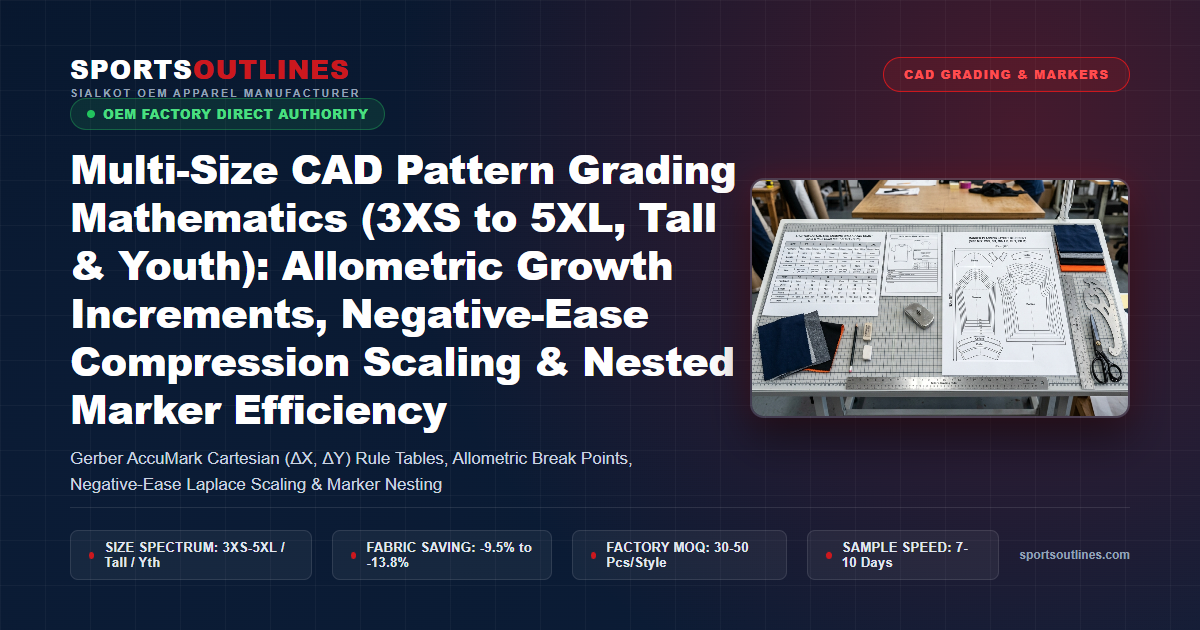
Super-Cluster 6 • Sub-Cluster 6.1 • Anthropometric Scaling, Gerber AccuMark® Vector Math & Marker Nesting
Executive Technical Summary: Non-Linear Allometric Grade Vectors, Laplace Compression Modulus Scaling & 86–92% Multi-Size Marker Utilization
In industrial garment engineering, CAD Pattern Grading is NOT the act of scaling a pattern piece up or down on a photocopier like a vector logo. Human anatomy grows allometrically (non-uniformly across X and Y axes): as an adult athlete moves from Size `Small` (`92 cm` chest) to Size `3XL` (`128 cm` chest), horizontal thoracic and abdominal girth expands by `+39.1%`, whereas vertical skeletal torso length increases by only `+11.4%` and neck circumference grows by `+16.2%`. If a factory applies naive uniform scaling—or uses constant linear increments without a Grade Break Point at Size `XL`—sizes `XS` and `2XL–5XL` become unwearable. This B2B engineering guide details Cartesian $(\Delta X, \Delta Y)$ cardinal node grading in Gerber AccuMark®, negative-ease compression modulus adjustments, Tall (`LT–3XLT`) and Youth (`Y-2XS–Y-XL`) blocks, and multi-size marker nesting optimization.
Direct Manufacturer Answer: How Does Multi-Size Sportswear CAD Pattern Grading Work Across 3XS to 5XL?
Industrial CAD pattern grading shifts individual perimeter cardinal nodes by independent $(\Delta X_i, \Delta Y_i)$ growth vectors relative to a fixed zero-origin axis (`0,0` along the chest/armhole line) rather than scaling the piece uniformly. Standard Western menswear activewear uses a 2-Tier Non-Linear Grade Break: between `2XS` and `L`, `1/2 Chest` and `1/2 Waist` increment by `+2.5 cm` (`1.0″`) per size (`5.0 cm` / `2.0″` full girth), while from `L` to `5XL`, horizontal girth increments step up to `+3.0 cm to +4.0 cm` (`1.2″–1.5″`) per size (`6.0–8.0 cm` full girth) and vertical `HPS Body Length` increments slow from `+2.0 cm` down to `+1.5 cm` per size.
- Low MOQ Split-Sizing: Factory-direct 30–50 pieces per style/colorway split freely across `XS` to `3XL` (or Youth/Tall) with zero grading surcharges.
- Physical Size-Set Verification: Pre-production prototypes built on Gerber AccuMark® blocks in 7–10 business days ($45–$85/pc non-refundable sample fee).
- Direct CAD Desk: Request `.DXF-AAMA` pattern grading & FOB quotes via Factory RFQ Portal or WhatsApp +92 316 7932595.
For sportswear brands, collegiate team outfitters, and gym apparel founders scaling across the United States, United Kingdom, Canada, Germany, and Australia, perfecting your Base Size `M` or `L` prototype is only 20% of the sizing battle. If your manufacturer uses crude Asian market grading rules (`+1.5 cm` half-chest increments with narrow armholes) on a Western athletic brand, your `XL` and `2XL` customers will complain that the shirts choke their armpits and fit two sizes too small—triggering a 30%+ return rate.
At Sports Outlines, our Sialkot CAD room operates licensed Gerber AccuMark® and Lectra Modaris® systems programmed with dedicated anthropometric grade tables for North American (`ASTM D6240 / D5585`), British/EU (`EN 13402`), and Australian body distributions. Below is the complete mathematical architecture governing multi-size pattern grading and nested marker efficiency.
1. Cartesian Cardinal Node Vector Mathematics $(\Delta X_k, \Delta Y_k)$ in Gerber AccuMark®
On a computerized CAD pattern drafting station, every pattern piece (Front Bodice, Back Bodice, Raglan Sleeve, Side Gusset, Hood Panel) is a closed polygon defined by Cardinal Grading Nodes ($P_1, P_2, \dots, P_m$) connected by cubic Bézier splines. By convention, the Horizontal X-Axis runs parallel to the fabric warp grainline (garment vertical length), and the Vertical Y-Axis runs parallel to the weft/course direction (garment horizontal width). When grading from Base Size $S_0$ (`Large`) to target size $S_k$, the position of any cardinal node $P_j$ is computed via the additive vector sum:
P_j(S_k) = P_j(S_0) + Sum_{s = S_0 to S_k} [ Delta_X_j(s) * i_hat + Delta_Y_j(s) * j_hat ]
Consider how a single `+2.5 cm` (`25.0 mm`) increase in `1/2 Chest Width` and `+2.0 cm` (`20.0 mm`) increase in `HPS Body Length` from Size `M` to Size `L` is distributed across the cardinal nodes of a Half-Front Bodice Pattern (`1/4` of full body circumference) anchored with its `(0, 0)` origin along the Center-Front Chest Line:
- Neck Width Node (`HPS`, Node #1): Moves upward (`-X` direction toward shoulder) by $\Delta X_1 = +4.0\text{ mm}$ and outward (`+Y` direction away from Center Front) by $\Delta Y_1 = +2.5\text{ mm}$ (producing a `+0.5 cm` total `HPS-to-HPS` inside neck width grade).
- Outer Shoulder Tip Node (Node #2): Moves upward (`-X`) by $\Delta X_2 = +5.0\text{ mm}$ and outward (`+Y`) by $\Delta Y_2 = +7.5\text{ mm}$ (producing a `+1.5 cm` total `Across Shoulder` grade when mirrored across left and right shoulders, while maintaining the exact `18°–21°` anatomical shoulder slope angle).
- Underarm Pit Intersection Node (Node #3): Moves downward (`+X` toward hem) by $\Delta X_3 = +5.0\text{ mm}$ (combining with the `+5.0 mm` upward shift of Node #2 to yield a `+1.0 cm` / `10.0 mm` `Armhole Depth` grade) and outward (`+Y`) by $\Delta Y_3 = +12.5\text{ mm}$ (which doubles across the half-front fold to `+2.5 cm` `1/2 Chest Width`, and quadruples around the 3D body to `+5.0 cm` / `2.0″` full chest circumference!).
- Side-Seam Bottom Hem Node (Node #4): Moves downward (`+X` away from chest line) by $\Delta X_4 = +16.0\text{ mm}$ (combining with the `+4.0 mm` upward shift of the HPS Node #1 to yield exactly `+20.0 mm` / `+2.0 cm` total `HPS Body Length` grade!) and outward (`+Y`) by $\Delta Y_4 = +12.5\text{ mm}$.
| Cardinal Pattern Node (`1/4` Front Block) | Length Vector `ΔX` (`XS->L`) | Width Vector `ΔY` (`XS->L`) | Width Vector `ΔY` (`L->3XL` Break) | Resulting `1/2 Flat Garment POM` Increment |
|---|---|---|---|---|
| Node 01: Center Front (`CF`) Neck Drop | `0.0 mm` (Fixed Datum) | `0.0 mm` (On Fold) | `0.0 mm` (On Fold) | Front Neck Drop (`POM-L`) increases `+0.4 cm` via HPS lift |
| Node 02: High Point Shoulder (`HPS`) | `-4.0 mm` (Upward) | `+2.5 mm` (Outward) | `+3.0 mm` (Outward) | Inside Neck Width (`POM-K`) grades `+0.5 cm` (`XS–L`) / `+0.6 cm` (`L–3XL`) |
| Node 03: Outer Shoulder Crown Tip | `-5.0 mm` (Upward) | `+7.5 mm` (Outward) | `+10.0 mm` (Outward) | Across Shoulder (`POM-E`) grades `+1.5 cm` (`XS–L`) / `+2.0 cm` (`L–3XL`) |
| Node 04: Mid-Armhole Pitch Notch | `0.0 mm` | `+8.5 mm` (Outward) | `+11.0 mm` (Outward) | Preserves smooth scye curvature & sleeve cap ease balance |
| Node 05: Underarm Pit Intersection | `+5.0 mm` (Downward) | `+12.5 mm` (Outward) | `+15.0 mm` (Outward) | 1/2 Chest (`POM-A`) grades `+2.5 cm` (`XS–L`) / `+3.0 cm` (`L–3XL`) |
| Node 06: Lateral Waist Taper Notch | `+8.0 mm` (Downward) | `+12.5 mm` (Outward) | `+16.5 mm` (Outward) | 1/2 Waist (`POM-B`) grades `+2.5 cm` (`XS–L`) / `+3.3 cm` (`L–3XL`) |
| Node 07: Bottom Side-Seam Hem Corner | `+16.0 mm` (Downward) | `+12.5 mm` (Outward) | `+15.0 mm` (Outward) | HPS Length (`POM-D`) grades `+2.0 cm` (`4 mm up + 16 mm down`) |
2. Non-Linear Allometric Break Points (`3XS` to `5XL`), Tall (`LT–3XLT`) & Youth (`Y-XS–Y-XL`)
Why do amateur brands fail when extending a sportswear collection into Plus/Heavyweight sizes (`2XL, 3XL, 4XL, 5XL`) or Youth Academy sizes (`Y-2XS` Age 5 to `Y-XL` Age 15)? Because human anthropometric distributions exhibit three distinct Allometric Inflection Points (Grade Breaks):
- The `XL -> 2XL -> 5XL` Heavyweight Inflection Point: Above Size `Large`, adult male and female body mass accumulates primarily in the chest, midsection waist (`+3.0 to +4.0 cm` half-measure per size), and upper bicep/thigh (`+1.2 to +1.8 cm` half-measure), whereas adult human stature (height) plateaus! If a pattern maker continues adding `+2.5 cm` of body length and `+1.5 cm` of sleeve length per size all the way to `5XL`, a `4XL` shirt becomes a knee-length dress with sleeves hanging past the fingertips. Above `XL`, vertical `HPS Length` increments must decelerate to `+1.5 cm` (`XL–3XL`) and `+1.0 cm` (`4XL–5XL`), while sleeve length decelerates to `+0.5 cm` per size.
- The Negative-Ease Laplace Compression Law in Elastomeric Knits: According to the Young-Laplace cylinder hoop-pressure equation ($P_{\text{mmHg}} = \frac{E_{\text{fabric}} \cdot t \cdot \varepsilon_{\text{stretch}}}{R_{\text{limb}}}$), perceived skin compression pressure is inversely proportional to the radius of the torso or limb ($R_{\text{limb}}$)! That means if a `Size 2XL` grappling rashguard or legging is graded with the exact same `-16%` negative ease percentage as a `Size XS`, the larger torso radius ($R_{2\text{XL}} = 19.5\text{ cm}$ vs. $R_{\text{XS}} = 13.8\text{ cm}$) reduces horizontal fabric curvature and makes the `2XL` feel looser unless the horizontal grade increment is slightly tightened (`+2.2 cm` instead of `+2.5 cm` on `250 GSM` compression blocks).
- Dedicated Tall (`MT, LT, XLT, 2XLT, 3XLT`) & Pediatric Youth (`Y-2XS` to `Y-XL`) Grading: For basketball, volleyball, and rowing rosters, our **Tall Block** keeps `1/2 Chest, Waist, and Shoulder` identical to the standard size while adding **`+5.0 cm` (`+2.0″`) to `HPS Body Length`**, **`+4.0 cm` (`+1.5″`) to `Sleeve Length`**, and **`+5.0 cm` (`+2.0″`) to `Pant Inseam`**. For Youth sizes (`Ages 6–14`), stature grows rapidly (`+5.0 cm` height per size) while the pediatric cranium is proportionally larger relative to the shoulders—requiring a wider `Inside Neck Width` (`15.5–17.0 cm`) relative to chest width so kids can pull jerseys over their heads without tearing collar seams.
| Grading Size Bracket | `1/2 Chest` Increment (`ΔA`) | `1/2 Waist` Increment (`ΔB`) | `HPS Length` Increment (`ΔD`) | `Across Shoulder` (`ΔE`) | `Pant Inseam` Increment (`ΔT`) |
|---|---|---|---|---|---|
| Pediatric Youth (`Y-2XS -> Y-XL`) | `+2.0 cm / size` | `+1.8 cm / size` | `+3.5 cm / size` (Rapid stature) | `+1.5 cm / size` | `+4.5 cm / size` |
| Adult Small/Core (`3XS -> XS -> S`) | `+2.0 cm / size` | `+2.0 cm / size` | `+1.8 cm / size` | `+1.2 cm / size` | `+1.5 cm / size` |
| Adult Athletic Core (`S -> M -> L`) | `+2.5 cm / size` (`1.0″`) | `+2.5 cm / size` (`1.0″`) | `+2.0 cm / size` (`0.78″`) | `+1.5 cm / size` | `+1.5 cm / size` |
| Adult Upper Break (`L -> XL -> 2XL`) | `+3.0 cm / size` (`1.2″`) | `+3.3 cm / size` (`1.3″`) | `+2.0 cm / size` | `+2.0 cm / size` | `+1.0 cm / size` |
| Plus / Heavyweight (`2XL -> 3XL -> 5XL`) | `+3.5 to +4.0 cm / size` | `+4.0 cm / size` (`1.6″`) | `+1.2 cm / size` (Height plateau) | `+1.8 cm / size` | `+0.0 to +0.5 cm / size` |
| Tall Athletic Conversion (`L -> LT`, `XL -> XLT`) | `0.0 cm` (Same width) | `0.0 cm` (Same width) | `+5.0 cm` (`+2.0″` Torso) | `0.0 cm` | `+5.0 cm` (`+2.0″` Leg) |
3. Multi-Size Nested Marker Efficiency (`η_marker`): Saving 8% to 14% on Bulk Fabric Cost
Once all graded sizes (`XS` through `3XL`) are generated in Gerber AccuMark®, the pattern pieces are sent to the Automated Marker Nesting Engine (`AccuNest™`). Marker Efficiency ($\eta_{\text{marker}}$) is the ratio of the exact geometric surface area of all cut pattern pieces to the rectangular area of the fabric lay consumed on the cutting table:
Marker_Efficiency (eta_marker) = [ Sum_{all pieces} Area_Pattern_i ] / [ L_marker * W_cuttable ] * 100% (Target: 84.5% to 91.5%)
Why is multi-size order structuring so powerful for your FOB unit cost? Because if a marker is nested with a Single Size Only (e.g., plotting only Size `2XL` pieces across a `1.75 m` wide fabric roll), two `2XL` front panels (`60.5 cm` each = `121.0 cm`) leave a `54.0 cm` wide strip on the side of the roll—which is `6.5 cm` too narrow to fit a third `2XL` panel, dropping marker efficiency to a wasteful `73.8%`! Conversely, when you order a Multi-Size Bell-Curve Ratio (such as `1 S : 2 M : 2 L : 1 XL` per 6-garment marker lay), the Gerber nesting algorithm interlocks the narrower `Size S` (`47.5 cm`) and `Size M` (`50.0 cm`) panels alongside the wide `Size XL` (`55.5 cm`) panels and tucks small collars, gussets, and pocket bags into the concave armhole and crotch valleys—boosting marker utilization to `86.5%–91.2%` and slashing raw fabric consumption by `-9.5% to -13.8%`!
| Marker Lay Strategy & Fabric Directionality | Size Ratio Nested on Marker | Pattern Rotation Allowed | Achieved Marker Efficiency (`η`) | Hoodie Shell Yield (`kg/pc`) | FOB Fabric Cost Impact |
|---|---|---|---|---|---|
| Single-Size Marker (Naive Lay) | `100% Size XL Only` (`1-Size Lay`) | `0° / 180°` Two-Way | `74.2%` (High Edge Waste) | `1.328 kg/pc` | `+$1.06 / pc` Waste Penalty |
| One-Way Nap Marker (Brushed Velvet / Corduroy) | `1 S : 2 M : 2 L : 1 XL` (`6-Pc Lay`) | `0° Only` (All tops point same way) | `81.4%` (Shade-consistent) | `1.210 kg/pc` | `+$0.31 / pc` (Prevents shading) |
| Standard Two-Way Multi-Size Marker (French Terry / Interlock) | `1 S : 2 M : 2 L : 1 XL` (`6-Pc Lay`) | `0° / 180°` Head-to-Toe Interlock | `85.6%` (Industry Optimal) | `1.151 kg/pc` | Baseline Standard FOB |
| Co-Nested 2-Piece Tracksuit / Kit Marker (`Hoodie + Jogger`) | `S–XL` Hoodie + Jogger Co-Nested | `0° / 180°` Cross-Garment Nesting | `90.8%` (Tapered legs fill voids) | `1.085 kg/pc` (Hoodie share) | Saves `-$0.78 to -$1.15 / set` |
4. Strategic 30–50 Piece Low-MOQ Size Curve Allocation Blueprints
When launching a new sportswear style at our factory-direct 30–50 piece low MOQ, how should you distribute those 50 units across `XS` to `3XL` so you never get stuck with dead inventory in extreme sizes while maximizing multi-size marker nesting efficiency? Below are the five proven 50-Piece Bell-Curve Size Allocations derived from 400+ international brand launches at Sports Outlines:
| Target Demographic & Sport Niche | `XS` | `S` | `M` | `L` | `XL` | `2XL` | `3XL` | Total Batch MOQ |
|---|---|---|---|---|---|---|---|---|
| 1. Men’s General Gymwear & Teamwear (USA/UK/AU) | 2 (`4%`) | 7 (`14%`) | 14 (`28%`) | 15 (`30%`) | 8 (`16%`) | 4 (`8%`) | 0 (`0%`) | 50 Pcs |
| 2. Bodybuilding / Powerlifting “Pump Cover” Streetwear | 0 (`0%`) | 4 (`8%`) | 10 (`20%`) | 15 (`30%`) | 12 (`24%`) | 6 (`12%`) | 3 (`6%`) | 50 Pcs |
| 3. Women’s Activewear Leggings, Sports Bras & Crops | 8 (`16%`) | 15 (`30%`) | 15 (`30%`) | 8 (`16%`) | 4 (`8%`) | 0 (`0%`) | 0 (`0%`) | 50 Pcs |
| 4. BJJ / MMA No-Gi Rashguards & Fight Shorts | 3 (`6%`) | 8 (`16%`) | 15 (`30%`) | 14 (`28%`) | 7 (`14%`) | 3 (`6%`) | 0 (`0%`) | 50 Pcs |
| 5. Marathon Running / Cycling Endurance Club Kits | 5 (`10%`) | 12 (`24%`) | 16 (`32%`) | 11 (`22%`) | 5 (`10%`) | 1 (`2%`) | 0 (`0%`) | 50 Pcs |
5. Grading Graphic Artworks, Chest Logos, Sublimation Panels & Pocket Proportions Across `3XS` to `5XL`
A critical failure in multi-size sportswear manufacturing occurs when the factory grades the 2D fabric pattern panels (`XS` to `5XL`) accurately, but applies a single fixed-size chest screen print, kangaroo pocket, or sublimation artwork file across every garment size! Imagine a `28.0 cm` wide center-chest graphic designed for a Size Large (`53.0 cm` half-chest): when that exact `28.0 cm` screen is printed onto a Women’s `Size XS` (`41.0 cm` half-chest) or Youth `Y-S` (`36.0 cm` half-chest), the graphic wraps awkwardly into the armpit seams! Conversely, when that same `28.0 cm` graphic is printed onto a Men’s Heavyweight `Size 4XL` (`68.5 cm` half-chest), it looks like a tiny postage stamp floating in the middle of the chest.
5.1 The Sialkot 3-Tier (or 4-Tier) Graphic & Component Scaling Protocol
Because burning a separate silk-screen stencil or punching a separate 3D silicone mold for every single garment size (`8 sizes × 4 colors = 32 screens`) would multiply setup costs unnecessarily on low-MOQ runs, industrial sportswear factories enforce the Grouped Bracket Scaling Rule in the tech pack:
- Screen Prints, Puff Inks, DTF Transfers & Chenille/Tackle-Twill Appliqués (`3-Bracket Grouping`): Group sizes into Bracket 1 (`Youth Y-XS–Y-L`: `75%` of Base Artwork Scale), Bracket 2 (`Small/Core 2XS / XS / S / M`: `90%` of Base Scale), Bracket 3 (`Athletic Core L / XL`: `100%` Base Scale), and Bracket 4 (`Plus/Heavyweight 2XL / 3XL / 4XL / 5XL`: `112%` of Base Scale). Additionally, the vertical placement distance down from the High Point Shoulder (`Y_HPS`) or Center Front Neck (`Y_CFN`) must grade by `+0.5 cm` per size (`e.g., S: 7.0 cm below CF neck seam / M: 7.5 cm / L: 8.0 cm / XL: 8.5 cm / 2XL: 9.0 cm`) so the chest logo never rides up toward the throat on tall/plus sizes.
- Full-Coverage Rotary Sublimation Panels (`100% Individual Size Nesting + +15 mm Bleed`): Unlike screen printing, digital dye-sublimation is printed via roll-to-roll Epson® SureColor inkjet plotters directly from Adobe Illustrator / Gerber AccuMark `.DXF` cut contours. In full-sublimation rashguards, cycling jerseys, and soccer kits, every single size (`3XS` through `5XL`) has its own individually scaled vector artboard with a mandatory `+15.0 mm` continuous background color bleed extending outside the raw cut line to eliminate white unprinted edge flashes during heat-calendar shrinkage (`205°C` for `40 seconds`, which shrinks polyester knit by `-1.8% to -2.5%`). Crucially, primary chest wordmarks and sponsor logos inside sublimated panels must be scaled using a Constrained Aspect-Ratio Script (`ΔX = ΔY`) rather than stretching the artwork horizontally by `+30%` and vertically by `+8%` (which distorts circular team crests into flat ovals!).
- Kangaroo Pouch Pockets, Side Zip Pockets & Hood Heights (`Proportional Component Grading`): Never allow a factory to sew a single “One-Size-Fits-All” kangaroo pocket across `XS` to `3XL` hoodies! In our Gerber AccuMark® rule tables, hoodie kangaroo pocket width (`POM-P1`) grades by **`+1.5 cm` per size** (`S: 33.0 cm -> M: 34.5 cm -> L: 36.0 cm -> XL: 37.5 cm -> 2XL: 39.0 cm -> 3XL: 40.5 cm`) and pocket height (`POM-P2`) grades by **`+0.6 cm` per size**, maintaining the golden `65%–68%` pocket-to-hem visual ratio across every size. Similarly, adult hood height (`POM-K`) grades Across Three Brackets (`XS–S: 35.0 cm` / `M–XL: 36.5 cm` / `2XL–5XL: 38.0 cm`) so the hood accommodates cranial circumference without pulling on the collar seam.
| Garment Size Bracket | Center-Chest Graphic Width (`W_art`) | Drop from CF Neck Seam (`Y_CFN`) | Left-Chest Crest Width (`W_crest`) | Kangaroo Pocket (`Width × Height`) | 3-Panel Hood (`Height × Depth`) |
|---|---|---|---|---|---|
| Bracket 1: Youth (`Y-S / Y-M / Y-L`) | `21.0 cm` (`8.25″` — `75%` Scale) | `5.5 cm – 6.5 cm` | `6.2 cm` (`2.45″`) | `27.0 – 30.0 cm × 17.5 cm` | `31.5 cm × 23.5 cm` |
| Bracket 2: Adult Compact (`2XS / XS / S`) | `25.0 cm` (`9.85″` — `90%` Scale) | `6.5 cm – 7.5 cm` | `7.2 cm` (`2.85″`) | `31.5 – 33.0 cm × 19.5 cm` | `35.0 cm × 25.5 cm` |
| Bracket 3: Adult Core (`M / L / XL`) | `28.0 cm` (`11.00″` — `100%` Base) | `7.5 cm / 8.0 cm / 8.5 cm` | `8.0 cm` (`3.15″`) | `34.5 / 36.0 / 37.5 cm × 21.0 cm` | `36.5 cm × 26.5 cm` |
| Bracket 4: Adult Plus (`2XL / 3XL / 4XL / 5XL`) | `31.5 cm` (`12.40″` — `112%` Scale) | `9.0 cm – 10.5 cm` | `8.8 cm` (`3.46″`) | `39.0 – 42.0 cm × 22.5 cm` | `38.0 cm × 27.5 cm` |
6. Automated `.DXF-AAMA` Assembly Notch, Drill-Hole & Shrinkage-Compensation Synchronization
Even when cardinal perimeter nodes are graded properly, a multi-panel garment (such as an 8-panel compression legging with mesh calf inserts or a 6-panel raglan shell jacket) will twist on the sewing line if Internal Assembly Notches (`V-Notches` and `Slit/T-Notches`) fail to walk in lockstep across curved seams! In our Sialkot Gerber AccuMark® CAD pipeline, we enforce two final pre-cutting audits before any graded nest is released to the cutting table:
- Dynamic Arc-Length Notch Synchronization (`±0.3 mm` Curve Matching): When a convex sleeve cap or ergonomic knee dart is sewn into a concave armhole or leg panel, our CAD engineers run an automated Perimeter Walk Audit across all 8 sizes (`3XS` to `5XL`). Every single `3.0 mm` deep `V-Notch` (single notch for front armhole, double notch for back armhole, triple notch for center gusset apex) is locked as a proportional percentage along the curved spline length so the sewing operator never has to ease or stretch mismatched fabric plies under the differential feed dogs.
- Directional Fabric Shrinkage & Sublimation Heat-Press Compensation (`Warp % × Weft %` Pre-Scaling): Before cutting bulk rolls of `450 GSM` cotton fleece or `220 GSM` polyester sublimation interlock, our lab tests a `50 cm × 50 cm` square from the exact incoming dye lot for steam-relaxation, rotary heat-calendering (`205°C`), and laundry shrinkage (`AATCC 135`). If a fabric lot exhibits `-2.5%` warp (lengthwise) shrinkage and `-1.5%` weft (widthwise) shrinkage, we apply a global **`+2.5% X / +1.5% Y` Shrinkage Compensation Factor** directly to the graded Gerber pattern nest prior to plotting—guaranteeing that after sublimation transfer and steam pressing, the finished garment hits your `Sheet 2` POM table within `±0.3 cm`!
7. Frequently Asked Questions (FAQ): Multi-Size CAD Pattern Grading
Q1: Why does simply scaling a pattern piece up or down by a fixed percentage in Illustrator ruin garment fit?
Uniform percentage scaling increases vertical lengths (`neck drop, collar rib height, body length`) at the exact same rate as horizontal widths (`chest, waist`). If you scale a Size Medium hoodie up by `+24%` to reach a `2XL` chest width, the neck opening becomes wide enough to slip off the shoulders and the body length grows by `18 cm` into a knee-length tunic. True Gerber AccuMark® grading shifts each cardinal node by independent $(\Delta X, \Delta Y)$ vectors.
Q2: Do you charge extra pattern grading fees to split a 30–50 piece low-MOQ bulk order across multiple sizes?
No! When you manufacture a bulk run at our 30–50 piece per style/colorway MOQ, multi-size computer grading across up to 5–7 standard sizes (`XS, S, M, L, XL, 2XL, 3XL`) in our Gerber AccuMark® CAD suite is included in your standard production setup.
Q3: What is the cost and turnaround time to produce a physical Base Size prototype (or a 3-piece S / L / 2XL Size-Set run)?
Physical pre-production prototype sampling is strictly $45–$85 per piece/pair/set as a non-refundable development fee with a 7–10 business days production turnaround. Brands ordering a 100+ unit drop often test both the Base Size (`L`) and the two outer grade-break sizes (`S` and `2XL`) to verify allometric proportions across the full spectrum.
Q4: Why must fabrics with a brushed pile, velvet sheen, or directional knit be nested on a “One-Way Marker”?
Textiles with a directional surface pile (such as brushed micro-fleece, corduroy, duchess satin, or high-sheen tricot) reflect light differently depending on whether you view the fibers “with the nap” (smooth and dark) or “against the nap” (matte and lighter). Locking Gerber AccuNest™ to a `0° Only One-Way Marker` ensures every front, back, and sleeve panel points in the exact same vertical direction, eliminating mismatched panel shading.
Q5: Can I export or receive my graded `.DXF-AAMA` pattern files if I already have 3D CLO3D blocks?
Yes! Our Sialkot CAD room imports and exports industry-standard `.DXF-AAMA / ASTM` graded pattern files with intact seam allowances, drill holes, internal baseline lines, and `V-notch / T-notch` markers directly between CLO3D, Browzwear, Lectra Modaris, and Gerber AccuMark.
Ready to Grade Your Sportswear Collection from `3XS` to `5XL` with Gerber AccuMark® Precision?
Eliminate sizing returns and maximize fabric marker efficiency with Sialkot’s premier CAD engineering team. We build physical prototypes in 7–10 business days ($45–$85/pc non-refundable sample fee) and deliver split-size bulk runs starting at 30–50 pieces per style.


Pingback: Pre-Production Samples (PPS), Size-Set Runs & Golden Sample Sealing: Locking Bulk Manufacturing Tolerances Before Cutting 30-50+ Piece Production Orders - Sports Outlines