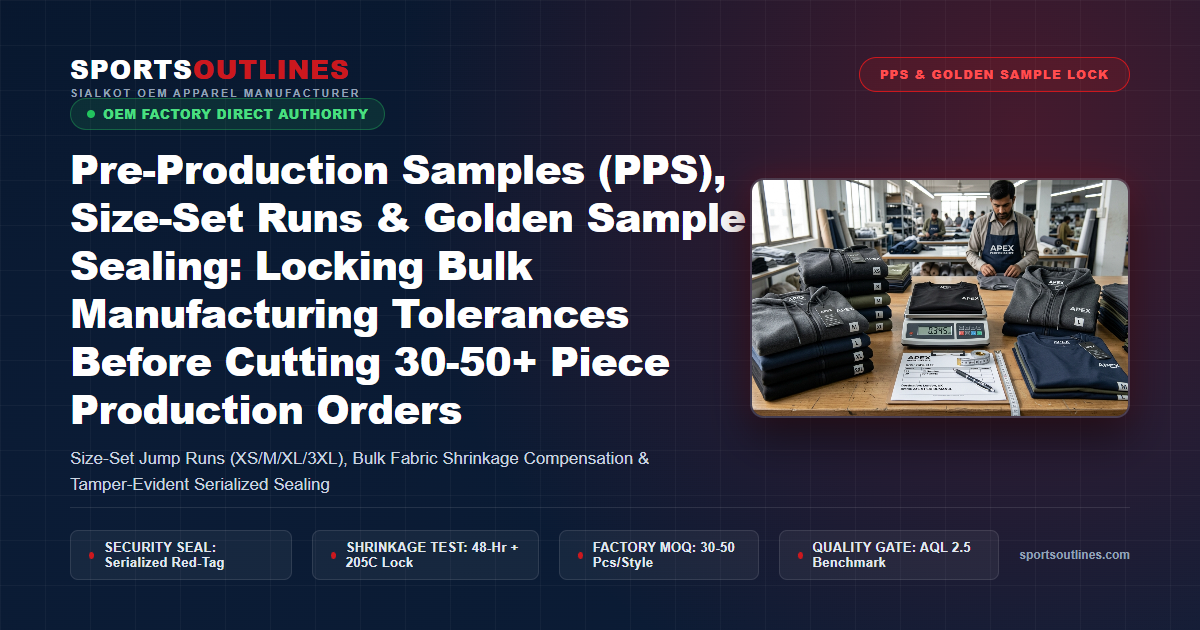
Why Approving a First Prototype Is Never Enough: The Engineering Gate of Pre-Production Samples (PPS), Size-Set Verification & Tamper-Evident Golden Sample Sealing
In global custom sportswear and technical outerwear manufacturing, the single greatest risk window occurs in the handover between the R&D Sample Room and the Bulk Sewing Floor. A first prototype (Proto 1) or fit sample may look and fit well on a base Medium model, yet still rely on substitute yardage, temporary trim hardware, or unverified multi-size grading rules. If a factory cuts bulk fabric directly from an unverified Proto 1 approval without locking a formal Pre-Production Sample (PPS) and sealing a physical Golden Sample, catastrophic bulk defects become inevitable—ranging from bulk fabric shrinkage differences of 3.5% to 5.0% under heat-press sublimation to distorted necklines on extreme sizes (XS and 3XL).
Key Engineering Takeaways: Discover the exact structural differences between Proto 1, Fit Samples, Size-Set Runs, Pre-Production Samples (PPS), and Top-of-Production (TOP) samples; how tamper-evident serialized security tags lock legal and technical accountability between brand and factory; how bulk fabric relaxation and shrinkage testing dictate final CAD marker adjustments before cutting 30–50+ piece low-MOQ production orders; and how AQL 2.5 inline inspectors use the hanging Golden Sample at the end of every modular sewing line to eliminate workmanship drift.
📋 Complete Technical Blueprint Navigation
- The 5-Stage Apparel Sample Hierarchy: Proto 1 vs. Fit Sample vs. Size-Set vs. PPS vs. TOP
- What Makes a True Pre-Production Sample (PPS)? 100% Bulk Fabric, Bulk Trims & Production Equipment
- Size-Set Sample Runs: Validating Extreme Grading Jump Rules Across XS, M, XL, and 3XL
- Bulk Fabric Lot Shrinkage & Relaxation Testing Before Cutting the PPS Marker
- The Golden Sample Sealing Protocol: Tamper-Evident Serialized Tags, Triplicate Archiving & Sign-Off
- How the Golden Sample Governs the Bulk Sewing Floor & Final AQL 2.5 Quality Audits
- Fast-Track Digital & Physical PPS Workflows for 30–50 Piece Low-MOQ Orders ($45–$85 Sampling Economics)
- Frequently Asked Questions (FAQ) on PPS, Size-Set Runs & Golden Sample Governance
1. The 5-Stage Apparel Sample Hierarchy: Proto 1 vs. Fit Sample vs. Size-Set vs. PPS vs. TOP
Emerging activewear founders and procurement managers frequently conflate the terminology of garment sampling, treating the phrase “sample approval” as a single monolithic event. In professional B2B apparel manufacturing across global hubs serving our USA sportswear manufacturer and UK activewear production clients, garment development follows a strict five-stage engineering gate system. Each sample stage tests a distinct physical variable—moving progressively from initial silhouette proof-of-concept to full production-line simulation.
Understanding where the Pre-Production Sample (PPS) and the Golden Sample sit within this hierarchy is essential to protecting your capital. Building directly upon our foundational guides on complete sportswear tech pack architecture, Points of Measure (POM) dimensional tolerances, and live-model fit sample evaluation and pattern redlining, the table below defines the exact engineering mandate of each sample stage.
| Sample Stage | Primary Engineering Purpose | Fabric & Trim Source | Size(s) Produced | Production Gate Unlocked |
|---|---|---|---|---|
| 1. First Prototype (Proto 1) | Validate initial 2D CAD block drafting, seam architecture, and visual design proportions from the Tech Pack. | R&D sample-room stock fabric (matched GSM/elastane) & available stock trims. | Base Size Only (typically Men’s L / M or Women’s S / M). | Unlocks pattern redlining and BOM trim adjustments. |
| 2. Fit / Revised Proto (Proto 2) | Verify biomechanical range of motion (ROM), eliminate drag lines, and lock base-size POM measurements within ±0.5 cm. | Exact GSM/elastane fabric quality; custom strike-offs or lab-dips attached. | Base Size Only (1–2 pieces). | Unlocks multi-size CAD pattern grading across the size curve. |
| 3. Size-Set Sample Run | Verify graded CAD nests across extreme sizes, checking aspect ratios, graphic scaling, and seam stress across size jumps. | Bulk-equivalent or early bulk lot fabric roll. | Jump Sizes (e.g., XS, M, XL, 3XL) or Full Curve. | Locks graded CAD markers for bulk cutting authorization. |
| 4. Pre-Production Sample (PPS) | 100% final dress rehearsal using actual bulk fabric lot, custom bulk trims, final neck labels, and bulk heat-press/sewing calibration. | 100% Actual Bulk Fabric Roll & Final Bulk Custom Trims/Packaging. | Base Size (or Base + 1 boundary size) in Triplicate. | Becomes the Sealed Golden Sample; authorizes bulk fabric cutting. |
| 5. Top-of-Production (TOP) Sample | Pulled directly from the first 5%–10% of finished bulk units off the actual modular sewing line to prove mass-production consistency. | 100% Bulk Production Line Output (fully polybagged with hangtags & barcodes). | 1–2 units pulled randomly from early bulk cartons. | Unlocks final AQL 2.5 pre-shipment inspection & balance wire release. |
2. What Makes a True Pre-Production Sample (PPS)? 100% Bulk Fabric, Bulk Trims & Production Equipment
A sample cannot legally or technically be classified as a Pre-Production Sample (PPS) if a single component is “simulated” or “substituted.” During the initial prototyping phase (where development samples are billed at $45–$85 per piece/pair/set as a non-refundable engineering fee with a 7–10 business day turnaround), sample masters frequently use available in-house YKK zippers, stock 40mm elastic waistbands, or digital sample-yardage rolls so the brand does not have to wait three weeks for custom-dyed bulk trim minimums before testing the garment’s fit.
However, once the bulk purchase order (starting at our low factory MOQ of 30–50 pieces/pairs/sets per style/colorway) is initiated and bulk materials arrive at the factory warehouse, the PPS must be assembled under zero-substitution rules. Every physical variable on the PPS must be identical to the bulk run:
- Actual Bulk Dye-Lot Fabric Roll: Even when ordering the exact same 220 GSM 80% Nylon / 20% Elastane tricot or 420 GSM 100% Cotton French Terry specified in your Apparel Bill of Materials (BOM), different mill dye-lots exhibit slight variations in compacting tension, calendaring heat, and residual shrinkage. The PPS must be cut from the actual bulk fabric roll delivered for the production order.
- Final Custom Bulk Trims & Findings: Custom-molded silicone zipper pullers, custom jacquard-woven waistbands, HD silicone heat-transfer chest crests, tear-away or heat-seal main neck labels, and wash-care laundry labels must all be installed in their exact final positions.
- Bulk Sewing & Bonding Machine Calibration: While a Proto 1 might be sewn by a single master tailor in the sample room, the PPS must be sewn using the exact folder attachments, automatic thread-trimmer tensions, differential-feed ratios, and flatlock (`ISO 607`) or overlock (`ISO 514`) stitch densities specified in our ISO 4915 stitch and seam callout guide.
- Bulk Sublimation Rotary Calendar & Heat-Press Settings: If the garment utilizes dye-sublimation or heat-applied 3D silicone branding, the PPS panels must pass through the actual industrial rotary heat calendar (e.g., 205°C for 38 seconds) rather than a small sample flatbread press, ensuring identical thermal shrinkage and Pantone Delta-E color fidelity as established in our Pantone FHI lab-dip and sublimation strike-off guide.
3. Size-Set Sample Runs: Validating Extreme Grading Jump Rules Across XS, M, XL, and 3XL
One of the most expensive blunders in technical apparel manufacturing is assuming that because a Base Size Medium fits perfectly, the computer-graded Small, Extra-Large, 2XL, and 3XL patterns will automatically fit and sew cleanly. As detailed in our technical treatise on multi-size CAD pattern grading mathematics and allometric increments, human bodies do not scale linearly like a photocopy enlargement.
Before cutting bulk fabric across a multi-size curve—especially for complex garments like raglan compression baselayers, articulated MMA fight shorts, or waterproof seam-taped ski jackets—high-authority factories execute a Size-Set Sample Run (often called a “Jump-Size Run”). Instead of sewing every single size twice before production, the sample team cuts and sews the alternating boundary sizes across the size spectrum: typically XS, M, XL, and 3XL (or S, L, 2XL).
🔍 The 4 Critical Engineering Defects Caught Only During a Size-Set Run
- Collar & Hood Disproportion on 2XL/3XL: Linearly grading neck openings at the same rate as chest width causes 2XL and 3XL crewnecks to gape open over the collarbones. Size-set verification confirms that neck width grading shifts from +1.0 cm per size down to +0.5 cm above XL.
- Armhole Pitch vs. Sleeve Cap Ease Mismatch: When raglan or set-in armholes grade vertically and horizontally simultaneously, the curved perimeter of the sleeve cap can gain 4 mm to 7 mm of excess ease on 2XL/3XL, causing unsightly puckering (`ease gathering`) under the overlock foot.
- Chest Graphic & Logo Visual Scaling Breaks: A 26 cm chest screen-print or tackle-twill crest that fills the chest heroically on a Size Small looks like a miniature postage stamp on a Size 3XL hoodie unless a 2-Tier or 3-Tier Graphic Scaling Break (e.g., Screen Set A for XS–M at 25 cm wide; Screen Set B for L–3XL at 29.5 cm wide) is verified on physical size-set garments.
- Pocket Bag & Zipper Placket Collision on XS: On XS women’s leggings or youth track jackets, full-length side-seam zipper pockets (`16 cm opening`) can collide with the waistband seam or hip curve dart unless the pocket opening is graded down proportionally for XS–S sizes.
| Size-Set Verification Checkpoint | XS / S Boundary Check | M / L Base Core Check | XL / 2XL / 3XL Plus-Grade Check | Corrective CAD / Marker Action |
|---|---|---|---|---|
| Chest / Waist Circumference (POM A & B) | Verify negative ease does not restrict ribcage expansion on high-elastane knits. | Must match approved Fit Sample within ±0.5 cm zero-drift target. | Verify allometric shift (+3.0 cm to +4.0 cm half-chest jump above XL). | Adjust X/Y grading cardinal node rules in Gerber/Optitex before nesting. |
| Neck Width & Front Neck Drop | Ensure head-passage circumference exceeds 56 cm minimum at full rib stretch. | Standard 18.5 cm – 19.5 cm seam-to-seam collar width. | Ensure collar does not sag or expose undergarment straps (+0.4 cm max jump). | Re-calculate neckband rib cut-ratio (typically 82%–85% of neckline arc). |
| Inseam & Front/Back Rise Ratio | Verify crotch gusset does not drop too low on petite/short frames. | Balanced front-to-back rise differential (typically 8–10 cm). | Back rise must grade +1.25 cm vs. front rise +0.75 cm to cover gluteal volume. | Modify crotch fork extension vs. vertical waist rise vector split. |
| Artwork & Trim Placement Coordinates | Confirm chest print edges stay ≥3.5 cm clear of armhole seams. | Standard anchor drop (e.g., 7.5 cm below CF neck seam). | Increase drop from CF neck by +0.5 cm per size; apply Tier-2 oversized graphic screen. | Update laser-alignment jig coordinates on screen/heat-press platens. |
4. Bulk Fabric Lot Shrinkage & Relaxation Testing Before Cutting the PPS Marker
Why do garments that measured perfectly in the sample room suddenly come off the bulk production line 2.5 cm too short in body length or 2.0 cm too tight across the chest? The culprit is almost always uncompensated bulk fabric lot shrinkage. Knitted fabrics (single jersey, interlock, French terry, heavy brush fleece, and warp-knit spandex tricot) are wound onto cylindrical mill rolls under high mechanical tension during stenter-frame drying and compacting.
Before cutting the Pre-Production Sample (PPS) and locking the final bulk CAD markers for brands managed by our Germany & EU technical sportswear hub and Canadian apparel manufacturing division, our Sialkot engineering floor executes a mandatory 3-Phase Bulk Fabric Shrinkage & Relaxation Protocol on a `50 cm × 50 cm` benchmark swatch cut from the actual bulk fabric lot:
- 24-to-48 Hour Open-Width Atmospheric Relaxation: High-elastane compression fabrics (`18%–28% Spandex/Lycra`) and heavy cotton fleeces (`380–500 GSM`) must be unrolled onto flat relaxation racks for a minimum of 24 to 48 hours prior to cutting. Cutting elastomeric fabric immediately off a tight roll causes instantaneous elastic snap-back (“knife-shrinkage”) the moment the blade slices the panel perimeter, shrinking panels by `1.5% to 3.0%` before they even reach a sewing machine.
- Thermal Sublimation / Heat-Press Shrinkage Test (`205°C / 400°F`): A benchmark `50 cm × 50 cm` square marked with `35 cm × 35 cm` internal calibration crosshairs is passed through the bulk rotary sublimation calendar at the exact bulk temperature (`205°C`) and dwell time (`38–42 seconds`). Polyester interlocks typically exhibit 1.8% to 3.2% warp (lengthwise) shrinkage and 1.0% to 2.2% weft (widthwise) shrinkage under sublimation heat.
- ISO 6330 / AATCC 135 Domestic Laundry & Steam Relaxation Test: For cotton-rich streetwear hoodies, joggers, and garment-dyed tees, the benchmark swatch undergoes three full wash-and-tumble-dry cycles (`AATCC 135`) plus industrial steam-table pressing. Based on the exact measured warp and weft percentage change, the CAD pattern master applies a Dynamic Shrinkage Allowance Buffer directly to the PPS and bulk cutting markers so that the garment hits 0.0 cm deviation after heat-pressing, steaming, or pre-shrinking.
| Bulk Fabric Architecture | Mandatory Roll Relaxation Time | Sublimation / Steam Shrinkage (Warp × Weft) | AATCC 135 Wash Shrinkage Standard | CAD Pattern Compensation Applied to PPS |
|---|---|---|---|---|
| 100% Polyester Birdseye / Micro-Interlock (140–180 GSM) | 12–24 Hours flat lay | -2.2% Warp × -1.5% Weft (at 205°C rotary calendar) | ≤ ±1.0% post-sublimation | Cut raw panels +2.2% longer & +1.5% wider prior to roll-to-roll or piece sublimation. |
| Nylon/Spandex Warp-Knit Tricot (210–250 GSM, 22% Elastane) | 48 Hours mandatory (tension-free rack) | -3.0% Warp × -2.8% Weft under steam/heat-seal | ≤ ±2.0% cold wash / line dry | Apply +3.0% length / +2.8% width pattern buffer; use low-tension pin-less spreading. |
| 80/20 Cotton/Polyester Heavy Fleece (360–420 GSM) | 24 Hours flat lay | -1.8% Warp × -1.2% Weft under vacuum steam table | ≤ -3.5% Warp × -2.5% Weft (compacted mill finish) | Add +2.0% length / +1.5% width buffer for steam table relaxation prior to QC measurement. |
| 100% Combed Ring-Spun Cotton French Terry (450–500 GSM, Garment-Washed) | 24–36 Hours flat lay | -5.5% to -7.5% Warp × -3.5% to -4.5% Weft (in enzyme/acid wash drum) | ≤ ±1.5% residual after factory pre-wash | Oversize raw cut pattern by +6.5% Length × +4.0% Width so post-wash garment hits exact POM spec. |
5. The Golden Sample Sealing Protocol: Tamper-Evident Serialized Tags, Triplicate Archiving & Sign-Off
Once the Pre-Production Sample (PPS) passes every dimensional POM audit, colorfastness check, and seam-strength pull test, it undergoes a formal legal and operational transformation: it is sealed as the Golden Sample (also referred to in tier-1 supply chains as the Sealed Red-Tag Sample or Counter-Sample).
Why is physical sealing necessary? In unorganized factories, if an unsealed sample sits on a sewing supervisor’s desk, an unscrupulous line leader might swap out a rejected bulk garment or alter a stitch line to claim “that’s how the sample was approved.” Even without malice, unsealed samples get mixed up with earlier Proto 1 or Proto 2 iterations. To establish absolute deterministic accountability, our Sialkot export facility enforces the Triplicate Tamper-Evident Golden Sample Sealing Protocol:
🔒 Anatomy of the Tamper-Evident Golden Sample Security Seal
- Non-Reversible Serialized Plastic Security Loop: A heavy-duty polypropylene security cable seal stamped with a unique laser-etched 8-digit serial number (e.g.,
SO-GS-2026-08491) is threaded directly through a non-destructible structural point of the garment (such as the care-label seam loop or a buttonhole/zipper eyelet) so that the tag cannot be removed without cutting the plastic security wire. - Attached Rigid Golden Sample Dossier Card: Locked onto the security loop is a tear-resistant Tyvek® or laminated cardstock dossier bearing:
- Brand Name, PO Number, Style Code, Colorway, and Base Size
- Bulk Fabric Roll Lot Number & Verified GSM / Shrinkage Differential
- Full POM Measurement Audit Sheet showing Spec vs. Actual Measured PPS (all within ±0.5 cm)
- Wet signatures and date stamps of the Head Pattern Master, Production Line Manager, and QA Director (plus digital counter-signature reference from the client).
- Triplicate Distribution Architecture (For 150+ Piece Runs) / Dual-Twin Digital-Physical Lock (For 30–50 Piece Runs):
- Golden Sample #1 (Client / Brand Archive): Dispatched via DHL/FedEx Express to the brand buyer (or verified via high-resolution 4K caliper video and macro photo dossier for fast-track low-MOQ runs) so the client holds an identical reference for incoming warehouse receiving inspection.
- Golden Sample #2 (Active Sewing Line Hanger): Hung on a high-visibility overhead steel frame directly at the end of the modular bulk sewing line so sewing operators and inline QC roamers can visually and tactilely compare seam tension, label placement, and hand-feel every 15 minutes.
- Golden Sample #3 (QA / AQL 2.5 Audit Room Vault): Stored inside a climate-controlled, UV-protected QA cabinet in the final inspection department, untouched by factory floor dust, used exclusively by final AQL 2.5 auditors and third-party inspection agencies (SGS, Intertek, Bureau Veritas, QIMA) during pre-shipment verification.
6. How the Golden Sample Governs the Bulk Sewing Floor & Final AQL 2.5 Quality Audits
A Tech Pack provides mathematical coordinates on paper, but a physical Golden Sample provides the three-dimensional tactile standard on the factory floor. During bulk sewing of 30–50+ piece low-MOQ orders or 5,000-piece commercial drops for brands working with our Australian sportswear manufacturing team, sewing operators face dozens of micro-decisions that paper drawings cannot fully convey: how flat the overlock differential feed should lay around a curved raglan shoulder, the exact lustre and depth of a 3D high-density silicone heat transfer after pressing, or the hand-feel tension of an encased drawcord waistband.
By hanging Golden Sample #2 at the front of the modular sewing cell alongside a bilingual visual defect board, our inline Quality Control (QC) engineers enforce a strict First-Piece Bundle Verification (“First-Off Check”):
- Bundle #1 Operation Lock: When a sewing operator receives the very first cut bundle of 20 panels for a specific operation (e.g., attaching a laser-cut welded chest pocket zipper or flatlocking an ergonomic knee gusset), they sew one single piece and immediately carry it to the hanging Golden Sample. The inline QC inspector compares stitch bite width, SPI density (`12 SPI`), and seam flatness against the Golden Sample before signing the bundle ticket to authorize sewing the remaining 19 pieces.
- Top-of-Production (TOP) Validation Gate: Once the first 5% to 10% of the bulk garments exit the finishing, thread-suction, steam-pressing, and polybagging stations, the QA team pulls two finished units as Top-of-Production (TOP) Samples. These TOP units are laid side-by-side against Golden Sample #3 in the QA vault under `D65` daylight illumination. If any POM measurement has drifted due to steam-table operator pressure or sewing foot tension, the line is halted and recalibrated immediately—preventing a systemic defect from infecting the remaining 90% of the order.
- Final Pre-Shipment AQL 2.5 Benchmark: During the final pre-shipment inspection (`ISO 2859-1 / ANSI ASQ Z1.4 Level II, AQL 2.5 Major / 4.0 Minor`), the Golden Sample serves as the legal tie-breaker. Every randomly pulled bulk unit is evaluated against both the approved graded POM chart and the physical Golden Sample’s construction, color shade band, and trim finish.
7. Fast-Track Digital & Physical PPS Workflows for 30–50 Piece Low-MOQ Orders ($45–$85 Sampling Economics)
For agile DTC activewear brands, CrossFit gyms, and independent streetwear labels ordering at our accessible factory MOQ of 30–50 pieces/pairs/sets per style/colorway, shipping physical samples back and forth across continents three separate times (Proto 1 → Size-Set → Physical Courier PPS) can add 18 to 25 days of courier transit time and hundreds of dollars in DHL air-freight expenses. How do smart brands maintain 100% Golden Sample protection without sacrificing speed-to-market?
As explained in our $45–$85 physical pre-production prototyping blueprint, Sports Outlines offers two structured PPS sign-off pathways tailored to order volume and launch timelines:
| Workflow Parameter | Pathway A: Fast-Track Digital-Twin PPS Lock (Ideal for 30–100 Piece Low-MOQ Runs) | Pathway B: Full Physical Triplicate Courier PPS Lock (Ideal for 150–5,000+ Piece Runs) |
|---|---|---|
| Initial Physical Proto 1 / Fit Sample | $45–$85 per piece/pair/set (non-refundable development fee, 7–10 business days turnaround) shipped via DHL/FedEx for physical hand-feel and live-model fit verification. | $45–$85 per piece/pair/set (non-refundable development fee, 7–10 business days turnaround) shipped via DHL/FedEx, followed by physical Size-Set jump run if required. |
| PPS Construction & Sealing | Factory cuts and sews 2 identical PPS units from 100% bulk fabric & bulk trims Incorporating all Proto 1 redline fixes, and seals both with serialized tamper-evident tags. | Factory cuts and sews 3 identical PPS units (plus jump sizes XS/XL/3XL) from 100% bulk fabric & trims, sealing all 3 with serialized tamper-evident tags. |
| Client Verification Mechanism | 4K Video Tape-Measure Audit + D65 Lightbox Macro Photo Dossier: Client verifies every POM measurement on camera and signs off digitally within 24 hours. (Golden Sample #1 ships inside Carton #1 of bulk delivery). | Physical DHL Express Dispatch of Golden Sample #1: Client physically inspects and signs the attached Tyvek® seal card in their studio before authorizing bulk cutting. |
| Timeline Impact on Bulk Delivery | Saves 6–8 calendar days of international courier transit; bulk cutting starts immediately upon digital PPS sign-off. | Adds 5–7 business days for courier delivery and physical studio review prior to bulk cutting. |
| AQL 2.5 Quality Guarantee | 100% identical enforcement—serialized Golden Sample hangs on the bulk sewing line and governs final AQL 2.5 audit. | 100% identical enforcement—both client warehouse and factory QA hold matching serialized Golden Samples. |
By combining rigorous physical prototyping with our structured PPS and Golden Sample governance—and connecting seamlessly into our next guide on tech pack cost engineering and split-sizing 30–50 MOQ allocation—brands eliminate the guesswork that plagues amateur apparel sourcing.
8. Frequently Asked Questions (FAQ) on Pre-Production Samples (PPS), Size-Set Runs & Golden Sample Sealing
Q1: What is the exact difference between a First Prototype (Proto 1) and a Pre-Production Sample (PPS)?
A First Prototype (Proto 1) is an R&D development sample (billed at $45–$85 per piece/pair/set as a non-refundable development fee with a 7–10 business day turnaround) built in the sample room to validate the initial 2D CAD pattern block, seam construction, and base-size fit, sometimes utilizing available stock zippers or sample-roll yardage. A Pre-Production Sample (PPS) is constructed after the bulk order is placed using 100% actual bulk dye-lot fabric, final custom trims, custom neck labels, and bulk production machinery. Once approved and sealed with a serialized security tag, the PPS becomes the Golden Sample that authorizes bulk cutting.
Q2: Why do factories seal Golden Samples with tamper-evident serialized plastic tags?
Tamper-evident serialized security seals prevent any accidental mix-up between early unapproved prototypes and the final approved PPS, and make it physically impossible for anyone on the production floor to swap or alter the reference garment. The unique serial number on the security loop is logged on the signed QC measurement dossier and referenced during both inline bundle inspections and the final pre-shipment AQL 2.5 audit.
Q3: When is a full Size-Set Sample Run (XS, M, XL, 3XL) necessary before bulk cutting?
A Size-Set Sample Run is strongly recommended whenever a brand launches a brand-new custom silhouette spanning five or more sizes (e.g., XS through 3XL), or when manufacturing high-compression activewear, articulated fightwear, or tailored outerwear. Sewing jump sizes (XS, M, XL, 3XL) validates that collar openings do not gape on plus sizes, sleeve cap ease does not pucker, and chest graphics scale proportionally across size breaks before cutting bulk fabric.
Q4: How does bulk fabric shrinkage testing impact the PPS and bulk CAD cutting markers?
Every bulk fabric roll lot exhibits unique residual shrinkage under rotary sublimation heat (`205°C`), steam pressing, or garment washing. By relaxing bulk rolls for 24–48 hours and testing a benchmark `50 cm × 50 cm` swatch from the actual bulk lot prior to cutting the PPS, our CAD engineers program exact warp and weft shrinkage compensation buffers into the cutting marker so the finished bulk garments match the approved POM table within `±0.5 cm`.
Q5: Can low-MOQ orders (30–50 pieces) use a Fast-Track Digital PPS approval to save shipping time?
Yes. Once you have physically approved your initial Prototype / Fit Sample in hand, our engineering team can construct and seal your Pre-Production Sample (PPS) from the bulk fabric lot and provide a 4K Caliper & Tape-Measure Video Audit + D65 Lightbox Macro Photo Dossier. This allows you to verify every POM dimension and trim detail digitally within 24 hours—saving 6–8 days of courier transit—while the sealed Golden Sample immediately governs your 30–50 piece bulk sewing line and ships inside Carton #1 of your bulk delivery.
Ready to Lock Your Bulk Production with Zero-Drift Golden Sample Governance?
Partner with Sports Outlines for deterministic Tech Pack execution, $45–$85 physical pre-production prototyping (7–10 business days turnaround), tamper-evident Golden Sample sealing, and flexible 30–50 piece/pair/set low-MOQ bulk manufacturing audited to strict AQL 2.5 export standards.