Direct Manufacturer Answer: How to Source Custom Baseball Stirrups & 2-in-1 Sublimated Socks
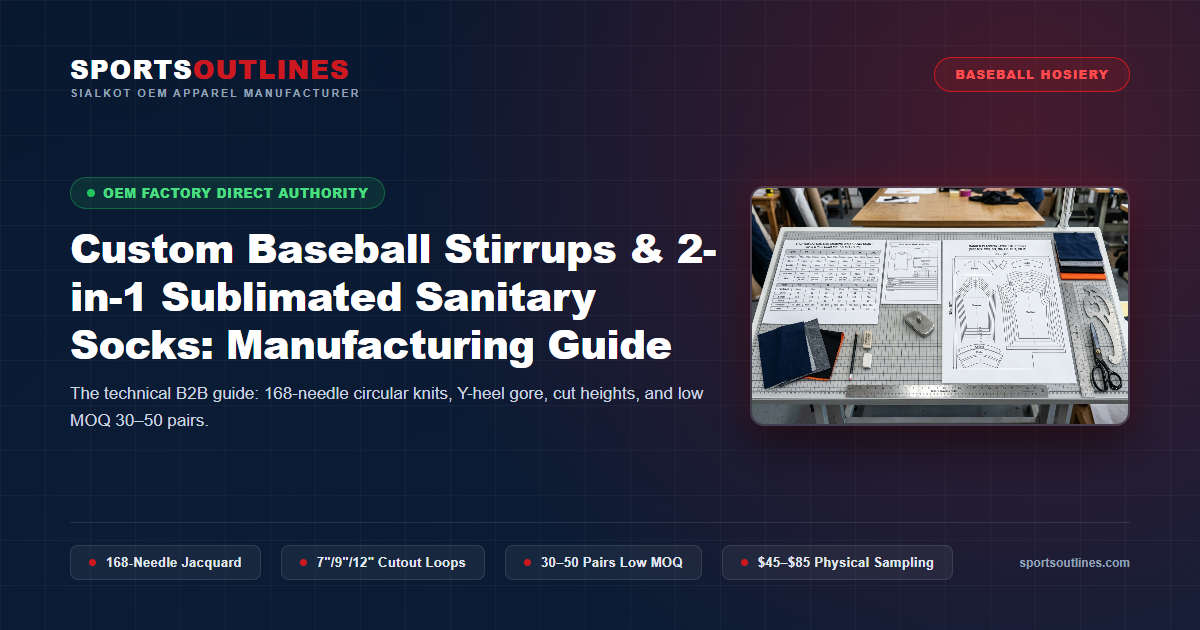
Manufacturing professional custom baseball stirrups and modern 2-in-1 mock stirrup socks requires precision 144 to 168-needle circular knitting machinery or specialized 200-needle high-definition digital sublimation sock presses. Traditional stirrups utilize an 80/20 or 70/30 nylon-acrylic/cotton yarn blend (or 100% heavy nylon rib knit) with reinforced double-welt top cuffs and reinforced stirrup loop straps designed to fit over a separate white sanitary under-sock. Modern 2-in-1 hybrid socks fuse the heritage stirrup pattern and white sanitary under-sock into a single, seamless, double-density athletic sock featuring a cushioned terry-loop footbed, targeted arch compression band, reciprocating Y-heel gore, and flat-toe seam. Factory direct low MOQ in Sialkot, Pakistan starts at 30 to 50 pairs per style/colorway with complete custom size runs (Youth, Intermediate, Adult Pro). Pre-production physical prototype samples cost $45 to $85 per pair/set delivered in 7 to 10 business days.
- Knitting Machinery: Lonati 144-needle and 168-needle computerized jacquard circular knit machines.
- Yarn Composition: 75% Nylon, 20% Combed Cotton / Moisture-Wicking Poly, 5% Spandex/Lycra core.
- Stirrup Cutout Heights: Classic 7-inch, retro 9-inch, and high-cut 12-inch open loops with bound bar-tack edges.
- 2-in-1 Mock Construction: Sublimated or jacquard knit upper calf with white athletic footbed and reinforced terry sole.
- Factory Low MOQ: 30–50 pairs per design across standard youth and adult size grading matrices.
- Physical Prototype Sampling: $45–$85 per custom physical sample pair in 7–10 days (strict zero credit/refund policy).
- Direct Factory Sourcing: WhatsApp factory direct at +92 316 7932595 or sportsoutlines.com.
Baseball hosiery represents one of the most distinctive, technically demanding, and culturally sacred sub-sectors of athletic teamwear manufacturing. From classic 1970s retro 12-inch cutouts to high-tech 2-in-1 sublimated mock stirrup game socks, teamwear brands and collegiate athletic directors demand hosiery that stays anchored over the calf without sagging, repels abrasive red dirt and infield clay, and delivers elite plantar support through 9-inning grinds.
In modern baseball apparel production, team apparel brands face a critical engineering decision: do they manufacture traditional two-piece hosiery (an outer colored knit stirrup worn over a separate white sanitary under-sock), or do they transition their team rosters to one-piece 2-in-1 mock stirrup socks? Both systems offer distinct athletic and commercial advantages. While traditional two-piece setups offer historic authenticity and adjustable stirrup cutout heights, modern 2-in-1 hybrid knits eliminate slipping layers, reduce blister-causing friction inside spikes, and streamline inventory fulfillment for team dealers.
At Sports Outlines in Sialkot, Pakistan, our specialized circular knitting and sock finishing divisions produce tournament-grade baseball stirrups, sanitary under-socks, and sublimated 2-in-1 performance socks for independent brands, collegiate programs, and high-school team outfitters worldwide. This comprehensive technical B2B manufacturing guide details circular needle configurations, yarn tensioning, compression arch mechanics, clay stain resistance, size grading curves, wholesale unit economics, and factory-direct low MOQ sourcing parameters.
1. The Evolution of Baseball Hosiery: Traditional Two-Piece vs 2-in-1 Hybrid Architecture
To manufacture baseball socks that meet competitive team specifications, apparel engineers must understand how modern hosiery mechanics evolved from 19th-century sanitary protection to modern biomechanical support:
The Origins & Mechanics of the Traditional Two-Piece System
In early professional baseball, colored garment dyes contained heavy metals, toxic mordants, and coal-tar chemicals. When metal spikes punctured a player’s shins or calves, dyed socks could cause blood poisoning. To protect athletes, clubs introduced an un-dyed, pure white cotton inner sock known as the “sanitary” sock (or “sani”). To maintain team colors and stripe identity on the field, clubs engineered a bottomless over-sock with an arch strap known as the “stirrup.”
Traditional two-piece systems remain beloved by vintage baseball enthusiasts, high-school varsity programs, and professional minor league franchises. The two-piece construction provides:
- Authentic Retro Visual Aesthetics: The physical cutout creates a distinct depth of field where the brilliant white sanitary shines through the open loop of the colored stirrup.
- Customizable Cutout Heights: Players can pull the stirrup higher or lower along the calf to showcase 7, 9, or 12 inches of white sanitary sock according to individual style.
- Independent Replacement Economics: When white sanitaries pick up permanent red clay staining or heel wear, teams can replace the inexpensive sanitaries without discarding expensive custom team-striped stirrups.
The Modern 2-in-1 Hybrid Revolution
While two-piece setups look stunning, they introduce real athletic friction. Two separate sock layers rubbing against each other inside a tightly laced baseball cleat generate shear friction, heat, and painful heel and metatarsal blisters. Furthermore, during high-speed slides into second base, the thin stirrup strap under the arch can shift, bundle, or dig uncomfortably into the athlete’s plantar fascia.
The 2-in-1 mock stirrup sock solves this problem completely by knitting the entire garment as a single, continuous piece. The calf portion is knitted or sublimated with the club’s striping and a faux-stirrup cutout graphic, while the ankle, heel, and footbed transition seamlessly into a high-cushion white athletic sock. The player gets the exact vintage visual aesthetic of a traditional stirrup and white sanitary sock with none of the layering, bunching, or cleat friction.
2. Circular Knitting Needle Configurations: 144-Needle vs 168-Needle vs 200-Needle Machinery
The structural density, elasticity, graphic clarity, and calf compression of baseball hosiery depend on the gauge and needle count of the circular knitting cylinder:
For traditional stirrups that endure rugged play on gravel and clay diamonds, 144-needle circular knitting remains the industry workhorse. The heavier needle spacing accommodates high-denier, texturized nylon filament yarns that withstand constant friction against cleat high-tops and dirt without snagging or developing ladder runs. Conversely, for 2-in-1 custom mock stirrups featuring intricate team mascots, player numbers, or fine accent pin-stripes, our factory utilizes 168-needle Lonati computerized jacquard machinery to ensure razor-sharp graphic rendering without yarn bleeding.
3. Technical Yarn Engineering: Blending Durability, Cushioning, and Elastic Recovery
A baseball sock must perform in contrasting environments: the upper calf requires compressive grip and UV/dirt protection, while the lower footbed demands impact shock absorption and extreme moisture management. At Sports Outlines, we engineer multi-zone yarn blends tailored to each zone of the garment:
- Calf Zone (70% Nylon / 25% Polyester / 5% Spandex): High-tenacity texturized Nylon 6,6 delivers exceptional abrasion resistance against sliding friction and shin guard straps. Core-spun Lycra/spandex provides 20–25 mmHg graduated compression to prevent the stirrup from sliding down the calf during 60-foot sprints.
- Footbed Zone (75% Combed Ringspun Cotton / 20% Polyester / 5% Elastane): In traditional sanitaries and the footbed of 2-in-1 hybrid socks, high-grade combed cotton provides natural sweat absorption and foot grip inside the cleat, eliminating internal foot sliding during abrupt direction changes.
- Terry Loop Sole Cushioning: We program our knitting machines to produce high-density 3-dimensional terry-loop padding beneath the calcaneus (heel) and metatarsal heads (ball of foot). This cushioning dampens the jarring ground reaction forces of running on rock-hard summer clay diamonds.
- Micro-Mesh Instep Ventilation: The top of the foot (instep) is knitted with open-mesh ventilation channels that allow thermal heat and vaporized perspiration to escape through the mesh tongues of modern baseball cleats.
4. Traditional Stirrup Cutout Heights & Loop Construction Mechanics
When manufacturing traditional standalone stirrups, the cutout dimension (the length of the open loop that exposes the underlying white sanitary) defines the historical era and aesthetic profile of the uniform:
The most vulnerable failure point on any traditional stirrup is the junction where the thin under-arch strap meets the front and rear vertical loop panels. In cheap overseas imports, this seam is simply joined with a weak single-needle chainstitch that snaps after two sliding plays. At Sports Outlines, our factory reinforces all stirrup loop junctions with heavyweight bar-tack stitching using 100% bonded nylon thread, ensuring the strap can withstand severe lateral torsion and cleat shear without tearing.
5. 2-in-1 Decoration Technologies: Jacquard Knit vs 360-Degree Dye Sublimation
When manufacturing 2-in-1 custom mock stirrup socks, brand founders must select the optimal embellishment technology based on graphic complexity, minimum order quantities, and budget:
Method A: Direct Jacquard Knit-In Embellishment
In direct jacquard knitting, every color, stripe, and letter is physically knitted into the fabric structure using pre-dyed colored yarn cones fed through automated yarn-finger selectors.
- Pros: Unbeatable durability and permanent colorfastness. The design can never crack, peel, or fade, even after 100 hot commercial laundry cycles. Beautiful tactile knit texture that looks premium on the field.
- Cons: Limited to 4–6 colors per horizontal knit row. Floated yarns on the inside of the sock must be closely controlled to prevent catching on player toes. Ultra-fine micro-text or photorealistic shading cannot be rendered.
- Best Suited For: Classic horizontal team stripes, bold collegiate block letters, clean mascot silhouettes, and high-volume school programs.
Method B: 360-Degree Rotary Dye Sublimation Printing
In 360-degree rotary sublimation, the sock is knitted from ultra-white high-filament micro-polyester yarn. The sock is stretched over an engineered aluminum cylinder, wrapped in custom dye-sublimation transfer paper infused with Italian Kiian disperse inks, and heated in a rotary heat press at 390°F (198°C).
- Pros: Unlimited color palette with zero setup fees for additional colors. Renders complex multi-color mascot logos, custom camo patterns, digital gradients, and intricate pinstripe artwork with photographic fidelity. Zero inside yarn floats.
- Cons: The footbed must remain white or unprinted cotton to preserve grip and sweat absorption. Slight “grinning” (white yarn visibility) can occur when the sock is stretched over exceptionally thick calves if the knitting gauge is too loose.
- Best Suited For: Travel ball tournament clubs, complex branded showcase teams, low-MOQ startup runs, and rapid turnaround programs.
6. Ergonomic Footbed Mechanics: Y-Heel Gore, Arch Compression & Seamless Toe Closures
A baseball player covers hundreds of yards in explosive bursts, pivoting on cleat studs and dragging their toes during pitching motions. Generic tube socks fail miserably under these conditions because they lack anatomical contouring. Every performance baseball sock manufactured at Sports Outlines incorporates four critical ergonomic features:
- Reciprocating Y-Heel Gore: Rather than knitting a straight tube, our circular machines knit an extended triangular gore seam (shaped like the letter ‘Y’) around the heel. This creates a deep anatomical pocket that locks the athlete’s heel in place, completely eliminating the annoying sock slippage that causes heel blisters.
- 360-Degree Ribbed Arch Compression Band: A 2-inch band of concentrated elastane interlock knits around the midfoot arch. This provides gentle plantar fascia support, delays foot arch fatigue over doubleheaders, and keeps the sock tightly stabilized against the foot so it cannot rotate inside the cleat.
- Hand-Linked / Rosso Flat-Toe Seam: Traditional cheap socks use a raised overlock seam across the toe box that presses painfully against the athlete’s toenails inside tight cleats. We utilize high-precision Rosso flat-seaming or seamless automated toe-closing machines to create a zero-friction, ultra-flat closure.
- Double-Welt Anti-Slip Top Cuff: The top 2.5 inches of the sock or stirrup features a folded, double-layer elastic welt knit with medical-grade ribbed rubber thread. This creates dependable frictional hold against the upper calf, ensuring the hosiery stays pinned below the knee without requiring athletic tape.
7. Complete Product Specifications Comparison Table
Compare technical factory engineering metrics across traditional stirrups, classic white sanitaries, and modern 2-in-1 hybrid mock stirrup socks:
8. Professional Size Grading & Footwear Mapping Matrix
Hosiery sizing must correlate directly with US, UK, and European shoe sizes while providing adequate calf circumference stretch to clear athletic calf musculature:
9. Industrial Manufacturing SOP & Quality Control Protocols
At Sports Outlines in Sialkot, our dedicated hosiery division follows an 8-stage Standard Operating Procedure to ensure zero structural defects and 100% dimensional consistency:
- Yarn Creel Setup & Tension Calibration: High-tenacity nylon, cotton, and spandex cones are mounted on our electronic creels. Yarn tension meters measure feed rate at 1.5–2.0 grams of tension per feed to guarantee uniform stitch loops and prevent uneven sock lengths.
- Computerized Circular Knitting: Lonati single-cylinder machines knit the tubular sock bodies. Programmed cams execute the double-welt top cuff, jacquard patterns, ribbed leg, Y-heel gore, terry cushioning, and instep ventilation mesh.
- Toe Seaming & Stirrup Strap Bar-Tacking: Socks proceed to automated Rosso seaming stations for toe closure. For traditional stirrups, high-speed automated bar-tack sewing stations attach and reinforce the bottom under-arch strap with 42 stitches of bonded nylon thread per anchor.
- Washing & Chemical Finishing: Knitted batches undergo industrial soft washing to remove knitting oils and relax yarn fibers. We apply antimicrobial silver-ion treatments to prevent odor-causing bacteria growth and soil-release fluorochemicals to repel diamond clay.
- Boarding & High-Pressure Steam Forming: Every sock and stirrup is mounted onto heated aluminum foot/leg forms. High-pressure steam (120°C) sets the thermodynamic memory of the synthetic fibers, permanently locking in the size, shape, and cuff elasticity.
- Tensile Recovery & Snapback Testing: Quality inspectors stretch sample socks over mechanical expanding calipers to verify that the top cuff and arch band deliver required elongation (minimum 180% stretch) and return to 98%+ original dimension without bagging.
- Paired Inspection & Needle Detection: Inspectors verify that left and right sock lengths match within a strict ±0.5 cm tolerance. Every single pair passes through a certified magnetic needle detector tunnel before packaging.
- Custom Banding & Barcode Packaging: Pairs are secured with custom branded cardstock header cards or belly bands, labeled with size, fiber content, and wash instructions, and sealed in master polybags.
10. Factory Sourcing Economics: Unit Costs, Physical Sampling & Low MOQ Rules
Understanding wholesale manufacturing unit economics enables team dealers, brand startups, and university equipment managers to optimize their purchasing budgets while earning 60% to 75% retail gross margins:
Rigid Physical Sampling & Low MOQ Invariants
To maintain institutional clarity, Sports Outlines enforces straightforward, non-negotiable sampling and production parameters:
- Physical Prototype Samples ($45 to $85 per pair): Every custom design requires dedicated machine programming, needle cam adjustments, and boarding forms. We deliver complete, fully functional physical prototype samples within 7 to 10 business days via DHL/FedEx Express. In strict accordance with factory operational policy, sample fees cover engineering labor and courier transit and are non-refundable with zero sample credits.
- Factory Direct Low MOQ (30 to 50 pairs): We reject the 500-pair minimums enforced by traditional mills. Our lean circular knitting lines accommodate orders as small as 30 to 50 pairs per style/colorway, allowing team dealers to service single varsity rosters with zero leftover inventory risk.
- Mixed Sizing Distribution: Within your 30 to 50-pair production run, you can mix youth, intermediate, and adult sizes to match your roster’s exact player specifications.
11. Frequently Asked Questions (FAQ) & Technical Troubleshooting
Q1: What causes traditional baseball stirrups to slip down players’ calves, and how does your factory prevent it?
Stirrup slippage is caused by two factors: low-grade single-welt cuffs with insufficient elastic recovery, and cheap polyester yarns that stretch out permanently when exposed to body heat. At Sports Outlines, we engineer our stirrups with a 2.5-inch double-welt folded top cuff embedded with high-gauge core-spun rubber and Lycra thread. This creates dynamic circumferential tension (20–25 mmHg) that clings firmly to the gastrocnemius muscle without requiring athletic tape.
Q2: Can we print complex multi-color team logos on 2-in-1 baseball socks without yarn snagging inside?
Yes. For intricate logos featuring 5+ colors, gradients, or complex mascots, we recommend our 360-degree rotary dye-sublimation process on 200-needle blanks. Unlike jacquard knitting which creates loose “float yarns” on the interior that can catch on player toes during insertion, sublimated socks have a completely flat, seamless interior with zero floating threads and photographic exterior print resolution.
Q3: How do your white sanitary socks withstand aggressive red clay diamond staining?
We blend 75% long-staple combed cotton with 20% high-filament texturized polyester and treat the fabric with a specialized fluorochemical soil-release finish during post-knit wash cycles. This finish prevents red clay and iron-rich dirt particles from embedding deep within the fiber core, allowing stains to release easily in standard detergent washes without requiring harsh chlorine bleaches that degrade elastic fibers.
Q4: What is the recommended stirrup cutout height for high school varsity and collegiate programs?
The 9-inch cutout is the gold standard for high school varsity and NCAA programs. It strikes the perfect balance between classic vintage aesthetics and modern athletic coverage, showcasing approximately 8 to 9 inches of brilliant white sanitary sock while providing ample calf compression above the ankle. For youth teams (under 12), we recommend the 7-inch cut, while retro throwback games favor the dramatic 12-inch Major League high cut.
12. The Semantic Silo Mesh & Direct Factory Production Funnel
Custom baseball stirrups and 2-in-1 sanitary socks represent an essential anchor in complete head-to-toe diamond uniform packages. To explore our full ecosystem of baseball apparel manufacturing capabilities, review our companion technical production guides:
- Explore our deep technical guide on Custom Full-Button Baseball Jerseys & Tackle Twill Embroidery to coordinate jersey striping with your team hosiery.
- Review lightweight tournament options in our Two-Button Henley Baseball & Softball Jerseys Guide for fastpitch and youth programs.
- Match your custom stirrups with rugged 320 GSM knickers via our Custom Baseball Pants & Knickers Manufacturing Guide.
- Source institutional teamwear orders across North America through our dedicated Sportswear Manufacturer USA Sourcing Portal.
- Browse full commercial team uniform lines in our Custom Sportswear Wholesale Catalog.
Launch Your Custom Baseball Stirrups & 2-in-1 Socks with Sports Outlines
From authentic 12-inch vintage stirrups with custom-knitted team stripes to high-performance 2-in-1 sublimated mock stirrup socks, we deliver institutional manufacturing quality, low 30–50 pair MOQs, and 7–10 day prototype physical sampling.