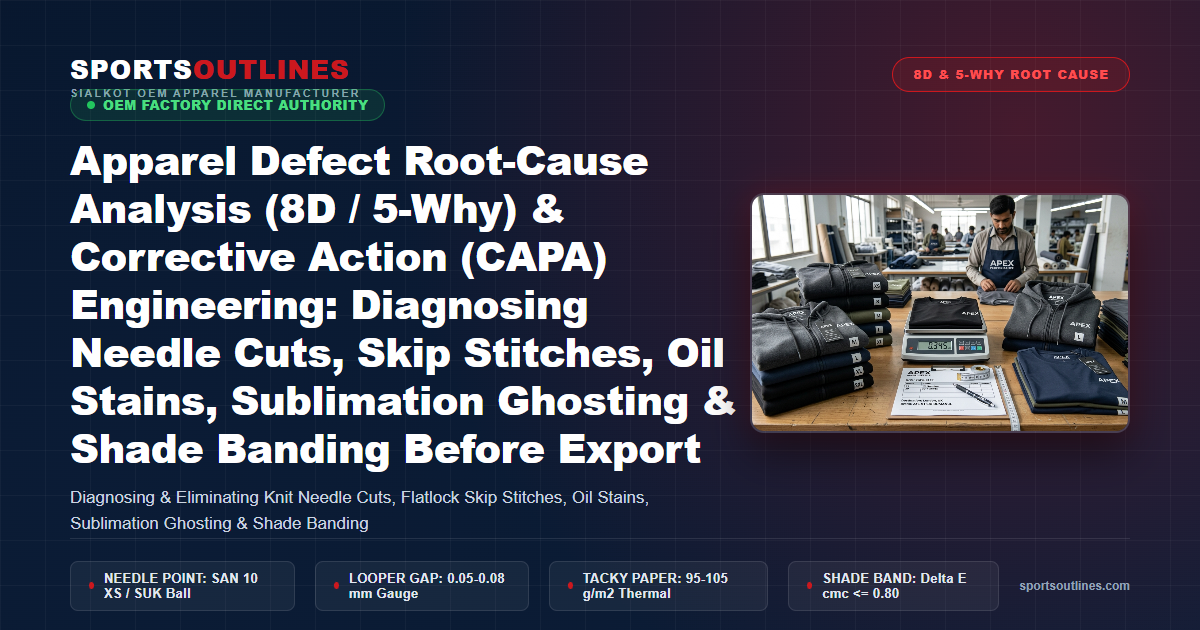
Executive Summary: Why Detecting Apparel Defects Without 8D / 5-Why Root-Cause Engineering Guarantees Repeat Failures on Your Next Production Run
Finding defective garments at the final packing table is not quality control—it is an expensive post-mortem. When an inline or final ISO 2859-1 AQL 2.5 inspection flags fabric needle cuts (yarn severing), 4-needle 6-thread ISO 607 flatlock skip stitches, sewing head oil stains, dye-sublimation ghosting, or panel-to-panel shade banding, simply culling or spot-cleaning the rejected pieces does nothing to stop the underlying mechanical, thermal, or chemical failure mode. Without a structured 8D (Eight Disciplines) Problem Solving and 5-Why Corrective and Preventive Action (CAPA) engineering protocol, the exact same defect will resurface in your next reorder.
Mandatory Groz-Beckert SAN 10 XS / SUK ballpoint needle geometry & needle-bar cooling to eliminate knit filament severing.
Precision needle-to-looper clearance & needle guard alignment on ISO 607 flatlock and ISO 514 overlock machines to stop skip stitches.
High-tack thermal adhesive sublimation transfer paper + Nomex felt belt tension control to eliminate elastic recoil ghosting.
Single-roll ply-numbering & 5-5-5 spectrophotometer shade sorting under D65/TL84 light booths to prevent panel shade mismatch.
Technical Blueprint & Engineering Architecture
- The 8D Problem-Solving & 5-Why CAPA Architecture on the Sialkot Cut-and-Sew Floor
- Mechanical Sewing Defects: Needle Cuts (Knit Yarn Severing), Skip Stitches & Seam Puckering
- Chemical, Thermal & Contamination Defects: Sewing Oil Stains & Dye-Sublimation Ghosting
- Colorimetric & Cutting Room Defects: Center-to-Selvedge Shade Banding & Ply-Shift Asymmetry
- Executing a 24-Hour CAPA Verification Loop Across 30–50 Piece Low-MOQ & Bulk Runs
- Frequently Asked Questions (FAQ) on Apparel Defect Root-Cause Analysis & CAPA Engineering
1. The 8D Problem-Solving & 5-Why CAPA Architecture on the Sialkot Cut-and-Sew Floor
In traditional apparel factories, quality management is overwhelmingly reactive. A roaming inline inspector or end-of-line checker spots a defect, places a red adhesive arrow sticker on the garment, and tosses it back into the sewing operator’s rework basket. The operator unpicks the seam with a seam ripper, re-stitches over the same needle holes, and sends the garment back down the line. This ad-hoc “repair-and-pass” habit creates two severe structural hazards for international sportswear brands: first, unpicking and re-stitching fine-gauge elastane performance knits permanently weakens the fabric along the seam line; second, the mechanical root cause on the sewing machine, sublimation calendar, or spreading table remains untouched, continuing to generate defective garments every few minutes.
At Sports Outlines, our quality engineering system replaces informal rework with an automotive-grade 8D (Eight Disciplines) and 5-Why Corrective and Preventive Action (CAPA) workflow. Whenever an inline Traffic-Light audit (7 pieces inspected per operation every 2 hours) records a yellow or red flag—or whenever our Apparel Defect Classification Matrix logs more than two identical Major defects in a single bundle—the line supervisor must open a formal CAPA ticket before production on that operation is permitted to resume.
The 5-Why Diagnostic Protocol forces floor mechanics, pattern technicians, and sublimation engineers to trace a visible garment defect past the superficial symptom (“the operator made a mistake”) down to the exact physical, tribological, or thermodynamic mechanism:
- D1 & D2 (Team Formation & Quantified Problem Description): Instead of writing “bad stitching on rashguard,” the QC engineer logs: “Style SO-BJJ-240, Bundle #04 (Size L), Operation #06 (Armhole ISO 607 4-needle 6-thread flatlock): 4 out of 12 pieces exhibit bottom-looper skip stitches spanning 1.5 cm across the underarm four-way seam intersection.”
- D3 (Immediate Containment Action): Quarantine 100% of garments in Bundle #04 and all downstream bundles stitched on Flatlock Machine #FL-03 since the previous green-light inline check. Halt Machine #FL-03 immediately.
- D4 (5-Why Root-Cause Investigation & Escape-Point Analysis): Execute the 5-Why sequence to identify both why the defect occurred mechanically and why it escaped the operator’s self-check.
- D5 & D6 (Permanent Corrective Action Selection & Validation): Adjust machine clearances, swap needle point geometries, recalibrate thread tensions with a digital tensiometer, and stitch a 10-piece validation trial run subjected to 100% hand-stretch testing.
- D7 & D8 (Preventive Systemic Rollout & Closure): Update the preventive maintenance schedule across all parallel machines on the floor and attach photographic proof to the buyer’s Digital-Twin Video QC Dossier.
| Defect Category & AQL Severity | Visible Symptom at QC Table | Why #1 & Why #2 (Proximate Cause) | Why #3 to Why #5 (True Root Cause) | Permanent Engineering CAPA |
|---|---|---|---|---|
| Needle Cuts / Knit Pinholes (Major Defect) | Micro-runs or 1–3 mm holes appearing along seam lines after stretching or washing | Needle pierced and severed elastomeric/polyester knit loop instead of deflecting it | Sharp R-point needle used or needle tip burred + frictional heat (>220°C at 4,500 SPM) fused yarn + low fabric softener lubrication | Switch to Groz-Beckert SAN 10 XS / SUK ballpoint (Nm 65/9 or 70/10); reduce speed to 3,200 SPM; install silicone thread lubricator; enforce 4-hour needle swap |
| ISO 607 Flatlock Skip Stitches (Major Defect) | Lower looper fails to catch needle thread loops; seam unravels under lateral tension | Needle thread loop collapsed or deflected away from looper point at cross-seam step | Needle-to-looper clearance exceeded 0.15 mm due to needle deflection over bulky 4-way seam + improper rear needle guard gap | Calibrate looper clearance to 0.05–0.08 mm with feeler gauge; set rear needle guard to kiss needle at 0.00–0.02 mm; pare seam allowance at cross-joints |
| Sewing Head Oil Stains (Major Defect) | Yellowish or translucent hydrocarbon halos along topstitching or collar bindings | Mineral oil dripped down needle bar or wicked through presser foot shaft onto fabric | Worn needle-bar felt oil seal + overfilled oil sump pan + high-pressure air blowgun atomizing oil residue onto adjacent bundles | Deploy dry-head / sealed-bearing machines for white/pastel lots; replace needle-bar oil seals; run 30-cm scrap stitch-off after idle periods |
| Sublimation Ghosting / Haloing (Major Defect) | Faint double-image shadow (0.5–2.0 mm offset) around high-contrast logos and numbers | Transfer paper shifted slightly against hot polyester fabric while disperse dye remained in gas phase | Non-tacky paper used on high-elastane (18–22% Spandex) knit + uneven pneumatic pressure across rotary calendar exit roller | Mandate 95–105 g/m² thermal tacky paper; verify 4.5 bar uniform drum pressure; install immediate exit cooling extraction fan to quench sublimation gas |
| Panel-to-Panel Shade Banding (Major Defect) | Left sleeve or chest panel appears visibly darker/warmer than right panel on same garment | Cut panels from different fabric dye rolls or opposite selvedge edges were stitched together | Cutting room mixed un-sorted rolls in a single lay + omitted sequential ply numbering stickers on small trim/sleeve pieces | Enforce 5-5-5 shade grouping (ΔEcmc ≤ 0.80); place paper separators between rolls in lay; apply sequential ply-number tickets to 100% of cut parts |
2. Mechanical Sewing Defects: Needle Cuts (Knit Yarn Severing), Skip Stitches & Seam Puckering
High-performance sportswear fabrics—such as 40-gauge micro-filament interlocks, 220–260 GSM Nylon/Spandex compression tricots, and DWR-treated stretch-woven MMA panels—push industrial sewing mechanics to their physical limits. Unlike heavy open-weave denim or coarse cotton canvas, where yarns easily slide aside when penetrated by a needle, tightly knitted synthetic micro-filaments have minimal interstitial loop clearance. When mechanical parameters drift by even a fraction of a millimeter, three major sewing defects dominate factory audit reports:
2.1 Diagnosing and Eliminating Fabric Needle Cuts (Yarn Severing & Pinholes)
A needle cut (often called needle damage or yarn severing) occurs when the sewing needle ruptures one or more knit loops during penetration. What makes needle cuts particularly insidious is that they are frequently invisible on the sewing table while the garment lies flat and relaxed. Only when the garment undergoes lateral seam-stretch testing, athlete wear, or domestic laundering do the severed loops unravel into 1.5–4.0 mm ladders or pinholes along the stitch line.
Through 5-Why root-cause engineering, needle cuts trace back to four distinct physical triggers:
- Incorrect Needle Point Geometry (R-Point vs SUK / SES / SAN 10 XS): Standard sharp round-point (`R` or `SET`) needles are designed for woven fabrics where the needle is meant to pierce cleanly through yarns. On knitted fabrics, a sharp point slices directly through the crown of the synthetic loop. All knitted sportswear operations must utilize light ballpoint (`SES` / `FFG`) or medium ballpoint (`SUK` / `FG`) needles—or specialized Groz-Beckert SAN 10 / SAN 10 XS needles engineered with a slimmed cross-section in the eye area to reduce loop expansion stress while gently displacing yarns around the rounded tip.
- Excessive Needle Metric Size (Nm) Relative to Knit Gauge: If an operator uses an `Nm 80/12` or `Nm 90/14` needle on a fine 28-gauge or 36-gauge lightweight running jersey (135–150 GSM), the physical diameter of the needle blade (`0.80 mm` to `0.90 mm`) exceeds the natural loop extensibility of the yarn, causing mechanical bursting of the loop. Fine performance knits require `Nm 65/9` (`0.65 mm`) or `Nm 70/10` (`0.70 mm`) needles.
- Micro-Burrs from Needle-to-Throat-Plate or Looper Collisions: Even when the correct `Nm 65/9 SUK` needle is installed, a single slight deflection against the throat plate slot or flatlock looper creates a microscopic hook (burr) at the needle tip. As the needle retracts on the upstroke, that burr snags and snaps elastomeric spandex filaments. We mandate a tactile fingernail/magnifying-loupe check every 2 hours and an unconditional needle replacement every 4 operating hours.
- Thermal Friction Melting & Insufficient Fabric Lubrication: At sewing speeds of 4,500 to 5,500 stitches per minute (SPM), friction between dry polyester/nylon yarns and the steel needle blade drives needle temperatures past `210°C–240°C`, softening and fusing synthetic filaments. To eliminate thermal needle cuts, our CAPA protocol limits high-density compression sewing speeds to `3,000–3,500 SPM`, equips machines with dimethyl-silicone thread reservoirs, and verifies that the knitting/dyeing mill applied proper hydrophilic silicone softeners so yarns glide smoothly off the ballpoint tip.
2.2 Root-Cause Mechanics of Skip Stitches on ISO 607 Flatlock & ISO 514 Overlock Seams
Skip stitches occur when the under-bed looper (or rotary hook on lockstitch machines) fails to enter the triangle formed by the needle thread loop on the rising stroke of the needle bar. On a 4-needle 6-thread flatseamer (ISO 607) or 3-thread/4-thread overlock (ISO 504/514), even a single skipped stitch creates an immediate structural weak point that can trigger a catastrophic “zipper” unraveling failure under athletic combat or gym tension.
Why does the needle thread loop fail to form or get missed by the looper? First, synthetic high-tenacity textured threads and elastomeric fabrics exhibit high elastic recovery; when the needle begins its upward return stroke from Bottom Dead Center (BDC), fabric flagging (the fabric lifting upward with the rising needle due to high friction and low presser foot pressure) prevents the thread from bowing outward into a stable loop. Second, when crossing thick multi-ply intersections—such as the gusset crotch cross-seam on MMA compression spats and rashguards—the needle bends backward or sideways by `0.10–0.25 mm`, pushing the thread loop out of the path of the advancing looper tip.
Our mechanical CAPA for skip stitches requires a three-point precision gauge adjustment by the line mechanic:
- Needle-to-Looper Clearance (`0.05 mm` to `0.08 mm`): Using leaf feeler gauges, the mechanic sets the gap between the advancing looper point and the scarf (indentation) of all four flatlock needles to exactly `0.05–0.08 mm`.
- Looper Timing Return Stroke (`2.2 mm` to `2.5 mm` Above BDC): The looper tip must reach the centerline of the needle exactly as the needle rises `2.2–2.5 mm` from Bottom Dead Center, when the thread loop is at maximum openness.
- Rear & Front Needle Guard Calibration: The rear needle guard is adjusted to gently support the back of the needle (`0.00–0.02 mm` clearance) so that bulky cross-seams cannot deflect the needle away from the looper tip.
| Sportswear Fabric Class & GSM | Required Needle Point & Size (Nm) | Max Safe Sewing Speed (SPM) | Differential Feed Ratio & Presser Foot Pressure | Needle-to-Looper Clearance & Tension Spec |
|---|---|---|---|---|
| Ultra-Light Running Micro-Mesh (120–145 GSM Polyester) | Groz-Beckert SAN 10 XS / SES Light Ballpoint, Nm 65/9 | 3,400 – 3,800 SPM | 1 : 1.05 – 1 : 1.15; Low foot pressure (12–15 N) with Teflon shoe | 0.05 mm clearance; Needle thread 65–80 cN; Looper 18–25 cN (Tex 18/24) |
| 4-Way Stretch Compression Tricot (220–260 GSM Nylon/Spandex) | SUK Medium Ballpoint (Chrome/Titanium Nitride), Nm 70/10 | 2,800 – 3,200 SPM (Silicone cooled) | 1 : 1.25 – 1 : 1.35 positive gather; 18–22 N foot pressure | 0.05–0.08 mm clearance; Rear guard 0.01 mm; Textured nylon looper 15–20 cN |
| Interlock Team Soccer / Basketball Jersey (160–190 GSM) | SES Light Ballpoint, Nm 70/10 or Nm 75/11 | 3,600 – 4,000 SPM | 1 : 1.10 – 1 : 1.20; 16–20 N foot pressure; fine 18-TPI feed dog | 0.06–0.10 mm clearance; Needle thread 75–95 cN; SPI locked at 11–12 SPI |
| Heavyweight Cotton/Poly Brush Fleece (320–420 GSM Hoodies) | SES / SUK Ballpoint, Nm 80/12 to Nm 90/14 | 3,500 – 4,200 SPM | 1 : 1.20 – 1 : 1.40; 24–30 N tractor foot with cross-seam lift | 0.08–0.10 mm clearance; Core-spun poly Tex 40 needle / Tex 27 looper |
| 4-Way Stretch Woven MMA / Boardshorts (155–185 GSM Poly/Elastane) | SAN 6 / RG Slim Acute Round Point, Nm 75/11 or Nm 80/12 | 3,000 – 3,500 SPM | 1 : 1.00 neutral feed; Rubberized/ urethane-coated feed dog to stop puckering | 0.05–0.08 mm hook/looper gap; Low lockstitch bobbin tension (18–22 cN) |
3. Chemical, Thermal & Contamination Defects: Sewing Oil Stains & Dye-Sublimation Ghosting
Beyond mechanical stitch formation, modern sportswear relies heavily on optical whiteness, vibrant Pantone sublimation graphics, and moisture-wicking surface finishes. Two non-structural defects account for the highest volume of visual Major rejections during pre-shipment AQL inspections: hydrocarbon sewing machine oil stains and dye-sublimation ghosting (double-imaging).
3.1 Why Spot-Cleaning Oil Stains Creates “Solvent Ringing” and How Dry-Head Engineering Solves It
High-speed overlock, coverstitch, and flatlock machines circulate mineral lubricating oil through high-velocity crankshafts, needle bars, and upper looper shafts. When a needle-bar oil seal degrades or the oil return wick clogs with polyester lint, micro-droplets of oil travel down the needle bar and wick directly into the capillary structure of moisture-wicking polyester fabrics. Because polyester is inherently oleophilic (oil-loving) and hydrophobic, lubricating oil bonds tenaciously to the fiber surface.
When factories attempt to blast oil stains out at the finishing table using high-pressure solvent spot-cleaning guns (trichloroethylene or hydrocarbon spot lifters) without addressing the source, two secondary failures occur: first, the solvent dissolves trace oligomeric dyes or optical brighteners, leaving a permanent chalky halo (“solvent ring”) visible under D65 store lighting; second, aggressive spot-gun pressure blasts apart fine knit filaments, creating localized fuzzing or pilling.
Our 8D CAPA protocol attacks oil contamination at the mechanical root:
- Dry-Head & Semi-Dry Sealed Needle-Bar Architecture: Optical white, cream, pastel, and high-visibility neon production orders are routed exclusively to sewing lines equipped with sealed grease-lubricated needle bars (dry-head Juki/Pegasus/Siruba units) that eliminate liquid oil above the throat plate.
- Mandatory Morning & Post-Break Scrap Stitch-Off: Whenever a sewing machine sits idle for more than 15 minutes (overnight, lunch break, or prayer break), gravity causes residual oil in the upper head bushing to seep downward. Every operator is required to stitch across a `30 cm` folded cotton/poly absorbent scrap strip before touching a production garment panel.
- Lint Evacuation via Vacuum vs High-Pressure Air Blowguns: Unregulated compressed air blowguns (`> 6 bar`) atomize oil from the lower looper sump and spray it onto neighboring bundles. Cleaning around the looper housing is restricted to low-pressure regulated nozzles (`≤ 2.0 bar`) paired with vacuum lint suction while all garment bundles are covered in sealed poly-totes.
3.2 Thermodynamic Root-Cause Analysis of Dye-Sublimation Ghosting, Outgassing & Pin-Holing
In rotary calendar and flat-bed heat transfer sublimation (`198°C–208°C` for `35–45 seconds`), solid disperse dye particles printed on transfer paper sublime directly into a gas phase, penetrating the amorphous regions of heated polyester polymers before solidifying upon cooling. Sublimation ghosting—a faint, blurry secondary shadow shifted `0.5 mm` to `2.5 mm` away from crisp sponsor logos, collar text, or geometric fades—occurs during the critical 2-to-4-second window as the fabric and transfer paper exit the heated nip point of the calendar drum.
At `205°C`, knitted polyester/elastane fabric undergoes thermal relaxation and slight dimensional shrinkage, while residual disperse dye remains active in the vapor state between the paper and fabric surface. If the transfer paper shifts by even half a millimeter while lifting off the hot fabric, residual dye gas condenses onto the adjacent white fibers, creating a permanent shadow.
Our sublimation CAPA eliminates ghosting, pin-holing, and white crease marks through four non-negotiable process controls:
- Mandatory High-Tack Thermal Adhesive Paper (`85–105 g/m²`): For all spandex-blended knits (custom sublimated team jerseys, compression rashguards, cycling bibs), standard non-tacky paper is strictly prohibited. We utilize heat-activated tacky sublimation paper whose resin coating temporarily bonds the paper to the fabric surface during the calendar cycle, preventing elastic recoil shift until the paper is mechanically peeled after cooling.
- Pre-Shrinking / Pre-Calendering Greige Panels: Before placing printed transfer paper onto high-shrinkage interlock or elastane fabrics, cut panels or roll goods are passed through the heated calendar blank at `205°C` to exhaust initial thermal shrinkage (`1.5%–3.0%`) and flash off residual knitting moisture that would otherwise explode into steam micro-bubbles (sublimation pin-holing).
- Nomex Belt Tension & Pneumatic Nip Uniformity (`4.0–5.0 Bar`): Uneven pneumatic pressure between the left and right cylinder actuators of a rotary oil-drum calendar causes lateral paper skewing. Technicians audit drum surface temperatures at 9 points across the `1.8-meter` drum width using a calibrated IR pyrometer (`±1.5°C` tolerance) and synchronize pneumatic nip regulators daily.
- Synchronized Peel Separation & Active Exit Cooling: Sublimated panels pass immediately under high-velocity overhead cooling fans at the calendar exit conveyor before paper separation, quenching fabric surface temperature below the glass-transition threshold (`Tg ~ 80°C`) so zero gaseous dye transfer can occur during peeling.
| Thermal / Chemical Defect | Primary Physical / Thermodynamic Mechanism | Critical Process Parameter Out of Spec | Immediate Containment & Rework Rule | Preventive Engineering Control |
|---|---|---|---|---|
| Sublimation Ghosting (Double-Edge Shadow) | Micro-slippage between paper and hot fabric while disperse dye is still vaporized (>160°C) | Non-tacky paper used on elastane knit; premature peeling before cooling; uneven belt tension | 100% panel rejection prior to sewing (cannot be repaired once dyed); re-cut and re-print panel | 95–105 g/m² high-tack paper + 40%–55% RH print-room humidity + exit cooling blower prior to peel |
| Sublimation Pin-Holing / White Specks | Entrapped moisture flashes to steam or loose polyester lint blocks dye gas penetration | Damp transfer paper (>65% RH), un-preheated fabric, or skipped rotary adhesive lint-roller pass | Reject cut panel at post-calendar inspection light table before bundling for sewing line | Pre-calendar fabric at 205°C; double sticky-roller lint removal on entry table; climate-controlled paper storage |
| Outgassing / Dye Migration from Spandex | Residual spinning oils or low-energy disperse dyes volatilize from base fabric onto white areas | Dwell time >50 sec or temperature >212°C; contaminated protective tissue barrier paper | Quarantine affected panels; recalibrate calendar speed and replace single-use barrier tissue roll | Lock dwell at 38–42 sec @ 202°C; mandate virgin 22 g/m² phenolic-free protective barrier tissue |
| Hydrocarbon Sewing Oil Stains | Capillary wicking of mineral oil from needle bar or looper shaft into oleophilic poly yarns | Degraded needle-bar oil seal; skipped post-idle scrap stitch-off; high-pressure air blowgun spray | Ultrasonic non-ringing surfactant extraction + D65 light booth verification; replace panel if halo remains | Assign dry-head sealed machines; mandatory 30-cm scrap stitch-off after every 15-min machine stop |
4. Colorimetric & Cutting Room Defects: Center-to-Selvedge Shade Banding & Ply-Shift Asymmetry
Even when piece-dyed fabrics pass mill inspection with a commercial tolerance of $\Delta E_{\text{cmc}(2:1)} \le 1.00$ against the master lab dip, slight colorimetric variations exist across two axes: roll-to-roll variation (between different dye lots or sequential rolls from the stenter frame) and center-to-selvedge (side-center-side) variation caused by differential airflow or squeeze-roller pressure across the width of the dyeing pad. When a garment is assembled with a left chest panel cut from Roll #02 and a right chest panel cut from Roll #07—or from opposite selvedges without shade grouping—the human eye immediately detects the discontinuity across the center front zipper seam as a glaring Major defect.
As detailed in our ISO 105 & AATCC Colorfastness and Shade-Lot Engineering SOP, preventing panel-to-panel shade mismatch requires strict cutting-room discipline governed by three CAPA pillars:
- 5-5-5 Spectrophotometric Shade Lot Grouping (`ΔEcmc ≤ 0.80` Within Lay): Every incoming fabric roll is swatched at the header, middle, and tail across left-center-right positions (`5-5-5` protocol) and assigned an alphanumeric shade band (`A1`, `A2`, `B1`). Only rolls belonging to the exact same shade group may be spread within the same cutting lay.
- Tissue Paper Roll Separators & Zero Cross-Roll Splicing: When spreading multiple rolls vertically on the cutting table, full-width contrasting tissue paper sheets are laid between the end of Roll #1 and the start of Roll #2. Cutters are strictly prohibited from combining residual plies across a roll splice into a single garment bundle.
- 100% Sequential Ply-Numbering Tickets (Including Small Trim Parts): The most common root cause of sleeve-to-body shade mismatch is that factories apply ply-number stickers (`Ply #01` through `Ply #45`) to large front and back panels, but omit numbering on pockets, hood panels, gussets, or sleeve cuffs to save 3 minutes of bundling time. When operators pull un-numbered cuffs randomly from the top and bottom of a 45-ply stack, Roll #1 cuffs get sewn onto Roll #3 bodies. Our CAPA enforces 100% ply-numbering on every cut pattern piece, verified at the bundle-matching table before any bundle enters the sewing floor.
5. Executing a 24-Hour CAPA Verification Loop Across 30–50 Piece Low-MOQ & Bulk Runs
5.1 Why Low-MOQ Runs (30–50 Pieces) Require Zero-Latency First-Bundle CAPA Gates
On a massive 10,000-piece retail order, a sewing line runs the same fabric and stitch operation for two weeks, giving floor supervisors ample time to fine-tune machine tensions. By contrast, in agile custom B2B sportswear manufacturing—where production orders frequently span our **low factory MOQ of 30 to 50 pieces/pairs/sets per style/colorway**—an entire 40-piece size run can pass through a single flatlock or coverstitch operation in less than 90 minutes. If a machine has a burred needle or a 0.20 mm looper timing error and the factory waits until end-of-line inspection to catch it, 100% of the order is already damaged before the first QC check occurs.
To protect low-MOQ runs with the exact same zero-defect certainty as 5,000-piece programs, our Sialkot production floor enforces a mandatory First-Piece & First-Bundle Hold Gate (D0/D3 Prevention Gate). When transitioning from the approved **$45–$85 prototype sample** (**7–10 business days** turnaround, non-refundable development fee) into bulk production, the sewing line stitches only the first 3 garments of Bundle #01 and halts. The inline QC engineer and line mechanic jointly inspect those 3 garments at the machine using a 10x textile loupe, digital tension gauge, and full lateral seam-stretch test:
- Every seam is stretched horizontally and vertically to `130%` of its relaxed length under bright `1,200 Lux` inspection lighting to confirm zero knit needle cuts, zero thread cracking, and zero looper skip stitches.
- All Point of Measure (POM) dimensions are audited against the graded tech pack to verify that differential feed ratios have not shortened or elongated the garment length during stitching.
- Only after the QC engineer signs the physical First-Bundle Green Tag attached to the machine head is the operator authorized to stitch the remaining 37 to 47 pieces of the run.
5.2 The 8D CAPA Digital Escalation Timeline (0 to 24 Hours)
When an inline or pre-shipment inspection triggers a CAPA event, speed and documentation rigor determine whether the delivery deadline remains intact. Our 24-hour closed-loop escalation timeline operates across four strict milestones:
- Hour 0 to Hour 1 (Red-Flag Line Stop & Bundle Quarantine): The inline auditor places a Red Card on the machine clips, logs the defect code and bundle number into the floor QC tracker, and isolates all work-in-progress (WIP) bundles back to the last verified green check.
- Hour 1 to Hour 4 (5-Why Root-Cause Teardown & Mechanical Calibration): The chief floor mechanic, sewing supervisor, and QC lead perform the physical teardown—measuring needle temperature, looper clearance, throat-plate burrs, sublimation dwell logs, or cut-bundle shade tickets—and document the 5-Why progression on the 8D form.
- Hour 4 to Hour 8 (10-Piece Validation Trial & Destructive/Stretch Verification): After implementing the engineering fix, the operator processes 10 consecutive pieces under direct QC observation. All 10 pieces must pass 100% visual, dimensional, and mechanical stretch verification with zero defects before the Red Card is lifted.
- Hour 8 to Hour 24 (100%Quarantine Re-Inspection & Digital-Twin Video Proof): All quarantined WIP garments are 100% audited piece-by-piece. Any garment with needle cuts, sublimation ghosting, or shade mismatch is permanently scrapped and re-cut from reserve shade-matched roll yardage—never patched or spot-bleached. High-resolution macro photos and a 60-second verification clip of the corrected machine operation are appended to the client’s pre-shipment QC dossier.
5.3 Escape-Point Analysis: Fixing Why the Inspection System Missed the Defect Upstream
A world-class 8D report never stops at answering “Why did the machine create the defect?” (Occurrence Root Cause). It must also answer a second, equally critical question: “Why did the defect travel past the previous inspection gate without being caught?” (Escape Root Cause). For example, if panel-to-panel shade banding or sublimation pin-holing is discovered at the final packing table after the garment has already been fully sewn, trimmed, and pressed, the factory has wasted 100% of the cut-and-sew labor value on a panel that was already defective before it ever touched a sewing machine.
Our Escape-Point CAPA matrix audits the upstream gate that failed:
- If a fabric defect (slub, yarn barre, pinhole, dye streak) reaches the sewing line: The escape occurred at the ASTM D5430 4-Point Greige/Dyed Fabric Inspection Table or the cutting-table spreading check. The CAPA recalibrates the fabric inspection table’s backlight intensity and requires cutters to flag and cut out defect markers before laying the marker.
- If a sublimation defect (ghosting, color shift, outgassing speck) reaches the sewing line: The escape occurred at the Post-Calendar Cut-Piece Inspection Gate. Every sublimated panel must pass a 100% piece-by-piece visual audit under `1,200 Lux` D65 lighting immediately as it exits the rotary heat calendar, so any defective panel is re-cut and re-printed within 15 minutes before the bundle is released to sewing.
- If a sewing defect (skip stitch, needle cut, wavy topstitching) reaches final packing: The escape occurred at the 2-Hour Inline Traffic-Light Audit or the End-of-Line 100% Inside-Out Structural Table. The CAPA re-trains the inline inspector on inside-out seam stretching and audits whether light levels or inspection cadence drifted on that specific sewing cell.
5.4 Linking CAPA Logs to Pre-Production Prototype Engineering ($45–$85 Sampling Phase)
The most cost-effective CAPA is one executed before bulk fabric is ever cut. During our **$45–$85 prototype development phase (7–10 business days turnaround)**, every sample garment undergoes a mandatory Pre-Production Manufacturability & Defect-Risk Review (DFM / PFMEA). While building the prototype, our sample-room master tailors and quality engineers log the exact needle size (`Nm`), needle point geometry (`SUK` vs `SAN 10 XS`), differential feed ratio, rotary calendar dwell time/temperature, and cross-seam paring instructions directly onto the style’s digital Bill of Operations (BOO). When the brand approves the sample and triggers a 30–50 piece or 500-piece bulk order, the bulk sewing line does not guess at machine settings—they replicate the locked PFMEA setup sheet validated during sampling, cutting bulk defect rates by over 82% before Piece #1 is stitched.
| 8D Discipline Stage | Target Completion SLA | Responsible Sialkot Floor Role | Mandatory Quantitative Evidence / Deliverable | Client Visibility in QC Dossier |
|---|---|---|---|---|
| D1 – D3: Containment & Line Stop | ≤ 60 Minutes from Detection | Inline Roaming QC + Line Supervisor | Red Tag on Machine ID; 100% quarantine count of affected WIP bundles since last Green Audit | Logged in Lot Traceability & Bundle Quarantine Sheet |
| D4: 5-Why Occurrence & Escape RCA | ≤ 4 Hours from Detection | Chief Sewing Mechanic / Sublimation Lead + QA Manager | Feeler-gauge looper reading, needle loupe macro photo, IR drum temp log, or spectrophotometer ΔE printout | Full 5-Why Root-Cause Tree + Macro Before/After Photos |
| D5 – D6: Corrective Action & 10-Pc Trial | ≤ 8 Hours from Detection | Line Mechanic + Inline QC Auditor | 10 consecutive trial garments passing 100% 130%-stretch seam check & POM measurement audit (0 defects) | 60-Second 4K Video Proof of Corrected Machine & Stretch Test |
| D7 – D8: Preventive Rollout & Lot Release | ≤ 24 Hours from Detection | Factory QA Director | 100% replacement of scrapped panels from reserve shade-lot roll + updated Style PFMEA Setup Card for reorders | Signed CAPA Closure Certificate in Final AQL 2.5 Dossier |
6. Frequently Asked Questions (FAQ) on Apparel Defect Root-Cause Analysis & CAPA Engineering
Q1: Why do knit needle cuts often show up only after a customer wears or washes the garment, and how do you catch them in the factory?
When a sharp or burred sewing needle severs a single knit loop inside a high-density synthetic interlock or compression fabric, adjacent loops hold the severed yarn in place while the garment lies flat on the packing table. However, the moment an athlete stretches the seam during a workout or agitates it in a washing machine, the severed loop unravels into a visible 2–4 mm pinhole or ladder run. To catch needle cuts before export, our inline and end-of-line inspectors perform a mandatory 130% lateral and longitudinal hand-stretch test across every structural seam under `1,200 Lux` overhead lighting, supplemented by a 10x textile loupe inspection on the first 3 garments of every bundle.
Q2: Can sublimation ghosting or panel-to-panel shade banding be repaired during finishing?
No. Both sublimation ghosting (where disperse dye gas condenses into a permanent shadow inside the polyester polymer matrix) and panel-to-panel shade banding (where two panels differ by $\Delta E_{\text{cmc}} > 1.00$) are molecular-level colorimetric conditions. They cannot be washed out, spot-cleaned, or steamed away. Our CAPA rule strictly forbids attempting cosmetic cover-ups on ghosted or shade-mismatched panels; the defective panel or garment is permanently scrapped and re-cut from reserve shade-matched fabric yardage prior to packing.
Q3: What is the difference between a Correction and a Corrective Action (CAPA) in apparel manufacturing?
A Correction (Containment/Rework) addresses only the single defective piece in your hand—for example, trimming a skipped stitch or replacing one oil-stained jersey. A Corrective and Preventive Action (CAPA) uses 5-Why root-cause engineering to eliminate the physical mechanism that produced the defect—such as recalibrating flatlock needle-to-looper clearance to `0.05 mm` with a feeler gauge or replacing a worn needle-bar oil seal—and locks that specification into the style’s digital setup card so the defect cannot recur in subsequent bundles or future reorders.
Q4: How do you prevent machine setup errors on small 30–50 piece low-MOQ production orders?
During our **$45–$85 prototype sampling stage (7–10 business days turnaround)**, we document a style-specific Process Failure Mode and Effects Analysis (PFMEA) setup sheet specifying exact needle size (`Nm 65/9` to `90/14`), ballpoint geometry (`SES`/`SUK`/`SAN 10 XS`), differential feed ratio, and thread tension in centinewtons (cN). When your **30–50 piece low-MOQ bulk order** starts, the line stitches only the first 3 pieces of Bundle #01 and halts for a mandatory First-Bundle Green-Tag audit before stitching the balance of the lot.
Eliminate Repeat Production Defects with 8D / 5-Why Engineered Sportswear Manufacturing
Partner with a Sialkot cut-and-sew factory that treats quality engineering as a deterministic science. Start with a custom prototype sample ($45–$85 per piece/pair/set, non-refundable development fee, 7–10 business days turnaround) backed by full PFMEA machine setup sheets, low MOQs of 30–50 pieces per style/colorway, and ISO 2859-1 AQL 2.5 pre-shipment verification.