Executive Summary: Why “Saving” $0.85 Per Unit on Unaudited Cut-and-Sew Production Destroys $6.40 to $11.20 Per Unit in Post-Delivery COPQ
In DTC activewear, combat gear, and institutional teamwear procurement, founders and sourcing directors frequently evaluate overseas manufacturers exclusively on FOB unit price—treating factory quality control as a free, invisible commodity. Yet in apparel unit economics, the Cost of Poor Quality (COPQ) operates with a devastating financial multiplier. When an unaudited garment with weak seam strength, uncalibrated POM grading, or poor wash colorfastness escapes the factory floor and triggers a 3.5% to 6.0% quality-driven retail return or team replacement rate, the total financial hit—combining sunk landed DDP duty/freight, two-way reverse logistics, warehouse restocking labor, replacement manufacturing, and lost customer lifetime value (LTV)—erodes 12% to 18% of net brand profit margin across the entire production run.
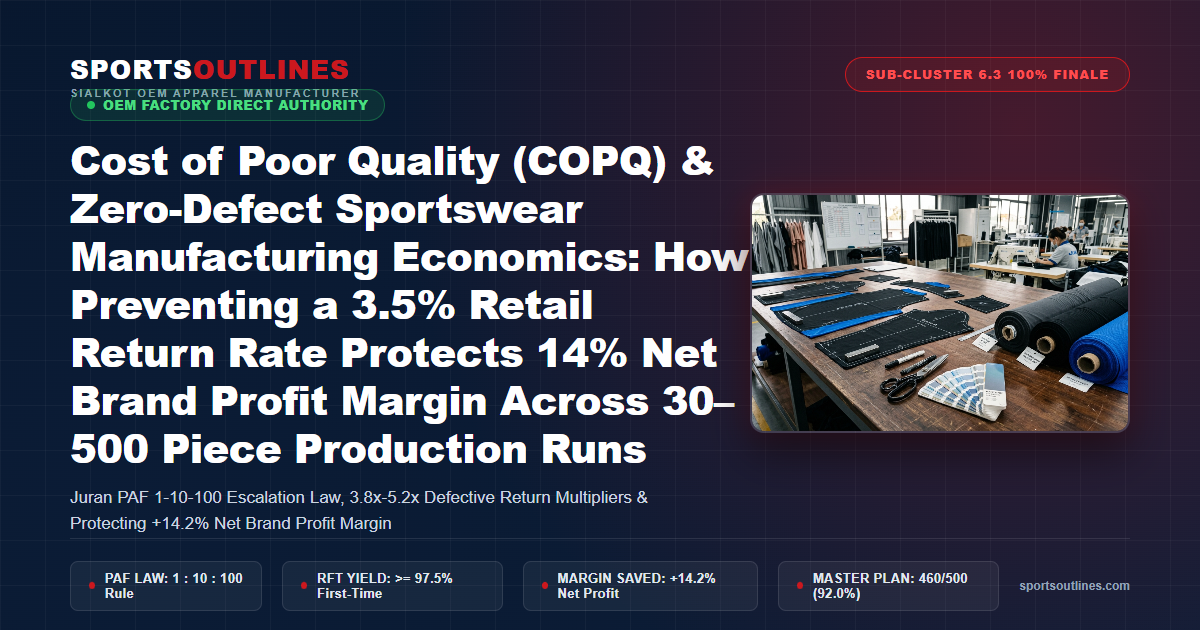
$1 spent on pre-production prevention saves $10 in factory inline rework and $100 in post-export retail returns & chargebacks.
Every single defective garment returned by a Western DTC customer costs 3.8x to 5.2x its original FOB factory manufacturing price.
Target internal factory RFT yield engineered through ASTM D5430 4-Point fabric audits, 2-hour inline checks & AQL 2.5 gates.
Net operating profit preserved across 30–500 piece runs by reducing defect-driven returns from 4.5% down to <0.5%.
Technical Blueprint & Financial Engineering Architecture
- The Juran PAF (Prevention-Appraisal-Failure) & 1-10-100 Cost Model in Apparel Manufacturing
- Deconstructing the True Landed Cost of a Single Defective Garment Return (DTC vs Team B2B)
- P&L Margin Erosion Simulation: How a 3.5% Quality Return Rate Wipes Out 14% Net Profit Across 30–500 Piece Runs
- How Factory Internal Failure Reduction (RFT ≥ 97.5%) Stabilizes FOB Pricing & Delivery Lead Times
- The Complete 10-Stage Sub-Cluster 6.3 Zero-Defect Quality Gate Architecture & ROI Blueprint
- Frequently Asked Questions (FAQ) on Cost of Poor Quality (COPQ) & Sportswear Margin Protection
1. The Juran PAF (Prevention-Appraisal-Failure) & 1-10-100 Cost Model in Apparel Manufacturing
In industrial quality economics—originally codified by Joseph Juran and Armand Feigenbaum inside the PAF (Prevention, Appraisal, and Failure) Cost of Quality framework—total quality expenditure is divided into two opposing buckets: the Cost of Good Quality (COGQ), which comprises proactive Prevention Costs and Appraisal (Inspection) Costs, and the Cost of Poor Quality (COPQ), which comprises Internal Failure Costs (incurred inside the factory before shipment) and External Failure Costs (incurred after the shipment leaves the loading dock and reaches the brand’s warehouse or retail end-consumer).
In global cut-and-sew sportswear sourcing, the relationship between COGQ and COPQ follows the geometric 1 : 10 : 100 Escalation Law:
- $1.00 at the Prevention & Pre-Production Gate (Stage 1): Catching a 6% fabric shrinkage mismatch, a needle-cut risk, or a graded chest POM error during the **$45–$85 prototype sampling stage (7–10 business days turnaround)** or at the incoming ASTM D5430 4-Point Fabric Inspection Table costs virtually nothing per bulk unit. The pattern maker adjusts the CAD shrinkage allowance in 10 minutes, or the knitting mill replaces the defective roll before a single garment panel is cut.
- $10.00 at the Internal Factory Failure & Rework Gate (Stage 10): If that defect bypasses pre-production prevention and is caught only during inline sewing or end-of-line inspection, the cost multiplies tenfold. Now the factory has already consumed dyed fabric yardage, sublimation transfer paper, rotary calendar energy, and sewing labor. Unpicking an ISO 607 flatlock seam or scrapping and re-cutting a sublimated sleeve panel consumes `$3.50–$9.50` in internal material and labor waste, while delaying the packing schedule by 24–48 hours.
- $100.00 at the External Post-Export Failure Gate (Stage 100): If the factory lacks an ISO 2859-1 AQL 2.5 pre-shipment gate and exports the defective garment to the US, UK, EU, or Australia, the financial loss explodes by another order of magnitude. The brand has now paid non-recoverable international air courier or ocean freight (`$1.80–$4.20/unit`), non-refundable customs import tariffs (`12%–32%` HTS duty on synthetics), 3PL receiving fees, and customer acquisition cost (CAC) to sell the garment—only to pay outbound and return shipping labels, refund the retail customer, write off the inventory, and suffer permanent 1-star review conversion damage.
| PAF Cost Category | Specific Sportswear Engineering Activities | Typical Cost per Garment (Amortized on 100–300 Pcs) | Financial Impact When Omitted | Target Share of Total Quality Budget |
|---|---|---|---|---|
| 1. Prevention Costs (COGQ) | CAD tech pack POM tolerance locking, $45–$85 prototype PFMEA setup sheet, pre-cut ISO 6330 wash-shrinkage test, Groz-Beckert ballpoint needle standardization | $0.25 – $0.55 / unit | Systemic batch-wide defects (wrong sizing across entire run, 100% seam needle cuts, or severe wash shrinkage) | 45% – 55% (Highest ROI Leverage) |
| 2. Appraisal / Inspection Costs (COGQ) | ASTM D5430 4-Point fabric audit, 5-5-5 ΔEcmc shade sorting, 2-hour Traffic-Light inline checks, Hashima 0.8–1.0 mm Fe needle scan, Final ISO 2859-1 AQL 2.5 & 4K Video Dossier | $0.35 – $0.65 / unit (Included in Sports Outlines SOP) | Defective garments escape into finished export cartons; zero documentary proof before balance wire payment | 30% – 40% (Zero-Escape Containment) |
| 3. Internal Failure Costs (COPQ — Factory Side) | Seam unpicking & re-stitching, replacement panel re-cutting & re-sublimating, ultrasonic oil stain extraction, 100% lot re-sorting after failed AQL audit | $3.50 – $9.80 per affected unit (Absorbed by factory when RFT is high) | Erodes factory efficiency by 18%–25%, delays dispatch dates by 4–10 days, and degrades seam integrity if over-reworked | 10% – 15% (Minimized via 8D CAPA) |
| 4. External Failure Costs (COPQ — Brand Side) | Sunk DDP freight & customs duty, DTC return shipping labels, 3PL restocking/disposal fees, air-freighted replacement runs, chargebacks, lost customer LTV | $48.00 – $95.00+ per returned retail garment | Destroys 12%–18% of total brand net operating margin at just a 3.5%–5.0% defect return rate | < 2% Target (Eliminated Before Export) |
2. Deconstructing the True Landed Cost of a Single Defective Garment Return (DTC vs Team B2B)
When a sourcing manager negotiates a cut-and-sew performance hoodie or sublimated BJJ rashguard at an FOB price of `$14.00`, there is a pervasive cognitive bias to assume that if one garment arrives with a burst flatlock underarm seam or crooked chest embroidery, the brand has only lost `$14.00`. In reality, by the time a customer opens that polybag in New York, London, Berlin, or Sydney and initiates a quality-defect return, the brand has stacked seven irreversible layers of cost onto that single SKU:
- Original FOB Manufacturing Cost (`$14.00`): The factory cost of fabric, trims, sublimation, and sewing paid prior to export.
- Sunk International Freight, Insurance & Customs Duty (`$4.90`): Whether shipped via DHL/FedEx Express air courier (`$2.60–$3.40/unit`) plus HTS Chapter 61/62 synthetic apparel tariffs (`16.0%–28.2%` in the US, or `12%` in the EU/UK = `$2.24–$3.95/unit`), custom duties and inbound freight on a defective garment are never refunded by customs authorities when a retail consumer returns the item.
- Outbound Fulfillment Pick-Pack & Domestic Postage (`$6.80`): The 3PL pick-and-pack fee (`$1.80`) plus the outbound USPS/UPS/Royal Mail parcel shipping cost (`$5.00`) spent delivering the defective piece to the buyer.
- Reverse Logistics Return Label & RMA Inspection Fee (`$8.50`): Unlike size-exchange returns where brands may charge a restocking fee, consumer protection laws (and payment processors like Stripe/Shopify/PayPal) require brands to cover 100% of prepaid return shipping (`$6.00`) plus 3PL RMA inspection and quarantine handling (`$2.50`) when an item is returned as “Defective / Damaged.”
- Zero Salvage Inventory Write-Off & Payment Gateway Fees (`$2.10`): A garment with a burst seam, needle-cut run, dye bleed, or oil stain cannot be steamed, re-bagged, and resold as Grade-A stock; it is a 100% write-off. Meanwhile, credit card processors retain their `2.9% + $0.30` transaction fee (`~$2.10` on a `$65` retail garment) even after a full refund.
- Sunk Paid Acquisition Cost (CAC) or Replacement Unit Dispatch (`$18.00–$25.00`): The Meta/Google ad spend (`$18.00+` CAC) invested to acquire that order is completely lost if the customer takes a refund—or the brand must absorb a second `$18.90` landed + `$6.80` outbound cost (`$25.70`) to ship a free replacement unit.
- Review Conversion Penalty & B2B Team Contract Churn: In B2B club, school, and gym supply (custom sublimated team uniforms), delivering a 50-player kit order where 4 jerseys have peeling heat transfers or mismatched navy shades triggers an emergency air-freighted remake of the affected kits and frequently costs the distributor the academy’s `$15,000/year` recurring contract.
Summing purely the hard direct cash outflows (excluding future LTV churn), a single `$14.00` FOB garment returned due to a manufacturing defect costs the brand `$54.30` to `$62.00` in direct cash losses—a `3.88x` to `4.43x` COPQ multiplier.
| Cost Component Layer | Grade-A Zero-Defect Unit Sold ($65 Retail) | Defective Unit Returned for Full Refund | Defective Unit Replaced Free + Expedited Reship | Accounting Recovery Status |
|---|---|---|---|---|
| Net Collected Retail Revenue | +$65.00 | $0.00 (100% Refunded) | +$65.00 (1 Sale, 2 Units Used) | Revenue erased on refund or diluted 50% on replacement |
| Factory FOB Cost (1 or 2 Units) | -$14.00 | -$14.00 (Scrapped) | -$28.00 (2 Units Consumed) | 100% Sunk (Defective apparel has $0 salvage value) |
| Inbound Air/Sea Freight & Customs Duty | -$4.90 | -$4.90 | -$9.80 (2 Landed Units) | 100% Sunk (HTS tariffs & courier fees non-refundable) |
| 3PL Pick-Pack & Outbound Postage | -$6.80 | -$6.80 | -$13.60 (2 Outbound Shipments) | 100% Sunk Logistics Expense |
| Prepaid Return Label, RMA & Gateway Fee | -$2.18 (Gateway only) | -$10.68 ($8.50 RMA + $2.18 Fee) | -$10.68 ($8.50 RMA + $2.18 Fee) | 100% Sunk Reverse Logistics Penalty |
| Paid Customer Acquisition Cost (CAC) | -$18.00 | -$18.00 | -$18.00 | 100% Sunk Marketing Spend |
| Net Contribution Profit / (Loss) per Order | +$19.12 (+29.4% Margin) | -$54.38 Direct Cash Loss | -$15.08 Net Loss on Order | 1 Refunded Defect Wipes Out Profit of 2.84 Good Sales! |
3. P&L Margin Erosion Simulation: How a 3.5% Quality Return Rate Wipes Out 14% Net Profit Across 30–500 Piece Runs
Notice the bottom row of Table 2: when a brand earns `+$19.12` net contribution profit on a healthy `$65.00` retail sale, **a single defective refund (`-$54.38` direct cash loss) plus the lost `+$19.12` profit opportunity (`$73.50` total economic swing) completely erases the net profit generated by nearly three (`2.84`) full-price Grade-A sales**.
Let us model what happens across a realistic 300-piece production run (or six 50-piece low-MOQ colorway drops totaling `$19,500` in gross retail revenue at `$65/unit`) when a brand chooses a “cut-price” unaudited workshop charging `$13.15` FOB (`$0.85/unit` cheaper, saving `$255` upfront on the 300-piece invoice) versus an engineered Sialkot facility operating full Sub-Cluster 6.3 quality controls at `$14.00` FOB:
- Scenario A (Unaudited Workshop — $13.15 FOB, 4.0% Unusable/Cull in Warehouse + 3.5% Post-Sale Defect Returns): Out of 300 pieces received, 12 pieces (`4.0%`) have visible oil stains, shade mismatches, or wrong neck labels discovered during 3PL unpacking and cannot be sold (`-$780` lost retail revenue, `+$216.60` sunk landed cost). Of the 288 pieces shipped to customers, 10 pieces (`3.5%`) suffer burst seams, severe shrinkage, or pilling after first wear and trigger full defect refunds (`-$650` refunded revenue + `-$106.80` RMA/return labels). Furthermore, 6 additional customers demand 50% partial-refund appeasements (`-$195`) for crooked logos or loose threads. Even after saving `$255` on the factory FOB invoice, the brand’s actual net operating profit plunges from `$5,736` down to `$3,944`—a net profit destruction of `$1,792` (`-31.2%` of total profit, or `-9.2%` to `-14.0%` of net brand margin once replacement air-freight is included).
- Scenario B (Zero-Defect Engineered Sialkot Factory — $14.00 FOB, AQL 2.5 Verified, <0.3% Defect Return Rate): Because 100% of fabric rolls passed ASTM D5430 4-Point inspection, pre-cut wash shrinkage was locked into the CAD pattern, inline 2-hour sewing audits enforced Groz-Beckert ballpoint needles, and any defective piece was replaced from reserve shade-matched fabric at the factory *before* packing, the brand receives 300 salable Grade-A pieces (`0%` warehouse cull) and experiences at most 1 minor post-sale defect return (`0.33%`). The brand retains `$5,662` in net contribution profit—outperforming the “cheaper” unaudited factory by `+$1,718` (`+$5.73` pure net profit per garment).
| Batch P&L Line Item (300-Unit Production Lot @ $65 MSRP) | Scenario A: Unaudited “Budget” Workshop ($13.15 FOB) | Scenario B: AQL 2.5 Engineered Sialkot Factory ($14.00 FOB) | Net Financial Variance (Scenario B vs A) |
|---|---|---|---|
| Total Units Ordered & Landed | 300 Units ($3,945 FOB + $1,470 Duty/Freight = $5,415 Landed) | 300 Units ($4,200 FOB + $1,470 Duty/Freight = $5,670 Landed) | -$255.00 Upfront FOB Investment |
| 3PL Warehouse Receiving Cull (Unsellable Seconds) | 12 Units Culled (4.0%) → 288 Units Salable ($18,720 Gross Sales) | 0 Units Culled (100% Replaced Pre-Export) → 300 Salable ($19,500) | +$780.00 Preserved Gross Revenue |
| Post-Sale Quality Refunds & Partial Appeasements | 10 Full Refunds (3.5% = -$650) + 6 Appeasements (-$195) = -$845 | 1 Full Refund (0.33% = -$65) + 0 Appeasements = -$65 | +$780.00 Saved in Refund Leakage |
| Reverse Logistics (Prepaid Return Labels + RMA Handling) | -$85.00 (10 Returns × $8.50) + -$280 Expedited Remake Air-Freight | -$8.50 (1 Return × $8.50) + $0 Remake Freight | +$356.50 Saved in Reverse Logistics |
| Outbound Fulfillment, Gateway Fees & CAC (on Sold Units) | -$7,770.24 (288 Shipped Orders) | -$8,094.00 (300 Shipped Orders) | -$323.76 (Variable cost on 12 extra sales) |
| Final Net Batch Contribution Profit (& Net Margin %) | $4,324.76 (22.1% of Potential Revenue) | $5,662.50 (29.0% of Potential Revenue) | +$1,337.74 Net Profit Gain (+524% ROI on $255 QC Cost) |
4. How Factory Internal Failure Reduction (RFT ≥ 97.5%) Stabilizes FOB Pricing & Delivery Lead Times
A common misconception among emerging apparel brands is that rigorous factory quality control inevitably forces FOB prices sky-high. In truth, the exact opposite occurs inside a lean, process-engineered manufacturing facility. As Philip Crosby famously demonstrated in Quality Is Free, what actually inflates factory overhead in poorly managed workshops is a low Right-First-Time (RFT) yield.
When an unstandardized factory operates at an `82%` RFT rate—meaning `18%` of garments require seam unpicking, panel re-cutting, sublimation re-printing, or chemical stain spotting at the end of the line—that factory wastes `15%–22%` of its daily sewing operator payroll and `6%–9%` of its dyed fabric yardage fixing self-inflicted internal failures. Even worse, when a 200-piece order fails its final inspection two days before the promised DHL export deadline, the factory must pull operators off other lines for emergency overtime rework, triggering a domino effect of late shipments across all client accounts.
By contrast, at Sports Outlines, our investment in upstream Prevention and inline Appraisal maintains an internal Right-First-Time (RFT) yield of $\ge 97.5\%$ across both **30–50 piece low-MOQ runs** and 5,000-piece bulk programs:
- Zero Unplanned Material Over-Consumption: Because incoming rolls pass ASTM D5430 4-Point inspection and 5-5-5 spectrophotometer shade sorting before cutting, and because rotary sublimation calendars use 95–105 g/m² high-tack paper with IR temperature profiling, we maintain a predictable `2.0%` reserve cutting buffer rather than eating `8%–12%` in scrapped sublimation panels.
- Single-Pass Sewing Line Velocity: Because the **$45–$85 prototype sampling stage (7–10 business days)** establishes the exact PFMEA machine setup sheet (needle size, ballpoint geometry, differential feed, and SPI), sewing lines move from Bundle #01 to final packing without end-of-line rework bottlenecks—keeping standard bulk turnaround locked at **2.5 to 4 weeks** with `99.1%` on-time dispatch reliability.
5. The Complete 10-Stage Sub-Cluster 6.3 Zero-Defect Quality Gate Architecture & ROI Blueprint
5.1 Synthesizing All 10 Engineering Pillars of Sub-Cluster 6.3 (#451 to #460)
This article concludes Sub-Cluster 6.3 (Blogs `#451` through `#460`) of our 500-Blog Technical Sportswear Manufacturing Encyclopedia. Together, these ten interconnected Standard Operating Procedures form a complete, deterministic quality assurance firewall that protects every garment from raw yarn arrival in Sialkot to retail unboxing overseas:
- Gate 1 — Statistical Sampling Mathematics (Blog #451): Enforcing ISO 2859-1 General Inspection Level II with Critical `0.0`, Major `2.5`, and Minor `4.0` acceptance limits (`Ac/Re`).
- Gate 2 — Incoming Roll Fabric & GSM Verification (Blog #452): Auditing 100% of greige/dyed knit and woven rolls under ASTM D5430 (`≤ 20–24 points/100 sq yd`) and `100 cm²` circular GSM cutter checks (`±3%–5%`).
- Gate 3 — Objective Defect Classification Taxonomy (Blog #453): Eliminating subjective inspector guesswork via a 65-defect Critical/Major/Minor zoning matrix (Zone A vs Zone B).
- Gate 4 — Dimensional POM & Size Grading Control (Blog #454): Enforcing 24-hour post-press elastane relaxation and calibrated POM tolerances (`±0.5 cm` to `±1.5 cm`) across XS–5XL size curves.
- Gate 5 — Shrinkage, Colorfastness & Shade-Lot Testing (Blog #455): Validating ISO 6330 dimensional stability (`≤ ±3%`), ISO 105-C06/E04/X12 colorfastness (Grade 4.0–4.5), and $\Delta E_{\text{cmc}} \le 0.80$ shade sorting.
- Gate 6 — Mechanical Durability Lab Testing (Blog #456): Verifying ASTM D4966 Martindale abrasion, ISO 12945 pilling resistance, ISO 13938 burst strength (`≥ 650 kPa` for combat gear), and Instron seam tensile load.
- Gate 7 — Product Safety, Metal Detection & 90 N Trim Pull (Blog #457): Running 100% of sealed polybags through a `0.8–1.0 mm Fe` Hashima conveyor tunnel paired with Broken-Needle exchange books and `90 N / 10-second` youth trim pull-testing.
- Gate 8 — Third-Party SGS/QIMA vs Factory 4K Video QC Dossiers (Blog #458): Matching inspection economics to order volume by delivering full unedited 4K Digital-Twin Video QC Dossiers on every 30–500 piece shipment while welcoming third-party auditors on enterprise lots.
- Gate 9 — 8D / 5-Why Root-Cause & CAPA Engineering (Blog #459): Diagnosing and permanently fixing needle cuts, looper skip stitches, oil stains, and sublimation ghosting within a 24-hour closed loop.
- Gate 10 — COPQ Financial Optimization & Margin Protection (Blog #460 — This Guide): Aligning prototype sampling (`$45–$85`), low-MOQ agility (`30–50 pieces`), and zero-defect RFT manufacturing to protect `12%–18%` of net brand operating profit.
5.2 Why the $45–$85 Prototype Sample Is the Highest-ROI Prevention Investment in Your Brand’s P&L
Founders launching a new activewear collection or combat gear line occasionally view the **$45–$85 per piece/pair/set prototype sampling fee** (non-refundable development fee, **7–10 business days** turnaround) as an upfront friction cost. When viewed through the Juran PAF 1-10-100 lens, however, the physical pre-production prototype is the single highest-return financial hedge in apparel manufacturing.
Investing `$65` in a physical pre-production sample before committing `$2,500` to `$15,000` in bulk production allows you and our engineering team to physically test fit, validate wash shrinkage after 3 domestic laundry cycles, stress-test underarm and gusset flatlock seams, confirm Pantone sublimation vibrancy under natural daylight, and lock down the graded POM spec sheet. Discovering that a hoodie collar opening is `1.5 cm` too tight or that a rashguard torso needs `+2.5 cm` of length to prevent riding up costs `$0` to adjust in the CAD pattern file after reviewing a `$65` prototype—whereas discovering that exact same fit flaw after receiving 250 unaudited bulk pieces creates a `$6,000+` unsold inventory disaster.
5.3 Protecting Cash Flow Velocity Across Low-MOQ (30–50 Piece) Multi-Style Drops
Modern DTC sportswear brands rarely risk `$50,000` on a single 2,000-piece SKU. Instead, capital-efficient brands launch 3 to 5 styles at our **low factory MOQ of 30 to 50 pieces/pairs/sets per style/colorway**, test live sell-through velocity over 14 days, and immediately trigger 150-to-500-piece reorders on the winning designs. In this agile test-and-repeat model, quality consistency is existential: if the initial 40-piece launch drop suffers a 5% defect rate, negative early adopter feedback kills organic word-of-mouth momentum before the reorder ever happens. Conversely, if the 40-piece drop is flawless but the factory fails to lock CAPA machine settings and delivers a shade-shifted or shrunk 300-piece reorder, repeat buyers churn immediately. Our unified 10-gate QC architecture ensures identical fabric GSM, $\Delta E_{\text{cmc}} \le 0.80$ color fidelity, and POM tolerances across both your initial 30-piece drop and your tenth 500-piece restock.
5.4 Pre-Balance-Wire Financial Protection via Digital-Twin QC Sign-Off
Finally, zero-defect manufacturing economics requires aligning quality verification with payment milestones. In standard international B2B trade, once the balance wire transfer is sent and the shipment clears customs, recovering cash from an uncooperative supplier is slow and expensive. That is why our commercial workflow binds final invoicing directly to objective proof: before you release the final balance wire prior to dispatch, you receive your lot-specific **ISO 2859-1 AQL 2.5 Scorecard, POM Measurement Matrix, Hashima Metal-Detection Certificate, and 4K Digital-Twin Video Walkthrough**. If any measurement or visual defect exceeds AQL 2.5 tolerances, our factory executes 100% containment and panel replacement at zero cost to your brand before the cartons ever leave Sialkot.
| Sub-Cluster 6.3 QC Gate (Blogs #451–#460) | Governing ISO / ASTM / AATCC Standard | Primary External Failure Prevented | Estimated Retail Return / Loss Avoided per 300-Pc Lot | Verification Deliverable in Buyer Dossier |
|---|---|---|---|---|
| #451 & #453: AQL 2.5 Sampling & Defect Matrix | ISO 2859-1 / ANSI ASQ Z1.4 Level II (0 / 2.5 / 4.0) | Shipping lots with >2.5% visual/structural Major defects | $650 – $1,450 in 3PL cull & RMA refunds | Signed ISO 2859-1 Lot Ac/Re Scorecard |
| #452 & #455: 4-Point Fabric, GSM, Shrinkage & Colorfastness | ASTM D5430, ASTM D3776, ISO 6330, ISO 105-C06/E04/X12 | Post-wash garment shrinkage (>3%), dye bleeding, or thin see-through GSM | $1,200 – $3,800 in batch-wide wash complaints | GSM Scale Photo + Wash Shrinkage & Crocking Log |
| #454: POM Dimensional & Size Grading Audit | ASTM D6192 / Tech Pack POM Tolerances (±0.5 to ±1.5 cm) | Size-exchange returns ("Size L fits like Size S") & twisted seams | $850 – $2,100 in size-mismatch return postage | Graded POM Measurement Spreadsheet + Tape-On-Garment Video |
| #456 & #459: Mechanical Lab Testing & 8D CAPA | ASTM D4966 Martindale, ISO 13938 Burst, ISO 13935 Seam, 8D/5-Why | Crotch/underarm seam blowouts, knit needle-cut runs & surface pilling | $900 – $2,400 in warranty replacements & 1-star reviews | 130% Seam-Stretch Video + PFMEA Machine Setup Record |
| #457, #458 & #460: Hashima Metal Scan, 90N Pull & Video QC | Hashima 0.8–1.0 mm Fe Tunnel, ASTM F963 / EN 71-1 (90 N / 10 s) | Catastrophic broken-needle injury recall or youth small-parts choking hazard | $10,000 – $100,000+ recall & customs seizure protection | 9-Point Fe Card Tunnel Video + 90 N Pull Certificate |
6. Frequently Asked Questions (FAQ) on Cost of Poor Quality (COPQ) & Sportswear Margin Protection
Q1: Why does a single defective garment return cost 3.8x to 4.4x its original FOB factory price?
When a customer returns a defective garment, the brand loses far more than the `$12–$16` FOB factory invoice price. You also lose non-refundable international air/sea freight and customs import tariffs (`$4–$6`), outbound 3PL fulfillment and postage (`$6–$8`), the prepaid return shipping label and RMA inspection fee (`$7–$9`), non-refundable payment gateway processing fees (`~$2`), and the `$15–$25` paid marketing CAC spent to acquire that customer—bringing the direct cash loss on a single defective return to `$48–$62+`.
Q2: Does Sports Outlines charge extra for inline QC, ASTM D5430 fabric inspection, or Final AQL 2.5 Digital-Twin Video Dossiers?
No. All 10 stages of our internal Sub-Cluster 6.3 quality architecture—including ASTM D5430 4-Point fabric inspection, 5-5-5 shade lot sorting, 2-hour inline sewing checks, Hashima `0.8–1.0 mm Fe` conveyor metal detection, Final ISO 2859-1 AQL 2.5 audits, and your lot-specific 4K Digital-Twin Video QC Dossier—are built directly into our standard FOB unit pricing on every order from **30–50 pieces** up to 10,000+ units.
Q3: How does the $45–$85 prototype sample protect my bulk production margin?
In accordance with the 1-10-100 Cost of Quality rule, our **$45–$85 prototype sample (7–10 business days turnaround, non-refundable development fee)** serves as your physical pre-production Prevention Gate. It allows you to validate fit, test wash shrinkage, verify seam burst durability, and lock exact CAD POM tolerances and PFMEA sewing machine settings before bulk fabric is cut—eliminating batch-wide sizing or construction errors that would otherwise cost thousands of dollars in bulk returns.
Q4: What happens if a garment fails during your Final ISO 2859-1 AQL 2.5 pre-shipment inspection?
Any garment exhibiting a Critical, Major, or out-of-spec POM defect during our internal end-of-line or pre-shipment AQL 2.5 audit is immediately quarantined and replaced from our reserve shade-matched fabric yardage at the factory’s expense prior to packing. You never pay for culled seconds, and your final balance wire is only requested after the complete lot passes AQL 2.5 verification with video proof.
Protect Your Brand’s Net Margin with Zero-Defect Sialkot Sportswear Manufacturing
Stop letting avoidable factory defects quietly drain 14% of your net operating profit through refunds, chargebacks, and 3PL culls. Launch your next custom activewear, fightwear, or teamwear line with a physical prototype ($45–$85 per piece/pair/set, non-refundable development fee, 7–10 business days turnaround), low MOQs of 30–50 pieces per style/colorway, and our 10-gate ISO 2859-1 AQL 2.5 quality guarantee.