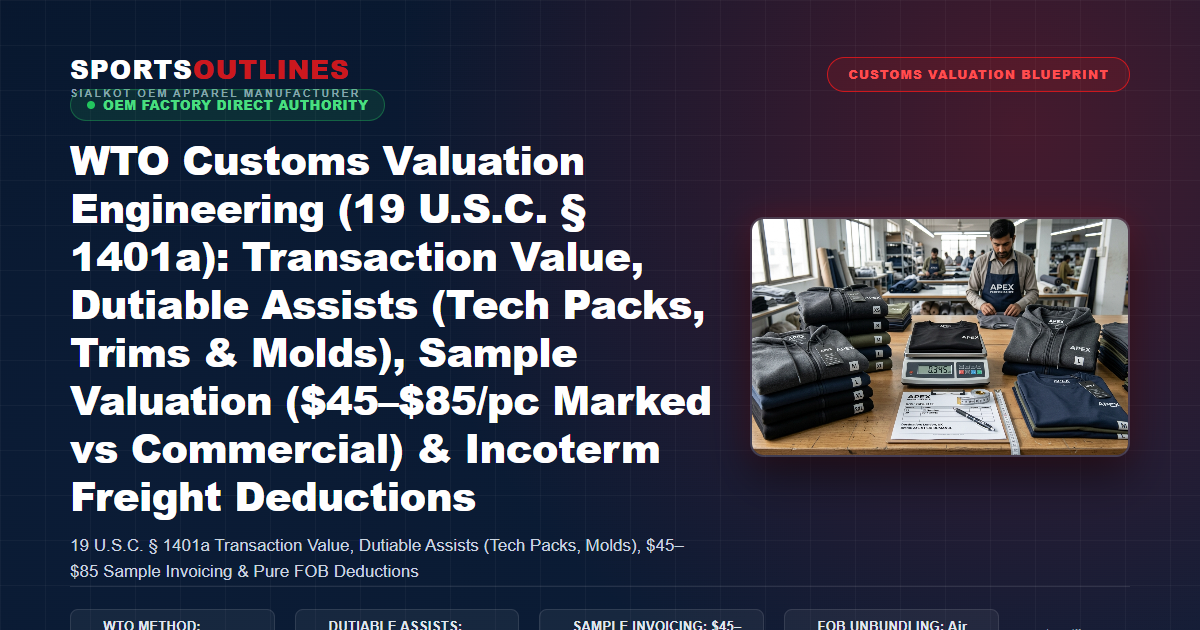
Why Declaring the Invoice Amount Isn’t Enough: Navigating 19 U.S.C. § 1401a, Dutiable “Assists” (Tech Packs, Molds & Trims), Sample Valuation & Legal Freight Deductions
For activewear, gym wear, and combat sports brand founders, determining the landed cost of goods does not stop at knowing your Harmonized Tariff Schedule (HTS) code. The total duty you pay is the product of two numbers: Duty Payable = HTS Duty Rate (%) × Customs Value ($). Even if you have selected the optimal tariff classification, errors in calculating the Customs Value can trigger catastrophic post-entry customs audits, retroactive duty bills, and fraud penalties from US Customs and Border Protection (CBP under 19 U.S.C. § 1592), UK HMRC, or the EU European Anti-Fraud Office (OLAF). Under the World Trade Organization (WTO) Customs Valuation Agreement and United States statutory law (19 U.S.C. § 1401a), the primary basis for appraisal is Transaction Value: the price actually paid or payable for the merchandise when sold for exportation. However, transaction value legally requires mandatory additions—most notably Dutiable Assists (such as factory tooling, silicone molds, and overseas tech packs supplied directly by the buyer)—while permitting mandatory deductions (such as international air and ocean freight). This master guide provides the complete legal, accounting, and operational blueprint for customs valuation engineering in apparel and combat sports manufacturing.
🛠️ Dutiable Assists: Mold Tooling, Silicon Badges & Tech Pack Rules
📦 Sample Valuation: $45–$85 Prototypes (Commercial vs Mutilated 9811.00.60)
🚢 FOB Deductions: Stripping Freight from CIF/DDP Invoices Saves 16%–32%
1. The WTO Customs Valuation Agreement & 19 U.S.C. § 1401a Hierarchy of Appraisal Methods
Established under Article VII of the General Agreement on Tariffs and Trade (GATT 1994) and codified in US law under 19 U.S.C. § 1401a (as well as Article 70 of the EU Union Customs Code and Section 159 of the Australian Customs Act), customs authorities across 164 WTO member countries must evaluate imported merchandise according to a strict, sequential hierarchy of six valuation methods. Importers and customs officers cannot randomly choose an appraisal method; they must proceed step-by-step from Method 1 to Method 6:
🏛️ The 6 Sequential Valuation Methods Under WTO & US Law
- Method 1: Transaction Value of the Imported Merchandise (19 U.S.C. § 1401a(b)): The primary and default method used for >95% of all commercial apparel imports. Defined as the “price actually paid or payable for the merchandise when sold for exportation to the United States” plus statutory additions (assists, packing costs, selling commissions, and royalties) and minus statutory deductions (international freight, customs duties, and post-importation construction). Transaction value is valid only if the buyer and seller are not related, or if related, the relationship did not influence the price.
- Method 2: Transaction Value of Identical Merchandise (19 U.S.C. § 1401a(c)): Used if Method 1 is rejected (e.g., consignment sales or no sale for export). Appraised using the transaction value of identical garments produced in the same country (Pakistan) and exported at or about the same time.
- Method 3: Transaction Value of Similar Merchandise (19 U.S.C. § 1401a(c)): Appraised using garments produced in the same country that, while not identical, have like characteristics and close commercial likeness (e.g., comparable fleece hoodies of similar weight and construction).
- Method 4: Deductive Value (19 U.S.C. § 1401a(d)): Calculated by taking the unit selling price of the imported activewear in the destination market (e.g., retail price in the US) and working backward, deducting US customs duties, sales taxes, local transportation, and standard wholesale markup/profit margins.
- Method 5: Computed Value (19 U.S.C. § 1401a(e)): Built from factory accounting books: the cost of raw materials and fabrication (fabrics, trims, labor) + general expenses and standard manufacturer profit + packing costs.
- Method 6: Fallback Method (19 U.S.C. § 1401a(f)): If all prior methods fail, customs values goods using reasonable means consistent with WTO principles. Forbidden practices include valuing goods based on domestic selling prices of domestic goods, minimum customs values, or arbitrary fictitious prices.
2. Dutiable “Assists” Under 19 U.S.C. § 1401a(h)(1)(A): Tooling, Molds, Hardware & Tech Packs
The single greatest trigger for customs penalties and underpayment audits in the apparel and sports equipment industry is the failure to declare “Assists.” Under 19 U.S.C. § 1401a(h)(1)(A), an assist is defined as any good or service supplied directly or indirectly by the buyer, free of charge or at a reduced cost, for use in the production of imported merchandise. If a brand provides physical or intellectual assets to the factory, their value must be added to the dutiable transaction value!
| Production Item / Input | Provided By | Dutiable Assist Status? | Statutory Legal Rationale | Customs Valuation Treatment |
|---|---|---|---|---|
| 1. Custom Injection Molds for Boxing Gloves / Shin Guards | Buyer purchases tooling ($1,200) & ships to Sialkot factory | DUTIABLE ASSIST | 19 U.S.C. § 1401a(h)(1)(A)(ii): “Tools, dies, molds, and similar items” | $1,200 mold cost must be apportioned across bulk units produced |
| 2. Custom Woven Neck Labels & Metal Aglets Shipped to Factory | Buyer sources trims from 3rd party & sends free to factory | DUTIABLE ASSIST | 19 U.S.C. § 1401a(h)(1)(A)(i): “Materials, components, parts incorporated into merchandise” | Unit cost of trims + shipping to Sialkot must be added to transaction value |
| 3. Tech Pack & CAD Design Created inside the United States | US-based designer creates tech pack and emails vector files | NON-DUTIABLE (Exempt) | 19 U.S.C. § 1401a(h)(1)(A)(iv): Engineering/design work undertaken within the US is exempt! | $0.00 added to customs value. Retain designer invoice showing US performance |
| 4. Tech Pack & Pattern Grading Developed by Third-Party in Europe/Asia | Buyer hires freelance agency in Portugal or Vietnam ($500) | DUTIABLE ASSIST | 19 U.S.C. § 1401a(h)(1)(A)(iv): Engineering/design undertaken outside the US is dutiable! | $500 fee must be declared and added to commercial import value |
| 5. Factory CAD Grading & Tech Pack Finalization by Sports Outlines | Factory engineers CAD patterns as part of commercial manufacturing | INCLUDED IN FOB PRICE | Factory overhead included in garment invoice; not a buyer-supplied assist | Fully captured inside regular garment FOB piece rate; zero separate assist declaration |
3. Customs Valuation of Physical Pre-Production Samples: $45–$85 Prototype Fee vs. Mutilated Samples (HTS 9811.00.60)
A frequent area of customs confusion occurs during product development. When Sports Outlines produces physical pre-production prototypes—which we engineer for $45–$85 per piece/pair/set in 7–10 business days (non-refundable engineering fee)—how should those samples be valued on the export commercial invoice and declared to destination customs?
| Sample Declaration Classification | HTS / Tariff Heading | Customs Duty Rate | Physical Requirements | Commercial Applicability & Risk |
|---|---|---|---|---|
| 1. Mutilated Samples of Negligible Value (USA) | HTSUS 9811.00.60 | 0.0% Duty-Free | Must be physically cut, punched with 1-inch visible holes, or stamped with indelible ink “SAMPLE NOT FOR RESALE” | Renders garment unwearable for marketing/fit testing; best for destructive fabric or lab testing only |
| 2. Commercial Fit & Photo Prototype Samples (USA Section 321) | Chapter 61 / 62 commercial HTS | 0.0% Duty-Free under $800 | Pristine condition. Invoice declares actual engineering value ($45–$85/pc) | Clears 100% duty-free under Section 321 de minimis. Perfect for photoshoot and athlete fitting! |
| 3. Commercial Samples Entering EU (UK HMRC / EU TARIC) | Customs Relief Regulation 1186/2009 | 0.0% Duty + 0% VAT | Must be declared as commercial samples of negligible value (< €150 or marked) | Single prototypes per style clear duty-free without VAT drain |
| 4. Low-Value Consignment Exemption (Australia ABF) | Section 68 Customs Act 1901 | 0.0% Duty-Free | Total consignment value under AUD $1,000. No mutilation required | Allows pristine physical samples to enter Australia completely duty-free |
4. Incoterm Freight Deductions: “FOB Stripping” on CIF, DAP & DDP Courier Shipments
Under 19 U.S.C. § 1401a(b)(4)(A) in the United States, Section 48 of the Canadian Customs Act, and Section 159 of the Australian Customs Act, the transaction value of imported merchandise is assessed exclusive of international freight, transportation, and marine insurance incurred after the goods leave the country of exportation. When emerging brands import via air express couriers (DHL, FedEx, UPS) under all-inclusive DAP or DDP terms, the courier invoice often lists a single bundled price. If you do not perform “FOB Stripping”—separating the pure garment manufacturing cost from the international air freight charges—customs will assess apparel duties (16.5% to 32.0%) on the expensive air shipping cost itself!
| Valuation Scenario | Declared Commercial Invoice Value | Dutiable Customs Value | US Duty @ 32.0% (Synthetic Knit) | Net Financial Outcome |
|---|---|---|---|---|
| Scenario A: Bundled DAP/CIF Invoice (Error) | $14,500.00 Total ($10,000 FOB + $4,500 Air Express) | $14,500.00 (Unadjusted) | $4,640.00 | Overpaid $1,440 in unnecessary duty on air freight! |
| Scenario B: Bifurcated FOB Export Invoice (Optimized) | FOB Garments: $10,000.00 Air Freight Line: $4,500.00 | $10,000.00 (FOB Only) | $3,200.00 | Saved $1,440.00 cash (+14.4% landed profit margin!) |
5. Dutiable Assists Allocation Methodologies: Amortizing Molds & Tooling Across Low-MOQ vs. Bulk Runs
When an apparel or fightwear brand supplies a dutiable assist (such as an injection mold for boxing gloves or a custom metal zipper puller die), customs regulations under 19 CFR § 152.103(e) give the importer two legal options for allocating that value:
| Amortization Method | How It Works | Mathematical Example ($1,500 Mold) | Cashflow Impact | Best Used For |
|---|---|---|---|---|
| Option 1: First-Shipment Lumpsum Allocation | The entire cost of the assist is declared and added to the first production shipment. | 1st order of 100 pairs: +$1,500 added to 1st entry. Subsequent shipments: $0 assist added. | High upfront duty payment on the first batch; zero duty tracking afterward. | Limited-edition drops or styles where future production volume is uncertain. |
| Option 2: Per-Unit Amortization Across Contracted Volume | Assist cost is divided across the anticipated lifetime production volume. | Contract for 3,000 pairs over 12 months: $1,500 / 3,000 = +$0.50 per pair added to each entry. | Smooth, predictable landed cost with lower initial cash outlays. | Core catalog styles produced repeatedly across ongoing 30–50 piece or 500-piece orders. |
6. Sialkot Valuation Protocol: Zero-Risk Customs Invoicing for Sports Outlines Clients
To eliminate customs exposure for our international activewear and fightwear partners, Sports Outlines implements a rigorous 4-step customs invoicing protocol across every shipment dispatched from our factory:
🛡️ The Sports Outlines Valuation Compliance Framework
- Transparent FOB Pricing: Every quote, proforma invoice, and final commercial invoice clearly isolates the pure FOB unit cost of each garment. International courier, air freight, and ocean shipping charges are itemized as separate line items to enable 100% legal freight deduction at destination ports.
- Factory-Absorbed Pattern Development: When we grade patterns and finalize CAD cut-markers in Sialkot, these engineering costs are integrated into our manufacturing service overhead—meaning they are fully included in the garment FOB price and do NOT constitute a buyer-provided assist.
- Accurate Sample Invoicing ($45–$85/pc in 7–10 Days): Prototype samples are invoiced at their true production cost ($45–$85 per piece) and accompanied by sample declarations tailored to clear under US Section 321, Australian AUD $1,000 threshold, or UK/EU low-value commercial sample reliefs.
- BOM Material Verification: Complete material specifications (including fiber percentage breakdown, fabric weight in GSM, and trim origins) are documented on every packing list and invoice to withstand any post-entry customs audit.
7. The Multi-Tier “First Sale” Valuation Blueprint: Eliminating Middleman Markup from Customs Duty
Under United States customs jurisprudence—grounded in the Federal Circuit landmark ruling in Nissho Iwai American Corp. v. United States (982 F.2d 505) and CBP Informed Compliance Publications on First Sale Rule—when merchandise is imported into the United States through a multi-tier transaction involving a middleman or trading company (e.g., Sialkot Manufacturer → Hong Kong/UK Middleman → US Brand Importer), the importer of record is legally entitled to base customs value on the first sale between the manufacturer and the middleman, rather than the higher second sale between the middleman and the US buyer!
| Valuation Structure | Factory Invoice to Middleman | Middleman Invoice to US Brand | Declared Customs Value | Duty Payable (32.0% Synthetic Knit) | Net Duty Savings |
|---|---|---|---|---|---|
| Standard Middleman Import (Second Sale) | $12.00 / hoodie ($12,000 total) | $18.00 / hoodie ($18,000 total) | $18,000.00 (Second Sale) | $5,760.00 | $0.00 (Standard Rate) |
| Certified First Sale Rule Valuation | $12.00 / hoodie ($12,000 total) | $18.00 / hoodie ($18,000 total) | $12,000.00 (First Sale Price!) | $3,840.00 | +$1,920.00 Cash Saved (-33.3% Duty!) |
| Direct OEM Sourcing via Sports Outlines | N/A (Zero Middleman) | Direct OEM Price: $12.00 / hoodie | $12,000.00 (Pure Direct Factory) | $3,840.00 | Zero markup, minimum landed duty, maximum brand margin! |
8. Valuation Defense Case Studies: Surviving CBP Focused Assessments & Inquiries
How do real-world apparel brands navigate customs valuation inquiries when audits occur? Here are three real-world scenarios resolved through structured customs engineering:
Case Study 1: The Combat Sports Injection Mold Audit
Situation: A California fightwear brand paid $2,400 to an independent engineering shop to machine CNC aluminum injection molds for ergonomic polyurethane foam padding in pro boxing gloves. The brand shipped the molds directly to Pakistan. During a routine CBP audit, the import specialist flagged the absence of tooling costs on the commercial invoice.
Remediation: Under 19 CFR § 152.103(e), the brand exercised Option 2 (Amortization over Contracted Volume). With an active supply agreement with Sports Outlines for 4,800 pairs over 24 months, the assist was apportioned at +$0.50 per pair ($2,400 / 4,800). On a duty rate of 4.4% (HTS 4203.21.80), this amounted to just $0.022 per pair in added duty ($22 per 1,000 units).
Result: CBP approved the prior disclosure without imposing a single dollar in negligence penalties under 19 U.S.C. § 1592, establishing a permanent approved assist ledger.
Case Study 2: The Freelance Designer Tech Pack Investigation
Situation: An activewear brand received a CBP Form CF-28 requesting contracts and invoices for external design agencies following an import of seamless gym tights. CBP suspected the tech packs were designed in Portugal or Vietnam, which would make them dutiable assists under 19 U.S.C. § 1401a(h)(1)(A)(iv).
Remediation: The brand provided designer 1099 tax forms, contracts, and IP address logs proving that the tech pack author was a freelance CAD designer physically resident in Austin, Texas. Furthermore, factory pattern grading done in Sialkot was shown to be included within the factory’s standard production overhead.
Result: CBP confirmed that 100% of the design work was performed inside the United States, issuing an official determination that zero assist value was dutiable, closing the inquiry with zero rate advance.
Case Study 3: Courier Air Freight Stripping Reclamation
Situation: A high-growth gym apparel startup was importing 800-piece drops via DHL Air Express on bundled DAP invoices totaling $22,000 ($15,000 garments + $7,000 air express). Over three consecutive shipments, the courier’s clearance broker mistakenly declared the full $22,000 as the customs value, assessing 28.2% synthetic knit duty ($6,204 per drop).
Remediation: Sports Outlines reissued verified commercial invoices bifurcating the $15,000 FOB garment manufacturing value from the $7,000 air courier cost, supported by the original air waybills showing freight prepaid in Pakistan. The brand filed an administrative post-summary correction (PSC) through their licensed broker.
Result: CBP approved the correction, refunding $1,974 in overpaid duty per shipment ($5,922 total cash refund across all three shipments!), permanently restoring the brand’s healthy gross margins.
9. Statutory Customs Valuation Compliance Checklist & Annual Assist Reconciliation SOP
To ensure total compliance with 19 U.S.C. § 1401a and prevent customs exposure, activewear brands should implement this annual 6-point valuation reconciliation protocol:
| Audit Review Point | Internal Accounting Check | Customs Legal Mandate | Required Audit File Asset |
|---|---|---|---|
| 1. General Ledger Tooling Review | Review all payments to machine shops, mold makers, and die fabricators | Add buyer-supplied tooling to transaction value (19 U.S.C. § 1401a(h)) | Signed Assist Ledger showing allocation method |
| 2. Freelance Design Location Audit | Verify geographic residence of all freelance apparel CAD designers | US-created designs are exempt; overseas designs must be added | Designer W-9 / 1099 tax forms and service agreements |
| 3. Buyer-Furnished Trim Verification | Audit any neck labels, hangtags, or zippers shipped directly to Sialkot | Trim cost + shipping to factory must be incorporated in entry value | Trim manufacturer invoices + export courier tracking |
| 4. Prototype Sample Segregation | Verify $45–$85 prototype fees are cleanly booked as R&D engineering | Prototypes clear duty-free under de minimis ($800 Section 321 / AUD $1,000) | Sample commercial invoices marked “Pre-Production Prototype” |
| 5. Freight Deduction Reconciliation | Ensure international freight is stripped from entry summary value | 19 U.S.C. § 1401a(b)(4)(A) statutory deduction from transaction value | Bifurcated commercial invoice with separate FOB & freight lines |
| 6. Five-Year Digital Archive | Archive all CBP Form 7501s, wire transfers, and BOM tech packs in secure cloud | 19 U.S.C. § 1508 mandatory 5-year retention period | Timestamped encrypted PDF archive folder per entry number |
10. Royalties & Licensing Fees: Dutiable vs. Non-Dutiable Analysis (19 U.S.C. § 1401a(b)(1)(E))
A second major pitfall in apparel customs valuation occurs when activewear brands license trademarks, athlete endorsements, or copyrighted graphics. Under 19 U.S.C. § 1401a(b)(1)(E) and 19 CFR § 152.103(f), royalties or license fees paid by the buyer are dutiable and must be added to the transaction value ONLY if they meet two strict cumulative statutory legal tests:
- Test 1: The Royalty is Paid as a Condition of the Sale for Exportation: If the overseas manufacturer (Sports Outlines) is legally barred from selling the activewear to the buyer unless the royalty is paid to a third-party licensor, the fee is considered a condition of sale and is dutiable. However, if the buyer holds an independent domestic licensing contract (e.g., paying a 5% royalty to a fitness athlete or brand ambassador for using their signature logo on garments sold in the US market) and that royalty payment is completely unrelated to the export sale from the Sialkot factory, the royalty is 100% NON-DUTIABLE!
- Test 2: Right to Reproduce the Imported Merchandise: Under long-standing US Customs Court precedent and CBP Informed Compliance guidelines on Customs Valuation, charges for the right to reproduce the imported merchandise inside the United States (such as domestic screen printing, heat pressing patches, or marketing licenses) are legally exempt from customs duties.
- Audit Protection Rule: To defend against customs challenges, your licensing agreements must clearly specify that royalty payments are triggered by retail sales in the destination country, not by the manufacture or export of the goods. Keep your factory manufacturing agreements with Sports Outlines strictly independent from domestic intellectual property licensing agreements.
Frequently Asked Questions (FAQ)
1. If my US company created the apparel tech packs, are they considered dutiable assists by US CBP?
No. Under 19 U.S.C. § 1401a(h)(1)(A)(iv), engineering, development, artwork, and design work undertaken within the United States are explicitly excluded from the definition of dutiable assists. You do not need to add the cost of US-created tech packs to your customs value. However, you must maintain proof (such as designer invoices, contracts, or employment records) demonstrating that the design work was performed inside the United States.
2. What happens if an importer fails to declare mold or tooling assists to customs?
Failing to declare dutiable assists is a major violation under 19 U.S.C. § 1592 (Penalties for Fraud, Gross Negligence, and Negligence). Customs authorities routinely audit bank wire records and general ledgers during Focused Assessments. If undeclared assists are discovered, customs will issue a retroactive bill for unpaid duties, charge compounding interest, and assess statutory civil penalties ranging from 20% to up to 400% of the unpaid duty amount.
3. Can pre-production prototype sample fees ($45–$85/pc) be credited toward subsequent bulk orders?
At Sports Outlines, physical pre-production prototype development ($45–$85 per piece/pair/set, completed in 7–10 business days) is a dedicated, non-refundable engineering fee reflecting our direct pattern-making, master-tailor cutting, sample-line assembly, and material costs. Samples are evaluated and billed separately from bulk manufacturing, which maintains a clean, transparent accounting audit trail for customs valuation.
4. How does separating international air freight from FOB garment costs reduce US customs duty?
Under 19 U.S.C. § 1401a(b)(4)(A), international freight incurred after exportation from Pakistan is not part of the dutiable transaction value. On a 500-piece synthetic hoodie order where air express shipping costs $4,500, separating the freight line from the garment value prevents paying the 32.0% synthetic knit duty on the shipping fee—saving $1,440.00 in pure cash at the border!
5. What are Sports Outlines’ commercial terms and minimum order quantities?
We provide low-MOQ contract manufacturing for high-performance sportswear, activewear, and combat gear: physical pre-production prototypes are developed for $45–$85 per piece in 7–10 business days, while commercial production begins at just 30–50 pieces per style/colorway, supported by comprehensive customs documentation.
Looking for Audit-Proof Manufacturing & Transparent Customs Valuation?
Partner with Sports Outlines in Sialkot, Pakistan. We develop custom physical prototypes for $45–$85 per piece in 7–10 business days, manufacture bulk orders starting at just 30–50 pieces per style, and structure export documentation for 100% compliant, duty-optimized customs clearance.