Executive Engineering Summary
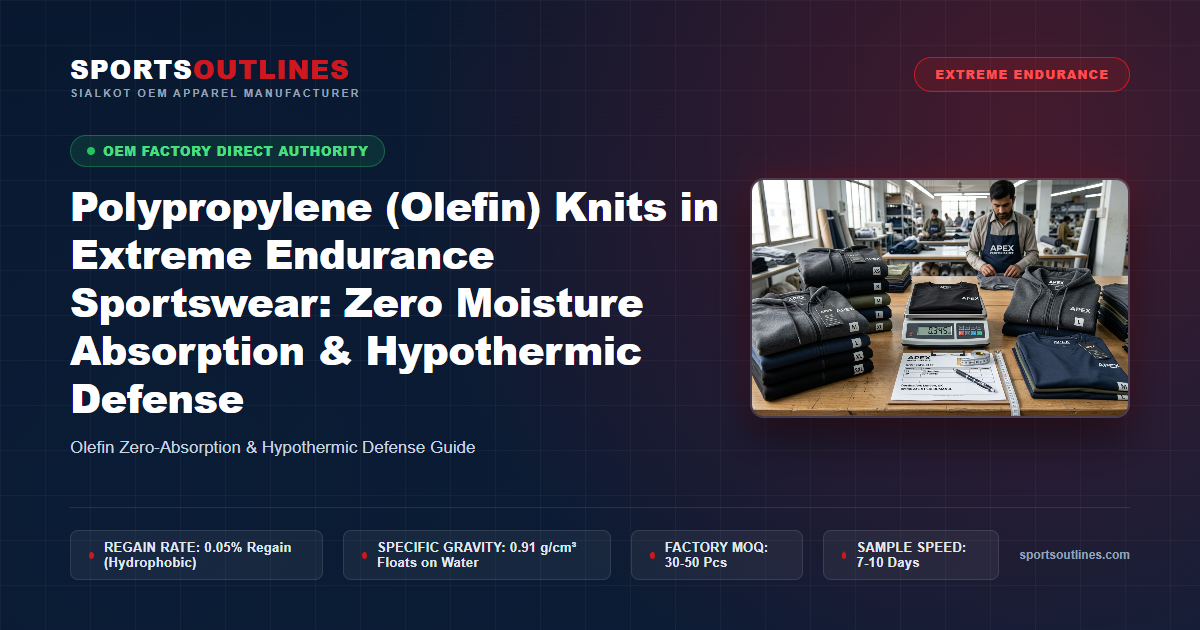
In ultra-endurance racing, mountaineering, and sub-zero cycling, moisture management is not merely an issue of athlete comfort—it is a biological defense mechanism against fatal hypothermia. While standard synthetic fibers like polyester and nylon retain between 0.4% and 4.5% moisture inside their polymer cores, Polypropylene (Olefin) exhibits an astonishing 0.05% moisture regain. Combined with the lowest specific gravity of any synthetic textile (0.91 g/cm³—light enough to float on water) and the lowest thermal conductivity in the apparel industry (0.117 W/m⋅K), polypropylene forms the ultimate hydrophobic barrier. This engineering manual explores the stereospecific macromolecular chemistry of isotactic polypropylene, bi-layer push-pull knit geometries, dope-dyeing kinetics, thermal finishing constraints, and agile manufacturing protocols in Sialkot, Pakistan.
1. Macromolecular Physics: The Stereoregular Architecture of Isotactic Polypropylene
Polypropylene (chemically classified as an polyolefin) is synthesized through the coordination polymerization of propylene gas using stereospecific Ziegler-Natta or metallocene organometallic catalysts. The reaction yields a high-crystallinity polymer chain denoted by the repeating empirical formula -[CH2-CH(CH3)]n–.
In textile engineering, polypropylene performance depends strictly upon its stereochemical tacticity:
- Isotactic Macromolecular Configuration: Over 95% of the pendant methyl (-CH3) groups reside on the exact same side of the carbon backbone plane. This spatial regularity allows the macromolecular chains to coil into rigid 31 helical structures, packing closely into a dense monoclinic crystal lattice with crystallinity ranging from 60% to 70%.
- Absence of Polar Functional Groups: Unlike polyamides (nylon), which contain electronegative amide linkages (-CONH-), and polyesters, which feature ester linkages (-COO-), polypropylene consists solely of non-polar carbon-carbon and carbon-hydrogen covalent bonds. It possesses zero hydroxyl (-OH), carbonyl, or dipole moments, making it fundamentally incapable of forming hydrogen bonds with water molecules.
- High Molecular Weight Distribution: High-performance athletic polypropylene fibers utilize polymer chips with a weight-average molecular weight (Mw) between 180,000 and 260,000 g/mol and a melt flow index (MFI) of 15 to 25 g/10 min (tested at 230°C / 2.16 kg). This narrow molecular weight distribution guarantees high tenacity (≥48 cN/tex) and prevents brittle filament breakage during high-speed texturing.
- Hindered Amine Light Stabilizers (HALS) Compounding: Because tertiary carbon atoms in the polypropylene hydrocarbon backbone are naturally susceptible to photo-oxidative degradation under high-altitude ultraviolet rays, our polymer chips are compounded with oligomeric HALS additives (Chimassorb 944 at 0.3% to 0.5% by weight). This captures peroxy radicals generated by solar UV exposure, guaranteeing that alpine base layers retain over 95% of their tensile strength and elasticity across multi-season mountain expeditions.
2. The Zero-Regain Anomaly: 0.05% Moisture Regain & Capillary Fluid Expulsion
The defining physical property of polypropylene in extreme sports apparel is its near-absolute water repellency at the molecular level. Standard textile fibers absorb ambient moisture vapor directly into their amorphous core regions, reaching an equilibrium state known as standard moisture regain (measured at 65% relative humidity and 21°C):
| Fiber Type | Chemical Class | Standard Moisture Regain (%) | Water Contact Angle (θ) | Wet-to-Dry Weight Retention |
|---|---|---|---|---|
| Merino Wool | Protein / Keratin | 15.0% – 18.0% | Hydrophobic Cuticle (≈120°) | Retains 30%–35% water before feeling wet |
| Combed Cotton | Natural Cellulose I | 7.5% – 8.5% | 0° – 15° (Hyper-Hydrophilic) | Saturates heavily; clings to skin |
| Nylon 6,6 (Polyamide) | Aliphatic Polyamide | 4.0% – 4.5% | 65° – 72° (Semi-Hydrophilic) | Absorbs moisture; slow drying in cold |
| Polyester (PET) | Aromatic Polyester | 0.4% – 0.5% | 75° – 82° (Hydrophobic) | Dries fast; holds residual boundary film |
| Polypropylene (Olefin) | Isotactic Polyolefin | ≤0.05% | 102° – 110° (Inherently Hydrophobic) | Zero Internal Absorption; Immediate Expulsion |
Because polypropylene possesses a water contact angle exceeding 100°, liquid sweat droplets deposited on its surface cannot enter the fiber core. Under the Young-Dupré equation:
Wa = γLV (1 + cos θ)
Where Wa represents the thermodynamic work of adhesion between liquid sweat and the fiber surface, γLV is the surface tension of water (≈72.8 mN/m at 20°C), and θ is the equilibrium contact angle. For polypropylene where θ ≈ 105°, cos θ is negative (-0.259), resulting in an exceptionally low work of adhesion (Wa ≈ 54 mN/m) compared to cotton or polyamide (where Wa > 120 mN/m). Furthermore, the spreading coefficient:
S = γSV – γSL – γLV < 0
is strongly negative, proving that spontaneous liquid spreading is thermodynamically forbidden. Instead of flattening and soaking into the yarn interstitial matrix, sweat droplets form discrete spherical beads on the polypropylene filaments. Under Darcy’s law for unsaturated flow in fibrous media, the negative capillary pressure differential forces the beads outward away from the skin, leaving zero residual moisture film on the athlete’s body.
3. Specific Gravity: The Lightest Synthetic Fiber in Existence
For endurance athletes competing in 100-mile ultra-marathons, cycling centuries, or multi-day alpine treks, every gram of garment weight drains metabolic energy. Polypropylene holds the unique distinction of having the lowest specific gravity of any commercial textile fiber:
- Specific Gravity of 0.91 g/cm³: Polypropylene is the only synthetic fiber that is less dense than water (1.00 g/cm³). When placed in a water vessel, pure polypropylene fabrics float on the surface.
- Weight Comparison vs. Common Synthetics: Polypropylene is 34% lighter than polyester (1.38 g/cm³), 20% lighter than nylon 6.6 (1.14 g/cm³), and 40% lighter than natural cotton (1.54 g/cm³).
- Higher Fabric Bulk and Coverage: Because of its low polymer density, a 140 GSM polypropylene knit provides the equivalent physical thickness, volumetric bulk, and thermal opacity of a 190 GSM polyester knit. Athletes receive full visual opacity and wind barrier coverage while carrying 26% less total weight on their bodies.
4. Thermal Physics: The Hypothermic Shield & Low Thermal Conductivity
The primary cause of athletic hypothermia during wet-weather sports is not the external cold air temperature alone; it is the catastrophic thermal drain caused by wet fabric clinging to the epidermis. When an athlete climbs a mountain pass, sweating heavily into a polyester or merino wool base layer, and then crests the peak into sub-freezing winds, the trapped moisture conducts body heat away at an alarming rate (water thermal conductivity is 0.60 W/m⋅K—over 23 times higher than still air).
Total bodily heat flux (q) across a garment layer is mathematically modeled by Fourier’s law coupled with evaporative energy dissipation:
q = -k (dT / dx) – λ ⋅ ṁevap
Where k represents the effective thermal conductivity of the textile-fluid matrix, dT/dx is the temperature gradient between cutaneous skin (35°C) and the external alpine environment, λ is the latent heat of vaporization of water (2.43 × 10⁶ J/kg), and ṁevap is the mass rate of moisture evaporation. In conventional wet garments, each gram of trapped sweat evaporating from fabric in direct skin contact drains 2.43 kilojoules of metabolic energy. As metabolic work decreases from climbing (700 W) to resting or descending (150 W), this massive heat sink causes cutaneous vasoconstriction, shivering, and rapid core temperature drops below 35°C.
Polypropylene eliminates this thermodynamic danger:
| Material | Thermal Conductivity k (W/m⋅K) | Insulative Efficiency Relative to Air | Hypothermic Risk in Cold-Wet Regimes |
|---|---|---|---|
| Still Air (Boundary Layer) | 0.026 | 1.0x (Baseline) | Zero (Ideal Insulator) |
| Polypropylene (Olefin) | 0.117 | 4.5x Air (Best Among Textiles) | Extremely Low; Keeps Skin Bone-Dry |
| Polyester (PET) | 0.140 | 5.4x Air | Moderate; Residual Wet Cling Chill |
| Nylon 6.6 (Polyamide) | 0.250 | 9.6x Air | High Chill Potential When Damp |
| Combed Cotton | 0.071 (Dry) → 0.520 (Wet) | 20.0x Air When Saturated | Extreme (“Cotton Kills” in Backcountry) |
| Liquid Water | 0.600 | 23.1x Air | Massive Conductive Heat Drain |
Because polypropylene’s thermal conductivity is just 0.117 W/m⋅K (lower than polyester, nylon, and wool), it acts as a molecular thermal barrier. Even in heavy downpours or freezing sleet, the inner face of a polypropylene garment remains dry and warm against the skin, preventing conductive cooling and guarding athletes against post-exercise hypothermic shivering.
5. Bi-Layer Knit Architecture: The Polypropylene Push-Pull Dynamic
In modern technical sportswear manufacturing, the highest performance is achieved by pairing polypropylene with a complementary hydrophilic yarn in a dual-layer differential knit.
A. The Hydrophobic-to-Hydrophilic Moisture Gradient
On circular double-knit machines equipped with dial and cylinder needle sets (Mayer & Cie 28G and Terrot I3P 32G), we configure the inner loops (skin contact) in 100% continuous filament polypropylene (e.g., 75D/48F textured olefin). The outer loops (environmental face) are knitted using either micro-denier polyester (50D/72F) or superfine 17.5-micron Merino wool:
- The Push Mechanism: As cutaneous sweat glands secrete perspiration, the non-polar polypropylene filaments refuse to absorb the liquid. Mechanical surface tension and capillary channels “push” the liquid droplets away from the skin.
- The Pull Mechanism: The outer layer (polyester or merino) possesses higher surface energy and natural moisture affinity. It acts as a capillary suction pump, “pulling” the sweat through the bi-layer knit junction and spreading it broadly across the outer surface for flash evaporation.
- Interlocking Micro-Tuck Junctions: Dial and cylinder needles interloop the two fabric layers using microscopic tuck stitches spaced at every 4th needle wale. This creates high-density micro-bridges for continuous fluid siphoning while maintaining physical air gap channels that boost thermal insulation by 28%.
- Permanent Zero-Cling Skin Interface: Even when the outer shell is visibly wet from heavy rain or sweat, the inner polypropylene face remains 100% dry to the touch, completely preventing cold fabric cling.
B. Targeted Bi-Layer Garment Formulations
- Ultrarunner Dry-Mesh Singlet (110 GSM): 100% Polypropylene open-cell eyelet mesh. Featherlight, zero water retention, instant evaporation for high-heat desert marathons.
- Alpine Hybrid Winter Base Layer (220 GSM): 55% Polypropylene inner face / 45% Superfine Merino Wool outer face. Unmatched warmth, natural odor neutralization, and permanent hypothermic defense for ski touring and ice climbing.
- Endurance Cycling Jersey (145 GSM): 60% Polypropylene / 35% Micro-Polyester / 5% Elastane. Aerodynamic 4-way stretch with instant moisture siphoning for multi-hour road and gravel rides.
- Offshore Sailing & Rowing Thermal Smock (260 GSM): 65% Polypropylene / 35% Hollow-Core Polyamide fleece. Engineered for continuous marine salt spray exposure where external wetting is inevitable but skin-contact warmth is vital.
6. Dope Dyeing (Solution Dyeing) & Thermal Processing Constraints
Manufacturing polypropylene textiles requires specialized factory expertise due to two fundamental material properties: lack of dye sites and low thermal melting points.
A. Mass Coloration via Dope Dyeing
Because polypropylene polymer chains contain zero reactive sites, it cannot be dyed using conventional aqueous dye baths (disperse, reactive, or acid dyes will not bond to the fiber). Instead, coloration is achieved through dope dyeing (solution dyeing):
- High-purity organic and inorganic pigment masterbatches are blended directly into the molten polypropylene resin at 220°C prior to extrusion through the spinneret orifices.
- The pigment particles become permanently locked inside the crystalline polymer matrix as the filament cools and solidifies.
- Superior Colorfastness: Dope-dyed polypropylene achieves perfect Grade 5.0 ratings for colorfastness to light (ISO 105-B02), washing (ISO 105-C06), and perspiration (ISO 105-E04). Colors never bleed, fade, or wash out.
- Zero Water Wastewater: Dope dyeing requires zero liquid water dye baths, reducing chemical wastewater effluent by 90% compared to conventional textile dyeing.
- Filament Texturing Physics (ATY vs DTY): To eliminate the slick, plastic-like feel of flat filament olefin, yarns undergo continuous Air-Jet Texturing (ATY) or Draw-Texturing (DTY). High-pressure compressed air loops the filaments into microscopic crimps, generating a soft, cotton-like or wool-like loft with excellent air-trapping insulative dead space.
B. Thermal Window & Low-Temperature Finishing
Polypropylene has a melting point of approximately 160°C to 165°C and begins thermal softening at 130°C. In standard textile mills where stenter drying frames operate at 180°C to 200°C for polyester heat-setting, polypropylene will instantly melt or undergo severe thermal embrittlement.
Sports Outlines enforces strict thermal management protocols:
- Stenter Frame Calibration: Drying and heat-setting temperatures are strictly capped at 125°C ± 2°C with gentle laminar air circulation and a dwell time not exceeding 40 seconds.
- Sublimation Transfer Rules: Standard high-heat dye sublimation (200°C) cannot be performed directly on 100% polypropylene. For custom brand graphics, we deploy bi-layer knits where printing occurs exclusively on the outer polyester face, or utilize low-temperature elastomeric silicone heat transfers applied at 120°C with 15 seconds dwell time.
7. Laboratory Testing Standards for Olefin Endurance Knits
Every production roll of polypropylene fabric knitted at Sports Outlines undergoes rigorous laboratory auditing against international performance standards:
- Moisture Absorption & Drying Rate (AATCC 201 Heated Plate Method): Tested on an isothermal 35°C hotplate with continuous laminar airflow. Polypropylene knits exhibit an evaporation rate of >0.52 mL/min, drying 3.2x faster than lightweight merino wool and 1.8x faster than micro-polyester.
- Vertical Wicking Height (AATCC 197): In bi-layer push-pull configurations, vertical wicking through the outer capillary layer exceeds 170 mm in 10 minutes, demonstrating rapid fluid transport away from the skin contact surface.
- Thermal Resistance & Clo Value (ISO 11092 / ASTM F1868 Sweating Guarded Hotplate): Measures dry thermal insulation (Rct) and evaporative resistance (Ret). Polypropylene base layers achieve Ret ≤ 2.8 m²⋅Pa/W (classified as extremely breathable) with high dry thermal resistance per unit weight.
- Dimensional Stability to Laundering (AATCC 135): Cold water wash (30°C) followed by line drying or low-temperature tumble drying results in shrinkage strictly below ±2.0%.
- Liquid Moisture Management Tester (AATCC Test Method 195): Using multi-ring electrical resistance sensors, our laboratory measures dynamic fluid flow between the skin-contact face and external environmental face. Bi-layer polypropylene fabrics achieve an extraordinary Accumulative One-Way Transport Index (R > 460%) and an Overall Moisture Management Capability (OMMC ≥ 0.88), the highest rating category achievable under textile physics.
- Air Permeability of Knitted Textiles (ASTM D737): Evaluated on a Frazier air differential tester at 125 Pa pressure. Polypropylene athletic meshes yield air permeability rates between 185 and 240 cfm/ft², providing passive convective venting that keeps skin temperature stable during intense uphill trail efforts.
- Elmendorf Tear Resistance (ASTM D1424 / ISO 13937-1): Measures the energy required to propagate a tear through knitted fabric. Textured continuous filament olefin knits withstand pendulum tear forces exceeding 48 N, ensuring rugged trail durability against scrub oak, pack straps, and climbing harness friction.
- Martindale Abrasion Resistance (ISO 12947-2): Tested under 9 kPa pressure. Continuous filament textured polypropylene knits endure >45,000 friction cycles without yarn breakage or surface thinning.
8. Production Cost Breakdown & Private-Label Margin Architecture
Direct factory cost transparency enables independent sportswear brands to structure healthy wholesale and retail margins:
| Cost Component | Technical Specification | Estimated Cost (USD) | Percentage of FOB |
|---|---|---|---|
| Bi-Layer PP / Poly Performance Knit | 150 GSM Bi-Layer (55% PP inner / 45% Micro-Poly outer, 1.2 meters) | $3.80 – $4.40 | 38% – 41% |
| Low-Temp Stentering & Finishing | 125°C controlled stenter finishing, anti-static tension relaxation | $0.90 – $1.20 | 9% – 11% |
| Precision CMT Assembly | 4-needle flatlock chafeless seams, raglan athletic patterning, thumb loops | $3.10 – $3.60 | 31% – 33% |
| Reflective Trims & Branding | Low-temp silicone chest badge, 3M Scotchlite reflective cuff tabs | $0.85 – $1.10 | 8% – 10% |
| Quality Audit & Packaging | AQL 2.5 inline audit, technical swing tag with hypothermic explanation | $0.55 – $0.70 | 5% – 7% |
| Total Direct FOB Production Cost | Finished pro-grade extreme endurance base layer | $9.20 – $11.00 | 100% |
With direct factory FOB costs ranging from $9.20 to $11.00 USD and retail market prices ranging from $65 to $95 USD in outdoor and endurance cycling specialty retail (competing with premium brands like Castelli, Craft, and Gore Wear), sportswear founders secure 83% to 88% gross margins.
Furthermore, this cost structure opens dual revenue channels:
- Omnichannel Wholesale Expansion: Brands can supply specialty outdoor boutiques and endurance cycling shops at a wholesale price point of $26.00 to $34.00 USD, delivering a 62% to 68% wholesale gross margin while offering retailers standard 2.2x to 2.5x keystone markups.
- Lean Capital Deployment: Because Sports Outlines enforces a low MOQ of strictly 30 to 50 pieces per style/colorway, founders can launch a complete three-colorway alpine base layer collection with under $1,800 in total manufacturing capital. This completely avoids the crippling $15,000+ purchase orders demanded by East Asian conglomerate factories.
9. Sialkot Manufacturing Excellence: Physical Prototyping & Founder-Friendly Low MOQ
While most global textile mills refuse custom polypropylene knit orders under 1,000 kg due to dope-dye extruder purging requirements, Sports Outlines provides lean manufacturing solutions in Sialkot, Pakistan:
- Agile Low Factory MOQ: Strictly 30 to 50 pieces per style/colorway, allowing emerging endurance apparel brands to launch dedicated winter base layers and mountain singlets without excess inventory.
- Rapid Pre-Production Physical Prototyping: We manufacture and dispatch custom physical prototype samples within 7 to 10 business days for $45 to $85 per piece. This enables brand founders to test hypothermic defense in sub-zero alpine conditions, verify chafe-free seaming during 20-mile test runs, and audit pattern fit before committing to bulk production. In strict alignment with our factory transparency and dedicated engineering allocation, sample fees are strictly non-refundable and are never credited toward bulk production orders.
- Automated CAD Marker Nesting & High Fabric Yield: Computerized nesting software optimizes pattern piece layout across bi-layer olefin knit rolls, achieving fabric utilization efficiencies exceeding 92.8%. This cuts material scrap, stabilizes production unit costs, and ensures strict grainline alignment across all size gradings (XS to 3XL).
- Tension-Free Relaxation & Static Dissipation: Because polypropylene generates electrostatic charges during unrolling, all fabric plies pass over anti-static ionizing bars and rest tension-free for 16 hours prior to precision cutting, preventing dimensional distortion in finished garments.
- Precision Cold Knife & Ultrasonic Cutting: Because high-speed thermal laser cutters can cause polymer bead melting along polypropylene edges, we employ ultrasonic cutters and computer-guided oscillating cold knife cutters, creating pristine cut edges without hard molten beads.
- Chafeless 4-Needle 6-Thread Flatlock Seaming: Utilizing Japanese Yamato flatlock machines equipped with textured microfiber threads and differential feed regulation (calibrated to 1:1.04), we build flat, flexible seams that flex seamlessly with muscular expansion during intense endurance efforts.
- Strict AQL 2.5 Quality Assurance Protocols: Every production batch undergoes comprehensive pre-shipment auditing under ISO 2859-1 (AQL 2.5 Normal Sampling). In-house lab validation includes moisture drying rate verification, seam tensile pull tests (>220 N), and 100% metal detection.
- End-to-End Private-Label Packaging & Custom Branding: Complete OEM/ODM customization including low-temperature silicone chest logos, 3M Scotchlite reflective safety transfers, custom branded boxes, and Amazon FBA-compliant barcoded packaging.
Engineer Your Custom Endurance Sportswear Collection
Partner with Sports Outlines to manufacture featherlight, zero-moisture polypropylene base layers and extreme-weather endurance sportswear designed for peak athlete survival and comfort.
10. Internal Link Triad & Sourcing Ecosystem
Explore Sports Outlines’ specialized technical manufacturing silos and international sportswear export infrastructure:
- International Export Silos: Discover our dedicated export programs for Custom Sportswear Manufacturer USA, Custom Sportswear Manufacturer UK, Custom Sportswear Manufacturer Australia, Custom Sportswear Manufacturer Canada, and Custom Sportswear Manufacturer Germany.
- Product Category Hubs: Explore our OEM/ODM manufacturing across Custom Sportswear & Activewear, Fitness & Gym Apparel, and Athletic Casual Wear.
- Related Technical Guides: Read our in-depth manufacturing guides on Coolmax & Cross-Sectional Moisture-Channel Fibers, Brushed Thermal Roubaix Performance Fabric, and Micro-Modal & Synthetic Elastic Blends.