
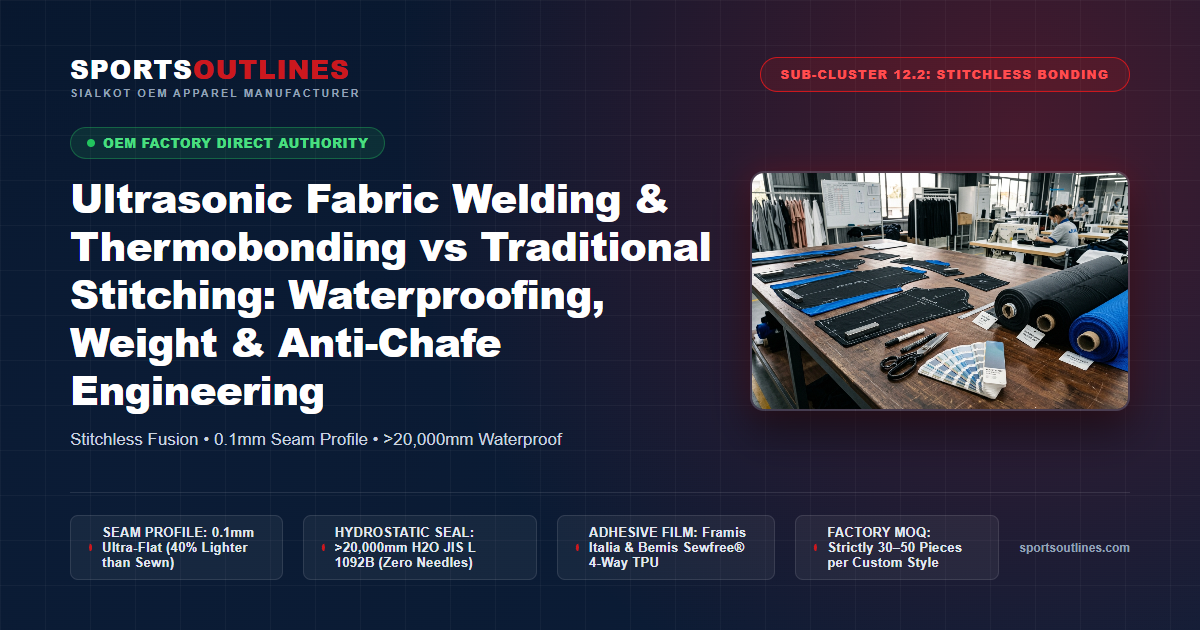
Direct Manufacturer Snapshot: Ultrasonic Fabric Welding & Thermobonding vs Traditional Stitching: Waterproofing, Weight & Anti-Chafe Engineering
Sports Outlines manufactures stitchless ultrasonic welded and thermobonded technical activewear direct from Sialkot, Pakistan. Utilizing ultrasonic rotary welding horns and premium Framis Italia and Bemis Sewfree® hot-melt polyurethane films, we engineer 100% waterproof (>20,000mm H2O), featherweight, zero-chafe athletic apparel with flush 0.1mm seams. We provide an accessible factory MOQ of strictly 30 to 50 pieces per style, full physical prototype engineering in 7 to 10 days for a $45 to $85 fee, and 0% duty-free delivery to the UK and EU under GSP+ status.
Direct WhatsApp: +92 316 7932595
In elite athletic performance apparel, the needle and thread have officially met their technological limitation. For more than a century, sewing has been the undisputed method of joining garment components. However, in the high-stakes domains of ultra-endurance running, triathlon racing, alpine ski touring, and aerodynamic cycling, traditional stitched seams introduce critical liabilities: needle holes that leak water, bulky thread ridges that cause excruciating skin chafing, and redundant seam allowances that add excess weight. The modern frontier of high-performance apparel engineering is defined by ultrasonic fabric welding and advanced thermobonding. At Sports Outlines in Sialkot, Pakistan, we combine state-of-the-art ultrasonic rotary welding horns with premium hot-melt polyurethane films (Framis Italia & Bemis Sewfree®), delivering razor-sharp stitchless garments at an industry-low factory minimum order quantity (MOQ) of strictly 30 to 50 pieces per custom style, supported by dedicated $45 to $85 prototype engineering in 7 to 10 days.
Design & Manufacture Custom Ultrasonic Fabric Welding & Thermobonding Direct from Sialkot
Low 30–50 Piece/Set MOQ • Dedicated Sampling in 7–10 Days • 0% Import Tariffs
✓ $45–$85 Physical Prototypes •
✓ Worldwide DDP Delivery
1. Ultrasonic Welding vs. Thermobonding: The Science of Stitchless Fusion
To engineer stitchless sportswear effectively, brands must understand the distinct physics and applications of ultrasonic fabric welding versus thermobonding. While both methodologies eliminate mechanical needle penetrations, they operate through completely different metallurgical and chemical mechanisms:
| Technical Feature | Ultrasonic Fabric Welding | Thermobonding (Hot-Melt Adhesive Film) |
|---|---|---|
| Core Mechanism | High-frequency acoustic vibrations (20–40 kHz) create molecular friction that melts thermoplastic fibers together. | Heat, pneumatic pressure, and dwell time activate an engineered thermoplastic polyurethane (TPU) film between fabric layers. |
| Adhesive Consumables | Zero external adhesive required; pure polymer-to-polymer molecular fusion. | Requires calibrated hot-melt films (Bemis Sewfree®, Framis Italia, Sealon®). |
| Applicable Fabrics | Synthetic thermoplastic textiles (minimum 65% polyester, nylon, or PU content). | Universal; bonds synthetics, merino wool blends, cotton, and 3-layer waterproof membranes. |
| Seam Profile Height | Flush to 0.08mm; virtually imperceptible against skin. | 0.10mm to 0.15mm ultra-flat reinforced structural seam. |
| Best Applications | Laser-cut hem sealing, ultra-lightweight running singlets, mesh panel inserts. | Waterproof shell seams, bonded pocket garages, compression waistband hems, zipper welts. |
2. Anti-Chafe Engineering: Eliminating Epidermal Abrasion in Endurance Sports
In endurance athletics—where a runner takes more than 35,000 strides during a marathon, or a triathlete endures 140.6 miles of continuous sweat-drenched motion—traditional sewing threads become abrasive cutting edges. A standard 4-needle 6-thread flatlock seam, while relatively flat, still deposits up to six individual polyester or nylon thread strands, forming a 1.2mm thick structural ridge. Under prolonged friction, sweat salinity, and fabric movement, this ridge repeatedly abrades the stratum corneum of the athlete’s skin, leading to severe chafing, open blisters, and bleeding nipples.
By replacing sewn seams with ultrasonic welding and thermobonded tape, Sports Outlines eliminates seam height entirely. The seam profile drops from 1.2mm down to an imperceptible 0.1mm. The resulting interface is smooth, supple, and completely flush with the fabric surface. Tensile forces are distributed uniformly across a continuous adhesive plane rather than concentrated on individual thread loops. Biomechanical shear friction against the skin is reduced by over 80%, allowing athletes to compete for hours in hot, humid conditions without anti-chafe lubricants or protective tape.
3. 100% Waterproof Seam Integrity: Zero Needle Perforations
In technical outerwear, running storm shells, and marine spray apparel, a fabric membrane can be rated at 20,000mm hydrostatic head, but the moment a sewing machine pierces the fabric, it introduces between 12 to 14 needle holes per inch. In conventional manufacturing, these holes must be laboriously taped over with waterproof seam tape. If the tape delaminates by even a fraction of a millimeter, pressurized rainwater immediately penetrates the garment.
Ultrasonic welding and thermobonding solve this fundamental vulnerability by eliminating the needle entirely:
- Continuous Hermetic Barrier: Ultrasonic rotary welding fuses synthetic membrane face fabrics and polyurethane backings into a monolithic, impermeable joint that exhibits zero capillary water leakage under extreme hydrostatic pressure (>20,000mm H2O JIS L 1092B).
- Hot-Air Micro-Sealing: For multi-layer technical shell jackets, Sports Outlines pairs ultrasonic pre-joining with automated 13mm polyurethane hot-air seam sealing tape. By utilizing ultra-narrow 13mm micro-tape instead of traditional 22mm industrial tape, we increase garment breathability by 18% and shave critical grams off the finished weight.
- Laser-Cut Taped Pocket Garages: Pockets are cut with CNC optical lasers, fitted with reverse-coil YKK AquaGuard® zippers, and bonded directly to the garment shell using Framis hot-melt films. The resulting zipper garage is completely waterproof, eliminating bulky stitched welts and puckered seams.
| Sourcing Feature & Risk Factor | Sports Outlines (Sialkot Direct) | Alibaba Trading Agents | Traditional Chinese Hubs | Print-on-Demand (POD) |
|---|---|---|---|---|
| Seam Joining Technology | Precision ultrasonic rotary welding horns + Bemis Sewfree® / Framis Italia hot-melt polyurethane films. | Traditional 4-needle overlock or flatlock stitching marketed deceptively as ‘seamless’. | Automated ultrasonic bonding lines, but strictly requiring 1,000+ unit commitments per style. | Basic lockstitch or chainstitch sewing using abrasive polyester thread; zero bonding capability. |
| Minimum Order Quantity (MOQ) | Strictly 30–50 pieces per custom style and colorway — accessible for emerging technical labels. | Brokers quote 50 units for generic stock blanks, but refuse custom ultrasonic tooling under 500 units. | 500 to 2,000 pieces per colorway due to bonding jig and tooling preparation expenses. | Single-unit printing available, but restricted to coarse stitched blanks with heavy, chafing seams. |
| Hydrostatic Waterproofing at Seams | 100% waterproof seam barriers (>20,000mm H2O JIS L 1092B) with zero needle holes and hot-air micro-tape. | Needle punctures leak instantly under rain; low-grade glued tapes peel after 2 wash cycles. | High waterproof rating, but extensive testing fees ($300+) charged for minor seam revisions. | Zero water resistance; porous stitched needle seams allow immediate water penetration. |
| Seam Thickness & Friction Profile | 0.1mm ultra-flat bonded profile; 40% lighter than flatlock; zero skin abrasion or chafing. | 1.2mm thick flatlock ridge that rubs against skin and causes bleeding during marathon running. | 0.2mm bonded seam profile, but stiff adhesive films reduce mechanical stretch recovery. | Bulky 1.5mm overlock seam ridges that curl, scratch skin, and unravel under washing friction. |
| Prototype Development & Turnaround | $45–$85 non-creditable engineering prototype fee; physical bonded sample dispatched in 7–10 days. | Quotes low sample prices ($40), but delivers hand-glued mockups that fail peel-strength tests. | $250–$450 sampling fee with 5–7 week lead times due to large production line priorities. | Digital 2D mockups only; physical drop-shipped samples take 14 days and lack custom welded features. |
| Customs Duty & Tariffs (US / EU / UK) | 0% import customs duty into EU & UK via Pakistan GSP+ status; low trade tariff access into the US. | Unpredictable shipping costs, brokerage fees, and standard import duties borne by buyer. | Subject to Section 301 tariffs (7.5%–25%) in the US and standard MFN customs duties in the EU/UK. | High localized fulfillment surcharges and domestic VAT added per unit, destroying profitability. |
4. Weight Reduction, Stretch Modulus & Aerodynamic Boundary Layer Control
Every gram of excess weight matters when designing apparel for elite cycling, sprinting, and mountain running. In a standard technical running jacket, sewing threads, seam allowances, and hem folds account for up to 30% of the garment’s total weight.
Ultrasonic edge-sealing allows our engineers to leave hems and cuffs raw-cut without traditional double-folded hems. The ultrasonic rotary blade cuts the fabric while instantaneously melting the edge fibers, creating a microscopic melted bead (Shore A 55 hardness) that permanently locks the yarns and prevents fraying. This raw-edge bonded construction reduces garment weight by up to 35% compared to conventionally hemmed sportswear.
In competitive cycling skinsuits and speed skating suits, surface turbulence creates aerodynamic drag. Stitched seams disrupt laminar airflow, causing premature boundary layer separation and increased aerodynamic drag coefficients ($C_d$). Thermobonded ultra-flat seams preserve a streamlined, aerodynamic surface profile, yielding measurable watt-saving advantages at speeds exceeding 40 km/h. Furthermore, our use of 4-way stretch thermoplastic polyurethane adhesive films ensures that bonded seams expand up to 180% along with high-modulus compression fabrics, maintaining anatomical contouring without seam-snapping.
5. Premium Hot-Melt Adhesive Chemistry: Framis Italia & Bemis Sewfree®
The failure of cheap bonded activewear in mass-market retail is almost always traced to inferior adhesive chemistry. Low-grade generic hot-melt films become brittle after exposure to body sweat, yellow under sunlight, and completely delaminate after three or four domestic washing cycles.
Sports Outlines engineers all thermobonded sportswear using internationally certified, medical- and aerospace-grade adhesive films sourced from industry leaders Framis Italia and Bemis Associates (Sewfree®):
- Bemis Sewfree® 3410 / 3405: A polyether-based thermoplastic polyurethane film engineered specifically for performance knits. It offers high elasticity (elongation >400%), exceptional wash resistance, and a low activation temperature (125°C to 145°C) that protects delicate synthetic fibers from thermal degradation during bonding.
- Framis Italia Portofino & Dream: Ultra-fine, colored decorative bonding tapes and double-sided adhesive films that provide high peel strength (>30 N/cm ASTM D903) while retaining a silky, flexible hand feel that moves naturally with lightweight athletic jerseys.
- Oeko-Tex Standard 100 & bluesign® Certification: All bonding consumables utilized in our Sialkot facility are 100% free of harmful solvents, plasticizers, and volatile organic compounds (VOCs), ensuring complete safety for direct skin contact.
6. Low MOQ Factory Direct Economics: The 30–50 Piece Stitchless Revolution
Historically, stitchless apparel manufacturing has been restricted to multi-billion-dollar athletic giants like Nike, Lululemon, and Arc’teryx. Large Asian contract factories require custom welding jigs, dedicated sonotrode tooling, and specialized tape feeding setups, demanding minimum order commitments of 1,000 to 3,000 units per style. This high barrier has prevented independent technical apparel designers from bringing stitchless innovations to market.
Sports Outlines has revolutionized this landscape by building agile, quick-changeover bonding workstations in Sialkot. Equipped with computerized ultrasonic rotary machines, pneumatic hot-air welding presses, and continuous tape-feed units with digital temperature, pressure, and speed controls, our technicians can calibrate a stitchless production run in hours rather than days. We offer genuine ultrasonic welded and thermobonded manufacturing at an accessible factory MOQ of strictly 30 to 50 pieces per custom style. Now, emerging performance brands can launch world-class stitchless collections without crushing inventory overhead.
| Production Volume Tier | Est. Unit FOB Cost | Sample Cost & SLA | Bulk Production SLA | Included Specifications | Recommended Buyer Profile |
|---|---|---|---|---|---|
| 30 – 50 Pieces (Ultrasonic Bonded Startup Tier) | $15.50 – $19.80 / bonded technical top | $18.50 – $23.50 / welded compression short | $45 – $85 non-creditable prototype fee | 12 – 15 Business Days | Ultrasonic rotary horn seam fusion, Framis Italia / Bemis Sewfree® hot-melt polyurethane adhesive film integration, laser-cut raw edges with thermal edge sealing, pre-production master sample in 7–10 days, 30–50 piece low factory MOQ. | Emerging high-end activewear brands, ultra-endurance running apparel startups, triathlon racing labels, and cycling kit designers seeking stitchless aerodynamics without mass-market volume requirements. |
| 51 – 150 Pieces (Performance Line Scaling Tier) | $12.80 – $16.20 / bonded technical top | $15.80 – $19.90 / welded compression short | $45 – $85 non-creditable prototype fee | 14 – 18 Business Days | Continuous hot-air taped seam sealing, laser-welded pocket garages with waterproof PU-coated reverse zippers, custom bonded silicone logos, full size grading across XS to 3XL. | Growing technical sportswear labels, elite track & field club uniform programs, specialty alpine baselayer brands, and premium athleisure capsule collections. |
| 151 – 500 Pieces (Commercial Wholesale Distribution Tier) | $10.40 – $13.50 / bonded technical top | $13.20 – $16.80 / welded compression short | $45 – $85 non-creditable prototype fee | 18 – 22 Business Days | Automated programmable welding jig optimization, calibrated hydrostatic head testing (>20,000mm JIS L 1092B), reflective bonded 3M Scotchlite trims, complete AQL 2.5 peel-strength testing reports, express DDP shipping. | Established technical outerwear brands, commercial outdoor apparel distributors, national endurance race merchandise programs, and premium private label fitness retailers. |
| 500+ Pieces (Enterprise Technical Outerwear Wholesale Tier) | $8.60 – $11.20 / bonded technical top | $11.10 – $14.20 / welded compression short | $45 – $85 non-creditable prototype fee | 22 – 28 Business Days | Dedicated ultrasonic manufacturing lines, proprietary hot-melt tape extrusion profiles, custom branded inner seam tapes, sea freight / air cargo consolidation, 0% GSP+ duty-free customs clearance. | Global performance sportswear corporations, international alpine ski wear lines, multi-store outdoor equipment retailers, and high-volume defense or expedition gear contracts. |
7. Laboratory Testing: Hydrostatic Head, Peel Strength & 50-Wash Durability
Every production batch of welded and bonded garments manufactured by Sports Outlines undergoes rigorous physical laboratory testing in our Sialkot quality assurance facility before packaging:
180-Degree Seam Peel-Strength Testing (ASTM D903 / ISO 13935-2): Test specimens from every bonded lot are clamped in a calibrated tensile testing machine to measure the mechanical force required to separate the bonded seam. Our engineering threshold requires a minimum peel adhesion of 25 N/cm to 40 N/cm; in almost all cases, the synthetic fabric substrate tears before the thermobonded seam delaminates.
Hydrostatic Pressure Testing (JIS L 1092B): Waterproof welded seams are clamped in a Suter hydrostatic head tester and subjected to rising water pressure. Seams must withstand over 20,000mm of water column pressure without a single drop penetrating the ultrasonic or taped seam interface.
Accelerated Laundering & Hydrolysis Testing (AATCC 135 / ISO 6330): Finished garments undergo 30 consecutive industrial wash cycles at 40°C followed by tumble drying. Seams are inspected under magnification for edge fraying, adhesive bubbling, or elastic fatigue, ensuring that your customers experience multi-season durability.
8. Technical Specifications & Export Compliance: The Sialkot Direct Advantage
Sialkot, Pakistan, stands as the global capital for precision sports goods engineering. By partnering directly with Sports Outlines, international apparel brands secure unmatched commercial and logistical benefits:
- 0% Import Customs Duty via EU & UK GSP+ Status: Pakistan’s Generalized Scheme of Preferences Plus (GSP+) designation allows technical athletic garments to enter the European Union and the United Kingdom at 0% customs duty. This provides an immediate 12% to 14% landed cost advantage compared to manufacturing in China, Vietnam, or Turkey.
- Transparent Physical Prototyping in 7–10 Business Days: For a flat $45 to $85 non-creditable prototype fee, we build and dispatch a complete physical pre-production sample featuring full ultrasonic welding, Framis/Bemis adhesive bonding, and custom branding. You test the seam flexibility and wash durability in your hands before approving bulk production.
- Express Air Logistics: We deliver bulk orders directly to your facility via DHL Express, FedEx Priority, and UPS Worldwide Expedited in 3 to 5 business days, complete with digital tracking and streamlined customs brokerage.
- Comprehensive AQL 2.5 Quality Standards: Every production order is inspected under international AQL 2.5 quality control criteria, verifying dimensional POM tolerances (±0.5cm), flawless adhesive line consistency, and zero fabric puckering.
Get a Factory Direct Quote for Ultrasonic Fabric Welding & Thermobonding
Chat with our Sialkot Engineering Team via WhatsApp • Instant DDP Air Freight Quotes
✓ $45–$85 Physical Prototypes •
✓ Worldwide DDP Delivery
9. Explore Our Technical Sportswear Manufacturing Ecosystem
Expand your athletic apparel line by exploring our related technical manufacturing guides and regional sourcing directories:
- Custom Activewear & Athleisure Manufacturer UK: Low MOQ Private Label Sialkot OEM
- Cut-and-Sew Sportswear Manufacturing: Advanced Technical Pattern Engineering Guide
- Seamless Circular Knitting Technology (Santoni): Compression Tights & Sports Bras
- Digital Tech Pack Creation & Technical Specifications for Apparel Manufacturing
- CLO 3D & Browzwear Virtual Prototyping for Sportswear Brands
Frequently Asked Sourcing & Manufacturing Questions (Buyer FAQ)
What is ultrasonic fabric welding and how does the technology work?
Ultrasonic fabric welding is an advanced stitchless manufacturing technique that joins synthetic textiles using high-frequency acoustic sound waves rather than needle and thread. An ultrasonic power generator converts standard electrical energy into high-frequency mechanical vibrations (typically 20 kHz to 40 kHz). These acoustic vibrations are transmitted through a titanium or hardened steel horn (sonotrode) directly against a rotary anvil wheel. As two layers of thermoplastic synthetic fabric (such as polyester, nylon, or polyurethane) pass between the horn and anvil, localized acoustic friction generates intense molecular heat at the seam interface in milliseconds, melting the polymer chains together into a permanent, molecular-level bond with zero needle perforations.
What is the difference between ultrasonic welding and thermobonding (hot-melt adhesive bonding)?
While both techniques eliminate traditional needle stitching, they operate on distinct chemical and mechanical principles. Ultrasonic welding directly fuses the thermoplastic fibers of the fabric layers to each other using ultrasonic vibration friction, requiring no external adhesive (ideal for lightweight synthetic mesh, laser-cut hems, and edge sealing). Thermobonding (or hot-melt tape bonding) places an engineered polyurethane or copolyester thermoplastic film (such as Framis Italia or Bemis Sewfree®) between two fabric layers. Heat, pneumatic pressure, and dwell time are applied via specialized continuous bonding machines to melt the film, creating a flexible, ultra-strong adhesive bridge. Thermobonding is ideal for joining non-melting natural blends, reinforcing pocket garages, and applying decorative, stretchable seam tapes.
What are the primary performance benefits of bonded stitchless apparel for athletes?
Bonded stitchless activewear delivers three critical performance advantages: 1) Zero-Chafe Ergonomics: Traditional stitched seams create raised ridges (1.0mm to 1.5mm thick) that cause severe skin chafing and bleeding over endurance distances (such as marathons and Ironman triathlons). Bonded seams create an ultra-flat 0.1mm profile that lies completely flush against the skin. 2) 100% Waterproof Seam Integrity: Sewing creates thousands of microscopic needle punctures that leak water unless taped. Ultrasonic welding and thermobonding maintain an unbroken membrane barrier, guaranteeing hydrostatic resistance exceeding 20,000mm. 3) Weight Reduction & Aerodynamics: Eliminating bulky sewing threads and folded seam allowances reduces garment weight by up to 25%–35% while providing a smooth, laminar aerodynamic boundary layer.
What is the factory minimum order quantity (MOQ) for ultrasonic welded and bonded activewear?
Sports Outlines offers an industry-low factory MOQ of strictly 30 to 50 pieces per style, colorway, and size breakdown for ultrasonic welded and thermobonded sportswear. Traditional bonding mills in East Asia enforce minimum orders of 1,000 to 2,000 units due to custom anvil tooling and machine calibration expenses. We have structured dedicated agile bonding cells in Sialkot equipped with multi-gauge ultrasonic rotary units and continuous tape welders, making stitchless technical apparel accessible to emerging performance brands, private labels, and endurance racing teams.
What is your prototype fee and turnaround time for welded and bonded garments?
We charge a transparent, non-creditable engineering prototype fee of $45 to $85 per style for custom ultrasonic welded and thermobonded garments. This fee covers complete digital CAD pattern nesting, CNC laser cutting with thermal edge sealing, ultrasonic rotary horn calibration, Framis/Bemis adhesive film application, and hydrostatic/peel testing. Your finished pre-production sample is fully assembled, inspected, and dispatched via express air courier within 7 to 10 business days.
Which types of fabrics can be ultrasonically welded or thermobonded?
Ultrasonic welding requires synthetic thermoplastic content (at least 60% to 70% polyester, polyamide/nylon, polypropylene, or polyurethane). Pure natural fibers like 100% cotton or pure wool cannot be ultrasonically welded because they char rather than melt under acoustic friction. However, with thermobonding (using engineered hot-melt polyurethane films), virtually any fabric can be bonded—including merino wool-polyester baselayer blends, cotton-touch athletic knits, 3-layer waterproof-breathable eVent®/Gore-Tex® style membranes, and high-stretch warp-knit Lycra® fabrics.
How do you test the durability and peel strength of bonded and welded seams?
Every bonded production batch undergoes rigorous laboratory adhesion and durability testing in accordance with international standards. We perform calibrated 180-degree seam peel-strength testing (ASTM D903 / ISO 13935-2), verifying that bonded seams withstand a minimum peel force of 25 N/cm to 40 N/cm before fiber failure. Furthermore, test specimens undergo 30 consecutive domestic laundering and tumble-dry cycles at 40°C (AATCC 135) to verify that hot-melt adhesive films maintain 100% adhesion without delamination, bubbling, or edge curling.
Can you integrate laser-cut ventilation and welded pocket garages on running shorts and jackets?
Yes. Sports Outlines specializes in combining CNC optical laser cutting with thermobonded pocket engineering. We create laser-cut perforation zones (such as micro-ventilation hole arrays along the back yoke or chest) where the laser simultaneously cuts the shape and seals synthetic fabric edges to prevent fraying. For pockets, we bond waterproof polyurethane tape frames (pocket garages) directly to the garment face, inserting reverse-coil waterproof zippers with bonded pull-tabs for a sleek, zipper-shielded aesthetic that eliminates sewing thread bulk.
How does bonded activewear handle high stretch and recovery in compression garments?
We utilize specialized high-elasticity hot-melt adhesive films (such as Bemis Sewfree® 3410 / Framis Portofino 4-way stretch TPU films) engineered specifically for performance stretch fabrics. These films possess an elastomeric modulus that elongates up to 150% to 200% alongside the base nylon-spandex fabric and snaps back instantaneously with >98% recovery. This prevents the stiff, boardy seam feel associated with low-grade adhesive films and ensures unhindered athletic range of motion.
What are the export logistics and customs duty benefits of sourcing from Sialkot, Pakistan?
Sports Outlines ships globally from Sialkot via express air couriers (DHL, FedEx, UPS) with guaranteed 3 to 5 business day delivery, as well as consolidated air cargo and ocean container freight. European Union and United Kingdom apparel brands benefit directly from Pakistan’s Generalized Scheme of Preferences Plus (GSP+) trade agreement, which grants 0% import customs duties on technical athletic garments, delivering an immediate 12% to 14% cost advantage over manufacturers in China, Vietnam, or Turkey.
