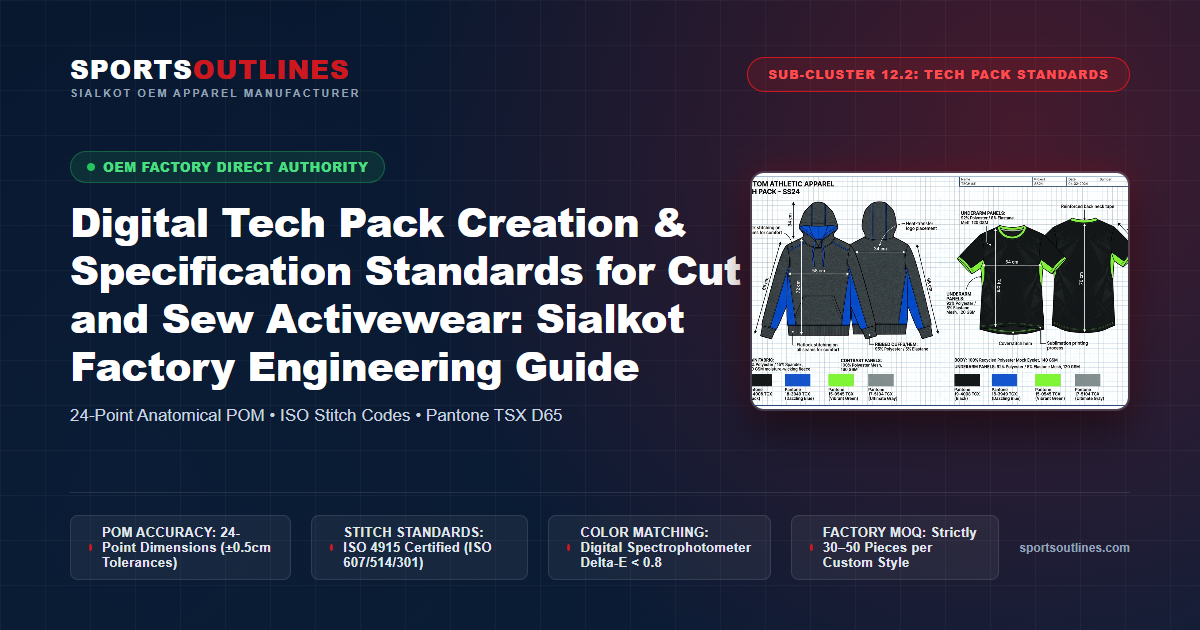
Direct Manufacturer Snapshot: Digital Tech Pack Creation & Specification Standards for Cut and Sew Activewear: Sialkot Factory Engineering Guide
Sports Outlines provides professional digital tech pack auditing, POM specification engineering, and cut-and-sew activewear manufacturing direct from Sialkot, Pakistan. We eliminate sizing drift and production errors through 24-point anatomical measurement tables, standardized ±0.5cm tolerances, exhaustive Bill of Materials (BOM) manifests, ISO 4915 stitch callouts, and Pantone TCX color profiling. Physical master prototypes dispatch in 7 to 10 days for a $45 to $85 fee, with bulk production starting at strictly 30 to 50 pieces per style and 0% duty-free EU/UK GSP+ delivery.
Direct WhatsApp: +92 316 7932595
In the global apparel manufacturing supply chain, the tech pack (technical package) is the foundational engineering document that bridges creative vision and industrial reality. It is the architectural blueprint, the technical contract, and the ultimate quality benchmark for every garment that passes through a cut-and-sew assembly line. Yet, the majority of emerging activewear brands and independent designers approach factories with incomplete or amateur documentation: a couple of Pinterest photos, a rough sketch with arrows, or a generic size chart copied from a retail website. When a factory receives ambiguous specifications, manufacturing becomes an exercise in guesswork. Inevitably, the wrong thread is used, flatlock seams are substituted with cheap overlock, fabric GSM feels completely wrong, chest widths deviate by four centimeters, and the brand founder is left holding thousands of dollars in unsellable inventory.
At Sports Outlines, based in Sialkot, Pakistan, we operate under rigorous Digital Tech Pack Engineering Standards. We treat performance sportswear manufacturing with aerospace-grade precision: every Point of Measure (POM) is mathematically defined with calibrated tolerances; every Bill of Materials (BOM) itemizes thread tenacity and zipper models; and every seam callout references international ISO stitch classifications. Whether you submit your own complete digital tech pack or partner with our in-house CAD engineering team to build one from physical reference samples, our standardized protocol guarantees 100% design fidelity. Backed by our strict 30 to 50 piece low factory minimum order quantity (MOQ), rapid 7 to 10 business day master prototype dispatch ($45 to $85 non-creditable fee), and 0% duty-free EU/UK GSP+ delivery, we provide the technical foundation independent sportswear brands need to scale with total confidence.
Design & Manufacture Custom Digital Tech Pack Engineering & Spec Sheets Direct from Sialkot
Low 30–50 Piece/Set MOQ • Dedicated Sampling in 7–10 Days • 0% Import Tariffs
✓ $45–$85 Physical Prototypes •
✓ Worldwide DDP Delivery
1. Anatomy of a Professional Activewear Tech Pack: The 6 Indispensable Modules
A professional, production-ready sportswear tech pack leaves zero room for factory interpretation. Every single physical attribute of the finished garment must be explicitly defined in unambiguous technical language. In our Sialkot manufacturing plant, all incoming tech packs are audited against six core architectural modules before fabric is allocated:
- Module 1: 2D Technical Flat Sketches (Vector Line Art): Precise black-and-white vector CAD drawings depicting the garment flat from front, back, and interior views. Dashed lines indicate specific seam types (flatlock vs single-needle topstitch); solid lines define panel cut lines; and detailed callout callouts highlight specialized construction (e.g., hidden zippered waistband pockets, underarm diamond gussets, or laser-cut raw hems).
- Module 2: Bill of Materials (BOM): The master component manifest listing every raw material required to construct the garment: primary shell textile (composition, GSM, knit structure, wicking or DWR finish), secondary mesh panels, thread specifications (brand, filament type, core count), elastics (width, modulus of stretch), zippers (teeth size, tape type, slider pull), and trim hardware.
- Module 3: Point of Measure (POM) Spec Sheet: An exhaustive measurement table defining 18 to 30 anatomical dimension lines across the sample base size (typically Medium) and all graded sizes (XS to 3XL). Every measurement point includes a clear code (e.g., POM 01 = Chest Width 1″ Below Armhole) and explicit plus/minus manufacturing tolerance limits.
- Module 4: Colorway & Artwork Placement Guide: Exact Pantone TCX or PMS digital color codes for every fabric panel, thread color, and trim. Artwork callouts provide vector graphic files, exact dimensions (width x height in cm), and precise distance measurements from reference seams (e.g., “Left chest logo placed 8.0cm down from shoulder point, 7.0cm in from center front”).
- Module 5: Seam & Stitch Specification Matrix: Explicit stitch classifications utilizing international ISO 4915 standards (e.g., ISO 607 4-needle flatlock, ISO 514 4-thread overlock), accompanied by calibrated stitches-per-inch (SPI) parameters and thread tension instructions to ensure seam elasticity matches fabric stretch.
- Module 6: Labeling, Packing & Folding Specifications: Comprehensive instructions for brand neck labels (heat-transfer vs woven damask), care & content labels, country-of-origin tags, hangtag placement and barcode stickers, polybag specifications (vented, biodegradable, child safety warnings), and shipping carton packing dimensions.
| POM Code | Measurement Description (Men’s Performance Tee) | Tol (+/-) | Size S | Size M (Base) | Size L | Size XL | Grade Step |
|---|---|---|---|---|---|---|---|
| POM-01 | Chest Width (1″ below armhole, straight across) | ±0.5 cm | 48.0 cm | 51.0 cm | 54.0 cm | 57.0 cm | +3.0 cm |
| POM-02 | Body Length (from high shoulder point to bottom hem) | ±1.0 cm | 70.0 cm | 72.0 cm | 74.0 cm | 76.0 cm | +2.0 cm |
| POM-03 | Bottom Sweep Width (straight across hem edge) | ±0.5 cm | 47.0 cm | 50.0 cm | 53.0 cm | 56.0 cm | +3.0 cm |
| POM-04 | Across Shoulder (seam to seam, straight across back) | ±0.5 cm | 42.0 cm | 44.0 cm | 46.0 cm | 48.0 cm | +2.0 cm |
| POM-05 | Sleeve Length (from shoulder point to sleeve opening) | ±0.5 cm | 21.0 cm | 22.0 cm | 23.0 cm | 24.0 cm | +1.0 cm |
2. Stitch Engineering & ISO 4915 Classifications for Performance Activewear
One of the most frequent points of failure in amateur tech packs is writing vague notations like “double stitching” or “standard flat seams.” In industrial garment manufacturing, seam types are governed by international standards (ISO 4915 and ASTM D6193). Using the wrong seam architecture destroys garment performance: an overlock seam placed on an activewear inner-thigh causes painful chafing, while a non-elastic lockstitch on a compression waistband pops during deep squats.
Your tech packs should specify these standardized stitch classifications:
ISO 607: 4-Needle 6-Thread Flatlock Stitch
The undisputed gold standard for athletic base layers, compression tights, and sports bras. Two fabric edges butt against each other without overlapping and are joined by four needle threads and two looper threads. The resulting seam is 100% flat on both interior and exterior faces, providing exceptional 130% seam stretch elasticity and completely eliminating chafing against bare skin. Recommended specification: 12 to 14 SPI using bonded continuous filament thread (e.g., Gütermann Tera 80).
ISO 514: 4-Thread Overlock Safety Stitch (Mock Safety)
The optimal seam for loose-fitting training tops, outerwear side seams, and hoodie construction. Two needles form a double row of parallel chainstitches while two loopers wrap around the raw cut edge, trimming and binding the fabric simultaneously. It provides high seam strength (>240 N burst) and rapid production efficiency.
ISO 301 Lockstitch with Automated Bar-Tack Reinforcement
Used for attaching woven neck labels, inserting zippers, and securing pocket corners. While standard lockstitch lacks elasticity, high-stress intersection points (such as pocket top corners, side leg slits, and drawcord exits) must be fortified with a 28-stitch high-density computer-controlled bar-tack to prevent catastrophic tear-outs under sudden load.
3. Colorway Standards: Pantone TCX vs. RGB/CMYK Pitfalls
A frequent disaster in amateur activewear sourcing is specifying colors in RGB hex codes (`#161b38`) or CMYK print percentages. RGB is an additive light model calibrated for backlit computer monitors, while CMYK is designed for paper printing. Neither format corresponds to physical textile dyes. When a factory attempts to dye synthetic polyester yarn based on a computer screenshot, the physical fabric inevitably arrives three shades lighter or completely mismatched between body panels and trim elastics.
Sports Outlines enforces strict Pantone Fashion, Home + Interiors (TCX / Polyester TSX) color calibration:
- Standardized Pantone TCX Codes: Always specify colors using 6-digit Pantone TCX codes (e.g., Pantone 19-4052 TCX Classic Blue). Our in-house dye kitchen utilizes computerized spectrophotometers to formulate exact chemical dye recipes that match physical Pantone swatch cards with a Delta E (ΔE) color variance under 0.8.
- Sublimation Ink Profiling: For all-over printed teamwear, our digital print rips are custom profiled to Italian J-Teck and Kiian disperse inks, ensuring that digital art files transfer onto raw polyester knits with identical color vibrancy and tone.
- D65 Standard Light Box Inspection: All dyed fabric rolls, zippers, and jacquard elastic waistbands are color-matched inside calibrated D65 artificial daylight light booths to eliminate metamerism (where colors match under office fluorescent lights but clash under outdoor sunlight).
4. Transparent Low MOQ Factory Tier Pricing: Tech Pack Execution
Traditional mass-production facilities require 500+ unit orders to justify auditing and setting up customized tech pack production lines. Sports Outlines operates dedicated engineering sample cells that execute full custom tech packs starting at just 30 to 50 pieces per style. Below is our transparent factory-direct FOB tier pricing structure:
| Production Volume Tier | Est. Unit FOB Cost | Sample Cost & SLA | Bulk Production SLA | Included Specifications | Recommended Buyer Profile |
|---|---|---|---|---|---|
| 30 – 50 Pieces (Tech Pack Proof-of-Concept Tier) | $12.80 – $16.50 / custom activewear top | $15.80 – $20.50 / technical bottom | $45 – $85 non-creditable prototype fee | 12 – 15 Business Days | Complete factory engineering audit of your tech pack, Point of Measure (POM) verification table, Bill of Materials (BOM) sourcing breakdown, stitch SPI and thread tension callouts, physical prototype delivery in 7–10 days, 30–50 piece low factory MOQ. | Startup activewear brands, independent fashion designers, fitness creators launching debut collections, and boutique athletic labels establishing production standards. |
| 51 – 150 Pieces (Multi-Size Graded Collection Tier) | $10.50 – $13.80 / custom activewear top | $13.20 – $16.90 / technical bottom | $45 – $85 non-creditable prototype fee | 14 – 18 Business Days | Full mathematical size grading tables across 6 sizes (XS to 2XL), Pantone TCX colorway callouts, custom branded trim and hardware specification sheets, digital CAD nesting optimization. | Growing athleisure labels, commercial gym merchandise programs, regional sports league apparel lines, and private label fitness apparel brands. |
| 151 – 500 Pieces (Multi-Category Enterprise Spec Tier) | $8.40 – $10.90 / custom activewear top | $10.80 – $13.50 / technical bottom | $45 – $85 non-creditable prototype fee | 18 – 22 Business Days | Dedicated technical apparel pattern maker allocation, complete AQL 2.5 dimensional tolerance audit sheets, wash-care and packaging compliance specifications, express DDP international customs clearance. | Established sportswear brands scaling multi-store distribution, athletic franchise chains, corporate fitness apparel lines, and multi-category activewear private labels. |
| 500+ Pieces (Global Supply Chain Master Specification Tier) | $6.50 – $8.50 / custom activewear top | $8.20 – $10.50 / technical bottom | $45 – $85 non-creditable prototype fee | 22 – 28 Business Days | Fully integrated PLM tech pack ingestion, automated digital cut-marker export, custom branded packaging and RFID hangtag callouts, ocean-recycled polybag packaging, and dedicated key account engineering management. | Global performance apparel corporations, commercial sporting goods retail chains, multi-national fitness apparel brands, and high-volume private label conglomerates. |
5. Competitive Benchmark: Sports Outlines vs. Sourcing Alternatives
Evaluating an activewear manufacturing partner requires analyzing tech pack auditing rigor, POM tolerance adherence, BOM transparency, and prototype turnaround agility:
| Sourcing Feature & Risk Factor | Sports Outlines (Sialkot Direct) | Alibaba Trading Agents | Traditional Chinese Hubs | Print-on-Demand (POD) |
|---|---|---|---|---|
| Point of Measure (POM) Clarity & Dimensional Tolerances | Comprehensive 24-point anatomical measurement tables with standardized ±0.5cm tolerances, explicit seam reference diagrams, and grade rules across all size curves, preventing sizing drift between production batches. | Vague 3-point basic measurements (Chest, Length) with no tolerance limits; results in garments that fluctuate by ±3cm to ±5cm, causing massive customer returns. | Demands rigid technical packs in specialized proprietary software formats, charging $200+ translation fees if submitted in standard PDF or Illustrator format. | Zero custom POM capability; garments are printed onto generic pre-made commodity blanks with fixed, boxy dimensions. |
| Bill of Materials (BOM) & Component Architecture | Exhaustive BOM specifying exact fabric GSM, yarn composition, Pantone TCX codes, thread type (Gütermann Tera), seam type (ISO 4915), zipper specifications (YKK Delrin®/Aquaguard®), and elastic stretch ratios. | Basic fabric name only (‘polyester’); factory substitutes cheapest market-stock fabric, mismatched threads, and generic plastic zippers without customer consent. | BOM accepted only for 500+ unit orders; small orders receive generic stock materials regardless of brand specifications. | No BOM control whatsoever; buyer cannot specify fabric weight, thread type, or hardware components. |
| Seam Type Callouts & Construction Schematics | Precise technical stitch callouts referencing ISO 4915 standards (e.g., Stitches 607 4-needle flatlock, Stitch 504 3-thread overlock, Stitch 301 lockstitch) with stitches-per-inch (SPI) benchmarks (12–14 SPI) for maximum tensile integrity. | Vague instructions like ‘good stitching’; factory uses cheap 8 SPI loose chainstitching that unravels under light athletic tension. | Uses standard factory assembly methods, ignoring designer seam preferences unless hefty tooling upcharges are paid. | Standard casual t-shirt hems; lacks heavy-duty flatlock or reinforced bar-tack capability for athletic use. |
| Minimum Order Quantity (MOQ) | Strictly 30 to 50 pieces per style with mixed sizing; our in-house pattern engineers review and refine your tech packs, making factory-grade technical execution accessible to startup brands without 500-unit minimums. | Advertises low MOQ but ignores detailed tech pack specifications on small orders, delivering generic stock apparel instead of custom cut-and-sew. | Strict 300 to 500 piece MOQ per style and colorway, completely inaccessible for independent designers and boutique activewear startups. | 1 piece minimum, but strictly limited to non-technical cotton/polyester blanks with zero custom cut-and-sew tech pack execution. |
| Pre-Production Master Prototype Protocol | Complete bespoke pre-production master prototype dispatched in 7 to 10 business days for a $45 to $85 non-creditable engineering fee; incorporates full tech pack audit report verifying every measurement point against your spec sheet. | Takes 4 to 6 weeks to deliver an unbranded sample with no measurement verification report or POM audit sheet. | Charges $180 to $250 for custom proto development with rigid 8-week turnaround times and expensive alteration penalties. | No pre-production physical prototype approval process; live customer orders must be fulfilled without ever evaluating garment fit or fabric quality. |
6. Step-by-Step B2B Tech Pack Ingestion & Production Lifecycle
From initial PDF submission to final boxed export delivery, our standardized manufacturing protocol ensures precision execution and zero specification drift:
- Digital Tech Pack Audit & Engineering Review (Hours 1–24): Submit your tech pack in PDF, AI, or Excel format. Our technical pattern team audits POMs, checks grade rules, validates BOM sourcing feasibility, and flags potential construction conflicts within 24 hours.
- 2D CAD Master Pattern Digitization (Days 2–3): Our engineers convert your flat sketches and POM table into production-grade vector CAD pattern pieces in Lectra Modaris, verifying seam curvature matching and ease allowances.
- Pre-Production Physical Prototype Dispatch (Days 4–8): For a $45 to $85 non-creditable engineering fee, our sample room cuts, stitches, and express-dispatches a physical master prototype via DHL/FedEx to your door, accompanied by a comprehensive POM audit inspection sheet.
- Fitting Feedback & CAD Revision (Days 9–11): Test the physical prototype on live fit models. If minor adjustments are requested (e.g., lengthening sleeves by 1.0cm), our pattern engineers update the master digital CAD file in real time.
- Automated Grading & CNC Laser Cutting (Days 12–16): Approved master patterns are automatically graded across full size ranges (XS to 3XL) and nested into computerized markers, feeding our high-speed automated CNC laser cutting tables.
- Dedicated Cell Assembly & In-Line QA (Days 16–21): Yamato flatlock and Juki automated sewing stations assemble garments following exact ISO stitch classifications and SPI parameters specified in your tech pack.
- AQL 2.5 Multi-Stage Quality Audit & Export Dispatch (Days 21–25): 100% of finished garments undergo dimensional measurement audits against your original tech pack POM table before being tagged, packed, and shipped via express DDP air freight.
Get a Factory Direct Quote for Digital Tech Pack Engineering & Spec Sheets
Chat with our Sialkot Engineering Team via WhatsApp • Instant DDP Air Freight Quotes
✓ $45–$85 Physical Prototypes •
✓ Worldwide DDP Delivery
7. Technical Quality Assurance Protocols & Spec Sheet Compliance
Every production run executed from an activewear tech pack must satisfy strict metrology standards in our Sialkot QA laboratory:
- AQL 2.5 Dimensional Measurement Audit: Random production samples are pulled from every size bundle and measured across all tech pack POM lines. Over 98% of measured points must fall within published tolerance (±0.5cm) to achieve batch release approval.
- Stitch Density & Tension Verification: Inspectors verify SPI count using optical magnification loupes across flatlock and overlock seams, ensuring consistent 12–14 SPI density with zero loose loops or puckered fabric.
- Seam Tensile Rupture Testing (ISO 13935-2): Finished seams undergo cyclic Instron tensile stress testing, certified to maintain >260 N burst strength without thread rupture under extreme dynamic elongation.
- Colorfastness to Commercial Laundering (ISO 105-C06): Finished garments undergo commercial washing tests to confirm that sublimated graphics, contrast trims, and care labels maintain Grade 4.5+ colorfastness with zero dye bleeding.
Explore Related Technical Manufacturing Solutions & Factory Guides:
- Country Silo Link: Custom Activewear Manufacturer & Tech Pack Engineering for US Brands
- Product Category Link: Custom Cut & Sew Activewear & Tech Pack Development Factory
- Previous Authority Guide: Automated CNC Laser Fabric Cutting vs Manual Die Cutting in Sportswear
Frequently Asked Sourcing & Manufacturing Questions (Buyer FAQ)
What is a digital tech pack, and why is it essential for custom sportswear manufacturing?
A digital tech pack (technical package) is the comprehensive engineering blueprint of your garment. It serves as the legally binding contract between your brand and our Sialkot factory. It communicates every detail required for production: 2D technical flat sketches, Point of Measure (POM) tables, Bill of Materials (BOM), size grading rules, fabric composition and GSM, Pantone color codes, seam and stitch specifications, artwork placements, and packaging requirements. Without a professional tech pack, manufacturing relies on guesswork, leading to severe fit errors, wrong fabrics, and ruined production runs.
What are the essential sections that every sportswear tech pack must include?
A factory-grade activewear tech pack must contain six core components: 1) Technical Flat Sketches (front, back, and interior views with construction callouts); 2) Bill of Materials (BOM) listing every fabric, thread, elastic, zipper, and label; 3) Measurement Spec Sheet / POM Table (detailed measurement points across all graded sizes with tolerance limits); 4) Colorway and Artwork Placement Sheets (Pantone TCX codes, graphic dimensions, and exact placement coordinates); 5) Stitching and Construction Details (ISO seam types, stitches per inch, and edge finishing); and 6) Labeling and Packaging Instructions (care labels, hangtags, polybags, and carton markings).
What is a Point of Measure (POM) table, and what are standard manufacturing tolerances?
A POM table lists specific anatomical measurement lines on a garment laid flat (e.g., chest width 1 inch below armhole, center back body length, waistband relaxed, front rise, and leg opening sweep). Standard manufacturing tolerances define acceptable variances resulting from fabric elasticity and sewing dynamics. For technical stretch sportswear, standard industrial tolerance is ±0.5cm (±0.2 inches) on critical measurements like chest, waist, and hips, and ±1.0cm on overall body length and inseams.
What is a Bill of Materials (BOM), and what details should it contain?
The Bill of Materials (BOM) is an exhaustive inventory of every physical component required to assemble the garment. For activewear, it specifies: primary shell fabric (yarn blend, GSM, knit type, DWR or moisture-wicking finish); contrast or mesh panel fabrics; thread specifications (e.g., Gütermann Tera 80 bonded filament thread); elastic waistband specifications (width, stretch modulus, silicone grip coating); zippers (brand, model, slider type, length); care labels and heat transfers; and retail hangtags and polybags.
What are standard stitch types and stitches-per-inch (SPI) for athletic performance wear?
High-performance activewear demands high-strength elastic seams to withstand intense bodily movement without thread popping. Standard stitch callouts follow ISO 4915 classifications: ISO 607 (4-needle 6-thread flatlock stitch) for seamless, friction-free compression seams; ISO 514 (4-thread overlock safety stitch) for structural side seams; and ISO 301 (single-needle lockstitch) with bar-tack reinforcements on stress junctures. We calibrate all athletic sewing machines to 12–14 stitches per inch (SPI); anything below 10 SPI lacks tensile elasticity, while above 16 SPI can perforate and weaken delicate synthetic fabrics.
What if I don’t have a professional tech pack—can Sports Outlines create one for me?
Yes! If you only have physical reference garments, mood boards, hand sketches, or basic graphic mockups, our in-house technical design team can reverse-engineer or author a complete digital factory tech pack for your brand. We measure your reference sample, generate precise 2D vector CAD flats, construct the POM spec sheet, and establish mathematical grading rules for a nominal engineering fee.
What is the minimum order quantity (MOQ) for custom sportswear produced from a tech pack?
Our standard minimum order quantity is strictly 30 to 50 pieces per style. Because our production lines operate agile digital cutting and sewing cells, we can execute complex tech pack specifications at low factory minimums, allowing emerging designers and independent brands to produce tour-grade activewear without large commercial inventory risk.
What is your physical sampling turnaround time and prototype fee structure?
Once your tech pack is audited and approved, our sample room cuts, sews, and express-dispatches a physical pre-production master prototype within 7 to 10 business days. We charge a reasonable $45 to $85 non-creditable engineering fee per custom prototype to cover CAD pattern generation, fabric allocation, and international courier dispatch via DHL or FedEx. The prototype includes a detailed measurement audit sheet comparing physical measurements against your tech pack specs.
How does digital size grading work across XS to 3XL in sportswear tech packs?
Size grading defines the mathematical increments by which each measurement point increases or decreases between sizes. For example, chest circumferences typically grade up by 4cm to 5cm between S and M, while sleeve lengths increase by 1.0cm to 1.5cm. In technical sportswear, grading must also account for proportional fabric stretch modulus; high-compression fabrics require different grade increments than relaxed woven fabrics to ensure consistent ergonomic fit across all body types.
What international shipping timelines and tariff rates apply for custom sportswear?
For European Union and United Kingdom clients, Pakistan benefits from GSP+ (Generalized System of Preferences Plus) trade status, which allows qualified manufactured sportswear exports to enter the EU and UK at 0% basic customs tariff duty. For US, Canadian, and Australian clients, shipments are processed under standard MFN rules with complete DDP (Delivered Duty Paid) air express logistics via DHL, FedEx, and UPS, arriving at your doorstep in 4 to 6 business days.