Direct Manufacturer Snapshot: Automated Pattern Grading Algorithms in Lectra & Gerber for Multi-Regional Sizing Curves (US, EU, Asian Athletic Fits)
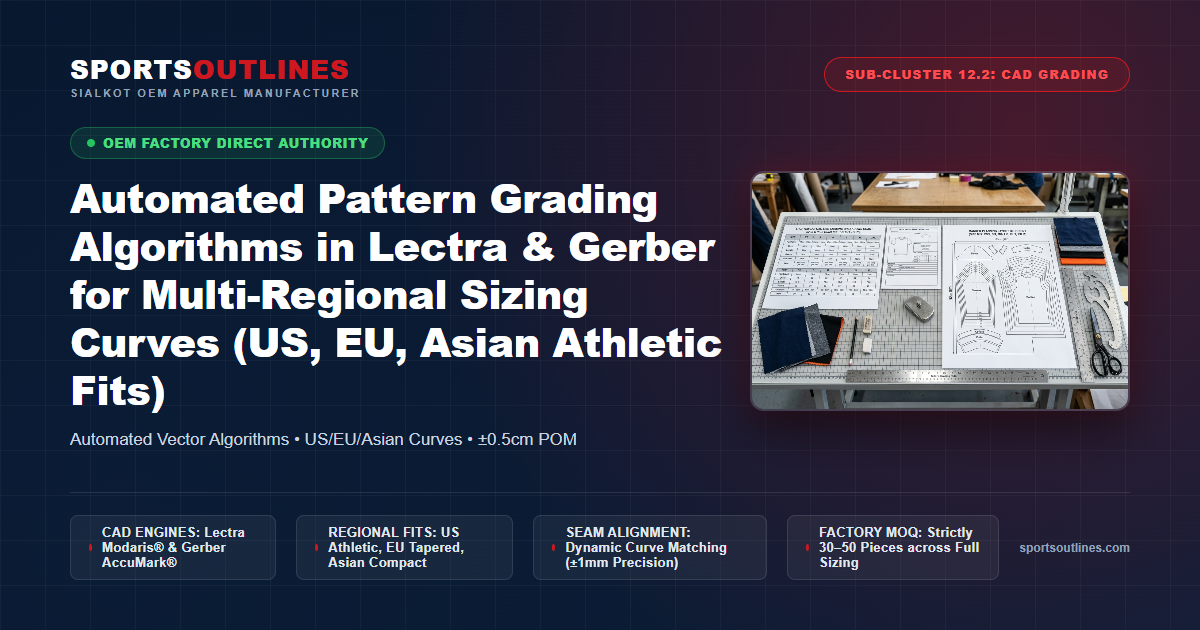
Sports Outlines provides automated vector CAD pattern grading for custom athletic apparel direct from Sialkot, Pakistan, utilizing industry-standard Lectra Modaris® Expert and Gerber AccuMark® systems. We engineer mathematically calibrated, distortion-free grading rule tables across XS to 5XL tailored to US Athletic, European Tapered, and Asian compact sizing curves with ±0.5cm POM tolerances. We offer an industry-low factory MOQ of strictly 30 to 50 pieces per style across full size breakdowns, physical prototype development in 7 to 10 days for a $45 to $85 fee, and 0% duty-free delivery to the UK and EU under GSP+ status.
Direct WhatsApp: +92 316 7932595
The difference between a commercial activewear brand that achieves viral customer loyalty and one that suffers catastrophic return rates lies in pattern grading precision. When an emerging athletic label develops a flawless Size Medium prototype, founders often assume that expanding into Size Small, Extra Large, or 3XL is a simple clerical formality. In reality, improper pattern grading is the number one cause of garment failure in global e-commerce: shirts with gaping collars, sleeves that strangle the biceps, leggings that sag at the crotch, and plus-size garments that fit like unshaped canvas sacks. High-performance athletic apparel requires automated vector CAD pattern grading algorithms executed on tier-one systems like Lectra Modaris® Expert and Gerber AccuMark®. At Sports Outlines in Sialkot, Pakistan, our certified pattern engineers deploy mathematically calibrated growth vectors tailored to US, European, and Asian athletic physiques. We deliver flawless, multi-regional graded collections at a low factory minimum order quantity (MOQ) of strictly 30 to 50 pieces per custom style, supported by dedicated $45 to $85 prototype engineering in 7 to 10 days.
Design & Manufacture Custom Automated Pattern Grading (Lectra & Gerber) Direct from Sialkot
Low 30–50 Piece/Set MOQ • Dedicated Sampling in 7–10 Days • 0% Import Tariffs
✓ $45–$85 Physical Prototypes •
✓ Worldwide DDP Delivery
1. The Mathematics of Vector CAD Pattern Grading: Cartesian Coordinate Rule Tables
In legacy apparel workshops, pattern grading was performed manually using cardboard templates, plastic curve rulers, and pencil offsets. This analog process introduced human error at every joint, causing subtle curve distortions that accumulated across size ranges until a 2XL pattern bore little resemblance to the approved Medium sample.
Modern athletic pattern grading is governed by Cartesian vector mathematics executed within computerized CAD engines. Every 2D pattern piece—such as a front bodice, raglan sleeve, or compression legging leg panel—is digitized into thousands of vector coordinates with designated grade points at key anatomical boundaries.
Our pattern engineers construct sophisticated Grading Rule Tables that define the exact lateral ($\Delta X$) and vertical ($\Delta Y$) displacement vectors for each grade point. When the algorithm runs, the CAD software recalculates every cubic Bézier spline curve simultaneously. Seam curves, grain lines, and internal construction notches are dynamically re-interpolated, ensuring that the visual proportion, aesthetic seam lines, and functional drape of the base pattern remain 100% distortion-free across every single size from XS up to 5XL.
| Anatomical Grade Point | Lateral Vector ($\Delta X$) | Vertical Vector ($\Delta Y$) | Biomechanical Function |
|---|---|---|---|
| Neck Point (HPS – High Point Shoulder) | +0.4 cm to +0.6 cm | +0.2 cm to +0.3 cm | Expands neck aperture proportionally without allowing the collar to drop down the chest. |
| Shoulder Tip (Acromion Process) | +1.0 cm to +1.5 cm | +0.5 cm to +0.7 cm | Accommodates deltoid muscle breadth while maintaining exact shoulder slope angle. |
| Underarm Armhole Point (Bicep Level) | +1.2 cm to +1.8 cm | +0.8 cm to +1.2 cm | Expands chest circumference and bicep volume while preserving armhole depth for overhead mobility. |
| Side Seam Waist Apex | +1.5 cm to +2.5 cm | +0.6 cm to +1.0 cm | Graduates waist circumference while preserving athletic ‘V-taper’ or hourglass silhouette. |
| Bottom Hem Sweep Corner | +1.2 cm to +2.0 cm | +1.2 cm to +2.0 cm | Ensures hip sweep clearance during athletic movement without creating an unflattering bell-shaped flare. |
2. Multi-Regional Sizing Curves: Calibrating for US, European & Asian Athletic Fits
A common reason why international sportswear brands struggle when expanding into cross-border e-commerce is the mistaken belief that a single sizing chart works globally. Anthropometric body scans of diverse athletic populations demonstrate stark anatomical divergence:
US Athletic Fit (North America): Engineered for broader skeletal bone structure, larger muscular frames, and higher body mass index (BMI) distributions. The US grading curve applies a generous +5.0cm grade drop in chest and hip circumferences per size, longer vertical torso lengths (+2.5cm drop), wider bicep girth, and relaxed waist ease. US consumers expect relaxed mobility across the shoulders and sufficient torso length to prevent untucking during athletic activity.
European Athletic Fit (UK & Continental EU): Focuses on an ergonomic, tailored silhouette that contours close to the musculature. Chest grade drops are tighter (+4.0cm), with pronounced waist suppression (-2.5cm to -3.5cm tighter than US cuts) to emphasize athletic abdominal tapers. Armholes are cut higher and sleeves are narrower to reduce excess fabric drag during running and cycling.
Asian Athletic Fit (Japan, Korea, Southeast Asia): Formulated for more compact anatomical frames. Sleeve lengths are condensed by -3.0cm to -5.0cm, pant inseams are shortened by -5.0cm to -7.0cm, shoulder spans are narrowed, and the front-to-back crotch rise is reduced. Delivering Western-sized garments into Asian retail channels results in overwhelming return rates due to dragging hems and excessively long sleeves.
3. Dynamic Seam Matching & Notch Alignment: Eliminating Assembly Puckering
When a pattern is graded, individual component pieces must still fit together flawlessly on the sewing floor. In amateur pattern grading, an engineer might grade the front bodice by +1.5cm along the armhole curve, but accidentally grade the mating sleeve cap curve by +2.2cm. When sewing operators attempt to join the sleeve to the body, they must forcefully stretch or gather the fabric, resulting in unsightly seam puckering, twisted sleeves, and restricted shoulder mobility.
Sports Outlines utilizes advanced dynamic seam-matching modules in Lectra Modaris and Gerber AccuMark. The CAD software continuously calculates the perimeter curve lengths of adjacent panels—such as front-to-back shoulder seams, side seams, and armhole-to-sleeve caps. The software enforces a microscopic perimeter variance tolerance of under ±1.0mm. Furthermore, construction balance notches (single notch for front armhole, double notch for back armhole) are dynamically shifted along the graded curves, guaranteeing that sewing operators match panels with pinpoint precision at production speeds.
| Sourcing Feature & Risk Factor | Sports Outlines (Sialkot Direct) | Alibaba Trading Agents | Traditional Chinese Hubs | Print-on-Demand (POD) |
|---|---|---|---|---|
| Pattern Grading Engine | Industry-standard Lectra Modaris® Expert and Gerber AccuMark® computerized vector CAD grading engines. | Manual paper card grading with inaccurate pencil offsets, leading to distorted armholes and necklines. | Automated CAD grading systems, but charging $300–$600 pattern engineering setup fees per style. | Crude proportional scaling that simply enlarges the entire image file, resulting in unwearable large sizes. |
| Minimum Order Quantity (MOQ) | Strictly 30–50 pieces per custom style across full multi-size curves (XS to 3XL) — startup accessible. | Brokers quote 50 units for a single medium size, demanding 100 units per additional graded size. | 500 to 1,500 units per style required to justify digitizer calibration and grading table setups. | Single unit available, but lacks anatomical grading; sleeves and collars become grossly oversized. |
| Multi-Regional Anthropometric Fits | Calibrated parametric curves for US Athletic (broad chest), EU Tapered (slim waist), and Asian (condensed inseam). | One-size-fits-all generic Asian sizing that runs 2–3 sizes too small for Western athletic consumers. | Standard US/EU grading available, but requires months of back-and-forth email approvals to adjust ease. | Generic unisex boxy cuts that fit poorly on both male and female athletic body profiles. |
| POM Tolerance Standards | Strict ±0.5cm tolerances verified across 24 anatomical Points of Measure under AQL 2.5 standards. | High variance (±2.0cm to ±3.5cm) between garments labeled as the same size; severe quality inconsistency. | ±0.75cm standard tolerance, but physical measurement audit sheets withheld from buyer. | Zero tolerance accountability; garments shrink or stretch unpredictably during fulfillment. |
| Prototype Development & Turnaround | $45–$85 non-creditable engineering prototype fee; physical graded master sample dispatched in 7–10 days. | Promises cheap samples ($35), but provides single-size blanks without grading verification. | $200–$400 sampling fee with 4–6 week queue times due to large production priorities. | Digital mockups only; physical drop-shipped items take 14 days and cannot be custom modified. |
| Customs Duty & Tariffs (US / EU / UK) | 0% import customs duty into EU & UK via Pakistan GSP+ status; low trade tariff access into the US. | Unpredictable customs brokerage fees, freight surcharges, and full import duties payable by buyer. | Subject to Section 301 tariffs (7.5%–25%) in the US and standard MFN customs duties in the EU/UK. | Local state sales taxes and individual delivery surcharges applied to every unit, eroding margins. |
4. Fabric Modulus Calibration: Grading for High-Stretch Knits vs. Rigid Wovens
Pattern grading cannot exist in a vacuum separated from textile physics. A grading rule that produces a magnificent fit in a rigid 100% nylon ripstop windbreaker jacket will completely ruin a 4-way stretch compression tight.
Our CAD technicians calibrate grading rule tables based on the precise tensile modulus and elastomeric recovery of the target fabric:
- Negative Ease for Compression Apparel: For compression tights, sports bras, and cycling bibs constructed from 280 GSM warp-knit nylon-spandex (80/20), patterns are drafted with negative ease (pattern dimensions are 8% to 15% smaller than human anatomical measurements). The grading vectors must account for fabric power-stretch curves, ensuring that larger sizes receive appropriate venous compression without cutting off blood circulation or becoming see-through.
- Positive Ease for Technical Outerwear: For 3-layer waterproof-breathable ski jackets and windbreakers, patterns require positive ease (+8cm to +14cm over body circumference) and articulated 3D elbow darts. Grading rules must preserve ample volumetric room across the back yoke and bicep to allow athletes to wear heavy thermal baselayers and mid-layers underneath without feeling constrained.
5. Automated Marker Nesting & Fabric Yield Optimization (Lectra Diamino)
Once all sizes are graded, they must be laid out for cutting. In traditional cutting rooms, marker makers arrange pattern pieces manually on long paper rolls. Human arrangers rarely achieve fabric yield efficiencies above 78% to 82%, wasting up to 20% of expensive technical textiles as scrap floor fallout.
Sports Outlines combines automated grading with Lectra Diamino® / Gerber AccuNest® automated nesting algorithms. Operating with artificial intelligence optimization routines, our systems test millions of spatial geometric orientations per second, nesting pattern pieces of mixed sizes (e.g., nesting 2 Small, 4 Medium, 4 Large, and 2 XL pieces simultaneously) along the exact fabric roll width. Fabric utilization efficiency regularly exceeds 88% to 94%. This substantial reduction in material waste directly lowers unit FOB manufacturing costs, allowing us to pass significant price savings back to our brand partners.
6. Low MOQ Factory Direct Economics: Solving the Multi-Size Startup Dilemma
Why do conventional apparel factories refuse to grade patterns for startup brands? In traditional manufacturing, creating grading rule tables, plotting paper markers, and digitizing patterns incurs high administrative overhead. Factories enforce minimums of 100 to 200 units per size, requiring an emerging brand to purchase 600 to 1,200 pieces just to offer an XS through 2XL collection.
Sports Outlines has completely democratized this workflow. By maintaining digitized standard athletic base blocks and parameterized CAD libraries in Sialkot, our engineers can grade a complete size range in hours. We offer full multi-size collection manufacturing at a low factory MOQ of strictly 30 to 50 pieces per custom style. You can distribute your 30-to-50-unit order across five or six distinct sizes, validating real consumer sizing demographics in your target market without risking thousands of dollars in unsold inventory.
| Production Volume Tier | Est. Unit FOB Cost | Sample Cost & SLA | Bulk Production SLA | Included Specifications | Recommended Buyer Profile |
|---|---|---|---|---|---|
| 30 – 50 Sets/Pieces (Graded Capsule Collection Tier) | $13.50 – $17.50 / custom graded top | $16.50 – $21.50 / custom graded bottom | $45 – $85 non-creditable prototype fee | 12 – 15 Business Days | Complete Lectra Modaris® / Gerber AccuMark® automated digital pattern grading across 5 core sizes (S to 2XL), multi-regional fit adjustments, physical master fit prototype in 7–10 days, 30–50 piece low factory MOQ. | Startup activewear brands, direct-to-consumer fitness labels, cross-border e-commerce sellers, and boutique athletic designers expanding sizing curves without large inventory liabilities. |
| 51 – 150 Sets/Pieces (Multi-Regional Line Scaling Tier) | $11.20 – $14.50 / custom graded top | $14.20 – $17.90 / custom graded bottom | $45 – $85 non-creditable prototype fee | 14 – 18 Business Days | Extended size range grading (XS to 4XL), dual sizing curve calibration (e.g., US Athletic + EU Tapered fits), automated marker nesting optimization (>88% fabric yield), custom size label integration. | Growing sportswear brands exporting to both North American and European markets, fitness franchise merchandise lines, and commercial apparel retailers. |
| 151 – 500 Sets/Pieces (Omnichannel Commercial Wholesale Tier) | $9.40 – $12.20 / custom graded top | $12.10 – $15.20 / custom graded bottom | $45 – $85 non-creditable prototype fee | 18 – 22 Business Days | Comprehensive 3-market grading libraries (US, EU, Asian fit matrix), dedicated CAD pattern engineer support, full AQL 2.5 POM tolerance verification reports (±0.5cm), express DDP door-to-door delivery. | Established international athletic brands, professional sporting league equipment managers, corporate fitness apparel lines, and multi-store retail distributors. |
| 500+ Sets/Pieces (Enterprise Global Retail Wholesale Tier) | $7.60 – $9.80 / custom graded top | $9.80 – $12.50 / custom graded bottom | $45 – $85 non-creditable prototype fee | 22 – 28 Business Days | Parametric DXF/AAMA pattern export files, dedicated automated cutting marker files, custom anthropometric population curve modeling, ocean freight or air cargo consolidation, 0% GSP+ duty-free customs clearance. | Multinational sportswear corporations, department store athletic private labels, national team uniform federations, and high-volume commercial garment importers. |
7. Technical Specifications & Export Compliance: The Sialkot Direct Advantage
Sialkot, Pakistan, is the recognized international epicenter for technical sports equipment and apparel engineering. By working directly with Sports Outlines, brand owners bypass trading intermediaries and secure unmatched commercial advantages:
- Strictly 30–50 Piece Factory MOQ: Launch custom athletic lines with professional CAD grading, custom branding, and personalized size distributions at accessible minimums.
- Rapid Physical Prototyping in 7–10 Business Days: For a transparent $45 to $85 non-creditable prototype fee, we produce and dispatch a full physical master prototype. You verify the anatomical fit, sleeve drape, and fabric stretch before approving bulk production.
- 0% Import Customs Duty via EU & UK GSP+ Status: Custom sportswear manufactured in Pakistan enters the European Union and the United Kingdom at 0% customs import duty under GSP+, delivering a direct 12% to 14% cost advantage over China, Vietnam, or Turkey.
- Comprehensive AQL 2.5 Quality Inspection: Every finished garment is inspected against the 24-point POM specification sheet, guaranteeing that measurements match approved CAD tolerances (±0.5cm) across every size before packaging.
Get a Factory Direct Quote for Automated Pattern Grading (Lectra & Gerber)
Chat with our Sialkot Engineering Team via WhatsApp • Instant DDP Air Freight Quotes
✓ $45–$85 Physical Prototypes •
✓ Worldwide DDP Delivery
8. Explore Our Technical Sportswear Manufacturing Ecosystem
Deepen your athletic production expertise by reviewing our dedicated manufacturing guides and regional activewear directories:
- Custom Activewear & Athleisure Manufacturer Germany: Low MOQ Sialkot OEM
- Complete Sportswear Size Guide & Technical Point of Measure (POM) Standards
- Italian Water-Based Sublimation Inks & Heat Calendering in Sportswear
- Direct-to-Film (DTF) vs Silicone Heat Transfer vs Screen Printing in Sportswear
- Digital Tech Pack Creation & Technical Specifications for Apparel Manufacturing
Frequently Asked Sourcing & Manufacturing Questions (Buyer FAQ)
What is automated pattern grading and how do CAD software algorithms work in garment manufacturing?
Automated pattern grading is the computerized mathematical process of expanding or contracting a base sample pattern (typically Size Medium) into an entire range of commercial sizes (e.g., XS to 5XL) while preserving the designer’s original fit, silhouette, and proportion. In modern CAD systems like Lectra Modaris® Expert and Gerber AccuMark®, master pattern cutters establish a Cartesian coordinate grid on each pattern piece. Mathematical grading rules—defined as vector displacement coordinates (delta X and delta Y increments)—are assigned to specific boundary points (such as shoulder points, armhole notches, waist apexes, and hem corners). When the software executes the grading algorithm, it recalculates every spline curve, seam curvature, and internal notch simultaneously, generating mathematically perfect patterns for all sizes in seconds without manual distortion.
Why is simple proportional scaling completely ineffective for athletic apparel pattern grading?
Simple proportional scaling (such as scaling a vector graphic up by 120%) fails catastrophically in apparel because the human body does not grow uniformly in all directions. When an athlete moves from a Size Small to a Size 2XL, their chest circumference and abdominal width expand significantly, but their vertical anatomical dimensions—such as neck circumference, collar depth, shoulder seam length, and bicep height—grow at radically smaller rates. If an apparel pattern is scaled proportionally, a Size 2XL shirt ends up with a gigantic, gaping neckline that sags to the mid-chest, armholes that drop past the ribs, and sleeves that hang past the fingertips. Modern CAD grading applies differential growth vectors: large growth increments on lateral body circumferences and minimal increments on vertical neck and shoulder joints.
What are the key anatomical differences between US, European (EU), and Asian athletic sizing curves?
Anthropometric population data reveals substantial morphological variations across regional consumer bases: 1) US Athletic Fit: Characterized by broader chest and deltoid circumferences (+5.0cm grade drop per size), wider bicep biceps, longer torso lengths (+2.5cm drop), and greater ease allowance across the abdomen to accommodate larger frames. 2) European (EU) Athletic Fit: Focuses on an ergonomic, tapered silhouette with narrower waist suppression (-3.0cm compared to US), slimmer sleeves, higher armhole cutouts for reduced fabric drag, and refined back curvature. 3) Asian Athletic Fit: Engineered for more compact skeletal structures, featuring condensed sleeve lengths (-3.0cm to -5.0cm), shorter pant inseams (-5.0cm to -7.0cm), narrower shoulder spans, and reduced front-to-back crotch rise heights on athletic bottoms.
What is the factory minimum order quantity (MOQ) for custom graded sportswear at Sports Outlines?
Our minimum order quantity for custom sportswear with automated pattern grading is strictly 30 to 50 pieces or sets per style and colorway. You can distribute your 30 to 50 units across a complete size breakdown (e.g., 5 XS, 10 S, 15 M, 10 L, 5 XL, 5 2XL) without paying additional grading setup fees. By maintaining computerized CAD pattern libraries in Sialkot, we make multi-size commercial manufacturing accessible to emerging private labels and fitness startups.
What is your prototype fee and turnaround time for pattern grading and sample production?
We charge a transparent, non-creditable engineering prototype fee of $45 to $85 per style. This covers complete base pattern digitizing, CAD grading rule assignment across your requested size range, computerized marker nesting, CNC fabric cutting, and complete physical garment assembly. Your finished physical pre-production prototype (typically constructed in your base size, such as Size M or L) is inspected, measured against the 24-point POM tech pack, and dispatched via express air courier within 7 to 10 business days.
How do you ensure that graded patterns maintain seam alignment and sewing notch precision?
In Lectra Modaris and Gerber AccuMark, our pattern engineers utilize automated dynamic seam matching algorithms. When an armhole curve is graded, the software automatically tracks the mating sleeve cap curve to ensure that the seam perimeter lengths match within a microscopic tolerance of ±1mm, and that matching alignment notches (single front notch, double back notch) align flawlessly. This prevents seam twisting, puckering, or fabric stretching during high-speed sewing assembly.
Can you grade patterns for high-stretch compression fabrics versus non-stretch woven textiles?
Yes. Pattern grading rules must be tailored to the textile’s elastomeric recovery and modulus. For 4-way stretch compression fabrics (such as 80/20 nylon-spandex with 140% elongation), grading vectors incorporate ‘negative ease’—meaning pattern measurements are engineered smaller than the athlete’s body to generate targeted 15–25 mmHg compression. For rigid woven outerwear fabrics (like 3-layer waterproof nylon shells or ripstop running jackets), grading rules apply generous ‘positive ease’ (+8cm to +12cm over body dimensions) to allow comfortable layering over baselayers without restricting shoulder extension.
What CAD export formats do you support for international design exchange?
We operate open, cross-platform CAD systems that export and import all recognized international apparel data standards: DXF-AAMA (ASTM D6673), DXF-ASTM, Lectra (.mdl), Gerber (.tmp / .prm), Optitex (.pds), and universal PDF vector grading nested plots. Brands can easily provide their existing digital patterns for grading, or receive fully graded vector files from us for their corporate intellectual property archives.
What Point of Measure (POM) dimensional tolerances does Sports Outlines guarantee across graded sizes?
We enforce strict AQL 2.5 dimensional quality assurance standards. For critical athletic measurements (chest circumference, waist width, sleeve length, and total garment length), we guarantee a strict tolerance of ±0.5cm (±0.2 inches). For non-critical measurements (pocket placement, collar height), tolerances are held within ±0.3cm. Every production batch includes a comprehensive 24-point measurement audit inspection sheet verifying consistency across every size.
What are the export shipping options and customs duty advantages from Sialkot, Pakistan?
We ship directly from Sialkot via DHL Express, FedEx Priority, and UPS Worldwide Expedited with guaranteed 3 to 5 business day delivery, as well as consolidated air and sea freight for larger commercial shipments. European Union and United Kingdom apparel brands benefit directly from Pakistan’s GSP+ status, allowing custom apparel to enter at 0% import customs duties, saving 12% to 14% compared to sourcing from China, Vietnam, or Turkey.