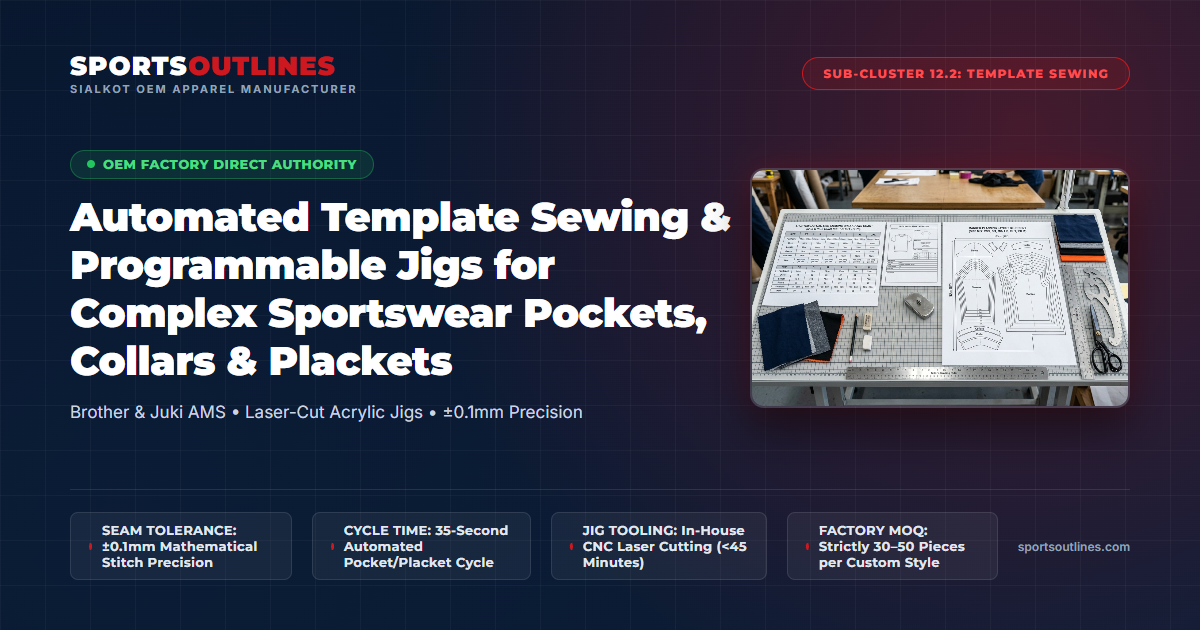
Direct Manufacturer Snapshot: Automated Template Sewing & Programmable Jigs for Complex Sportswear Pockets, Collars & Plackets
Sports Outlines manufactures precision-engineered athletic apparel direct from Sialkot, Pakistan, deploying automated template sewing and programmable clamping jigs (Brother BAS & Juki AMS systems). Utilizing custom in-house CNC laser-cut acrylic jigs, we execute polo plackets, concealed zipper pocket welts, and articulated collar stands with sub-millimeter stitch precision (±0.1mm) and 35-second cycle times. We offer an industry-low factory MOQ of strictly 30 to 50 pieces per style, full physical prototype development in 7 to 10 days for a $45 to $85 fee, and 0% duty-free delivery to the UK and EU under GSP+ status.
Direct WhatsApp: +92 316 7932595
In technical activewear, luxury athleisure, and performance golf apparel, the ultimate mark of craftsmanship is symmetry and stitch parallelism. When an athlete or retail buyer inspects a premium garment, their eyes naturally gravitate toward complex focal points: the crisp rectangular box-stitch at the base of a polo placket, the razor-straight parallel topstitching along a concealed zipper pocket welt, or the curved contour of an articulated pocket flap. In traditional apparel factories relying on manual sewing, these complex operations are a chronic source of defects: human operators waver by 2 to 4 millimeters, pocket corners skew at asymmetrical angles, and fabric puckers under inconsistent presser foot drag. The modern engineering solution that separates tier-one luxury sportswear from amateur goods is automated template sewing and programmable CNC clamping jigs. Operating state-of-the-art Brother BAS and Juki AMS computerized programmable pattern sewing systems, Sports Outlines in Sialkot, Pakistan, combines in-house CNC laser jig manufacturing with digital vector sewing. We deliver robotic stitch precision (±0.1mm) at an industry-low factory minimum order quantity (MOQ) of strictly 30 to 50 pieces per custom style, supported by dedicated $45 to $85 prototype engineering in 7 to 10 days.
Design & Manufacture Custom Automated Template Sewing & Jigs Direct from Sialkot
Low 30–50 Piece/Set MOQ • Dedicated Sampling in 7–10 Days • 0% Import Tariffs
✓ $45–$85 Physical Prototypes •
✓ Worldwide DDP Delivery
1. The Mechanics of Automated Template Sewing: Cartesian Robotics & Vector Stitching
Traditional sewing machines rely entirely on human hand-eye coordination: an operator manually pushes fabric under a vibrating needle while a mechanical feed dog pulls the bottom layer forward. When sewing multi-layered technical activewear—where slick elastomeric knits, polyurethane waterproof membranes, and stiff pocket welts meet—the top and bottom plies stretch at different rates, resulting in diagonal torque, rippled seams, and uneven stitch density.
An automated programmable pattern sewing machine eliminates this human failure point by decoupling fabric feeding from operator dexterity. Instead of manual manipulation, the machine operates as a precision Cartesian robot:
- Direct-Drive Sewing Head: A high-torque, synchronized servo motor drives the needle bar and rotary hook with micro-second timing, maintaining uniform needle penetration force through materials ranging from delicate 80 GSM mesh to 4-layer 320 GSM fleece.
- Dual-Axis X-Y Servo Carriage: The fabric clamp is mounted to a rigid robotic gantry controlled by pulse motors and linear encoders with a positional resolution of 0.05mm. The carriage moves the workpiece across the horizontal plane beneath the stationary needle head at speeds up to 3,000 stitches per minute.
- Vector Interpolation Programming: Seam trajectories are authored in digital CAD vector environments (DXF/PLT format) and translated into G-code stitch instructions. Linear interpolation produces knife-straight seams, while circular Bézier algorithms execute smooth, continuous curves without stitch bunching or angular stepping.
By translating mathematical geometry directly into mechanical needle penetration, automated pattern sewing machines guarantee that every single seam coordinate matches the master digital tech pack with zero deviation across thousands of production cycles.
2. Anatomical Engineering of Clamping Template Jigs: Materials, Tolerances & Alignment
The programmable sewing head provides the robotic motion, but the template jig is the physical tool that dictates manufacturing accuracy. A template jig is a precision-engineered clamping fixture that sandwiches the garment panels, interlinings, and closure hardware, presenting them to the needle in a completely immobilized state:
| Jig Component | Material & Construction | Engineering Function & Manufacturing Role |
|---|---|---|
| Lower Base Plate | 4.0mm CNC Laser-Cut Acrylic or Cast Aluminum Tooling Plate | Provides rigid planar support; features recessed alignment pockets that match the cut contours of the garment bodice and pocket welts. |
| Upper Clamping Plate | 3.0mm Transparent Polycarbonate or High-Density Composite Resin | Enables operator visual verification; cut with 1.8mm wide guide tracks that expose only the exact seam path to the sewing needle. |
| Registration Pins | Hardened Stainless Steel Dowel Pins (±0.02mm tolerance) | Engage with laser-cut registration notches on the cut fabric plies, guaranteeing 100% repeatable fabric positioning within 0.1mm. |
| Clamping Mechanism | Neodymium Magnet Arrays (N52) or Pneumatic Toggle Clamps | Applies uniform compressive force across the entire fabric surface, completely neutralizing elastomeric stretch and ply slippage. |
| Anti-Friction Base Coating | PTFE (Teflon®) Low-Friction Adhesive Film | Applied to the underside of the base plate, allowing the jig to glide across the machine bed with zero stick-slip vibration. |
Because the fabric is clamped firmly across its entire surface area, the internal elastomeric tension of spandex fibers is neutralized. The sewing needle penetrates through the pre-cut guide track in the upper plate, depositing stitches with microscopic parallelism and identical distance from the fabric edge.
3. High-Impact Applications: Polo Plackets, Zipper Welts & Articulated Collars
While simple t-shirt side seams are efficiently handled by continuous overlock machines, complex geometric assemblies in premium activewear are notoriously difficult to sew manually. Automated template sewing is deployed for the highest-value, highest-scrutiny garment components:
Golf & Tennis Performance Polo Plackets: The traditional three-button polo placket requires folding delicate pique knit around fusible woven interlining, stitching down two parallel edge margins, closing the bottom tabs, and executing a reinforced box-and-cross stitch at the base. In manual production, operators frequently stretch the pique, resulting in plackets that flare open, twist diagonally across the chest, or display asymmetrical bottom boxes. Our automated polo placket template clamps the bodice and placket strips simultaneously, sews both sides with absolute parallel symmetry, stitches the reinforced bottom box, and deploys an automated internal pneumatic blade that slashes the center placket slit in a single 35-second cycle.
Concealed Waterproof Zipper Pocket Welts: Modern running shorts, tactical training pants, and lightweight waterproof shell jackets feature concealed zipper pockets that must sit completely flush against the body. Manual zipper insertion requires hand-pinning zipper tape to welt strips, resulting in fabric puckering around the zipper teeth and uneven pocket frames. Our programmable zipper jig clamps the shell fabric, waterproof polyurethane zipper tape, and internal pocket bag under magnetic pressure. The sewing head deposits a perfect 12mm x 160mm rectangular frame of reinforced lockstitching with integrated 42-stitch bar-tacks at each corner, resisting over 320 N of lateral pull force without fabric distortion.
Articulated Collar Stands & Pocket Flaps: Structured athletic collars on track jackets and golf pullovers require identical left-and-right point sharpness. Template jigs clamp collar wings into rigid molds during topstitching, ensuring that both collar points match within 0.2mm in angle and length. Similarly, curved cargo pocket flaps on training shorts receive perfectly identical Bézier curves across all sizes from XS to 3XL.
| Sourcing Feature & Risk Factor | Sports Outlines (Sialkot Direct) | Alibaba Trading Agents | Traditional Chinese Hubs | Print-on-Demand (POD) |
|---|---|---|---|---|
| Pattern Stitching Technology | Computerized Brother BAS & Juki AMS programmable X-Y pattern sewing machines paired with custom CNC laser-cut template jigs. | Manual sewing by eye; crooked polo plackets, uneven zipper welts, and wavy pocket topstitching. | Automated template sewing lines, but strictly requiring 2,000+ unit commitments per style to cut custom jigs. | Zero template capability; limited to flat sublimation tees with no functional pockets, plackets, or collar engineering. |
| Minimum Order Quantity (MOQ) | Strictly 30–50 pieces per custom style and colorway — accessible for emerging technical brands. | Quotes 50 units for blank stock, but demands 1,000 units for custom pocket jigs or complex plackets. | 1,000 to 3,000 units per style to justify technician programming and jig fabrication expenses. | Single unit available, but lacks any technical athletic pockets, collar stands, or reinforced seams. |
| Stitch Margin Symmetry & Tolerances | Mathematical ±0.1mm stitch precision; perfectly symmetrical pocket flaps and razor-straight 1.5mm edge topstitching. | High human variance (±2.5mm to ±4.0mm); pocket corners skew diagonally and zipper welts pucker. | ±0.5mm standard tolerance, but manual fabric loading can cause slippage on slippery Lycra®. | Zero tolerance verification; garments distort unpredictably during assembly. |
| Polo Placket & Pocket Cycle Time | Automated 35-second cycle per complex pocket/placket; consistent quality across thousands of units. | Manual sewing takes 3 to 5 minutes per unit; operators rush on piece-rate, causing high defect scrap. | High speed, but line changeovers take 3 to 4 days, locking factory schedules for weeks. | Non-existent; cannot produce technical collared golf polos, cargo joggers, or welded pocket jackets. |
| Prototype Development & Turnaround | $45–$85 non-creditable engineering prototype fee; template-perfect master prototype dispatched in 7–10 days. | Promises cheap samples ($35), but delivers hand-stitched rough mockups that fail symmetry audits. | $250–$500 sampling fees with 5–7 week queue times due to large volume factory schedules. | Digital mockups only; physical drop-shipped blanks take 14 days and lack custom hardware. |
| Customs Duty & Tariffs (US / EU / UK) | 0% import customs duty into EU & UK via Pakistan GSP+ status; low trade tariff access into the US. | Unpredictable customs brokerage fees, freight surcharges, and full import duties payable by buyer. | Subject to Section 301 tariffs (7.5%–25%) in the US and standard MFN customs duties in the EU/UK. | Local domestic sales taxes and fulfillment surcharges added per unit, destroying profitability. |
4. Needle Thermal Dynamics: Cold-Air Chillers & Titanium-Coated Hardware
Automated programmable pattern sewing machines operate at speeds up to 3,000 stitches per minute. When a needle penetrates dense, multi-layer performance textiles—such as 3-layer laminated waterproof membranes, Cordura® abrasion-resistant pocket bags, and synthetic heat-activated adhesive films—friction generates localized needle temperatures exceeding 250°C (482°F).
In conventional apparel factories, this extreme heat triggers catastrophic failure modes:
- Synthetic Thread Melting: Core-spun polyester and nylon sewing threads have a melting point between 220°C and 250°C. When touching the superheated needle blade, the thread softens, loses tensile strength, and snaps, causing machine stoppages.
- Needle-Hole Glazing & Fabric Rupture: Friction heat melts the synthetic fibers around the needle puncture hole into hard, brittle plastic rings. Under athletic stretching, these glazed micro-holes tear open into catastrophic fabric runs.
- Adhesive Film Fouling: Heat-activated thermoplastic polyurethane (TPU) bonding films melt and transfer onto the needle eye and scarf, creating sticky resin build-ups that cause chronic skipped stitches and tension loops.
At Sports Outlines, we eliminate needle thermal degradation through three engineering safeguards:
- Pneumatic Vortex Cold-Air Needle Chillers: Our programmable sewing heads are fitted with vortex tube cooling nozzles that direct a continuous jet of refrigerated compressed air (-5°C to 0°C) directly onto the needle blade during operation, holding needle temperatures below 80°C even during sustained high-speed stitching.
- Groz-Beckert Titanium Nitride (GEBEDUR®) Needles: We use industrial needles coated with a gold-colored titanium-nitride surface layer. With a surface hardness of approximately 2,300 HV, these needles resist deflection, prevent adhesive adhesion, and run significantly cooler than standard chrome-plated needles.
- Continuous Silicone Lubricating Baths: Sewing threads pass through an active silicone oil bath before entering the tension discs. The micro-coating of silicone reduces thread-to-needle friction coefficients by over 60%, ensuring smooth loop formation and preventing thermal thread degradation.
5. In-House CNC Laser Jig Fabrication: The Key to Low MOQ Agility
Why do conventional overseas contract factories demand massive orders of 1,000 to 3,000 pieces per style before offering automated template sewing?
The bottleneck is not the sewing machine; it is the fabrication of the template jig. Traditional apparel factories do not own metal or acrylic machining equipment. When a client requests a custom pocket geometry or specialized placket, the factory must send the pattern to an external machine shop. The machine shop charges $400 to $800 per metal template and requires 3 to 4 weeks for delivery. High-volume factories cannot justify this expense or lead-time delay for small production runs.
Sports Outlines has solved this economic obstacle through full vertical integration. In our Sialkot manufacturing plant, we operate dedicated CNC CO2 laser cutting and acrylic engraving tables directly adjacent to our pattern engineering department:
- Digital CAD-to-Laser Pipeline: As soon as the garment tech pack and pattern grading are finalized in CAD (Lectra Modaris / Optitex), our tooling engineers extract the exact seam guide paths and generate laser-cutting toolpaths in under 15 minutes.
- Rapid In-House Acrylic Jig Cutting: Using high-density cast acrylic and optical-grade polycarbonate sheets, our CNC laser cutters cut upper and lower template plates, alignment pin holes, and needle guide channels in under 30 minutes with a cutting precision of ±0.05mm.
- Same-Day Tooling Turnaround: Because custom jigs are fabricated in-house at negligible raw material cost, we can build custom template tooling for small production runs of strictly 30 to 50 pieces per custom style without charging exorbitant tooling surcharges or adding weeks to production schedules.
6. Low MOQ Factory Direct Economics: Solving the 30–50 Piece Complex Styling Dilemma
Historically, independent activewear designers, boutique athleisure labels, and startup athletic brands were forced to compromise on design complexity. Because overseas suppliers refused to build custom jigs for small runs, emerging brands had to settle for basic blank garments without functional zipper pockets, articulated plackets, or reinforced technical details.
Sports Outlines eliminates this barrier. By combining in-house CNC laser jig cutting with agile programmable sewing cells in Sialkot, we offer robotic precision at an accessible factory MOQ of strictly 30 to 50 pieces per custom style.
Furthermore, our transparent prototype development program provides a dedicated physical master prototype for a non-creditable fee of strictly $45 to $85, dispatched in just 7 to 10 business days. Because the prototype is constructed directly on the identical automated template machines and jigs that will execute bulk manufacturing, our clients verify stitch symmetry, seam elasticity, and pocket ergonomics with 100% confidence before committing to production.
| Production Volume Tier | Est. Unit FOB Cost | Sample Cost & SLA | Bulk Production SLA | Included Specifications | Recommended Buyer Profile |
|---|---|---|---|---|---|
| 30 – 50 Sets/Pieces (Template Engineered Startup Tier) | $12.80 – $16.50 / template-sewn activewear top | $15.80 – $20.50 / template-built bottom | $45 – $85 non-creditable prototype fee | 12 – 15 Business Days | Custom CNC laser-cut acrylic template clamping jigs, Brother/Juki programmable X-Y automated pattern sewing, polo placket / zipper pocket welt automation, physical master prototype in 7–10 days, 30–50 piece low factory MOQ. | Startup sportswear brands, boutique golf apparel labels, technical outerwear designers, and athletic founders requiring mathematical stitch parallelism without 1,000-unit minimums. |
| 51 – 150 Sets/Pieces (Complex Styling Line Scaling Tier) | $10.50 – $13.80 / template-sewn activewear top | $13.40 – $16.90 / template-built bottom | $45 – $85 non-creditable prototype fee | 14 – 18 Business Days | Multi-station template rotation, integrated pocket bag automated topstitching, laser-aligned placket buttonhole positioning, custom heat-seal branding, full size curve grading (XS to 3XL). | Scaling technical activewear brands, equestrian apparel labels, collegiate athletic programs, and digital direct-to-consumer athletic brands. |
| 151 – 500 Sets/Pieces (Commercial Wholesale Distribution Tier) | $8.90 – $11.50 / template-sewn activewear top | $11.50 – $14.20 / template-built bottom | $45 – $85 non-creditable prototype fee | 18 – 22 Business Days | Dedicated programmable sewing workstation allocation, automated pneumatic jig clamping, certified AQL 2.5 stitch symmetry reports (±0.2mm), express DDP door-to-door delivery. | Established athletic apparel corporations, professional sports team uniform suppliers, commercial sportswear distributors, and multi-store fitness retail chains. |
| 500+ Sets/Pieces (Enterprise Volume Wholesale Tier) | $7.20 – $9.20 / template-sewn activewear top | $9.30 – $11.80 / template-built bottom | $45 – $85 non-creditable prototype fee | 22 – 28 Business Days | Dual-pallet continuous automated template shuttles, custom aluminum mold tooling, sea freight or air cargo consolidation, 0% GSP+ duty-free customs clearance. | Multinational sportswear conglomerates, department store private athletic labels, international sports federation uniform contracts, and high-volume commercial garment importers. |
7. Technical Specifications & Export Compliance: The Sialkot Direct Advantage
Sialkot, Pakistan, stands as the premier global engineering center for technical sports equipment and apparel, manufacturing for Olympic federations, international combat sports organizations, and premier athletic brands. Partnering directly with Sports Outlines provides decisive commercial benefits:
- Strictly 30–50 Piece Factory MOQ: Launch custom technical activewear featuring automated template sewing, custom CNC jigs, and complex pocket/placket engineering at accessible startup minimums.
- Full Physical Prototyping in 7–10 Business Days: For a transparent $45 to $85 non-creditable prototype fee, we manufacture and dispatch your template-sewn pre-production master prototype. You verify the stitch parallelism, placket symmetry, and pocket durability in your hands before bulk production.
- 0% Import Customs Duty via EU & UK GSP+ Status: Custom sportswear manufactured in Pakistan enters the European Union and the United Kingdom at 0% customs import duty under GSP+, delivering a direct 12% to 14% landed margin benefit over China, Vietnam, or Turkey.
- Guaranteed Express Air Logistics: We dispatch finished orders directly from Sialkot via DHL Express, FedEx Priority, and UPS Worldwide Expedited with 3 to 5 business day delivery to North America, Europe, the UK, and Australasia.
Get a Factory Direct Quote for Automated Template Sewing & Jigs
Chat with our Sialkot Engineering Team via WhatsApp • Instant DDP Air Freight Quotes
✓ $45–$85 Physical Prototypes •
✓ Worldwide DDP Delivery
8. Explore Our Technical Sportswear Manufacturing Ecosystem
Deepen your athletic production knowledge by exploring our related technical manufacturing guides and regional activewear sourcing portals:
- Custom Activewear & Athleisure Manufacturer USA: Low MOQ Private Label Sialkot OEM
- Cut-and-Sew Sportswear Manufacturing: Advanced Technical Pattern Engineering Guide
- Lean Modular Manufacturing Cells vs Bundle Systems in Sportswear
- Automated Polybag Packaging & Barcode Labeling in Sportswear OEM
- 3D Body Scanning & Digital Anthropometric Custom-Fit Activewear
- 4-Needle 6-Thread Flatlock (ISO 607) Differential Feed in Sportswear
Frequently Asked Sourcing & Manufacturing Questions (Buyer FAQ)
What is automated template sewing and how do programmable jigs function in sportswear manufacturing?
Automated template sewing is a computerized manufacturing methodology that utilizes programmable Cartesian X-Y coordinate sewing heads—such as Brother BAS-342H or Juki AMS-224EN systems—integrated with precision-machined mechanical clamping jigs to execute complex sewing operations with absolute mathematical reproducibility. The template jig comprises a dual-plate sandwich constructed from CNC laser-cut acrylic, engineered composite resin, or aircraft aluminum, featuring micro-milled guide channels that trace the exact seam path. Fabric panels, interlinings, and zipper tapes are precisely placed onto alignment pins within the jig. Once clamped under pneumatic or magnetic pressure, the jig immobilizes the slippery elastomeric knits. The automated machine carriage then transports the jig beneath a stationary direct-drive sewing head, laying down stitches along pre-programmed CAD vector paths at up to 3,000 stitches per minute with sub-millimeter accuracy (±0.1mm), entirely eliminating manual operator handling variances.
Why is template jig sewing critical for technical activewear pockets, collars, and polo plackets?
In performance sportswear—such as golf polos with structured plackets, running shorts with concealed bonded zipper pockets, and articulated cycling jerseys—visual quality and physical durability depend upon micro-tolerances. When operators stitch these features manually, human dexterity limitations lead to edge-stitching deviations of 2mm to 4mm, asymmetrical collar wings, puckered zipper welts, and skewed corner box-stitches. When dealing with slippery 4-way stretch synthetic fabrics like polyester-spandex and nylon-elastane blends, the mechanical feed dogs and presser feet of standard sewing machines induce differential ply stretch, causing severe waves and puckers. Template jigs compress the fabric uniformly across its entire surface area, neutralizing elastomeric distortion and ensuring that every single pocket, collar, and placket is stitched with identical geometry across the entire production run.
How does automated template sewing reduce labor costs, cycle times, and scrap rates?
In conventional apparel assembly, creating a clean double-welt zipper pocket requires four skilled manual operations: chalking placement guidelines, basting zipper tape, edge-stitching welts, and hand-cutting corner triangles with snips, consuming 3 to 5 minutes per unit with a 4% to 8% defect rate on lightweight synthetics. In contrast, an automated programmable template machine equipped with an integrated center-slit cutter completes the entire welt stitching, zipper attachment, and precision corner slitting in a single 35-second automated cycle. By condensing four manual workstations into one computerized process, template automation slashes labor cycle times by over 80%, eliminates rework, and reduces scrap rates to less than 0.3%, directly lowering per-unit production costs.
What is the factory minimum order quantity (MOQ) for custom template-sewn sportswear at Sports Outlines?
Our minimum order quantity for custom technical sportswear utilizing automated template sewing and custom-machined CNC jigs is strictly 30 to 50 pieces or sets per style and colorway. Conventional Asian contract mega-factories enforce massive minimums of 1,000 to 3,000 units per style because they outsource jig manufacturing to external metal fabrication shops at high tooling costs. In contrast, Sports Outlines operates dedicated in-house CNC laser cutting and rapid acrylic tooling stations in Sialkot, Pakistan. This allows us to cut custom template jigs in under 45 minutes directly from digital pattern files, making automated robotic sewing commercially accessible for boutique activewear labels and emerging athletic brands.
What is your prototype fee and turnaround time for template-engineered activewear samples?
We provide a transparent, non-creditable engineering prototype fee of $45 to $85 per style. This covers CAD vector stitch programming, in-house CNC laser cutting of dedicated acrylic templates, machine tension calibration, and complete physical garment assembly. Your pre-production master prototype is produced directly on the identical automated template machines scheduled for bulk production—guaranteeing 100% fidelity between sample and production units—and is dispatched via express air courier within 7 to 10 business days.
Which specific activewear components benefit most from automated programmable template sewing?
The components that achieve the greatest functional and visual improvements include: 1) Performance Polo Plackets: Perfectly straight edge margins, square box-stitching, and automated buttonhole spacing; 2) Concealed Waterproof Zipper Welts: Completely flat, pucker-free zipper frames on athletic shorts, track jackets, and hoodies; 3) Articulated Collar Stands: Uniform collar points and curved edge topstitching that prevent collar curling after repeated wash cycles; 4) Technical Cargo Pockets & Bellows: Identical curved corner radiuses and reinforced flap borders on outdoor and tactical joggers; and 5) Structural Harness & Drawcord Anchor Points: High-density cross-box reinforced bar-tacks delivering over 350 N of tensile burst strength.
How do you prevent needle friction heat and thread melting during high-speed programmable pattern stitching?
Stitching dense, multi-layer synthetic textiles (such as 3-layer laminated waterproof membranes, Cordura® pocket welts, and polyurethane thermal bonding films) at speeds up to 3,000 stitches per minute generates friction temperatures exceeding 250°C (482°F) on standard sewing needles. This thermal surge causes polyester thread melting, skipped stitches, and localized fabric hole glazing. Sports Outlines mitigates this by equipping our programmable sewing heads with pneumatic cold-air vortex needle chillers that blast refrigerated air (-5°C to 0°C) across the needle blade during operation. Additionally, we use Groz-Beckert titanium-nitride (GEBEDUR®) coated needles and continuous silicone thread lubrication baths, reducing friction by over 60% and ensuring uninterrupted structural integrity.
Can you program custom decorative stitch patterns and brand logos into the template machine?
Yes. Our computerized Brother BAS and Juki AMS programming consoles accept standard DXF and vector CAD stitch paths. In addition to structural functional seams, we can program decorative geometric topstitching, diamond-quilted chest panels, stylized aerodynamic seam lines, and micro-embroidered brand emblems stitched directly into pocket welts, yokes, or hem tabs, providing distinctive private label branding without requiring separate embroidery hooping.
What Point of Measure (POM) dimensional tolerances are guaranteed on template-sewn components?
We enforce strict AQL 2.5 quality control standards with guaranteed dimensional tolerances of ±0.2cm (±0.08 inches) across all template-sewn features, including placket length and width, pocket placement coordinates, and flap symmetry. Every finished production batch undergoes optical magnification audits against master CAD vector files before final packaging, guaranteeing that size XS matches size 3XL in component proportion and symmetry.
What are the export shipping options and customs duty advantages from Sialkot, Pakistan?
We dispatch finished bulk orders directly from Sialkot via DHL Express, FedEx Priority, and UPS Worldwide Expedited, providing guaranteed 3 to 5 business day delivery to North America, the European Union, the United Kingdom, and Australia, alongside consolidated air cargo and ocean container freight. Crucially, activewear brands in the EU and UK benefit from Pakistan’s GSP+ trade status, allowing custom performance apparel to enter at 0% import customs duties, yielding an immediate 12% to 14% bottom-line margin advantage compared to sourcing from China, Vietnam, or Turkey.