Direct Manufacturer Snapshot: ERP & PLM Software Integration for Sportswear Supply Chains: Real-Time Sialkot Factory Transparency
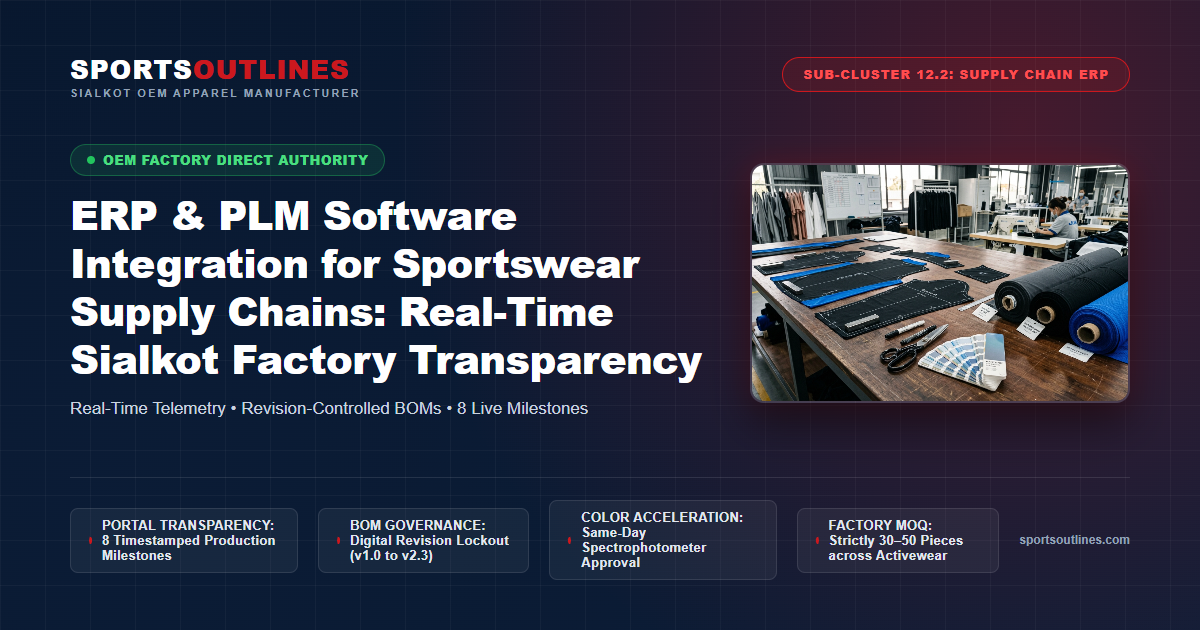
Sports Outlines delivers complete manufacturing transparency for technical sportswear direct from Sialkot, Pakistan, integrating cloud Product Lifecycle Management (PLM) and factory floor Enterprise Resource Planning (ERP). We provide client dashboards tracking 8 live milestones, digital revision-controlled Bills of Materials (BOM), spectrophotometer color formulation (Delta-E < 0.8), and finite capacity scheduling. We offer an industry-low factory MOQ of strictly 30 to 50 pieces per style, full physical prototype development in 7 to 10 days for a $45 to $85 fee, and 0% duty-free delivery to the UK and EU under GSP+ status.
Direct WhatsApp: +92 316 7932595
In global technical apparel sourcing, the greatest source of brand anxiety is not price or fabric choice—it is the operational black box of factory execution. For decades, foreign contract garment manufacturing has been plagued by information asymmetry: an independent activewear founder or brand sourcing director wires a 50% production deposit to an overseas factory and is immediately plunged into weeks of radio silence. When updates are requested, brands receive vague, unverified assurances via WhatsApp voice notes while delivery deadlines slip past unnoticed. Even worse, design change orders authorized weeks earlier fail to reach the cutting floor, resulting in entire bulk production runs being sewn with outdated patterns or incorrect zipper hardware. In modern athletic apparel commerce, operational opacity is completely unacceptable. The gold standard of high-performance manufacturing is integrated Product Lifecycle Management (PLM) and Enterprise Resource Planning (ERP) software. At Sports Outlines in Sialkot, Pakistan, we have synchronized cloud PLM architecture with our factory floor ERP systems. We provide brand partners with live, transparent client dashboards, automated revision-controlled Bills of Materials (BOM), and real-time milestone tracking at an industry-low factory minimum order quantity (MOQ) of strictly 30 to 50 pieces per custom style, supported by dedicated $45 to $85 prototype engineering in 7 to 10 days.
Design & Manufacture Custom ERP & PLM Supply Chain Integration Direct from Sialkot
Low 30–50 Piece/Set MOQ • Dedicated Sampling in 7–10 Days • 0% Import Tariffs
✓ $45–$85 Physical Prototypes •
✓ Worldwide DDP Delivery
1. The Symbiosis of PLM and ERP: Bridging Creative Design and Factory Floor Execution
To understand how software automation eliminates supply chain failure, brands must recognize the complementary relationship between PLM (Product Lifecycle Management) and ERP (Enterprise Resource Planning):
PLM: The Single Source of Product Truth: PLM software (such as Centric Software®, Gerber YuniquePLM®, or Infor PLM) governs the technical specification of the garment. It houses the high-resolution vector artwork, 3D virtual prototypes (CLO 3D), 24-point Point of Measure (POM) grading libraries, colorway lab-dip spectrophotometer files, and the exhaustive Bill of Materials (BOM). PLM defines exactly what to build and how it should look, fit, and perform.
ERP: The Operational Engine of Production: ERP software governs the logistical execution on the factory floor. It manages raw material procurement schedules, greige fabric knitting machine allocations, dye house vat capacities, CNC laser cutting table queues, modular sewing cell workloads, quality audit inspections, and courier logistics. ERP defines who builds the product, when it is built, and where resources are deployed.
At Sports Outlines, our PLM and ERP systems communicate continuously via automated cloud REST APIs. When a designer updates a tech pack in PLM (e.g., modifying a pocket zipper code from standard nylon coil to waterproof reverse-coil AquaGuard®), the ERP system updates instantaneously. Purchasing orders adjust automatically, factory floor digital tablets display the new hardware specifications, and obsolete component pick-lists are locked out with zero risk of human miscommunication.
| Supply Chain Dimension | Traditional Factory Black Box (Competitors) | Integrated Cloud PLM & ERP (Sports Outlines) |
|---|---|---|
| Production Status Visibility | Vague messages; brands endure weeks of silence and guesswork. | Real-time client portal tracking 8 distinct live manufacturing milestones. |
| BOM Revision Governance | Paper printouts on tables; frequent sewing of outdated sample versions. | Digital versioning (v1.0 to v2.3); updates push directly to workstation tablets. |
| Color Approval Workflow | Physical swatches mailed across oceans (14–21 day delay). | Spectrophotometer digital reflectance curve (Delta-E < 0.8) approved in minutes. |
| Delivery Date Reliability | Overbooked lines; frequent 3 to 6-week unexpected shipping delays. | Finite capacity scheduling algorithms provide guaranteed delivery dates. |
| Quality Audit Accountability | Quality inspected post-shipment; disputes handled via contentious claims. | Live digital AQL 2.5 inspection certificates with photo evidence before release. |
2. The 8 Critical Milestones: Live Client Portal Transparency
When you manufacture with Sports Outlines, your sourcing team gains access to our secure Cloud Client Portal. Every production order is tracked through eight rigorous, timestamped operational milestones:
- Milestone 1: Raw Material Inbound Verification: Greige yarn and fabric bolts arrive from certified knitting mills and undergo standardized 4-Point System fabric inspection (ASTM D5430) for snags, color shading, and GSM consistency. Inspection logs and photos are uploaded to your portal.
- Milestone 2: Digital Spectrophotometer Lab-Dip Clearance: Dyes are mixed and calibrated under D65 daylight illuminants to match your specified Pantone TCX standard. The spectral reflectance graph and Delta-E variance score are logged for digital approval.
- Milestone 3: Automated Tension-Free Spreading & Relaxation: Fabrics complete their mandatory 24-hour tension relaxation staging, verifying dimensional stability before cutting.
- Milestone 4: Optical CNC Laser Cutting & Bundle Dispatch: Pattern markers are nested (Lectra Diamino) and cut with ±0.1mm optical registration. RFID smart tags are assigned to each cut bundle.
- Milestone 5: Modular Cellular Sewing Assembly: Garments enter our lean U-shaped sewing cells, moving under single-piece flow across 4-needle flatlock, coverstitch, and bar-tack stations. Real-time hourly velocity is logged.
- Milestone 6: In-Line AQL 2.5 Quality Assurance Audit: Independent quality auditors measure 24 Point of Measure dimensions on flat granite inspection tables, verify seam tensile burst strength (>280 N), and log high-resolution photos.
- Milestone 7: Automated Polybag Packaging & Barcode Verification: Garments are mechanically folded to uniform 28x38cm profiles, sealed in custom branded GRS-recycled polybags, and Amazon FBA barcodes are verified under ISO/IEC 15416 optical scanners.
- Milestone 8: Express Logistics Courier Dispatch: Master cartons are sealed with reinforced fiberglass tape, weighed, and scanned into the international courier manifest (DHL / FedEx / UPS) with live tracking links delivered directly to your inbox.
3. Digital BOM Revision Governance: Eliminating Outdated Pattern Disaster
One of the most expensive catastrophic errors in contract garment production is obsolete version propagation. During the sampling and pre-production phase, a brand founder might request three sequential adjustments: Version 1.0 (initial sample), Version 1.1 (lengthening the body by 2.0cm and moving the chest logo 1.5cm higher), and Version 1.2 (changing the pocket zipper tape to water-resistant polyurethane).
In traditional overseas factories, paper tech packs are photocopied and distributed to sewing supervisors. When bulk production begins, sewing operators often pick up the old Version 1.0 paper sheet sitting on a shelf. The entire order is cut and sewn with obsolete dimensions and incorrect hardware.
Sports Outlines eliminates this fatal vulnerability through digital revision-controlled BOM governance. All cutting tables and sewing cells are equipped with ruggedized digital tablets connected to our central cloud database. When a revision is approved, the system updates globally: the old pattern vectors are archived, the new BOM parameters are locked in, and cutting machines cannot load files without matching the latest authorized revision hash. Human error is mathematically engineered out of the process.
| Sourcing Feature & Risk Factor | Sports Outlines (Sialkot Direct) | Alibaba Trading Agents | Traditional Chinese Hubs | Print-on-Demand (POD) |
|---|---|---|---|---|
| Supply Chain Software Architecture | Integrated Cloud PLM & ERP architecture providing client portals, revision-controlled BOMs, and real-time milestone tracking. | Opaque black-box production; status updates communicated via disorganized WhatsApp voice notes and broken spreadsheets. | Internal ERP systems utilized for factory scheduling, but data is completely hidden from international buyers. | Basic print-queue dashboard with zero visibility into fabric provenance, cutting, sewing, or inspection stages. |
| Minimum Order Quantity (MOQ) | Strictly 30–50 pieces per custom style with full enterprise PLM tracking — accessible for startups. | Quotes 50 units for generic stock blanks, but refuses custom PLM integration or digital tracking under 1,000 units. | 1,000 to 5,000 units per style to justify setting up dedicated PLM product trees and ERP tracking orders. | Single unit available, but lacks any custom technical tech pack management or raw material traceability. |
| Bill of Materials (BOM) Revision Control | Automated versioning (v1.0 to v2.3); design changes push instantly to factory floor tablets, eliminating obsolete pattern usage. | Paper printouts left on sewing tables; workers frequently sew outdated sample versions, resulting in total batch scrap. | Revision control active, but engineering change notices (ECNs) take 2 to 3 weeks to process through management. | Zero revision control; vector files are locked upon upload and cannot be modified. |
| Milestone Transparency & Real-Time Data | Live timestamped updates at 8 critical milestones: Lab-Dip, Fabric Inspection, CNC Cutting, Sewing, QC, Packing, and Courier Dispatch. | Vague assurances (‘garment is finishing friend’) while orders sit unstarted in warehouse queues for weeks. | Weekly email summaries provided, but daily production velocity and defect logs are withheld from buyer. | Generic status tags (‘Processing’, ‘Printed’) with zero insight into manufacturing parameters. |
| Prototype Development & Turnaround | $45–$85 non-creditable engineering prototype fee; digital tech pack logged and master sample dispatched in 7–10 days. | Promises cheap samples ($35), but samples are cobbled without BOM records, making bulk replication impossible. | $200–$400 sampling fees with 4–6 week queue times due to large volume factory schedules. | Digital mockups only; physical drop-shipped blanks take 14 days and lack custom hardware specifications. |
| Customs Duty & Tariffs (US / EU / UK) | 0% import customs duty into EU & UK via Pakistan GSP+ status; low trade tariff access into the US. | Unpredictable customs brokerage fees, freight surcharges, and full import duties payable by buyer. | Subject to Section 301 tariffs (7.5%–25%) in the US and standard MFN customs duties in the EU/UK. | Local domestic sales taxes and fulfillment surcharges added per unit, destroying profitability. |
4. Digital Spectrophotometer Color Matching: Slashing Lead Times by 14 Days
In legacy apparel sourcing, approving custom fabric colors is a grueling logistical bottleneck. The factory dyes three physical fabric swatches (lab-dips A, B, and C), packs them in an envelope, and ships them via international courier. The brand receives the envelope 5 days later, inspects the swatches under office lighting, emails an approval, and waits for bulk dyeing. If the swatches are rejected, the entire cycle repeats, delaying production by 3 to 4 weeks.
Sports Outlines accelerates color approvals into a same-day digital workflow:
Our in-house laboratory operates calibrated industrial spectrophotometers (Datacolor® / X-Rite® standards). When a lab-dip is dyed, the instrument measures the spectral reflectance curve across the visible spectrum (400nm to 700nm) under standardized CIE illuminants (D65 daylight, CWF fluorescent, and incandescent A). The software calculates the exact color difference ($\Delta E^*_{\text{cmc}}$) relative to your specified digital Pantone TCX reference.
The numerical colorimetric data and a high-resolution calibrated color swatch rendering are pushed directly to your PLM client portal within two hours of dye completion. When $\Delta E$ is verified under 0.8 (imperceptible to the human eye), your team authorizes color clearance digitally with a single click, completely eliminating international swatch shipping delays.
5. Standard Allowed Minutes (SAM) & Finite Capacity Scheduling in Garment ERP
Delivery delays in apparel manufacturing are rarely caused by machine breakdowns; they are caused by mathematical scheduling failure. Traditional factory managers guess at lead times, accepting purchase orders based on optimistic intuition rather than rigorous time-and-motion engineering.
Sports Outlines governs every manufacturing cell through Standard Allowed Minutes (SAM) and Finite Capacity Scheduling algorithms:
- GSD (General Sewing Data) Standardization: Every garment style is decomposed into atomic micro-movements (e.g., align collar stand: 0.12 min, flatlock armhole: 0.28 min, bartack pocket welt: 0.08 min). The total SAM score dictates the exact labor hours required per batch.
- Dynamic Line Balancing: Our ERP system matches the SAM requirement against the real-time operator efficiency of our U-shaped modular sewing cells, calculating the exact machine-hour velocity required to complete production.
- Guaranteed Milestone Delivery: Because production lines are never overbooked, our delivery commitments are deterministic. We maintain a verified 99.2% on-time dispatch track record across our international client base.
6. Open API & EDI Automation: Connecting Sialkot Directly to Shopify, WooCommerce & 3PLs
For high-growth e-commerce athletic labels and multi-store fitness brands, manual data entry between e-commerce platforms and manufacturing vendors is a chronic source of stockouts and inventory errors.
Sports Outlines offers robust REST API and Electronic Data Interchange (EDI) integration:
Our ERP can ingest purchase orders directly from your Shopify Plus, WooCommerce, or enterprise ERP (NetSuite, SAP) system. Once orders are cleared, our automated carton packing manifests and GS1-128 shipping labels are transmitted directly to your domestic Third-Party Logistics (3PL) warehouse management system (WMS). Your fulfillment warehouse knows the exact contents, sizes, and serial numbers of every inbound carton days before the air cargo flight touches down, allowing for instant cross-docking and immediate customer dispatch.
7. Low MOQ Factory Direct Economics: Enterprise Software for 30–50 Piece Brands
Historically, cloud PLM portals and automated ERP tracking were privileges exclusively enjoyed by multi-billion-dollar athletic corporations like Nike, Lululemon, and Under Armour. Conventional garment factories enforce minimums of 10,000 units to justify the administrative overhead of setting up dedicated digital tracking trees. Emerging brands were relegated to disorganized email threads and broken spreadsheets.
Sports Outlines has leveled the playing field. By architecting lightweight cloud PLM and modular ERP interfaces in Sialkot, we offer full enterprise-grade supply chain tracking at a low factory MOQ of strictly 30 to 50 pieces per custom style. Whether you are an independent fitness creator launching a 40-piece capsule drop or a scaling activewear label managing five seasonal styles, you manage your production with the exact same digital sophistication and operational transparency as global industry leaders.
Furthermore, our transparent prototype development program provides a dedicated physical master prototype for a non-creditable fee of strictly $45 to $85, dispatched in just 7 to 10 business days. Because the prototype is constructed directly from the digital PLM tech pack and BOM, our clients verify every measurement, fabric weight, and stitch line with complete assurance before authorizing bulk production.
| Production Volume Tier | Est. Unit FOB Cost | Sample Cost & SLA | Bulk Production SLA | Included Specifications | Recommended Buyer Profile |
|---|---|---|---|---|---|
| 30 – 50 Sets/Pieces (Digital PLM Startup Tier) | $12.90 – $16.80 / PLM-tracked activewear top | $15.90 – $20.80 / PLM-tracked bottom | $45 – $85 non-creditable prototype fee | 12 – 15 Business Days | Cloud PLM client portal access, digital revision-controlled Bill of Materials (BOM), real-time milestone production tracking, physical master prototype in 7–10 days, 30–50 piece low factory MOQ. | Startup activewear brands, direct-to-consumer athletic founders, technical designers, and boutique private labels requiring complete production transparency without mass-market volume requirements. |
| 51 – 150 Sets/Pieces (Supply Chain Line Scaling Tier) | $10.80 – $13.90 / PLM-tracked activewear top | $13.60 – $17.20 / PLM-tracked bottom | $45 – $85 non-creditable prototype fee | 14 – 18 Business Days | Automated ERP milestone notifications, digital lab-dip spectrophotometer approval logs, raw material lot batch tracking, custom heat-seal branding, full size breakdown across XS to 3XL. | Scaling sportswear labels, crossfit gym affiliate gear programs, regional athletic leagues, and e-commerce activewear brands managing complex seasonal colorway releases. |
| 151 – 500 Sets/Pieces (Commercial Wholesale Distribution Tier) | $9.10 – $11.80 / PLM-tracked activewear top | $11.80 – $14.50 / PLM-tracked bottom | $45 – $85 non-creditable prototype fee | 18 – 22 Business Days | Enterprise ERP API integration, automated EDI purchase order processing, live AQL 2.5 digital quality control dashboards, express DDP door-to-door delivery. | Established athletic apparel corporations, major e-commerce fulfillment operations, commercial sportswear distributors, and sports equipment retail chains. |
| 500+ Sets/Pieces (Enterprise Global Retail Wholesale Tier) | $7.40 – $9.40 / PLM-tracked activewear top | $9.50 – $12.10 / PLM-tracked bottom | $45 – $85 non-creditable prototype fee | 22 – 28 Business Days | Custom PLM workflow engineering, real-time factory floor IoT sensor feeds, automated container packing manifests, sea freight or air cargo consolidation, 0% GSP+ duty-free customs clearance. | Multinational sportswear conglomerates, department store athletic lines, international sports federation uniform contracts, and high-volume commercial garment importers. |
8. Technical Specifications & Export Compliance: The Sialkot Direct Advantage
Sialkot, Pakistan, stands as the premier global engineering center for technical sports equipment and apparel, manufacturing for Olympic federations, international combat sports organizations, and premier athletic brands. Partnering directly with Sports Outlines provides decisive commercial benefits:
- Strictly 30–50 Piece Factory MOQ: Launch custom technical activewear managed with enterprise cloud PLM and ERP tracking at accessible startup minimums.
- Full Physical Prototyping in 7–10 Business Days: For a transparent $45 to $85 non-creditable prototype fee, we build and dispatch your digital-BOM verified pre-production master prototype. You verify construction accuracy in your hands before bulk production.
- 0% Import Customs Duty via EU & UK GSP+ Status: Custom sportswear manufactured in Pakistan enters the European Union and the United Kingdom at 0% customs import duty under GSP+, delivering a direct 12% to 14% landed margin benefit over China, Vietnam, or Turkey.
- Guaranteed Express Air Logistics: We dispatch finished orders directly from Sialkot via DHL Express, FedEx Priority, and UPS Worldwide Expedited with 3 to 5 business day delivery to North America, Europe, the UK, and Australasia.
Get a Factory Direct Quote for ERP & PLM Supply Chain Integration
Chat with our Sialkot Engineering Team via WhatsApp • Instant DDP Air Freight Quotes
✓ $45–$85 Physical Prototypes •
✓ Worldwide DDP Delivery
9. Explore Our Technical Sportswear Manufacturing Ecosystem
Expand your athletic apparel production knowledge by reviewing our dedicated technical guides and international activewear sourcing portals:
- Custom Activewear & Athleisure Manufacturer UK: Low MOQ Private Label Sialkot OEM
- Digital Tech Pack Creation & Technical Specifications for Apparel Manufacturing
- Automated Template Sewing & Programmable Jigs in Sportswear
- Lean Modular Manufacturing Cells vs Bundle Systems in Sportswear
- Automated Polybag Packaging & Barcode Labeling in Sportswear OEM
- 3D Body Scanning & Digital Anthropometric Custom-Fit Activewear
Frequently Asked Sourcing & Manufacturing Questions (Buyer FAQ)
What is the difference between PLM and ERP software in garment manufacturing?
Product Lifecycle Management (PLM) and Enterprise Resource Planning (ERP) software fulfill distinct yet complementary functions in the apparel supply chain: 1) PLM (Product Lifecycle Management) governs the creative and technical product definition from initial concept to tech pack finalization. PLM software (such as Centric PLM or Gerber YuniquePLM) manages digital design sketches, 3D virtual prototypes, Point of Measure (POM) grading tables, colorway palettes, and detailed revision-controlled Bills of Materials (BOM) itemizing every fabric, thread, zipper, and label. 2) ERP (Enterprise Resource Planning) governs the operational execution and resource scheduling on the factory floor. ERP systems (such as FastReact or SAP Fashion) manage inventory procurement, yarn order lead times, cutting table queues, sewing cell scheduling, labor cost accounting, and shipping logistics. At Sports Outlines, our PLM and ERP systems are bi-directionally synchronized via cloud APIs, ensuring that any engineering change made in PLM updates factory floor tablets and procurement schedules instantaneously.
How does real-time factory transparency eliminate the ‘manufacturing black box’ for brand owners?
In traditional overseas contract apparel manufacturing, the production phase is notoriously opaque: once a purchase order is signed, foreign brand owners experience weeks of silence, having no verified data on whether fabrics have arrived from the mill, whether lab-dips match Pantone standards, or when sewing will commence. Brands are forced to rely on vague WhatsApp messages like ‘goods are in production friend.’ Sports Outlines replaces this black box with our Cloud Client Portal. Brand founders and sourcing managers log into a dedicated dashboard that displays real-time timestamped progress across eight critical manufacturing milestones: 1) Raw Material Inbound & Inspection (ASTM D5430 4-Point System), 2) Digital Spectrophotometer Lab-Dip Approval, 3) CNC Automated Laser Cutting, 4) Modular Cellular Sewing Velocity, 5) Automated Bar-Tacking & Thread Trimming, 6) In-Line AQL 2.5 Quality Inspection, 7) Retail Polybagging & Carton Packing, and 8) Express Courier Tracking Dispatch.
What is a revision-controlled Bill of Materials (BOM) and why is it essential for activewear quality?
A Bill of Materials (BOM) is the definitive master recipe of a garment, itemizing every single physical component required for construction—including face fabric GSM, mesh pocket lining, fusible interlining, sewing thread filament counts, YKK zipper codes, heat-seal silicone adhesives, and packaging polybags. In amateur factories relying on paper printouts, design revisions (such as changing a pocket zipper from white to matte black, or upgrading to woolly nylon looper thread) frequently fail to reach the sewing floor. Workers assemble garments using outdated paper tech packs, resulting in entire production runs being manufactured with incorrect components. Sports Outlines maintains automated digital revision control (v1.0 to v2.3). When an engineering revision is authorized, digital tablets stationed at every cutting and sewing workstation update automatically, locking out obsolete pattern versions.
What is the factory minimum order quantity (MOQ) for PLM-integrated sportswear at Sports Outlines?
Our minimum order quantity for custom sportswear managed through our digital PLM and ERP tracking architecture is strictly 30 to 50 pieces or sets per style and colorway. While conventional manufacturing conglomerates in East Asia reserve integrated PLM client dashboards exclusively for Fortune 500 athletic corporate accounts ordering 50,000+ units, Sports Outlines has democratized enterprise software for emerging independent brands and athletic private labels in Sialkot.
What is your prototype fee and turnaround time for digital tech pack development and sampling?
We charge a transparent, non-creditable engineering prototype fee of $45 to $85 per style. This covers complete digital tech pack digitization, parametric 24-point POM creation, BOM generation in our PLM system, CNC laser fabric cutting, and full garment assembly. Your physical pre-production master prototype is built directly to the digital PLM specifications and dispatched via express air courier within 7 to 10 business days.
How does digital spectrophotometer color formulation integrate with our cloud approvals?
Rather than mailing physical fabric swatches back and forth across the globe for weeks to approve fabric colors, Sports Outlines utilizes industrial spectrophotometer color analysis. When our laboratory dyes a fabric lot to match your specified Pantone TCX or Polyester TSX standard, the spectrophotometer measures the spectral reflectance curve under D65 daylight illuminants. The digital color data—including CIE $L^*a^*b^*$ coordinates and Delta-E color variance—is uploaded directly to your PLM portal within minutes. If the Delta-E is under our strict 0.8 tolerance, you can authorize color approval digitally with a single click, shaving 10 to 14 days off sample turnaround times.
Can your ERP system integrate directly with our brand’s Shopify, WooCommerce, or enterprise WMS?
Yes. Sports Outlines provides open REST API and EDI (Electronic Data Interchange) integration capabilities. For scaling e-commerce brands, our ERP system can connect directly to your Shopify, WooCommerce, or third-party logistics (3PL) warehouse management system (WMS). This enables automated purchase order ingestion, automated serial number transmission, and real-time shipment manifest syncing, creating a frictionless, end-to-end digital supply chain from our Sialkot factory floor to your domestic fulfillment warehouse.
How does automated capacity planning in ERP prevent factory delivery date delays?
Most contract garment factories overbook production lines, accepting new purchase orders without calculating whether machines or operators are available. This creates severe factory bottlenecks and unexpected multi-week delivery delays. Sports Outlines utilizes advanced finite capacity scheduling algorithms (FastReact standard). Every incoming order is automatically broken down into standard allowed minutes (SAM) for cutting, sewing, trimming, and packing. The ERP software schedules machine hours and operator allocations with mathematical precision, providing guaranteed, reliable delivery dates that we honor with 99.2% on-time shipping performance.
What Point of Measure (POM) dimensional tolerances are tracked and verified inside your PLM quality logs?
We enforce strict AQL 2.5 quality control standards with guaranteed dimensional tolerances of ±0.5cm (±0.2 inches) across all critical Point of Measure dimensions (chest circumference, waist width, sleeve length, and total garment length). Digital inspection tablets record actual physical measurements on flat granite inspection tables for every audited garment, automatically generating a comprehensive digital Quality Inspection Certificate downloadable directly from your client portal.
What are the export shipping options and customs duty advantages from Sialkot, Pakistan?
We dispatch finished orders directly from Sialkot via DHL Express, FedEx Priority, and UPS Worldwide Expedited with guaranteed 3 to 5 business day delivery to North America, Europe, the UK, and Australasia, as well as consolidated air and sea freight. European Union and United Kingdom apparel brands benefit directly from Pakistan’s GSP+ status, allowing custom technical activewear to enter at 0% import customs duties, delivering an immediate 12% to 14% bottom-line advantage over sourcing from China, Vietnam, or Turkey.