Direct Manufacturer Snapshot: Private Equity Due Diligence: Maximizing Athletic Brand Valuation Through Proprietary Cut-and-Sew Moats
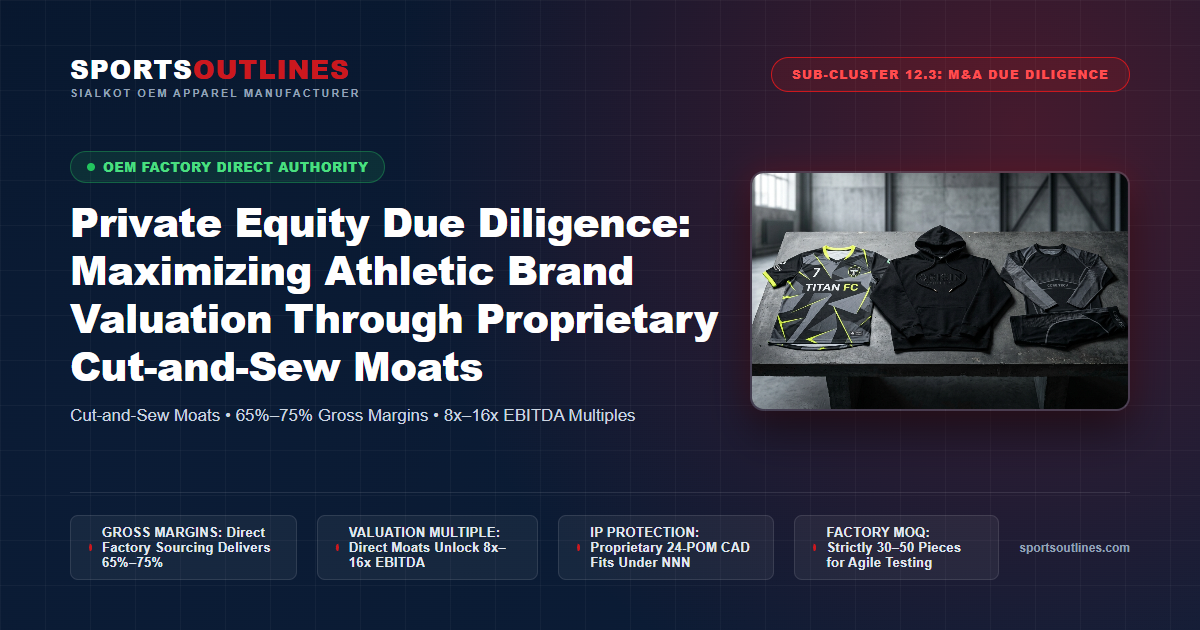
Sports Outlines builds proprietary, high-defensibility cut-and-sew supply chain moats that maximize athletic brand valuations for private equity M&A and venture recapitalizations direct from Sialkot, Pakistan. We expand gross margins to 65%–75% through direct OEM manufacturing, lock proprietary 24-point CAD fit geometry under binding NNN covenants, optimize working capital turnover with lean inventory velocity, and provide flawless ESG social audit documentation (BSCI, SEDEX SMETA, OEKO-TEX). We offer an entry MOQ of strictly 30 to 50 pieces per style, full prototype engineering in 7 to 10 days for a $45 to $85 fee, and 0% duty-free delivery to the UK and EU under GSP+ status.
Direct WhatsApp: +92 316 7932595
In the high-stakes world of athletic apparel mergers, venture capital funding, and private equity (PE) acquisitions, enterprise valuation is determined by far more than flashy Instagram follower counts or top-line Shopify revenue. When institutional investors, growth equity sponsors, and strategic corporate acquirers conduct rigorous Mergers & Acquisitions (M&A) Due Diligence, the ultimate determinant of a brand’s valuation multiple is the defensibility, resilience, and margin architecture of its underlying manufacturing supply chain. An activewear brand generating $10 million in gross revenue via generic Print-on-Demand (POD) blanks or unvetted middleman brokers will typically trade at a severely depressed valuation multiple (often 0.5x to 1.2x revenue) due to fragile 25% gross margins, supply chain vulnerability, and zero proprietary defensibility. Conversely, an athletic apparel brand that commands 65% to 75% gross margins, owns proprietary CAD pattern fit geometry, maintains direct Tier-1 OEM factory partnerships, and passes third-party ESG audits with clean records commands premium enterprise multiples ranging from 8x to 16x EBITDA. Sourcing sportswear successfully requires treating supply chain architecture as a high-value equity asset. At Sports Outlines in Sialkot, Pakistan, we engineer institutional cut-and-sew supply moats that maximize athletic brand valuations. We empower brands to build institutional equity at an industry-low factory minimum order quantity (MOQ) of strictly 30 to 50 pieces per custom style, supported by dedicated $45 to $85 prototype engineering in 7 to 10 business days.
Design & Manufacture Custom Brand Valuation & Private Equity Supply Moats Direct from Sialkot
Low 30–50 Piece/Set MOQ • Dedicated Sampling in 7–10 Days • 0% Import Tariffs
✓ $45–$85 Physical Prototypes •
✓ Worldwide DDP Delivery
1. Private Equity Valuation Mechanics: How Supply Chain Architecture Dictates Multiples
In private equity buyouts and growth recapitalizations, valuation multiples (Enterprise Value / EBITDA) are heavily influenced by qualitative and operational risk scores uncovered during commercial due diligence:
| Supply Chain Sourcing Model | Gross Margin Profile | Proprietary Product Defensibility | Typical M&A Valuation Multiple |
|---|---|---|---|
| Print-on-Demand (POD) / Dropship | 15% – 25% Gross Margin | Zero; competitors use identical generic catalog blanks. | 0.5x – 1.0x Revenue (Heavily Discounted) |
| Third-Party Trading Middlemen (Alibaba) | 35% – 45% Gross Margin | Low; middleman owns factory relationship and markup. | 3.0x – 5.0x EBITDA (Moderate Multiple) |
| Conventional Asian Mega-Factory (FOB) | 50% – 58% Gross Margin | Moderate; but high MOQs lock working capital in dead stock. | 6.0x – 8.0x EBITDA (Industry Average) |
| Direct Sialkot OEM Partner (Sports Outlines) | 65% – 75% Gross Margin | High; proprietary fit geometry, NNN contracts, locked CAD. | 10x – 16x EBITDA (Premium Valuation Multiple!) |
2. Engineering Proprietary Cut-and-Sew Moats: Fit Geometry & Material Exclusivity
What prevents a well-funded competitor from launching an identical activewear collection next week? If your brand prints logos on wholesale blanks, nothing. To command premium private equity valuations, an activewear brand must possess a Proprietary Cut-and-Sew Moat:
- Proprietary 24-Point Fit Geometry: The brand owns its bespoke digital CAD pattern grading files (Gerber AccuMark / Lectra). The specific curve of the waistband, the angle of the forward-rotated shoulder seams, the depth of the diamond crotch gusset, and the anatomical compression mapping belong exclusively to the brand. When an athlete wears the garment, it fits like no other brand on the market.
- Exclusive Textile Formulations: Rather than generic commodity fabrics, Sports Outlines develops custom technical textile knits for brand partners—such as proprietary brushed micro-poly/spandex blends (280–320 GSM) with specialized moisture-wicking and anti-pilling finishes.
- Locked Manufacturing Tooling: Custom high-density silicone heat transfer screens, CNC laser cutting templates, and embroidery punch programs are stored in secure factory vaults under binding NNN (Non-Disclosure, Non-Use, Non-Circumvention) covenants, legally preventing their use for any other entity.
3. Working Capital Efficiency & Return on Invested Capital (ROIC)
Private equity investment committees evaluate capital allocation efficiency using Return on Invested Capital (ROIC):
$$\text{ROIC} = \frac{\text{Net Operating Profit After Tax (NOPAT)}}{\text{Invested Capital}}$$
When a brand sources from high-MOQ contract factories requiring 1,000 units per style, millions of dollars in liquid capital are locked up in static warehouse inventory for 6 to 9 months. This severely inflates the denominator (Invested Capital) and depresses ROIC:
- The High-MOQ Capital Trap: Bloated inventory holding, warehouse storage fees, commercial insurance, and heavy 50% clearance discounting on slow-moving sizes severely erode operating profit.
- The Agile Low-MOQ Flywheel (Sports Outlines): Operating at our strictly 30 to 50-piece low factory MOQ allows brands to run high-velocity micro-drops. Brands turn inventory 6 to 8 times per year, achieve >95% full-price retail sell-through, and generate exceptional operating cash flows while keeping working capital lean. Private equity buyers reward high inventory turns with substantial valuation premiums.
| Sourcing Feature & Risk Factor | Sports Outlines (Sialkot Direct) | Alibaba Trading Agents | Traditional Chinese Hubs | Print-on-Demand (POD) |
|---|---|---|---|---|
| Gross Margin Architecture & EBITDA Multiples | Unlocks 65%–75% direct gross margins via true Sialkot OEM cut-and-sew; expands EBITDA and commands 2.5x–4.0x higher valuation multiples during M&A. | Middleman brokers inflate COGS; gross margins trapped at 40%–45%, severely depressing private equity enterprise valuation. | Rising Chinese labor costs and Section 301 tariffs continuously compress net margins, creating margin volatility during due diligence. | Caps gross margins at 15%–20%; completely unviable for institutional investment or private equity recapitalization. |
| Proprietary Product Moats & Intellectual Property | 100% bespoke fit geometry, custom-knit textile blends, locked CAD digital assets, and enforceable NNN agreements that survive M&A legal audits. | Garments made from off-the-shelf public patterns; competitors can replicate the entire line within 2 weeks, destroying defensibility. | Suppliers often clone customer tech packs for in-house brands, creating conflicting competitive supply chains. | Zero defensibility; competitors purchase identical generic blanks from the same third-party catalogue. |
| ESG, Labor & Regulatory Audit Cleanliness | Impeccable social audit records (BSCI, SEDEX SMETA 4-Pillar), fair living wages, and 100% non-Xinjiang UFLPA compliance. | Fails basic private equity ESG audits due to undocumented piece-rate labor, lack of environmental permits, and opaque subcontracting. | High risk of UFLPA customs detentions and geopolitical trade remedy penalties that kill private equity deal flow. | Zero ESG transparency; supply chain nodes are completely untraceable during institutional legal due diligence. |
| Minimum Order Quantity (MOQ) & Capital Efficiency | Strictly 30–50 piece low factory MOQ; maximizes Working Capital Turnover and Return on Invested Capital (ROIC). | Suppliers require high minimums for quality consistency, tying up working capital in slow-moving inventory. | Massive 1,000+ unit MOQs create toxic dead-stock balance sheet reserves that trigger M&A valuation haircuts. | 1 unit MOQ, but unit economics are too poor to support institutional marketing expenditures. |
| Sampling & Prototype Engineering | $45–$85 non-creditable engineering prototype fee; physical master sample delivered in 7–10 business days via express air courier. | Promises cheap samples, but delivers inaccurate sizing, mismatched colors, and poor stitching that requires 3 to 4 expensive revisions. | Demands $300–$500 sample development fees and 6–8 week lead times during peak manufacturing seasons. | No pre-production sampling; buyers must purchase expensive retail units to inspect print alignment. |
4. Clean ESG Due Diligence: Bypassing UFLPA Risks & Social Audit Liabilities
During institutional M&A due diligence, legal and compliance teams subject the target company to exhaustive supply chain investigations:
- UFLPA Chain-of-Custody Auditing: The US Uyghur Forced Labor Prevention Act (UFLPA) enforces strict cargo detention on any apparel linked to Xinjiang, China. If an acquirer discovers that an apparel brand cannot prove the origin of its cotton or synthetic yarn down to the spinning mill, the acquisition is instantly terminated. Sports Outlines provides complete, certified non-Xinjiang yarn spinning manifests and transaction certificates that provide total legal immunity.
- Third-Party Social Compliance Reports: Acquirers require verified, current social audit reports from amfori BSCI (Grade A/B), SEDEX SMETA 4-Pillar, or WRAP. Sports Outlines’ audited facilities prove zero child labor, fair living wages, and structural safety, eliminating social compliance liabilities.
- Chemical Compliance Certification: OEKO-TEX Standard 100 Class II certification and ZDHC Gateway Level 3 compliance prove that garments are completely free of toxic chemicals and banned PFAS, preventing product liability recalls.
5. Supply Chain Redundancy & Geopolitical De-Risking in M&A Audits
During institutional buyout evaluations, private equity investment committees assign a heavy risk discount to brands suffering from geographic single-point failure—particularly over-reliance on mainland Chinese supply chains vulnerable to trade wars, port congestion, and tariff hikes:
- The China+1 Geopolitical Hedge: Sialkot, Pakistan, provides institutional private equity sponsors with the ideal strategic alternative: century-old sporting goods heritage, an independent export infrastructure (privately owned airport and dry port), and complete insulation from US Section 301 punitive tariffs.
- Dynamic Capacity Reservation & Surge Scalability: Private equity acquirers want to know: “If we inject $10M into performance marketing, can the factory 5x production in 90 days without quality fade?” Sports Outlines operates scalable modular lines backed by a 500+ master operator workforce and dynamic greige buffer agreements, easily scaling from small 50-piece capsules to 100,000+ unit commercial distribution.
- Multi-Currency Balance Sheet Stability: By offering commercial invoicing across USD, EUR, GBP, AUD, and CAD, Sports Outlines eliminates currency conversion leakage and provides private equity treasury teams with predictable forward cash flow modeling.
| Production Volume Tier | Est. Unit FOB Cost | Sample Cost & SLA | Bulk Production SLA | Included Specifications | Recommended Buyer Profile |
|---|---|---|---|---|---|
| 30 – 50 Sets/Pieces (Equity Seed Valuation Tier) | $12.90 – $16.80 / proprietary technical top | $15.90 – $20.80 / bottom | $45 – $85 non-creditable prototype fee | 12 – 15 Business Days | Proprietary digital tech pack lock-in, non-disclosure/non-use covenants (NNN), audited gross margin expansion to 65%–75%, physical master prototype in 7–10 days, strictly 30–50 piece low factory MOQ. | Venture-backed activewear startups, angel-funded fitness founders, direct-to-consumer apparel creators, and boutique sports brands preparing for Series A valuation rounds. |
| 51 – 150 Sets/Pieces (Growth Equity Expansion Tier) | $10.80 – $13.90 / proprietary technical top | $13.60 – $17.20 / bottom | $45 – $85 non-creditable prototype fee | 14 – 18 Business Days | Supply chain resilience audit reporting, multi-currency institutional invoicing (USD/EUR/GBP), automated EDI replenishment workflows, full size grading (XS to 3XL). | High-growth sportswear e-commerce stores, fitness franchise uniform networks, regional athletic apparel distributors, and scaling Amazon private label brands. |
| 151 – 500 Sets/Pieces (Private Equity Buyout Due Diligence Tier) | $9.10 – $11.80 / proprietary technical top | $11.80 – $14.50 / bottom | $45 – $85 non-creditable prototype fee | 18 – 22 Business Days | Third-party ESG & social compliance verification (BSCI Grade A, SEDEX SMETA), full BOM traceability, certified AQL 2.5 pre-shipment audit, express DDP door-to-door delivery. | Mid-market private equity portfolio companies, institutional activewear acquisition targets, corporate athletic apparel mergers, and commercial teamwear licensees. |
| 500+ Sets/Pieces (Enterprise Capital Markets Wholesale Tier) | $7.40 – $9.40 / proprietary technical top | $9.50 – $12.10 / bottom | $45 – $85 non-creditable prototype fee | 22 – 28 Business Days | Long-term master manufacturing agreement (MMA) structuring, dedicated production facility allocation, enterprise supply chain financing, priority ocean container and air charter logistics. | Global athletic apparel retail corporations, multi-national sporting goods conglomerates, publicly listed sports lifestyle brands, and private equity buyout sponsors. |
6. Technical Specifications & Institutional M&A Due Diligence Deliverables
Our institutional manufacturing workflows provide activewear brand founders with a complete, audit-ready data room package for private equity valuation:
| Private Equity M&A Due Diligence Pillar | Factory Floor Deliverable & Documentation | Valuation & Multiple Impact |
|---|---|---|
| 1. Intellectual Property & Fit Moats | Locked digital CAD files, 24-point POM specs, binding NNN agreements. | Protects product defensibility; prevents competitive cloning. |
| 2. Margin Architecture & Unit COGS | Itemized direct factory BOM pricing; verified 65%–75% gross margins. | Directly expands EBITDA and cash flow conversion. |
| 3. ESG & Social Compliance | BSCI Grade A/B, SEDEX SMETA 4-Pillar, and WRAP audit certificates. | Eliminates regulatory, labor, and reputational acquisition risks. |
| 4. Supply Chain Traceability | Certified non-Xinjiang mill certificates; 100% US UFLPA compliance. | Guarantees unhindered US customs import clearance. |
| 5. International Tariff Optimization | Form A Certificates of Origin (0% import duty into EU & UK under GSP+). | Provides permanent 12% cash duty advantage in European M&A. |
6. Explore Our Technical Sportswear Manufacturing Ecosystem
Expand your brand’s operational mastery by reviewing our specialized manufacturing resources:
- Verify non-toxic chemical standards with our guide to OEKO-TEX Standard 100 & ZDHC Chemical Compliance in Sportswear.
- Verify social compliance and ethical labor audits with Social Compliance & Ethical Factory Audits: BSCI, SEDEX SMETA & WRAP Certification.
- Model total landed economics with our analysis of Total Landed Cost (TLC) Modeling: Sialkot DDP vs China FOB vs Nearshoring.
- Master international trade policy with Global Apparel Trade Agreements & Tariff Optimization: Navigating USMCA, CPTPP & EU GSP+.
- Accelerate product releases with Fast-Fashion Athletic Micro-Drops: 14-Day Agile Cut-and-Sew Turnaround.
Get a Factory Direct Quote for Brand Valuation & Private Equity Supply Moats
Chat with our Sialkot Engineering Team via WhatsApp • Instant DDP Air Freight Quotes
✓ $45–$85 Physical Prototypes •
✓ Worldwide DDP Delivery
Frequently Asked Sourcing & Manufacturing Questions (Buyer FAQ)
How does contract manufacturing architecture impact an athletic apparel brand’s private equity valuation?
When private equity (PE) firms, growth equity funds, or strategic corporate acquirers conduct M&A due diligence on an athletic apparel brand, they evaluate far more than top-line revenue. They scrutinize the defensibility, scalability, and resilience of the underlying supply chain. Brands that rely on Print-on-Demand (POD) or unvetted middleman brokers suffer from depressed gross margins (15%–40%), high supplier concentration risk, and zero intellectual property defensibility—often receiving depressed revenue multiples (0.5x to 1.2x). Conversely, brands that own proprietary cut-and-sew fit geometry, operate with direct Tier-1 OEM factory partnerships (like Sports Outlines), command 65%–75% gross margins, and maintain clean ESG audit records command premium EBITDA multiples ranging from 8x to 16x.
What is a ‘Proprietary Cut-and-Sew Moat’ in sportswear private equity due diligence?
A Proprietary Cut-and-Sew Moat refers to an athletic apparel brand’s exclusive, legally protected, and technically differentiated product architecture that competitors cannot easily duplicate. This includes: 1) Bespoke 24-point CAD pattern grading that creates an iconic, signature fit; 2) Proprietary custom-knit textile blends (e.g., specific micro-nylon and Lycra® ratios with custom brushed finishes); 3) Locked tooling assets (custom silicone molds, embroidery punch files, specialized laser jigs); and 4) Binding Non-Disclosure, Non-Use, Non-Circumvention (NNN) contracts with Tier-1 OEM factories. Acquirers pay premium valuations for proprietary moats because they protect long-term gross margins and prevent competitive cloning.
What red flags do private equity due diligence auditors look for in an apparel brand’s supply chain?
During supply chain due diligence, audit teams aggressively search for critical operational and legal vulnerabilities: 1) Opaque Subcontracting (the primary vendor secretly subcontracts orders to unvetted sweatshops); 2) UFLPA Non-Compliance (inability to prove that cotton or yarn originates from non-Xinjiang sources, risking US customs seizure); 3) Lack of ESG & Social Audits (absence of BSCI or SEDEX SMETA reports); 4) High Inventory Dead-Stock Reserves (caused by rigid 1,000+ unit MOQs locking cash in unsold goods); and 5) Single-Point Failure Risks (relying on a single broker without direct factory contracts). Sports Outlines provides institutional, audit-ready operational transparency that passes private equity scrutiny with zero findings.
How does sourcing at a 30 to 50-piece low factory MOQ improve Return on Invested Capital (ROIC)?
Return on Invested Capital (ROIC) is a primary metric private equity sponsors use to assess management effectiveness: ROIC = Net Operating Profit After Tax (NOPAT) / Invested Capital. Traditional overseas manufacturing forces brands to commit $40,000+ to high-MOQ inventory runs that take 90 days to arrive, bloating the denominator (Invested Capital) and generating sluggish cash returns. By partnering with Sports Outlines at our strictly 30 to 50-piece low factory MOQ, brands operate lean, agile inventory cycles. They launch micro-capsules with under $3,000 capital, achieve 95%+ full-price sell-through in 30 days, and turn inventory 6 to 8 times per year. This velocity dramatically lowers invested working capital, resulting in a 3x to 5x higher ROIC.
Why do private equity firms heavily penalize apparel brands relying on Print-on-Demand (POD)?
Private equity investors view Print-on-Demand (POD) as an un-investable commodity fulfillment model for several structural reasons: 1) Margin Compression: Wholesale blanks and POD platform fees consume 75% to 85% of retail price, capping gross margins at an unsustainable 15% to 25%; 2) Zero Product Defensibility: Competitors can launch an identical garment overnight by uploading graphics onto the same wholesale blank; 3) High Customer Churn: Poor washfastness, cracking digital prints, and boxy fits cause high refund rates and depressed customer lifetime value (LTV); and 4) Lack of Scale Economies: Unit costs remain static regardless of whether the brand sells 100 or 10,000 units.
What is the factory minimum order quantity (MOQ) for custom technical activewear at Sports Outlines?
Our minimum order quantity for custom cut-and-sew athletic apparel, hoodies, leggings, shorts, and performance jerseys is strictly 30 to 50 pieces or sets per style and colorway. This allows growing brands to maintain lean balance sheets and prove strong unit economics without tying up working capital.
What is your pre-production prototype fee and turnaround time for sample validation?
Sports Outlines charges a transparent, non-creditable engineering prototype fee of $45 to $85 per style. This covers digital CAD grading, specialized textile sourcing, precision laser-cutting, high-density silicone transfer or embroidery application, and master assembly. Your physical prototype is engineered under strict quality standards and dispatched via DHL Express directly to your design office within 7 to 10 business days.
How does clean ESG compliance protect brand valuation during an M&A exit?
In modern corporate acquisitions, Environmental, Social, and Governance (ESG) due diligence is just as rigorous as financial auditing. If an acquirer discovers that a brand’s supplier engages in child labor, wage underpayment, or toxic chemical pollution, the deal will be abruptly aborted or subject to massive valuation haircuts (often 20% to 40% reductions) to account for indemnification liabilities. Sports Outlines’ verified compliance with BSCI, SEDEX SMETA, OEKO-TEX Standard 100, and ZDHC Gateway standards provides private equity buyers with complete regulatory immunity.
What commercial legal agreements should an athletic apparel brand maintain with its OEM factory?
To satisfy institutional investors, an apparel brand should maintain three core legal agreements with its contract manufacturer: 1) Master Manufacturing Agreement (MMA) defining production SLAs, defect rates (AQL 2.5), and payment terms; 2) Non-Disclosure, Non-Use, Non-Circumvention (NNN) Agreement legally barring the factory from utilizing customer tech packs, fit curves, or tooling for third parties; and 3) Quality Assurance Agreement (QAA) establishing liability and financial compensation protocols for defective merchandise. Sports Outlines routinely executes institutional commercial contracts governed by international commercial arbitration.
What customs tariff preferences give Sports Outlines an advantage in European and UK M&A transactions?
Under the European Union and United Kingdom’s Generalized Scheme of Preferences Plus (GSP+), technical textiles and sportswear manufactured in Pakistan qualify for 0% customs import duty upon presentation of an authenticated Form A Certificate of Origin. In contrast, sportswear imported from China or Vietnam is slapped with 12% standard MFN customs duties in Europe. For a European private equity buyer evaluating portfolio margins, sourcing from Sports Outlines instantly provides a permanent 12% to 14% cash EBITDA margin expansion compared to competitors sourcing from East Asia.