Direct Manufacturer Snapshot: High-Volume Container Sourcing: FCL / LCL Ocean Freight Optimization from Sialkot Dry Ports
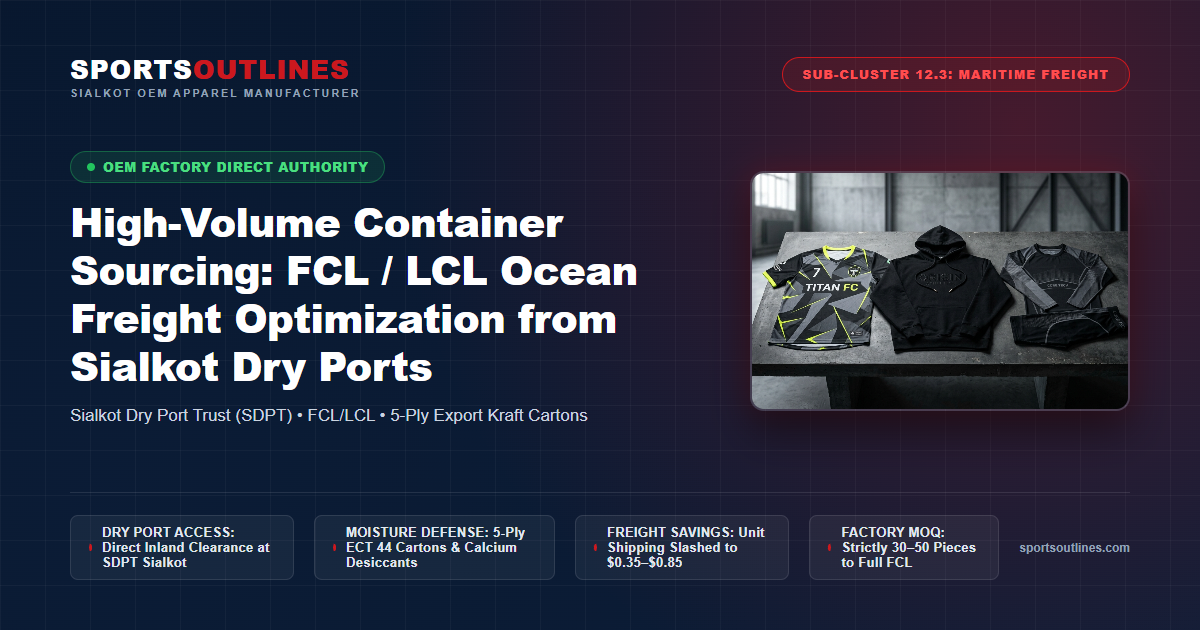
Sports Outlines provides high-volume FCL (Full Container Load) and LCL (Less-than-Container Load) ocean container sourcing direct from Sialkot, Pakistan. We eliminate seaport bottlenecks through direct customs clearance at the Sialkot Dry Port Trust (SDPT) and bonded rail transit to Karachi terminals. We protect maritime cargo with 5-ply double-wall cartons (ECT 44 / >1,400 kPa), moisture-proof EVA pouches, and calcium chloride desiccants. We offer an agile entry MOQ of strictly 30 to 50 pieces per style, full prototype engineering in 7 to 10 days for a $45 to $85 fee, and 0% duty-free delivery to the UK and EU under GSP+ status.
Direct WhatsApp: +92 316 7932595
As direct-to-consumer (DTC) athletic apparel brands and private label sportswear companies scale from early startup micro-drops into commercial retail wholesale distribution, their logistics requirements undergo a fundamental transformation. While express air freight is unbeatable for rapid prototyping, agile hype drops, and high-velocity testing, scaling an activewear brand to multimillion-dollar revenues requires mastering high-volume maritime transport: Full Container Load (FCL) and Less-than-Container Load (LCL) ocean freight. Sourcing sportswear by the ocean container slashes unit shipping costs from $5.50–$7.00 per garment down to just $0.35 to $0.85 per garment—instantly unlocking an additional 10% to 15% in gross profit margin. However, international ocean shipping introduces a gauntlet of complex operational risks: moisture condensation inside shipping containers (‘container rain’), carton structural crushing under multi-tier stacking loads, phytosanitary pallet regulations, demurrage fee penalties, and customs port clearance bottlenecks. Mastering maritime sportswear sourcing requires an OEM manufacturing partner with integrated dry port customs clearance, heavy-duty 5-ply export packaging engineering, and volumetric container load optimization. At Sports Outlines in Sialkot, Pakistan, we combine accessible low-MOQ agility with full enterprise maritime container scale. We support agile startups at an industry-low factory minimum order quantity (MOQ) of strictly 30 to 50 pieces per custom style, backed by dedicated $45 to $85 prototype engineering in 7 to 10 business days and seamless scaling to 20ft and 40ft high-cube ocean containers cleared directly through the historic Sialkot Dry Port Trust (SDPT).
Design & Manufacture Custom Ocean Container Freight & Port Logistics Direct from Sialkot
Low 30–50 Piece/Set MOQ • Dedicated Sampling in 7–10 Days • 0% Import Tariffs
✓ $45–$85 Physical Prototypes •
✓ Worldwide DDP Delivery
1. Sialkot Dry Port Trust (SDPT): Direct Inland Customs & Bonded Maritime Corridors
One of Sialkot’s greatest competitive advantages in global trade is its world-class privately owned export infrastructure. Established in 1984 by the Sialkot Chamber of Commerce & Industry (SCCI), the Sialkot Dry Port Trust (SDPT) was the first private dry port in Asia, created specifically to eliminate bureaucratic bottlenecks and connect Sialkot’s thriving manufacturing base directly to global sea lanes:
How the Inland Port Model Operates: Rather than trucking loose cartons over 1,200 kilometers to Karachi Seaport and risking port delays or pilferage, containers are stuffed, weighed, inspected, and customs-cleared directly at SDPT in Sialkot. Official customs wire seals are affixed locally under the supervision of Pakistan Customs officials. The sealed containers are then loaded onto dedicated bonded rail freight corridors and bonded GPS-tracked trucks for non-stop transit to Karachi Port and Port Qasim.
Direct Carrier Contracts: SDPT operates direct terminal agreements with the world’s leading ocean container lines—including Maersk Line, Mediterranean Shipping Company (MSC), CMA CGM, Hapag-Lloyd, and Ocean Network Express (ONE). This guarantees reliable container vessel allocations, predictable weekly sailing schedules, and direct ocean bills of lading (B/L) issued directly with Sialkot as the port of origin.
| Ocean Freight Dimension | Conventional China Coastal Port (FOB) | Sports Outlines Sialkot Dry Port (SDPT) |
|---|---|---|
| Customs Clearance Location | Congested seaport terminals (Ningbo / Shanghai) | Direct inland customs clearance at SDPT Sialkot |
| Port Congestion & Rollover Risk | Frequent container rollings during peak export seasons | Dedicated bonded rail corridor; priority vessel loading |
| Import Customs Duty (EU & UK) | 12.0% Standard MFN Duty payable by buyer | 0% Duty under Pakistan GSP+ status (Form A) |
| US Import Trade Remedy Tariffs | Subject to 7.5%–25% Section 301 punitive tariffs | Zero Section 301 tariffs; standard tariff entry |
| Container Stuffing Supervision | Often outsourced to unmonitored third-party CFS docks | In-house factory floor stuffing under supervisory CCTV |
2. FCL vs. LCL Economics: When to Transition from Air Freight to Ocean Containers
For growing sportswear brands, timing the transition from air freight to ocean shipping is critical to managing cash flow and optimizing unit economics:
- Express Air Freight (0 to 500 Units): For agile micro-drops, influencer pre-orders, and emergency replenishment, express air freight (3–5 day transit via Sialkot International Airport) is unbeatable. Although shipping costs $4.50 to $7.00 per unit, total capital lockup is minimal and speed to market maximizes full-price sell-through.
- Less-than-Container Load (LCL) Ocean Freight (500 to 3,000 Units): When a brand’s shipment reaches 3 to 15 cubic meters (CBM), air freight becomes cost-prohibitive ($5,000–$12,000 in freight). LCL shipping consolidates cartons within a shared ocean container, dropping shipping cost to $1.20–$1.80 per unit while allowing steady, predictable inventory replenishment.
- Full Container Load (FCL) Ocean Freight (3,000+ Units): Sourcing 20ft or 40ft containers unlocks the lowest possible transportation cost in apparel sourcing: $0.35 to $0.65 per garment. The container remains sealed from Sialkot factory doors directly to your 3PL fulfillment dock, providing maximum physical security and zero carton re-handling damage.
3. Preventing Container Rain & Cargo Damage: Packaging Engineering Standards
During a 25 to 35-day ocean voyage, metal shipping containers pass through dramatic ambient temperature swings. High tropical daytime humidity causes moisture inside the container to evaporate; when night falls and ambient temperatures plummet, condensation collects on the metal ceiling and walls, creating container rain. In unengineered shipments, water drips onto cheap cartons, causing mold growth, cardboard collapse, and unsellable merchandise.
Sports Outlines enforces an exhaustive Maritime Moisture & Structural Defense Protocol:
- Individual Sealed EVA Pouches: Every activewear garment is packed inside high-grade 80–100 micron frosted ethylene-vinyl acetate (EVA) pouches featuring airtight slide-zippers and laser micro-perforations, preventing moisture penetration.
- 5-Ply Double-Wall Master Cartons: We construct export master cartons from heavy-duty 5-ply corrugated kraft board rated at ECT 44 (Edge Crush Test) and bursting strength exceeding 1,400 kPa. This guarantees cartons survive vertical 6-tier container stacking without crushing.
- High-Capacity Container Desiccants: We suspend heavy-duty calcium chloride desiccant hanging poles (Dry-Bag® / Absortech®) along the internal container walls. These desiccants absorb up to 300% of their weight in moisture, maintaining internal relative humidity below 50% throughout the voyage.
- Moisture-Barrier Pallet Wrapping: Palletized consignments are built on ISPM-15 certified heat-treated wooden pallets, capped with corrugated top sheets, and wrapped in 7 layers of heavy-gauge stretch film with reinforced corner boards.
| Sourcing Feature & Risk Factor | Sports Outlines (Sialkot Direct) | Alibaba Trading Agents | Traditional Chinese Hubs | Print-on-Demand (POD) |
|---|---|---|---|---|
| Ocean Freight Logistics & Port Access | Direct dry port customs clearance at Sialkot Dry Port Trust (SDPT); bonded rail/truck corridor to Karachi/Port Qasim; direct global shipping lines. | Third-party trading agents inflate freight markups by 30%–50% and charge exorbitant destination CFS handling fees on LCL shipments. | Port congestion at Ningbo/Shanghai causes weeks of container rollings and expensive demurrage charges. | Zero ocean container capability; strictly domestic parcel drop-shipping with exorbitant per-unit shipping fees. |
| Customs Duty & Tariffs (EU / UK / US) | 0% import customs duty into EU & UK under Pakistan GSP+ status (Form A); bypasses US Section 301 punitive tariffs entirely. | Unpredictable customs declarations often misclassify HS codes, resulting in customs penalties and delayed clearance. | Subject to Section 301 tariffs (7.5%–25%) in the US and 12% standard MFN customs duty in Europe, destroying initial price advantages. | Domestic sales taxes applied per item; zero international trade preference or customs duty optimization. |
| Minimum Order Quantity & Scaling Elasticity | Strictly 30–50 piece low factory MOQ; seamlessly scales from small air capsules to 20ft and 40ft high-cube ocean containers. | Small orders receive poor quality fabric; factory only honors specifications if ordering 500+ pieces. | Rigid 1,000+ unit MOQs per style and colorway; refuses low-volume consolidation or mixed-SKU container stuffing. | 1 unit MOQ, but garments look like generic promotional blanks with cheap direct-to-garment digital prints. |
| Carton & Pallet Protection Engineering | 5-ply double-wall kraft master cartons (ECT 44 / >1,400 kPa); ISPM-15 certified heat-treated wooden pallets with moisture-barrier wrapping. | Cheap single-wall 3-ply cartons that collapse under ocean humidity and container stacking pressure, damaging garments. | Standard cartons, but charges extra for palletization, desiccant silica packs, and container moisture protection. | Plastic poly mailers only; zero master carton durability or palletized shipping infrastructure. |
| Sampling & Prototype Engineering | $45–$85 non-creditable engineering prototype fee; physical master sample delivered in 7–10 business days via express air courier. | Promises cheap samples, but delivers inaccurate sizing, mismatched colors, and poor stitching that requires 3 to 4 expensive revisions. | Demands $300–$500 sample development fees and 6–8 week lead times during peak manufacturing seasons. | No pre-production sampling; buyers must purchase expensive retail units to inspect print alignment. |
4. Volumetric Container Stuffing: 3D CAD Optimization & Maximizing Fill Rates
In ocean container shipping, air space is wasted capital. If a factory packs cartons loosely or uses oversized boxes, a 40ft container that should hold 65,000 garments might only fit 45,000 units—increasing the freight cost per garment by over 40%.
Sports Outlines utilizes advanced 3D Container Load Optimization Software (Cube-IQ / Cape Pack) to calculate mathematically optimal carton dimensions and stuffing configurations before production begins:
- Standardized Modular Carton Sizing: Carton dimensions (e.g., 60 x 40 x 30 cm) are engineered to nest perfectly into standard ISO container dimensions without dead space or overhang.
- Volumetric Compression Packing: Garments are gently vacuum-compressed during polybag packing, reducing uncompressed garment volume by 15% to 22% without damaging elastomeric stretch recovery or silicone logo prints.
- Over 92% Usable Volume Utilization: Our supervised factory loading teams achieve over 92% cubic capacity utilization, packing up to 35,000 performance t-shirts into a standard 20ft container and up to 75,000 units into a 40ft High Cube container.
| Production Volume Tier | Est. Unit FOB Cost | Sample Cost & SLA | Bulk Production SLA | Included Specifications | Recommended Buyer Profile |
|---|---|---|---|---|---|
| 30 – 50 Sets/Pieces (LCL Consolidated Ocean Starter Tier) | $12.90 – $16.80 / high-volume activewear top | $15.90 – $20.80 / bottom | $45 – $85 non-creditable prototype fee | 12 – 15 Business Days | Less-than-Container Load (LCL) consolidated cargo routing, standard 5-ply double-wall export carton packing, customs bond clearance at Sialkot Dry Port Trust (SDPT), physical master prototype in 7–10 days, strictly 30–50 piece low factory MOQ. | Emerging commercial sportswear brands, boutique fitness studio chains, regional athletic distributors, and agile e-commerce brands scaling toward sea freight. |
| 51 – 150 Sets/Pieces (Palletized Consolidation Tier) | $10.80 – $13.90 / high-volume activewear top | $13.60 – $17.20 / bottom | $45 – $85 non-creditable prototype fee | 14 – 18 Business Days | ISPM-15 heat-treated export wood palletization, heavy-duty shrink-wrap corner protection, GS1-128 barcode pallet placards, full size grading (XS to 3XL), Form A origin certificates. | Growing athletic apparel distributors, CrossFit box networks, collegiate sports team suppliers, and wholesale sporting goods importers. |
| 151 – 500 Sets/Pieces (20ft FCL Dedicated Container Tier) | $9.10 – $11.80 / high-volume activewear top | $11.80 – $14.50 / bottom | $45 – $85 non-creditable prototype fee | 18 – 22 Business Days | Dedicated 20ft Full Container Load (FCL) stuffing (approx. 28–30 CBM / 25,000–35,000 garments), direct rail/bonded truck transit from Sialkot to Port Qasim/Karachi, express Bill of Lading (B/L) release, DDP door-to-door delivery. | Established corporate athletic brands, commercial teamwear contract suppliers, professional sports federation apparel licensees, and institutional retail buyers. |
| 500+ Sets/Pieces (40ft High-Cube Enterprise Fleet Tier) | $7.40 – $9.40 / high-volume activewear top | $9.50 – $12.10 / bottom | $45 – $85 non-creditable prototype fee | 22 – 28 Business Days | 40ft High Cube (40HC) container optimization (68–72 CBM / 60,000–80,000 garments), automated volumetric floor-loading software, continuous factory stuffing under supervisory CCTV, direct ocean carrier contract rates (Maersk, MSC, CMA CGM). | Global sportswear retail corporations, multi-national athletic licensing conglomerates, international sporting goods chains, and nationwide department stores. |
5. Technical Specifications & Maritime Sourcing Workflow
Our end-to-end maritime sourcing protocol ensures flawless cargo transition from factory floor to overseas dock doors:
| Supply Chain Stage | Operational SOP & Deliverable | Standard SLA Timeline |
|---|---|---|
| 1. Tech Pack & Sampling | $45–$85 prototype fee; master sample engineered and approved. | 7–10 Business Days |
| 2. Bulk Manufacturing | Modular cell cutting, sewing, printing, and AQL 2.5 final inspection. | 18–25 Business Days |
| 3. Container Stuffing & Sealing | Container loading at Sialkot factory; customs wire seals applied under CCTV. | 24 Hours |
| 4. SDPT Dry Port Clearance | Electronic Form E, customs export declaration, and GSP+ Form A issuance. | 24–48 Hours |
| 5. Bonded Transit to Karachi | Dedicated bonded rail freight transport from SDPT to seaport terminal. | 3–4 Days |
| 6. Ocean Voyage Transit | Direct mother vessel sailing to Rotterdam, Hamburg, Southampton, or New York. | 22–28 Days |
6. Explore Our Technical Sportswear Manufacturing Ecosystem
Expand your supply chain mastery by reviewing our specialized manufacturing resources:
- Master international freight and border logistics with our guide to Cross-Border E-Commerce Logistics: Sialkot DDP Air Freight & 3PL Inbound Prep.
- Automate your replenishment pipeline using EDI & Open API Integration for Automated Sportswear Replenishment.
- Optimize multi-currency trade financing with Multi-Currency B2B Sourcing Invoicing: Hedging FX Volatility & MT103 Bank Rails.
- Model total landed economics with our analysis of Total Landed Cost (TLC) Modeling: Sialkot DDP vs China FOB vs Nearshoring.
- Coordinate large-scale multi-door distribution via Multi-Store Retail Sportswear Distribution & GS1-128 Carton Labeling.
Get a Factory Direct Quote for Ocean Container Freight & Port Logistics
Chat with our Sialkot Engineering Team via WhatsApp • Instant DDP Air Freight Quotes
✓ $45–$85 Physical Prototypes •
✓ Worldwide DDP Delivery
Frequently Asked Sourcing & Manufacturing Questions (Buyer FAQ)
What is the Sialkot Dry Port Trust (SDPT) and how does it streamline ocean container shipping for sportswear?
Established in 1984 as Asia’s first privately owned dry port, the Sialkot Dry Port Trust (SDPT) is a full-service inland customs port located directly in Sialkot, Pakistan. SDPT allows Sports Outlines to execute complete customs inspection, export documentation, container stuffing, and customs clearance locally in Sialkot. Once cleared and sealed under official customs wire seals, ocean containers are transported via dedicated bonded rail and bonded road corridors directly to the seaport docks at Port Qasim and Karachi Port for immediate crane loading onto mother vessels operated by Maersk, MSC, Hapag-Lloyd, and CMA CGM. This inland dry port infrastructure completely eliminates seaport congestion delays and bureaucratic bottlenecks.
What is the difference between FCL (Full Container Load) and LCL (Less-than-Container Load) in athletic apparel sourcing?
Full Container Load (FCL) means a brand books an entire dedicated 20ft or 40ft container exclusively for their shipment. In FCL, the container is stuffed and sealed at our Sialkot factory and remains unopened until it reaches the buyer’s destination warehouse, providing maximum cargo security, zero handling damage, and the lowest freight cost per garment ($0.25 to $0.60 per unit). Less-than-Container Load (LCL) is designed for smaller shipments (e.g., 2 to 10 cubic meters / 1,000 to 5,000 garments) where multiple shippers share space within a single consolidated container. In LCL, cartons are consolidated at a container freight station (CFS), offering lower total shipping cost than air freight for medium-volume restocks.
How many garments can fit into a 20ft container and a 40ft High Cube (40HC) container?
Garment capacity depends on fabric weight (GSM) and packaging volume (flat-packed vs hanging). As a general benchmark for compressed, polybagged athletic apparel: 1) A 20ft Standard Container (internal volume ~33 CBM, usable ~28 CBM) accommodates approximately 22,000 to 28,000 technical athletic t-shirts or 12,000 to 16,000 heavyweight fleece hoodies; 2) A 40ft High Cube Container (internal volume ~76 CBM, usable ~68 CBM) accommodates approximately 55,000 to 75,000 athletic t-shirts or 30,000 to 42,000 fleece hoodies. Sports Outlines utilizes 3D container load optimization software to calculate exact carton nesting and maximize container fill rates (>92% cubic utilization).
How does Sports Outlines prevent container rain and moisture damage during ocean transit?
Ocean freight consignments cross equatorial temperature zones where high daytime heat followed by cool nights causes condensation inside metal containers—a phenomenon known as ‘container rain’. Condensation dripping onto cardboard cartons causes carton collapse, mildew growth, and musty odors on garments. Sports Outlines prevents moisture damage through multi-barrier protection: 1) Every garment is sealed inside heavy-duty 80–100 micron moisture-proof EVA or polyethylene pouches; 2) Master cartons are constructed from 5-ply double-wall kraft board (ECT 44 / >1,400 kPa bursting strength) with water-resistant exterior coating; 3) Containers are lined with moisture-barrier kraft paper; and 4) High-capacity calcium chloride desiccant hanging poles (absorbing up to 300% of their weight in moisture) are suspended throughout the container.
What is ISPM-15 wood packaging certification and why is it mandatory for palletized ocean freight?
The International Standards for Phytosanitary Measures No. 15 (ISPM-15) is an international treaty enforced by customs authorities worldwide (including US CBP, EU Customs, and Australian DAFF) to prevent the global spread of timber-borne insects and plant pests. Any wooden pallet, crate, or dunnage used in international ocean shipping must undergo certified heat treatment (heated to 56°C for a minimum of 30 minutes) and bear the official IPPC ‘wheat stamp’. Uncertified pallets will be immediately quarantined, rejected, or re-exported at the buyer’s expense. Sports Outlines exclusively utilizes certified ISPM-15 heat-treated wood pallets or moisture-resistant heavy-duty plastic export pallets.
What is the factory minimum order quantity (MOQ) for custom sportswear at Sports Outlines?
Our minimum order quantity for custom activewear, hoodies, teamwear jerseys, and performance apparel is strictly 30 to 50 pieces or sets per style and colorway. While ocean containers represent our high-volume scaling capability, our low 30 to 50-piece MOQ allows emerging brands to start with air freight capsules, test product market fit, and scale organically into LCL and full container ocean shipments as volume grows.
What is the pre-production prototype fee and turnaround time for ocean freight bulk orders?
Sports Outlines charges a transparent, non-creditable engineering prototype fee of $45 to $85 per style. This covers CAD pattern drafting, specialized textile knitting or sourcing, computerized embroidery or silicone printing, and precision master sample assembly. Your physical prototype is engineered under strict quality standards and dispatched via express air courier directly to your design studio within 7 to 10 business days.
What commercial documentation is required for clearing ocean container shipments at destination ports?
Every ocean container dispatched from our Sialkot manufacturing facility is accompanied by complete international trade documentation: 1) Original Negotiable Ocean Bill of Lading (B/L) or Express Telex Release; 2) Commercial Invoice detailing itemized FOB prices, HS codes, and contract numbers; 3) Detailed Packing List detailing carton numbers, gross/net weights, and garment ratios; 4) Authenticated Certificate of Origin (Form A) unlocking 0% customs import duty under GSP+ into the EU and UK; and 5) Container Seal Manifest and Fumigation / Phytosanitary Certificates.
How does ocean freight shipping cost compare to express air freight for sportswear?
Ocean freight delivers massive transportation cost savings for commercial apparel shipments: while express air freight typically costs $4.50 to $7.00 per garment (depending on weight and fuel surcharges), ocean container freight slashes shipping costs to just $0.35 to $0.90 per garment. For established activewear brands managing steady replenishment pipelines, shipping core inventory via ocean freight expands gross profit margins by an extra 10% to 15%.
How does Sports Outlines help brands manage hybrid air-sea replenishment strategies?
Top-tier athletic apparel brands utilize a Hybrid Air-Sea Logistics Strategy: when launching a new collection, the brand ships an initial agile air freight capsule (10%–15% of total volume, 30–100 units per style) via express air out of Sialkot International Airport (SKT) to meet launch dates and satisfy immediate customer demand. Simultaneously, the remaining bulk production (85%–90% of volume) is dispatched via ocean container from Sialkot Dry Port. By the time the air drop sells out, the ocean container arrives at the destination 3PL warehouse, achieving optimal cash flow velocity, zero stockouts, and maximized profit margins.