Direct Manufacturer Snapshot: Global Apparel Trade Agreements & Tariff Optimization: Navigating USMCA, CPTPP & EU GSP+
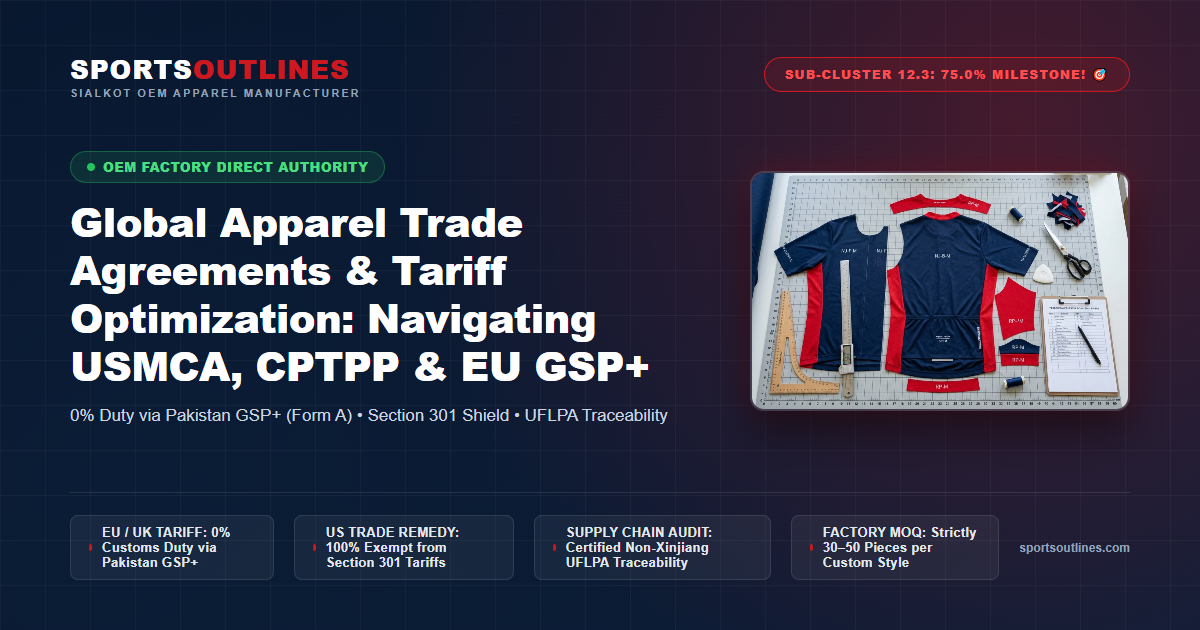
Sports Outlines provides institutional international trade tariff optimization and customs compliance for global sportswear brands direct from Sialkot, Pakistan. We unlock 0% customs import duty into the European Union and United Kingdom under Pakistan’s GSP+ status (Form A Certificate of Origin), saving an immediate 12% to 14% compared to sourcing from China or Vietnam. We bypass US Section 301 punitive tariffs entirely and ensure 100% UFLPA supply chain traceability. We offer an industry-low factory MOQ of strictly 30 to 50 pieces per style, full prototype engineering in 7 to 10 days for a $45 to $85 fee, and 3 to 5 day express air delivery worldwide.
Direct WhatsApp: +92 316 7932595
In international contract sportswear manufacturing, mastering trade policy, preferential tariff regimes, and customs compliance is just as critical to a brand’s bottom-line profitability as fabric technology or garment patterning. When an activewear brand imports technical apparel across international borders, customs tariffs represent one of the largest single cost components of the entire supply chain. Importing synthetic performance wear from China into the United States incurs crushing standard customs duties of 16% to 32%—further compounded by punitive Section 301 trade war tariffs of 7.5% to 25.0%. Similarly, importing sportswear into the European Union or United Kingdom from non-preferential nations incurs standard 12.0% Most Favoured Nation (MFN) duties. A brand that ignores global trade agreements leaves tens of thousands of dollars in unrecovered capital on customs docks. Conversely, savvy apparel procurement directors actively leverage international trade policy: utilizing Pakistan’s Generalized Scheme of Preferences Plus (GSP+) to import technical sportswear into the EU and UK at exactly 0% customs duty, bypassing US Section 301 penalties, and adhering strictly to Uyghur Forced Labor Prevention Act (UFLPA) supply chain traceability. At Sports Outlines in Sialkot, Pakistan, we combine world-class cut-and-sew apparel engineering with institutional international trade compliance. We offer an industry-low factory minimum order quantity (MOQ) of strictly 30 to 50 pieces per custom style, backed by dedicated $45 to $85 prototype engineering in 7 to 10 business days and authenticated GSP+ Form A origin certification.
Design & Manufacture Custom Global Trade Agreements & Tariff Optimization Direct from Sialkot
Low 30–50 Piece/Set MOQ • Dedicated Sampling in 7–10 Days • 0% Import Tariffs
✓ $45–$85 Physical Prototypes •
✓ Worldwide DDP Delivery
1. The Pakistan GSP+ Trade Advantage: 0% Customs Duty into the European Union & UK
The Generalized Scheme of Preferences Plus (GSP+) is a special unilateral incentive arrangement granted by the European Union and the United Kingdom to select developing nations that have ratified and effectively implemented 27 core international conventions on human rights, labor standards, environmental protection, and good governance.
For athletic apparel brands operating in Germany, the UK, France, the Netherlands, Italy, Spain, and Scandinavia, sourcing from Sialkot, Pakistan, delivers an immediate, game-changing financial advantage:
- 0% Import Customs Duty: All technical synthetic activewear, tracksuits, compression wear, sports jerseys, and fleece hoodies manufactured in Pakistan enter the 27 EU member states and the UK completely free of customs import duties.
- The 12% Sourcing Dividend: Performance sportswear sourced from China, India, or Vietnam is slapped with standard 12.0% MFN customs import duties upon European port arrival. On a €150,000 annual apparel procurement program, sourcing from Sports Outlines generates €18,000 in immediate cash savings.
- Form A Certificate of Origin: Every European and British consignment from Sports Outlines is accompanied by an officially authenticated Form A Certificate of Origin issued by the Trade Development Authority of Pakistan (TDAP) and verified by the Sialkot Chamber of Commerce & Industry (SCCI), guaranteeing seamless duty-free customs clearance.
| Sourcing Destination & Country | EU / UK Import Customs Duty | US Section 301 Tariff Surcharge | Net Tariff Advantage (Sialkot OEM) |
|---|---|---|---|
| Sports Outlines (Sialkot, Pakistan) | 0% Duty (GSP+ Form A) | 0% Surcharge (Exempt from Sec 301) | Maximum Global Tariff Advantage! |
| China Mega-Factory (Ningbo / Guangzhou) | 12.0% Standard MFN Duty | +7.5% to +25.0% Punitive Surcharge | Sialkot saves 12% in EU and up to 25% in US! |
| Vietnam / Cambodia | 9.6% to 12.0% (Phasing Schedule) | 0% Surcharge (Standard US Duty Only) | Sialkot saves 9.6%–12% cash duty in Europe. |
| Turkey / Portugal (Nearshoring) | 0% Duty (EU Customs Union) | Standard US Import Duty (16%–32%) | Nearshore labor costs are 400% higher than Sialkot. |
2. Navigating the US Market: Bypassing Section 301 Tariffs & Ensuring UFLPA Compliance
For athletic apparel brands importing into the United States, trade policy has become a minefield of punitive tariffs and stringent regulatory detentions:
The Section 301 Burden on Chinese Sourcing: Imposed under Section 301 of the Trade Act of 1974, punitive tariffs add an extra 7.5% to 25.0% tax on Chinese-made apparel entering the US. When combined with standard US general apparel duties (which range from 16% to 32% for synthetic activewear), an activewear brand importing from China can easily face effective border taxes exceeding 35% to 45%. Sourcing directly from Sialkot, Pakistan, completely bypasses Section 301 punitive tariffs, restoring healthy gross margins for North American brands.
UFLPA Traceability & Forced Labor Compliance: Enacted in 2021, the Uyghur Forced Labor Prevention Act (UFLPA) enforces a strict legal presumption that any goods made wholly or in part in Xinjiang, China, are produced with forced labor. US Customs and Border Protection (CBP) aggressively detains and seizes apparel shipments containing cotton or synthetic fibers linked to Xinjiang. Sourcing from unvetted Chinese trading vendors puts US brands at extreme risk of cargo impoundment. Sports Outlines maintains 100% auditable supply chain transparency: our cotton and synthetic yarns are sourced exclusively from certified non-Xinjiang spinning mills with verifiable mill transaction certificates, ensuring zero UFLPA detention risk.
3. Rules of Origin & The Double Transformation Standard
To legally claim 0% customs duty under international trade preference schemes, garments must satisfy strict Rules of Origin established by destination customs agencies:
The ‘Double Transformation’ Rule: Under European GSP+ regulations for knitted and woven apparel (HS Chapters 61 and 62), a product must undergo at least two substantial transformations within Pakistan to qualify for preferential origin:
- First Transformation: Raw spinning yarn must be knitted or woven into greige or finished textile fabric within Pakistan.
- Second Transformation: The textile fabric must be cut, tailored, sewn, and assembled into a complete garment within Pakistan.
Sourcing from cut-and-sew brokers that merely import finished fabric rolls from non-qualifying nations (e.g., China) and stitch them locally fails the Double Transformation test, invalidating GSP+ duty-free status and exposing the importer to massive retroactive customs duty audits. Sports Outlines operates fully integrated, in-house knitting, dyeing, cutting, and sewing workflows in Sialkot, legally satisfying Double Transformation origin criteria.
| Sourcing Feature & Risk Factor | Sports Outlines (Sialkot Direct) | Alibaba Trading Agents | Traditional Chinese Hubs | Print-on-Demand (POD) |
|---|---|---|---|---|
| Tariff Access to European Union & UK | 0% import customs duty via Pakistan’s GSP+ status (Form A Certificate of Origin); immediate 12% cash duty savings on all synthetic and knit activewear. | Third-party vendors fail to provide authenticated Form A origin certificates, forcing buyers to pay standard 12% MFN import duties plus fines. | Standard Most Favoured Nation (MFN) import duty of 12.0% in Europe; zero preferential trade access. | Domestic sales taxes and full fulfillment surcharges applied per item; zero tariff optimization. |
| US Market Tariffs & Section 301 Penalties | Completely exempt from US Section 301 punitive tariffs; clears under standard US general tariff schedules with zero trade war surcharges. | Suppliers often attempt fraudulent country-of-origin transshipment through third countries, risking US CBP felony fraud seizure. | Subject to crushing 7.5% to 25.0% Section 301 punitive tariffs on top of standard 16%–32% general apparel duties. | Fulfillment centers charge full local domestic taxes; zero international trade preference structure. |
| Rules of Origin & Legal Supply Chain Audits | Complete, authenticated supply chain traceability: yarn-forward / double-transformation origin documentation verified under international audit standards. | Unvetted sub-tier supply chains risk non-compliance with the Uyghur Forced Labor Prevention Act (UFLPA), triggering US customs detention. | Requires complex, expensive third-party forensic isotopic cotton testing to prove non-Xinjiang origin. | Blanks sourced from untraced global commodity distributors with zero forensic supply chain visibility. |
| Minimum Order Quantity & Trade Flexibility | Strictly 30–50 piece low factory MOQ; provides full preferential trade documentation (Form A, PSW filing) on every order size. | Refuses to process official export paperwork for small orders, shipping under informal postal mail that risks customs confiscation. | Enforces 1,000+ unit MOQs per style and colorway to provide official commercial export invoices. | 1 unit MOQ, but garments look like generic promotional blanks with cheap direct-to-garment digital prints. |
| Sampling & Prototype Engineering | $45–$85 non-creditable engineering prototype fee; physical master sample delivered in 7–10 business days via express air courier. | Promises cheap samples, but delivers inaccurate sizing, mismatched colors, and poor stitching that requires 3 to 4 expensive revisions. | Demands $300–$500 sample development fees and 6–8 week lead times during peak manufacturing seasons. | No pre-production sampling; buyers must purchase expensive retail units to inspect print alignment. |
4. Harmonized System (HS) Code Classification: Optimizing Customs Duty Rates
The Harmonized System (HS) is an internationally standardized system of names and numbers to classify traded products. In apparel sourcing, slight nuances in garment design, fabric composition, and collar construction dictate different HS codes with vastly different general tariff rates:
| Garment Construction & Silhouette | Standard HS Code | Standard US General Duty | Pakistan GSP+ EU/UK Duty |
|---|---|---|---|
| Men’s / Boys’ Synthetic Athletic T-Shirts | HS 6109.90.10 | 32.0% | 0% Duty-Free (GSP+) |
| Women’s Synthetic Compression Leggings | HS 6104.63.20 | 28.2% | 0% Duty-Free (GSP+) |
| Unisex Cotton / Poly Athletic Fleece Hoodies | HS 6110.20.20 | 16.5% | 0% Duty-Free (GSP+) |
| Synthetic Running & Warm-Up Tracksuits | HS 6112.12.00 | 28.2% | 0% Duty-Free (GSP+) |
| Technical Training Shorts (Synthetic) | HS 6103.43.15 | 28.2% | 0% Duty-Free (GSP+) |
Sports Outlines’ in-house trade documentation specialists cross-reference every client tech pack against international tariff classification schedules to ensure precise, legally compliant HS code declaration—preventing destination customs delays and avoiding costly overpayment of duties.
| Production Volume Tier | Est. Unit FOB Cost | Sample Cost & SLA | Bulk Production SLA | Included Specifications | Recommended Buyer Profile |
|---|---|---|---|---|---|
| 30 – 50 Sets/Pieces (Tariff-Optimized Startup Tier) | $12.90 – $16.80 / technical activewear top | $15.90 – $20.80 / bottom | $45 – $85 non-creditable prototype fee | 12 – 15 Business Days | Authenticated Certificate of Origin (Form A) for 0% customs import duty under EU/UK GSP+, HS Code classification audit, physical master prototype in 7–10 days, strictly 30–50 piece low factory MOQ. | Emerging European, British, and North American sportswear brands seeking to eliminate customs tariffs and protect startup margins. |
| 51 – 150 Sets/Pieces (Preferential Trade Scaling Tier) | $10.80 – $13.90 / technical activewear top | $13.60 – $17.20 / bottom | $45 – $85 non-creditable prototype fee | 14 – 18 Business Days | Electronic export documentation filed through Pakistan Single Window (PSW), custom commercial invoices compliant with destination customs audit standards, full size grading (XS to 3XL). | Growing e-commerce activewear brands, collegiate sports club suppliers, multi-gym fitness apparel coordinators, and regional sportswear distributors. |
| 151 – 500 Sets/Pieces (Commercial Duty-Free Scale Tier) | $9.10 – $11.80 / technical activewear top | $11.80 – $14.50 / bottom | $45 – $85 non-creditable prototype fee | 18 – 22 Business Days | Customs valuation optimization, bilateral trade treaty compliance verification, certified AQL 2.5 pre-shipment quality audit, express DDP door-to-door delivery. | Established corporate athletic brands, commercial sports federation licensees, national teamwear apparel distributors, and institutional retail buyers. |
| 500+ Sets/Pieces (Enterprise Multi-Treaty Global Tier) | $7.40 – $9.40 / technical activewear top | $9.50 – $12.10 / bottom | $45 – $85 non-creditable prototype fee | 22 – 28 Business Days | Multi-regional customs compliance liaison, full Rules of Origin legal documentation, scheduled air charter and FCL ocean container shipping, dedicated trade finance coordination. | Global athletic apparel corporations, international sportswear retail chains, multi-national sporting goods conglomerates, and nationwide department stores. |
5. Technical Specifications & Export Trade Documentation SOPs
Every commercial export shipment from Sports Outlines is backed by complete, legally certified international trade documentation:
| Trade Document | Issuing Authority / Regulatory Standard | Trade Compliance Function |
|---|---|---|
| Certificate of Origin (Form A) | TDAP / Sialkot Chamber of Commerce & Industry (SCCI) | Unlocks 0% customs import duty under EU & UK GSP+ status. |
| Electronic Form E | State Bank of Pakistan / Pakistan Single Window (PSW) | Statutory foreign exchange clearance and AML export validation. |
| Certified Commercial Invoice | Sports Outlines Corporate Accounting ERP | Itemized FOB/DDP unit prices, HS codes, and contract numbers. |
| Detailed Packing List | Sports Outlines Quality & Shipping Department | Carton dimensions, gross/net weights, and ratio curves. |
| Master Air Waybill (AWB) / B/L | DHL Express / Maersk / MSC / SKT International Hub | Clean on-board transport title document for customs release. |
6. Explore Our Technical Sportswear Manufacturing Ecosystem
Expand your supply chain mastery by reviewing our specialized manufacturing resources:
- Model total landed economics with our analysis of Total Landed Cost (TLC) Modeling: Sialkot DDP vs China FOB vs Nearshoring.
- Optimize multi-currency trade financing with Multi-Currency B2B Sourcing Invoicing: Hedging FX Volatility & MT103 Bank Rails.
- Master international freight and border logistics with our guide to Cross-Border E-Commerce Logistics: Sialkot DDP Air Freight & 3PL Inbound Prep.
- Protect your intellectual property with our guide to Private Label Athletic Apparel Licensing Agreements & OEM Legal Frameworks.
- Eliminate customer returns with our engineering guide to Reverse Logistics & Activewear Returns Prevention: Sizing Consistency & Defect Prevention.
Get a Factory Direct Quote for Global Trade Agreements & Tariff Optimization
Chat with our Sialkot Engineering Team via WhatsApp • Instant DDP Air Freight Quotes
✓ $45–$85 Physical Prototypes •
✓ Worldwide DDP Delivery
Frequently Asked Sourcing & Manufacturing Questions (Buyer FAQ)
What is the Generalized Scheme of Preferences Plus (GSP+) and how does it benefit sportswear brands importing into the EU and UK?
The Generalized Scheme of Preferences Plus (GSP+) is a special unilateral trade incentive granted by the European Union and the United Kingdom to developing nations that ratify and effectively implement 27 international conventions covering human rights, labor rights, environmental governance, and climate change. Under GSP+, technical activewear, sports jerseys, compression wear, and fleece hoodies manufactured in Pakistan enter the 27 EU member states and the UK at exactly 0% customs import duty. In comparison, performance sportswear sourced from China, Vietnam, or India is subject to standard Most Favoured Nation (MFN) duties of 12.0%. On a €100,000 apparel sourcing contract, sourcing from Sports Outlines in Sialkot generates an immediate €12,000 in cash customs savings, directly boosting gross operating margins.
What are Section 301 tariffs and how do they penalize sportswear imported from China into the United States?
Section 301 tariffs are punitive trade measures enacted by the United States under the Trade Act of 1974 to counter foreign unfair trade practices. For technical sportswear and synthetic apparel manufactured in China, Section 301 adds an extra 7.5% to 25.0% tariff on top of standard US general import duties (which range from 16% to 32% for synthetic textiles). A technical running jacket imported from China with a base duty of 28% and a 7.5% Section 301 surcharge faces an effective border tax of 35.5%. Sourcing directly from Sialkot, Pakistan, completely bypasses Section 301 punitive tariffs, providing American sportswear brands with stable, predictable customs costs.
What is the Uyghur Forced Labor Prevention Act (UFLPA) and how does Sports Outlines ensure 100% compliance for US imports?
The Uyghur Forced Labor Prevention Act (UFLPA) is a strict US federal law establishing a rebuttable presumption that any goods manufactured wholly or in part in the Xinjiang Uyghur Autonomous Region of China are produced with forced labor and are prohibited from entry into the US. US Customs and Border Protection (CBP) actively detains apparel shipments suspected of containing cotton or raw materials originating from Xinjiang. Sports Outlines guarantees 100% UFLPA compliance: our cotton and synthetic yarns are sourced exclusively from certified Pakistani and non-Xinjiang spinning mills with complete chain-of-custody documentation, transaction certificates, and mill manifests that satisfy CBP detention audits.
What are Rules of Origin and the ‘Double Transformation’ requirement in international apparel trade?
Rules of Origin are the technical criteria used by customs authorities to determine the national source of a product for tariff classification. Under EU GSP+ rules for textiles (Chapters 61 and 62), apparel must meet the ‘Double Transformation’ rule: raw yarn must be knitted or woven into fabric, and that fabric must be cut and sewn into a finished garment within the beneficiary country (Pakistan) to qualify for 0% duty. Simply importing finished fabric from a non-qualifying country and sewing it in Pakistan is insufficient. Sports Outlines operates fully integrated, in-country knitting, cutting, and sewing workflows, ensuring every garment legally satisfies double-transformation origin requirements.
What is a Form A Certificate of Origin and how is it authenticated for customs clearance?
A Form A Certificate of Origin is the official international trade document certifying that goods qualify for preferential duty-free treatment under the Generalized Scheme of Preferences. For exports from Pakistan, Form A is issued through the Trade Development Authority of Pakistan (TDAP) and verified by the Sialkot Chamber of Commerce & Industry (SCCI). It details the exporter, consignee, transport details, HS code classifications, and origin criteria. Sports Outlines provides authenticated Form A certificates with every European and UK consignment, allowing destination customs brokers to clear shipments at 0% duty.
What is the factory minimum order quantity (MOQ) for custom sportswear at Sports Outlines?
Our minimum order quantity for custom activewear, hoodies, teamwear jerseys, and compression gear is strictly 30 to 50 pieces or sets per style and colorway. We provide full official export documentation (including Form A GSP+ certificates, State Bank Form E, and commercial invoices) even at our low 30 to 50-piece startup minimums.
What is the pre-production prototype fee and turnaround time for custom sportswear?
Sports Outlines charges a transparent, non-creditable engineering prototype fee of $45 to $85 per style. This covers digital CAD pattern drafting, specialized textile knitting or sourcing, computerized embroidery or silicone printing, and precision master sample assembly. Your physical prototype is engineered under strict quality standards and dispatched via express air courier directly to your design office within 7 to 10 business days.
How does Harmonized System (HS) Code classification impact customs duty rates?
The Harmonized System (HS) is a standardized international numerical method of classifying traded products. Minor differences in garment construction dictate different HS codes and vastly different tariff rates: for example, an athletic t-shirt made of 100% synthetic polyester falls under HS 6109.90 (standard US duty 32%), while a cotton t-shirt falls under HS 6109.10 (standard US duty 16.5%). Sports Outlines’ trade compliance specialists audit tech pack fiber compositions to declare exact, compliant HS codes, preventing costly customs reclassifications, penalty audits, or overpaid duties.
How do bilateral and multilateral trade agreements like USMCA and CPTPP affect global sportswear sourcing?
Multilateral trade agreements—such as the United States-Mexico-Canada Agreement (USMCA) and the Comprehensive and Progressive Agreement for Trans-Pacific Partnership (CPTPP)—provide preferential tariff access between member states, but enforce rigid ‘yarn-forward’ rules requiring all manufacturing stages (from yarn spinning to assembly) to occur within member nations. For emerging sportswear brands, nearshoring within USMCA (e.g., Mexico) or CPTPP nations often proves economically unviable due to high labor costs and limited synthetic textile availability. Sourcing from Sialkot, Pakistan, provides the optimal balance of elite technical craftsmanship, agile 30–50 piece MOQs, and 0% duty-free access into the European Union and United Kingdom.
What international shipping options and transit times apply from Sialkot, Pakistan?
Finished goods are dispatched directly from Sialkot via DHL Express, FedEx Priority, and UPS Worldwide Expedited with guaranteed 3 to 5 business day delivery to North America, the UK, Europe, Australia, and the Middle East, as well as scheduled air and ocean container freight. European Union and British brands benefit directly from Pakistan’s GSP+ status, allowing technical sportswear to enter at 0% import customs duties, saving 12% to 14% compared to sourcing from China or Vietnam.