Direct Manufacturer Answer: How to Source Custom Baseball Sliding Shorts & Base Layers
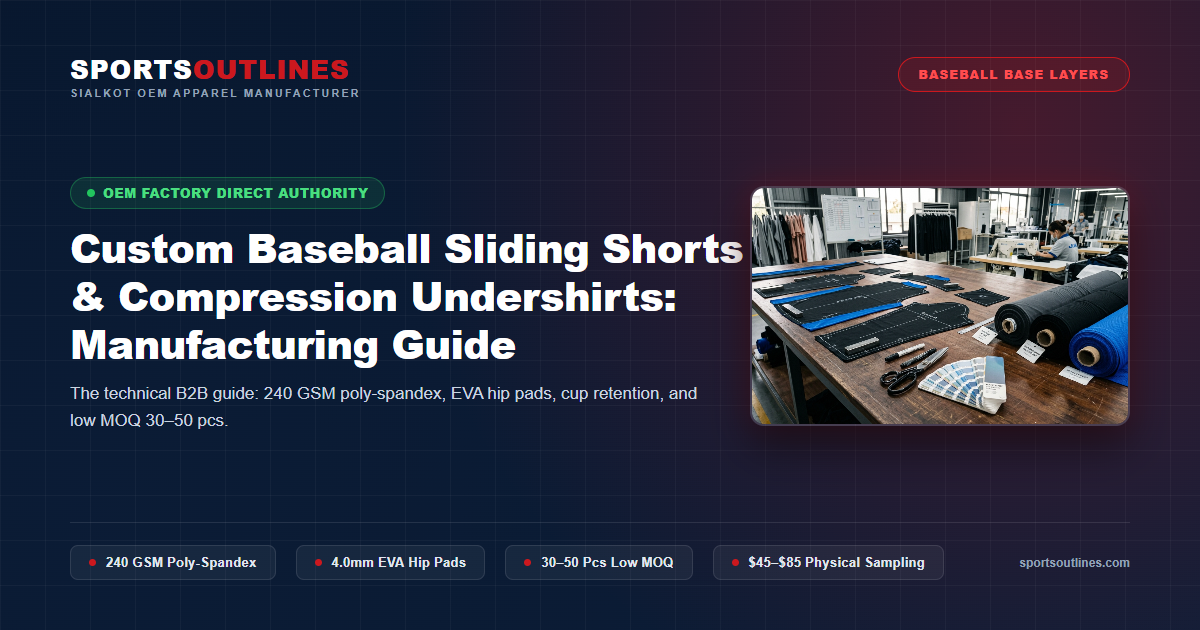
Manufacturing professional custom baseball sliding shorts, protective compression girdles, and moisture-wicking undershirts requires high-tenacity 220 to 250 GSM warp-knit polyester-spandex (82/18) or nylon-elastane (80/20) delivering 18–22 mmHg graduated athletic compression. Sliding shorts incorporate die-cut anatomical 3.0mm to 5.0mm high-density EVA foam or thermoplastic polyurethane (TPU) pads heat-bonded over the greater trochanter (outer hips) and upper iliac crest to absorb acute abrasive shear forces during high-speed slides on rock-hard diamond clay. Built with a reinforced dual-layer athletic cup pouch, 4-needle 6-thread flatlock anti-chafing seams, and a plush 40mm jacquard brushed-elastic waistband, factory direct low MOQ in Sialkot, Pakistan starts at 30 to 50 pieces per style/colorway across Youth YS to Adult 3XL. Pre-production physical prototype samples cost $45 to $85 per piece delivered in 7 to 10 business days.
- Base Layer Textile: 230 GSM 4-Way Stretch Interlock (82% Poly / 18% Spandex) with silver-ion antimicrobial finish.
- Impact Protection: 4.0mm Die-Cut High-Density EVA Foam or Honeycomb Hex-Pads with breathable micro-perforations.
- Cup Retention System: Ergonomic double-layer poly-mesh pouch compatible with all standard adult and youth athletic cups.
- Seam Construction: ISO 607 4-needle 6-thread flatlock stitching with zero-friction internal seam profiles.
- Factory Low MOQ: 30–50 pieces/pairs per style across comprehensive youth and adult size curves.
- Physical Prototype Sampling: $45–$85 per custom sample in 7–10 days (strict zero credit/refund policy).
- Direct Factory Sourcing: WhatsApp factory direct at +92 316 7932595 or sportsoutlines.com.
In modern competitive baseball and fastpitch softball, a player’s outer uniform is only as effective as the protective technical base layers worn underneath. When a base runner launches their body into a dirt slide at 18 miles per hour to beat a tag at second base, the sheer frictional heat and lateral impact against compressed red clay and limestone can cause debilitating “strawberries” (severe skin abrasion) and deep hip contusions.
This makes custom padded sliding shorts and compression undershirts the most vital protective components of an athlete’s equipment arsenal. Generic off-the-shelf gym compression shorts fail on the baseball diamond: they lack dedicated hip pad density, tear instantly against abrasive clay, and allow athletic cups to shift dangerously during explosive lateral defensive movements.
At Sports Outlines in Sialkot, Pakistan, our specialized athletic base layer and compression division manufactures tournament-grade baseball sliding shorts, integrated cup-pocket girdles, 3/4-sleeve pitching compression tops, and sleeveless thermal undershirts for collegiate programs, minor league franchises, and performance sports brands worldwide. This comprehensive technical B2B manufacturing guide details compression textile engineering, EVA pad thermo-lamination, cup pouch biomechanics, flatlock seaming protocols, wholesale unit economics, and factory-direct low MOQ sourcing parameters.
1. Biomechanical Impact Dynamics: Base Stealing & Hard-Clay Frictional Shear
To manufacture protective sliding gear that elite athletes trust, apparel engineers must calculate the severe physical stresses generated during competitive diamond baserunning:
- Abrasive Frictional Shear: During a head-first or hook slide, the athlete’s outer hip (greater trochanter) and thigh experience acute friction against compacted clay traveling at 15 to 20 feet per second. This kinetic friction generates instantaneous thermal heat that melts cheap nylon fibers and tears thin polyester knits. Sliding shorts require thick 220+ GSM dense warp-knits paired with closed-cell foam buffers.
- Blunt Force Ground Reaction Shock: When an athlete drops their hip to slide on baked summer diamonds, their skeletal pelvis absorbs substantial blunt-force impact. High-density EVA foam pads dissipate this kinetic energy outward across a broader surface area, preventing deep bone bruising.
- Cup Stabilization Under High-G Deceleration: Infielders routinely make sudden diving stops and lateral pivots. If an athletic protective cup shifts out of alignment by even 10 millimeters, it exposes the athlete to catastrophic testicular trauma. A baseball sliding short must lock the cup securely in place relative to the pelvic bone.
2. Compression Textile Science: Polyester-Spandex vs Nylon-Elastane Blends
The foundation of any high-performance base layer is its yarn composition, knitting gauge, and modulus of elasticity:
For padded sliding shorts, our 230–250 GSM warp-knit polyester-spandex provides the optimal balance of compressive containment and abrasion resistance. Warp knitting creates interlocked vertical tricot columns that resist snagging, laddering, and puncture runs when subjected to gravelly infield dirt, while 18% core-spun spandex ensures the shorts snap back to their anatomical shape after 50 wash cycles.
3. Anatomical Impact Padding: Die-Cut EVA Foam vs Hexagonal Molded Pads
Sliding short pads must protect vulnerable bones without adding stiff, bulky ridges that hinder running sprint mechanics or look lumpy beneath baseball pants:
- Die-Cut Low-Profile EVA Foam (3.0mm–4.0mm): The modern collegiate standard. Closed-cell ethylene-vinyl acetate (EVA) foam is precision die-cut into anatomical kidney-bean shapes mapping the greater trochanter and lateral thigh. The foam is micro-perforated with 1.5mm holes to allow heat and sweat vapor to vent freely. It flexes smoothly around the thigh muscle without restricting knee drive.
- Honeycomb Hex-Molded Foam (5.0mm–6.0mm): Independent 10mm hexagonal foam cells bonded between dual layers of stretch fabric. The gaps between hexagons create natural hinge points that wrap seamlessly around 3-dimensional hip curves, delivering elite shock absorption for aggressive base stealers.
- Thermosonic Edge Welding: To prevent pad displacement during laundering, our factory uses ultrasonic or high-frequency heat presses to bond the foam perimeter directly into the fabric pocket. This creates a flat, clean-finished border that never bunches or rolls inside the casing.
4. The Athletic Cup Pocket Matrix: Dual-Layer Mesh Retention System
An athletic cup pocket must satisfy two non-negotiable engineering requirements: it must firmly immobilize the hard plastic cup against the athlete’s pubic bone during high-speed running, and it must cushion the hard edges of the cup against the delicate skin of the inner groin.
At Sports Outlines, our proprietary cup retention system incorporates four specialized features:
- Dual-Layer Power-Mesh Construction: The outer pocket is constructed from high-breathability 140 GSM stretch poly-mesh, while the interior layer that touches the athlete is lined with ultra-soft combed cotton-poly knit. This prevents hard cup ridges from rubbing directly against sensitive skin.
- Top-Loading Envelope Flap: A folded, self-locking envelope flap at the top of the pocket allows easy insertion and removal of the protective cup before washing, while ensuring the cup cannot eject or ride upward during sliding plays.
- Triangular Anatomical Darting: Rather than a flat rectangular pouch, the cup pocket features 3-dimensional bottom darts that cradle the contours of standard adult and youth protective cups, locking the apex of the cup centered over the genitals.
- Reinforced Bar-Tack Stress Junctions: The upper corners and lower base of the cup pocket absorb extreme lateral tension during batting stances and catcher squats. We reinforce every stress junction with 42-stitch high-tensile bar-tacks.
5. Baseball Compression Undershirts: 3/4-Sleeve, Short-Sleeve & Sleeveless Cuts
Baseball players wear compression undershirts to regulate core temperature, minimize muscle oscillation during explosive throws, and prevent arm chafing from heavy game jersey sleeves:
- The 3/4-Sleeve Pitcher’s Cut: The definitive baseball silhouette. Sleeves end exactly below the elbow and midway down the forearm. This provides compression support to the elbow flexors and forearm pronators while keeping the wrist and throwing hand completely bare for optimal baseball grip and tactile feel.
- Raglan Sleeve Shoulder Drafting: Traditional set-in sleeves have shoulder seams that sit directly beneath the heavy seams of the outer jersey, creating painful friction points during 100-pitch outings. Our compression tops feature seamless raglan drafting that eliminates top-shoulder seams entirely.
- Zoned Axillary & Spine Mesh Ventilation: The underarm panels and center spine incorporate high-ventilation pinhole mesh inserts that channel cool air across high-sweat zones while the front chest maintains gentle muscle compression.
6. Product Specifications Comparison Table
Compare technical factory engineering metrics across our baseball protective base layer silhouettes:
7. Sizing & Compression Grading Matrix
Base layer grading must maintain consistent 18–22 mmHg graduated athletic compression across all athlete demographics without causing excessive tightness around the abdominal waist:
8. Industrial Manufacturing SOP & Quality Control Protocols
At Sports Outlines in Sialkot, every batch of compression base layers and sliding shorts undergoes an 8-stage technical production process:
- Raw Spandex Elasticity & Recovery Audit: Inbound poly-spandex rolls undergo elongation testing on mechanical tensile fixtures, requiring minimum 220% elongation in length and width with >96% immediate snapback recovery.
- Precision Automated Laser Cutting: Multi-ply CNC laser cutting tables cut pattern panels and power-mesh inserts, heat-sealing synthetic edges to eliminate running threads.
- EVA Foam Die-Cutting & Ultrasonic Bonding: Closed-cell EVA foam pads are die-cut and sealed inside exterior protective casings using high-frequency bonding presses.
- Cup Pocket Pre-Assembly & Bar-Tacking: The double-layer mesh cup pouch is assembled with inverted safety seams and reinforced with heavy bar-tacking along the top envelope corners.
- 4-Needle 6-Thread Flatlock Assembly: Garments are constructed on Yamato flatseaming machines. The flatlock seam joins fabric edges flush without overlap, creating an ultra-flat 5.5mm seam profile that prevents inner thigh chafing.
- Waistband Insertion: Heavy 40mm jacquard elastic waistbands (with soft brushed interior facing) are attached using 3-needle chainstitch elastic attachers, ensuring 200% waist stretch without thread snapping.
- AQL 2.5 Quality Audit: Inspectors verify flatlock thread tension, check cup pocket dimensions against standard athletic cup forms, and test pad adhesion under rigorous mechanical torsion.
- Sanitizing Steam Press & Polybag Packaging: Garments are steam sanitized, folded with custom branded size stickers, and packed in heavy frosted zipper bags.
9. Antimicrobial Textile Science & Permanent Odor Elimination Protocols
A primary performance defect in cheap synthetic base layers is “perma-stink”—the stubborn bacterial odor that lingers in polyester compression garments even after thorough machine laundering. Synthetic polyester fibers are hydrophobic and lipophilic, meaning they repel water but naturally attract skin lipids, sebum oils, and sweat proteins. In the warm, enclosed environment of sliding shorts and tight undershirts, bacteria (specifically Corynebacterium and Staphylococcus hominis) feed on these trapped lipids and metabolize volatile sulfur compounds that generate sour odors.
At Sports Outlines, our base layer finishing facility eradicates this issue at the microscopic fiber level:
- Silver-Ion (Ag+) Nano-Encapsulation: During post-knit textile dyeing, we infuse the fabric baths with bioactive silver-ion compounds (such as Silvadur or Polygiene technology). Silver ions continuously release at the fabric surface to neutralize bacterial cell membranes, preventing microorganisms from multiplying and stopping odor formation before it starts.
- ASTM E2149 Antimicrobial Certification: Our treated poly-spandex fabrics are subjected to independent laboratory testing under ASTM E2149 shake-flask protocols, verifying a >99.4% bacterial reduction efficacy maintained across 50 industrial wash cycles.
- Hydrophilic Moisture Channels: We apply chemical wicking agents that modify the surface energy of polyester filaments, pulling liquid sweat away from the athlete’s skin and dispersing it across a 400% wider surface area for ultra-rapid evaporative cooling.
Base Layer Care: Preserving Spandex Elasticity & Foam Integrity
To educate team managers and athletes on maximizing gear longevity over demanding 60-game travel schedules, we recommend three critical care protocols:
- Never Use Chemical Fabric Softeners: Liquid fabric softeners deposit a silicone wax coating over polyester fibers, clogging micro-pores and neutralizing moisture-wicking and silver-ion functionality.
- Wash Cold in Mild Detergent: Wash in cold water (30°C / 85°F) to preserve the molecular elasticity of core-spun Lycra/spandex threads and prevent adhesive breakdown in heat-bonded EVA foam pads.
- Always Air Hang Dry: Tumble drying on medium or high heat melts internal rubber elastic threads in the waistband and degrades closed-cell foam padding. Compression shorts hang dry within 60 minutes.
10. Factory Sourcing Economics: Unit Costs, Physical Sampling & Low MOQ Rules
Base layer compression gear provides recurring, high-frequency revenue for athletic apparel brands, delivering healthy 65% to 75% gross retail margins:
Rigid Physical Sampling & Low MOQ Invariants
To maintain institutional manufacturing efficiency, Sports Outlines enforces straightforward, non-negotiable production parameters:
- Physical Prototype Samples ($45 to $85 per piece): Every custom compression prototype requires precision pattern digitizing, die-cut foam pad preparation, and flatlock machine recalibration. We ship fully functional physical prototypes within 7 to 10 business days via DHL/FedEx Express. Sample fees cover custom labor and express transit and are non-refundable with zero sample credits.
- Factory Direct Low MOQ (30 to 50 pieces): We allow athletic brands and tournament clubs to produce professional padded sliding gear with orders as small as 30 to 50 pieces per style/colorway.
- Mixed Sizing Distribution: Distribute your order across any breakdown of Youth Medium through Adult 3XL sizes.
11. Frequently Asked Questions (FAQ) & Technical Troubleshooting
Q1: What prevents the protective EVA hip pads from bunching or shifting inside sliding shorts after repeated washing?
Cheap sliding shorts leave loose foam pads inside unstabilized fabric pockets. At Sports Outlines, we bond our closed-cell EVA foam pads using high-frequency ultrasonic thermo-welding around the entire perimeter, and anchor the casing with dual-needle perimeter lockstitching. This ensures the pads remain permanently flat and anatomically positioned through 100+ commercial wash cycles.
Q2: Do your sliding shorts come with an athletic cup included, or can players use their own?
We manufacture the sliding shorts with an universal 3-dimensionally darted mesh retention pocket designed to fit all major commercial cups (Shock Doctor, NuttyBuddy, McDavid). We can also supply CE-certified protective cups custom-branded with your brand logo upon request.
Q3: Why is 4-needle flatlock stitching mandatory for compression baseball base layers?
Standard overlock seams leave a raised ridge of thread that presses painfully into the skin under compression, causing severe inner thigh chafing during sweaty doubleheaders. Our 4-needle 6-thread flatlock seams join fabric edges completely flush, creating a zero-friction, second-skin interior surface that eliminates abrasion.
Q4: What is the sample cost and turnaround for custom branded sliding shorts?
Custom physical prototype samples cost between $45 and $85, completed and delivered within 7 to 10 business days via DHL/FedEx Express. This allows brand managers to evaluate pad placement, cup pocket retention, and compression tension prior to placing bulk orders.
12. The Semantic Silo Mesh & Direct Factory Production Funnel
Baseball sliding shorts and compression undershirts form the invisible protective engine of high-performance teamwear. Explore our companion technical manufacturing guides to build an entire diamond apparel line:
- Coordinate base layers with outer pants in our Custom Baseball Pants & Knickers Manufacturing Guide.
- Review varsity on-field jersey tailoring in our Custom Full-Button Baseball Jerseys Guide.
- Explore tournament options in our Two-Button Henley Baseball & Softball Jerseys Guide.
- Outfit coaching staffs with weather-resistant gear in our Baseball Dugout Jackets & Batting Cage Pullovers Guide.
- Source institutional bulk orders across North America via our Sportswear Manufacturer USA Sourcing Portal.
- Browse full commercial team uniform lines in our Custom Sportswear Wholesale Catalog.
Launch Your Custom Baseball Base Layer Line with Sports Outlines
From 240 GSM EVA-padded sliding shorts with secure cup retention pockets to 3/4-sleeve pitcher’s compression tops, we deliver medical-grade compression engineering, low 30–50 piece MOQs, and 7–10 day prototype physical sampling.