Direct Manufacturer Answer: How to Source Custom Full-Button Baseball Jerseys Factory Direct
Manufacturing professional full-button baseball jerseys requires heavy-duty 220–250 GSM warp-knit polyester tricot or circular pin-dot mesh engineered with high abrasion resistance against infield clay slides. The jersey features a fusible non-woven interlining reinforced 6-button placket to eliminate fabric gapping and collar curling, paired with shatter-resistant melamine cross-stitched buttons spaced exactly 7.5 to 8.5 cm apart to accommodate arched tackle twill team wordmarks without button interference. Sports Outlines in Sialkot, Pakistan offers factory direct low MOQ starting at 30 to 50 jerseys per style/colorway across Youth YS to Adult 4XL. Pre-production physical prototype samples cost $45 to $85 per piece delivered in 7 to 10 business days.
- Fabric Specification: 230 GSM Pro-Weight Warp-Knit Polyester (100% Filament) with mechanical stretch.
- Placket Construction: 35mm wide full front placket with internal fusible canvas interlining.
- Button Hardware: 4-hole cross-stitched melamine shatterproof buttons resistant to high-impact throws.
- Decoration Options: Multi-layer laser-cut tackle twill embroidery, sublimated hybrid, or direct embroidery.
- Factory Low MOQ: 30–50 pieces per style/colorway across complete custom size distributions.
- Physical Prototype Sampling: $45–$85 per sample jersey in 7–10 days for placket & embroidery audit (no free credits).
- Direct Factory Sourcing: WhatsApp factory direct at +92 316 7932595 or sportsoutlines.com.
In the storied landscape of North American sports apparel, the full-button baseball jersey represents the ultimate pinnacle of diamond heritage, varsity prestige, and professional craft. From Major League Baseball diamonds and NCAA Division 1 programs to competitive travel ball circuits and elite high school varsity squads, a crisp, pro-weight button-down jersey projects timeless athletic authority.
Yet athletic directors, equipment managers, and teamwear brand founders routinely face aggravating manufacturing defects when sourcing full-button baseball jerseys from inexperienced suppliers: flimsy lightweight fabrics that snag and tear on dirt slides, cheap unlined button plackets that curl and ripple like bacon after three laundry cycles, buttons that snap off on high-impact line drives, and chest wordmarks clumsily split across buttonholes.
At Sports Outlines in Sialkot, Pakistan, we manufacture pro-grade full-button baseball jerseys built to withstand the physical punishment of 80-game championship seasons. This comprehensive technical B2B manufacturing guide breaks down warp-knit textile selection, fused placket architecture, button spacing geometry, tackle twill embroidery execution, unit production economics, and factory-direct low MOQ sourcing workflows.
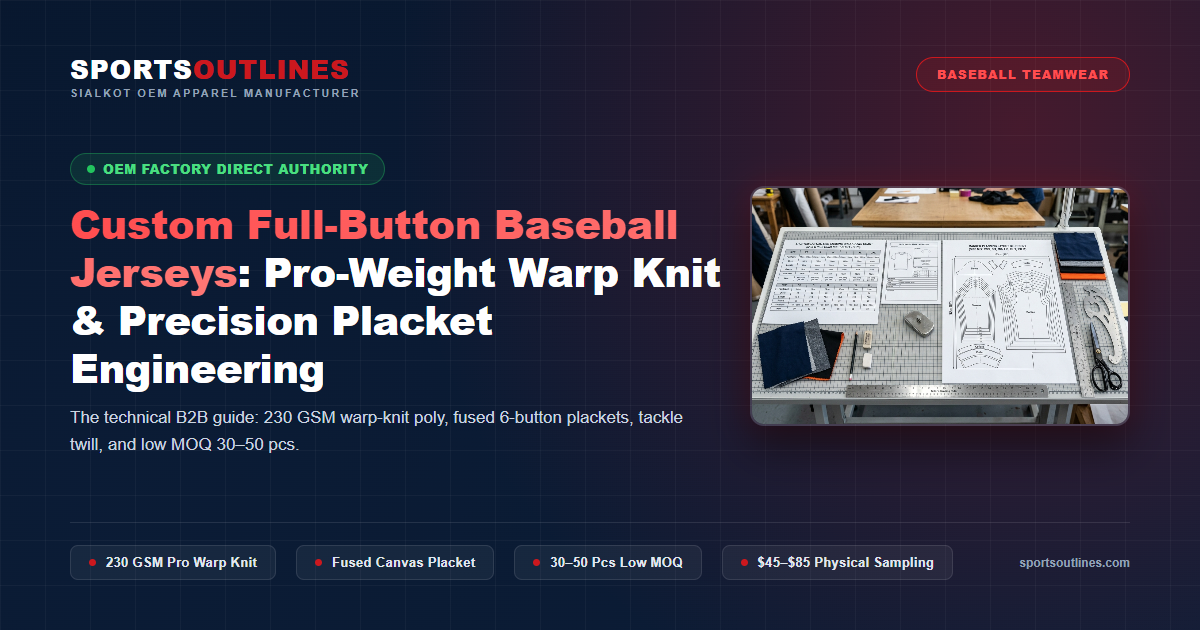
1. Textile Engineering: 230 GSM Pro-Weight Warp Knit vs Lightweight Circular Knits
Unlike basketball or soccer jerseys where featherweight fluidity is prioritized, baseball demands substantial fabric weight and high tear resistance. Baseball athletes execute head-first slides into clay infields, dive across abrasive dirt basepaths, and engage in repeated batting swings where chest fabric is subjected to rotational torque:
- 230–250 GSM Warp-Knit Pro-Weight Tricot: Built from heavy multi-filament synthetic yarns arranged in vertical interlocking columns. This locked mechanical structure provides exceptional structural stiffness, giving the jersey a crisp, tailored military-grade drape while withstanding sharp infield gravel abrasion without pulling runs.
- Why 150 GSM T-Shirt Fabrics Fail on the Diamond: Inexpensive promotional suppliers frequently cut baseball jerseys from lightweight 140–160 GSM circular single knits. Under the weight of heavy multi-layer tackle twill numbers and letters, these lightweight fabrics sag clumsily, pull open at buttonholes, and shred within weeks of infield sliding.
- Pin-Dot & Air-Flow Mesh Hybrids: For high-humidity summer leagues in Florida, Texas, and Southern California, Sports Outlines crafts jerseys utilizing 210 GSM micro-pin-dot mesh. The subtle micro-perforations boost evaporative air circulation while retaining sufficient fabric density to anchor multi-layer embroidery without puckering.
2. Precision Placket Architecture: Fused Canvas Interlining & Anti-Wave Structure
The button placket is the defining architectural feature of a baseball jersey. An unlined placket will curl inward at the collar tips, ripple between buttons after washing, and gap open across the chest when an athlete bends forward into fielding stance:
- 35mm Fused Interlining Canvas: We insert an 80 GSM non-woven polymide fusible canvas inside both the left (buttonhole) and right (button) placket folds. Fused at 145°C under 3.0 bar pneumatic pressure, the canvas creates a semi-rigid backbone that keeps the placket razor-straight through dozens of hot laundry cycles.
- Precision Button Spacing Geometry: Standard jerseys feature 6 buttons. The top two buttons are placed closer together (5.5 cm spacing) to maintain modesty and collar security. Buttons 3 through 6 are spaced at an exact 8.0 cm pitch, providing a broad, unobstructed 16 cm central chest canvas where arched team wordmarks (e.g., ‘YANKEES’ or ‘WILDCATS’) can be sewn without overlapping buttons.
- Gapping Elimination Overlap: The right placket underlap extends 38mm beneath the top placket, ensuring total modesty and zero undergarment flash even during explosive batting swings and full torso rotation.
3. Hardware Engineering: Shatterproof Melamine Buttons & Cross-Stitch Anchoring
A baseball traveling at 90+ MPH or an aggressive tag at home plate exerts immense shock force on jersey hardware. Brittle polyester buttons shatter instantly on impact:
- Shatterproof Melamine Resin: Our 18mm (28-ligne) buttons are molded from high-density thermoset melamine resin. Melamine withstands extreme impact shock without cracking, splintering, or chipping.
- Automated 4-Hole Cross-Stitching: Attached on programmable Brother button-sewing automatons using high-tensile core-spun polyester thread. The machine executes a 24-stitch cross pattern (X-stitch) followed by an automated thread wrap around the button shank and lock-stitch knotting. Each button withstands over 180 Newtons of direct tensile pull force.
- Buttonhole Keyhole Cut & Gimp Cord Reinforcement: Buttonholes are cut with an ergonomic keyhole head on Reece automated buttonholers. A high-strength gimp cord is inlaid beneath the purl stitch, preventing the buttonhole from stretching open over time.
4. Sleeve Engineering: Raglan vs Set-In Mobility for Pitchers & Hitters
Throwing a baseball requires maximal glenohumeral internal and external rotation. A poorly patterned sleeve binds the shoulder joint and restricts throwing velocity:
- Classic Set-In Sleeve with Underarm Mobility Gusset: Features a traditional structured shoulder seam preferred for crisp varsity aesthetics. To eliminate binding during pitching extension, Sports Outlines inserts an underarm diamond mobility gusset that permits 180-degree overhead arm extension without pulling the jersey hem out of the player’s pants.
- Ergonomic Raglan Sleeve Architecture: The sleeve panel extends diagonally all the way from the underarm to the collar neckline, eliminating the top shoulder seam entirely. This provides completely uninhibited rotational mobility favored by elite collegiate pitchers and outfielders.
- Sleeve Braid & Soutache Piping: We offer custom 5mm, 10mm, and 15mm woven soutache braid sewn along the neck placket and sleeve cuffs in single, double, or triple-stripe colorways matching school varsity traditions.
5. Embellishment Mastery: Tackle Twill vs Sublimation vs Hybrid Construction
Sports Outlines offers three primary embellishment pathways for custom baseball jerseys:
6. Complete Factory Manufacturing Workflow in Sialkot
At our specialized baseball production facility in Sialkot, each full-button jersey moves through an exacting 7-stage manufacturing process:
- CAD Digital Pattern Plotting & Wordmark Arching (Day 1): Vector patterns are digitally graded across Youth YS to Adult 4XL. Wordmarks are scaled proportionately so that letter kerning remains balanced across placket button placements.
- Textile Cutting & Placket Interlining Fusion (Days 2–3): 230 GSM warp-knit fabric panels are cut via CNC laser tables. 80 GSM non-woven interlining is heat-fused onto placket bands using industrial flatbed heat presses.
- Laser-Cut Tackle Twill Generation (Days 4–5): Polyester twill fabrics are kiss-cut on optical laser cutters with heat-sealed edges to prevent fraying during embroidery.
- Multi-Head Tajima Zigzag Embroidery (Days 6–7): Computerized multi-head embroidery machines stitch twill letters onto chest panels using 120-denier polyester thread at 850 stitches per minute.
- Buttonhole Cutting & Button Attachment (Day 8): Automated keyhole buttonholers stitch plackets, followed by automated melamine cross-stitching on Brother machinery.
- Full Garment Assembly & Braid Application (Days 9–10): Technicians sew side seams, attach set-in/raglan sleeves, apply neck soutache braids, and finish curved bottom drop hems.
- 100% Quality Inspection, Steam Pressing & Dispatch (Day 11): Inspectors audit button alignment, placket flatness, and embroidery tension before folding, polybagging, and dispatching via air courier.
7. B2B Sourcing Economics: Unit Costs, Low MOQ Tiers & Profit Margins
Sports Outlines provides direct factory pricing for custom full-button baseball jerseys, empowering team dealers, apparel decorators, and independent sportswear brands to achieve substantial 72% to 78% gross margins:
Sample Policy Transparency: To evaluate placket flatness, tackle twill embroidery density, fabric drape, and button durability on an actual athlete prior to bulk production, Sports Outlines produces physical pre-production prototype samples for $45 to $85 per piece, delivered via express international air courier in 7 to 10 business days. This fee covers individual laser pattern cutting, custom tackle twill embroidery programming, machine operator labor, and courier freight. We do not provide free CAD mockups or offer sample fee credits against bulk orders, ensuring transparent, sustainable, and reliable factory pricing.
8. Technical Sizing Specification: Youth to Adult Baseball Sizing Matrix
Baseball jerseys are worn tucked into baseball pants over compression base layers or chest protectors. Sizing incorporates generous chest ease (+8.0 cm ease) and curved drop-tail hems that stay tucked. Measurements in centimeters (tolerance ±1.0 cm):
9. Physical Testing & Quality Compliance Protocols
To guarantee that jerseys endure full seasons of high-impact play, our Sialkot quality laboratory subjects every production batch to rigorous testing:
- Button Pull-Off Strength (ASTM D7142): A pneumatic tensile clamp pulls buttons vertically until failure. Each melamine button must resist over 180 Newtons of force without pulling through the fused placket fabric.
- Tackle Twill Stitch Adhesion: Zigzag embroidered edges undergo 20 consecutive commercial wash-and-dry cycles at 60°C. Zero thread unraveling or edge lifting is permitted.
- Martindale Abrasion Test (ASTM D4966): Fabric swatches undergo 3,500 abrasive rubs against coarse wool abradant to simulate clay sliding wear. The warp-knit structure must show zero yarn breakage.
- Placket Flatness After Washing: Jerseys are inspected after tumble drying to verify that the fused non-woven interlining maintains placket curvature within ±3mm of a flat plane.
10. Curved Drop-Tail Hem vs Flat Hem: The Physics of Basepath Tucking
In official amateur, collegiate, and professional baseball rules, jerseys must remain securely tucked into the player’s pants at all times. When a hitter unleashes a violent rotational swing or a base-runner slides head-first into second base, standard flat-hem jerseys pull completely untucked:
- The 6.0 cm Extended Scoop Drop-Tail: Sports Outlines patterns incorporate an asymmetrical rear hem curve that drops 6.0 cm lower than the front hem. This contoured tail ensures that when a player bends over at the waist in a defensive crouch or reaches overhead to snare a line drive, the back hem remains locked securely beneath the pants waistband.
- Side Vent Slits with Bartack Reinforcement: The bottom 4.5 cm of the side seams feature reinforced overlap split vents. These slits permit the jersey hem to spread naturally around the hip and thigh contours without pulling upward on the placket or popping open the bottom buttons.
- Overlocked Clean Curve Hemming: The curved hem is bound with a 15mm double-folded edge and sewn with high-elasticity woolly nylon chainstitching that stretches smoothly over the player’s hips without thread snapping.
11. Pinstripe Pattern Alignment: Direct-Knit vs Rotary Sublimation
Few design elements in team sports carry more iconic prestige than classic baseball pinstripes. However, sewing pinstripe jerseys requires extreme precision during cutting and assembly:
- Direct Yarn-Dyed Warp Pinstripes: In traditional MLB-grade flannels and heavy tricots, the pinstripes are knitted directly into the fabric using pre-dyed black or navy yarns spaced exactly 25mm (1 inch) apart. Direct-knit pinstripes provide authentic depth and texture, but require painstaking laser-alignment during panel cutting so that vertical stripes match seamlessly across the button placket seam.
- Rotary Disperse Dye Sublimation Pinstripes: For lightweight modern travel ball uniforms, pinstripes are digitally generated in CAD and printed via all-over dye sublimation. This allows teams to incorporate custom pinstripe gradients, subtle camo fills, or custom drop shadows that would be impossible with traditional knitting.
- Placket Center-Stripe Matching Tolerance: Our automated sewing jigs align the center-chest vertical pinstripes across both placket layers with a tolerance of under ±1.5mm. When fully buttoned, the visual stripe continuity across the chest is virtually unbroken.
12. Infield Clay & Grass Stain Maintenance: Post-Game Laundry Protocols
Red infield clay, calcined conditioner dust, and grass chlorophyll present stubborn cleaning challenges for equipment managers. Improper washing methods will fray tackle twill zigzag stitches and warp the fused canvas interlining:
- Cold Water Enzymatic Pre-Soak: Before placing jerseys in commercial washers, stained garments should soak in cold water with enzymatic detergent for 45 minutes. Hot water must never be used on red clay stains, as heat permanently binds iron oxide clay minerals to synthetic polyester filaments.
- Button-Up Before Washing: Always button all 6 buttons completely and turn the jersey inside-out before laundering. This prevents buttons from snagging against the washing machine drum or catching on delicate embroidery threads of other garments.
- Low-Heat Tumble Dry or Hang Dry: Tumble dry on delicate low-heat settings (below 55°C) or hang to air-dry. Excessive commercial dryer temperatures can cause the non-woven fusible interlining to soften and blister, ruining the clean placket silhouette.
Explore Related Sialkot Factory Manufacturing Silos:
- Baseball & Softball Jerseys Overview Guide — Traditional tackle twill vs lightweight sublimation.
- Tackle Twill vs Chenille Embroidery Guide — Letterman patches and zig-zag stitching science.
- Sportswear Fabric GSM Selection Guide — Why baseball requires 230 GSM warp-knits.
- Sportswear Manufacturer for USA Teams & Brands — Direct air shipping to North America.
- Contact Sports Outlines Factory — Request a wholesale quote or order a physical sample.
Ready to Manufacture Custom Full-Button Baseball Jerseys for Your Brand?
Partner with Sialkot’s dedicated teamwear manufacturer. Enjoy low MOQ of 30–50 jerseys, fused non-woven plackets, shatterproof melamine buttons, and swift 7–10 day physical sampling.
Frequently Asked Questions: Sourcing Custom Full-Button Baseball Jerseys
How do you prevent the button placket from curling or rippling after washing?
We insert an 80 GSM non-woven polymide fusible canvas inside both placket folds, heat-fused at 145°C under pneumatic pressure. This semi-rigid core keeps the placket straight through dozens of commercial wash cycles.
What is the factory minimum order quantity (MOQ) for full-button baseball jerseys?
Our factory direct low MOQ is 30 to 50 jerseys per style/colorway across Youth YS to Adult 4XL with mixed player sizes.
How much does a physical sample prototype cost and what is the turnaround time?
A physical prototype sample costs between $45 and $85, completed in 7 to 10 business days for complete physical evaluation of fabric weight, placket flatness, button security, and tackle twill embroidery.
What kind of buttons do you use, and will they break when struck by a baseball?
We use shatterproof 18mm melamine resin buttons cross-stitched with 24-stitch locking patterns, rated to withstand over 180 Newtons of direct tensile force without cracking.
How do you handle arched chest wordmarks across the button placket?
We space buttons 3 through 6 at an exact 8.0 cm pitch, creating an unobstructed 16 cm central chest canvas. If a letter overlaps the placket seam, it is laser-split and finished with satin borders on both halves for seamless closure.
What fabric weight is standard for pro-grade full-button baseball jerseys?
We recommend 230–250 GSM warp-knit polyester tricot. It provides the necessary structural body to support heavy tackle twill without sagging, and resists clay slide abrasion.
Can we add soutache braid piping along the neck placket and sleeve cuffs?
Yes. We offer single, double, or triple-stripe woven soutache braid (5mm, 10mm, or 15mm widths) custom dyed to match your team’s exact Pantone colors.
Do you manufacture matching custom baseball pants with double knees?
Yes, 100%. We manufacture pro-weight 280 GSM baseball pants and knickers with reinforced double knees, silicone gripper waistbands, tunnel belt loops, and rear welt pockets.