Direct Manufacturer Answer: How to Source Custom Baseball Dugout Jackets & Cage Pullovers
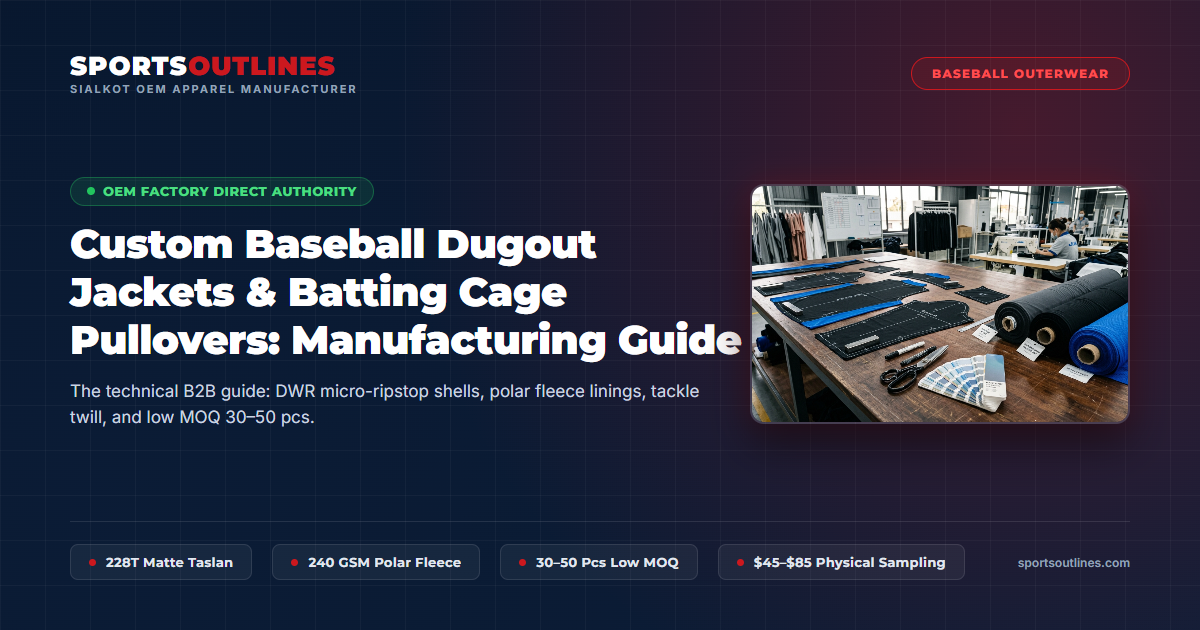
Manufacturing institutional custom baseball dugout jackets, batting cage pullovers, and team windshirts requires high-tenacity 100% micro-ripstop polyester or matte Taslan nylon (210T to 240T) treated with a Durable Water Repellent (DWR) C6 fluorochemical coating and polyurethane back-coating for windproofing up to 45 mph. For freezing early-spring dugouts, garments are engineered with 220–260 GSM anti-pill polar fleece or 120–160 GSM diamond-quilted polyfill insulation. For active batting cages and warmups, garments feature unlined or lightweight moisture-wicking poly-mesh drop linings paired with underarm stretch-mesh gussets and bi-swing back expansion pleats. Custom branded with laser-cut multi-layer tackle twill, 3D puff embroidery, or waterproof TPU chest crests, factory direct low MOQ in Sialkot, Pakistan starts at 30 to 50 pieces per style/colorway with complete custom size runs (Youth YS to Adult 4XL). Pre-production physical prototype samples cost $45 to $85 per piece delivered in 7 to 10 business days.
- Shell Fabrics: 228T/240T Micro-Taslan Nylon or 75D/150D Polyester Micro-Ripstop with DWR.
- Insulation Options: 240 GSM Anti-Pill Polar Fleece, 140 GSM Diamond-Quilted Polyfill, or 120 GSM Mesh.
- Functional Silhouettes: Classic V-Neck Short/Long Sleeve Pullover, Quarter-Zip Cage Shirt, Full-Snap Dugout Parka.
- Embellishment Standards: Multi-layer tackle twill chest lettering, direct embroidery, and heat-sealed badges.
- Factory Low MOQ: 30–50 pieces per silhouette across comprehensive youth and adult size curves.
- Physical Prototype Sampling: $45–$85 per custom jacket/pullover in 7–10 days (strict zero credit/refund policy).
- Direct Factory Sourcing: WhatsApp factory direct at +92 316 7932595 or sportsoutlines.com.
Baseball is an unpredictable game played across extreme thermal conditions. In the northern United States, Canada, and Northern Europe, high school varsity and collegiate programs open their spring seasons in late February, enduring freezing 38°F (3°C) winds, freezing rain, and bitter bench downtime. By June, those same teams are taking pre-game batting practice under blistering 95°F (35°C) summer heat.
This drastic climatic variance demands two completely distinct categories of technical baseball outerwear: heavy-insulated dugout jackets engineered to preserve pitcher arm warmth and protect stationary players from biting wind chill, and featherweight batting cage pullovers engineered with bi-swing mechanical shoulder gussets that give batters uninhibited rotational whip through the hitting zone. Sourcing generic lifestyle windbreakers for competitive baseball invariably results in torn armpit seams, restricted swings, and frozen players.
At Sports Outlines in Sialkot, Pakistan, our technical outerwear manufacturing facility designs and manufactures custom dugout parkas, quarter-zip batting jackets, short-sleeve cage shirts, and pitching windshirts for athletic brands, high schools, colleges, and professional clubs worldwide. This comprehensive technical B2B manufacturing guide breaks down shell textile engineering, thermal insulation matrices, ergonomic cut-and-sew patterns, tackle twill embellishment, weatherproofing hardware, wholesale cost structures, and factory-direct low MOQ sourcing parameters.
1. Outerwear Taxonomy: Cold-Weather Dugout Insulation vs Batting Cage Kinetic Mobility
To engineer baseball outerwear that performs flawlessly on the diamond, apparel developers must divide their collection into three specialized functional classifications:
Classification A: Heavyweight Dugout Parkas & Full-Snap Jackets
Stationary bench players, relief pitchers waiting in the bullpen, and coaching staffs lose body heat rapidly during long defensive half-innings. When a relief pitcher’s core and rotator cuff temperature drops by just 2°C, pitch velocity decreases and the risk of shoulder labrum or UCL injury spikes exponentially. Dugout parkas feature:
- Full Thermal Containment: Heavy 240 GSM polar fleece or quilted 140 GSM polyfill insulation spanning the chest, back, and sleeves.
- Extended Drop-Tail Hem: Lengthened rear body panels (4–6 cm longer than standard jackets) that keep players insulated while seated on freezing concrete or metal dugout benches.
- Heavy-Gauge Closures: Heavy-duty full-front snaps with reinforced storm flaps or oversized two-way nylon coil zippers that players can operate while wearing bulky batting gloves.
- Fleece-Lined Slash Pockets: Deep hand-warmer pockets positioned at a 45-degree angle to keep pitchers’ throwing hands warm between innings.
Classification B: Quarter-Zip Batting Cage Pullovers
Worn during pre-game infield/outfield practice, throwing warmups, and batting cage rotations, the quarter-zip pullover prioritizes kinetic freedom over heavy thermal insulation. It blocks wind and light drizzle while allowing internal metabolic heat to dissipate during high-exertion drills.
Classification C: Short-Sleeve Batting Cage Windshirts
A beloved staple of Major League hitters and college power programs, the short-sleeve cage shirt features a lightweight wind-resistant shell cut with elbow-length sleeves and a ribbed V-neck. It shields the athlete’s core from cool morning breezes while keeping their forearms, wrists, and throwing elbows completely unrestricted during batting cage sessions.
2. Shell Textile Engineering: Micro-Ripstop Polyester vs Matte Taslan Nylon
The exterior shell fabric must deliver two conflicting characteristics: it must be soft and quiet enough to move naturally without noisy swishing during swings, yet rugged enough to withstand abrasions against dugout fences, gear bags, and sliding dirt:
For modern collegiate and travel ball brands, 228T Matte Taslan Nylon is the premier shell textile. Unlike cheap shiny nylon taffetas that feel like crinkly garbage bags, air-texturized Taslan yarns mimic the soft, premium hand-feel of brushed cotton while providing exceptional tear strength (tensile load exceeding 450N) and total wind impermeability.
3. Thermal Lining Architectures: Polar Fleece vs Quilted Polyfill vs Mesh Drop Linings
The interior lining governs the jacket’s thermal insulation, skin comfort, and moisture evaporation:
- Anti-Pill Polar Fleece (240–260 GSM): Hydrophobic micro-fleece sheared on both faces with an anti-pilling chemical finish. It traps a thick boundary layer of static warm air against the athlete’s body, maintaining core temperature down to 32°F (0°C). Because fleece is naturally hydrophobic, it does not absorb sweat, allowing perspiration vapor to migrate toward the outer shell.
- Diamond-Quilted Polyfill (120–160 GSM): Virgin hollow-fiber polyester batting quilted in a 2-inch diamond matrix between a smooth 190T polyester taffeta lining and the outer shell. Taffeta sleeve linings are essential in dugout jackets because they allow players wearing long-sleeve fleece sweatshirts or rubberized elbow sleeves to slide their arms smoothly into the jacket without catching or dragging on the lining.
- Moisture-Wicking Birds-Eye Mesh (120 GSM): Used in batting cage pullovers and windshirts. The open knit eyelet mesh creates a micro-air gap between the sweaty jersey and the windproof shell, preventing the cold clammy cling that occurs when single-layer windbreakers get wet from sweat.
4. Kinetic Pattern Engineering: Bi-Swing Pleats, Raglan Sleeves & Underarm Gussets
A standard casual jacket cannot accommodate the violent upper-body kinetics of a baseball swing or an overhead 90 mph throw. When an athlete cocks their bat or brings their throwing arm into maximum external rotation, standard set-in sleeve armholes bind across the latissimus dorsi and pull the jacket’s waist hem 6 inches upward, exposing the lower back.
At Sports Outlines, our baseball pattern masters integrate three kinetic solutions into every batting jacket pattern:
- Bi-Swing Back Shoulder Pleats: Hidden expansion pleats running vertically along the posterior deltoid seam. Inside the pleat, a high-tension spandex mesh panel expands up to 3 inches when the player coils their shoulders to swing, providing completely uninhibited reach across the plate without pulling the torso.
- Underarm Diamond Gusset: Rather than joining four seams at a single point in the armpit, we insert a diamond-shaped breathable poly-spandex mesh gusset. This eliminates underarm bulk, provides dynamic 360-degree overhead freedom for throwing mechanics, and vents excessive heat from the axillary lymph zone.
- Full Raglan Sleeve Drafting: Sleeves extend in one continuous piece from the collar down to the wrist, eliminating top shoulder seams. This ensures zero seam friction when players wear heavy gear bags or batting backpacks over their shoulders.
5. Embellishment Engineering: Multi-Layer Tackle Twill, 3D Puff Embroidery & TPU Crests
Outerwear represents the ultimate brand statement for any sports organization. The embellishments on a dugout jacket must convey substantial weight, luxury craftsmanship, and weather resistance:
Multi-Layer Laser-Cut Tackle Twill Lettering
The undisputed gold standard for collegiate and varsity dugout jackets is 2-layer or 3-layer tackle twill. We cut heavy 100% woven polyester twill patches using industrial CNC laser cutting tables. The laser melts the edges of the twill, permanently sealing them against fraying. Each layer is individually positioned on the shell and secured with high-density zig-zag embroidery stitching using UV-resistant Madeira polyester embroidery thread.
3D Direct Puff Embroidery
For left-chest secondary logos, sleeve numbers, and back neck team icons, we utilize high-density 3D puff embroidery. An EVA foam underlay (2.5mm–3.0mm thickness) is placed over the Taslan shell, and our computerized Tajima multi-head embroidery machines stitch over the foam at 800 stitches per minute, creating a bold, raised architectural relief that stands out dramatically from the matte shell.
Sublimated Sleeve Stripe Insets & TPU Badges
For modern travel ball programs wanting complex digital camouflage or custom mascot graphics on the sleeves, we cut and sew dedicated sublimated polyester interlock stripe panels into the sleeves, giving the jacket striking color accents while preserving the rugged Taslan nylon body.
6. Weatherproofing Hardware & Trim Specifications
A jacket is only as dependable as its hardware. In freezing, muddy conditions, inferior zippers jam and cheap plastic snaps pop loose under stress. Sports Outlines incorporates heavy-duty commercial hardware on all baseball outerwear:
7. Product Specifications Comparison Table
Compare technical factory engineering metrics across our three primary baseball outerwear silhouettes:
8. Institutional Sizing Matrix & Layering Ease Allowances
A fatal flaw in commercial outerwear is grading jackets identically to athletic t-shirts. A player wearing a dugout jacket is typically already wearing a compression base layer, a heavyweight 240 GSM game jersey, and potentially an undershirt or protective chest guard. Our pattern division adds dedicated +4 to +6 inch chest circumference layering ease allowances to guarantee athletes have unrestricted room without ordering two sizes too large:
9. Industrial Manufacturing SOP & Quality Control Protocols
At Sports Outlines in Sialkot, every custom dugout jacket and batting cage pullover undergoes a meticulous 8-stage manufacturing workflow governed by strict ISO 9001 and AQL 2.5 standards:
- Raw Textile Inspection & DWR Spray Verification: Inbound rolls of Taslan nylon and micro-ripstop undergo ASTM 4-Point inspection. We conduct ISO 4920 spray rating tests to verify water beading performance (minimum Grade 4 rating) before cutting.
- Automated Laser Panel Cutting: Multi-ply automated CNC laser tables cut the shell, fleece lining, and diamond gusset components with absolute sub-millimeter precision, guaranteeing that bi-swing pleats align perfectly across all production sizes.
- Tackle Twill & Embroidery Pre-Assembly: Embellishments are applied to individual front panels prior to jacket assembly. This ensures all back-thread stitches are concealed cleanly between the shell and the fleece lining, leaving zero exposed threads to scratch the athlete.
- Seam Sealing & Precision Assembly: Critical shoulder seams and hood seams (if specified) are taped with thermoplastic polyurethane (TPU) heat-seal tape applied at 180°C under high pneumatic roller pressure to block water infiltration through needle perforations.
- Pocket Welt & Hardware Insertion: Heavy-duty reversed nylon coil zippers, custom metal snaps, and internal bungee cord locks are installed with double-needle lockstitching and bar-tack anchors at high-stress pull points.
- Lining Drop & Bagging: Fleece or quilted polyfill linings are joined to the shell using clean-finished bagged-edge construction. The hem is closed and inspected to ensure the lining hangs flat without bunching or twisting.
- AQL 2.5 Quality Inspection: Garments are inspected on lighted inspection mannequins. Quality managers audit seam tensile strength, zipper glide smoothness (minimum 5,000 cycle rating), snap retention force, and dimensional tolerance (±1.0 cm POM allowance).
- Steam Pressing & Polybag Packaging: Garments undergo high-pressure vertical steam forming, receive custom branded woven neck tags and hangtags, and are packaged in heavy-gauge 100% recyclable frosted zipper bags.
10. Factory Sourcing Economics: Unit Costs, Physical Sampling & Low MOQ Rules
Outerwear represents the highest-ticket merchandise item in any athletic organization’s team store. Sourcing directly from our Sialkot factory floor unlocks institutional pricing that delivers 60% to 75% gross retail margins:
Rigid Physical Sampling & Low MOQ Invariants
To maintain institutional efficiency and transparency, Sports Outlines enforces straightforward, non-negotiable sampling and production parameters:
- Physical Prototype Samples ($45 to $85 per garment): Every custom jacket prototype requires dedicated pattern digitization, custom laser cutting, embroidery digitizing, and manual artisan assembly. We ship fully functional physical prototype samples within 7 to 10 business days via DHL/FedEx Express. Sample fees cover custom engineering labor and express air courier transit and are non-refundable with zero sample credits.
- Factory Direct Low MOQ (30 to 50 pieces): Unlike legacy factories requiring 300 to 500 units per style, our agile production cells accommodate orders as small as 30 to 50 pieces per style/colorway, allowing brands to launch outerwear collections without risking thousands of dollars in unsold inventory.
- Mixed Sizing Distribution: You can distribute your 30 to 50-piece production order across any required breakdown of Youth YS through Adult 4XL sizes.
11. Frequently Asked Questions (FAQ) & Technical Troubleshooting
Q1: Why do conventional windbreakers tear in the armpits when players take batting practice?
Conventional streetwear windbreakers are patterned with rigid circular set-in armholes designed for walking, not violent rotational swinging. When a batter coils and unleashes rotational force, stress concentrates entirely along the underarm cross-seam. At Sports Outlines, our batting pullovers feature diamond-shaped stretch mesh gussets and bi-swing back expansion pleats that redistribute rotational stress across 4-way stretch panels, eliminating armpit blowouts.
Q2: How do your dugout jackets keep pitchers’ arms warm without causing overheating?
We engineer our dugout jackets with zoned thermal insulation: the core torso and throwing shoulder/arm feature thick 240 GSM polar fleece or quilted batting to maintain muscle warmth, while the underarms and lower flank panels incorporate breathable micro-ventilation channels. This locks in critical rotator cuff heat while allowing metabolic humidity to vent naturally.
Q3: Can heavy tackle twill lettering cause the front of a lightweight batting jacket to sag?
Yes, if applied incorrectly to lightweight 85 GSM micro-ripstop. To prevent front sagging on cage pullovers, we apply a lightweight fusible interlining behind the shell fabric to distribute twill weight evenly. Alternatively, for ultra-lightweight batting tops, we recommend direct high-density screen printing, 3D silicone heat seals, or dye-sublimated lettering instead of heavyweight tackle twill.
Q4: What is the minimum order quantity for custom embroidered dugout jackets?
Our low MOQ is firmly set at 30 to 50 pieces per style/colorway. You can distribute this quantity across any required sizing breakdown from Youth Medium to Adult 4XL, with full custom tackle twill chest lettering and embroidered logos included.
12. The Semantic Silo Mesh & Direct Factory Production Funnel
Custom baseball dugout jackets and cage pullovers complete the comprehensive diamond uniform collection. To integrate your outerwear with matching jerseys, pants, and hosiery, review our companion manufacturing guides:
- Design matching on-field uniforms with our Custom Full-Button Baseball Jerseys & Tackle Twill Embroidery Guide.
- Source tournament game tops with our Two-Button Henley Baseball & Softball Jerseys Guide.
- Match your outerwear with reinforced 320 GSM pants via our Custom Baseball Pants & Knickers Manufacturing Guide.
- Coordinate team color schemes with our Custom Baseball Stirrups & 2-in-1 Socks Guide.
- Access institutional team uniform distribution across North America via our Sportswear Manufacturer USA Sourcing Portal.
- Browse full commercial team uniform lines in our Custom Sportswear Wholesale Catalog.
Manufacture Custom Baseball Dugout Jackets with Sports Outlines
From 240 GSM fleece-lined cold-weather dugout parkas with tackle twill to featherweight quarter-zip batting cage pullovers with bi-swing back pleats, we deliver institutional manufacturing quality, low 30–50 piece MOQs, and 7–10 day prototype physical sampling.