Direct Manufacturer Answer: How to Manufacture Custom Boxing Trunks & Ring Robes
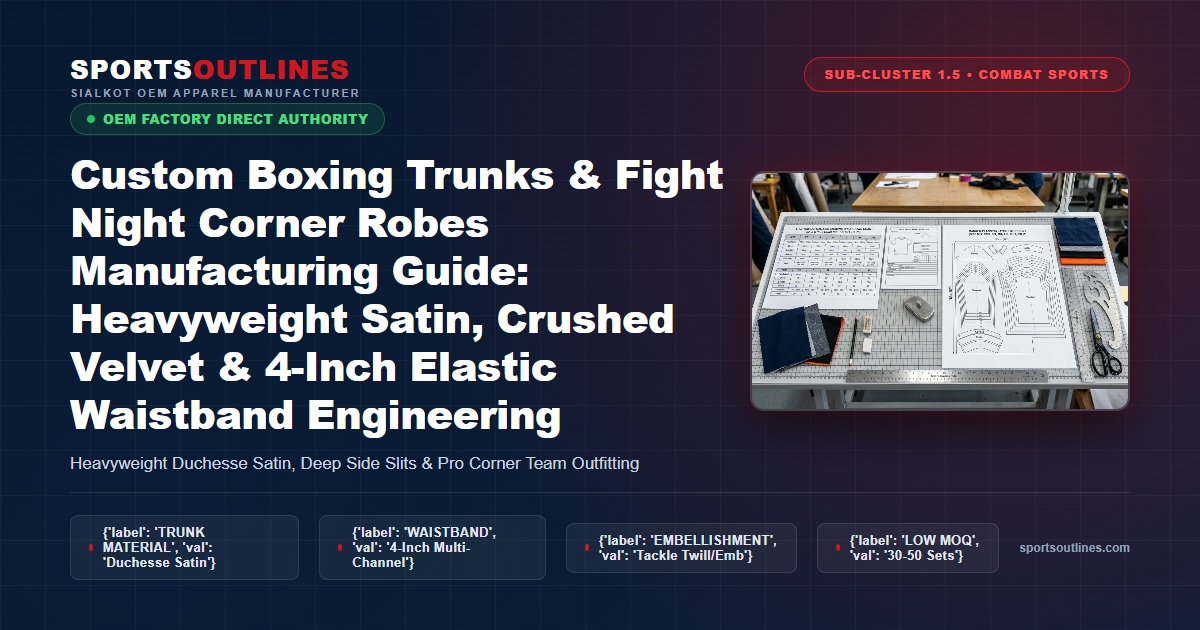
Manufacturing professional-grade custom boxing trunks and fight night corner robes requires combining luxury ceremonial aesthetics with heavy-duty athletic functionality built for high-stakes championship bouts. Professional competition trunks are cut from 220 to 260 GSM heavyweight Duchesse polyester satin (featuring a rich high-gloss luster, zero static cling, and fluid draping) or 320–380 GSM crushed micro-velvet. The defining structural element is the 4-inch (10 cm) multi-channel elasticized waistband, constructed with four or five independent high-tension rubber channels and reinforced canvas interlinings. This wide waistband serves two critical biomechanical and regulatory functions: it anchors the boxer’s bulky abdominal foul protector (cup) firmly to the hips without slipping, and establishes a razor-sharp, high-contrast visual “belt line” mandated by championship sanctioning bodies (WBC, WBA, IBF, WBO) to assist referees in adjudicating legal body blows versus low blows. Walk-in corner robes are tailored with oversized structured hoods (accommodating taped cornrows and headphones), wide kimono sleeves, and optional 280 GSM French Terry interior towel linings that keep the athlete’s core musculature warm prior to the opening bell. Factory direct low MOQ at our Sialkot facility starts at 30 to 50 sets per style or fighter collection. Pre-production physical prototype samples cost $45 to $85 per piece/set completed in 7 to 10 business days.
- Trunk Textiles: 240 GSM Heavy Duchesse Satin, 350 GSM Micro-Velour Velvet, or Matte Stretch Satin.
- Waistband Engineering: 4-Inch (10 cm) 5-channel high-tension elastic waistband with contrast center patch.
- Side Leg Slits: Deep 4.5-inch side vents with double-folded satin piping and bar-tack anchors for footwork agility.
- Robe Architecture: Full-length (ankle drop) or 3/4 length cuts with oversized deep hood and matching 2-inch tie belt.
- Embellishment Methods: Multi-layer tackle twill with satin zigzag embroidery, metallic Lurex gold/silver threading.
- Sanctioning Compliance: 100% compliant with WBC, WBA, IBF, WBO, and USA Boxing uniform belt line rules.
- Factory Low MOQ: 30–50 sets per style/fighter package across mixed waist and length curves.
- Physical Prototype Sampling: $45–$85 per custom piece in 7–10 days (strict zero credit/refund policy).
- Direct Sialkot Sourcing: WhatsApp factory floor direct at +92 316 7932595 or sportsoutlines.com.
In professional boxing, the ring walk and fight attire are the ultimate stage of athlete branding. From Las Vegas pay-per-view main events and Saudi Arabian mega-cards to grassroots amateur Golden Gloves tournaments, a fighter’s trunks and corner robe project warrior identity, power, and team prestige.
For boxing gym owners, combat promotions, and combat lifestyle apparel brands in the USA, UK, Canada, and Germany, sourcing custom boxing apparel has historically been fraught with manufacturing headaches: flimsy 120 GSM costume-grade satins that snag on Velcro corner stools, waistbands that roll over and collapse during grueling 12-round fights, heavy robes that overheat fighters before the first round, and peeling vinyl sponsor decals that look amateur under high-definition TV lighting.
At Sports Outlines in Sialkot, Pakistan, our specialized boxing tailoring ateliers combine decades of traditional tailoring craftsmanship with modern athletic textile science. We craft professional fight wear for world titleholders, Olympic contenders, and private label combat brands. This comprehensive technical B2B guide covers textile weights, waistband engineering, tackle twill embellishment, corner robe architecture, regulatory compliance, size grading, wholesale unit economics, and factory direct low MOQ sourcing.
1. Textile Engineering: Luxury Draping vs. Combat Durability
Unlike standard gym shorts made of matte knits, boxing trunks require high-gloss, liquid-like draping that accentuates footwork and hip rotation under harsh ring lights. However, cheap costume satins (under 160 GSM) are disastrous—they tear easily, cling to sweaty legs through electrostatic attraction, and wrinkle into a cheap mess. We manufacture professional boxing trunks and robes using three heavy-density textile architectures:
Anti-Static & Moisture-Shedding Chemical Finishing
Synthetic polyester satins have an inherent tendency to build up static electricity under friction. In a heated boxing match, static cling causes the satin legs to wrap tightly around the boxer’s sweaty thighs, impeding lateral footwork and pivot angles. At Sports Outlines, all our boxing satins undergo a proprietary hydrophilic anti-static bath treatment during yarn finishing. This treatment neutralizes triboelectric charge generation and lowers surface friction, ensuring the wide leg openings remain billowy, free-flowing, and completely detached from the fighter’s legs throughout 36 minutes of intense action.
2. The Anatomy of the 4-Inch Multi-Channel Boxing Waistband
In no other sport is the waistband as critical as in professional boxing. The 4-inch (10 cm) waistband is not merely decorative—it is a functional athletic and regulatory mechanism:
The Biomechanical Physics of Foul Cup Anchoring
A professional leather abdominal foul protector (often weighing between 650 to 900 grams) is strapped directly over the athlete’s pelvic girdle. As the boxer dips, slips, and crouches during high-speed exchanges, standard single-elastic waistbands lack the surface frictional grip to support this mass, causing the trunks to slide downward and expose the top leather rim of the cup. Our 5-channel waistband generates over 85 Newtons of uniform circumferential clamping tension spread over a full 10-centimeter vertical surface area. This distributes the pressure without causing abdominal cramping or restricting deep diaphragmatic breathing.
The Referee “Belt Line” Regulation (WBC, WBA, IBF, WBO Compliance)
In professional boxing championship rules, a legal punch must land above the “belt line.” The belt line is defined by the top edge of the trunks’ waistband, drawn horizontally across the navel. If a boxer wears trunks where the waistband blends indistinguishably into the body color, the referee cannot accurately judge borderline punches. Our design team recommends engineering high-contrast waistbands (e.g., white waistband on black trunks, or gold waistband on red trunks) to assist the referee in identifying legal scoring blows and defending against erroneous low-blow point deductions.
3. Fight Night Corner Robes & Walk-In Hoodies
A professional walk-in robe must look imposing while preserving the fighter’s physiological warmup state in chilly arena tunnels. We engineer three distinct robe silhouettes:
A. Full-Length Championship Ring Robe (Ankle Drop)
Measuring 135 to 145 cm from collar to lower hem, this grand silhouette drops to the boxer’s ankle. Cut with a sweeping 2.4-meter hem circumference, wide kimono-style sleeves (allowing gloved hands to pass through effortlessly), and an oversized structured hood. We finish the opening borders and cuffs with 6 cm wide contrast satin or velvet trim.
B. 3/4 Length Sleeveless Corner Jacket / Vest
Popularized in modern high-pace bouts, the sleeveless corner vest drops to mid-thigh (85–95 cm). Eliminating sleeves reduces overall garment weight to under 450 grams and keeps the boxer’s deltoids and arms cool while keeping their core warm. Constructed with an open front tied with a heavy 2-inch matching sash belt or a heavy-duty front zipper.
C. Interior Towel Lining for Muscle Warmth Retention
In world title bouts, fighters can spend up to 45 minutes in air-conditioned dressing rooms after completing their mitt warmup before walking out to the arena. If the fighter cools down, their muscles tighten, increasing injury risk. We offer optional 280 GSM French Terry looped cotton towel linings inside the torso and hood. This absorbent lining captures pre-fight perspiration while insulating the back and chest, ensuring the boxer steps into the ring with loose, warmed-up musculature.
4. Embellishment Technologies: Tackle Twill, Metallic Lurex & Rhinestones
A championship fight trunk requires heavy, three-dimensional, light-catching embellishment. Our specialized embroidery workshops in Sialkot offer four premier branding techniques:
5. Corner Team Apparel: Trainer Tracksuits & Cutman Utility Vests
In high-profile televised fights on DAZN, ESPN, or Sky Sports, the athlete does not walk into the ring alone. A complete championship presentation requires unified outfitting for the head trainer, assistant corner coach, and cutman:
- Cutman Multi-Compartment Utility Vests: Crafted from heavy 280 GSM cotton canvas or ripstop. Features specialized gusseted pockets engineered for immediate access to petroleum jelly jars, Q-tips, brass enswells (iron cold presses), and coagulant gauze swabs.
- Corner Coach Warmup Tracksuits: Matching micro-poly or French terry track jackets with full front zip and ribbed baseball collars. Embroidered with team crest on chest and main sponsor logos across the back shoulders.
- Cornerman Technical Polos: 190 GSM moisture-wicking interlock polos matching the team’s visual palette, ensuring all corner personnel present a cohesive professional appearance under camera scrutiny.
6. Pro Boxing Sizing Grading: Waist & Inseam Clearance
Boxing trunks must fit comfortably over bulky leather groin protectors. Therefore, our patterns are cut with generous hip and crotch depth while maintaining exact waist tension. The table below represents our standard size grading matrix:
7. Technical Tech Pack Drafting & Seam Construction Standards
To guarantee zero failure inside the ring, our boxing production ateliers enforce strict manufacturing standards across every cut pattern panel:
- Double-Row Safety Overlock & Topstitch: The main front-to-back outseams and inseams are joined with a 4-thread differential safety overlock, pressed open, and finished with a 1/4″ parallel double-needle topstitch. This prevents seam gaping under rapid hip twists.
- Piped Side Slit Reinforcement: The 4.5-inch side vents are bound with double-folded 15 mm contrast satin piping. A heavy 42-stitch bar-tack anchors the apex of each slit, ensuring the seam cannot tear upward when the boxer drops into a deep stance.
- Anti-Fraying Hem Sealing: Because satin yarns have high surface luster and can unravel if raw edges are left exposed, all internal fabric allowances are 100% enclosed within clean-finished overlock borders.
Tackle Twill Laser Digitizing & Zigzag Border Calibration
When applying large-scale fighter lettering across the rear waistband and thigh panels, standard embroidery places excessive needle punctures directly into the satin shell, causing the delicate fabric to pucker and buckle under tension. To guarantee razor-flat results, we utilize a specialized two-stage tackle twill bonding and embroidery process:
- Precision Laser Silhouette Cutting: Lettering shapes are vector-cut from high-density twill fabric backing using computerized CO2 lasers. The thermal laser cut instantly cauterizes the raw edges, eliminating fraying.
- Polyamide Heat-Activated Film Bonding: The cut twill shapes are backed with 100% polyamide thermoplastic adhesive web and heat-pressed onto the satin panels at 150°C under 3 bar pressure. This bonds the lettering permanently to the fabric, eliminating bubbling during wear.
- High-Density Zigzag Perimeter Overlock: The bonded twill edges are anchored using 40-weight trilobal polyester embroidery thread with a 2.0 mm wide zigzag satin stitch calibrated to 0.4 mm pitch. This produces a bulletproof border that withstands repeated laundering without lifting.
- AQL 2.5 Quality Audit: Every completed fight night garment undergoes rigorous inspection for symmetry, thread tension, rhinestone adhesion, and waistband elasticity prior to export packaging.
ASTM D2261 Tongue Tear Mechanics & Groin Gusset Tensile Engineering
During a 12-round championship bout, a boxer’s trunks endure violent directional stresses—from deep ducking under hooks, pivoting off the back foot, to accidental entanglement with opponent gloves or ropes. Cheap dress satins tear instantly along the warp threads when subjected to localized shear stress. At Sports Outlines, our 240 GSM Duchesse satin undergoes rigorous ASTM D2261 (Standard Test Method for Tearing Strength of Fabrics by the Tongue Procedure) validation.
In our laboratory tests, our heavy satin withstands tear propagation forces exceeding 380 Newtons along both the warp and weft directions. To further bulletproof high-stress junctions, our master tailors insert a triangular double-folded satin gusset reinforcement at the apex of the side slits and double-topstitch the crotch inseam with high-tenacity bonded polyester thread (Tex 60 / Ticket 50). This mechanical reinforcement guarantees that even under the widest athletic stances and rapid footwork angles, the seams remain completely intact without puckering, popping, or thread rupture.
8. Wholesale Unit Economics, Sampling Protocols & Low Factory MOQ
At Sports Outlines, we eliminate the steep barriers to entry for professional fight teams, boxing gyms, and startup combat apparel labels. We provide true low MOQ production starting at only 30 to 50 sets per style or fighter collection.
Sampling Protocol: $45–$85 Physical Prototypes in 7–10 Days
We mandate physical sample approval prior to bulk production. Physical prototypes cost $45 to $85 per custom piece/set. This fee covers digital CAD pattern tailoring, tackle twill laser cutting, high-density embroidery digitizing, multi-channel waistband assembly, and hand-finishing over 7 to 10 business days. We maintain a strict zero-refund and zero-credit policy on sample fees. Once approved, the physical prototype serves as the golden standard for bulk manufacturing.
Manufacture Custom Boxing Trunks & Ring Robes with Low MOQ
Equip your fighters or launch your boxing lifestyle brand with championship fightwear engineered in Sialkot. From 240 GSM Duchesse satins to 4-inch multi-channel waistbands and metallic tackle twill embroidery, we deliver world-class ring appeal with 30–50 sets low MOQ and fast 7–10 days physical sampling.
9. Frequently Asked Questions (FAQ) — Boxing Trunks & Robes Manufacturing
1. Why is the waistband on boxing trunks so wide (4 inches)?
The 4-inch (10 cm) waistband serves two vital functions: it provides mechanical clamping power to anchor the boxer’s bulky abdominal foul protector (cup) firmly to the hips without slipping, and it creates a distinct, visible “belt line” mandated by championship sanctioning bodies (WBC, WBA, IBF, WBO) to help the referee adjudicate legal body shots versus low blows.
2. What fabric is best for professional boxing trunks: satin or velvet?
Heavyweight Duchesse polyester satin (220–260 GSM) is the standard for combat action because it is lightweight, sheds sweat easily, and glides smoothly over legs during footwork. Crushed velvet (320–380 GSM) is heavier and warmer, making it the premier choice for walk-in robes, oversized hoods, and waistband accent trims.
3. Can you do multi-layer tackle twill and metallic embroidery on boxing robes?
Yes. Our factory specializes in laser-cut multi-layer tackle twill with dense satin zigzag perimeter stitching, metallic Lurex gold and silver threading, 3D puff embroidery, and hotfix crystal rhinestones for marquee championship bouts.
4. What is your minimum order quantity (MOQ) for custom boxing apparel?
Our factory direct low MOQ is 30 to 50 pieces or complete sets per style. You can split this quantity across standard waist sizes (XS to 2XL) for gym collections, fight promotion events, or retail releases.
5. How much does a physical sample prototype cost, and what is the turnaround time?
A physical custom prototype sample costs $45 to $85 per piece/set depending on embroidery complexity and fabrics. Turnaround time for custom pattern drafting, embroidery digitizing, and assembly is 7 to 10 business days, followed by 4 to 6 business days for DHL/FedEx Express air delivery directly from Sialkot.
6. What stitch technology secures the 4-inch waistband against thread breakage during torso pivoting?
We utilize high-speed multi-needle chainstitch machines (Kansai Special) operating with Tex 40 polyester filament threads. Chainstitching forms a flexible interlocking loop on the underside that elongates synchronously with the elastic bands during violent waist rotations, completely preventing the thread snapping common in domestic lockstitched waistbands.
7. How should custom satin and crushed velvet fight robes be laundered to protect embroidery?
Fight night robes and trunks featuring metallic Lurex embroidery or crystal embellishments should be cold hand-washed or professionally dry cleaned. Avoid tumble drying; robes must be air-dried on heavy wooden contoured hangers to preserve velvet pile alignment and prevent metallic thread tarnishing.
Explore Related Combat Sports & Teamwear Manufacturing Guides:
Complete your fightwear arsenal with our factory guides on Custom MMA Fight Shorts, Custom Compression Rashguards, or explore our Factory Sportswear Catalog.