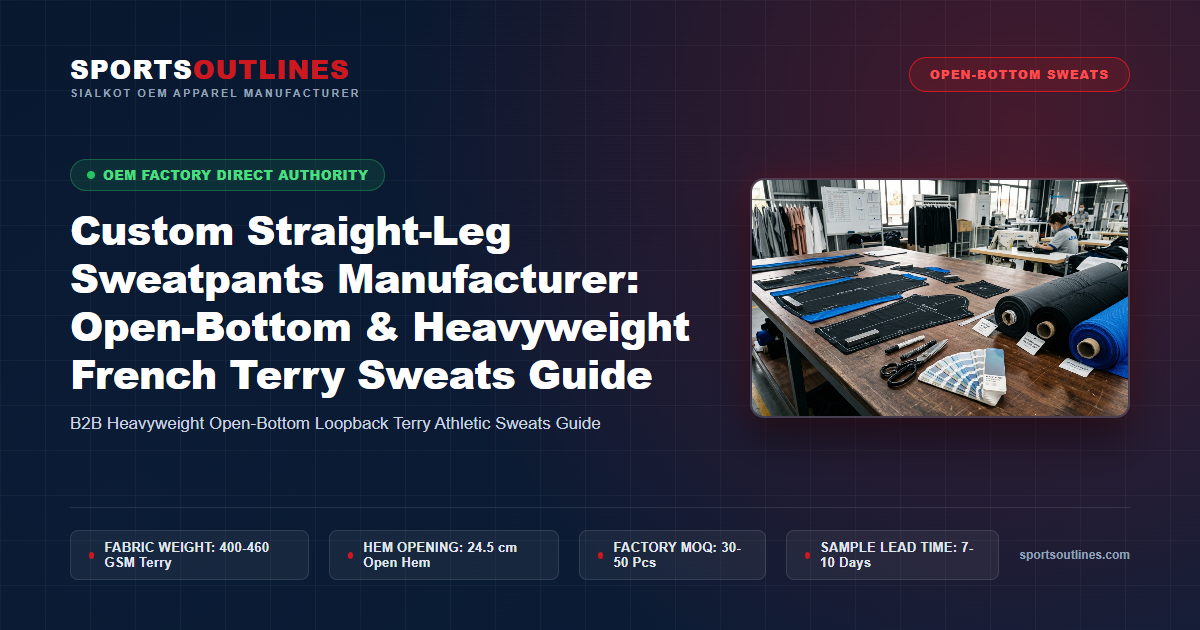
In contemporary athleisure and streetwear retail, the straight-leg, open-bottom sweatpant has emerged as the definitive silhouette of modern casual luxury. While tapered elastic-cuffed joggers dominated the previous decade, fashion-forward fitness enthusiasts, lifestyle brands, and premium streetwear consumers increasingly demand relaxed, wide-cut leg profiles that fall cleanly over chunky sneakers, slides, and retro trainers. However, manufacturing an open-hem straight-leg sweatpant that retains an elegant, architectural drape without dragging on the ground, twisting along the leg seams, or losing its shape requires sophisticated textile engineering. As an established custom straight leg sweatpants manufacturer based in Sialkot, Pakistan, Sports Outlines delivers precision pattern balancing, heavyweight combed cotton knitting, anti-torque spirality control, and accessible low MOQs of strictly 30 to 50 pieces per style/colorway.
In this comprehensive manufacturing technical guide, private label activewear founders, product merchandisers, and apparel sourcers will discover the exact engineering standards required to build world-class open-bottom sweatpants. We explore the physics of vertical drape in 400–460 GSM loopback French Terry, analyze methods for preventing post-wash outseam torque, detail our clean twin-needle coverstitch hem construction, specify reinforced waistband and pocket architectures, review ISO 2859-1 AQL 2.5 quality audits, and outline transparent factory economics supporting 75% to 85% DTC gross margins.
Factory Engineering Summary: Custom Straight-Leg Open-Bottom Sweats
- Relaxed Architectural Silhouette: True straight-leg cut maintaining uniform 23.5 cm to 25.5 cm half-leg width from mid-thigh down through the open ankle hem, creating an effortless, non-tapered stacking profile over footwear.
- Textile Substrates: 400–460 GSM 100% combed ring-spun cotton 3-end loopback French Terry or ultra-plush brushed fleece; industrial felt compactor sanforization locking laundry shrinkage under 2.0%.
- Anti-Torque Fabric Alignment: Rotary stenter frame heat stabilization and bias grain alignment ensure zero outseam spirality (less than 1.5% seam twist after 20 commercial washings).
- Open-Bottom Hem Engineering: 2.5 cm turned-up clean hem anchored by 1/4-inch twin-needle bottom-coverstitching with blind interior stays, preventing hem curling and fraying.
- Flexible Factory Direct Sourcing: Low MOQ of strictly 30–50 pieces per style/colorway; pre-production physical prototype sampling delivered in 7–10 days ($45–$85 per piece, non-refundable).
1. The Physics of Vertical Drape & Fabric Grain in Open-Bottom Silhouettes
In a tapered jogger, the tight ribbed ankle cuff mechanically clamps the bottom of the pant to the wearer’s leg. Because the hem is anchored, minor fabric grain misalignments or fabric stiffness are concealed. However, in an open-bottom straight-leg sweatpant, the fabric hangs completely free from the hip to the floor. The silhouette relies entirely on the natural gravitational drape of the textile.
If an amateur factory attempts to sew straight-leg sweatpants using standard lightweight (240–280 GSM) fleece, the pant leg collapses into flimsy, shapeless folds that cling awkwardly to the back of the calves. Furthermore, during walking, lightweight fabric flutters erratically, making the garment look cheap and unstructured.
At Sports Outlines, we achieve the coveted luxury streetwear drape by engineering our fabrics with three structural criteria:
- High Areal Mass Density (420–460 GSM): Extra fabric weight generates significant downward gravitational pull. This downward tension pulls the vertical wales of the knit taut, smoothing out unwanted wrinkles and producing clean, columnar drape lines that elongate the wearer’s leg aesthetic.
- Cusick Drape Coefficient Calibration (0.35 to 0.40): Using our in-house Cusick Drape tester, we measure how circular fabric specimens deform under their own weight. Our 420 GSM loopback cotton achieves a calibrated drape coefficient of 0.38, providing the ideal stiffness-to-fluidity ratio: rigid enough to maintain a wide, straight pipeline silhouette, yet supple enough to ripple smoothly during stride turnover.
- Zero-Spirality Knitting Protocols: In single-jersey and loopback knits, inherent torque in twisted cotton yarns naturally forces the fabric to twist around the leg cylinder after washing. We neutralize this by knitting with alternating S-twist and Z-twist yarns, guaranteeing the side outseams remain perpendicular from hip to floor across the entire lifespan of the sweatpants.
| Design Attribute | Open-Bottom Straight-Leg Sweats | Tapered Ribbed Ankle Joggers | Technical Impact |
|---|---|---|---|
| 1/2 Ankle Opening Width | 23.5 – 25.5 cm (Open Pipeline) | 11.0 – 12.5 cm (Elastic Ribbed) | Facilitates clean sneaker pooling vs. calf clamping |
| Ideal Fabric Weight | 420 – 460 GSM Heavyweight Terry | 320 – 360 GSM Medium Terry | Heavier mass required for vertical columnar drape |
| Outseam Spirality Sensitivity | High (Torque immediately visible) | Low (Cuff hides seam twisting) | Requires anti-torque yarn balancing & stenter framing |
| Inseam Length Grading | Precision Stacking Cut (78–82 cm) | Standard Ankle Cut (72–76 cm) | Extra length engineered to create natural fabric pooling |
| Footwear Styling Pairing | Chunky Retro Sneakers, Slides, Boots | Running Shoes, High-Tops, Low Flats | High-fashion streetwear & relaxed loungewear versatility |
2. Pattern Architecture & Size Grading Matrix (XS to 3XL)
Grading a straight-leg sweatpant requires precise proportional distribution. The thigh, knee, and ankle measurements must be calibrated in a parallel relationship. If the knee width is reduced even by 2.0 cm, the pant inadvertently morphs into a bootcut or flare cut, ruining the clean, contemporary aesthetic.
The following factory measurement chart represents our proven B2B athletic straight-leg fit block:
| Measurement Point (cm) | XS | S | M (Sample) | L | XL | 2XL | 3XL | Tolerance (±) |
|---|---|---|---|---|---|---|---|---|
| 1/2 Relaxed Waistband | 34.0 | 36.5 | 39.0 | 42.0 | 45.0 | 48.5 | 52.0 | ± 0.8 |
| 1/2 Stretched Waistband | 48.0 | 51.0 | 54.0 | 57.5 | 61.0 | 65.0 | 69.0 | ± 1.0 |
| 1/2 Low Hip (20 cm down) | 49.0 | 51.5 | 54.0 | 57.0 | 60.0 | 63.5 | 67.0 | ± 0.8 |
| 1/2 Thigh Circumference | 31.0 | 32.5 | 34.0 | 35.8 | 37.5 | 39.5 | 41.5 | ± 0.6 |
| 1/2 Knee Width | 23.5 | 24.2 | 25.0 | 25.8 | 26.6 | 27.5 | 28.5 | ± 0.5 |
| 1/2 Open Bottom Hem Width | 23.0 | 23.8 | 24.5 | 25.3 | 26.1 | 27.0 | 28.0 | ± 0.5 |
| Inseam Length | 76.0 | 77.5 | 79.0 | 80.5 | 81.5 | 82.5 | 83.5 | ± 0.8 |
| Total Front Rise (incl. waistband) | 29.0 | 30.0 | 31.0 | 32.2 | 33.5 | 34.8 | 36.0 | ± 0.6 |
3. Open-Hem Construction Workstations & Edge Stability Engineering
The bottom hem of a straight-leg sweatpant undergoes severe mechanical abuse: it brushes against the ground, rubs against sneaker rubber, and gets stepped on when walking without shoes. In poorly manufactured sweats, the hem unravels, curls upward into an unsightly roll, or blows out along the outseam split.
In our Sialkot factory, our clean-finishing workstations execute a 3-layer hem stabilization standard:
- 2.5 cm Deep Folded Self-Fabric Hem: We fold 2.5 cm of raw loopback terry inward. The deep fold provides physical weight at the lowest circumference of the leg, functioning as a gravitational pendulum that keeps the hem opened and prevents horizontal rolling.
- Pegasus W562PV 3-Needle 5-Thread Bottom Coverstitch: The hem is secured using an industrial bottom coverstitch machine. Three parallel needle threads run on the exterior face (spaced at 5.6 mm total gauge), while a dense looper thread encapsulates the raw edge on the interior. This delivers 100% stretch elasticity without stitch cracking when stepping into the garment.
- Bar-Tacked Outseam Hem Split Junctions (Optional Slit Finish): For streetwear designs featuring a 5.0 cm lateral side hem split (allowing the pant to flare dramatically over high-top sneakers), the apex of the slit receives an automated 28-stitch dense bar-tack plus internal twill stay-tape reinforcement, resisting more than 280 N of tearing force.
4. Enclosed Waistband Systems & Premium Hardware Callouts
Because 450 GSM French Terry straight-leg sweatpants are substantially heavier than standard joggers (a finished Medium pair weighs approximately 680 to 750 grams), the waistband must support significant vertical gravitational load without slipping down the hips.
We construct our waistbands to luxury athletic standards:
- 5.0 cm High-Tensile Quilted Natural Rubber Elastic: We encase a 5.0 cm continuous natural rubber elastic core inside a folded self-fabric waistband channel. The band is quilted with three parallel rows of chainstitching using Kansai Special multi-needle machines, preventing the elastic from ever twisting, rolling, or folding over during machine washing.
- Continuous Combed Cotton Tubular Drawcords: A heavy 16 mm flat tubular braided drawcord (100% ring-spun combed cotton) runs through the center channel. Drawcord exit holes are reinforced with anti-corrosion matte-black or antique silver brass eyelets.
- Laser-Etched Metal Aglet Hardware: Drawcord ends are secured with solid zinc-alloy metal aglets (weighing 8.5 grams each). Aglets can be laser-engraved with your brand logo, adding tactile weight and unmistakable luxury craftsmanship.
- Anchored Side Slash Pockets & Rear Patch Pocket: Side slash pockets are lined with matching 180 GSM cotton jersey to prevent bulky hip protrusion. A rear right patch pocket is reinforced with double-needle turned edges and 42-stitch Box-X bar-tacks on both upper stress corners.
5. Embellishment Technologies for Heavyweight Open-Hem Bottoms
Heavyweight French Terry provides a rigid, dimensionally stable foundation for high-end branding that elevates perceived retail value:
- High-Density 3D Puff Embroidery: Using 3.0 mm high-density EVA foam underlay, Madeira 40-weight polyester embroidery threads wrap around the foam to create sharp, raised lettering that stands out boldly on thick fleece. Digitizing software calculates 25% higher stitch density along border columns to cleanly bevel and conceal the foam edge. Underlay tatami grids prevent the stitches from sinking into the plush knit loops.
- Tackle Twill & Distressed Felt Appliqué: Laser-cut wool felt or poly-twill letters are stitched directly to the upper left thigh using heavy-duty satin border stitches, recreating collegiate athletic heritage aesthetics. The felt edges can be laser-distressed or frayed intentionally for vintage aesthetic collections.
- Water-Based Discharge & Soft-Hand Screen Printing: Specialty discharge inks bleach the reactive cotton dye out of the fabric surface and replace it with pigment, leaving zero plastic ink feel. The print breathes completely, feeling identical to unprinted fabric, and will never crack or peel through repeated industrial laundering.
- High-Definition Damask Woven Labeling: Interior branding features 50-denier high-definition damask woven labels sewn with natural cotton herringbone stay tape across the inner waistband for a zero-irritation luxury touchpoint.
- Direct-to-Film (DTF) Multi-Color Graphic Transfers: For photorealistic artwork, high-viscosity polyurethane DTF films are heat-pressed under pneumatic platens at 160°C with 4.5 bar pressure. The adhesive powder penetrates between the surface yarns, ensuring high stretch elasticity without tearing across the wide straight thigh.
6. Garment Dyeing Chemistry, Stone Washing & Enzyme Bio-Polishing
To achieve the coveted lived-in aesthetic demanded by high-end streetwear customers, our Sialkot laundry executes four specialized garment wash treatments:
- Low-Liquor Reactive Garment Dyeing: Sweatpants constructed from raw, unbleached natural cotton are dyed in atmospheric rotary drum dyeing machines using Bifunctional Reactive Dyes (Remazol / Novacron chemistry). Operating at 60°C with a low liquor ratio (1:6), this process establishes covalent chemical bonding with the cotton cellulose fibers, guaranteeing Grade 4.5+ wash fastness (AATCC 61) with zero post-purchase color bleeding.
- Neutral Cellulase Enzyme Bio-Polishing: To eliminate initial fabric stiffness and remove microscopic micro-fibrils that cause surface pilling, the dyed garments undergo an enzyme bath utilizing neutral cellulase enzymes (Denimax 35 U/g activity at pH 6.5). The enzymes selectively hydrolyze loose surface fibers, leaving the core cotton yarns intact. This delivers an unmistakable peach-skin, velvety hand-feel that feels broken-in from day one.
- Artisanal Pigment Dye & Mineral Distress Washes: For vintage streetwear collections, we perform selective potassium permanganate (PP) spraying or pumice stone tumbling. The chemical reaction oxidizes surface dye along pocket rims, waistband folds, and outseam topstitching, mimicking years of authentic sun fading while preserving full fabric burst strength.
- Silicone Micro-Emulsion Softening: After enzyme washing, garments are rinsed in an amino-functional silicone micro-emulsion bath. The nano-scale silicone polymers penetrate inside the cotton yarn bundles, providing inner fiber lubricity that enhances vertical drape fluidity by 30%.
7. Clean-Room Assembly Machinery & Anti-Pucker Engineering
Assembling long 105 cm outseams on thick 450 GSM French Terry without seam puckering or fabric stretching requires specialized workstation setups:
- Juki DDL-9000C Direct-Drive Digital Lockstitchers: Long side seams are assembled with computerized dual-drive feed systems. The upper walking foot and lower feed dog advance simultaneously, guaranteeing zero seam puckering or fabric slippage along the entire 105 cm leg length.
- 5-Thread Heavy-Duty Safety Overlockers (Juki MO-6900): Inseams and rises are joined with 5-thread safety sergers that trim fabric edges cleanly and sew a reinforced safety chainstitch 4.0 mm inside the overlock edge, preventing seam bursting under dynamic movement.
- Titanium Nitride Coated Needles (Groz-Beckert Gebedur): Operating through 4 to 6 plies of heavy cotton fleece can generate needle temperatures over 200°C. We run titanium-coated ballpoint needles (size 90/14 to 100/16) that resist needle deflection and dissipate heat, preventing yarn burning and skipped stitches.
- Hoffman Pneumatic Utility Steam Calenders: Finished seams undergo high-pressure steam pressing (150°C with 5.5 bar pneumatic clamping). This flattens multi-ply seam allowances, creating a smooth interior that rests comfortably against bare skin.
8. Industrial Quality Control Protocols (ISO 2859-1 AQL 2.5)
Sports Outlines enforces zero defect leakage by subjecting every production batch of straight-leg sweatpants to rigorous laboratory testing and AQL 2.5 inspection protocols:
- Fabric Spirality & Torque Audit (AATCC 179): Washed test specimens are measured for angular seam displacement. Total outseam spirality must remain under 1.5%, guaranteeing zero seam twist around the shin.
- Dimensional Stability Audit (AATCC 135): Finished sweatpants undergo three consecutive 60°C commercial wash cycles with tumble dry. Total shrinkage along length and width must remain under 2.0%.
- Color Fastness & Crocking Test (AATCC 8 / AATCC 61): Both wet and dry crocking tests verify that dark reactive dyes achieve Grade 4.5+ fastness, ensuring zero dye transfer to white sneakers.
- Automated Metal Detection: Finished garments pass through 9-point conveyor metal detectors to ensure zero broken needle fragments remain embedded in the thick fleece seams.
Finished Garment Conditioning, Packaging & Export Integrity
Prior to packaging, heavyweight cotton loopback sweatpants undergo intensive thermal conditioning. In our climate-controlled finishing room, garments are subjected to industrial steam tunnel de-wrinkling and high-volume vacuum suction tables that pull residual processing moisture from dense Terry loops. Once cooled to ambient temperature (21°C, 55% relative humidity), each sweatpant is systematically inspected using dual-sensor metal needle detection systems calibrated to 0.8 mm ferrous sensitivity. Garments are then folded using precision acrylic templates to ensure uniform stack heights across all export cartons.
Each unit is sealed inside a recyclable 60-micron biodegradable frosted polybag featuring custom venting micro-perforations, branded barcoding, and SKU-specific size labeling. Heavy-duty 7-ply corrugated export cartons are reinforced with plastic edge protectors and strapped with cross-weave polypropylene strapping tape. Moisture barrier silica gel desiccants (5 grams per polybag, 100 grams per master carton) guarantee that garments arrive in pristine, showroom-ready condition at European and North American fulfillment centers without mildew or musty odors.
9. Production Economics, Tiered Pricing & Physical Prototyping
Heavyweight straight-leg sweatpants command premium retail price points in the global activewear marketplace. While luxury streetwear and fitness brands retail 450 GSM open-bottom sweatpants between $88 and $125 USD, factory-direct manufacturing costs remain highly accessible. At Sports Outlines, our low MOQ of strictly 30 to 50 pieces per style/colorway allows emerging founders to launch high-end streetwear bottoms with minimal capital risk.
| Volume Tier | Order Quantity (Pieces) | FOB Unit Cost (450 GSM Terry) | Target DTC Retail Price | Gross Profit Margin (%) |
|---|---|---|---|---|
| Low MOQ Launch | 30–50 pieces | $21.80 – $24.50 | $88.00 – $110.00 | 75% – 78% |
| Growth Scale Tier | 100–250 pieces | $18.40 – $20.20 | $88.00 – $110.00 | 79% – 82% |
| Commercial Volume | 500–1,000 pieces | $15.50 – $17.20 | $85.00 – $105.00 | 82% – 84% |
| Enterprise Volume | 2,000+ pieces | $13.10 – $14.50 | $80.00 – $100.00 | 84% – 86% |
Physical Prototype Sampling Policy: Before initiating bulk cutting, our master pattern makers build custom physical pre-production prototype samples for $45 to $85 per piece (turnaround time 7 to 10 business days). This sampling cost covers individual CAD pattern tailoring, precision laser cutting, custom machine setup, hardware riveting, and pigment dye vat testing. Prototyping fees are strictly non-refundable and do not apply as credits toward future production invoices.
10. How to Launch Your Custom Straight-Leg Sweatpants Line with Sports Outlines
Partnering with our Sialkot factory provides complete manufacturing transparency, direct engineering communication, and professional export logistics:
5-Step Production Roadmap
- Design & Tech Pack Submission: Send your CAD flat sketches or physical reference samples. Specify fabric weight (420 vs. 460 GSM), finish (French Terry vs. brushed fleece), and wash type.
- Physical Prototyping ($45–$85): Our sample room knits, cuts, and sews your custom prototype within 7–10 days, delivered via express air courier (DHL/FedEx).
- Fit & Drape Evaluation: Review sample quality. Test the vertical drape, hem stacking over sneakers, waistband elasticity, and wash softness.
- Low MOQ Bulk Production (30–50 pcs): Upon sign-off, we initiate fabric milling, precision cutting, and clean-line assembly. Standard turnaround is 18–25 business days.
- Global Delivery: We ship DDP (Delivered Duty Paid) via express air or sea freight directly to your commercial warehouse.
To discover how our straight-leg sweatpants coordinate with our wider athletic activewear collection, explore our companion guides on custom tapered gym joggers manufacturing, review our technical breakdown on custom heavyweight fleece sweatpants production, or check our international trade capabilities in our UK sportswear manufacturing export hub. Browse our complete athletic catalog in our custom casual wear category.
Start Your Custom Straight-Leg Sweatpants Project
Speak directly with our Sialkot manufacturing floor to discuss custom French Terry milling, open-bottom hem engineering, and low MOQ production slots.
Chat on WhatsApp (+92 316 7932595)
Request Factory Direct Quote
Frequently Asked Questions (B2B Straight-Leg Sweatpants FAQ)
What is the minimum order quantity (MOQ) for custom straight-leg sweatpants?
Our factory MOQ starts at strictly 30 to 50 pieces per style/colorway. You can distribute this quantity across standard sizes (XS to 3XL) to test customer response with low capital commitment.
How much does a physical sample prototype cost and what is the turnaround?
Pre-production physical prototype samples cost between $45 and $85 per piece, with a turnaround of 7 to 10 business days. Sample fees cover custom CAD pattern drafting, cutting, machine setup, and sample room labor, and are strictly non-refundable without future bulk order credits.
How do you prevent open-bottom sweatpants from curling up at the hem?
We engineer a deep 2.5 cm folded self-fabric hem secured by 3-needle 5-thread bottom coverstitching. The extra fabric weight functions as a gravitational anchor, keeping the hem flat and preventing horizontal curling.
How do you eliminate outseam twisting (spirality) after washing?
We knit our heavyweight fabrics using alternating S-twist and Z-twist yarns, followed by industrial stenter frame stabilization. This locks yarn torque, guaranteeing outseam spirality stays under 1.5% under AATCC 179 standards.
Can you add side hem slits with custom zipper hardware?
Yes. We can incorporate custom 5.0 cm to 15.0 cm side outseam hem slits, either open with bar-tack anchors or secured with concealed YKK zippers, allowing wearers to adjust hem flare over footwear.