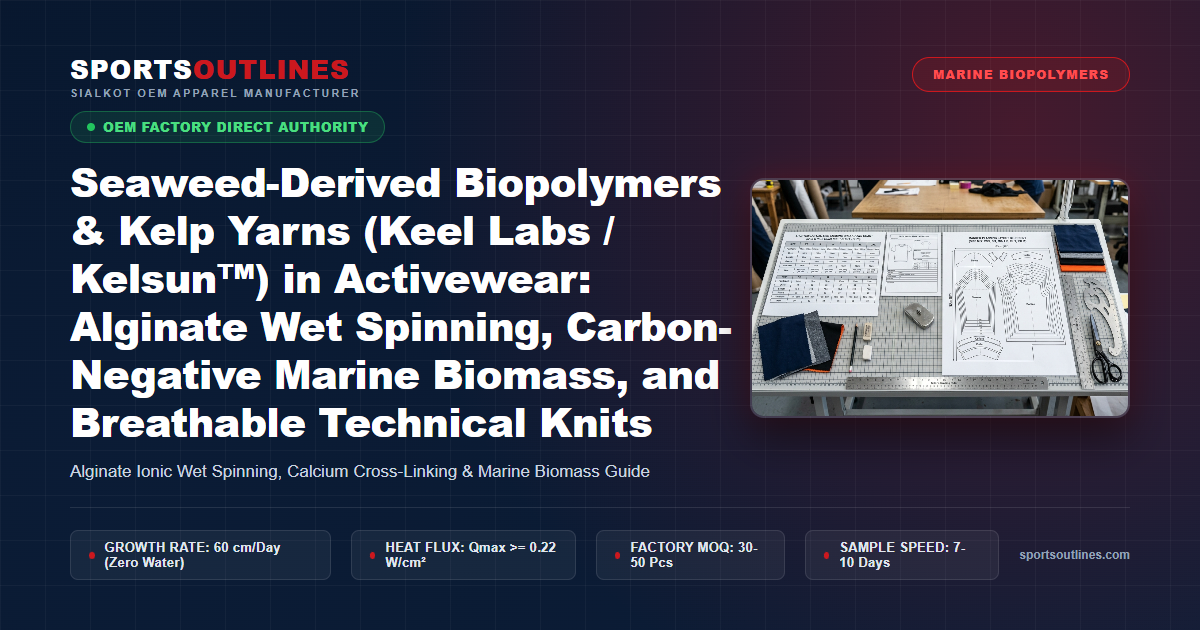
As the performance apparel industry confronts the environmental dead-end of petrochemical synthetics and water-intensive terrestrial agriculture, material science has turned to the world’s most productive marine ecosystems: kelp forests. Terrestrial cotton cultivation consumes up to 10,000 liters of freshwater per kilogram, while virgin polyester extraction releases approximately 7.2 kilograms of carbon dioxide equivalent for every kilogram of fiber produced. In contrast, macroalgae—specifically giant brown kelp (Macrocystis pyrifera and Laminaria hyperborea)—grows at staggering rates of up to 60 centimeters per day without requiring a single drop of potable freshwater, arable farmland, chemical fertilizers, or toxic pesticides.
Pioneered by advanced biomaterial innovators such as Keel Labs (creators of Kelsun™), seaweed-derived biopolymer yarns represent a paradigm shift in regenerative sportswear manufacturing. By isolating long-chain sodium alginate biopolymers from wild-harvested or ocean-farmed marine biomass and extruding them through precision ionic wet-spinning coagulation baths, textile engineers can produce continuous filament and staple fibers that exhibit natural moisture management, high breathability, inherent flame resistance, and total home compostability. At Sports Outlines, operating from our precision manufacturing center in Sialkot, Pakistan, we partner with visionary activewear founders to engineer custom kelp-blend athletic apparel. We provide dedicated physical prototype sampling at $45 to $85 per piece (non-refundable, 7–10 business days turnaround) and scalable cut-and-sew production starting at an accessible factory minimum order quantity (MOQ) of just 30 to 50 pieces per style/colorway.
Seaweed & Kelp Biopolymer Activewear: Technical Directory
- 1. Macroalgae Cultivation & Carbon-Negative Sequestration
- 2. Alginate Chemistry: Extraction & Molecular Architecture
- 3. Ionic Wet-Spinning & Coagulation Bath Mechanics
- 4. Tensile Tenacity, Elongation & Wet Burst Strength
- 5. Hybrid Blending: Kelsun™ with Lyocell, Cotton & rPET
- 6. Moisture Regain, Vapor Transport & Cutaneous Cooling
- 7. End-of-Life: Marine Biodegradation & Zero Microplastics
- 8. Circular Knitting, Tension & Dyeing Parameters
- 9. Engineering Matrix: Kelp Biopolymer vs Conventional Fibers
- 10. Low-MOQ Sourcing & Commercial Factory Terms
- 11. Technical Sourcing FAQ
1. Macroalgae Cultivation & Carbon-Negative Sequestration
The environmental baseline of seaweed-derived fiber production begins with marine biology. Unlike terrestrial fiber crops such as upland cotton, flax, or viscose wood pulp, brown marine macroalgae (Phaeophyceae) grows in vertical ocean water columns. The primary species harvested for biopolymer fiber manufacturing include giant kelp (Macrocystis pyrifera), sugar kelp (Saccharina latissima), and oarweed (Laminaria digitata).
These kelp species inhabit cold-water temperate coastal zones and represent some of the most dynamic photosynthetic organisms on Earth. A wild or cultivated kelp forest can absorb dissolved carbon dioxide directly from the sea, sequestering an estimated up to 20 tons of carbon dioxide per hectare annually—a sequestration rate approximately 20 times greater than that of terrestrial terrestrial forests. Furthermore, ocean farming provides vital ecosystem co-benefits: kelp farms de-acidify local marine waters, provide critical nursery habitats for pelagic fish species, and absorb excess agricultural nitrogen and phosphorus runoff, directly counteracting coastal hypoxia and dead zones.
Because kelp absorbs all of its mineral nutrients directly across its cellular fronds via osmotic diffusion, cultivation requires zero synthetic inputs. When evaluating raw material inputs under ISO 14040 Life Cycle Assessment (LCA) standards, kelp biopolymer possesses a cradle-to-gate agricultural carbon footprint that is genuinely carbon-negative (-1.2 to -1.8 kg CO₂e per kg of harvested dry biomass), establishing an unprecedented ecological starting point for performance activewear textiles.
2. Alginate Chemistry: Extraction and Molecular Architecture
The fundamental structural biopolymer that gives brown kelp its flexible mechanical strength in ocean currents is alginic acid. In living kelp, alginate constitutes between 20% and 40% of the plant’s total dry weight, residing primarily within the intercellular mucilage and cell walls as a structural polysaccharide.
At an industrial extraction refinery, harvested kelp is washed to remove surface sea salts, milled into fine particles, and treated with dilute acid (0.1 M HCl) to convert insoluble calcium and magnesium salts into alginic acid. The biomass is then dissolved in a warm alkaline solution of sodium carbonate (Na₂CO₃) at 50°C to 60°C. This alkaline digest converts alginic acid into water-soluble sodium alginate, while insoluble cellulosic plant fibers are filtered out via centrifugation and plate-and-frame filtration.
Chemically, alginate is a linear, unbranched anionic co-polymer composed of two uronic acid monomer residues:
- β-D-mannuronic acid (M-block): Linked via 1,4-glycosidic bonds in an extended flat ribbon conformation, imparting flexibility and high solubility.
- α-L-guluronic acid (G-block): Linked via 1,4-glycosidic bonds in a buckled, pleated conformation, containing localized cavity regions that exhibit exceptionally high affinity for divalent metal cations.
- Alternating MG-blocks: Heteropolymeric sequences that provide amorphous elasticity.
The ratio of mannuronic to guluronic acid (the M/G ratio) is the supreme chemical determinant of the fiber’s ultimate mechanical performance. High-G alginate extracts (M/G ratio < 0.70), derived from older kelp stems and holdfasts, produce rigid, high-tenacity fibers with high wet strength. High-M alginate extracts (M/G ratio > 1.2), extracted from young fronds, produce soft, highly elastic, but mechanically weaker fibers. Advanced activewear biopolymer production requires strict molecular fractionation to guarantee a standardized M/G ratio between 0.65 and 0.80.
3. Ionic Wet-Spinning and Coagulation Bath Mechanics
Unlike synthetic polymers (polyester, nylon) which are melt-spun at extreme temperatures above 260°C, and unlike traditional viscose which relies on neurotoxic carbon disulfide (CS₂) solvent chemistries, seaweed biopolymers are converted into yarn through benign aqueous ionic wet-spinning.
The wet-spinning sequence follows a closed-loop chemical engineering protocol:
- Dope Preparation: Purified sodium alginate powder is dissolved in demineralized water at a concentration of 4.5% to 6.5% by weight, forming a viscous spinning dope with a dynamic viscosity between 1,200 and 1,800 mPa·s at 25°C. The dope is degassed under continuous vacuum (30 mbar) for 12 hours to eliminate micro-air bubbles that could cause filament breaks.
- Extrusion through Micro-Spinnerets: The dope is metered through high-precision gear pumps and extruded through precious-metal spinneret plates (platinum-gold or tantalum alloy) containing 5,000 to 20,000 micro-orifices with diameters ranging from 50 to 70 micrometers.
- Ionic Cross-Linking in Calcium Coagulation Bath: The liquid dope streams emerge directly into an aqueous coagulation bath containing 2.5% to 4.0% calcium chloride (CaCl₂) and dilute hydrochloric acid (pH 2.8 to 3.5) maintained at 40°C to 45°C.
- The “Egg-Box” Supramolecular Transition: The instant sodium alginate contacts the calcium bath, a spontaneous ion-exchange reaction occurs: monovalent sodium ions (Na⁺) diffuse out of the dope, while divalent calcium cations (Ca²⁺) diffuse in. The Ca²⁺ ions coordinate precisely between the electronegative carboxylate and hydroxyl oxygen atoms of opposing guluronic acid (G-block) chains. This forms the legendary “egg-box” supramolecular chelation junction, cross-linking linear polysaccharide chains into an insoluble, three-dimensional calcium alginate hydrogel filament network in less than 0.2 seconds.
- Drawing, Washing, and Orientation: The coagulated filaments are continuously drawn out of the bath across heated godet rolls at a draw ratio of 1.4 to 1.8. This stretching aligns the amorphous alginate polymer chains parallel to the fiber axis, inducing molecular orientation and dramatically elevating crystalline tensile tenacity. The filaments pass through multi-stage counter-current hot water washes to remove residual salts, followed by finish oil application, steam drying at 95°C, and crimping into staple fiber (38 mm to 51 mm) or winding as continuous filament.
| Process Variable | Target Operating Range | Under-Specification Impact | Over-Specification Impact |
|---|---|---|---|
| Dope Alginate Concentration | 5.0% – 6.2% w/w | Filament collapse, low linear density | Excessive viscosity, spinneret clogging |
| CaCl₂ Bath Concentration | 3.0% – 3.8% w/w | Incomplete cross-linking, sticky fiber | Brittle shell-core skin effect, low elongation |
| Bath Temperature | 42°C – 46°C | Sluggish ion diffusion, low tenacity | Thermal degradation of alginate chain DP |
| Post-Spin Draw Ratio | 1.45x – 1.65x | Low molecular orientation (<1.8 cN/dtex) | Capillary micro-void tearing, filament breaks |
| Dope Deaeration Vacuum | ≤30 mbar (12 hrs) | Micro-voids in fiber, catastrophic bursting | Excessive energy draw, foaming if uncalibrated |
4. Tensile Tenacity, Elongation and Wet Burst Strength
For decades, the historical commercial use of calcium alginate fibers was confined to advanced wound care dressings (such as Kaltostat®), because alginate fibers absorb copious exudate and gel upon contact with sodium-rich physiological fluids. However, medical alginate fibers are structurally fragile: in pure form, standard calcium alginate displays a dry tensile tenacity of barely 1.6 to 2.1 cN/dtex and a wet tenacity that plummets below 0.8 cN/dtex. If an athlete wore a shirt of 100% pure medical-grade calcium alginate, prolonged perspiration would cause the calcium ions to exchange with sodium ions in sweat, destabilizing the egg-box lattice and causing the garment to disintegrate.
Next-generation activewear kelp fibers like Kelsun™ by Keel Labs overcome this barrier through three patented chemical engineering breakthroughs:
- Ultra-High Degree of Polymerization (DP): Kelp biomass is processed using non-destructive low-temperature enzymatic extraction that preserves long alginate polysaccharide backbones (DP > 1,200 vs standard medical alginate DP of 400 to 600).
- Dual-Cation Cross-Linking: Rather than relying solely on calcium (Ca²⁺), advanced spinning baths incorporate trace zinc (Zn²⁺) or aluminum (Al³⁺) cross-linkers that form coordinate covalent bonds resistant to sodium-sweat ion displacement.
- Secondary Hydrophobic Sizing: Micro-filaments are coated with plant-based bio-polyamide or cellulose ester surface finishes that protect internal coordination nodes while permitting water vapor respiration.
As a result of these innovations, performance kelp fiber delivers a dry tensile tenacity of 2.6 to 3.2 cN/dtex and an elongation at break of 14% to 18%. While dry tenacity remains slightly below standard virgin polyester (4.5 to 5.2 cN/dtex), it is fully comparable to upland carded cotton (2.4 to 3.0 cN/dtex) and standard modal (2.8 to 3.4 cN/dtex), making it fully capable of withstanding industrial circular knitting tensions and rigorous athletic wear.
5. Hybrid Blending: Kelsun™ with Lyocell, Organic Cotton and rPET
In commercial garment engineering, pure 100% kelp fiber is rarely utilized for high-strain athletic activewear. Instead, modern sports apparel developers deploy intimate hybrid blending, spinning Kelsun™ staple fibers alongside high-tenacity carrier fibers to create synergistic yarns that balance structural endurance with marine sustainability.
At Sports Outlines, our textile development laboratory in Sialkot has engineered four standard hybrid spinning formulations for international activewear brands:
Sports Outlines Kelp-Blend Engineering Formulations:
- 30% Kelsun™ / 70% TENCEL™ Lyocell (160–190 GSM): The gold standard for yoga, studio pilates, and lifestyle athleisure. The high wet-tenacity of Lyocell (3.4 cN/dtex) acts as a structural exoskeleton, while kelp provides cool-touch sensory drape and moisture buffering. Delivers hydraulic burst strength >520 kPa and Grade 4.5 Martindale pilling resistance.
- 25% Kelsun™ / 65% Organic Ring-Spun Cotton / 10% ROICA™ V550 Elastane (210–240 GSM): Designed for premium heavyweight gym t-shirts and pump covers. Delivers substantial hand-feel, zero electrostatic cling, and 4-way stretch with 96% elastic recovery.
- 40% Kelsun™ / 60% GRS Post-Consumer Recycled Polyester (140–165 GSM): Engineered for high-aerobic endurance sports (marathon running, cycling base layers). The continuous filament rPET provides high abrasion durability (>45,000 Martindale cycles) and rapid dry times, while the kelp staple fibers provide skin-soothing comfort and natural anti-odor ion binding.
- 50% Kelsun™ / 50% Superfine 17.5µm Merino Wool (180–220 GSM): Luxury alpine trail running and winter base layers. Combines wool’s exothermic heat of sorption with seaweed’s microclimate humidity buffering for unmatched thermal equilibrium.
6. Moisture Regain, Vapor Transport and Cutaneous Cooling Physics
Synthetic activewear made from 100% polyester suffers from a major physiological flaw: zero intrinsic moisture regain (0.4%). Polyester cannot absorb water molecules into its polymer matrix; it can only transport liquid sweat across fiber exterior crevices via mechanical capillary wicking. When an athlete exercises in hot, humid environments, polyester fabrics quickly saturate, creating a clammy, suffocating microclimate against the skin.
Seaweed-derived kelp fibers operate under entirely different thermodynamic principles. Because the alginate polysaccharide backbone is densely decorated with polar carboxyl (-COOH) and hydroxyl (-OH) functional groups, the fiber possesses a massive equilibrium moisture regain of 12.5% to 15.0% at 65% relative humidity and 21°C—higher than upland cotton (8.5%) and approaching pure wool (16.0%).
This hydrophilic molecular architecture generates two profound performance advantages:
- Vapor-Phase Humidity Absorption: Kelp fibers absorb perspiration in its vapor phase directly from the skin boundary layer before it condenses into liquid droplets. This maintains the athlete’s skin microclimate in the optimal comfort zone (relative humidity < 60%), preventing sticky fabric cling.
- High Transient Contact Cooling (Qmax): When an athlete touches a dry kelp-blend knit, the fiber rapidly conducts heat away from the skin. Measured via the Kawabata Evaluation System (KES-F7 Thermo Labo II), kelp-lyocell knits achieve a peak heat flux value of Qmax ≥ 0.22 to 0.26 W/cm², delivering a crisp, soothing cooling sensation upon initial cutaneous contact (significantly cooler than polyester at 0.14 W/cm²).
7. End-of-Life: Marine Biodegradation and Zero Microplastics
The catastrophic failure of conventional activewear lies in end-of-life disposal and microplastic shedding. Every laundry cycle of a standard polyester or nylon gym shirt sheds between 700,000 and 1,500,000 non-biodegradable microfibers into municipal waterways, which persist in ocean food chains for centuries.
Seaweed-derived biopolymer fibers represent the ultimate closed-loop solution to the microfiber crisis. Born in the ocean, kelp fiber naturally biodegrades if shed into marine environments:
- Marine Biodegradation (ASTM D6691 / ISO 22404): In natural seawater containing indigenous marine microflora, calcium alginate fibers achieve >85% biodegradation within 90 days, mineralizing completely into water, carbon dioxide, and harmless biomass without releasing synthetic chemical fragments.
- Soil Compostability (ASTM D5988 / ISO 17556): In municipal or backyard soil composting conditions, kelp fibers achieve >92% mass loss in 120 days, acting as a natural soil conditioner rich in trace ocean micronutrients (potassium, magnesium, iodine).
- Zero Ecotoxicity: Rigorous laboratory testing confirms that kelp fiber breakdown products cause zero mortality or developmental abnormalities in marine aquatic bioassays (Daphnia magna and microalgae growth inhibition tests).
When an apparel brand crafts garments from 100% bio-based blends (such as Kelsun™ paired with organic cotton or TENCEL™ and stitched with cotton thread), the entire garment is 100% home compostable, eliminating textile landfill burdens permanently.
8. Circular Knitting, Tension and Dyeing Parameters in Sialkot
Translating laboratory-grown kelp yarns into commercially viable athletic garments requires rigorous engineering adjustments on the factory floor. At Sports Outlines, our cut-and-sew manufacturing hub in Sialkot enforces specialized processing protocols for kelp-blend textiles:
Circular Knitting Machine Setup
Kelp-blend yarns are knitted on Mayer & Cie 28-gauge to 32-gauge single-jersey and double-jersey circular knitting machines. Because alginate fibers have lower elasticity than synthetic filament, yarn feeding tensions must be strictly stabilized between 2.5 and 3.2 cN using Memminger-IRO MPF positive feeding units. Needle cams are set with shallow stitch angles to prevent excessive bending shear, and high-lubricity vegetable-based needle oils are utilized to eliminate friction-induced lint generation.
Dyeing Chemistry and Finishing
Because calcium alginate is sensitive to harsh alkaline conditions (which can dissolve alginic acid), conventional reactive cotton dye baths (pH 11.5) must be avoided. Instead, kelp-blend textiles are dyed using neutral-affinity low-temperature reactive dyes or direct dyes operating at pH 6.8 to 7.5 and temperatures strictly capped at 65°C to 75°C. Softening is achieved through bio-silicone or plant-lipid micro-emulsions, followed by tension-free conveyor relaxation drying to lock dimensional stability below 3.0% residual shrinkage (AATCC 135).
Precision Cut-and-Sew Assembly
Garment panels are cut on computerized CNC vacuum cutting tables using micro-serrated high-speed oscillating blades to prevent edge fraying. Panel stitching is executed on Pegasus W500PV 4-needle 6-thread flatlock machines utilizing light-ball-point needles (Organ UY 128 GAS size 65/9) and low-tension core-spun Lyocell or micro-denier recycled polyester sewing threads. This produces an ultra-flat 0.8 mm seam that eliminates chafing during intense athletic training.
9. Engineering Comparison Matrix: Kelp Biopolymer vs Conventional Fibers
The following technical comparison contrasts the physical, environmental, and physiological metrics of seaweed-derived kelp fiber against industry benchmarks:
| Performance Metric | Seaweed Kelp Fiber (Kelsun™) | Virgin Polyester (PET) | Organic Combed Cotton | TENCEL™ Lyocell |
|---|---|---|---|---|
| Feedstock Origin | Wild/Farmed Ocean Kelp | Crude Oil / Petrochemicals | Agricultural Farmland | FSC Certified Wood Pulp |
| Freshwater Usage (L/kg) | <50 L/kg (Processing only) | ~120 L/kg | 5,000 – 10,000 L/kg | ~350 L/kg (Closed-loop) |
| Cradle Carbon (kg CO₂e/kg) | -1.2 to -1.8 (Negative) | +7.2 to +8.5 (High fossil) | +2.1 to +3.4 (Moderate) | +0.8 to +1.4 (Low) |
| Dry Tensile Tenacity | 2.6 – 3.2 cN/dtex | 4.5 – 5.2 cN/dtex | 2.4 – 3.0 cN/dtex | 3.8 – 4.4 cN/dtex |
| Moisture Regain (%) | 12.5% – 15.0% | 0.4% (Hydrophobic) | 8.5% | 11.5% |
| Peak Heat Flux Qmax (W/cm²) | 0.22 – 0.26 (Cool touch) | 0.14 – 0.16 (Warm/clammy) | 0.17 – 0.19 | 0.24 – 0.28 |
| Marine Biodegradability | >85% in 90 days (ASTM D6691) | 0% (Persistent centuries) | ~65% in 180 days | >80% in 120 days |
10. Low-MOQ Sourcing & Commercial Factory Terms at Sports Outlines
Pioneering sustainable materials should not be restricted to multinational conglomerates with seven-figure budgets. At Sports Outlines, we make regenerative kelp-blend athletic wear accessible to innovative independent labels, yoga studios, and performance sports brands globally:
Sports Outlines Sialkot Manufacturing Framework:
- Low Production MOQ: We support custom seaweed-blend activewear production starting at just 30 to 50 pieces per style/colorway, enabling growing brands to launch circular capsule collections without excessive deadstock risk.
- Comprehensive Size Grading: Full athletic sizing matrix from XS through 3XL, tailored to international anatomical grading profiles (US, UK, EU, and Australia).
- Dedicated Prototype Development: Pre-production physical prototype samples are crafted at $45 to $85 per piece (non-refundable) with an agile turnaround of 7 to 10 business days. This fee covers pattern engineering, kelp-blend fabric sourcing, circular knit calibration, and custom branding trims prior to bulk factory production.
- Advanced Seam Engineering: Pegasus 4-needle 6-thread flatlock assembly, ultrasonic edge trimming, laser-cut ventilation, and OEKO-TEX certified biodegradable trims.
- Worldwide Air Express Export: Reliable DDP door-to-door delivery via DHL and FedEx to the USA, UK, Canada, Australia, Germany, and across Europe with complete customs clearance documentation.
Ready to Engineer Performance Activewear from Ocean Kelp Biopolymers?
Consult directly with our technical textile developers in Sialkot. Review seaweed biopolymer fabric swatches, evaluate custom kelp-lyocell knit blends, and manufacture your circular activewear line with true factory-direct low MOQs.
Explore Our Comprehensive Manufacturing Hubs & Technical Sourcing Guides
International Export Hubs
Core Product Silos
11. Frequently Asked Questions: Seaweed & Kelp Activewear
Q1: What is seaweed kelp yarn (such as Kelsun™) and how is it made?
Kelp yarn is a regenerative biopolymer fiber produced from brown seaweeds like giant kelp. Long-chain sodium alginate polysaccharides are extracted from kelp biomass using mild alkaline chemistry and extruded through micro-spinnerets into an aqueous calcium chloride coagulation bath. This triggers ionic cross-linking, transforming the liquid biopolymer into strong, continuous calcium alginate filaments without relying on petrochemicals or toxic solvents.
Q2: Does seaweed-based activewear dissolve or degrade when an athlete sweats or machine washes it?
No. Unlike historical medical alginate dressings that dissolve upon contact with sodium fluids, modern activewear kelp fibers like Kelsun™ utilize high-molecular-weight polymers, multi-cation cross-linking, and protective bio-finishes. When knitted into hybrid yarns with carrier fibers like Lyocell or organic cotton, the fabric withstands standard commercial machine washing and prolonged sweat exposure with exceptional dimensional stability and zero degradation during active athletic use.
Q3: How does seaweed kelp fiber help eliminate ocean microplastic pollution?
Conventional polyester and nylon sportswear sheds hundreds of thousands of non-biodegradable synthetic microfibers per laundry cycle, which accumulate in marine organisms. Kelp fibers are 100% bio-based marine biopolymers: under ASTM D6691 seawater testing standards, shed kelp microfibers achieve over 85% biodegradation in natural ocean waters within 90 days, returning harmlessly to the marine carbon cycle with zero toxic persistence.
Q4: What physiological benefits do athletes experience wearing kelp-blend activewear?
Athletes experience exceptional thermoregulation and skin comfort. Kelp fibers feature high moisture regain (12.5% to 15.0%) that absorbs sweat vapor before it condenses into clammy liquid droplets. Furthermore, kelp knits exhibit superior transient contact cooling (Qmax ≥ 0.22 W/cm²), dissipating surface body heat rapidly and providing an immediate cool-touch sensation during warm-weather exertion.
Q5: What are the minimum order quantities (MOQ) and prototype terms for custom kelp activewear at Sports Outlines?
Sports Outlines offers low factory production MOQs starting at just 30 to 50 pieces per style/colorway, supporting size grading from XS through 3XL. Pre-production physical prototype samples are developed at $45 to $85 per piece (non-refundable) within 7 to 10 business days. This prototype fee covers pattern drafting, kelp fabric milling, specialized knitting machine tension calibration, and custom branding trims prior to bulk factory production.