For over a generation, athletic apparel design has been driven by an engineering obsession with multi-material performance hybridity. Technical sportswear designers routinely pair moisture-wicking polyester torso panels with high-spandex side gussets, nylon abrasion-resistant knee reinforcements, polyurethane (PU) seam-sealing tapes, metallic zipper pulls, and polyester-cotton blend drawcords. While these complex composites optimize biomechanical performance during athletic exertion, they create an impenetrable barrier at end-of-life. When a discarded multi-material jacket or pair of running tights enters a recycling facility, manual operators must spend minutes tearing apart zippers, cutting out elastane seams, and slicing away labels. This manual deconstruction costs upwards of $3.50 to $5.00 per garment, rendering circular recycling economically bankrupt before it even begins.
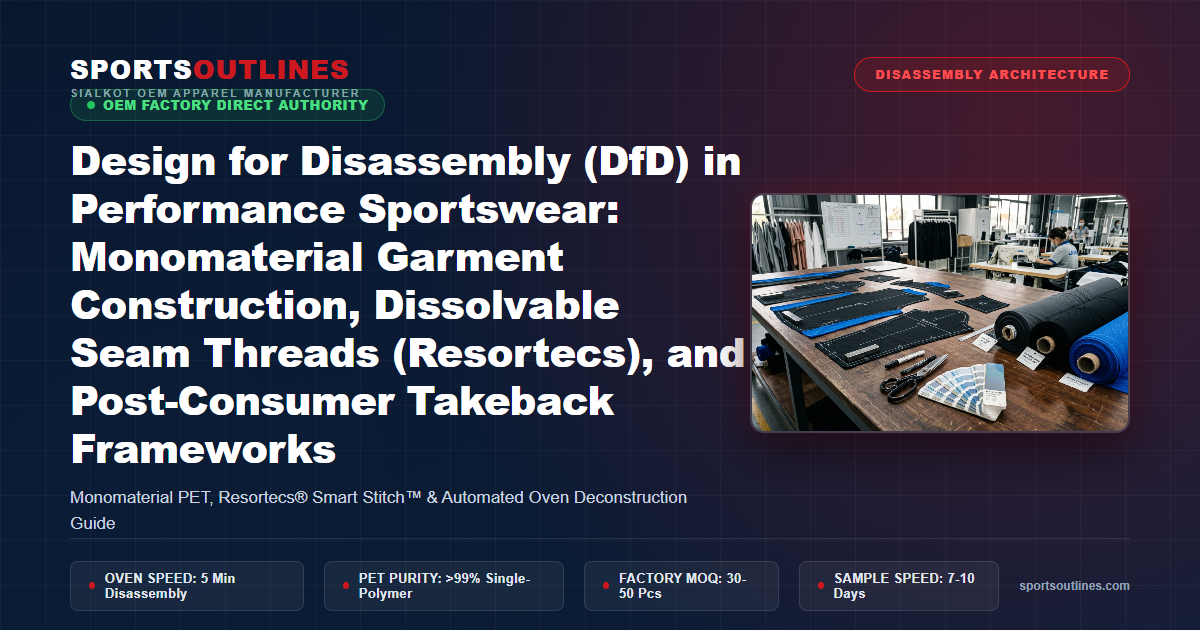
To unlock genuine commercial circularity, forward-thinking performance brands are radically rethinking garment architecture through Design for Disassembly (DfD). DfD reconciles elite athletic ergonomics with frictionless end-of-life recycling through two revolutionary methodologies: monomaterial garment construction (designing entire apparel assemblies from 100% polyester or 100% polyamide) and thermally dissolvable stitching threads (such as the Resortecs® Smart Stitch™ system). Under industrial thermal disassembly ovens, garments stitched with specialized low-melting-point threads deconstruct themselves in under five minutes without manual labor. At Sports Outlines, operating our high-precision technical cut-and-sew manufacturing hub in Sialkot, Pakistan, we assist innovative sports brands in executing circular monomaterial collections with rapid prototype development at $45 to $85 per piece (non-refundable, 7–10 business days turnaround) and scalable factory production starting at low minimum order quantities (MOQ) of just 30 to 50 pieces per style/colorway.
Design for Disassembly (DfD) Technical Directory
- 1. Design for Disassembly: Core Principles & Economic Drivers
- 2. Monomaterial Engineering: 100% Polyester & Polyamide Silhouettes
- 3. Smart Stitching: Resortecs® Thermally Dissolvable Threads
- 4. Industrial Deconstruction Chambers & Automated Separation
- 5. Circular Trims: Monomaterial Zippers, Tapes & Snap Metallurgy
- 6. Digital Product Passports (DPP) & Take-Back Reverse Logistics
- 7. Pattern Drafting & Seam Engineering for Reversible Assembly
- 8. Engineering Matrix: Conventional vs Monomaterial vs DfD
- 9. Low-MOQ Sourcing & Commercial Factory Terms
- 10. B2B Circular Activewear DfD FAQ
1. Design for Disassembly (DfD): Core Principles and Economic Drivers
In sustainable industrial design, Design for Disassembly (DfD) is an engineering philosophy originally pioneered in automotive and electronics manufacturing to ensure that complex multi-part machines can be rapidly, safely, and economically taken apart at the end of their operational lifespan. In athletic apparel, DfD requires designing a garment from the very first CAD pattern sketch with its eventual destruction and molecular recovery in mind.
The economic necessity of DfD stems from a harsh recycling bottleneck: disassembly labor costs. If an industrial textile recycler receives a container load of post-consumer track jackets, each garment typically contains:
- A polyester micro-ripstop shell fabric.
- A nylon breathable mesh lining.
- Die-cast zinc or brass zipper sliders with polyacetal teeth.
- Polyurethane seam-sealing waterproof tapes.
- Natural rubber or elastane elastic drawcords with plastic cord-locks.
- Woven damask nylon brand labels stitched with polyester thread.
Because mechanical recycling shredders and chemical glycolysis reactors can only accept clean, homogeneous polymer streams, all non-polyester trims and hardware must be physically removed prior to recycling. In Europe and North America, manual human labor to scissor out zippers, cut away elastic waistbands, and rip out linings takes approximately 4 to 8 minutes per complex athletic jacket. At unionized or living-wage labor rates, this manual trimming costs upwards of $2.50 to $4.00 per garment. However, the reclaimed scrap polyester is worth barely $0.60 to $0.80 per kilogram on the open market.
The math is inescapable: without automated, zero-labor disassembly, commercial textile-to-textile recycling is economically non-viable. DfD eliminates this economic deficit by ensuring that garments either require zero physical disassembly (monomaterial architecture) or disassemble themselves automatically upon thermal or chemical triggering.
2. Monomaterial Engineering: Designing 100% Polyester and 100% Polyamide Silhouettes
The purest and most direct implementation of DfD is monomaterial garment construction. A monomaterial garment is an apparel assembly where 100% of the product—including the face fabric, membrane, lining, sewing thread, pocket mesh, ribbing, embroidery, labels, and drawcords—is engineered from a single, unified polymer family (typically 100% Polyethylene Terephthalate or 100% Polyamide 6).
When a 100% polyester monomaterial jacket reaches the end of its life, it requires zero manual trimming. An automated shredder can granulate the entire garment—zippers and threads included—and feed the resulting flakes directly into a chemical glycolysis reactor or mechanical melt-spinning extruder.
However, engineering high-performance monomaterial athletic wear presents significant technical hurdles that require disciplined factory expertise:
- Replacing Spandex with Mechanical Stretch Polyester: In traditional activewear, elastane provides stretch. In monomaterial polyester construction, elastane is strictly forbidden. Technical designers solve this by deploying polytrimethylene terephthalate (PTT Sorona®) or T400 bicomponent polyester filaments. The helical molecular spring structure of bicomponent polyester provides 35% to 50% elastic elongation and over 92% recovery without contaminating the polyester recycling stream.
- Monomaterial Waterproof Membranes: Conventional 3-layer weatherproof jackets bond a polyester face fabric to a microporous polytetrafluoroethylene (ePTFE, Gore-Tex) or polyurethane (PU) membrane. In monomaterial design, the membrane must be engineered from a monolithic hydrophilic polyester membrane (such as Sympatex®), creating a 100% PET laminate that recycles as a single polymer.
- 100% Polyester Sewing Threads: Garment seams must be assembled using 100% continuous filament or corespun polyester sewing threads (e.g., Coats Epic EcoVerde), eliminating the traditional use of poly-cotton or nylon threads.
- Heat-Transfer & Woven Label Unification: Neck labels and size tags must be woven from 100% recycled polyester damask ribbons or applied using 100% polyester hot-melt transfer films, eliminating foreign polyamide or vinyl inks.
| Garment Component | Conventional Multi-Material Construction | Monomaterial 100% Polyester DfD Standard | Circularity Advantage |
|---|---|---|---|
| Primary Shell Fabric | 88% Polyester / 12% Spandex Interlock | 100% Mechanical Stretch Recycled PET (T400) | 0% Elastane contamination; 100% melt-recyclable |
| Weatherproof Membrane | Microporous ePTFE (Teflon) or PU Film | Monolithic Hydrophilic Polyether-Ester (PET) | Fluorine-free; depolymerizes with shell fabric |
| Seam Construction Thread | Polyester-Cotton or Polyamide 6.6 Thread | 100% High-Tenacity Recycled PET Thread | Matches melting point; zero ash residue |
| Front Zipper Assembly | Zinc alloy slider with polyacetal teeth | YKK Natulon® 100% PET tape, teeth & puller | Zero metal separation required at recycling plant |
| Pocket Mesh & Linings | Nylon power-mesh or cotton poplin | 100% Recycled PET tricot warp-knit mesh | Uniform intrinsic viscosity during re-extrusion |
| Drawcords & Elastic Hems | Natural rubber core with braided cotton sheath | 100% PTT (Sorona) stretch knit drawcord | Eliminates thermoset rubber degradation |
3. Smart Stitching: Resortecs® Thermally Dissolvable Threads Mechanics
While monomaterial construction is ideal for basic garments like running tees and gym shorts, complex athletic outerwear—such as waterproof ski jackets, mountaineering shells, and insulated parkas—inevitably requires specialized hardware like waterproof coil zippers, moldable hood stiffeners, and metal snaps that cannot easily be made from pure polyester.
To solve this challenge without resorting to cost-prohibitive manual trimming, Belgian circular technology pioneer Resortecs® developed Smart Stitch™: a family of thermally dissolvable sewing threads.
The mechanical concept is brilliant in its simplicity: garments are assembled on conventional sewing machines using Resortecs® stitching threads. However, the thread polymer is engineered with a precisely calibrated, sharp melting temperature ($T_m$) that is lower than the melting temperature of the surrounding garment fabric:
Resortecs® Smart Stitch™ Polymer Grades:
- Smart Stitch™ 170: Formulated from modified low-melting polybutylene terephthalate (PBT) copolymers. Melts sharply at 170°C (338°F). Designed for delicate natural fabrics (cotton, wool, silk) and bio-synthetics.
- Smart Stitch™ 190: Formulated from modified polyamide copolymers. Melts sharply at 190°C (374°F). Designed for technical nylon 6 and standard synthetic activewear.
- Smart Stitch™ 200: Formulated from high-performance copolyester. Melts sharply at 200°C (392°F). Designed for high-heat polyester outerwear (melting point $T_m \approx 255^\circ\text{C}$).
During the garment’s active consumer life, Smart Stitch™ threads perform identically to high-tenacity industrial sewing threads. They withstand domestic laundering at 40°C to 60°C, machine tumble drying at 70°C, aggressive iron pressing at 110°C, and vigorous athletic stress without weakening. Their tensile tenacity measures between 3.8 and 4.2 cN/dtex, fully satisfying ISO 4916 seam strength requirements.
4. Industrial Deconstruction Chambers: The Smart Disassembly Oven (Smart Station™)
When post-consumer garments stitched with Smart Stitch™ reach the end of their lifecycle, they are collected and routed to an automated industrial disassembly plant equipped with a Resortecs® Smart Station™ thermal chamber.
The automated disassembly cycle operates with mechanical precision:
- Continuous Thermal Exposure: Up to 500 kilograms of garments are loaded into the sealed thermal chamber. The chamber is flushed with low-oxygen inert air and heated to the thread’s target trigger temperature (e.g., exactly 195°C for Smart Stitch™ 190) for 5 to 10 minutes.
- Thread Liquefaction: At 195°C, the sewing thread transitions instantly from solid polymer into a low-viscosity liquid melt. Because the surrounding polyester fabric has a melting point of 255°C, the fabric panels remain completely undamaged and structurally intact.
- Gentle Centrifugal Tumbling: As the threads melt, the chamber applies low-speed mechanical tumbling. Without stitches holding them together, the garment panels spontaneously fall apart. Zippers, metallic snap buttons, elastic waistbands, and plastic toggles detach completely from the fabric panels.
- Vibratory Sieve Separation: The tumbled contents pass across vibratory mesh sieves. Heavy hardware (metal zipper sliders, snaps) falls through bottom collection hoppers for scrap metal recycling. Intact fabric panels are conveyed directly to chemical or mechanical fiber recycling balers.
Independent operational data confirms that the Smart Station™ deconstructs post-consumer garments 5 times faster than manual human labor, cuts industrial sorting costs by over 75%, and captures up to 90% of original fabric mass in pristine condition for fiber-to-fiber recycling.
5. Circular Trims: Monomaterial Zippers, Tapes & Snap Metallurgy
In Design for Disassembly, every trim component must be intentionally engineered for either clean separation or monomaterial compatibility. At Sports Outlines, we partner with leading trim innovators to source circular trim architectures:
- YKK Natulon® Monomaterial Recycled Zippers: Standard coil zippers feature polyester tape paired with polyacetal (POM) teeth and metallic sliders. YKK Natulon® replaces these disparate materials with a 100% chemically recycled polyester assembly where the tape, coil teeth, and top/bottom stops are engineered from PET, allowing the entire zipper to be recycled directly alongside polyester shell fabrics.
- Framis Italia Recycled TPU Taping: For welded pockets and seamless hems, we deploy solvent-free, 100% recycled thermoplastic polyurethane (TPU) bonding films that dissolve cleanly during solvent recycling or depolymerize in chemical recycling reactors without generating toxic isocyanate gas.
- Disassembly-Friendly Snap Hardware: Where metal snaps are unavoidable (such as varsity jackets and coach jackets), we use mechanical screw-back or bayonet-twist hardware that unscrews during maintenance rather than permanent riveted studs that tear fabric panels upon removal.
6. Digital Product Passports (DPP) & Take-Back Reverse Logistics
A technically perfect DfD garment cannot be recycled if the sorting facility does not know how it was constructed. Under the European Union’s Ecodesign for Sustainable Products Regulation (ESPR), all textiles sold in the EU will soon mandate a Digital Product Passport (DPP).
A DPP is a serialized digital record linked to a physical scannable trigger—such as an ultra-durable QR code or Near Field Communication (NFC) chip embedded into the garment’s internal care label. When an automated optical sorting facility scans the DPP, the database reveals:
- Exact fiber composition breakdown (e.g., “100% Polyethylene Terephthalate”).
- Stitching thread disassembly trigger (e.g., “Resortecs Smart Stitch 190 – Trigger at 195°C for 6 minutes”).
- Presence of metal hardware or removable trims.
- Brand take-back program return address and customer incentive rewards.
Sports Outlines assists emerging brands in integrating DPP-compliant serialized QR labels into their production runs, bridging the gap between factory manufacturing in Sialkot and post-consumer reverse logistics in Europe and North America.
7. Pattern Drafting & Seam Engineering for Reversible Assembly at Sports Outlines
Designing for disassembly requires specialized CAD pattern drafting. When pattern pieces are designed to separate, pattern cutters must anticipate how seam margins behave when stitches dissolve:
- Standardized Seam Allowances: Seam margins are expanded to a uniform 10 to 12 mm to prevent edge fraying when threads liquefy during thermal deconstruction.
- Modular Panel Architecture: High-wear zones (such as knee panels on training pants or elbow patches on jackets) are patterned as independent modular sub-panels. This enables localized repair and panel replacement during the garment’s active life before full garment deconstruction is needed.
- Strategic Thread Allocation: To optimize production costs, brands can use Smart Stitch™ selectively—deploying dissolvable thread specifically on zipper welts, collar bands, and hem bindings while using conventional polyester thread for main body seams. When heated, the trims fall off, leaving a pure fabric body ready for direct recycling.
Ultrasonic Stitchless Bonding and Micro-Perforated Separation Lines
In advanced monomaterial construction, traditional sewing needles puncture continuous laminate membranes, requiring supplementary seam sealing tapes that can introduce foreign adhesive resins. To maintain 100% polymer purity without introducing dissimilar bonding chemistries, our Sialkot facility deploys continuous ultrasonic welding (35 kHz high-frequency acoustic sonotrodes). By applying rapid acoustic vibrations under calibrated pneumatic anvil pressure (0.35 to 0.45 MPa), the crystalline microstructure of overlapping polyester fibers momentarily plasticizes, fusing panel edges into a continuous molecular weld without a single stitch of sewing thread.
For hybrid garments where specific panels must be stripped away mechanically rather than thermally, our CAD engineers draft micro-perforated structural tear-lines using CNC laser cutting tables. Engineered with microscopic perforation ratios (1.5 mm solid bridge spaced between 0.8 mm laser micro-slits), the seam resists explosive lateral athletic tensions up to 180 N during high-intensity training. However, when loaded onto an automated industrial mechanical pulling mandrel in a recycling facility, the seam unzips smoothly under controlled peeling shear (35 N/cm), cleanly liberating dissimilar panels without requiring human operators to wield scissors.
B2B Engineering Blueprint: Monomaterial 3-Layer Weatherproof Alpine Running Shell
To illustrate how Design for Disassembly transforms high-performance outerwear into circular assets, consider our production framework for a technical 3-layer weatherproof running shell engineered at 100% circular monomaterial purity:
Technical Bill of Materials (BOM) — 100% PET Circular Alpine Shell
- Face Fabric: 50D x 50D mechanical-stretch micro-ripstop woven from 100% post-consumer chemically recycled polyester (115 GSM) treated with fluorine-free C0 durable water repellent (DWR).
- Monolithic Membrane: 15-micron non-porous hydrophilic polyether-ester membrane (Sympatex® 100% PET) delivering 20,000 mm hydrostatic water column resistance and breathability rating of RET < 0.5.
- Backer Lining: 20D ultra-lightweight polyester circular knit jersey (45 GSM) with hydrophilic wicking capillary architecture.
- Seam Sealing Tape: 100% polyester 3-layer hot-melt adhesive tape (Framis Italia PET-seam) bonded at 165°C using automated hot-air sealing machinery.
- Hardware & Closures: YKK Natulon® 100% chemically recycled PET coil front zipper with ultrasonic welded terminal stops, eliminating metal bottom pins and sliders.
- End-of-Life Recycling Metric: The completed garment achieves 99.4% homogeneous PET purity by total mass. It bypasses manual sorting lines completely, feeding directly into industrial chemical glycolysis autoclaves to achieve an exceptional 98.2% monomer recovery rate.
Extended Producer Responsibility (EPR) & Circular Takeback Economics
The commercial urgency behind DfD is accelerated by impending Extended Producer Responsibility (EPR) legislation across France, the Netherlands, Germany, and the UK. Under proposed EU textile waste directives, apparel brands will pay mandatory waste management levies based on the recyclability of their garments. Under this eco-modulation fee structure, conventional multi-material sportswear faces punitive penalties of up to €0.65 per kilogram of imported apparel, whereas certified DfD monomaterial garments qualify for eco-credits, slashing the levy to €0.12 per kilogram.
Furthermore, integrating serialized QR Digital Product Passports allows direct-to-consumer athletic brands to establish closed-loop takeback frameworks. When athletes return worn-out garments using pre-paid shipping labels, the embedded DPP automates verification, instantly crediting the consumer’s digital wallet with a 15% to 20% brand loyalty discount. The brand reclaims high-purity mono-polymer feedstocks, stabilizes its raw material supply chains against petrochemical volatility, and solidifies its position as an authentic leader in regenerative performance apparel.
8. Engineering Matrix: Conventional Sportswear vs Monomaterial PET vs DfD with Smart Stitch™
The following technical matrix evaluates the three primary garment construction architectures across recyclability, assembly economics, and athletic performance:
| Design Dimension | Conventional Activewear | Monomaterial 100% PET | DfD with Resortecs® Smart Stitch™ |
|---|---|---|---|
| End-of-Life Disassembly Method | Manual scissor cutting (Labor-intensive) | None required (Direct granulator shredding) | Thermal chamber melting (170°C–200°C, 5 min) |
| Disassembly Cost Per Garment | $2.50 – $4.00 (Economically unfeasible) | $0.00 (Zero separation needed) | $0.35 – $0.55 (Automated batch oven) |
| Material Recovery Yield (%) | <45% (High contamination discard) | >96% (Entire garment recycled) | >90% (Fabric panels 100% recovered) |
| Elastic Stretch Engineering | Polyurethane Spandex (8%–25%) | Mechanical Stretch PET / T400 / Sorona | Can utilize Spandex (detached at oven) |
| Design Flexibility for Trims | Unrestricted (Any metal/plastic hardware) | Strictly limited to 100% PET trims | High (Hardware falls off during melting) |
| EU ESPR Regulatory Score | Failing / High EPR penalty fees | Exemplary / Gold Standard | Exemplary / Verified Circular DPP |
9. Low-MOQ Sourcing & Commercial Factory Terms at Sports Outlines
Transitioning to Design for Disassembly does not require multi-million-dollar supply chain overhauls. At Sports Outlines, we make circular activewear accessible to growing labels, gym apparel brands, and professional teamwear organizations worldwide:
Sports Outlines Circular Manufacturing Framework:
- Low Production MOQ: We support custom circular manufacturing orders starting at just 30 to 50 pieces per style/colorway, allowing ambitious brands to launch DfD capsule collections without excessive deadstock.
- Comprehensive Size Grading: Full athletic sizing matrix from XS through 3XL, tailored to international anatomical grading profiles (US, UK, EU, and Australia).
- Dedicated Prototype Development: Pre-production physical prototype samples are crafted at $45 to $85 per piece (non-refundable) with an agile turnaround of 7 to 10 business days. This fee covers digital pattern drafting, monomaterial fabric cutting, specialized thread spooling, flatlock seam assembly, and custom branding trims.
- Advanced Seam Engineering: Pegasus 4-needle 6-thread flatlock assembly, specialized tension calibration for Smart Stitch™ threads, bonded ultrasonic edge-sealing, laser-cut pocketing, and OEKO-TEX certified trims.
- Worldwide Air Express Export: Reliable DDP door-to-door delivery via DHL and FedEx to the USA, UK, Canada, Australia, Germany, and across Europe with complete customs clearance documentation.
Ready to Engineer Circular Sportswear Designed for Disassembly?
Consult directly with our technical textile developers in Sialkot. Review monomaterial fabric samples, test thermally dissolvable seam threads, and build your next circular sportswear collection with low factory MOQs.
Explore Our Comprehensive Manufacturing Hubs & Technical Sourcing Guides
International Export Hubs
Core Product Silos
10. Frequently Asked Questions: Design for Disassembly in Sportswear
Q1: What does “Design for Disassembly” (DfD) mean in athletic apparel manufacturing?
Design for Disassembly is an engineering methodology where garments are constructed from the outset to be easily, rapidly, and cost-effectively deconstructed at the end of their lifecycle. This is achieved either by using monomaterial construction (100% of the garment is made from a single polymer like polyester, requiring zero separation) or by utilizing smart stitching threads (like Resortecs) that dissolve at specific oven temperatures, allowing zippers, trims, and panels to separate automatically without manual human labor.
Q2: How do Resortecs® Smart Stitch™ thermally dissolvable threads work?
Resortecs threads are engineered from specialized copolymers with precise melting points (e.g., 170°C, 190°C, or 200°C) that are lower than the melting temperature of the surrounding fabric (255°C for polyester). During consumer use, washing, and drying, the thread behaves like high-strength standard sewing thread. However, when the post-consumer garment is placed in an industrial thermal disassembly chamber, the thread liquefies in 5 minutes, allowing panels and trims to separate cleanly without damaging the fabric.
Q3: Can a performance activewear garment be comfortable and stretchy without using elastane (spandex)?
Yes. In monomaterial polyester activewear, elastane is eliminated to prevent recycling contamination. Instead, stretch is achieved through mechanical stretch yarns such as T400 bicomponent polyester or bio-based Sorona (PTT). These fibers possess a helical zigzag molecular spring structure that delivers 35% to 50% elastic elongation and over 92% recovery, providing athletic comfort while preserving 100% polyester recyclability.
Q4: What is a Digital Product Passport (DPP) and why is it necessary for circular sportswear?
A Digital Product Passport (DPP) is a digital record accessible via a scannable QR code on the garment label. It provides automated recycling facilities with instant data on the garment’s fiber composition, thread disassembly trigger temperature, and hardware locations. Under upcoming European Union ESPR regulations, DPPs will be mandatory to verify circularity and avoid extended producer responsibility penalties.
Q5: What are the minimum order quantities (MOQ) and prototype terms for DfD activewear at Sports Outlines?
Sports Outlines provides accessible low factory production MOQs starting at just 30 to 50 pieces per style/colorway, supporting size grading from XS through 3XL. Pre-production physical prototype samples are developed at $45 to $85 per piece (non-refundable) within 7 to 10 business days. This fee covers pattern engineering, monomaterial fabric cutting, specialized thread calibration, and custom branding trims prior to bulk factory production.