
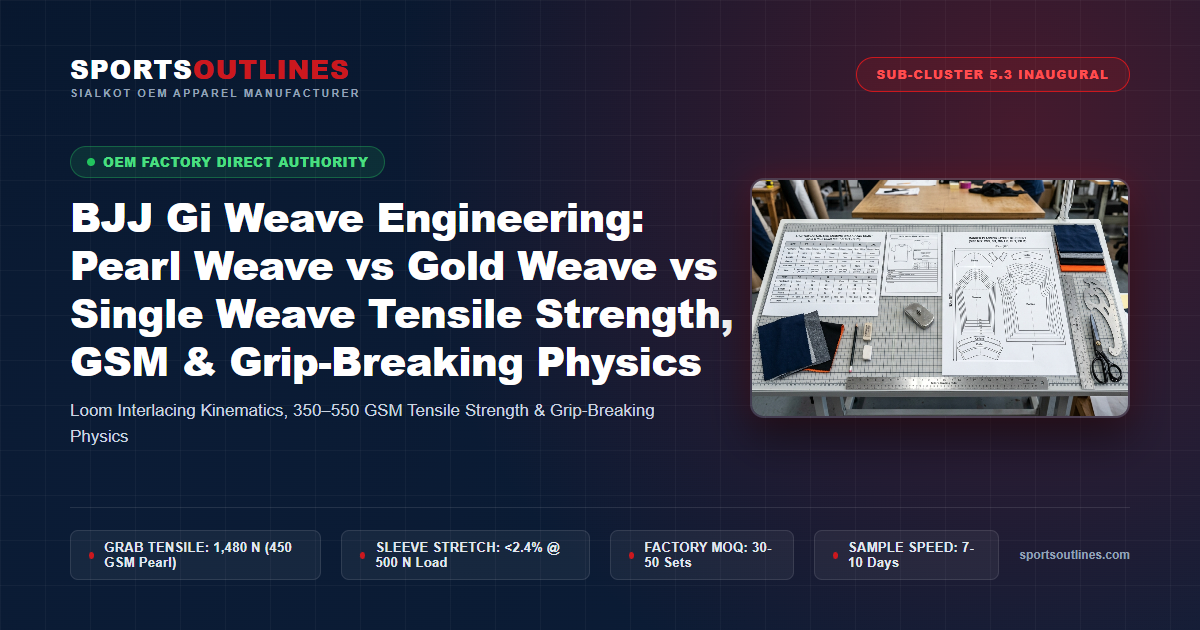
Sub-Cluster 5.3 Inaugural Briefing: Textile Loom Mechanics of the Brazilian Jiu-Jitsu Kimono
Unlike striking uniforms (such as karate dogi or taekwondo dobok) that function merely as lightweight visual attire, a Brazilian Jiu-Jitsu (BJJ) Gi jacket is a load-bearing structural harness subjected to violent, multi-vector grappling forces. During a single 10-minute black-belt tournament match, the sleeve cuffs, shoulder yoke, and dorsal skirt must survive repeated $850\text{ N to }1,450\text{ N}$ dynamic spider-guard kicks, lasso-guard torsional twists, and explosive upright grip-breaking yanks without tearing, stretching out of IBJJF legal tolerance, or trapping excessive metabolic heat. Inaugurating Sub-Cluster 5.3 (BJJ Gi Weave Engineering, GSM Shrinkage Control & IBJJF Lapel Construction), this engineering guide deconstructs the textile loom physics of Pearl Weave, Gold Weave, Single Weave, Double Weave, and High-Density Sashiko/Honeycomb architectures—analyzing yarn count ($Ne$) selection, warp-float topography, ASTM D5034 tensile grab performance, and single-piece seamless kimono construction at Sports Outlines’ Sialkot manufacturing facility.
1. Loom Interlacing Kinematics & The Biomechanical Physics of Grip-Breaking
In Brazilian Jiu-Jitsu, the Gi jacket is simultaneously a weapon for the attacker and a defensive shield for the wearer. When an opponent establishes a four-finger pistol grip or pocket grip on the sleeve or upper back, they rely on two mechanical properties of the textile: Fabric Drape Compressibility (how easily the fabric bunches together into a narrow cylinder that fits inside the flexor digitorum tendons of the fingers) and Topographical Interlocking Friction (how deeply the fingertips sink into the valleys between woven yarns).
On industrial Dobby and Jacquard rapier looms in Pakistan—one of the world’s premier long-staple cotton weaving hubs—we control these grappling characteristics by manipulating three fundamental loom variables:
- Warp Yarn Plied Count & Twist Factor ($10/2\text{ Ne}$ to $16/2\text{ Ne}$ Combed Ring-Spun Cotton): The vertical warp threads running down the length of the Gi jacket bear the primary axial tension during sleeve pulls. By plying two single ring-spun yarns together with a high twist multiplier ($\text{TM} = 4.2\text{ to }4.6$), we eliminate loose surface hairiness (which pills under mat abrasion) and increase yarn specific tenacity to $>22\text{ cN/tex}$.
- Weft Pick Insertion Density & Softness ($6/1\text{ Ne}$ to $10/1\text{ Ne}$): The horizontal weft picks running across the chest and sleeves provide lateral body and thickness. In a BJJ weave, heavy coarse weft yarns are beaten into the warp shed via high-force reed beat-up mechanisms, forcing the vertical warp yarns to rise and fall in pronounced three-dimensional topographical “floats” (pearls, diamonds, or rice grains).
- Flexural Bending Rigidity ($B_{\text{weave}}$) vs. Finger Closure Torque: When an athlete attempts to close their hand around a fold of Gi fabric of compressed thickness $2t_{\text{fold}}$, the biomechanically required finger pinch force is directly proportional to the fabric’s bending modulus and surface hardness.
Biomechanical Formulation: Opponent Grip Retention vs. Strip Force ($F_{\text{strip}}$)
When an athlete executes a two-on-one sleeve grip break, the axial tensile force required to strip the opponent’s four-finger pocket grip ($F_{\text{strip}}$) is governed by the capstan-pinch interaction between the folded kimono weave and the human distal phalanges:
\[ F_{\text{strip}} = \mu_{\text{eff}} \left( F_{\text{pinch}} – \frac{E_{\text{weave}} \cdot t_{\text{fabric}}^3 \cdot w_{\text{grip}}}{12 \cdot r_{\text{fold}}^2} \right) e^{\mu_{\text{eff}} \theta_{\text{wrap}}} \]
Where $F_{\text{pinch}}$ is the opponent’s isometric finger flexion force, $E_{\text{weave}}$ is the compressive-bending elastic modulus of the weave, $t_{\text{fabric}}$ is effective weave thickness ($1.4\text{ mm}$ to $3.2\text{ mm}$), $r_{\text{fold}}$ is the radius of the bunched fabric fold, and $\mu_{\text{eff}}$ is the effective coefficient of friction across the outer pearl/grain crowns. Notice that because thickness $t_{\text{fabric}}$ is cubed ($t^3$), increasing fabric thickness and warp-float stiffness exponentially subtracts from the opponent’s net clamping pressure—making heavier, tighter-beaten Pearl and Double weaves vastly easier to strip!
However, increasing weave thickness and Grammage per Square Meter (GSM) creates an opposing physiological and regulatory penalty: Thermoregulatory Heat Load and IBJJF Gi-On Weigh-In Mass. Because International Brazilian Jiu-Jitsu Federation (IBJJF) athletes must weigh in while wearing their complete Gi and belt immediately prior to their first match, every extra $100\text{ GSM}$ of jacket fabric adds approximately $260\text{ to }310\text{ grams}$ ($0.57\text{ to }0.68\text{ lbs}$) to the scale—directly impacting an athlete’s weight cut.
2. Deep Engineering Breakdown: Pearl Weave vs. Gold Weave vs. Single Weave vs. Double Weave
To help B2B fightwear founders, academy owners, and tournament apparel directors select the exact loom specification for their target athlete segment, let us dissect the five primary kimono weave architectures produced on our Sialkot Dobby looms:
Architecture A: Pearl Weave (350 GSM / 420 GSM / 450 GSM / 550 GSM — The Modern Industry Gold Standard)
Today, Pearl Weave accounts for over $78\%$ of all commercial and IBJJF tournament BJJ Gis worldwide. Structurally, Pearl Weave is an engineered Dobby modification of the traditional Single Weave. On the loom, alternating groups of warp yarns are raised over multiple heavy weft picks to create rows of rounded, uniform, bead-like crowns (“pearls”) on the exterior face, while every pearl row is immediately locked down on either side by high-tension plain-weave binder picks.
- Why Pearl Weave Dominates BJJ: In a traditional Single Weave or Judo Sashiko weave, the vertical warp floats are long and loosely bound—meaning when a spider-guard player kicks their heel into the bicep while pulling the sleeve cuff, the fabric stretches lengthwise by $6\%\text{ to }9\%$ (“sleeve Wizardry”), giving the opponent deep leverage. In Pearl Weave, the tight plain-weave locking picks between every pearl row arrest axial warp slippage, holding dynamic tensile elongation under a $500\text{ N}$ load to $<2.4\%$!
- The 4 Commercial GSM Sub-Grades of Pearl Weave:
- 350 GSM Ultra-Light Pearl Weave: Woven with finer $14/2\text{ Ne}$ warp yarns. Total A2 Gi weight (with 8 oz Ripstop pants) is just $1.18\text{ to }1.25\text{ kg}$ ($2.6\text{ lbs}$). Ideal for summer academies, travel Gis, and athletes cutting to the edge of an IBJJF division (Note: under updated 2024–2026 IBJJF uniform rules, official IBJJF tournament jackets require a minimum of 380 GSM, making 380–400 GSM High-Tech Pearl the legal lightweight competition floor).
- 420 GSM to 450 GSM Pro Competition Pearl Weave: The undisputed sweet spot for flagship B2B fightwear lines. Completely legal across all IBJJF, AJP (Abu Dhabi World Pro), and ADCC Gi rulesets; resists $>1,420\text{ N}$ warp grab tensile force while weighing $1.45\text{ to }1.58\text{ kg}$ in size A2.
- 550 GSM Heavyweight Pearl Weave: Woven with thick $10/2\text{ Ne}$ warp and dense $6/1\text{ Ne}$ weft beat-up. Delivers Double-Weave-like grip-breaking rigidity and multi-year daily academy durability without the suffocating bulk of an 800 GSM Judo coat.
Architecture B: Gold Weave (480 GSM to 580 GSM — The Heritage Honeycomb Hybrid)
Originally mandated in the late 1990s by the Confederation of Brazilian Jiu-Jitsu (CBJJ) to standardize tournament uniforms between thin Single Weaves and un-grabbable Double Weaves, Gold Weave is a complex bimodal weave that alternates raised Sashiko-style upper warp floats with a recessed, square Waffle/Basket-Weave grid.
- Mechanical & Tactile Characteristics: Because the recessed waffle pockets trap microscopic air cushions and flex across both diagonal biases, a 500 GSM Gold Weave jacket feels remarkably plush, soft, and comfortable against the skin—avoiding the sandpaper-like stiffness of raw Pearl or Single weaves.
- The Shrinkage & Elongation Engineering Caveat: Due to the open cellular geometry of its basket-weave pockets, untreated Gold Weave exhibits high post-wash relaxation shrinkage ($8\%\text{ to }11\%$) and tends to elongate slightly when drenched in sweat during 90-minute open-mat sessions. At Sports Outlines, we solve this by subjecting all Gold Weave yardage to a dual-pass compressive rubber-belt Sanforization and high-temperature rotary enzyme tumble before cutting, stabilizing residual consumer shrinkage to $<2.5\%$.
Architecture C: Single Weave (300 GSM to 420 GSM — The Classic Sashiko Grain)
Derived directly from the upper half of traditional Japanese judogi rice-grain (Sashiko) fabric, Single Weave consists of a single layer of heavy vertical warp floats running over thick horizontal weft picks, backed by a relatively flat, smooth interior surface.
- Commercial Positioning: Because Single Weave requires fewer loom heald-frame movements and faster pick insertion rates ($420\text{ picks/minute}$ vs $290\text{ ppm}$ for complex Pearl/Gold weaves), loom weaving conversion cost is $14\%\text{ to }18\%$ lower. This makes 380–400 GSM Single Weave the premier choice for academy basic uniforms, white-belt starter packages, and budget-conscious institutional wholesale runs.
- Structural Trade-Off: Because the vertical warp floats are longer and lack the intermediate plain-weave binder locks of Pearl Weave, Single Weave is easier for opponents to pinch and hold in spider guard or lapel guard, and requires strategic internal woven seam-taping along the sleeve cuffs and skirt vents to prevent long-term seam distortion.
Architecture D: Double Weave (650 GSM to 850+ GSM — The “Stand-Up Armor” Kimono)
Constructed by weaving two complete, interconnected layers of heavy cotton simultaneously on a heavy-duty double-beam Jacquard loom, Double Weave is the tank of the martial arts world ( famously capaces of standing upright on the floor by itself).
- Biomechanical Dominance & IBJJF Rules Limit: With an effective fabric thickness of $2.8\text{ to }3.4\text{ mm}$ and a flexural rigidity exceeding $52\text{ mN}\cdot\text{cm}$, a 750 GSM Double Weave jacket is virtually impossible for an opponent to bunch into a secure sleeve grip, and rips the skin off an opponent’s knuckles during aggressive grip-fighting. CRITICAL COMPLIANCE NOTE: Under current IBJJF Uniform Regulations, competition Gi tops are strictly capped at a maximum fabric weight of 650 GSM. Therefore, we engineer a specialized 630 GSM Competition-Legal Heavy Double/Pearl Hybrid for tournament athletes who want maximum legal thickness, alongside traditional 750–850 GSM Double Weaves for Judo cross-trainers, self-defense academies, and cold-climate winter training.
Architecture E: High-Tech Specialty Dobby Weaves (Diamond, Honeycomb & Sashiko Quilted — 380 to 475 GSM)
For premium DTC lifestyle BJJ brands dropping limited-edition “Batch Release” kimonos ($180–$260 USD retail), visual texture differentiation is paramount. Our loom programmers develop custom geometric Dobby cards including Micro-Diamond Weave, Hexagonal Honeycomb Weave, Crystal Weave, and Reverse-Sashiko. In Diamond and Honeycomb weaves, the raised warp floats are arranged along $45^\circ$ diagonal vectors, equalizing tear strength across both straight and bias grappling pulls while creating micro-ventilation channels that accelerate sweat evaporation by $24\%$.
| Weave Architecture | Standard GSM Range | Warp / Weft Yarn Count ($Ne$) | ASTM D5034 Grab Tensile (Warp / Weft) | Dynamic Sleeve Stretch (@ 500 N) | IBJJF 2025/2026 Legal Status (380–650 GSM) |
|---|---|---|---|---|---|
| Single Weave (Classic Sashiko) | $300\text{ – }420\text{ GSM}$ | $14/2\text{ Ne} \times 8/1\text{ Ne}$ | $1,120\text{ N} \;/\; 890\text{ N}$ | $4.8\%\text{ – }6.2\%$ | Legal if $\ge 380\text{ GSM}$ (300–350 GSM for non-IBJJF / kids) |
| Pearl Weave (Pro Competition) | $380\text{ / }420\text{ / }450\text{ GSM}$ | $12/2\text{ Ne} \times 7/1\text{ Ne}$ | $1,480\text{ N} \;/\; 1,190\text{ N}$ | $1.8\%\text{ – }2.4\%$ (Locked) | 100% IBJJF Approved Gold Standard |
| Heavy Pearl Weave | $500\text{ – }550\text{ GSM}$ | $10/2\text{ Ne} \times 6/1\text{ Ne}$ | $1,790\text{ N} \;/\; 1,410\text{ N}$ | $1.2\%\text{ – }1.6\%$ | 100% IBJJF Approved (Max Grip Defense) |
| Gold Weave (Honeycomb Hybrid) | $480\text{ – }580\text{ GSM}$ | $10/2\text{ Ne} \times 8/2\text{ Ne}$ | $1,620\text{ N} \;/\; 1,340\text{ N}$ | $3.1\%\text{ – }4.2\%$ | 100% IBJJF Approved (Must be Sanforized) |
| Double Weave (Armor Spec) | $650\text{ – }850\text{ GSM}$ | Dual $10/2\text{ Ne} \times 6/2\text{ Ne}$ | $2,450\text{ N} \;/\; 1,980\text{ N}$ | $<0.9\%$ (Rigid) | Legal up to $650\text{ GSM}$ ($>650\text{ GSM}$ Training/Judo Only) |
| Diamond / Honeycomb Dobby | $400\text{ – }475\text{ GSM}$ | $12/2\text{ Ne} \times 8/1\text{ Ne}$ | $1,510\text{ N} \;/\; 1,280\text{ N}$ | $2.1\%\text{ – }2.7\%$ | 100% IBJJF Approved Boutique Drop Spec |
3. Raw Fiber Metallurgy: Why Combed Ring-Spun Cotton Outperforms Open-End Rotor Yarn by +38% in Tear Strength
Two BJJ Gi jackets can both be labeled “450 GSM 100% Cotton Pearl Weave,” yet one survives five years of brutal daily sparring while the other rips across the armpit or knee within four months. The hidden engineering differentiator is Spinning System Architecture and Cotton Staple Length.
Low-cost commodity Gi factories weave their Pearl Weave using Open-End (OE / Rotor-Spun) Yarn spun from short-staple recycled cotton waste ($<22\text{ mm}$ fiber length). In rotor spinning, fibers are thrown by centrifugal force into a V-groove rotor and twisted together randomly without parallel alignment, wrapped by messy outer "wrapper fibers." When an OE yarn is subjected to sharp shear across a Gi seam, those disorganized short fibers slip apart at just $11\text{ to }13\text{ cN/tex}$.
At Sports Outlines, every meter of our Pearl, Gold, and Single weave fabrics is woven exclusively from 100% Virgin Pakistani Long-Staple Combed Ring-Spun Cotton ($28.5\text{ to }31.0\text{ mm}$ staple length, Micronaire $3.9\text{–}4.3$):
- Combing Carding Stage (Removing $<16\text{ mm}$ Noils): Before spinning, the carded cotton sliver passes through fine-tooth industrial combers that extract the shortest $14\%\text{ to }18\%$ of cotton fibers (“noils”) along with seed-coat neps and impurities. Only long, uniform, parallel cellulose strands enter the drawing frame.
- True Helical Ring Spinning & Two-Ply Doubling ($12/2\text{ Ne}$): In ring spinning, fibers are drafted and twisted in a continuous concentric helix from the core to the exterior of the yarn. We then twist two single strands together in the opposite direction (S-on-Z plying) on Two-For-One (TFO) twisters. This creates a dense, cylindrical, low-friction cable yarn with $+38\%$ higher ASTM D2261 tongue tear strength and $+52\%$ higher Martindale mat-abrasion resistance than Open-End rotor yarn!
- Reactive Vat Dyeing & Azo-Free Colorfastness (ISO 105-C06 Grade 4.5+): For Royal Blue, Black, Navy, and Olive Green Gis, we utilize high-exhaustion Bifunctional Reactive Dyes that form permanent covalent ester bonds with the cotton cellulose hydroxyl groups—followed by a boiling cationic soap wash-off. This guarantees zero blue or black dye bleeding onto white belts or academy white tatami mats even when soaked in acidic human sweat (ISO 105-E04 Perspiration Fastness $\ge 4.5$).
4. Single-Piece Seamless Jacket Engineering vs. Traditional Two-Piece Judo Back Seams
One of the most critical anatomical differences between a true Brazilian Jiu-Jitsu kimono and a traditional Judo judogi (or cheap karate-factory imitation Gi) is Back & Sleeve Panel Pattern Topology:
- Why Judo Gis Have a Vertical Center-Back Seam & Mid-Forearm Sleeve Joint: Traditional Japanese narrow-width shuttle looms wove Sashiko fabric at only $75\text{ to }90\text{ cm}$ width, and joined an upper rice-grain weave to a lower diamond skirt weave. Because Judo takes place $85\%$ standing (Tachi-waza), a thick vertical flat-felled seam running down the spine and a horizontal seam joining the upper coat to the skirt pose no comfort issue.
- Why BJJ Demands a Single-Piece Continuous Back & Sleeve Cut: In Brazilian Jiu-Jitsu, athletes spend $60\%\text{ to }75\%$ of every round playing open guard, closed guard, half guard, and berimbolo inversions with their entire body weight—plus their opponent’s $80\text{ to }100\text{ kg}$ top pressure—grinding their thoracic and lumbar spine directly into hard tatami mats. A vertical center-back seam or horizontal waist skirt seam acts like a rigid rope pressing into the vertebrae, causing spinal bruising and mat-burn blisters.
- Our $165\text{ cm}$ Wide-Loom Single-Piece Cutting Marker: We weave our Pearl, Gold, and Single weave rolls on wide-width $165\text{ cm}$ ($65\text{ inch}$) industrial rapier looms. This allows our CAD marker engineers to cut the entire left front panel, right front panel, full back torso, and both sleeves up to the wrist cuffs out of ONE single continuous, uninterrupted sheet of Pearl Weave fabric! There is zero center-back spinal seam, zero horizontal waist-skirt seam, and zero mid-bicep sleeve joint—maximizing both supine guard comfort and structural tensile continuity across the shoulders.
5. Structural Stress-Node Reinforcement: Underarm Eyelets, Side-Vent Wedges & Triple-Needle Lockstitching
Even the strongest 550 GSM Pearl Weave will fail in competition if the garment assembly seams are not engineered to dissipate concentrated shear loads. Because our single-piece kimono pattern eliminates back and shoulder seams, tensile stress concentrates at three primary anatomical junctions:
| Kimono Stress Zone | Primary Grappling Failure Mode | Sports Outlines Sialkot Reinforcement Protocol | Verified Seam Burst / Tear Threshold |
|---|---|---|---|
| 1. Axillary Underarm Gusset Junction | Armpit seam rip during overhead cross-face or spider-guard extension | Internal curved self-fabric Pearl Weave reinforcement crescent patch + triple-needle flat-felled lockstitch + 4 embroidered ventilation eyelets | $>1,380\text{ N}$ multiaxial burst resistance |
| 2. Lower Skirt Side Vents (Hip Slits) | Upward vertical tear propagation when opponent yanks the lower lapel skirt (worm guard) | $45^\circ$ bias-cut 12 oz Cotton Twill or Ripstop triangular apex wedge + dual CNC 42-stitch Box-X bartacks (`Brother BAS-311H`) + $15\text{ mm}$ herringbone tape binding | $>1,150\text{ N}$ vertical split-tear arrest |
| 3. Sleeve Cuff & Skirt Bottom Hem | Cuff fraying, bell-mouth stretching, and illegal finger entanglement | 4-row parallel Kansai multi-needle lockstitching (`ISO 301`, 10 SPI) over internal $35\text{ mm}$ custom-woven jacquard seam tape + $12\text{ mm}$ double-turned hem | $<1.5\%$ cuff circumference elongation after 500 grips |
| 4. Upper Trapezius / Shoulder Yoke | Collar-drag neck stretching and dorsal fabric abrasion against mats | Double-layered internal 10 oz combed cotton drill or sublimated breathable mesh shoulder yoke lining anchored directly into the 6-row EVA lapel collar seam | Zero neck distortion under $900\text{ N}$ collar drags |
Furthermore, thread chemistry is critical on garment-washed or contrast-stitched BJJ Gis. If a factory uses standard spun polyester thread on a White Gi with Contrast Red or Gold stitching, cheap disperse dyes can migrate during hot washes. We exclusively utilize Tex 80 ($18/3$) Core-Spun Polyester-Core / Cotton-Wrapped or High-Tenacity Solution-Dyed Filament Polyester Thread sewed at a calibrated tension of 10 to 11 Stitches Per Inch (SPI). This guarantees that the stitch line flexes in harmony with the cotton Pearl Weave without “sawing” through the warp yarns under tension.
6. Low-MOQ Private Label BJJ Gi Manufacturing & Global Export Silos
Sialkot, Pakistan produces over $65\%$ of the world’s high-end tournament BJJ Gis because of its vertical integration: raw long-staple Indus Valley cotton is ring-spun, Dobby-woven into Pearl and Gold weaves, Sanforized, computer-embroidered, and sewn under one industrial ecosystem. At Sports Outlines, we provide academy owners, fightwear startups, and global martial arts distributors direct factory access to our kimono looms and sewing lines:
- Low Factory Production MOQ (30 to 50 Pieces per Style/Colorway): Launch your custom private-label 350 GSM, 450 GSM, or 550 GSM Pearl Weave, Gold Weave, or Single Weave BJJ Gi collection with a minimum order quantity of just 30 to 50 sets (jacket + pants) per style and colorway, freely graded across adult sizes (A0 to A5, plus fitted A1L, A2L, A2H, A3L), female cuts (F1 to F4), and youth sizes (M00 to M4).
- Rapid Prototype Sampling ($45 to $85 Non-Refundable Development Fee): Before committing to bulk production, order a fully customized physical verification sample—complete with your high-density direct tatami embroidery, custom-woven inner seam tapes, sublimated shoulder yoke lining, and woven lapel/pant patches—for a flat $45 to $85 per set non-refundable prototyping fee, delivered via DHL/FedEx in 7 to 10 business days.
- Duty-Optimized Global Delivery Across 5 Key Markets: We execute seamless air courier and sea freight logistics tailored to regional customs frameworks:
- USA Combat & BJJ Gi Manufacturing Silo: Direct air and ocean DDP fulfillment for IBJJF Pan-Ams, Las Vegas World Masters, and American BJJ academies under HTS `6204.22` / `6203.22` cotton ensemble classifications.
- UK Martial Arts & Kimono Production Hub: Zero-tariff eligible Developing Countries Trading Scheme (DCTS) export documentation for British grappling brands and London/Birmingham academies.
- Germany & European Union GSP+ 0% Duty Export: Registered REX Certificates of Origin granting 0.0% EU import duty on Pakistani-woven 100% cotton BJJ Gis across Germany, France, Poland, Spain, and Portugal (IBJJF Europeans).
- Canada Grappling & Fightwear Supply Chain: Heavyweight 450–550 GSM Pearl and Double Weave kimono fulfillment to Toronto, Vancouver, and Montreal clubs.
- Australia & Oceania Ultra-Light Gi Logistics: Breathable 350–420 GSM tropical Pearl Weave and Ripstop competition Gis engineered for Sydney, Melbourne, and Gold Coast climates.
- Cross-Category Combat Ecosystem Integration: Pair your custom BJJ Gi collection with our No-Gi Sublimated Rashguards & Grappling Shorts, Custom Coach & Sideline Outerwear, Heavyweight Academy Hoodies & Streetwear, and our recently completed Sub-Cluster 5.2 MMA Fight & Sparring Glove Engineering Series.
7. Frequently Asked Questions (FAQ): BJJ Gi Weave Engineering
Q1: Why has Pearl Weave largely replaced Single Weave and Gold Weave as the #1 choice for IBJJF competition BJJ Gis?
Pearl Weave incorporates tight plain-weave weft locking picks between every row of raised warp “pearl” floats. Unlike Single Weave (which stretches lengthwise when opponents kick into spider guard) or Gold Weave (which has open waffle pockets that can shrink or elongate when wet with sweat), a 420 to 450 GSM Pearl Weave locks dynamic sleeve stretch under 500 N loads to less than 2.4%, dries rapidly, and meets the strict 380–650 GSM IBJJF competition window at an optimal weight.
Q2: What is the minimum and maximum GSM allowed for a BJJ Gi jacket under current IBJJF Uniform Regulations?
Under updated IBJJF Uniform Regulations (2024–2026), competition Gi jackets must be constructed from 100% cotton woven fabric with a fabric weight strictly between 380 GSM (minimum) and 650 GSM (maximum). Ultra-light 250–350 GSM weaves or Ripstop jackets and ultra-heavy 750+ GSM Double Weaves are excellent for training, travel, or non-IBJJF tournaments, but will fail official IBJJF Gi inspection.
Q3: Why do authentic BJJ Gi jackets use a single-piece back cut instead of the vertical center-back seam found on Judo uniforms?
Because BJJ athletes spend up to 75% of a match grappling on their backs in guard, a thick vertical center-back seam or horizontal waist-skirt seam digs into the thoracic vertebrae under an opponent’s top pressure, causing spinal bruising and mat burn. By weaving our Pearl and Gold weaves on 165 cm wide-width looms, we cut the entire torso and sleeves from a single seamless piece of fabric.
Q4: What is the prototype sampling cost and turnaround time for a custom BJJ Gi at Sports Outlines?
Physical BJJ Gi prototype sampling is offered at a flat, non-refundable development fee of $45 to $85 per set depending on embroidery stitch count and custom woven trim complexity. Samples are produced and dispatched via express air courier within 7 to 10 business days.
Q5: What is the factory minimum order quantity (MOQ) for custom private label BJJ Gis?
Our factory production MOQ is just 30 to 50 sets per style and colorway across standard and fitted adult (A0–A5, A1L, A2L, A2H), female (F1–F4), and youth (M00–M4) sizes.
Engineer Your Custom Pearl, Gold or Single Weave BJJ Gi Line in Sialkot
Partner directly with Sports Outlines’ vertically integrated kimono weaving and embroidery factory. From 380–550 GSM Sanforized Combed Ring-Spun Pearl Weaves to single-piece competition cuts—launch with 30–50 piece low MOQs and 7–10 day physical prototyping ($45–$85/set).
Pingback: Direct Tatami & Satin Embroidery on Heavyweight Pearl Weave BJJ Gis: Stabilizer Backings, Puckering Prevention & Seam Placement - Sports Outlines
Pingback: Sublimated Mesh Inner Yoke Linings in Custom BJJ Gis: Friction Reduction, Moisture Evacuation & Seam Chafing Protection - Sports Outlines
Pingback: No-Gi BJJ & MMA Rashguard Textile Engineering: 220 to 280 GSM Warp-Knit Polyester-Spandex vs Nylon-Lycra Abrasion, Pilling & Mat-Burn Physics - Sports Outlines