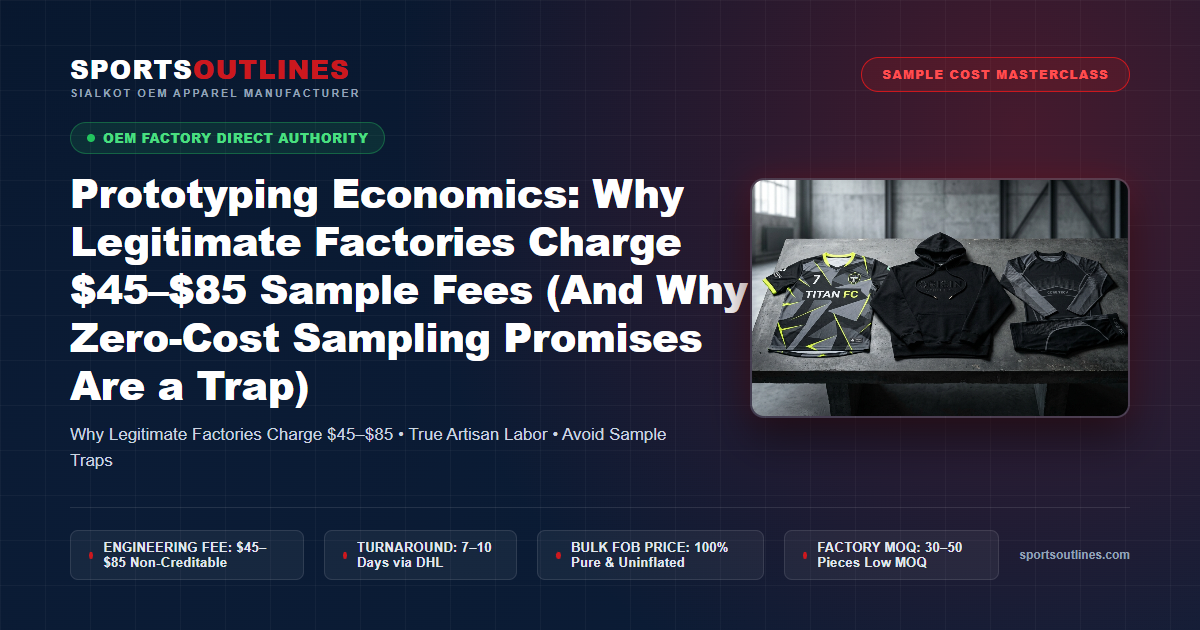
Direct Manufacturer Snapshot: Prototyping Economics: Why Legitimate Factories Charge $45–$85 Sample Fees (And Why Zero-Cost Sampling Promises Are a Trap)
Apparel prototyping economics refers to the operational and financial cost structure of crafting a single, custom pre-production master garment prior to mass manufacturing. In legitimate apparel engineering, creating a single bespoke sample requires 6 distinct labor and material operations: 1) Master pattern drafting & CAD digitizing ($25–$35 labor value); 2) Single-unit retail fabric bolt procurement ($15–$25); 3) Individual manual electric shear cutting ($10–$15); 4) Single-operator artisan machine threading & assembly ($20–$35); 5) Individual embellishment setup (screen burning or embroidery digitizing); and 6) Dimensional caliper inspection against tech pack Points of Measure (POM). Consequently, an authentic prototype costs a factory $75 to $120 in real operational expenditure. Legitimate factories charge a transparent $45 to $85 non-creditable engineering fee to share initial development costs and filter out casual non-commercial inquiries. Overseas agents advertising ‘zero-cost promotional samples’ employ deceptive commercial traps: either baking a $300 hidden markup into your bulk invoice or dispatching pre-existing warehouse scrap blanks. Sports Outlines International in Sialkot, Pakistan, delivers bespoke physical prototypes in 7–10 business days for a transparent $45–$85 fee.
Direct WhatsApp: +92 316 7932595
Introduction: The Illusions and Realities of Garment Prototyping
In the digital landscape of e-commerce brand building, aspiring fashion designers and sportswear entrepreneurs are bombarded with seductive marketing promises from overseas sourcing agents and trading platforms: “Send us your design and we will ship you a complimentary sample immediately!” To an inexperienced founder guarding a modest startup budget, this sounds like the ultimate low-risk opportunity. Why pay a reputable manufacturer an engineering fee when an anonymous supplier on the internet offers to build your sample for zero upfront cost?
In the unforgiving realities of industrial textile manufacturing, there is an immutable physical truth: skilled human labor, specialized industrial machinery, and premium raw materials always cost money. When an overseas factory claims to build a custom garment for zero upfront cost, they are not engaging in altruistic charity; they are executing a calculated commercial trap designed to capture your bulk production deposit or offload warehouse scrap.
Operating from Sialkot, Pakistan—the export epicenter of high-performance sportswear, tactical athletic apparel, and luxury heavyweight streetwear—Sports Outlines International has earned the trust of global apparel brands by upholding absolute operational and financial transparency. In this comprehensive technical guide, we break down The Prototyping Economics Masterclass. We dissect the true labor and overhead cost of creating a single bespoke garment, expose the hidden traps of zero-cost sampling promises, and explain why our transparent $45 to $85 flat non-creditable engineering fee is the only sustainable foundation for building a high-margin apparel enterprise.
Commission Your Physical Pre-Production Sample on WhatsApp
Send us your tech pack or design vectors for a transparent $45–$85 prototype quote with guaranteed 7–10 business day dispatch via DHL Express.
✓ $45–$85 Physical Prototypes •
✓ Worldwide DDP Delivery
The Real Cost of a Single Garment: A Factory Labor Deconstruction
To understand why legitimate garment manufacturers charge an engineering fee for prototypes, one must step inside an industrial apparel factory and examine the operational friction caused by manufacturing a single unit. An industrial garment factory is designed for continuous linear throughput: automated cutting tables slicing 50 plies simultaneously, specialized sewing cells where an operator stitches the same seam hundreds of times per shift, and high-speed packaging lines.
When an order arrives for one single custom prototype, the factory cannot run it through an automated mass production line. The prototype must be built as a standalone artisan project, requiring individual manual intervention across 6 distinct engineering departments:
| Department / Operation | Artisan & Technical Labor Description | Time Required | True Factory Operational Cost |
|---|---|---|---|
| 1. Pattern Drafting & CAD | Senior pattern master translates tech pack into digital CAD vectors, drafts custom pattern pieces, and checks seam allowances. | 2.0 – 3.0 Hours | $25.00 – $35.00 |
| 2. Material Sourcing & Cut | Cutting specialist unrolls fabric bolt, checks grainline alignment, pins paper pattern, and hand-cuts individual panels with electric shears. | 1.0 – 1.5 Hours | $15.00 – $22.00 |
| 3. Single-Unit Sewing Assembly | Master sample machinist manually threads 4 different machines (lockstitch, 4-thread overlock, coverstitch, flatlock) and constructs garment solo. | 2.5 – 3.5 Hours | $28.00 – $38.00 |
| 4. Embellishment Setup | In-house digitizing of vector artwork, burning silk screen mesh or setting up single-head Tajima embroidery machine with 3D EVA foam. | 1.5 – 2.0 Hours | $18.00 – $25.00 |
| 5. Trims, Labels & Finishing | Manual hand-crimping of custom aglets, sewing sample neck tag and care label, thread trimming, and high-pressure steam pressing. | 0.75 – 1.0 Hours | $8.00 – $12.00 |
| 6. QA Caliper Audit & Report | Technical auditor measures all 18 Points of Measure (POM) against tech pack spec, checks seam stretch, and logs dimensional inspection report. | 0.5 – 0.75 Hours | $10.00 – $15.00 |
| Total True Factory Operating Cost to Build 1 Custom Prototype: | $104.00 – $147.00 | ||
When you examine the hard mathematical reality of the factory floor, the economics become crystal clear. Creating a single bespoke prototype costs an industrial apparel factory between $104.00 and $147.00 in real cash outlay. When Sports Outlines charges a flat fee of $45 to $85 per style, we are actually subsidizing nearly half of the prototyping cost as an investment in a serious commercial client relationship.
The 4 Dark Traps of Zero-Cost Promotional Sampling Promises
If building a custom garment costs over $100 in skilled labor, how can online brokers and deceptive factories promise zero-cost complimentary sampling? They do so by executing one of four predatory commercial traps:
Trap 1: The Bulk Invoice Inflation Scam
The factory manager promises that your sample is zero-cost, but requires a $2,500 deposit for your eventual bulk order before shipping it. What they do not disclose is that they have artificially marked up your bulk unit cost by $3.50 per garment. On a 100-piece order, you end up paying $350.00 for a “zero-cost” sample, completely eroding your direct-to-consumer profit margins.
Trap 2: The Leftover Factory Scrap Blank
When you request a custom 450 GSM oversized boxy hoodie with specific drop-shoulder measurements, the deceptive supplier does not draft a pattern or cut custom fabric. Instead, they walk into their warehouse, pull a dusty, generic 280 GSM polyester-cotton blank left over from an old canceled order, print your logo onto the chest, and ship it to you. You receive a generic stock garment that bears zero resemblance to your tech pack.
Trap 3: The Hostage Deposit Trap
The supplier sends an acceptable sample, but when you attempt to place the bulk production order, they inform you that the initial quote was a “rough estimate” and that the real bulk price is 35% higher. If you refuse to accept the price increase, they keep your non-refundable deposit.
Trap 4: The Endless Revision Delay
Because the factory is losing money on the sample, your project is assigned to junior apprentice seamstresses and placed at the absolute bottom of the factory queue. Sampling drags on for 6 to 10 weeks, missing your marketing launch window and stalling your brand’s commercial momentum.

Why Sports Outlines Enforces a Transparent Non-Creditable Fee
At Sports Outlines International, we reject deceptive marketing tactics and unbundled surcharge structures. We operate on a strict, professional engineering standard: We charge a flat, transparent $45 to $85 non-creditable engineering fee per garment style.
Why Non-Creditable Pricing Protects Your Brand:
Many novice founders ask: “Can you credit the $65 sample fee toward my bulk production invoice when I order 100 pieces?” While crediting fees is a common sales gimmick, it violates financial transparency:
- Unbundled, Pure Production Pricing: If a factory credits your sample fee back on the bulk order, they must recover that cost by inflating their bulk FOB price or substituting cheaper sewing threads and trims. By keeping the prototype fee separate and non-creditable, Sports Outlines guarantees that our bulk production pricing (e.g., $15.20 for a 450 GSM hoodie) is 100% pure, uninflated, and rock-bottom factory-direct.
- Serious Partner Alignment: The modest $45 to $85 fee filters out casual hobbyists who have no intention of manufacturing, allowing our master pattern drafting team to dedicate their full technical focus and craftsmanship to serious commercial founders.
- Rapid 7–10 Business Day SLA: Because our sample artisans are properly compensated, your prototype is treated with top-tier priority, guaranteeing dispatch via DHL Express within 7 to 10 business days.
| Production Volume Tier | Est. Unit FOB Cost | Sample Cost & SLA | Bulk Production SLA | Included Specifications | Recommended Buyer Profile |
|---|---|---|---|---|---|
| 1 Prototype (Engineering Sample) | $45.00 – $85.00 Flat Fee | 7–10 Days Turnaround | 7–10 Business Days | Complete bespoke cut-and-sew, 1 custom print/embroidery, physical POM inspection | Physical fit verification, fabric GSM testing, creator photoshoots, buyer approval |
| 30 Units (Micro MOQ Batch) | $22.50 – $24.50 / Unit | Prototype Fee Non-Creditable | 12–15 Days | Bulk production matching approved prototype, stock fleece, polybag packing | Pilot brand proof-of-concept founders executing low-risk market launches |
| 50 Units (Capsule Drop Tier) | $18.50 – $20.00 / Unit | Prototype Fee Non-Creditable | 14–18 Days | Custom lab dips matching prototype, 2-color split, woven damask label | Streetwear capsule drops and boutique fitness lines expanding catalog depth |
| 100 Units (Commercial Tier) | $15.20 – $16.50 / Unit | Prototype Fee Non-Creditable | 18–21 Days | Automated laser cutting matching prototype CAD, custom hardware tooling | Growing e-commerce brands demanding identical replication of master sample |
| Sourcing Feature & Risk Factor | Sports Outlines (Sialkot Direct) | Alibaba Trading Agents | Traditional Chinese Hubs | Print-on-Demand (POD) |
|---|---|---|---|---|
| Prototype Pricing Structure | Transparent $45 – $85 flat non-creditable engineering fee covering true artisan drafting and cutting labor | Deceptive ‘zero-cost promotional sampling’ claims that secretly bake a $250+ hidden fee into bulk production invoices | Punitive $150 – $350 prototype charges designed to subsidize high corporate overhead and administrative layers | Zero physical sampling — purely digital 3D screen mockups with no tactile physical prototype verification |
| Prototype Assembly Precision | Crafted by dedicated senior pattern masters using identical fabric, ribbing, and thread specified for bulk | Subcontracted to apprentice workshops using cheap scrap bolt remnants that differ from bulk production rolls | Crafted in dedicated sample room, but often uses substitute hardware if bulk trims are not yet cast | Automated digital direct-to-garment print onto generic pre-sewn blanks from mass distributors |
| Sample Turnaround Speed | Guaranteed 7 to 10 business days door-to-door dispatch via DHL Express with direct tracking | Unpredictable 3 to 6-week delays with frequent excuses regarding fabric availability and queue bottlenecks | Standard 4 to 5-week sample queue with expedited fees ($100+) required to bypass backlog | Instant digital rendering, but zero physical sample sent to brand prior to customer ordering |
| Points of Measure (POM) Inspection | Full 100% dimensional caliper audit against tech pack POMs; detailed measurement report sent with sample | No inspection report provided; samples frequently arrive with major sleeve length and neck drop errors | Inspection report provided, but strict ±1.5cm tolerances that allow noticeable fit drift | Zero measurement verification — garments adhere only to the generic loose tolerances of blank mills |
| Long-Term Commercial Alignment | True factory partnership: Prototype data permanently archived in CAD for seamless reorders from 30 to 300+ units | Transactional relationship: Factory treats sampling as a profit center and abandons client if bulk order is small | Requires immediate 1,000+ unit commitment following prototype approval or burns account relationship | No account ownership — brand is merely a retail software user subject to unpredictable catalog price hikes |
The Multi-Stage Sampling Hierarchy: Proto 1, Fit Sample, SMS, and PPS
In high-end commercial fashion and athletic apparel product development, prototyping is not a singular, monolithic event; it progresses through a disciplined multi-stage sampling hierarchy. Understanding these distinct sampling milestones prevents confusion and aligns factory expectations:
1. The Proto 1 (Design & Feasibility Sample)
The initial prototype built directly from your preliminary tech pack. The primary goal of Proto 1 is assessing pattern balance, silhouette proportions, and structural manufacturing feasibility. It is constructed using available stock fabric in the correct weight (GSM) to verify drape and cut lines before ordering custom dye lots.
2. The Fit Sample
Once silhouette proportions are approved, the fit sample is tried on live anatomical models representing your core target demographic (e.g., an athletic Medium frame). The pattern master adjusts armhole depth, neck drop, and waistband tension down to millimeter tolerances to ensure effortless range of motion.
3. The Salesman Sample (SMS)
Produced in full colorways and complete branded trims for showroom presentations, wholesale buyer appointments, and lookbook content creation. The SMS must be 100% retail-identical to what customers will unbox.
4. The Pre-Production Sample (PPS)
The final, legally binding master garment produced immediately before bulk fabric cutting. The PPS is cut from the actual bulk fabric lot, stitched on the designated production sewing line, and serves as the physical benchmark against which all bulk units are evaluated during final AQL 2.5 quality control audits.
Digital 3D Simulation (Clo3D) vs. Physical Prototype Realities
In recent years, 3D apparel simulation software like Clo3D and Browzwear has revolutionized virtual design visualization. Designers can render realistic digital avatars, drape digital fabrics, and simulate colorways in minutes. Some digital agencies even claim that 3D rendering eliminates the need for physical sampling altogether.
In the factory environment, however, physical prototyping remains completely irreplaceable. Virtual simulations cannot replicate:
- Tactile Fabric Hand-Feel: A screen cannot convey whether 450 GSM French Terry feels uncomfortably stiff against bare skin or buttery soft after an enzyme wash.
- True Seam Tensile Friction: A digital render cannot verify whether a flatlock seam chafes against inner thighs during a 10-mile run or whether high-tension bar-tacks hold under explosive athletic strain.
- Actual Thermal Shrinkage: Digital avatars do not undergo high-temperature laundering cycles to measure true fabric torquing and warp shrinkage.
At Sports Outlines, we embrace modern 3D CAD modeling to perfect pattern geometry upfront, but we mandate physical sample verification to ensure 100% real-world performance.
The 5-Point Physical Prototype Verification Gauntlet
When your physical pre-production prototype arrives from our Sialkot facility via DHL Express, do not simply try it on and look in the mirror. Execute our professional 5-point physical verification gauntlet to ensure every component meets your brand’s exacting standards:
- Points of Measure (POM) Dimensional Audit: Lay the garment flat on a smooth inspection table. Using a flexible steel garment measuring tape, measure every Point of Measure specified in your tech pack (Chest Width, HPS Body Length, Sleeve Length, Neck Opening). Confirm that every single dimension falls strictly within the specified ±0.5 cm manufacturing tolerance.
- GSM Analytical Cutter & Digital Weighing: Using a mechanical circular 100 cm² fabric sample cutter, extract swatches from the body fleece and ribbing panels. Weigh each circular swatch on an analytical digital gram scale. Verify that the body fleece measures 450 GSM (±3%) and ribbing measures 480 GSM.
- Dynamic Athletic Fit & Mobility Evaluation: Have an athlete or fit model perform functional movements (overhead shoulder raises, deep squats, torso rotations). Verify that armhole depth allows full range of motion without pulling the bottom hem up over the waistline.
- Seam Tensile Stress & Thread Recovery Check: Firmly grip the armhole and side seams with both hands and pull laterally to maximum extension. Verify that the high-tenacity core-spun thread stretches harmoniously with the fleece without snapping, popping, or distorting.
- Laundering Shrinkage & Torque Gauntlet: Subject the prototype to three consecutive warm machine washes (40°C/104°F) with standard commercial detergent and medium tumble drying. Measure all dimensions again; verify that dimensional shrinkage remains strictly below 3.0% and side seams do not twist (torque).
Start Your Pre-Production Sample with Sports Outlines Today
Direct Sialkot factory direct pricing • In-house CAD pattern drafting • Zero hidden bulk markups or sample traps.
✓ $45–$85 Physical Prototypes •
✓ Worldwide DDP Delivery
Conclusion: Invest in Professional Engineering Transparency
In the unforgiving arena of modern apparel commerce, your brand’s physical product quality is your ultimate marketing moat. Compromising your product development on the deceptive lure of zero-cost sampling promises will cost your business thousands of dollars in delayed launches, ruined bulk runs, and lost customer trust.
By partnering with Sports Outlines International, you align your brand with a legitimate, vertically integrated manufacturing partner that respects your intelligence, values your capital, and delivers uncompromising engineering precision from day one. Our transparent $45 to $85 prototype fee guarantees that your vision is translated into a physical master garment crafted with world-class Sialkot craftsmanship and dispatched to your door in 7 to 10 business days.
Contact our senior apparel engineering desk on WhatsApp today. Send us your tech pack or design files for a comprehensive review, and let us engineer your pre-production prototype to absolute perfection.
Frequently Asked Sourcing & Manufacturing Questions (Buyer FAQ)
What is an apparel prototype sample fee?
An apparel prototype sample fee is an engineering charge paid to a garment factory to develop, cut, sew, and inspect a single physical master garment according to a brand’s tech pack before mass production begins. It covers the intensive manual labor of master pattern drafting, single-unit fabric sourcing, and individual machine calibration.
Why do legitimate clothing factories charge $45 to $85 for a prototype?
Creating a single garment disrupts an industrial factory’s production flow. A single prototype requires a master pattern maker to draft and digitize the CAD vectors (2–3 hours), a cutting specialist to hand-cut individual pattern pieces, a seamstress to manually thread machines for one unit, and specialized setup for embellishments. In real operational costs, a factory expends $75 to $120 to build a prototype; the $45 to $85 fee represents a transparent shared engineering cost.
Why are zero-cost promotional sample offers considered a commercial trap?
In manufacturing, physical labor and raw materials always cost money. Overseas brokers who promise zero-cost promotional sampling employ deceptive commercial tactics: 1) They bake an inflated $200 to $400 markup into your bulk production invoice to recover the sample cost; 2) They send you a pre-existing leftover factory scrap blank that does not reflect your tech pack; or 3) They demand a large non-refundable bulk deposit before sending the sample.
Are prototype engineering fees creditable toward bulk production at Sports Outlines?
No. At Sports Outlines, our $45 to $85 prototype fee is strictly a flat, non-creditable engineering fee. We maintain a non-creditable policy to keep our bulk production FOB prices completely uninflated and transparent, ensuring you never pay hidden sample subsidization markups in your bulk order.
What should I test when my pre-production prototype arrives?
Execute our 5-step prototype verification audit: 1) Measure every dimension against your tech pack Points of Measure (POM) table to confirm ±0.5cm tolerance; 2) Cut a 100 cm² fabric swatch and weigh it on a digital scale to verify specified GSM; 3) Conduct athletic wearability and mobility tests on a fit model; 4) Check seam elasticity and embellishment adhesion; and 5) Subject the garment to a warm machine wash and tumble dry to verify shrinkage remains under 3%.
How long does prototype development take at Sports Outlines?
Standard physical prototype turnaround is 7 to 10 business days from tech pack sign-off and engineering fee payment. Prototypes are dispatched via DHL Express directly to your address, with transit typically taking 3 to 5 business days.
Can I make revisions to my tech pack after receiving the prototype?
Yes. The primary purpose of a prototype is physical validation. If you need to lengthen the body by 2cm, widen the hood, or adjust chest graphic placement, our CAD engineering team updates your digital pattern files before bulk cutting. If adjustments are minor, a second sample is rarely necessary.
What materials are used to construct the prototype?
Sports Outlines constructs your prototype using the exact fabric, ribbing, thread, and embellishment methods specified in your tech pack Bill of Materials (BOM), ensuring the sample perfectly replicates the physical hand-feel, weight, and drape of your bulk production run.
What is the difference between a prototype sample and a sales sample?
A prototype sample (or fit sample) is created to verify dimensions, pattern geometry, and construction viability. A sales sample (or SMS – Salesman Sample) is an approved, final-spec retail-ready garment produced in multiple colorways for showroom displays, buyer meetings, and lookbook photoshoots.
How do I commission a physical prototype with Sports Outlines?
Send your tech pack, vector artwork, and base size measurements via WhatsApp (+92 316 7932595) or email. Our technical engineering desk will review your specifications, verify fabric availability, and issue your prototype development invoice within 24 hours.