
Direct Manufacturer Answer: How to Manufacture Custom Rugby Uniforms Factory Direct
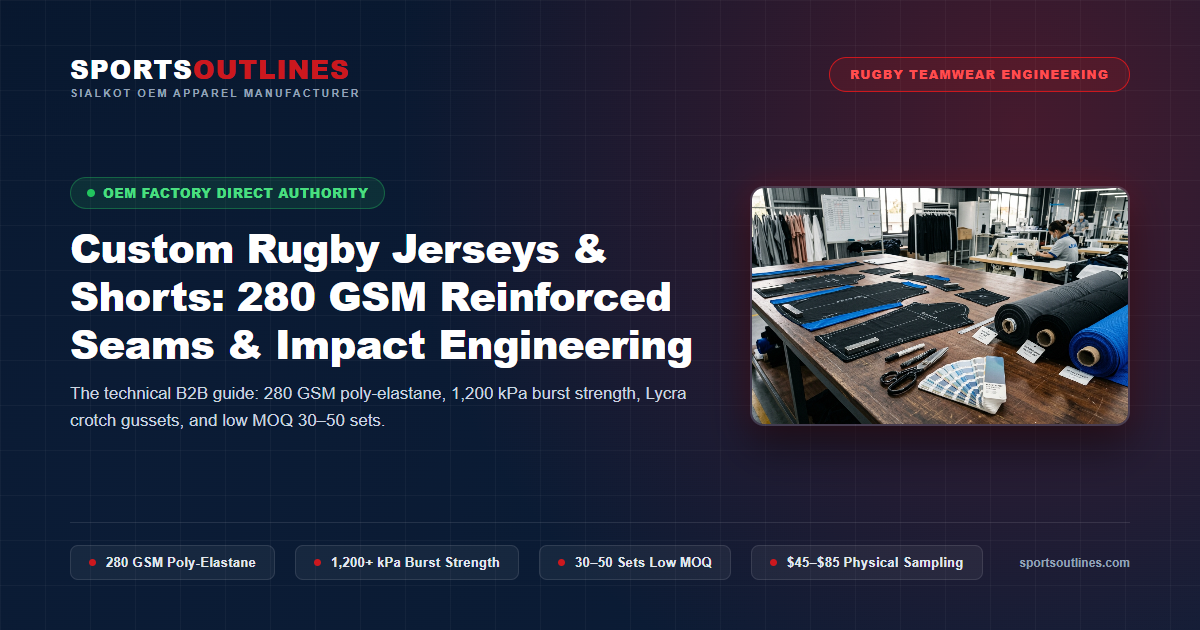
High-performance custom rugby jerseys require heavyweight 280–300 GSM 4-way stretch polyester elastane (92/8 blend) or heavy ripstop interlock with an ISO 13938-1 pneumatic burst strength exceeding 1,200 kPa to withstand aggressive tackling. Construction demands reinforced twin-needle flatlock seams, bar-tacked armholes, tear-proof loop collars, and optional silicone chest gripper dots for wet-weather ball handling. Matching rugby shorts utilize 240 GSM heavy drill with an elastic Lycra crotch gusset for scrums. Factory direct low MOQ is 30 to 50 complete rugby sets with mixed sizing (Youth YM to Adult 4XL). Pre-production physical prototype samples cost $45 to $85 per set in 7 to 10 business days.
- Jersey Fabric: 280–300 GSM High-Tensile Poly-Elastane (92% Poly / 8% Spandex).
- Tensile Integrity: 1,200+ kPa burst strength; bar-tacked stress points.
- Shorts Engineering: 240 GSM Poly Drill with 4-way stretch Lycra crotch gusset.
- Low MOQ Flexibility: 30–50 complete sets per design.
- Direct Sourcing Contact: WhatsApp factory direct at +92 316 7932595 or sportsoutlines.com.
In contact team sports, no garment experiences more violent kinetic punishment than the rugby jersey. During scrums, rucks, mauls, and high-velocity tackles, opponents grab, twist, and pull the jersey with hundreds of Newtons of force. An ordinary soccer or athletic jersey will shred or pop its seam threads within the opening ten minutes of a rugby match.
At Sports Outlines in Sialkot, Pakistan, our athletic apparel factory engineers heavy-duty teamwear for Rugby Union, Rugby League, and Rugby Sevens clubs across the United Kingdom, Australia, New Zealand, France, Canada, and the United States. This technical white paper examines 280 GSM fabric physics, pneumatic burst strength testing, reinforced seam architecture, silicone grip print chemistry, and factory-direct low MOQ sourcing economics.
1. Textile Physics: 280–300 GSM Heavy Poly-Elastane vs Traditional Cotton
Historically, rugby jerseys were crafted from 350 GSM 100% heavy cotton jersey. In modern professional rugby, cotton has been completely phased out because it absorbs rainwater and sweat, becoming dangerously heavy (up to 900 grams wet) and giving tacklers an easy handle to pull the ball carrier down. Modern rugby teamwear relies on synthetic high-recovery knits:
2. Collar Architecture: Anti-Grab Loops vs Mandarin Necks
In rugby, the neck collar is the prime target for illegal high tackles and jersey pulls. A traditional folded collar with plastic buttons is a liability that can choke the player or tear off:
- Contemporary Mandarin Round Neck (Pro Standard): Sits flush against the clavicle with a low 1.5 cm profile. Constructed from reinforced double-layer ribbed poly-spandex with high-density herringbone interior tape. Defenders cannot slip fingers beneath the collar band.
- Anti-Grab Loop Collar (Kiwi Loop): Features an overlapping crossover elastic insert at the center throat. It expands to allow the player’s head through effortlessly, then snaps back into a snug throat contour.
- Heritage Rugby Collar: A traditional folded collar made from heavy 280 GSM cotton/poly twill with soft rubber buttons (never plastic, preventing dental injury during contact). Favored for club casual wear, touring kits, and retro collections.
3. Seam Engineering & 3D Silicone Ball Grip Technology
At Sports Outlines, our rugby assembly lines enforce rigorous sewing standards:
- 4-Needle Flatlock Stitching (ISO 607): All structural seams (raglan sleeves, side panels, shoulders) are joined using 4-needle 6-thread flatlock machines threaded with bonded high-tenacity polyester filament threads. The seam lies totally flat against the skin, eliminating chafing while delivering 45 kg of tensile seam strength.
- Reinforced Bar-Tacking: High-stress junctions—specifically the armpit gusset intersection, collar base, and side hem splits—receive automated 28-stitch bar-tacks to prevent seam unraveling.
- 3D Silicone Ball Gripper Print: We offer localized screen-printed micro-dot silicone patterns across the upper chest and torso. These rubberized dots provide friction against wet synthetic match balls, reducing dropped passes in heavy rain.
4. Rugby Match Shorts Engineering: Lycra Gussets & Waistbands
Rugby shorts must allow explosive hip abduction during scrums and high jumping in line-outs without tearing the crotch seam:
- Body Fabric: 240 GSM heavy polyester drill or cotton-rich twill that slides smoothly across opposing players’ thighs.
- 4-Way Stretch Lycra Crotch Gusset: A diamond-shaped insert sewn into the crotch using 260 GSM high-recovery spandex. This allows props and hookers to drop into full squats during scrums without seam tension.
- Internal Tunnel Drawcord & Non-Slip Waistband: Heavy 2.5-inch elastic waistband with an interior silicone gripper band that grips the jersey hem, keeping it tucked during physical contests.
5. Sourcing Economics: Unit Costs, Low MOQ & Sampling Math
At Sports Outlines in Sialkot, Pakistan, our direct manufacturing pricing unlocks substantial commercial margins for rugby apparel brands, tournament organizers, and school sports programs:
Prototype Sampling Protocol: Pre-production physical prototype samples cost $45 to $85 per set (completed in 7 to 10 business days). This allows rugby directors to test bursting strength, verify team color calibration, and evaluate the stretch recovery of the crotch gusset.
Start Custom Rugby Uniform Manufacturing
Collaborate with specialized contact sports apparel engineers in Sialkot, Pakistan. Send your team designs or Tech Pack for instant quote generation and prototype development.
6. World Rugby Regulation 12 Player Safety & Material Standards
Rugby is governed by stringent international apparel safety laws outlined in **World Rugby Regulation 12**. Sourcing from an inexperienced garment factory that ignores these guidelines can lead to team uniform disqualification or severe player injury during matches. At Sports Outlines, all rugby uniforms are engineered to strict World Rugby compliance:
- Zero Rigid Protrusions: No metal zippers, rigid plastic snaps, or hard buckles are permitted on jerseys or shorts. All collar closures must utilize soft rubber buttons or continuous elastic stretch gussets.
- Padding Thickness Restrictions: If padded protective vests or padded undershirts are worn beneath the jersey, foam padding cannot exceed 10mm in thickness and must meet an impact absorption density threshold between 45 and 100 kg/m³.
- Drawstring Safety Constraints: Shorts drawstrings must be enclosed within an internal tunnel waistband without loose trailing aglets longer than 5cm, preventing finger entanglements during rucks.
- Skin Friction & Seam Smoothness: Flatlock seams must not create sharp abrasive ridges. All thread ends are hot-sealed or buried inside the seam casing to avoid eye lacerations during close-contact scrums.
7. Rugby Sevens vs Rugby Union / League Silhouette Dynamics
Different rugby codes demand tailored silhouette architectures:
- Rugby Sevens (Aerodynamic Speed Cut): Sevens is defined by continuous open-field running, high sprint frequency, and rapid heat accumulation. For Sevens teams, we engineer a 240–250 GSM micro-ripstop poly-elastane jersey with high-mobility raglan sleeves and laser-cut underarm airflow vents, minimizing aerobic drag.
- Rugby Union & League (Scrum & Contact Cut): 15-a-side Rugby Union forwards require the maximum 290–300 GSM heavy-denier interlock with reinforced shoulder yoke taping and high-friction silicone torso prints to lock into scrums without slippage.
- GPS Tracker Spine Pockets: Professional clubs require integrated GPS performance monitoring. We sew an internal stretch mesh pocket positioned between the scapulae on the upper spine, reinforced with flatlock seams and an elasticized top flap to secure Catapult or STATSports tracking units during collisions.
8. Professional Club Laundering Protocols & Enzyme Wash Science
Rugby jerseys are subjected to extreme soil conditions including clay mud, grass stains, pitch chalk, and blood. If laundered incorrectly, synthetic elastane fibers break down, causing the jersey to lose elasticity and sag. Our technical care guide ensures maximum uniform longevity:
- Enzyme-Based Cold Presoak (30°C): Mud and protein stains should be presoaked in neutral pH enzyme detergents rather than chlorine bleach. Chlorine permanently breaks down spandex elastane cores.
- Wash Temperature & Spin Cycle: Maximum wash temperature should not exceed 40°C (104°F) with a gentle spin cycle (sub-800 RPM). Italian Kiian disperse dyes will never fade, but excessive centrifuge speeds can abrade silicone chest grip prints.
- Line Dry vs Tumble Dry: Garments should be hung to air dry away from direct scorching heat. Never use high-heat commercial dryer settings, as excessive heat will degrade elastane memory.
9. Mini & Junior Rugby Sizing Specs & Youth Protection Protocols
Youth and junior rugby players require specialized ergonomic considerations that differ from senior club forwards. Because children and teenagers experience rapid growth spurts and possess differing head-to-neck ratios, standard neck openings can cause discomfort or safety hazards. At Sports Outlines, our junior rugby jerseys incorporate widened anti-grab loop collars with high-elastic Lycra expansion bands, allowing safe, effortless donning while preventing neck compression. Furthermore, junior rugby shorts feature extra-wide 3-inch elastic waistbands with fully enclosed safety drawcords to guarantee that shorts stay securely positioned during youth tackling and tag-rugby matches.
Our junior sizing curves cover U6 to U18 age brackets with reinforced multi-needle lockstitching on all collar and crotch seams, ensuring that school sports kits survive full seasons of multi-team contact play without tearing or unraveling.
Explore International Logistics & Country Sourcing
- UK Sourcing Hub – Express delivery for RFU and British rugby league clubs.
- Australia Sourcing Hub – Heavy-duty rugby union and NRL teamwear manufacturing.
- USA Sourcing Hub – Major League Rugby (MLR) and collegiate rugby programs.
- Canada Sourcing Hub – Provincial rugby and contact sports teamwear.
- Germany Sourcing Hub – European rugby union championship team kits.
- Discover our Full Sportswear Product Catalog for additional performance categories.