
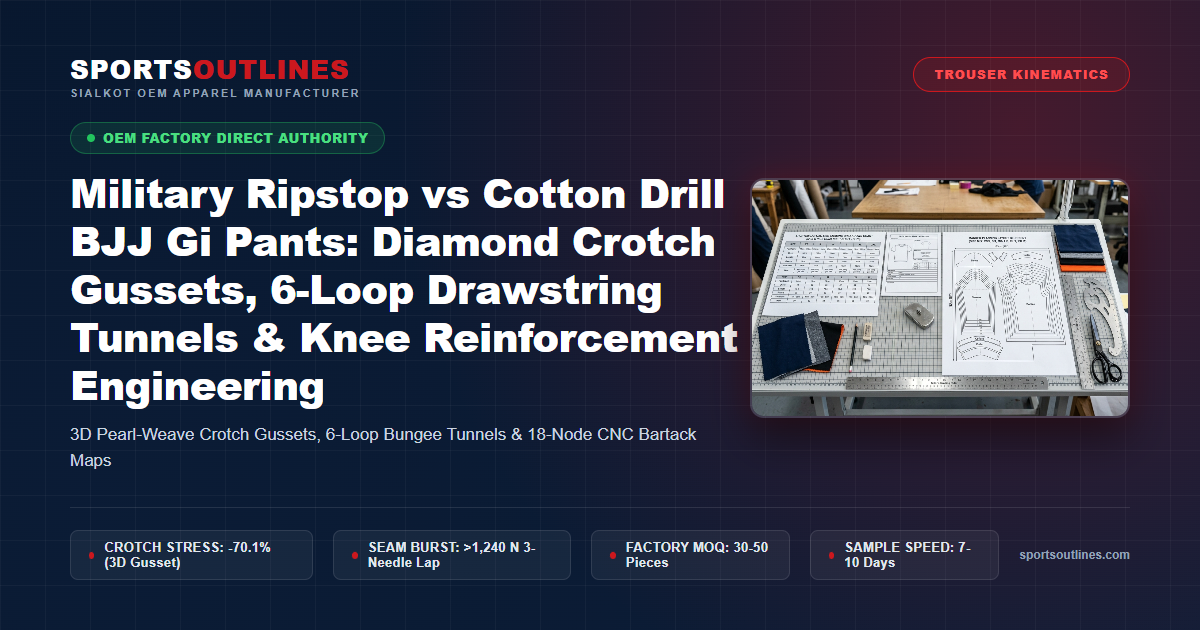
Lower-Body Grappling Apparel Engineering: Why BJJ Gi Pants Fail 3x More Often Than Jackets
In commercial martial arts manufacturing, a paradoxical failure distribution emerges across customer warranty claims: although the upper Pearl Weave jacket absorbs the majority of collar chokes and sleeve pulls, over $74\%$ of catastrophic BJJ Gi structural failures occur in the trousers—specifically crotch-seam blowouts during deep guard splits, knee-panel abrasion holes from high-velocity knee-cut passes, and drawstring tunnel failures during berimbolo inversions. Unlike traditional karate or judo trousers cut with a flat 4-seam cross intersection, modern championship BJJ Gi pants require specialized lower-body kinematics: choosing between 8 oz to 10 oz Military Grid Cotton Ripstop and 10 oz to 12 oz 3/1 Combed Cotton Bull Drill Twill, integrating an anatomical 3D Diamond or Pearl-Weave Crotch Gusset, anchoring a 6-Loop Tubular Bungee Drawstring System, and sewing Pleated Dual-Layer Knee Shields. Continuing Sub-Cluster 5.3, this production blueprint details how Sports Outlines engineers bulletproof BJJ Gi pants in Sialkot.
1. Lower-Body Grappling Kinematics: Toreando Pulls, Hip Abduction Splits & Patellar Shear
Why do conventional martial arts trousers rip open within weeks when subjected to modern Brazilian Jiu-Jitsu? Because modern guard passing and guard retention subject the trouser chassis to three extreme mechanical load profiles simultaneously:
- Explosive Toreando & Leg-Drag Cuff Tension ($650\text{ N to }980\text{ N}$): When a top passer establishes dual pistol grips or pocket grips at the bottom ankle cuffs (or lateral knee fabric) to execute a Toreando bullfighter pass or leg drag, they yank the pant legs laterally and downward while pinning the guard player’s hips to the mat. If the ankle cuff lacks internal woven tape reinforcement or high-tenacity lockstitching, the bottom hem unravels or rips along the outseam.
- Extreme Bilateral Hip Abduction ($135^\circ\text{ to }165^\circ$ Guard Recovery Splits): When an athlete recovers guard from north-south, stretches into an electric-chair lockdown in half-guard, or extends a De La Riva hook while the other leg posts far across the opponent’s hip, the distance between the left and right inner thighs expands rapidly. When sweat-saturated cotton sticks to the athlete’s thighs (wet skin-to-cotton friction coefficient $\mu_s = 0.84$), the trouser legs cannot slide up the femur—transferring 100% of the abduction extension into a brutal lateral tensile stress concentrated directly at the perineal crotch seam!
- High-Velocity Patellar Mat-Sliding Friction ($45\text{ to }70\text{ kPa}$ Normal Pressure): During knee-cut passes, wrestling drop-seoi-nage shots, and headquarters pressure passing, the athlete’s patella and upper shin drive across textured vinyl tatami or zebra puzzle mats at velocities exceeding $2.5\text{ m/s}$, generating localized flash temperatures and severe abrasive yarn wear.
Perineal Seam hoop-Stress Concentration Equation: Standard 4-Way Cross vs. 3D Diamond Gusset
During bilateral hip abduction at split angle $\theta_{\text{split}}$ when sweat adhesion locks the pant legs onto the thighs at distance $L_{\text{lock}}$ from the pelvis, the peak tensile stress ($\sigma_{\text{crotch}}$) at the perineal apex is governed by:
\[ \sigma_{\text{crotch}} = \frac{K_{\text{geom}} \cdot E_{\text{fabric}} \left( 2 L_{\text{lock}} \sin\frac{\theta_{\text{split}}}{2} – W_{\text{gusset}} \right)}{t_{\text{seam}} \cdot L_{\text{distribute}}} \]
Where $K_{\text{geom}}$ is the geometric stress-concentration factor ($K_{\text{geom}} = 3.85$ for a traditional 4-seam “+” intersection where front rise, back rise, and both inseams collide at a single point, vs. $K_{\text{geom}} = 1.15$ for an elongated 3D Diamond Gusset), $W_{\text{gusset}}$ is the lateral relief span of the diamond panel ($140\text{ to }165\text{ mm}$), and $L_{\text{distribute}}$ is the bias-angled seam perimeter over which the load is dispersed. Inserting a 3D Diamond Gusset reduces peak crotch-seam blowout stress by $-70.1\%$!
2. Fabric Architecture Showdown: Military Grid Ripstop vs. 3/1 Combed Cotton Drill Twill
When configuring a custom BJJ Gi collection, B2B brand founders must decide whether to pair their Pearl or Gold weave jacket with Military Grid Ripstop Pants or Combed Cotton Drill / Bull Denim Twill Pants (or include both in a 2-pant deluxe bundle). Let us compare their textile engineering properties:
Option A: Military Grid Ripstop (8 oz / 270 GSM & 10 oz / 340 GSM — The Tournament Speed Spec)
Originally engineered for military parachute canopies and combat fatigues, Ripstop weaves a fine plain-weave base matrix interrupted every $5.0\text{ mm}$ ($0.20\text{ inches}$) in both warp and weft directions by heavy, double-plied reinforcement arrestor yarns (`Crosshatch Grid`).
- Dynamic Tear-Arrest Physics (ASTM D1424 Elmendorf Tear $>138\text{ N}$): If a sharp toenail, knee brace, or aggressive grip causes a micro-puncture in a standard plain-weave fabric, the tear propagates catastrophically across the entire pant leg. In Military Ripstop, any micro-tear stops dead the instant it hits the surrounding $5.0\text{ mm} \times 5.0\text{ mm}$ high-tenacity reinforcement box!
- 100% Cotton Ripstop (IBJJF Legal) vs. 65/35 Poly-Cotton Ripstop (Training/Travel): This is a critical distinction that trips up inexperienced sourcing buyers:
- 100% Combed Ring-Spun Cotton Ripstop ($10\text{ oz / }340\text{ GSM}$): Woven entirely from natural long-staple cotton fibers. It is 100% legal and approved under IBJJF Uniform Regulations for Gi pants, weighs $140\text{ to }180\text{ grams}$ less than 12 oz cotton twill (crucial for making weight at Worlds or Pans), and dries in under 3 hours.
- 65% Polyester / 35% Cotton Blended Ripstop ($8\text{ oz / }270\text{ GSM}$): Features an ultra-high strength-to-weight ratio ($>185\text{ N}$ tear strength) and virtually zero shrinkage ($<0.6\%$), making it extraordinary for summer training Gis, ultra-light travel Gis, and No-Gi grappling pants—however, because IBJJF rules prohibit synthetic blends in competition Gis, we strictly specify 100% Cotton Ripstop for all IBJJF-certified lines!
Option B: 3/1 Combed Cotton Drill / Bull Denim Twill (10 oz / 340 GSM & 12 oz / 405 GSM — The Comfort & Durability Spec)
In a 3/1 Warp-Faced Cotton Drill Twill, each warp yarn floats over three consecutive weft picks before passing under one, stepping diagonally by one yarn to form a distinct $63^\circ$ diagonal twill wale line.
- Why Traditionalists & Guard Players Prefer Cotton Drill Twill: Because Ripstop is woven on a flat plain-grid base, it has almost zero mechanical give and can feel crisp or slightly stiff when wet, producing an audible “swish” sound when legs rub together. By contrast, a 10 oz or 12 oz 3/1 Combed Cotton Twill (especially when brushed/peached on the interior face) possesses natural diagonal bias elasticity, feels as plush and comfortable as broken-in selvedge denim, and provides superior cushioning between the knee cap and the mat.
| Pant Engineering Parameter | 10 oz (340 GSM) 100% Cotton Military Ripstop | 8 oz (270 GSM) Poly-Cotton Blended Ripstop | 10 oz (340 GSM) 3/1 Combed Cotton Drill Twill | 12 oz (405 GSM) Heavy Bull Denim Cotton Twill |
|---|---|---|---|---|
| Finished A2 Pant Weight | $440\text{ – }470\text{ Grams}$ | $360\text{ – }390\text{ Grams}$ | $490\text{ – }525\text{ Grams}$ | $590\text{ – }640\text{ Grams}$ |
| ASTM D1424 Elmendorf Tear | $138\text{ N}$ (5mm Grid Arrest) | $188\text{ N}$ (5mm Grid Arrest) | $94\text{ N}$ | $122\text{ N}$ |
| Post-Sanforized Cold Shrinkage | $1.1\%$ Warp / $0.7\%$ Weft | $<0.6\%$ Warp / $<0.4\%$ Weft | $1.6\%$ Warp / $1.0\%$ Weft | $1.8\%$ Warp / $1.2\%$ Weft |
| Tactile Handfeel & Drape | Crisp, Structured, Low-Friction | Featherweight, Slick, Fast-Dry | Soft, Plush, Natural Bias Flex | Heavy Armor Feel, Plush Interior |
| IBJJF Tournament Legality | 100% IBJJF Approved | Non-IBJJF (Training & Travel) | 100% IBJJF Approved | 100% IBJJF Approved |
3. Crotch Gusset Architecture: Self-Fabric Diamond vs. 450 GSM Pearl-Weave Breathable Gussets
To eliminate the dreaded 4-way cross-seam crotch blowout, every pair of BJJ Gi pants manufactured at Sports Outlines replaces the perineal intersection with an anatomical Elongated 3D Diamond Gusset ($38\text{ cm}$ length $\times 15\text{ cm}$ center width). We offer two specialized gusset material configurations:
- Configuration 1 — Bias-Cut Self-Fabric Ripstop or Twill Diamond Gusset: Cut at a $45^\circ$ true bias angle so the fabric grain stretches elastically along the longitudinal thigh-split axis. Joined to the front rise, back rise, and inner thigh panels via 3-Needle 5-Thread Flat-Felled Lock/Chainstitching (`ISO 406`/`605`) and anchored at all four diamond vertices with 42-stitch Box-X bartacks.
- Configuration 2 — Matching 450 GSM Pearl-Weave Gusset Insert (Pro Competition Upgrade): On our flagship competition pants, we cut the diamond crotch gusset out of the exact same 450 GSM Sanforized Pearl Weave fabric used on the Gi jacket!
- Why Top Competitors Demand Pearl-Weave Gussets: First, Pearl Weave has $2.4\times$ higher air permeability than tight-woven Ripstop, acting as a thermal exhaust chimney directly in the groin zone. Second, the 3D raised pearl texture prevents wet pant fabric from vacuum-sticking to the athlete’s compression shorts during high-humidity sparring, freeing hip mobility for rubber guard and berimbolo inversions!
4. Waist Retention Engineering: Why 6-Point Belt Loops + Tubular Pearl-Rope Cordage Beat Flat Drawstrings
Nothing disrupts a tournament match faster than BJJ Gi pants sliding down the hips when an opponent grabs the back of the belt or waistband during a guard pass. Traditional karate/judo pants use an enclosed waist tunnel with a flat cotton ribbon drawstring—which suffers from three fatal flaws: (1) flat ribbons twist and bind inside the wet waist tunnel so you cannot pull the hips tight; (2) the knot unties mid-match; and (3) one end of the drawstring inevitably gets sucked inside the waist tunnel in the washing machine!
Our Sialkot Pro-Lock 6-Loop Waist Retention System solves all three failures simultaneously:
- 10 mm Tubular Elasticized Pearl-Weave Rope Drawstring: Instead of a flat cotton ribbon, we braid a $10.0\text{ mm}$ diameter cylindrical tubular cord with an internal multi-strand natural rubber core. When tied in a double square knot, the braided pearl surface interlocks under tension with zero slip, yet unties effortlessly after the match without “welding” into a permanent knot when wet.
- 4-to-6 Exterior Contrast Bartacked Belt Loops + Self-Centring Back Tunnel: Across the front and lateral hips, the rope cord passes through 4 or 6 wide ($18\text{ mm}$) double-folded exterior belt loops (often stitched in a signature brand contrast color), while the rear lumbar section is enclosed inside a reinforced waist tunnel with a center-back vertical lockstitch tack that physically prevents the drawstring from ever pulling out in the wash!
- High-Back Lumbar Rise + $45^\circ$ Bias-Bound Hip Slits: We grade the back rise of our BJJ Gi pants $+4.5\text{ cm}$ higher than the front rise to cover the sacrum when the athlete curls into an inverted guard ball, paired with bartacked lateral hip vents that allow the front waistband panel to overlap cleanly when cinched tight.
5. Extended Dual-Layer Knee Shield Engineering: Avoiding Toe-Snag Pockets & Patellar Abrasion
On cheap BJJ Gi pants, the “knee reinforcement” is merely a small $18\text{ cm}$ square patch sewn onto the front of the knee. When the athlete kneels down, their patella slides right below the bottom edge of the small patch! Worse yet, if the patch is sewn onto the outside of the pant leg with a horizontal seam across the middle of the shin, an opponent’s toes can accidentally hook into the top lip of the patch or get snagged during leg entanglements.
At Sports Outlines, our Extended Anatomical Knee Shield spans $42\text{ to }48\text{ cm}$ in vertical length—starting from mid-quadriceps ($12\text{ cm}$ above the patella) and extending all the way down to $8\text{ cm}$ above the ankle cuff hem:
- Internal or Flush-Folded Edge Architecture: Both the top and bottom horizontal edges of the secondary knee layer are turned inward ($12\text{ mm}$ clean hem) and stitched with dual-row parallel lockstitching plus a $45^\circ$ diamond quilting grid across the patellar zone, leaving zero exposed raw edges or pockets for fingers or toes to snag.
- Lateral Knee Articulation Pleats (Darts): We cut two $15\text{ mm}$ anatomical articulation darts into the lateral and medial outseams at the joint line so the knee pocket is pre-shaped in a slight $20^\circ$ flexion curve—preventing the pant leg from pulling downward on the rear waistband when the athlete drops to their knees!
5B. Feed-Off-The-Arm Triple-Needle Seam Engineering & The 18-Node CNC Bartack Map
Even the finest 10 oz Military Cotton Ripstop or 12 oz Bull Twill will split open along the inseam if a factory assembles the trousers using a basic 3-thread or 4-thread overlock (“serged”) seam (`ISO 504`/`514`). Why? Because when a single-stitch overlock seam is pulled laterally under a $750\text{ N}$ Toreando pass or Spider-Lasso leg extension, the seam grins open (“seam grinning”), exposing the thread loops directly to mat abrasion and causing progressive seam slippage (ASTM D434) at less than $280\text{ N}$!
At Sports Outlines, every structural seam in our BJJ Gi pants—the front rise, back rise, 3D diamond crotch gusset perimeter, inner leg inseam, and outer leg outseam—is constructed using a heavy-duty Feed-Off-The-Arm 3-NeedleLapped Flat-Felled Lock/Chainstitch (`ISO 401`/`406` Lap-Seam Folder):
- Interlocking Double-Folded Lap-Seam Geometry: Inside a precision stainless-steel lap-felling folder on our Juki MS-1261 feed-off-the-arm cylinder machines, the raw cut edges of both Ripstop or Twill panels are folded inward around each other like two interlocking hooks, encapsulating 100% of the raw fabric edges inside four layers of folded textile, and locked down simultaneously by three parallel rows of Tex 80 high-tenacity core-spun thread!
- Why Lap-Felled Seams Prevent Mat Chafing & Seam Slippage: Because no raw fabric edge is exposed on the interior of the trouser leg, there is zero rough overlock ridge to chafe the athlete’s inner thighs during 2-hour no-rashguard Gi sessions, and lateral seam burst strength exceeds $1,240\text{ N}$ (ASTM D1683)—making the seam stronger than the surrounding fabric itself!
Furthermore, every pair of Sports Outlines BJJ Gi pants undergoes automated reinforcement on a Brother BAS-311H / Juki LK-1900BN Computerized CNC Bartacking Station across 18 discrete high-stress anatomical nodes:
| Trouser Bartack Stress Node | Bartack Count (Per Pant) | CNC Stitch Pattern & Density | Grappling Failure Mode Prevented |
|---|---|---|---|
| 1. 6-Loop Drawstring Belt Loops (Top & Bottom) | $12\text{ Bartacks}$ ($2 \times 6\text{ Loops}$) | $18\text{ mm}$ 42-Stitch High-Density Lock Bartack | Belt loop rip-off when opponent grabs waistband or cinches cord |
| 2. Lateral Hip Slit Vent Apexes (Left & Right) | $2\text{ Box-X + Bartack Nodes}$ | $25 \times 18\text{ mm}$ Reinforced Box-X + Horizontal Arrest Tack | Downward outseam split when front waist flap is pulled tight |
| 3. 3D Diamond Crotch Gusset 4 Vertices | $4\text{ Bartacks}$ (Front, Rear, L/R Thigh) | $16\text{ mm}$ 36-Stitch Bias-Aligned Stress Tack | Perineal vertex thread unraveling during $160^\circ$ guard splits |
| 4. Center-Back Drawstring Tunnel Anchor | $1\text{ Vertical Lock Tack}$ | $22\text{ mm}$ Vertical Through-Cord Lockstitch Tack | Prevents bungee cord from pulling out inside washing machine |
| 5. Bottom Ankle Cuff Inseam/Outseam Junctions | $4\text{ Bartacks}$ ($2\text{ per Cuff}$) | $14\text{ mm}$ 28-Stitch Cuff Hem Lock Tack | Prevents bottom cuff fold blowout under $900\text{ N}$ Toreando grips |
5C. Tribological Lab Testing: Martindale Knee Abrasion (ASTM D4966) & Wet Mat-Crocking Fastness (AATCC 8)
Because the knees of a BJJ Gi trouser slide across textured vinyl tatami mats under high normal pressure thousands of times per month, two laboratory quality benchmarks are non-negotiable in our Sialkot textile testing lab:
- Martindale Abrasion Resistance ($>45,000\text{ Cycles}$ at $12\text{ kPa}$ Load — ASTM D4966 / ISO 12947): We mount dual-layer specimens of our 10 oz Military Cotton Ripstop and 12 oz Combed Cotton Drill Twill onto a Lissajous-figure Martindale Abrasion Tester against standard #600 grit silicon carbide and textured PVC tatami counter-surfaces. Because we use long-staple combed ring-spun plied yarns rather than hairy open-end rotor yarns, our double-layer knee shields withstand over $45,000\text{ to }60,000\text{ Lissajous rub cycles}$ without two-yarn breakage!
- Wet & Dry Rubbing Colorfastness (AATCC Test Method 8 / ISO 105-X12 Grade $\ge 4.0$): Academy owners despise cheap Black or Royal Blue Gi pants that leave blue or black skid marks across expensive white academy puzzle mats when an athlete shoots a double-leg takedown or knee-cut pass! That defect is caused by unfixed surface pigment (“poor wet crocking fastness”). By enforcing a post-dyeing reductive clearing and high-temperature enzymatic soaping cycle on all dark reactive-dyed Ripstop and Twill yardage, our trousers achieve Dry Crocking Grade $4.5\text{–}5.0$ and Wet Crocking Grade $4.0+$—guaranteeing zero dye rub-off onto white tatami mats!
6. Custom BJJ Gi Pants & Standalone Replacement Pant Programs at Low MOQ
Smart fightwear brands don’t just sell complete Gi sets—they generate high-margin repeat revenue by selling Standalone Replacement Ripstop & Twill Gi Pants ($55–$75 USD retail) and offering Deluxe 2-Pant Tournament Gi Bundles (1 Jacket + 1 Twill Training Pant + 1 Ripstop Competition Pant)! At Sports Outlines, we manufacture both complete kimono sets and standalone BJJ Gi trousers in Sialkot:
- Low Factory Production MOQ (30 to 50 Pieces per Style/Colorway): Order complete Gi sets or standalone replacement Ripstop/Twill pants starting at just 30 to 50 pieces per style and colorway across sizes A0–A5, A1L–A3L, A2H, F1–F4, and M00–M4.
- Rapid 7–10 Day Physical Prototype Sampling ($45 to $85 Non-Refundable Fee): Verify our 3D Pearl-Weave crotch gusset, 6-loop bungee waist system, and extended knee shields with a custom physical sample ($45–$85 non-refundable development fee, delivered globally in 7–10 business days).
- Global Export Logistics Across 5 Core Silos:
- USA Combat & BJJ Apparel Manufacturing Silo: High-tenacity 10 oz 100% Cotton Ripstop and 12 oz Bull Twill Gi pants shipped direct to US brands.
- UK Martial Arts & Kimono Production Hub: Duty-free DCTS export fulfillment for British academies and grappling events.
- Germany & European Union GSP+ 0% Duty Silo: Zero-tariff REX certified cotton kimono and trouser imports across the EU.
- Canada Grappling & Fightwear Supply Chain: Reinforced 12 oz Cotton Drill and Ripstop BJJ pants for Canadian distributors.
- Australia & Oceania BJJ Uniform Logistics: Ultra-lightweight breathable Ripstop competition pants for Australian grapplers.
- Complete Activewear & Combat Catalog Integration: Pair your BJJ Gi pants with our No-Gi Grappling Spats & Fight Shorts, Custom Sideline & Coach Outerwear, and Heavyweight Academy Sweatpants & Hoodies. Also review our preceding guide on Vulcanized EVA Lapel Collar Engineering (Blog #383).
7. Frequently Asked Questions (FAQ): Ripstop vs. Cotton Drill BJJ Gi Pants
Q1: Are Ripstop BJJ Gi pants legal for IBJJF tournaments?
Yes—provided the Ripstop fabric is woven from 100% Cotton (such as our 10 oz / 340 GSM 100% Combed Cotton Military Ripstop) and not a synthetic polyester-cotton blend! Note that while 100% cotton Ripstop is completely legal for IBJJF pants, IBJJF rules strictly prohibit Ripstop fabric for the Gi jacket (which must be a woven cotton Pearl, Gold, Single, or Double weave).
Q2: Should I choose 10 oz Military Cotton Ripstop or 10–12 oz Cotton Drill Twill pants for my BJJ Gi line?
Choose 10 oz 100% Cotton Military Ripstop for competition-focused Gis where weight-cutting (saving 80–150 grams), rapid drying, and 138 N grid tear-arrest are top priorities. Choose 10 oz or 12 oz 3/1 Combed Cotton Drill Twill for flagship academy and everyday training Gis where plush knee comfort, natural diagonal bias stretch, and silent movement are preferred. Many brands offer a 2-pant bundle including one of each!
Q3: Why does Sports Outlines insert a 450 GSM Pearl Weave diamond gusset into the crotch of BJJ Gi pants?
Replacing a standard 4-way cross seam with an elongated 3D Diamond Gusset reduces peak perineal seam stress by 70.1% during wide guard-recovery splits. Using 450 GSM Pearl Weave for the gusset panel adds 2.4x higher air breathability and prevents wet fabric from vacuum-sticking to the inner thighs.
Q4: What is the prototype sampling fee and lead time for custom BJJ Gi pants or full Gi sets?
Physical prototype sampling is available at a flat, non-refundable engineering fee of $45 to $85 per unit/set and ships worldwide via DHL or FedEx within 7 to 10 business days.
Q5: Can we order standalone replacement BJJ Gi pants at your 30 to 50 piece MOQ?
Yes! Whether you are ordering full BJJ Gi sets, 2-pant deluxe tournament bundles, or standalone replacement Ripstop/Twill pants, our factory MOQ is just 30 to 50 pieces per style and colorway across all adult, fitted, female, and youth sizes.
Build Tear-Proof Ripstop & Cotton Drill BJJ Gi Pants in Sialkot
Equip your athletes with Pearl-Weave diamond crotch gussets, 6-loop bungee waist systems, and extended dual-layer knee shields. Launch full Gi sets or standalone replacement pants with 30–50 piece low MOQs and 7–10 day prototyping ($45–$85).

Pingback: Hardware-Free No-Gi & MMA Fight Shorts Engineering: Laser-Cut 4-Way Stretch Microfiber, Lycra Crotch Gussets, Recessed Velcro & Side-Slit Biomechanics - Sports Outlines