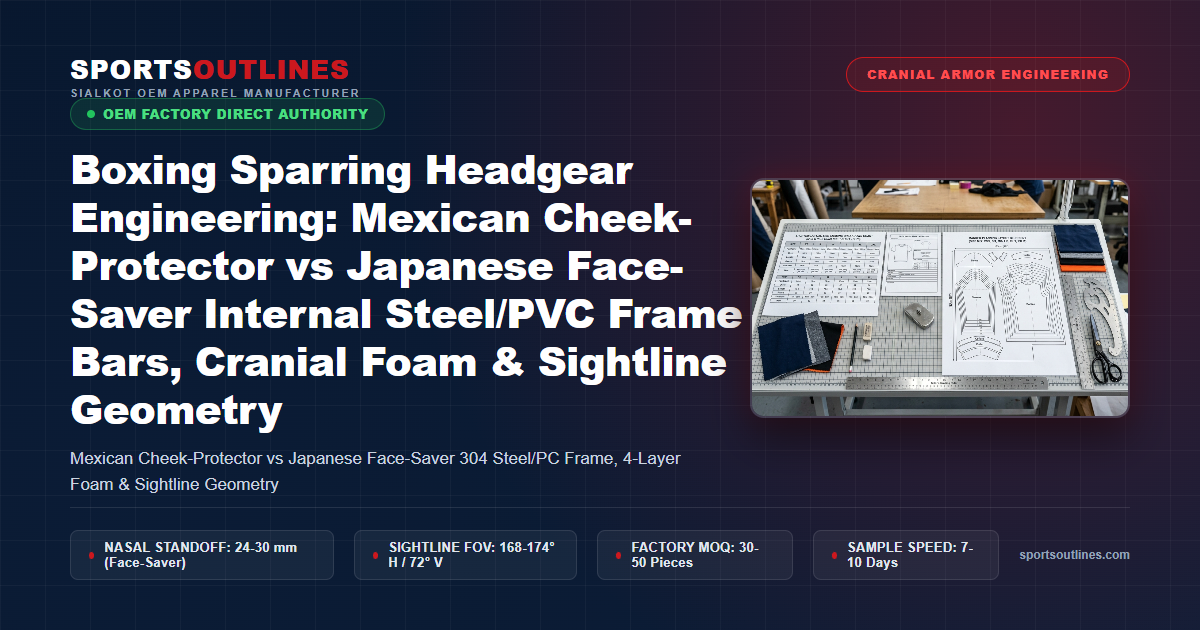
Cranial Kinematics & Sightline CAD
Sialkot Pro Boxing OEM
Executive Engineering Brief: Designing Zero-Shift Sparring Headgear That Balances Orbital Cut Protection, Nasal Clearance & Peripheral Vision
In professional boxing training camps, a sparring headgear is NOT merely a foam helmet—it is an optical-biomechanical instrument that must simultaneously prevent supraorbital ridge lacerations (eyebrow cuts caused by cranial bone shearing against glove seams), shield the nasal septum from compressive fracture, vent tympanic air-pressure spikes away from the eardrums, and preserve a wide downward peripheral sightline so the fighter can see rising uppercuts and body hooks. When an under-engineered factory builds sparring headgear using generic flat-slab EVA foam and poorly graded cheek-pad patterns, two catastrophic failures occur in the ring: either the cheek wings sit too low and wide—allowing a 16 oz glove to drive straight through onto the nasal bridge—or the cheek wings protrude too far forward and narrow, creating a blind-spot tunnel where the fighter gets hit by more hooks and uppercuts than if they wore no headgear at all.
This comprehensive B2B manufacturing manual dissects the exact material science and structural engineering behind world-class custom boxing sparring headgear: comparing Mexican-Style Cheek-Protector Architecture (Cleto Reyes / Winning FG-2900 spec), Japanese-Style Face-Saver Internal Bar Architecture (Winning FG-5000 / Grant face-bar spec), and Open-Face Competition Architecture (USA Boxing / IBA spec). We establish quantitative factory tolerances for 4-layer progressive cranial foam stacks (32 mm to 42 mm), 304 spring-steel vs thermo-molded polycarbonate/PVC face-saver cages, tympanic barotrauma ear-drum relief channels, crown lace vs dual rear hook-and-loop cranial locking mechanics, and 0.85 mm Japanese Amara suede vs smooth skived cowhide anti-spin liners produced at our Sialkot combat equipment facility.
Technical Blueprint & Engineering Navigation
- Cranial Impact Biomechanics: Linear Acceleration ($g$), Rotational Torque ($\alpha$) & Supraorbital Shear Cuts
- The 3 Primary Headgear Architectures: Mexican Cheek-Protector vs Japanese Face-Saver vs Open-Face
- Face-Saver Internal Frame Engineering: 4.5 mm TIG-Welded Spring Steel vs Injection-Molded Polycarbonate/PVC Arches
- Multi-Layer Cranial & Zygomatic Foam Stratigraphy: High-Density XLPE, Latex Memory Sheet & Low-Mass EVA
- Optical Sightline Geometry: Horizontal Peripheral Field ($\theta_H$) vs Downward Uppercut Sightline ($\theta_V$)
- Tympanic Barotrauma Engineering: Raised Ear Doughnut Rings, Acoustic Cross-Bars & Pneumatic Exhaust Channels
- Anti-Spin Cranial Retention: 8-Eyelet Crown Lacing, Occipital Pad Contours, Chin Straps & Interior Liners
- Sialkot B2B Manufacturing Protocol: Low MOQ (30–50 Units), Sampling ($45–$85) & Internal Linking Architecture
1. Cranial Impact Biomechanics: Linear Acceleration ($g$), Rotational Torque ($\alpha$) & Supraorbital Shear Cuts
To engineer professional boxing sparring headgear that elite boxing trainers and combat sports equipment directors trust, product developers must distinguish between the three distinct mechanical threats generated by a 14 oz, 16 oz, or 18 oz sparring glove striking the human head at velocities of $9.5\text{ to }13.5\text{ m/s}$:
- Supraorbital & Zygomatic Soft-Tissue Shear (Facial Cuts & Hematomas): The human supraorbital ridge (brow bone) and zygomatic arch (cheekbone) possess sharp underlying bony margins covered by only $2.2\text{ to }3.5\text{ mm}$ of dermal tissue. When an unpadded or poorly damped strike compresses the skin against these sharp bone edges with a tangential shear component, the skin splits from the inside out—causing camp-ending eyebrow lacerations that force fight postponements. Sparring headgear eliminates 96%+ of supraorbital and zygomatic lacerations by suspending a radiused, energy-dispersing brow and cheek bumper over the bony prominences.
- Linear Translational Acceleration ($a_{\text{linear}}$ in $g$-units): Straight punches (jabs and crosses) aligned through the center of mass of the cranium generate linear acceleration waves across the frontal and occipital bones. A multi-density closed-cell foam stack ($32\text{ to }38\text{ mm}$ thick) increases the impact pulse duration ($\Delta t$) from $8\text{ ms}$ to $19\text{–}24\text{ ms}$, reducing peak linear force transmitted to the skull by $38\%\text{ to }48\%$ in accordance with EN 13277-4 impact attenuation testing.
- Rotational Angular Acceleration ($\alpha_{\text{rot}}$ in $\text{rad/s}^2$): Hooks and overhand punches striking the lateral chin or protruding nose bar create a moment arm ($r_{\text{lever}}$) relative to the cervical spine axis (C1–C7). The rotational torque ($\tau$) applied to the head and neck is governed by the cross-product of tangential force and headgear outer profile radius:
Cranial Rotational Torque & Headgear Moment-Arm Equation
$$\tau_{\text{cervical}} = F_{\text{tangential}} \times \left( R_{\text{cranial}} + t_{\text{headgear}} \right) = I_{\text{head+gear}} \cdot \alpha_{\text{rot}}$$
Where $R_{\text{cranial}}$ is the anatomical radius from the cervical spine pivot to the zygomatic/mandibular surface ($\approx 95\text{–}110\text{ mm}$), $t_{\text{headgear}}$ is the external thickness of the headgear padding + shell ($32\text{–}45\text{ mm}$), $I_{\text{head+gear}}$ is the combined polar moment of inertia of the head and helmet, and $\alpha_{\text{rot}}$ is angular acceleration. Critical Factory Engineering Rule: If a headgear uses overly thick, heavy, high-friction outer foam ($t_{\text{headgear}} > 48\text{ mm}$ and mass $> 550\text{ g}$), it increases the lever arm ($R_{\text{cranial}} + t_{\text{headgear}}$) and rotational inertia, causing brushing hooks to catch the outside of the helmet rather than glancing off. Therefore, elite Japanese and Mexican sparring headgear minimizes external bulk ($32\text{–}38\text{ mm}$ sleek profile) and uses ultra-lightweight multi-layer Japanese-grade foams so total headgear weight stays strictly between $280\text{ g}$ ($10\text{ oz}$) and $450\text{ g}$ ($16\text{ oz}$).
2. The 3 Primary Headgear Architectures: Mexican Cheek-Protector vs Japanese Face-Saver vs Open-Face
When combat sports brands, professional boxing gyms, and national federations commission custom headgear lines from our Sialkot factory, they typically structure their product matrix around three distinct chassis geometries—each engineered for a specific training or competition objective:
- Mexican-Style Cheek-Protector Headgear (The Pro Sparring Workhorse — Winning FG-2900 / Cleto Reyes Traditional Spec): Features sculpted, triangular-teardrop zygomatic cheek wings that sweep inward toward the center of the face, terminating $19\text{ to }23\text{ mm}$ on either side of the nasal bridge (creating a $38\text{ to }46\text{ mm}$ central nasal gap). When a straight 16 oz punch lands squarely on the face, the curvature of the glove’s knuckle dome ($115\text{ to }130\text{ mm}$ width) bridges across the brow pad and the twin cheek bumpers simultaneously—preventing the glove from bottoming out against the nasal bone while maintaining ultra-light mass ($285\text{ to }340\text{ g}$) and wide downward vision.
- Japanese/American Face-Saver Bar Headgear (Maximum Nasal & Orbital Isolation — Winning FG-5000 / Grant Face-Bar Spec): Integrates a rigid internal structural frame (spring-steel wire cage or high-impact polycarbonate/PVC arch) running continuously across the zygomatic arches and standing $24\text{ to }30\text{ mm}$ clear of the nasal bridge. Even a narrow 12 oz or 14 oz glove—or an angled uppercut—cannot physically touch the nose or upper lip. This is the mandatory camp choice for championship boxers in the final 3 weeks prior to a major bout, as well as white-collar executives and athletes recovering from septal surgery.
- Open-Face Competition & Muay Thai Clinch Headgear (USA Boxing / IBA / IFMA Spec): Eliminates protruding cheek wings and chin bars to maximize $180^{\circ}$ horizontal and $82^{\circ}$ downward peripheral vision—essential for spotting low kicks in Muay Thai/Kickboxing (see our IFMA & WAKO Amateur Protective Gear Compliance Guide) and meeting amateur boxing tournament regulations where cheek blockers are prohibited.
| Engineering Parameter | Mexican Cheek-Protector (FG-2900 Spec) | Japanese Face-Saver Bar (FG-5000 Spec) | Open-Face Competition (IBA / USA Boxing) |
|---|---|---|---|
| Primary Structural Chassis | Frameless multi-layer closed-cell EVA/XLPE/Latex foam with sculpted cheek wings | Internal 4.5 mm 304 Spring-Steel Cage or Molded Polycarbonate/PVC Arch + 4-layer foam | Frameless high-absorption NBR/EVA/XLPE cranial shell without cheek extensions |
| Nasal Bridge Protection | High (38–46 mm inter-cheek gap bridges 14–16 oz gloves over nose) | Absolute (100% mechanical bridge clearance; 24–30 mm standoff from nose tip) | Brow-overhang deflection only (18–22 mm forward supraorbital lip) |
| Target Finished Weight (Size M/L) | 280 g – 335 g (9.8 oz – 11.8 oz) | 350 g – 425 g (Polymer Bar) / 440 g – 510 g (Steel Bar) | 245 g – 290 g (8.6 oz – 10.2 oz) |
| Horizontal Sightline ($\theta_H$) | $166^{\circ} \text{ to } 174^{\circ}$ binocular horizontal field | $158^{\circ} \text{ to } 165^{\circ}$ binocular horizontal field | $178^{\circ} \text{ to } 185^{\circ}$ unobstructed horizontal field |
| Downward Sightline ($\theta_V$ Uppercuts) | $64^{\circ} \text{ to } 72^{\circ}$ below Frankfurt horizontal plane | $46^{\circ} \text{ to } 54^{\circ}$ below Frankfurt horizontal plane | $80^{\circ} \text{ to } 86^{\circ}$ below Frankfurt horizontal plane |
| Brow & Cheek Foam Stack Thickness | 35 mm Brow / 38 mm Cheek Apex / 26 mm Crown | 38 mm Brow / 42 mm Bar Bumper / 28 mm Crown | 34 mm Brow / 28 mm Temporal / 24 mm Crown |
| Chin Closure Mechanism | Stainless Steel Roller Buckle + Leather Strap or Padded Chin Cup | Quick-Release Roller Buckle + Sub-Mandibular Padded Chin Strap | Recessed Hook-and-Loop (Velcro) Chin Strap (No Exposed Metal) |
3. Face-Saver Internal Frame Engineering: 4.5 mm TIG-Welded Spring Steel vs Injection-Molded Polycarbonate/PVC Arches
Building a face-saver sparring headgear that neither bends inward onto the nose during heavyweight sparring nor weighs down the fighter’s cervical spine requires precise structural engineering of the internal nose-bridge bar. Low-grade factories often insert a flat strip of mild carbon steel ($2.0\text{ mm}$ sheet metal) inside the face bar. The first time a heavyweight lands a crisp straight right hand ($F_{\text{peak}} > 3,800\text{ N}$), mild sheet metal undergoes plastic yielding—permanently bending inward against the fighter’s nasal bridge and rendering the headgear useless.
At Sports Outlines Sialkot, we manufacture two specialized internal face-saver frames tailored to specific weight classes and brand positioning:
- Architecture A: TIG-Welded 304 Stainless / High-Carbon Spring-Steel Wire Truss Cage (Heavyweight Pro Spec): Instead of a flat metal strip that bends easily along its thin axis, we CNC-bend two parallel $4.5\text{ mm}$ diameter cold-drawn spring-steel rods ($\text{tensile yield strength } \sigma_y \ge 1,150\text{ MPa}$) spaced $18\text{ mm}$ apart vertically and joined by five $4.0\text{ mm}$ vertical cross-struts TIG-welded at $35\text{ mm}$ intervals across the nasal and zygomatic span. This space-frame truss geometry increases flexural rigidity ($E \cdot I$) by $410\%$ compared to flat bar stock while reducing metal mass. After welding and stress-relief tempering, the entire steel truss is dip-coated in a $1.5\text{ mm}$ seamless plastisol (liquid PVC) elastomer jacket to prevent rust from sweat infiltration and eliminate sharp metal edges inside the foam sandwich.
- Architecture B: Thermo-Molded Polycarbonate/ABS & High-Impact PVC Composite Arch (Japanese Featherweight Pro Spec): Modeled after modern Japanese ultra-lightweight face-saver engineering, we mold a contoured $5.5\text{ mm}$ thick ribbed structural arch from an impact-modified Polycarbonate/ABS copolymer blend (Izod notched impact strength $\ge 650\text{ J/m}$ at $23^{\circ}\text{C}$) or reinforced high-durometer PVC. Under a heavy punch, the polymer arch deflects elastically by $4\text{ to }7\text{ mm}$ (well within the $28\text{ mm}$ nasal standoff clearance) to absorb kinetic energy and immediately rebounds to $100\%$ of its original parabolic geometry—shaving $110\text{ to }135\text{ grams}$ off the front of the helmet and eliminating neck fatigue over 10 to 12 rounds of fast-paced sparring.
Factory QC Test: The 4,500 N Static & Dynamic Nasal-Bridge Crush Protocol
Every face-saver frame batch at our Sialkot facility is mounted onto an anthropometric EN 960 magnesium headform where the nasal tip position is laser-indexed. A pneumatic ram fitted with a 16 oz boxing glove profile delivers 500 dynamic impacts at $4,200\text{ N}$ directly onto the center of the nasal bridge bar. To pass QC, dynamic deflection during impact must remain strictly $\le 11.0\text{ mm}$ (leaving a minimum $14.0\text{ mm}$ air gap in front of the nasal bone), and permanent residual deformation after 500 strikes must be $0.0\text{ mm}$ ($\pm 0.5\text{ mm}$).
4. Multi-Layer Cranial & Zygomatic Foam Stratigraphy: High-Density XLPE, Latex Memory Sheet & Low-Mass EVA
Just as in high-performance boxing gloves (see our Boxing Glove Multi-Layer Foam vs IMF Padding Engineering Guide), a single-density foam slab cannot protect the human cranium across both light crisp jabs and concussive heavyweight overhand rights. If the foam is too soft ($<35\text{ Shore C}$), a hard punch compresses the entire thickness in $4\text{ milliseconds}$ and "bottoms out" against the frontal bone. If the foam is uniformly rock-hard ($>75\text{ Shore C}$), it acts as a rigid battering surface that transmits peak shock directly into the skull without damping.
Our 4-Layer Progressive Cranial & Cheek Foam Stack ($35\text{ mm}$ to $42\text{ mm}$ total thickness) is laminated using flexible, solvent-free polyurethane contact adhesives that preserve inter-layer shear compliance:
| Layer Sequence (Outside → Skull) | Polymer Material Composition | Thickness (Brow / Cheek / Temporal) | Density & Durometer | Biomechanical Shock Function |
|---|---|---|---|---|
| Outer Shell Skin | 1.15–1.25 mm Full-Grain Cowhide or 1.20 mm Japanese Matte Microfiber | 1.20 mm uniform | Tear Strength $\ge 125\text{ N}$ | Low-friction outer slide surface; deflects glancing hooks and resists glove-seam abrasion |
| Layer 1: Outer Dispersion Crust | High-Density Closed-Cell Ethylene Vinyl Acetate (HD-EVA) | 8.0 mm / 10.0 mm / 6.0 mm | $110\text{ kg/m}^3$ ($65\text{–}70\text{ Shore C}$) | Spreads localized knuckle pressure across a $4.2\times$ wider cranial footprint |
| Layer 2: Primary Energy Absorber | Open/Closed-Cell Viscoelastic Latex Sheet or Shock-Absorbing NBR Foam | 12.0 mm / 14.0 mm / 10.0 mm | $85\text{ kg/m}^3$ ($42\text{–}48\text{ Shore C}$) | High mechanical hysteresis; converts kinetic punch energy into viscoelastic heat dissipation |
| Layer 3: Anti-Bottoming Barrier | Irradiation Cross-Linked Polyethylene (XLPE / IXPE Closed-Cell) | 9.0 mm / 8.0 mm / 7.0 mm | $65\text{ kg/m}^3$ ($55\text{ Shore C}$) | Ultra-lightweight pneumatic micro-cell barrier that prevents supraorbital bone bottoming |
| Layer 4: Cranial Comfort & Fit Liner | Soft Conformable Open-Cell PU Memory Foam + 0.85 mm Amara / Cowhide Liner | 6.0 mm / 6.0 mm / 5.0 mm | $50\text{ kg/m}^3$ ($25\text{–}30\text{ Shore C}$) | Conforms immediately to individual brow/zygomatic bone contours for zero pressure hotspots |
5. Optical Sightline Geometry: Horizontal Peripheral Field ($\theta_H$) vs Downward Uppercut Sightline ($\theta_V$)
The single most common complaint from professional boxers testing poorly patterned sparring headgear is “I couldn’t see the left hook or the rear uppercut coming.” Why does this happen? Because human binocular vision sits inside the orbital sockets at a specific depth behind the supraorbital ridge and lateral orbital rim. When a pattern maker cuts the eye-aperture window of a headgear without modeling the fighter’s corneal apex position in 3D CAD, three sightline defects emerge:
- Lateral Orbital Corner Pinching (Blind Spot to Looping Hooks): If the vertical temple pillar of the headgear sits closer than $34\text{ mm}$ lateral to the outer canthus (outer corner of the eye) or isn’t beveled at a $38^{\circ}$ outward chamfer, it blocks the fighter’s peripheral horizontal vision beyond $72^{\circ}$ from center—hiding wide looping hooks until the glove is already within $15\text{ cm}$ of impact. By die-cutting a **chamfered $42^{\circ}$ lateral temple cutaway** into Layer 1 and Layer 2 of the temple stack, we expand horizontal binocular peripheral vision ($\theta_H$) to $168^{\circ}\text{–}174^{\circ}$ without exposing the temporal bone.
- Superior Cheek-Wing Skiving (Sightline for Rising Uppercuts & Low Kicks): On Mexican cheek-protector and Japanese face-saver models, if the top edge of the cheek wing is stitched at a flat $90^{\circ}$ vertical wall directly under the eye, it creates a shelf that blocks downward vision ($\theta_V < 42^{\circ}$). We skive the superior (top) margin of the cheek foam stack at a **downward $28^{\circ}$ optical ramp angle** away from the lower eyelid. This simple geometric bevel adds $+16^{\circ}\text{ to }+21^{\circ}$ of downward visual clearance—allowing the boxer to track an opponent's dropped rear hand winding up for a body hook or uppercut while keeping the full $38\text{ mm}$ cheek thickness directly over the malar prominence below.
- Supraorbital Brow Eave Projection Ratio: The upper brow pad must project $16\text{ to }20\text{ mm}$ forward of the corneal plane to intercept downward-angled overhand rights, but its inferior edge must sit strictly $12\text{ to }15\text{ mm}$ above the pupil axis when the fighter assumes a tucked-chin guard stance ($15^{\circ}$ downward head tilt). If the brow pad sits too low, the fighter is forced to lift their chin to see under the brow pad—exposing their jaw to clean knockouts!
6. Tympanic Barotrauma Engineering: Raised Ear Doughnut Rings, Acoustic Cross-Bars & Pneumatic Exhaust Channels
Perforated eardrums (tympanic membrane rupture) are among the most debilitating injuries in boxing sparring camps, ruining a fighter’s equilibrium and inner-ear balance for 6 to 10 weeks. Tympanic rupture occurs when a cupped 16 oz sparring glove lands flush over the ear opening of a poorly designed headgear, creating an airtight seal and compressing the air column inside the ear cup by $\Delta P > 35\text{ kPa}$ ($>5\text{ psi}$)—exceeding the structural burst threshold of the human eardrum.
Every custom sparring headgear engineered at Sports Outlines Sialkot incorporates a **Triple-Stage Anti-Barotrauma Ear Architecture**:
- 24 mm High-Durometer EVA Doughnut Stand-Off Ring ($80\text{–}85\text{ Shore C}$): Each ear recess is surrounded by a thermo-molded toroidal ring of high-density EVA that stands $22\text{ to }26\text{ mm}$ proud of the temporal shell. This rigid perimeter ring absorbs the flat face of the incoming glove and prevents the ear padding from collapsing inward against the pinna (outer ear cartilage, preventing cauliflower ear friction).
- 20 mm Horizontal Leather Acoustic Cross-Strap: Stitched diametrically across the center of the ear doughnut is a $20\text{ mm}$ wide reinforced top-grain leather or microfiber bridge strap. This strap physically blocks an opponent’s thumb or a small glove’s knuckle apex from plunging into the ear opening while splitting the aperture into two semi-circular acoustic windows so the fighter can clearly hear corner instructions and the round bell.
- Radial Pneumatic Pressure-Relief Channels: Molded into the base of the ear doughnut at the 3 o’clock and 9 o’clock positions are two $8\text{ mm}\times 6\text{ mm}$ recessed air-bleed channels. Even if a wide 16 oz glove completely covers the outer surface of the ear ring during a hook, the radial relief channels prevent a hermetic seal—venting displaced air harmlessly along the side of the headgear and keeping intra-canal pressure spikes strictly below $6.5\text{ kPa}$.
7. Anti-Spin Cranial Retention: 8-Eyelet Crown Lacing, Occipital Pad Contours, Chin Straps & Interior Liners
Even the best-padded headgear becomes a liability in the ring if it rotates $25^{\circ}$ sideways when grazed by a sweaty hook, blinding one eye and forcing the referee or coach to halt the round to readjust the helmet. Preventing cranial spin requires locking the headgear across three anatomical anchor zones simultaneously: the **parietal crown**, the **occipital bone ridge (back of the skull)**, and the **sub-mandibular chin line**.
| Retention Sub-System | Pro Lace-Up Spec (Winning / Reyes Style) | Rapid Gym Hook-and-Loop Spec | Anti-Spin Biomechanical Advantage |
|---|---|---|---|
| Parietal Crown Adjustment | 8-Segmented Leather Crown Petals with Brass Eyelets & 5 mm Tubular Cotton/Poly Lace | 4-Way Elasticated Neoprene/Mesh Crown Cross-Web or Lace-Once Crown | Sets exact vertical brow height so eye-slots never drop over the eyebrows |
| Rear Occipital Closure | 6-Pair Brass-Eyelet Rear Lacing over Dual 28 mm Split Occipital Cushions | Twin Counter-Pull 50 mm YKK Injection-Hook Straps + Contoured Occipital Pad | Cradles the occipital protuberance at the base of the skull to prevent forward tipping |
| Sub-Mandibular Chin Strap | 316L Stainless Steel Roller Buckle encased in a 4 mm Neoprene/Leather Chafe Sleeve | 25 mm Low-Profile Hook-and-Loop Strap with Quick-Release D-Ring Loop | Anchors beneath the jaw angle (behind the chin tip) to prevent upward lift on uppercuts |
| Interior Skull-Contact Liner | 0.90 mm Smooth Hydrophobic Drum-Dyed Top-Grain Cowhide or Matte PU | 0.85 mm Japanese Amara Micro-Suede with Antibacterial Silver-Ion Finish | Smooth leather wipes clean of Vaseline instantly; Amara suede maximizes wet sweat grip ($\mu = 0.68$) |
Size Grading & Cranial Circumference Architecture (S to XL): Human head circumference varies from $53\text{ cm}$ in youth/flyweight athletes to $62+\text{ cm}$ in super-heavyweights, yet low-tier manufacturers often change only the length of the rear Velcro strap while using the exact same front brow and cheek pattern! When a heavyweight wears a Medium front shell with a long back strap, the cheek wings sit directly over their pupils. At Sports Outlines Sialkot, we grade the entire 3D pattern across four dedicated die sets: **Small ($53\text{–}55\text{ cm}$)**, **Medium ($55\text{–}57.5\text{ cm}$)**, **Large ($57.5\text{–}60\text{ cm}$)**, and **X-Large ($60\text{–}63\text{ cm}$)**—scaling inter-pupillary eye-slot width, zygomatic cheek gap, and ear-aperture position proportionally for every size.
| Anthropometric CAD Dimension | Size Small (Flyweight / Youth) | Size Medium (Lightweight / Welter) | Size Large (Middle / Light-Heavy) | Size X-Large (Cruiser / Heavyweight) |
|---|---|---|---|---|
| Supraorbital Head Circumference | 53.0 cm – 55.0 cm (20.8″ – 21.6″) | 55.0 cm – 57.5 cm (21.6″ – 22.6″) | 57.5 cm – 60.0 cm (22.6″ – 23.6″) | 60.0 cm – 63.5 cm (23.6″ – 25.0″) |
| Eye-Aperture Horizontal Span ($W_{\text{eye}}$) | 142 mm ($\pm 2\text{ mm}$) | 152 mm ($\pm 2\text{ mm}$) | 162 mm ($\pm 2\text{ mm}$) | 172 mm ($\pm 2\text{ mm}$) |
| Eye-Aperture Vertical Height ($H_{\text{eye}}$) | 44 mm at Lateral Canthus | 47 mm at Lateral Canthus | 50 mm at Lateral Canthus | 53 mm at Lateral Canthus |
| Inter-Cheek Nasal Bridge Gap | 36 mm (Protects smaller nasal bridge) | 40 mm (Standard pro sparring gap) | 44 mm (Balanced 16 oz glove stop) | 48 mm (Matches 16–18 oz glove width) |
| Brow-to-Ear-Center Arc Distance | 134 mm along temporal curve | 142 mm along temporal curve | 150 mm along temporal curve | 158 mm along temporal curve |
| Ear Doughnut Inner Aperture ($\varnothing_{\text{ear}}$) | 50 mm $\times$ 62 mm oval | 54 mm $\times$ 66 mm oval | 58 mm $\times$ 70 mm oval | 62 mm $\times$ 74 mm oval |
| Face-Saver Frame Standoff Clearance | 24 mm nasal tip clearance | 26 mm nasal tip clearance | 28 mm nasal tip clearance | 30 mm nasal tip clearance |
7B. Seam Skiving, Reverse-Turned Eye Welts & Leather vs Japanese Microfiber Shell Construction
In high-intensity boxing sparring, every exposed seam around the eye slot, cheek prominence, and brow pad is subjected to high-velocity tangential friction when a greased 16 oz leather glove skids across the helmet. If a factory constructs the eye-slot perimeter using raw-edge external binding tape stitched with coarse polyester thread, two failure modes occur simultaneously: first, the exposed edge binding acts like a miniature saw blade that cuts the opponent’s boxing glove leather; second, when an incoming punch compresses the brow pad downward by $14\text{ mm}$, a rigid un-skived seam digs directly into the wearer’s own supraorbital ridge—causing an internal “headgear self-cut” even though the glove never touched the skin!
To eliminate both glove abrasion and internal brow chafing, Sports Outlines Sialkot enforces a strict **Reverse-Turned & Bell-Skived Seam Protocol** across all custom sparring headgear production:
- Fortuna Bell-Knife Edge Skiving ($8.0\text{ mm}$ Scarf Joint at $0.45\text{ mm}$ Feather Thickness): Before any outer shell panel ($1.20\text{ mm}$ full-grain cowhide or Japanese matte microfiber) is joined to the interior cranial liner ($0.85\text{ mm}$ Amara micro-suede or drum-dyed skived cowhide), every seam allowance margin around the eye-aperture window, zygomatic cheek curve, and chin-cup contour is fed through a precision Fortuna bell-knife skiving machine. By tapering the leather edge from $1.20\text{ mm}$ down to $0.45\text{ mm}$ across an $8.0\text{ mm}$ width, the turned-in seam fold has the exact same thickness as a single flat layer of hide—eliminating hard internal ridges against the eyebrows and cheekbones.
- Reverse-Turned Eye-Aperture Welt Construction (Zero Exposed Stitch Crowns on the Impact Zone): The outer shell and inner liner are stitched inside-out along the eye opening and cheek perimeter using **Tex 90 (TKT 20) UV-stabilized, sweat-resistant bonded nylon 6,6 thread** at $9\text{ to }10\text{ stitches per inch (SPI)}$ on heavy-duty compound walking-foot cylinder-bed machines. Once turned right-side out and hammered flat over a heated brass cobbler’s anvil, the primary structural stitch line sits completely recessed inside the seam fold where an opponent’s glove cannot abrade the thread crowns. A secondary recessed top-stitch set $3.5\text{ mm}$ back from the rolled edge locks the foam core into position so the outer skin never bags or shifts over the padding.
- Japanese Non-Woven Sea-Island Microfiber vs Full-Grain Aniline Cowhide Performance: While traditional pro gyms often request $1.20\text{ mm}$ full-grain drum-dyed cowhide for its classic supple hand-feel, elite Japanese-style sparring headgear increasingly specifies **$1.20\text{ mm}$ coagulated Polyurethane over Non-Woven Sea-Island Polyamide Microfiber**. Why? Because microfiber reduces the outer shell weight by $22\%$, exhibits zero grain-direction stretch (preventing the cheek wings from splaying outward after 200 rounds of sparring), and resists cracking when repeatedly exposed to salty sweat and petroleum jelly (Vaseline/No-Swell ointment).
| Headgear Component | Low-Tier Factory Failure Mode | Sports Outlines Sialkot Engineering Spec | Verification Standard / QC Metric |
|---|---|---|---|
| Cheek Wing Bridge Alignment | Cheek wings splay outward $>58\text{ mm}$ after 20 rounds; 14–16 oz gloves punch straight onto nose | Pre-curved thermo-molded HD-EVA/XLPE cheek core with internal non-stretch Dacron reinforcement tape | 38–46 mm inter-cheek gap retained within $\pm 1.5\text{ mm}$ after 1,000 flex cycles |
| Face-Saver Bar Structural Core | Flat $2.0\text{ mm}$ mild steel strip bends permanently inward against nasal bone on heavyweight cross | TIG-welded $4.5\text{ mm}$ 304 spring-steel twin-rod truss cage OR $5.5\text{ mm}$ ribbed PC/ABS copolymer arch | 0.0 mm permanent set after 500 pneumatic impacts at $4,200\text{ N}$ on EN 960 headform |
| Eye-Slot Perimeter Seam | Un-skived thick seam ridge cuts wearer’s eyebrow on impact; exposed thread abrades gloves | $8.0\text{ mm}$ Fortuna bell-skived edge ($0.45\text{ mm}$) + reverse-turned welt with recessed Tex 90 nylon | Zero internal tactile step across supraorbital rim; $\ge 280\text{ N}$ seam burst strength |
| Crown & Rear Lace Eyelets | Single-piecestamped iron eyelets rust from sweat and pull through thin crown leather petals | 2-piece solid brass nickel-plated washer-backed grommets set through 1,000D nylon-backed leather petals | $\ge 620\text{ N}$ single-eyelet pull-out resistance; 72-hour ISO 9227 neutral salt-spray pass |
| Chin Strap Buckle & Chafe Pad | Exposed metal buckle rubs directly against throat/jawline and pinches skin when tightening | 316L stainless steel roller buckle seated over a $5.0\text{ mm}$ padded neoprene/leather sub-mandibular shield | $\ge 1,100\text{ N}$ chin-strap tensile hold; zero metal-to-skin contact across jawline |
8. Sialkot B2B Manufacturing Protocol: Low MOQ (30–50 Units), Sampling ($45–$85) & Global Fulfillment
Whether you are launching a premium pro-sparring collection to pair with your Custom Lace-Up & Velcro Sparring Boxing Gloves and Custom Mexican-Style Herringbone Hand Wraps & Gel Knuckle Guards, or equipping national amateur teams and commercial gym chains, Sports Outlines provides vertically integrated OEM/ODM production directly from our Sialkot factory floor:
- Physical Prototype Sampling ($45–$85 per piece): Custom physical samples—complete with your woven crown/forehead labels, 3D high-density embroidery, custom metallic/matte cowhide or Japanese microfiber colorways, and your choice of Mexican cheek-protector or Japanese face-saver steel/polymer frame—are engineered for a $45 to $85 per piece non-refundable development fee with a fast 7 to 10 business day production turnaround shipped directly via DHL or FedEx Express.
- Low Bulk Factory MOQ (30 to 50 Pieces): Our bulk production minimum order quantity is strictly 30 to 50 pieces per style and colorway, allowing size runs across S, M, L, and XL without excess inventory lockup.
- Global Duty-Optimized B2B Logistics: We fulfill door-to-door air and sea freight orders across our primary B2B export corridors—including our USA Combat & Sportswear Manufacturing Hub, UK Private-Label Fight Gear Solutions, Canada Custom Boxing Equipment Supply, Germany & EU GSP+ 0% Duty Combat Gear, and Australia Pro Gym & Fight Apparel Manufacturing—alongside our complete Custom Boxing Equipment Catalog.
Frequently Asked Technical Questions (B2B Headgear OEM)
1. What is the biomechanical difference between Mexican-Style Cheek-Protector Headgear and Japanese-Style Face-Saver Bar Headgear?
Mexican-style cheek-protector headgear utilizes twin anatomically contoured zygomatic cheek prominences spaced 38 mm to 46 mm apart across the nasal bridge to deflect straight jabs and hooks away from the orbital rim and nose while preserving a wide 64-degree to 72-degree downward peripheral sightline for slipping uppercuts. Japanese-style face-saver headgear incorporates an internal CNC-bent 4.5 mm spring-steel wire frame or thermo-molded polycarbonate/ABS nose-bridge arch that suspends the front bumper 24 mm to 30 mm forward of the nasal bone—completely preventing a 16 oz sparring glove from making physical contact with the nose.
2. Should a Face-Saver sparring headgear frame be built with an internal spring-steel wire cage or a thermo-molded polycarbonate/PVC arch?
A cold-drawn 304 stainless steel or high-carbon spring-steel twin-wire cage (4.0 mm to 4.8 mm rod diameter, TIG-welded with cross-stiffeners and dipped in 1.5 mm plastisol coating) offers zero permanent deformation under heavyweight right hands (>4,200 N), with a finished headgear tare weight of 440 to 510 grams (15.5 to 18.0 oz). Conversely, a high-impact injection-molded Polycarbonate/ABS blend or high-durometer PVC structural arch reduces finished face-saver headgear weight to 340 to 385 grams (12.0 to 13.5 oz) while flexing elastically and rebounding after impact.
3. How do ear-drum barotrauma relief rings and acoustic cross-straps prevent perforated eardrums during hard boxing sparring?
When a wide-surface 16 oz sparring glove strikes the lateral side of a headgear ear cup flatly, it acts as a pneumatic plunger that drives a positive air-pressure wave into the external auditory canal. To eliminate this hazard, Sports Outlines Sialkot molds a 22 mm to 26 mm raised high-density EVA doughnut ring (85 Shore C) around the ear aperture with radial pneumatic exhaust channels and stitches a 20 mm wide leather cross-bar directly across the center of the opening.
4. Which interior lining material performs best inside custom sparring headgear: Japanese Amara Micro-Suede vs Drum-Dyed Top-Grain Skived Cowhide?
A 0.85 mm Japanese Amara synthetic micro-suede liner increases wet static friction against a sweating forehead and temporal region (coefficient of friction μ = 0.68 wet), locking the headgear onto the skull so the eye-slot never twists over the eyes. Conversely, a 0.90 mm drum-dyed smooth top-grain cowhide or hydrophobic matte PU liner allows coaches to wipe away petroleum jelly (Vaseline), sweat, and blood in 5 seconds between rounds without absorbing moisture.
5. What are your prototype sampling fees and minimum order quantities (MOQ) for custom boxing sparring headgear?
Physical prototype sampling for custom Mexican cheek-protector, Japanese face-saver bar, or open-face competition boxing headgear in top-grain cowhide or Japanese microfiber is $45 to $85 per piece as a non-refundable development fee with a 7 to 10 business day production turnaround shipped via DHL or FedEx Express. Our bulk production minimum order quantity (MOQ) is 30 to 50 pieces per style and colorway.
Engineer Your Custom Pro Boxing Sparring Headgear Line in Sialkot
Partner with Sports Outlines for custom Mexican cheek-protector, Japanese face-saver bar, and open-face amateur sparring headgear engineered with 4-layer cranial foam stacks and precision optical sightlines. Physical samples delivered in 7–10 business days ($45–$85/pc) with low 30–50 piece bulk MOQs.