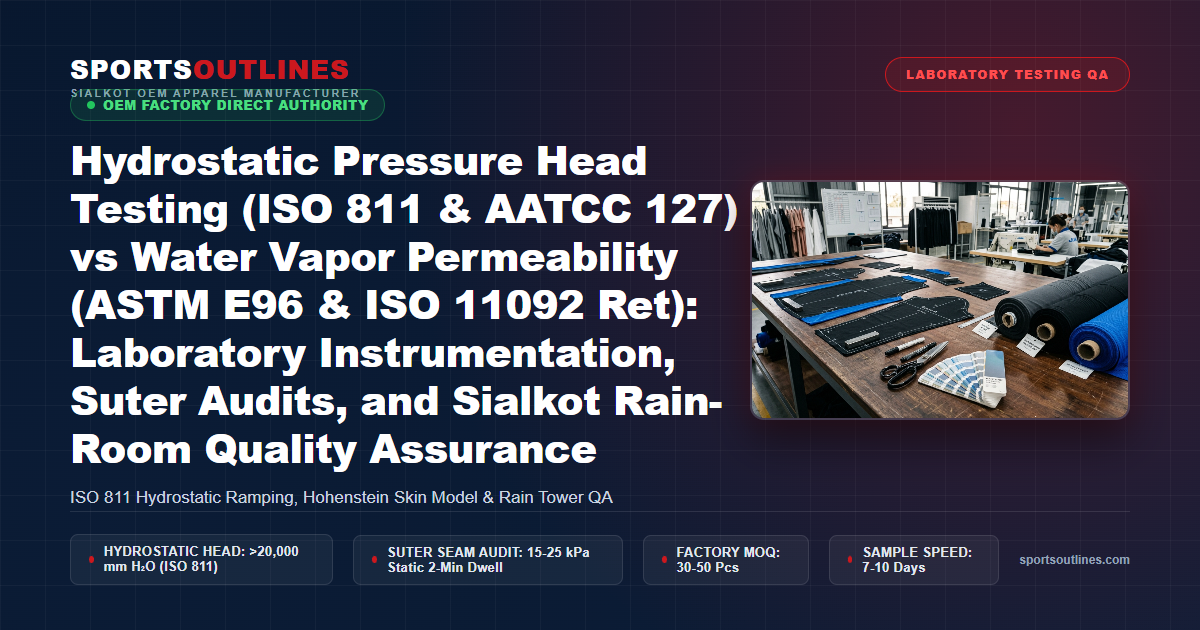
In the technical sportswear and alpine outerwear industries, marketing hangtags frequently display bold specifications such as “20,000 mm Waterproof / 20,000 g/m²/24h Breathable”. Yet, behind these ubiquitous commercial claims lies a complex, often misunderstood landscape of international textile testing standards. A fabric rated at 20,000 g under an inverted cup potassium acetate method can register under 6,000 g on an upright desiccant cup, while a jacket made from a 30,000 mm membrane will leak catastrophically after ten minutes in an alpine downpour if its seam tape application parameters or 3-way seam junctions are miscalibrated.
To build dependable, expedition-grade technical outerwear, apparel brands, product developers, and materials engineers must master the rigorous laboratory physics governing hydrostatic pressure head testing (ISO 811 & AATCC 127), water vapor permeability protocols (ASTM E96 & ISO 11092 Ret), pneumatic Suter seam audits, and full-garment rain tower storm room simulations. At Sports Outlines, operating our technical outerwear lamination, cleanroom seam sealing, and quality assurance testing facility in Sialkot, Pakistan, we bridge the gap between textile physics and commercial garment manufacturing. We combine precision in-house hydrostatic testing benches, Hohenstein Skin Model verification, and automated rain-room storm testing with accessible client terms: physical prototype sampling at $45 to $85 per piece (non-refundable, 7–10 business days turnaround) and low-MOQ bulk manufacturing starting at strictly 30 to 50 pieces per style/colorway.
Outerwear Weatherproofing & Breathability QC: Technical Navigation Directory
- 1. Hydrostatic Pressure Head Fundamentals: Water Column Column Height & Pascals
- 2. ISO 811 vs AATCC 127: Test Area, Pressure Ramp Rates, and Third-Drop Criteria
- 3. Suter Seam Audits: Pneumatic Static Clamping at Multi-Seam Intersections
- 4. Water Vapor Permeability Discrepancies: Inverted Cup vs Upright Desiccant Cup
- 5. ISO 11092 (Sweating Guarded Hotplate): Ret Evaporative Resistance Mastery
- 6. Technical Standards Comparison Matrix: Hydrostatic & Breathability Benchmarks
- 7. Seam Tape Peel Strength Testing: ASTM D903 & Multi-Layer Step-Downs
- 8. Accelerated Laundering & Delamination Audits: 50-Cycle ISO 6330 Protocols
- 9. Sialkot Rain Tower Testing: EN 14360 & ASTM F2757 Mannequin Simulations
- 10. Forensic Failure Analysis: Seam Leaks, DWR Wet-Out, and Needle Deflection
- 11. Outerwear Tech Pack Specifications: Defining QA Tolerances for Factories
- 12. Sialkot Technical Outerwear Manufacturing & Quality Assurance
- 13. Low-MOQ Sourcing & Commercial Factory Terms
- 14. Technical Sourcing FAQ
1. Hydrostatic Pressure Head Fundamentals: Water Column Height & Pascals
Hydrostatic pressure head measures the ability of a textile composite to resist liquid water penetration under increasing physical pressure. In physics, the relationship between fluid pressure ($P$), water density ($\rho$), gravitational acceleration ($g$), and column height ($h$) is expressed by the hydrostatic equation:
For distilled water at standard ambient temperature ($20^\circ\text{C}$):
- A water column height of $10,000\text{ mm } \text{H}_2\text{O}$ equates to approximately $98.1\text{ kPa}$ ($0.981\text{ bar}$ or $14.22\text{ psi}$).
- An expedition-grade rating of $20,000\text{ mm } \text{H}_2\text{O}$ corresponds to $196.2\text{ kPa}$ ($1.962\text{ bar}$ or $28.45\text{ psi}$).
- A maximum mountaineering rating of $28,000\text{ mm } \text{H}_2\text{O}$ corresponds to $274.7\text{ kPa}$ ($2.75\text{ bar}$ or $39.83\text{ psi}$).
In real-world mountain environments, static rainfall generates surprisingly low pressure (gentle drizzle exerts $<1,000\text{ mm}$, while violent storm downpours rarely exceed $2,500\text{ mm}$). However, dynamic mechanical forces generated by the wearer dramatically multiply localized pressures:
- Kneeling on Wet Ground: A 75 kg mountaineer kneeling in wet snow or soggy turf generates localized kneecap pressures exceeding $10,000\text{ to }14,000\text{ mm } \text{H}_2\text{O}$ ($1.0\text{ to }1.4\text{ bar}$).
- Heavy Backpack Shoulder Straps: An expedition pack weighing 25 kg exerts localized shoulder yoke pressures reaching $12,000\text{ to }16,000\text{ mm } \text{H}_2\text{O}$.
- Sitting on a Wet Ski Chairlift: Concentrated bodyweight on a wet seat generates pressures of $8,000\text{ to }12,000\text{ mm } \text{H}_2\text{O}$.
Consequently, an alpine outerwear shell must achieve a minimum verified hydrostatic head of $>15,000\text{ to }20,000\text{ mm } \text{H}_2\text{O}$ across both fabric panels and seam-taped junctions to guarantee zero water ingress under real-world athletic biomechanics.
2. ISO 811 vs AATCC 127: Test Area, Pressure Ramp Rates, and Third-Drop Criteria
Two dominant international standards govern laboratory hydrostatic head measurement: ISO 811 (predominant in Europe and Asia) and AATCC 127 (standard across North America). While both employ hydrostatic pressure testers, key procedural parameters dictate test accuracy:
Standardized Testing Parameters: ISO 811 vs AATCC 127
- Clamping Specimen Test Area: Standard test head diameter is $113\text{ mm}$, providing an exposed test area of $100\text{ cm}^2$. Specimen clamping pressure must be sufficient to prevent edge leakage without crushing the membrane laminate.
- Pressure Gradient (Ramp Rate): Standard ramp rate is $60\text{ cmbar/min}$ ($600\text{ mm } \text{H}_2\text{O}/\text{min}$). A slower alternate ramp rate of $10\text{ cmbar/min}$ is permitted for delicate ultra-lightweight fabrics, but must be explicitly documented because slower rates allow greater time for water sorption, often resulting in lower reported burst values.
- Water Purity & Temperature: Distilled or deionized water maintained strictly at $20^\circ\text{C} \pm 2^\circ\text{C}$ (ISO 811) or $21^\circ\text{C} \pm 2^\circ\text{C}$ (AATCC 127). Water temperature is critical: warm water reduces water surface tension, artificially depressing hydrostatic head by up to $15\%$.
- The “Third-Drop” Failure Criterion: The definitive test endpoint occurs the precise millisecond the third separate water droplet penetrates through the fabric surface. Droplets appearing within $3\text{ mm}$ of the clamping ring are disqualified as edge leakage, requiring re-testing on fresh fabric swatches.
3. Suter Seam Audits: Pneumatic Static Clamping at Multi-Seam Intersections
While ISO 811 measures dynamic ramping until fabric failure, the Suter Hydrostatic Pressure Test (often specified per ASTM D751 / Federal Test Method Standard 191A, Method 5514) is the industry’s premier factory-floor quality assurance audit for taped seams:
- Static Pressure Dwell Protocol: Rather than ramping pressure continuously until burst, a Suter tester clamps a circular fabric specimen containing a taped seam intersection over a water orifice and pressurizes it instantly to a target static holding pressure—typically $3.0\text{ psi}$ ($20.7\text{ kPa} \approx 2,100\text{ mm } \text{H}_2\text{O}$) for low-stress garments, or $15.0\text{ kPa}$ ($1.5\text{ m } \text{H}_2\text{O}$) to $25.0\text{ kPa}$ for severe alpine outerwear.
- Two-Minute Dwell Audit: The specimen is maintained under constant pressure for strictly 2 continuous minutes (120 seconds). The taped seam surface is inspected under high-intensity angled LED illumination for any micro-droplet sweat beads or air bubble weeping.
- Multi-Seam Cross Junction Auditing: The most critical failure point in any jacket is where multiple seams converge: the “cross-point” where sleeve seams intersect body side panels, or where raglan shoulder seams meet the collar. At our Sialkot factory, 100% of pre-production samples and random lot audits test these multi-layer step-down junctions to ensure zero adhesive channeling.
4. Water Vapor Permeability Discrepancies: Inverted Cup vs Upright Desiccant Cup
Nowhere in textile engineering is there greater commercial confusion than in moisture vapor transmission rate (MVTR) ratings. Brands routinely see numbers ranging from $5,000$ to $40,000\text{ g/m}^2\cdot 24\text{h}$ quoted for the exact same fabric roll. This divergence is driven by incompatible testing methodologies:
- Upright Desiccant Cup Method (ASTM E96 Method A): A sealed cup containing anhydrous calcium chloride desiccant is covered with the fabric specimen and placed upright in a conditioned environmental chamber ($23^\circ\text{C}, 50\%\ RH$). Water vapor must diffuse across an air gap between the fabric and desiccant. Because an unagitated boundary air layer exists, vapor transport is severely restricted, yielding conservative readings typically between $3,000\text{ to }7,000\text{ g/m}^2\cdot 24\text{h}$.
- Upright Water Cup Method (ASTM E96 Method B): The cup contains liquid water with an air gap beneath the fabric. Measures evaporation into a low-humidity room. Typical readings: $5,000\text{ to }10,000\text{ g/m}^2\cdot 24\text{h}$.
- Inverted Water Cup Method (ASTM E96 Method BW): The cup contains liquid water and is inverted so that water directly contacts the inner membrane surface. This completely eliminates the stagnant internal air boundary layer, simulating saturated garment conditions. The same fabric that scored $5,000\text{ g}$ on Method A will register $15,000\text{ to }22,000\text{ g/m}^2\cdot 24\text{h}$ under Method BW.
- Inverted Potassium Acetate Method (JIS L 1099 B1): The Japanese industrial standard widely utilized across Asian fabric mills. A saturated potassium acetate solution inside an inverted cup creates an extreme chemical osmotic suction gradient. Because the salt solution drives rapid sorption into hydrophilic polymers, monolithic polyurethanes and PEBA films achieve astronomical scores between $25,000\text{ and }42,000\text{ g/m}^2\cdot 24\text{h}$.
The Engineering Takeaway: An MVTR number is completely meaningless unless the exact testing standard and method are specified. A brand comparing a 10,000 g/m² (ASTM E96 A) fabric against a 20,000 g/m² (JIS L 1099 B1) fabric might mistakenly believe the second fabric is twice as breathable, when in reality the first fabric is significantly more permeable under identical environmental conditions!
5. ISO 11092 (Sweating Guarded Hotplate): Ret Evaporative Resistance Mastery
Because cup methods suffer from huge boundary-layer artifacts, serious alpine apparel engineers and military procurement agencies rely almost exclusively on the Sweating Guarded Hotplate (ISO 11092 / ASTM F1868, known as the Hohenstein Skin Model).
The instrument features an electrically heated porous metal plate maintained at human skin temperature ($35^\circ\text{C}$) in a conditioned wind tunnel ($35^\circ\text{C}, 40\%\ RH$, airflow $1.0\text{ m/s}$). Distilled water is pumped through the porous plate, simulating human perspiration. The instrument measures the electrical heating power ($H$) required to maintain plate temperature as water evaporates through the test textile:
where $R_{et}$ is the water vapor resistance in $\text{m}^2\text{Pa/W}$, $A$ is the plate surface area ($0.04\text{ m}^2$), $p_m$ is the saturation water vapor pressure at plate temperature ($5,622\text{ Pa}$), and $p_a$ is the vapor pressure in the test chamber.
Hohenstein Comfort Classification Scale for Outerwear ($R_{et}$)
- $R_{et} < 3.0\text{ m}^2\text{Pa/W}$ (Extreme Breathability): Super-breathable activewear laminates (electrospun nanofiber membranes, unjacketed microporous PTFE). Ideal for high-exertion trail running and ski mountaineering.
- $R_{et} = 3.0\text{ to }6.0\text{ m}^2\text{Pa/W}$ (Very Breathable): Elite 3-layer mountaineering shells (PEBA block copolymers, advanced bicomponent ePTFE). Highly comfortable at sustained aerobic rates.
- $R_{et} = 6.0\text{ to }13.0\text{ m}^2\text{Pa/W}$ (Breathable): Standard trekking and alpine resort ski jackets (monolithic bio-TPUs, heavy 3L nylon shells). Suitable for moderate physical exertion.
- $R_{et} = 13.0\text{ to }20.0\text{ m}^2\text{Pa/W}$ (Satisfactory / Poor): Heavy-duty commercial workwear and tactical rainwear. Sweating produces significant internal condensation.
- $R_{et} > 20.0\text{ m}^2\text{Pa/W}$ (Unbreathable): Solid PVC, PU-coated rain slickers, and unbreathable ponchos. Generates severe “sweat-box” clamminess.
6. Technical Standards Comparison Matrix: Hydrostatic & Breathability Benchmarks
The technical engineering matrix below benchmarks all primary international standards for weatherproofing and breathability:
| Testing Standard | Property Measured | Test Setup & Mechanism | Standard Unit & Industry Target |
|---|---|---|---|
| ISO 811 | Hydrostatic Resistance | Dynamic ramp (60 cmbar/min), 100 cm² head, 20°C water | mm H₂O (>20,000 mm alpine) |
| AATCC 127 | Hydrostatic Resistance (US) | Dynamic ramp (60 mbar/min), third-drop endpoint | mm H₂O or mbar (>15,000 mm) |
| Suter Seam Audit (ASTM D751) | Static Seam Waterproofness | Static clamp hold (15–25 kPa) for 2 minutes | Pass / Fail (Zero droplet weeping) |
| ISO 11092 (Hohenstein) | Evaporative Resistance | Sweating Guarded Hotplate, 35°C plate, wind tunnel | Ret (m²Pa/W) (<4.0 elite) |
| JIS L 1099 Method B1 | MVTR (Inverted Cup) | Inverted cup with saturated potassium acetate | g/m²·24h (>25,000 g/m²·24h) |
| ASTM E96 Method BW | MVTR (Inverted Water) | Inverted cup with distilled water contacting membrane | g/m²·24h (>15,000 g/m²·24h) |
| EN 14360 / ASTM F2757 | Full Rain-Tower Simulation | Mannequin storm room (450 L/m²·h, 40 km/h wind, 1–3h) | Pass / Fail (Zero inner dampness) |
7. Seam Tape Peel Strength Testing: ASTM D903 & Multi-Layer Step-Downs
A waterproof membrane is only as reliable as the adhesive tape sealing its seam needle perforations. To ensure seam tapes do not delaminate during aggressive field movement or repeated washing, we conduct standardized peel tests:
- ASTM D903 180° Peel Adhesion Protocol: A $25\text{ mm}$ wide test specimen containing a hot-air sealed seam tape is clamped into an Instron tensile tester. The tape is peeled backward at a steady crosshead speed of $300\text{ mm/min}$ while continuous load data is recorded.
- Factory Acceptance Criterion: Baseline dry peel strength must exceed $>15\text{ to }20\text{ N/cm}$ across face and backer fabrics. When peeling occurs, ideal failure mode is cohesive tear within the substrate or adhesive, rather than adhesive peel cleanly separating from the membrane.
- Multi-Layer Step-Down Sealing: When three seam panels converge, the combined thickness of folded fabric creates a sharp physical “step” of $0.8\text{ to }1.5\text{ mm}$. If seam sealing roller pressure is insufficient, micro-channels form along the edge of the step, allowing water to track through under hydrostatic head. We utilize pneumatic differential pressure rollers and localized silicone tape cushions to compress tape completely into the step corner.
8. Accelerated Laundering & Delamination Audits: 50-Cycle ISO 6330 Protocols
Unscrupulous fabric mills sometimes produce laminates with high initial bond strength that fail catastrophically after a few laundry cycles due to adhesive hydrolysis. At Sports Outlines, our quality assurance protocol includes accelerated wash durability validation:
- 50-Cycle Wash Stressing (ISO 6330): Test garments undergo 50 continuous commercial laundry wash-and-tumble-dry cycles at $40^\circ\text{C}$ using standardized ECE non-phosphate detergent.
- Post-Wash Hydrostatic Head Retention: Following 50 wash cycles, the fabric must retain at least $80\%$ of its initial hydrostatic head rating (e.g., a $20,000\text{ mm}$ jacket must still test above $16,000\text{ mm}$).
- Peel Adhesion Retention: Post-wash ASTM D903 peel strength must remain $>12\text{ N/cm}$, with zero visual bubbling, blistering, or seam tape edge lifting.
- Spray Rating Durability (AATCC 22): Topical C0 fluorine-free DWR finishes must maintain an initial $100$ spray rating and retain a minimum $80\text{ rating after 20 washes}$, preventing surface wet-out.
9. Sialkot Rain Tower Testing: EN 14360 & ASTM F2757 Mannequin Simulations
Swatches of fabric clamped in laboratory beakers cannot reveal whether an actual jacket design will keep an athlete dry in a hurricane. To bridge the gap between fabric physics and garment performance, Sports Outlines maintains an industrial Rain Tower Storm Simulation Chamber in Sialkot:
- Calibrated Storm Downpour Volume: Rain nozzle arrays deliver high-velocity water droplets mimicking extreme storm conditions calibrated at $450\text{ L/m}^2\cdot\text{h}$ (exceeding tropical torrential monsoons).
- Multi-Directional Wind Buffeting: High-power industrial blowers generate continuous and pulsating wind speeds of $40\text{ to }50\text{ km/h}$, forcing water droplets into zipper tracks, storm flaps, and hood drawcord tunnels.
- Thermal Sensor Mannequin: Finished jackets are fitted over an articulated sensor-equipped mannequin dressed in moisture-sensitive absorbent base layers. The mannequin is subjected to the storm for 1 to 3 continuous hours.
- Post-Test Inspection: The inner base layer is audited for any wet spots. Zero water penetration across taped seams, collar storm flaps, or welded pockets is required for bulk production release.
10. Forensic Failure Analysis: Seam Leaks, DWR Wet-Out, and Needle Deflection
When technical outerwear fails in the field, forensic laboratory analysis typically reveals one of three root causes:
- DWR Surface Wet-Out (The “False Leak”): When the outer face fabric’s water-repellent finish degrades, liquid water saturates the outer yarns, forming a continuous water film. Even though the inner membrane is 100% waterproof and not a single drop penetrates, this liquid water film completely blocks moisture vapor from escaping. The athlete’s perspiration condenses instantly on the cold inner face, soaking their clothing and leading them to believe the jacket is leaking.
- Needle Deflection and Over-Stitching: Using overly thick sewing needles (e.g., size 90/14 instead of micro-ballpoint 70/10) creates large puncture holes that tear membrane fibrils. If stitch density is too high (>5 stitches/cm), needle perforations create a continuous perforation line that splits under stress.
- Improper Seam Tape Melting Temperature: If hot-air sealing temperature is set $10^\circ\text{C}$ too low, the polyurethane adhesive will not achieve proper melt flow into the textured knit backer. The tape will appear bonded initially, but will peel off cleanly after 3 to 5 washes. Conversely, if temperature is $15^\circ\text{C}$ too high, the adhesive degrades and the membrane film suffers thermal burnout.
11. Outerwear Tech Pack Specifications: Defining QA Tolerances for Factories
To guarantee factory quality consistency, technical brands must specify rigorous testing protocols directly inside their apparel tech packs:
Essential Quality Assurance Specifications for Technical Tech Packs
- Hydrostatic Head (ISO 811): Specify minimum initial rating ($>20,000\text{ mm}$) AND post-20-wash retention ($>16,000\text{ mm}$).
- Breathability: Specify exact standard: $R_{et} < 4.0\text{ m}^2\text{Pa/W}$ (ISO 11092) OR MVTR $>25,000\text{ g/m}^2\cdot 24\text{h}$ (JIS L 1099 B1).
- Seam Tape Adhesion (ASTM D903): Minimum $18\text{ N/cm}$ initial peel strength, minimum $14\text{ N/cm}$ post-wash.
- Suter Seam Audit: Pass 2-minute dwell at $15\text{ kPa}$ with zero droplet weeping.
- Rain Tower Simulation: 100% pass rate under EN 14360 3-hour storm test.
12. Sialkot Technical Outerwear Manufacturing & Quality Assurance
At Sports Outlines in Sialkot, every technical outerwear production run undergoes rigorous quality engineering audits:
- Suter Pneumatic Seam Audits: Finished taped seams undergo pneumatic clamp audits at $15\text{ kPa}$ ($1.5\text{ m } \text{H}_2\text{O}$) for 2 minutes to confirm zero air bubble leakage along multi-seam cross junctions.
- Dynamic Hydrostatic Head Burst Testing (ISO 811): Fabric specimens undergo hydraulic water pressure ramping ($60\text{ cmbar/min}$) to verify sustained barrier resistance exceeding $20,000\text{ mm } \text{H}_2\text{O}$ before first drop penetration.
- Sialkot Rain Tower Simulation: Finished jackets are tested on articulated mannequins under simulated high-density storm downpours ($450\text{ L/m}^2\cdot\text{h}$) for 3 continuous hours, verifying zero water ingress across taped raglan seams and waterproof zipper garages.
- Fluorine-Free Certification (EN 14582): All laminates and C0 water-repellent finishes are certified to contain $<10\text{ ppm total fluorine}$, guaranteeing compliance with US California AB 1817 and EU chemical standards.
13. Low-MOQ Sourcing & Commercial Factory Terms
Historically, obtaining certified ISO 811 and rain-tower validated outerwear required placing massive 3,000-piece orders with rigid overseas conglomerates. At Sports Outlines, our agile manufacturing facility in Sialkot brings laboratory-grade quality assurance to emerging technical brands:
Sports Outlines Commercial Production Terms & Sourcing Terms
- Low Factory Minimum Order Quantity (MOQ): Strictly 30 to 50 pieces per style/colorway, supporting flexible size grading across XS, S, M, L, XL, 2XL, and 3XL.
- Physical Prototype Sampling: Quoted at $45 to $85 per piece (non-refundable), completed within 7 to 10 business days. Prototypes undergo Suter seam pressure testing and rain tower audits prior to client sign-off.
- Client-Furnished CAD Tech Packs: Clients provide finalized jacket tech packs, POM measurements, and pocket placement specs; our outerwear engineering team optimizes seam tape routing and hood storm articulation.
- Complete OEM/ODM Production: In-house 3-layer lamination sourcing, CNC laser cutting, hot-air seam taping, waterproof zipper welding, and custom silicone branding.
- Global Express Air Delivery: 3 to 5 business days door-to-door transit to the USA, UK, Australia, Canada, and Europe via DHL/FedEx.
Explore Our Global Manufacturing Silos & Product Portfolios
We manufacture and export compliant technical activewear across major global markets:
- Custom Sportswear Manufacturer USA — Lab-certified waterproof outerwear & technical shells for US brands.
- Custom Sportswear Manufacturer UK — British mountain activewear & ISO 811 seam-taped technical outerwear.
- Custom Sportswear Manufacturer Australia — High-performance outdoor gear & stormproof activewear.
- Custom Sportswear Manufacturer Canada — Cold-climate sub-zero mountaineering shells & ski jackets.
- Custom Sportswear Manufacturer Germany — EU REACH & PFAS-compliant technical outerwear shells for Europe.
Related Technical Outerwear & Membrane Guides:
Ready to Engineer Lab-Certified Stormproof Outerwear for Your Brand?
Consult with our outerwear textile engineering team in Sialkot. From ISO 811 hydrostatic head testing and Hohenstein Ret breathability optimization to pneumatic Suter seam audits and rapid 7–10 day physical prototyping, we deliver dependable performance activewear at accessible 30–50 piece MOQs.
14. Frequently Asked Questions (Technical Sourcing FAQ)
Q1: What is the difference between ISO 811 and AATCC 127 hydrostatic head testing?
Both standards measure the pressure required to force water through a fabric, using the third water droplet as the failure criterion. ISO 811 is predominantly European/international and strictly specifies a 100 cm² test head and 60 cmbar/min ramp rate at 20°C. AATCC 127 is American, specifying 21°C water. When performed under standardized 60 mbar/min rates, both yield virtually identical results, though ISO 811 is more widely recognized across global textile supply chains.
Q2: Why do MVTR breathability ratings differ so wildly between testing methods?
MVTR ratings depend entirely on boundary-layer dynamics and osmotic driving forces. Upright desiccant cup methods (ASTM E96 A) include a stagnant air gap, resulting in conservative scores of 3,000 to 7,000 g/m²·24h. Inverted water cup methods (ASTM E96 BW) eliminate this air gap, raising scores to 15,000–20,000 g. Inverted potassium acetate methods (JIS L 1099 B1) use chemical salts that pull moisture aggressively, yielding scores of 25,000 to 40,000+ g on the identical fabric roll. Always compare fabrics using the same test standard.
Q3: What is ISO 11092 Ret and why is it considered the gold standard for breathability?
ISO 11092 (Sweating Guarded Hotplate) measures evaporative resistance (Ret in m²Pa/W) by determining how much electrical heating power is needed to maintain a sweating porous metal plate at 35°C in a wind tunnel. Unlike cup methods, it has minimal boundary-layer error and directly simulates physiological human sweating. Lower Ret numbers mean better breathability: Ret < 4 is extremely breathable, 4 to 6 is very breathable, and >13 is poorly breathable.
Q4: What is a Suter seam audit and how does it prevent jacket field failures?
A Suter audit clamps taped seam junctions over a pressurized water orifice and holds a static pressure (typically 15 to 25 kPa / 1.5 to 2.5 m H₂O) for strictly two continuous minutes. This static dwell test detects microscopic adhesive voids, tape edge lifting, and needle hole channels at multi-seam cross junctions that standard fabric swatches cannot reveal, ensuring zero water weeping before garments leave the factory.
Q5: What are your sample turnaround time and factory MOQ terms for custom technical outerwear?
Physical prototype sampling is quoted at $45 to $85 per piece under a strict non-refundable policy, with an expedited completion turnaround of 7 to 10 business days. Commercial production starts at a low factory minimum order quantity of just 30 to 50 pieces per style/colorway, supporting custom size grading from XS to 3XL.