The Master Timeline: Navigating the Cash-to-Cash Conversion Cycle (CCC) in Overseas Sportswear Manufacturing to Eliminate Working Capital Deficits
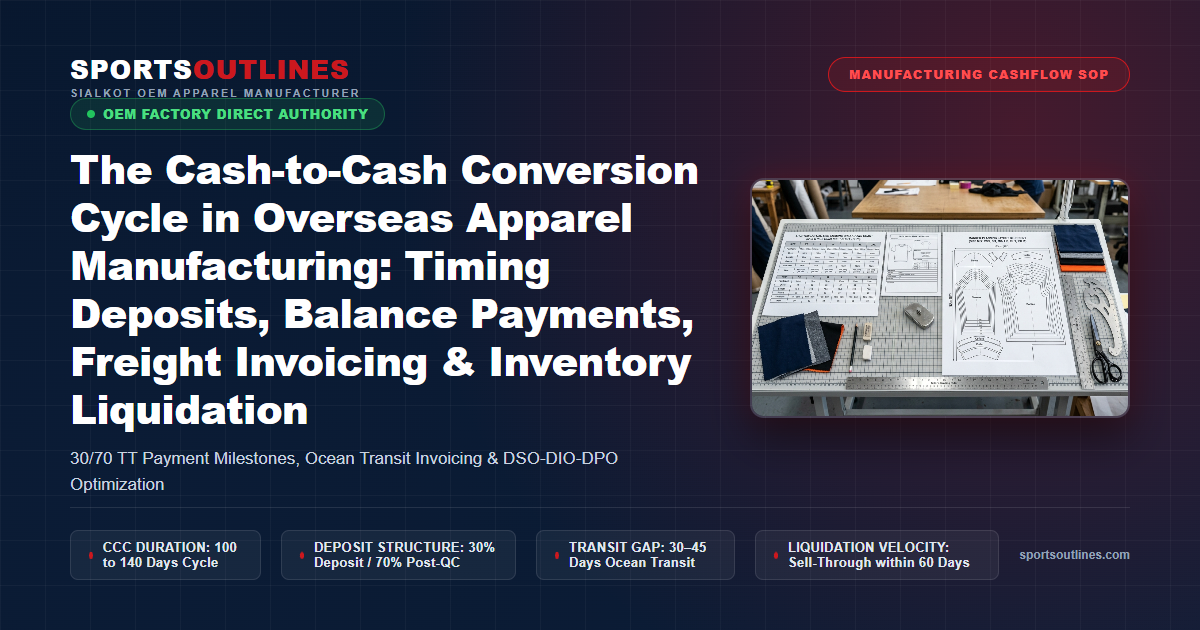
In the high-growth direct-to-consumer (D2C) and wholesale sportswear arena, profitability on paper is meaningless if your bank account is empty. The operational metric that dictates whether an athletic apparel brand thrives or enters insolvency is the Cash-to-Cash Conversion Cycle (CCC)—the precise number of days between the moment you wire a deposit for raw yarn and factory production, and the moment a retail customer or wholesale stockist deposits cash into your checking account. Traditional overseas sourcing from East Asia traps brands in devastating 120-day to 160-day cash conversion valleys, characterized by 60-day factory lead times, 45-day ocean transit delays, and slow port deconsolidation. For an emerging brand with finite reserves, this extended liquidity freeze prevents timely reorders, creates out-of-stock crises, and stalls marketing momentum. In this comprehensive engineering guide, Sports Outlines deconstructs the mathematical anatomy of the apparel CCC, demonstrating how to align 30% production deposits, 70% quality inspection gates, air express logistics, and agile 30–50 piece MOQs in Sialkot to compress your cash conversion cycle down to under 40 days.
💳 Milestone Payments (30% Dep / 70% Bal)
✈️ Air Express vs Ocean CCC Velocity
🚀 Low MOQ (30–50 Pcs) Liquidity Multiplier
1. The Financial Anatomy of CCC: The Mathematical Formula Governing Apparel Liquidity
In corporate treasury management, the Cash Conversion Cycle measures the efficiency with which an enterprise converts its working capital into cash inflows through operations. For physical goods companies—and apparel manufacturers in particular—the standard formula is defined as:
CCC (Days) = Days Sales of Inventory (DSI) + Days Sales Outstanding (DSO) − Days Payables Outstanding (DPO)
Where:
• Days Sales of Inventory (DSI): The average time required to convert raw cash outlay into a finished good, ship it overseas, receive it into your fulfillment warehouse, and sell it to an end customer.
• Days Sales Outstanding (DSO): The time it takes to collect revenue after a sale occurs. For direct-to-consumer (D2C) e-commerce on Shopify via Stripe/Shop Pay, DSO is typically 2 to 3 days. For B2B wholesale orders with retail gyms or boutique distributors, DSO stretches to Net-30 or Net-60 days.
• Days Payables Outstanding (DPO): The time you have to pay your factory suppliers and freight forwarders before cash leaves your account. In overseas contract manufacturing, DPO is rarely extended beyond milestone gates (deposit upon order, balance upon pre-shipment inspection).
In standard consumer retail, a shorter or negative CCC is the holy grail. Giants like Amazon operate with a negative CCC (-28 to -35 days) because they collect customer cash instantaneously while delaying vendor payouts for 60 to 90 days. Emerging sportswear brands, however, face the exact opposite dynamic: overseas suppliers demand upfront deposits before buying fabric, air couriers demand immediate payment, and retail inventory must be stored and marketed before generating cash receipts.
If your CCC is 120 days, it means that every dollar invested in your clothing line is locked inside a physical supply-chain pipeline for a third of a year. If you wish to grow your quarterly sales from $25,000 to $100,000, you must possess the cash to fund four consecutive production runs before the capital from Run 1 returns to your account. This is the structural reason why fast-growing apparel companies run out of cash during high sales spikes.
Table 1: Institutional Cash Conversion Cycle Comparison Across Three Sourcing Frameworks
This matrix contrasts three realistic operational models: Traditional Far East Ocean Freight, Standard Air Cargo Wholesale, and Agile Low-MOQ Sialkot Air Express.
2. The Chronological Cash Drain: Milestone Payments Across Overseas Manufacturing
To master your working capital, you must map the chronological timing of cash outflows during the production lifecycle. In international apparel manufacturing, payments are tied directly to operational risk gates:
Milestone 1: The Prototyping Gate (Day 0)
Every professional cut-and-sew production order begins with the physical sample. At Sports Outlines, physical prototypes carry an engineering fee of $45 to $85 per piece (strictly non-refundable) with an agile 7 to 10 business days completion timeline. Because samples represent dedicated manual cutting, machine adjustments, and custom ink formulations, this fee is paid 100% upfront before pattern drafting begins. This small initial outlay protects the brand from committing thousands of dollars to unverified patterns.
Milestone 2: The Production Deposit (Day 15)
Once the physical prototype is evaluated on a live athletic model and approved as the “Golden Sample,” the bulk Purchase Order (PO) is executed. The brand wires a 30% to 50% deposit. This capital is immediately deployed by the factory to procure raw cotton yarn, knit circular fleece, purchase elastane tricot, order custom woven labels, and book sewing line capacity. At this moment, your first major capital tranche leaves your bank account.
Milestone 3: The Quality Inspection Clearance & Balance Payment (Day 40)
Following garment cutting, sewing assembly, thread trimming, and steam pressing, the production lot undergoes ISO 2859-1 AQL 2.5 quality control inspection. Sports Outlines compiles a digital inspection dossier featuring 4K macro video walkthroughs of critical seams, needle-detection scans, and measurement verification against your Points of Measure (POM) chart. Upon your sign-off, the remaining 70% balance payment is wired.
Milestone 4: International Freight & Customs Clearance (Day 42)
The finished goods are packed into 5-ply export master cartons and handed over to the logistics carrier. For air express (DHL, FedEx, UPS), freight charges and customs brokerage are invoiced under Delivered Duty Paid (DDP) or DAP terms. At this point, 100% of your manufacturing and logistics capital has been expended, while zero sales revenue has been collected. You have reached the maximum trough of your cashflow curve.
Table 2: Milestone Capital Drawdown Schedule for a $10,000 Production Run
This table tracks cumulative capital outflow across milestones for a standard 400-piece cut-and-sew activewear drop.
3. Transit Velocity vs. Capital Stagnation: Why Air Courier Accelerates Cash Returns
When founders evaluate shipping options, they frequently focus entirely on the freight invoice cost: “$1.20 per piece by ocean vs. $4.80 per piece by air express.” On paper, choosing sea freight appears to save $3.60 per garment. However, this superficial analysis completely ignores the holding cost of capital and the devastating elongation of the Cash Conversion Cycle.
Consider the transit timeline of an ocean LCL shipment from Asia to an inland US or European warehouse:
- Factory to Port Consolidation (CFS): 4 to 6 days.
- Container Loading & Vessel Departure Cutoff: 5 to 7 days.
- Ocean Water Transit: 22 to 32 days.
- Port Discharge & Terminal Deconsolidation: 5 to 8 days.
- Customs Inspection & Inland Trucking: 4 to 7 days.
- Total Ocean Lead Time: 40 to 60 calendar days.
In contrast, air express courier (DHL Express, FedEx Priority) takes 4 to 7 business days door-to-door from our Sialkot factory to your doorstep. That represents a difference of 35 to 50 days during which your entire $10,000 capital investment is floating on a container ship producing zero revenue. If your gross margin is 70% and you can recycle that capital in 35 days, using air express allows you to execute two complete sales drops in the time it takes one ocean container to dock, generating double the aggregate profit dollars!
Table 3: Financial Velocity Analysis: Air Express vs. Ocean LCL Freight
This model compares two brands starting with identical $15,000 capital pools over a 12-month period, demonstrating how air velocity compounds gross profits.
4. Inverting the Equation: Achieving a Negative Cash Conversion Cycle via Pre-Orders
Is it possible for an emerging activewear brand to operate with a negative Cash Conversion Cycle? Absolutely. The most capital-efficient D2C streetwear and combat gear brands utilize pre-order drops, VIP early-access campaigns, and Kickstarter launches to collect 100% of retail cash from customers before paying the factory’s bulk manufacturing deposit.
The mechanics of the Negative CCC Drop Model operate as follows:
- Sample Development (Day 0–10): The brand commissions high-precision physical prototypes from Sports Outlines ($45–$85/pc, 7–10 day turnaround).
- Creative Production (Day 11–18): The physical samples are shot in professional lookbook photography, athletic motion video, and influencer seedings.
- The 72-Hour Pre-Order Window (Day 20–23): The brand opens pre-orders on Shopify with a guaranteed ship date of 4 weeks. Customers pay 100% upfront via credit card or digital wallet ($30,000 collected).
- Factory Bulk Order Placement (Day 24): The brand uses customer funds to wire the 30% factory production deposit to Sports Outlines. Zero founder personal capital is risked.
- Production & Air Express Dispatch (Day 25–48): Bulk goods are cut, sewn, QC-inspected, and flown via DHL express.
- Fulfillment & Delivery (Day 52): Customer orders ship out. The brand retains 65% to 75% gross margin cash immediately.
In this framework, your CCC is negative 20 days! Your customers are financing your inventory expansion, completely eliminating third-party debt, factoring interest, or equity dilution.
Table 4: The 4-Stage Cash Conversion Evolution Matrix (From Bootstrap to Enterprise)
This roadmap demonstrates how an athletic brand’s cash conversion cycle evolves as operational maturity and capital reserves expand over five years.
5. The Reorder Point (ROP) Formula: Preventing Stockouts During Production Lead Times
A fatal consequence of poor CCC management is running out of stock while waiting for overseas production. When an activewear brand’s core sizes sell out, the business suffers compounding penalties: Google and Meta advertising pixel optimization resets, organic keyword rankings decline, and frustrated shoppers turn to competing brands.
To prevent stockouts, procurement managers calculate their Reorder Point (ROP) with surgical mathematical discipline:
ROP (Units) = (Lead Time in Days × Average Daily Sales Velocity) + Safety Stock
Where:
• Lead Time = Factory production days + Air/Ocean transit days + 3PL receiving days.
• Safety Stock = (Max Daily Sales × Max Lead Time) − (Average Daily Sales × Average Lead Time).
Assume your brand sells an average of 5 oversized hoodies per day (with a peak of 9 units/day during promotion spikes). When sourcing from Sports Outlines via air express, production takes 21 days and shipping takes 5 days (total lead time = 26 days, max lead time = 32 days):
Lead Time Demand = 26 days × 5 units/day = 130 units.
Reorder Point = 130 + 158 = 288 units.
The moment inventory in your warehouse drops to 288 units, your ERP system triggers the 30% production deposit for the subsequent batch. By maintaining this mathematical threshold, you ensure zero stockouts and uninterrupted sales momentum.
Table 5: Reorder Point (ROP) Trigger Matrix Based on Production Lead Times
This matrix details the exact inventory unit trigger required to prevent stockouts across four daily sales velocities when manufacturing in Sialkot.
6. Payment Instruments & Banking Mechanics: Telegraphic Transfers (T/T) vs. Letters of Credit (L/C)
In international trade finance, the choice of payment instrument directly governs both counterparty risk and treasury liquidity lockup. Emerging apparel brands frequently question whether they should utilize commercial banking Letters of Credit (L/C) or standard Telegraphic Transfer (T/T) Milestone Wires.
A Documentary Letter of Credit (L/C at Sight or Usance L/C) is an irrevocable commitment issued by the buyer’s bank guaranteeing payment to the seller’s bank upon presentation of compliant shipping documents (Air Waybill or Ocean Bill of Lading, Commercial Invoice, Packing List, and Certificate of Origin). While an L/C provides institutional security for multi-million-dollar conglomerates, it is completely ill-suited for agile, low-MOQ athletic brands:
- Bank Issuance Fees & Discrepancies: Commercial banks charge $350 to $750 in opening fees, amendment charges, and document discrepancy penalties ($75 to $150 per discrepancy). On a $3,000 to $10,000 production order, bank fees erode 5% to 10% of total product gross margin!
- 100% Cash Collateralization: Unless a brand possesses an established commercial revolving credit facility, the issuing bank requires 100% cash collateral frozen in an escrow certificate of deposit (CD) from the day the L/C is opened. This locks your liquidity for the entire 60-day manufacturing window, preventing you from deploying cash into advertising or sampling.
- Minimum Transaction Thresholds: Most international commercial banks will not open an import documentary letter of credit for amounts under $25,000 to $50,000.
In contrast, Milestone Telegraphic Wire Transfers (T/T 30/70) provide maximum operational agility. The buyer wires only 30% to initiate raw material purchases, retaining 70% of their working capital in their operational account for 25 to 30 days. The balance is released only after approving a comprehensive digital AQL 2.5 video inspection dossier. Table 6 compares the four primary payment mechanisms used in international sportswear manufacturing.
Table 6: International Trade Payment Instrument Comparison Matrix
This matrix evaluates fees, liquidity freeze duration, factory acceptance, and security gates across four commercial payment methods.
7. Partnering Direct with Sports Outlines: Slashing Cash Cycle Friction
By establishing a direct manufacturing partnership with Sports Outlines in Sialkot, Pakistan, your brand unlocks an agile operational ecosystem engineered to protect and accelerate your cash conversion cycle:
Agile 30–50 Piece MOQs
Eliminate massive inventory lockups. Order precisely what you can liquidate within 30 days, keeping your Days Sales of Inventory (DSI) lean and your cashflow perpetually liquid.
Rapid 7–10 Day Prototyping ($45–$85/pc)
Eliminate 6-week sampling delays. We draft CAD patterns and produce physical prototypes in 7 to 10 business days for a transparent, non-refundable fee of $45 to $85 per piece.
Predictable Milestone Payments
Clear 30% bulk deposit and 70% balance structure tied to digital AQL 2.5 video inspection dossiers. You maintain control of your funds until quality is verified.
Direct Air Courier Integration (4–7 Days DDP)
Seamless door-to-door air courier dispatch via DHL and FedEx. Skip freight forwarder delays, port congestion, and dock junk fees to land inventory in your warehouse in days.
8. Frequently Asked Questions: Cash Conversion Cycles & Production Financing
What is a healthy Cash-to-Cash Conversion Cycle for an emerging D2C sportswear brand?
For an early-stage D2C brand utilizing air express shipping and low-MOQ manufacturing (30–50 pieces), a healthy CCC is 30 to 45 calendar days. Brands executing successful pre-order drop campaigns can achieve a negative CCC (-15 to -25 days), collecting customer cash weeks before paying the factory balance invoice. Any CCC exceeding 90 days creates severe liquidity hazards for bootstrapped companies.
Why is paying higher air express freight rates often more profitable than ocean shipping?
Because capital velocity trumps nominal per-unit freight savings. While ocean freight saves $3.00 to $4.00 per unit on shipping, it ties up your entire capital investment for an additional 40 to 60 days. Air express allows you to liquidate and recycle that same capital 2.5 times faster. The cumulative gross margin dollars earned from multiple rapid inventory turns far exceed the modest freight savings of slow ocean transit.
Why do physical prototypes carry a non-refundable $45–$85 fee?
Physical sampling is an independent engineering operation requiring expert CAD pattern generation, single-piece fabric cutting, individual machine adjustments, print strike-offs, and dedicated craftsmanship. The $45 to $85 fee covers these direct labor hours and material setups with a 7 to 10-day turnaround, protecting the factory from uncommitted inquiries while providing the brand with an authentic production-grade sample.
When does it make sense to transition from air freight to sea freight?
Transition to ocean LCL/FCL freight only when your production volume exceeds 500 to 1,000 units per style (over 1.5 CBM or 350 kg total weight), and your company possesses sufficient liquid cash reserves to fund your subsequent production order while Order 1 is on the water. If switching to sea freight forces you to wait for shipment arrival before placing your next order, the resulting stockout will cost you far more than the freight savings.
How can I protect my brand against currency exchange fluctuations during overseas manufacturing?
All export production contracts with Sports Outlines are denominated in US Dollars (USD), providing complete invoice price stability from prototype approval to final balance clearance. Brands based in Europe, the UK, or Australia can lock in forward exchange contracts through fintech platforms like Wise or Revolut Business at the time of PO issuance to eliminate foreign exchange volatility between deposit and balance dates.
Compress Your Cash Conversion Cycle with Agile Direct Manufacturing
Stop waiting months for overseas production. Partner directly with Sports Outlines in Sialkot, Pakistan. Access agile low MOQs (30–50 pcs), rapid 7–10 day physical prototyping ($45–$85/pc), predictable milestone payments, and door-to-door air courier delivery that recycles your working capital in under 40 days.