Direct Manufacturer Answer: How to Manufacture Custom Technical Scuba & Spacer Fabric Structured Hoodies
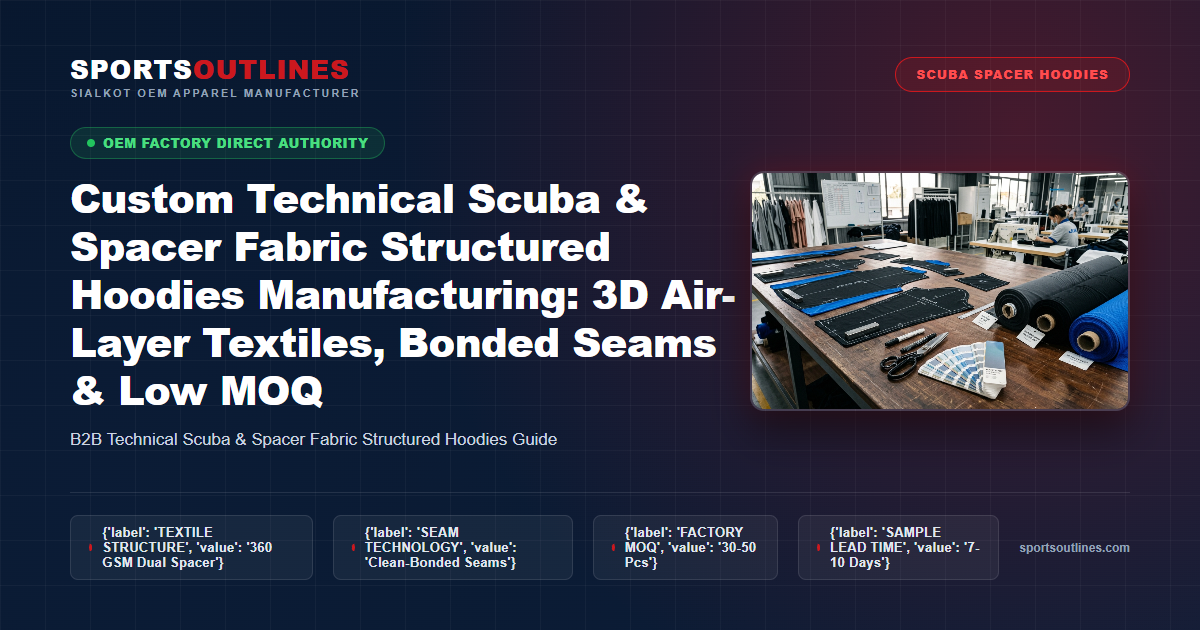
Manufacturing commercial-grade custom technical scuba and spacer fabric structured hoodies requires engineering high-density 340 to 380 GSM 3D air-layer double-knit textiles (50% Rayon/Viscose, 42% Filament Nylon/Polyamide, 8% Spandex or 92% Micro-Poly, 8% Elastane dual-knit interlock), paired with ultrasonic laser-cut pattern panels, seamless thermoplastic polyurethane (TPU) bonded seams or 4-needle 6-thread low-profile flatlock stitching, and sculptural chimney-collar hoods. In contemporary luxury gymwear and modern athletic streetwear, traditional cotton fleece falls short because it drapes loosely, wrinkles easily, and bags out at the elbows during daily wear. Technical scuba and 3D spacer knits utilize a three-dimensional sandwich architecture: two smooth, dense outer faces connected by internal microfilament spacer yarns creating a microscopic air cushion. This delivers remarkable architectural stiffness, natural crease resistance, zero elbow sagging, and a smooth, futuristic silhouette that holds its sculptural structure off the body. Seams are assembled with low-profile flatlock or Framis/Bemis heat-activated seam bonding tape (135°C, 3.5 bar pressure), complemented by matte coated water-resistant YKK Aquaguard zippers and laser-cut bonded eyelets. At Sports Outlines in Sialkot, Pakistan, we produce private label scuba and spacer fabric structured hoodies at an accessible low factory MOQ of 30 to 50 pieces per style/colorway with mixed sizing (XS to 3XL). Physical pre-production prototypes are developed in 7 to 10 business days for $45 to $85 per piece under a strict zero refund and zero credit policy.
- Textile Foundation: 360 GSM 3D Air-Layer Double-Knit (Rayon/Nylon/Spandex or Micro-Poly Spacer) with hollow microfilament air core.
- Structural Silhouette: Architectural tailored drape with natural wrinkle recovery and zero fabric sagging at joint flex zones.
- Seam Technology: Ultrasonic knife edge trimming paired with 4-needle 6-thread flatlock or thermo-bonded Framis/Bemis seam tape.
- Hood Architecture: Sculptural high-neck chimney collar (funnel hood) that stands rigid and freestanding without collapsing.
- Sleeve Ergonomics: Articulated 2-piece sleeves with anatomical elbow darts for fluid motion during training and travel.
- Hardware & Trims: Matte black YKK Aquaguard reverse-coil zippers, laser-welded zip pockets, and bonded drawcord eyelets.
- Low Production MOQ: 30–50 pieces per style/colorway across flexible size curves from XS to 3XL.
- Physical Sample Terms: $45–$85 per custom prototype in 7–10 days (strict zero credit or refund policy).
- Direct Sourcing Channel: WhatsApp factory direct at +92 316 7932595 or via sportsoutlines.com.
Over the past decade, a quiet revolution has transformed the global activewear market: the rise of architectural, structured athletic wear. While heavy cotton loopback fleece continues to dominate traditional bodybuilding culture, a new category of luxury athletic streetwear has emerged—popularized by high-end lines like Nike Tech Fleece, Lululemon Scuba, Alo Yoga, and Gymshark Onyx—where garments are defined by crisp geometry, razor-sharp seams, and smooth, futuristic textile surfaces.
At the core of this modern design movement is technical scuba and 3D spacer fabric. Unlike traditional knitted cotton fleece, which drapes in soft, organic folds and tends to lose its shape after hours of travel or intensive training, technical scuba fabric possesses an inherent sculptural memory. It holds its tailored silhouette away from the body, creates clean architectural lines over the shoulders, and never pills, creases, or bags out at the elbows.
However, manufacturing commercial-grade scuba hoodies is an intricate technical challenge. Amateurs often mistake genuine neoprene (chloroprene synthetic rubber used in wetsuits) for apparel scuba, resulting in stiff, non-breathable garments that trap body moisture like plastic wrap. Furthermore, sewing dense double-knit spacer fabrics with standard overlock machines causes thick, unsightly bulky seams that chafe against the skin and curl outward after washing.
At Sports Outlines in Sialkot, Pakistan, our performance outerwear division specializes in high-precision technical cut-and-sew apparel. We utilize specialized circular double-knit machinery, ultrasonic cutting knives, heat-seal bonding presses, and 4-needle flatlock workstations to produce museum-grade scuba and spacer fabric hoodies. Whether your brand is catering to luxury athleisure markets in the United States, contemporary streetwear labels in the United Kingdom, or technical lifestyle brands across Canada, Germany, or Australia, our low factory MOQ of 30 to 50 pieces per style allows you to bring enterprise-grade technical outerwear to market without crippling inventory minimums.

1. Material Science: Demystifying Scuba vs 3D Spacer Fabric vs Real Neoprene
In the activewear industry, terminology is frequently confused. Brand founders often ask for “neoprene hoodies” when what they actually need is an athletic scuba double-knit or a 3D spacer mesh. Understanding the micro-structural differences between these materials is vital for designing high-performance apparel:
As the table illustrates, true neoprene should never be used for commercial gym hoodies because its closed-cell rubber core cannot breathe, resulting in excessive sweat accumulation within 10 minutes of physical activity. Instead, we manufacture using 3D Air-Layer Spacer Fabric or Rayon/Nylon Scuba Interlock. These textiles mimic the sleek, boxy, structured look of neoprene while providing full textile breathability, high moisture vapor permeability, and supreme 4-way stretch comfort.
2. Construction Technology: Ultrasonic Cutting & Seam Sealing
Because scuba and spacer fabrics have a substantial thickness (1.8 mm to 2.8 mm gauge), joining panels using traditional 4-thread overlock produces a bulbous, bulging seam ridge that ruins the minimalist aesthetic of the garment. At Sports Outlines, we employ two advanced seam engineering methods:
Method 1: 4-Needle 6-Thread Low-Profile Flatlock Seaming
For athletic styles subjected to dynamic joint strain (such as gym training, CrossFit, or track running), we utilize high-precision 4-needle 6-thread flatlock machines (Yamato FD-62SD). The machine’s integrated carbide knife trims the raw fabric edges to a micro-tolerance before butting the two panel edges together flat. Four parallel needle threads interlock with top and bottom looper threads (using micro-denier textured woolly nylon), creating a seam that is 100% flat with zero interior ridge. The flatlock seam stretches up to 130% horizontally, eliminating thread breakages during explosive barbell lifts.
Method 2: Ultrasonic Edge Trimming & Bemis/Framis Seam Bonding
For luxury streetwear and ultra-minimalist athleisure collections, we utilize stitch-free thermo-bonded construction:
- Ultrasonic CNC Knife Cutting: High-frequency sound vibrations (35 kHz) melt and fuse the synthetic microfibers of the scuba fabric as they cut, producing a sealed, laser-sharp edge that cannot fray or shed lint.
- Heat-Activated TPU Bonding Tape: Panels are joined using specialized 2-layer or 3-layer thermoplastic polyurethane bonding tape from Framis Italia or Bemis Associates. The tape is activated under pneumatic heat-press machinery at 135°C to 145°C with 3.5 bar pressure for 12 seconds.
- Performance Result: The bonded seam achieves a shear peel strength exceeding 35 N/cm, exhibits complete water resistance, and lays completely flat against the skin with zero needle punctures or visible stitching.
3. Sculptural Hood & Funnel Neck Geometry
The defining visual hallmark of a technical scuba hoodie is its sculptural chimney funnel hood. In conventional hoodies, the hood collapses into a soft, wrinkled pile behind the neck when not worn over the head. In contrast, the rigidity of 360 GSM spacer fabric allows us to engineer a freestanding architectural structure:
- High-Neck Funnel Chimney: The front collar extends upward 9 cm to 11 cm above the clavicle, forming a clean cylindrical collar that stands completely erect without collapsing inward or choking the athlete’s throat.
- 3-Piece Contoured Crown Pattern: A 7 cm wide center gusset panel spans from the front collar apex over the parietal crown down to the occipital base, flanked by two curved cranial side panels. This 3-piece geometry creates a rounded, helmet-like dome that frames the face cleanly.
- Laser-Cut Bonded Eyelets & Minimalist Drawcords: Instead of cheap metal grommets that can tear loose from knit fabric, we reinforce drawcord exit points with heat-welded circular TPU patches and laser-cut apertures. Drawcords are specified as 6 mm dense tubular cord with custom-dipped silicone rubber tips or laser-etched gunmetal aglets.
4. Hardware & Pocket Integration: Clean-Welded Tech Aesthetics
To complement the futuristic aesthetic of scuba fabric, all hardware and pocketing components must match the garment’s clean, minimalist lines:
- Matte YKK Aquaguard® Reverse-Coil Zippers: For full-zip and quarter-zip styles, we integrate polyurethane-coated reverse coil zippers. The matte black zipper tape provides a sleek technical contrast against the smooth scuba fabric while providing water-resistant protection.
- Laser-Welded Zipper Garages: The upper end of the zipper track terminates inside a laser-cut, bonded TPU chin garage, preventing metal zipper sliders from contacting the wearer’s neck or facial hair.
- Bonded Internal Pockets: Rather than stitching bulky patch pockets onto the exterior, pocket bags are constructed from lightweight 90 GSM stretch mesh and bonded to the interior torso panel using Framis tape. This keeps the exterior face 100% smooth and uninterrupted.
5. Embellishment Techniques for Technical Scuba Textiles
Scuba fabric has a remarkably smooth, low-friction exterior face. Conventional plastisol screen printing can peel or crack because it cannot anchor deeply into the dense synthetic fibers. At Sports Outlines, we execute specialized embellishments designed specifically for double-knit synthetics:
- High-Density Matte 3D Silicone Heat Transfers: 1.0 mm to 1.5 mm raised silicone logos with a velvet matte finish. Silicone adheres permanently to nylon and polyester blends and flexes up to 300% without cracking or delaminating.
- Micro-Injection Molded Rubber Badges: Ultra-fine PVC or silicone patches sewn on using single-needle micro-stitching or ultrasonic heat bonding on the left chest or sleeve bicep.
- Laser-Etched Tonal Branding: CO2 laser engraving machines etch surface fibers to create subtle, tonal shadow logos with zero added weight and zero ink.
- Direct-to-Film (DTF) High-Stretch Transfers: Full-color photographic graphics printed with stretch-polyurethane adhesives cured under digital heat presses (145°C, 15 seconds).
6. Complete POM Sizing & Pattern Grading Specification (XS to 3XL)
Technical scuba hoodies feature a modern semi-tailored athletic silhouette. Below is our master factory Point of Measure (POM) grading chart for Structured Scuba Funnel Hoodies (360 GSM spacer fabric, high chimney collar, bonded hem):
7. Step-by-Step 11-Stage Factory Manufacturing Workflow
Manufacturing technical scuba and 3D air-layer hoodies demands state-of-the-art machinery and rigorous quality control. Here is our standardized 11-stage factory workflow:
- Yarn Selection & Double-Knit Circular Knitting: High-filament rayon/nylon and spandex or micro-poly yarns are knitted on 28-gauge double-knit interlock machines into raw air-layer spacer fabrics.
- Low-Tension Dyeing & Thermo-Fixation: Rolls undergo overflow jet dyeing followed by precision stenter thermo-fixation at 180°C to stabilize dimensional elasticity and ensure zero shrinkage (<1.5%).
- CAD Vector Grading & Optimization: Customer tech packs are digitized in Gerber Accumark CAD systems with tailored compensation factors for synthetic stretch.
- Ultrasonic CNC Knife Cutting: Synthetic fabric plies are cut with ultrasonic automated CNC knives that seal raw edge yarns simultaneously, preventing edge fraying.
- Embellishment & High-Density Heat Seals: Flat pattern panels receive 3D silicone transfers, laser engravings, or bonded rubber patches using calibrated pneumatic heat presses.
- Laser-Cut Pocket Welds & Zipper Bonding: Pocket openings are laser-cut and bonded to YKK Aquaguard matte zippers using Framis heat-activated adhesive film.
- Funnel Collar & 3-Piece Hood Construction: The sculptural 3-piece chimney hood is assembled using 4-needle 6-thread low-profile flatlock or internal thermo-bonded seam tape.
- Torso Assembly & Articulated Sleeve Joining: Torso panels and pre-curved sleeves with elbow darts are joined with flatlock seaming, maintaining clean interior comfort.
- Clean-Bonded Hem & Cuff Finishing: Hems and cuffs are finished with ultrasonic clean cuts backed by internal 20 mm bonded elastic tape for razor-sharp edge definition.
- Comprehensive QC & Peel Strength Testing: Our quality audit team inspects POM measurements (tolerances ≤ 0.75 cm), performs 35 N/cm seam bond peel tests, and checks zipper glide smoothness.
- Industrial Tunnel Finishing, Labeling & Polybagging: Finished hoodies receive custom heat-seal neck labels, recycled luxury hangtags, and are sealed in individual bio-polybags ready for global shipping.
8. Yarn Micro-Denier Physics & Anti-Pilling Engineering in Double-Knit Spacers
In high-end sportswear manufacturing, the difference between an ordinary synthetic sweatshirt and a true luxury scuba hoodie comes down to filament denier and spinning cleanliness. In low-cost market imitations, manufacturers use coarse polyester filaments (such as 150D/48F), where each individual fiber filament has a relatively large diameter. These coarse filaments create a scratchy, stiff handfeel, produce an undesirable glossy plastic shine under overhead gym lighting, and fracture easily when rubbed against rough surfaces, causing severe pill fuzz.
At Sports Outlines, our performance technical textiles division utilizes ultra-fine micro-denier yarns (75D/72F or 50D/48F). In a 75D/72F filament bundle, 72 microscopic filaments are packed into a 75-denier yarn thread. This micro-filament density yields an extraordinarily supple, petal-soft tactile surface that feels virtually weightless against bare skin while creating a matte, light-absorbing exterior finish.
To eliminate pilling across the life of the garment, our raw yarn undergoes four proprietary textile finishing stages:
- High-Temperature Spinning Oil Washoff: During industrial knitting, spinning lubricants are applied to yarns to reduce needle friction. If left on the textile during dyeing, these oils cause patchy dye absorption and degrade elastane longevity. We execute a continuous 85°C scour wash with bio-enzymes to strip 100% of spinning oils before dyeing.
- Precision Stenter Relaxation & Thermo-Fixation: The double-knit spacer fabric is fed into a 6-chamber Monforts stenter frame at 180°C with 15% overfeed. This relaxes internal knitting loop tensions and thermo-fixes the spandex core, permanently eliminating unpredictable garment shrinkage during tumble drying.
- Micro-Singeing Surface Treatment: For luxury rayon/nylon scuba varieties, the textile passes over high-speed micro-gas burners at 80 meters per minute. The microscopic protruding fiber ends are vaporized instantly without affecting the core fabric, resulting in an ultra-clean, glassy surface that resists lint attraction.
- Silicone Softening & Anti-Static Emulsion: During final framing, the fabric passes through a hydrophilic silicone bath combined with anti-static agents. This prevents synthetic static cling against cotton base layers and repels gym dust and pet hair.
9. Quality Assurance Lab Protocols: Martindale Pilling, Seam Peel & Wash Testing
Because technical scuba hoodies are positioned as premium luxury activewear (retailing between $95 and $145 USD on consumer websites), quality failures are fatal to an emerging brand’s reputation. At Sports Outlines, every production dye lot undergoes comprehensive laboratory testing in our internal testing facility prior to cut-and-sew dispatch:
This rigorous level of testing ensures that when your customers unbox their custom scuba hoodies, the garments deliver that unmistakable feeling of high-end engineering: an intoxicatingly smooth tactile handfeel, sculptural lines that never sag, and seam construction built to withstand years of active wear.
10. Factory Low MOQ & Prototype Sampling Policy
In traditional activewear manufacturing, accessing technical double-knit scuba fabrics requires purchasing multi-thousand-meter dye lots. Most overseas factories reject orders under 1,000 units per colorway.
Sports Outlines eliminates this barrier with our accessible low-risk production model:
- Low Factory Production MOQ: 30 to 50 pieces per style/colorway, allowing you to launch high-end technical outerwear across sizes XS to 3XL.
- Physical Prototype Sampling: We engineer complete, fully branded pre-production physical prototypes in 7 to 10 business days for $45 to $85 per piece.
- Strict Sample Policy: Prototype sampling fees cover specialized CAD vectoring, ultrasonic tool setups, bonding film, and skilled labor. Under our strict zero refund and zero credit policy, all prototype fees are 100% non-refundable and cannot be applied as credits toward bulk orders.
- Bulk Production Turnaround: Commercial bulk production orders are manufactured and dispatched in 18 to 24 business days following prototype sign-off.
- Direct Manufacturer Support: Collaborate directly with our apparel production engineering team in Sialkot, Pakistan via WhatsApp at +92 316 7932595 for real-time video updates, tech pack audits, and swatch samples.
Launch Your Custom Technical Scuba & Spacer Hoodie Line
Work directly with Sialkot’s leading technical activewear factory. Submit your tech packs or reference samples to receive physical prototypes in 7–10 days with production MOQs starting at just 30–50 pieces.
Frequently Asked Questions (FAQ) – Scuba & Spacer Fabric Hoodie Manufacturing
Is technical scuba fabric the same as real wetsuit neoprene?
No. Real neoprene is a solid, non-breathable synthetic chloroprene rubber sheet used for wetsuits that traps heat and sweat. Technical scuba and spacer fabrics are double-knit circular textiles (typically rayon/nylon/spandex or micro-polyester/elastane) that create a 3D air-layer micro-chamber structure. They replicate the sleek, sculptural structure of neoprene while providing full breathability, moisture vapor transmission, and athletic 4-way stretch.
How do you construct seams on thick scuba fabric without creating bulky ridges?
We use two advanced methods: 4-needle 6-thread low-profile flatlock stitching with edge trimming, which butts the panel edges flat against each other; and ultrasonic cutting paired with heat-activated Framis or Bemis thermoplastic polyurethane (TPU) bonding tape. Both techniques eliminate traditional overlock seam bulk, ensuring completely flat interior surfaces that will not chafe.
Why does a scuba hoodie hold its shape better than a cotton fleece hoodie?
Scuba fabric’s double-knit interlocking construction and high-filament synthetic fibers (nylon/polyester/spandex) create elastic resilience with high shape memory. The vertical spacer microfilaments between the two knitted faces resist compression and shear, preventing the fabric from creasing, bagging out at the elbows, or sagging after prolonged wear.
What is your minimum order quantity (MOQ) for custom scuba fabric hoodies?
Our low factory production MOQ is 30 to 50 pieces per style/colorway. You can distribute this quantity across sizes XS to 3XL, enabling activewear brands to test luxury structured apparel without high volume commitments.
How much do custom scuba hoodie physical samples cost and how long does it take?
Physical pre-production prototypes are developed in 7 to 10 business days for $45 to $85 per piece. Under our strict zero refund and zero credit policy, prototype development charges are 100% non-refundable and non-creditable toward bulk orders.
Published by the Technical Activewear Division at Sports Outlines. For private label manufacturing inquiries and custom tech pack evaluations, contact our Sialkot factory directly via WhatsApp at +92 316 7932595 or explore our related manufacturing guides for heavyweight French terry gym hoodies, raglan athletic training hoodies, and thermal brushed fleece hoodies.