In modern high-intensity fitness, bodybuilding, CrossFit, and endurance athletics, technical sportswear faces a pervasive consumer dissatisfaction crisis known throughout the textile sector as synthetic odor retention, or colloquially, “permastink.” While polyester and polyamide knits reign supreme for moisture wicking, rapid drying, and mechanical stretch, their chemical affinity for human sebum and lipid-rich perspiration makes them fertile breeding grounds for odor-producing bacteria. Athletes regularly discover that high-priced compression rash guards, gym tees, and yoga leggings retain sour, pungent odors even after thorough hot-water laundering.
For technical sportswear founders, solving the permastink dilemma is not a marketing gimmick—it is a fundamental brand survival requirement. Consumer return rates, repeat purchasing velocity, and product reviews in the premium activewear sector ($60 to $95 retail price points) hinge directly on textile freshness after 50+ wash cycles.
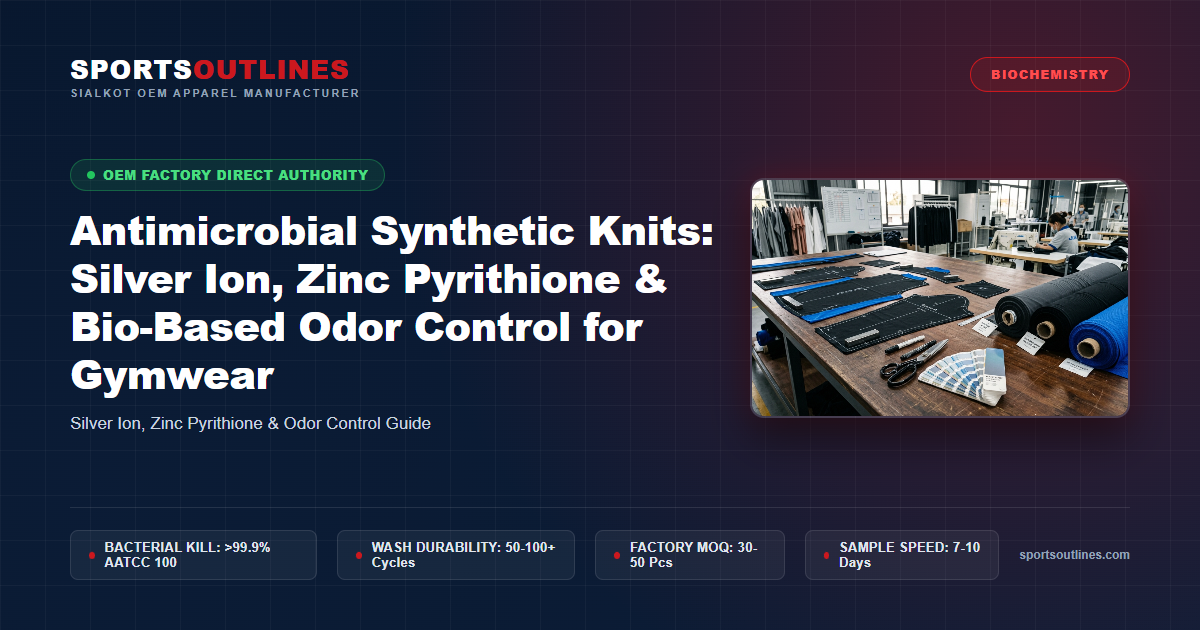
The scientific antidote lies in Antimicrobial Synthetic Knits and Active Odor-Control Technologies. By strategically incorporating inorganic biocides (such as silver chloride nanoparticles and zinc pyrithione), mechanical cell-puncturing organosilanes, or next-generation bio-based botanical finishes (peppermint extracts and recycled chitin/chitosan), textile engineers inhibit bacterial proliferation at the molecular level. These technologies achieve greater than 99.9% bacterial reduction (AATCC 100), neutralize volatile fatty acids, and maintain hypoallergenic skin safety across the lifespan of the garment.
At Sports Outlines in Sialkot, Pakistan, our technical textile knitting and activewear cut-and-sew manufacturing divisions produce commercial-grade antimicrobial activewear, odor-free gym apparel, and compression training wear for international sportswear brands, boutique fitness chains, and high-performance athletic labels. Supported by our founder-friendly low minimum order quantity (MOQ) of strictly 30 to 50 pieces per style/colorway and precision physical sample development (7 to 10 business days, $45 to $85 per piece, non-refundable), Sports Outlines bridges advanced biochemical textile finishing with agile, cost-effective factory production.
Executive Sourcing Summary: Antimicrobial Knits
- Microbiology of Body Odor: Fresh perspiration is odorless. Malodor is caused by commensal skin bacteria (primarily Corynebacterium, Staphylococcus epidermidis, and Micrococcus luteus) enzymatically breaking down sweat lipids into volatile fatty acids (VFAs) and pungent thioalcohols.
- The Polyester “Permastink” Dilemma: Polyester is hydrophobic and highly lipophilic (oil-loving). Body sebum embeds deeply into the polymer matrix during workouts, shielding bacteria from domestic detergents during low-temperature washing.
- Core Antimicrobial Technologies: Silver Ion (AgCl/Ag+) disrupting cellular respiration, Zinc Pyrithione (ZnPT) destabilizing fungal/bacterial membranes, Quaternary Organosilane molecular physical piercing, and bio-based plant menthol/chitosan finishes.
- Yarn Masterbatch vs. Topical Padding: Masterbatch melt-spinning incorporates additives directly into the filament core (retaining 99%+ efficacy past 75–100 wash cycles), whereas stenter pad-bath exhaustion delivers cost-effective 30–50 wash durability.
- International Testing Verification: Validated via AATCC 100 (>99.9% quantitative kill rate), ASTM E2149 (dynamic shake flask), and ISO 20743, ensuring OEKO-TEX Standard 100 Class I/II and bluesign® non-cytotoxic safety.
- Agile Sialkot Manufacturing: Low factory MOQ of strictly 30–50 pieces per style/colorway across custom size runs (XS to 3XL) with 7–10 business day physical prototyping ($45–$85 per piece, non-refundable).
1. The Microbiology of Workout Malodor: Sweat Chemistry vs. Bacterial Metabolism
A common misconception among consumers is that human sweat itself possesses an offensive odor. In reality, freshly secreted human sweat is virtually sterile and completely odorless. The physiological production of workout odor is a complex biochemical reaction occurring at the interface of human skin, sweat glands, and fabric fibers:
- Eccrine Glands: Distributed across the entire body, eccrine glands secrete a watery, saline solution (99% water, 1% salts, trace potassium, and lactate) primarily designed for thermoregulation via evaporative cooling. While high in volume, eccrine sweat contains minimal organic nutrients for bacteria.
- Apocrine Glands: Concentrated in dense hair follicle zones (the axillae/armpits, groin, and perineum), apocrine glands secrete a viscous, nutrient-rich fluid packed with lipids, squalene, steroids, amino acids, and triglycerides. Apocrine secretion increases exponentially during physical exertion, adrenaline surges, and athletic stress.
- Microbial Colonization: The warm, humid microclimate created beneath synthetic gymwear creates an ideal incubator for skin microbiome colonies. Specific commensal bacteria dominate the axillary zone:
- Corynebacterium xerosis and Corynebacterium striatum: Highly active lipid-cleaving bacteria that synthesize bacterial aminoacylases, cleaving apocrine precursors into pungent 3-methyl-2-hexenoic acid (3M2H), the hallmark chemical compound responsible for sharp, acrid armpit odor.
- Staphylococcus epidermidis: Degrades branched-chain amino acids (such as leucine and valine) into isovaleric acid, which produces a sour, pungent, locker-room stench.
- Micrococcus and Anaerococcus: Break down sulfur-containing amino acids (cysteine and methionine) into pungent thioalcohols (such as 3-methyl-3-sulfanylhexan-1-ol), which have an extremely low sensory odor detection threshold in human noses (detectable at parts per trillion).
When an athlete exercises in untreated activewear, sweat nutrients transfer to the garment fibers. Within 20 to 45 minutes of sustained training, bacterial populations multiply exponentially, turning the technical shirt into an active odor reactor.
2. The Lipophilic Curse of Polyester: Why Synthetic Knits Retain “Permastink”
Natural fibers such as cotton and merino wool behave differently from synthetic polymers under bacterial exposure. Cotton is hydrophilic and absorbs liquid water into its core, but its chemical surface is relatively polar, repelling non-polar sebum lipids. Merino wool contains natural keratin scales and lanolin traces that resist bacterial colonization.
In contrast, standard polyethylene terephthalate (PET polyester) possesses unique chemical and physical properties that make it acutely vulnerable to permanent odor buildup:
| Textile Substrate | Surface Energy & Polarity | Sebum & Lipid Affinity | Laundering Wash Release (30°C–40°C) | Permastink Risk |
|---|---|---|---|---|
| 100% Cotton Combed Jersey | Polar, highly hydrophilic | Very Low; oils wash off readily | High; water flushes surface soils easily | Low (develops mildew only if damp) |
| Polyamide (Nylon 6.6) Knit | Semi-polar (amide polar bonds) | Moderate; absorbs some lipid soils | Moderate; surfactants dislodge sebum | Moderate |
| Standard PET Polyester Interlock | Non-polar, hydrophobic | Extreme; highly lipophilic / oil-absorbent | Poor; standard surfactants cannot penetrate | Critical; develops severe permastink |
| Sports Outlines Antimicrobial Knit | Engineered antimicrobial surface | Active biocide disrupts lipid digestion | High; bacteria destroyed before colonization | Zero; permanent freshness across 50+ washes |
Because polyester is composed of non-polar ester chains, it acts like an organic magnet for human body oils (sebum, squalene, and triglycerides). During exercise, these hydrophobic lipids dissolve into the microscopic amorphous regions of the polyester fiber. When the athlete places the garment into a domestic washing machine at eco-temperatures (30°C to 40°C), standard water-based laundry detergents cannot generate sufficient thermal energy or surface tension reduction to extract the embedded lipids.
The garment emerges from the dryer smelling clean due to artificial fragrance masking. However, the moment the athlete puts the garment on and body heat warms the fabric to 35°C, dormant bacteria rapidly re-activate and resume feeding on the unwashed sebum reserves, instantly releasing volatile malodors within minutes of starting a workout. This persistent failure mode is precisely what antimicrobial activewear finishes eliminate.
3. Biochemical Mechanisms of Major Antimicrobial Finishes
In performance textile manufacturing, antimicrobial finishes fall into distinct biochemical categories, each operating through specialized cell-inhibition mechanics:
A. Silver Ion (Ag+) Technologies (Polygiene® / SILVADUR™)
Silver has been recognized for centuries as a potent broad-spectrum antibacterial agent. In modern synthetic knits, silver is applied as microscopic silver chloride (AgCl) salts or silver-doped aluminosilicate glass particles rather than metallic silver.
- Ion Release Mechanism: In the presence of ambient humidity and perspiration, the silver salt slowly dissociates, releasing positively charged silver ions (Ag+).
- Triple Action Cell Disruption:
- Membrane Permeabilization: Positively charged Ag+ ions bind electrostatically to negatively charged peptidoglycan cell walls of Gram-positive and Gram-negative bacteria, puncturing the membrane and causing osmotic lysis.
- Enzymatic Inactivation: Ag+ ions penetrate into the microbial cytoplasm and bind with high affinity to thiol (-SH) sulfhydryl groups in respiratory enzymes, shutting down cellular ATP synthesis.
- DNA Replication Arrest: Ag+ intercalates between nucleic acid bases, preventing bacterial cell division and reproduction.
- Extreme Chemical Efficiency: Silver ion finishes are lethal to bacteria at parts-per-million (PPM) concentrations (typically 10 to 50 ppm active silver across the fabric mass), meaning the treatment adds zero weight and does not alter the buttery-soft hand feel of lightweight knits.
B. Zinc Pyrithione (ZnPT) and Zinc Chelates
Zinc pyrithione (bis(2-pyridylthio)zinc 1,1′-dioxide) is a coordination complex widely recognized for both antibacterial and potent antifungal efficacy.
- Proton-Motive Force Disruption: ZnPT acts as an ionophore, depolarizing mitochondrial and bacterial cell membranes. It disrupts the vital electrochemical proton gradient across bacterial cell membranes, starving the microbe of cellular energy.
- Direct Odor Adsorption (Zinc Ricinoleate): In dual-action zinc formulations, zinc ions chemically chelate and bind volatile fatty acids and mercaptans, trapping odor molecules directly in a non-volatile organometallic complex so they cannot enter the surrounding airspace.
- Broad Antimycotic Shield: Unlike silver which excels primarily against bacteria, zinc pyrithione provides superior defense against fungi and dermatophytes (such as Trichophyton interdigitale), making it the premier choice for athletic socks, boxing wraps, and wrestling gear.
C. Quaternary Ammonium Organosilanes (AEGIS Microbe Shield®)
Organosilane quaternary ammonium compounds operate via a completely non-leaching, mechanical mechanism often described as a “molecular sword”:
- Covalent Silane Anchor: The silane base copolymerizes with the synthetic fiber surface, creating a permanent, non-migrating covalent bond that does not leach into wash water or skin sweat.
- Electro-Mechanical Puncture: Extending from the fiber surface are long-chain carbon molecules (typically 18-carbon chains) tipped with a positively charged nitrogen atom. When negatively charged bacteria land on the fabric, they are drawn onto the molecular spikes by electrostatic attraction. The rigid carbon chain physically punctures the bacterial cell membrane like a microscopic needle, causing instant cell death without chemical consumption.
- Zero Superbug Mutation Risk: Because the kill mechanism is physical and mechanical rather than metabolic, bacteria cannot develop adaptive antimicrobial resistance.
D. Next-Gen Bio-Based & Botanical Finishes (Peppermint & Chitosan)
As eco-conscious consumers demand petroleum-free and heavy-metal-free activewear, bio-based odor-control solutions have matured from experimental lab concepts into high-performance commercial standards:
- Botanical Peppermint Oil Menthol Derivatives (HeiQ Fresh MNT / Life Natural): Natural menthol terpenes extracted from sustainably harvested field mint (Mentha arvensis) are encapsulated in bio-polymers and padded onto knit goods. Menthol disrupts bacterial outer membranes and imparts a natural, clean olfactory freshness that withstands 40+ wash cycles.
- Crustacean Chitin / Chitosan Nano-Coatings: Upcycled from discarded food-industry crab and shrimp shells, chitosan is a non-toxic polycationic biopolymer. The abundant positive amino groups (-NH3+) bind to negatively charged microbial surfaces, blocking bacterial nutrient uptake while being 100% biodegradable and hypoallergenic.
4. Yarn-Level Masterbatch Extrusion vs. Fabric Topical Pad-Finishing
For private-label sportswear founders, choosing how the antimicrobial agent is integrated into the garment dictates product longevity, retail price positioning, and production MOQ:
| Integration Method | Technical Process | Wash Durability Lifespan | Cost Impact (per Garment) | Recommended Apparel Tier |
|---|---|---|---|---|
| Yarn-Level Masterbatch Extrusion | Inorganic nano-silver or ZnPT compounded directly into polymer chips before melt-spinning into filament yarns | Permanent (75 – 100+ industrial wash cycles) | +$1.40 – +$2.20 USD | Flagship tier gymwear, professional compression, marathon rash guards |
| Stenter Pad-Bath Exhaustion | Liquid antimicrobial chemical emulsion padded onto knitted open-width rolls during final stenter drying (140°C–160°C cure) | High (30 – 50 domestic wash cycles) | +$0.60 – +$0.95 USD | Core activewear collections, workout tees, training shorts, yoga sets |
| Spray-On Garment Dyeing Additive | Added to the industrial tumble washing or softening bath after cut-and-sew assembly | Low to Moderate (15 – 25 wash cycles) | +$0.35 – +$0.55 USD | Budget gym merchandise, seasonal promo runs, race participant shirts |
At Sports Outlines, we specialize in both yarn-level masterbatch spinning for high-end professional performance collections and certified stenter pad-bath exhaustion for emerging brands seeking agile low MOQs without prohibitive yarn minimums.
5. Laboratory Testing Protocols: AATCC 100, ASTM E2149 & ISO 20743
To make legitimate B2B performance claims and withstand regulatory scrutiny in North American and European markets (EPA FIFRA registration in the US and BPR compliance in the EU), every antimicrobial production lot must be validated through standardized microbiology laboratory assays:
- AATCC Test Method 100 (Quantitative Antibacterial Assessment): The gold-standard benchmark in performance sportswear testing. Swatches of treated and untreated control knits are inoculated with known bacterial suspensions of Gram-positive Staphylococcus aureus (ATCC 6538) and Gram-negative Klebsiella pneumoniae (ATCC 4352). After 24 hours of incubation at 37°C, surviving bacterial colonies are enumerated. Fabrics must achieve a minimum 99.0% (2-log) reduction, with Sports Outlines premium lines consistently achieving >99.9% (3-log to 4-log) kill efficacy.
- ASTM E2149 (Dynamic Contact Shake Flask Test): Designed specifically for non-leaching, immobilized antimicrobial agents (such as organosilanes). Fabric swatches are placed in a buffered bacterial solution and agitated vigorously on a mechanical shaker for 1 hour. This tests how rapidly the surface kills bacteria upon physical contact under athletic motion.
- ISO 20743 (Determination of Antibacterial Activity of Textile Products): Internationally harmonized standard using absorption and transfer methods, essential for European Union compliance and CE marking verification.
- Wash Durability Cycling (AATCC 135 / ISO 6330): Fabrics undergo 25, 50, and 75 standardized domestic wash-and-dry cycles before antimicrobial testing is re-run, proving to wholesale buyers that odor-protection efficacy is permanently bound.
- In-Vitro Cytotoxicity & Dermatological Safety (ISO 10993-5): Verifies that antimicrobial agents do not leach into human transdermal layers or kill beneficial native skin microbiome bacteria, preventing contact dermatitis and allergic sensitization.
- Laundering Chemistry & Silicone Softener Occlusion: A critical technical insight Sports Outlines communicates to private-label clients is consumer care instructions. Standard liquid fabric softeners contain polydimethylsiloxane (silicone) emulsions. When applied to antimicrobial sportswear, these silicone polymers coat the micro-filaments, forming an impermeable barrier that masks silver ions and organosilane spikes, temporarily suppressing odor-control efficacy. Recommending sports detergents free of cationic softeners and chlorine bleach ensures that active biocide sites remain unblocked for the life of the garment.
6. Comparative Analysis: Performance, Longevity, Skin Safety & Environmental Profile
Selecting the right antimicrobial chemistry requires balancing performance, washing longevity, consumer skin safety, and global environmental certifications:
| Chemistry Type | Active Kill Mechanism | Wash Longevity | Dermatological Profile | Environmental Compliance |
|---|---|---|---|---|
| Silver Chloride (AgCl) / Ag+ | Cell wall rupture, enzyme inactivation, DNA arrest | 50 – 100+ washes (Yarn or stenter) | Hypoallergenic; minimal ionic migration | bluesign®, OEKO-TEX Standard 100, ZDHC compliant |
| Zinc Pyrithione (ZnPT) | Membrane depolarization + direct VFA neutralization | 40 – 60 washes | Excellent; non-irritating skin record | Strict dosage regulations in aquatic wastewater runoff |
| Quat Organosilane | Mechanical molecular puncture (spikes) | 40 – 50 washes (Permanent covalent bond) | Completely non-migrating; zero skin absorption | Non-leaching; eco-friendly wastewater profile |
| Bio-Based Peppermint / Chitosan | Botanical membrane disruption + bio-chelation | 30 – 45 washes | 100% natural, food-grade derivative safety | 100% biodegradable, USDA BioPreferred eligible |
7. Premium Activewear Applications: Gym Tees, Rash Guards & Seamless Leggings
Sports Outlines integrates antimicrobial synthetic knit engineering across high-friction athletic apparel categories where odor control directly defines product value:
- High-Exertion Gym & Bodybuilding T-Shirts (140 to 180 GSM): Crafted from 88% micro-polyester / 12% spandex or 85% nylon / 15% elastane knits treated with dual-action silver ion and capillary wicking. Athletes can complete double workout sessions, stow sweaty shirts in gym bags for 8 hours, and experience zero sour bacterial odor.
- BJJ, MMA & Combat Sports Compression Rash Guards (220 to 260 GSM): Close skin-to-skin contact, heavy mat sweating, and ringworm/staph infection risks make antimicrobial finishes mandatory in combat sports. We infuse zinc pyrithione and silver compounds to provide antibacterial and antifungal defense against mat-borne pathogens.
- Seamless High-Waisted Gym Leggings & Bike Shorts (240 to 300 GSM): High-density nylon 6.6 interlock knit with organosilane permanent bonding in the crotch gusset and inner thigh panels, eliminating friction-induced sweat odors without altering compressive muscle support.
- CrossFit & Functional Training Performance Shorts: Lightweight 4-way stretch knits (120 to 150 GSM) incorporating bio-based peppermint oil finishes for fresh, breathable workout comfort.
- Performance Athletic Socks & Base-Layer Undergarments: Feet contain the highest density of sweat glands on the human body (over 250,000 glands). Sports Outlines knits specialized technical socks from combed polyamide blended with silver-ion masterbatch filament yarns, completely suppressing foot malodor and blister-aggravating microbial biofilms during 20+ kilometer runs.
- High-Impact Sports Bras & Molded Cup Linings: The inframammary fold is a primary hotspot for friction chafing and sweat accumulation. We line sports bra interiors with antimicrobial modal-nylon micro-ribs, preventing heat rash and fungal candidiasis under heavy athletic training loads.
8. Production Cost Breakdown & Private-Label Margin Architecture
Incorporating commercial antimicrobial finishes adds negligible raw material cost while enabling sportswear brands to command significant retail price premiums ($58 to $82 USD for high-performance training tees):
| Cost Component | Technical Specification | Direct Cost (USD) | Share of FOB |
|---|---|---|---|
| Technical Synthetic Base Knit | 160 GSM 85% Nylon 6.6 / 15% Spandex single jersey (1.1 meters) | $3.80 – $4.40 | 36% – 38% |
| Antimicrobial & Wicking Treatment | Certified Silver Ion + hydrophilic capillary pad stenter finish | $0.75 – +$1.10 | 8% – 9% |
| Precision Cut-and-Sew (CMT) | 4-needle flatlock flat-seaming, raglan sleeve styling, ribbed neckband | $3.40 – $4.00 | 32% – 35% |
| Custom Branding & Trims | Silicone chest transfer logo, branded neck tape, woven hem tag | $0.85 – $1.20 | 8% – 10% |
| Quality Control & Eco-Packaging | AQL 2.5 final inspection, antimicrobial hangtag, bio-polybag | $0.60 – $0.80 | 6% – 7% |
| Total Direct FOB Production Cost | Pro-grade anti-odor training gym tee | $9.40 – $11.50 | 100% |
With an average factory FOB production cost of $9.40 to $11.50 USD and retail market values of $58 to $75 USD, private-label fitness brands capture exceptional 80% to 85% gross margins, driving long-term customer loyalty through scientifically verifiable freshness.
9. Sialkot Manufacturing Excellence: Physical Prototyping & Founder-Friendly Low MOQ
Most large overseas mills require astronomical minimum orders (500 kg to 1,000 kg of custom-treated fabric per colorway) before running antimicrobial stenter applications. This effectively locks emerging activewear brands and gym startups out of advanced odor-control textiles.
Sports Outlines eliminates this barrier through specialized lean production systems in Sialkot, Pakistan:
- Agile Low Factory MOQ: Strictly 30 to 50 pieces per style/colorway, allowing fitness brands to launch complete capsule collections without tying up cash in thousands of units.
- Physical Pre-Production Prototyping: We manufacture and deliver custom physical prototype samples within 7 to 10 business days for $45 to $85 per piece. This enables brand owners to perform real-world gym wear-testing, verify anti-odor efficacy after sweat sessions, and inspect flatlock stitch elasticity before placing bulk orders. In alignment with our direct factory transparency and dedicated engineering allocation, sample fees are strictly non-refundable and are never credited toward bulk production orders.
- Certified Chemical Compliance: All antimicrobial finishes applied in our facility comply strictly with OEKO-TEX Standard 100 Class II (direct skin contact), bluesign® criteria, and ZDHC Level 3 wastewater safety standards.
- Full In-House Customization: Sublimation printing, high-density silicone heat transfers, custom woven neck labels, and branded recycled packaging executed under one roof.
Engineer Odor-Free Performance Apparel With Sports Outlines
Launch high-performance gymwear, compression gear, and athletic training tops engineered with lab-certified silver ion, zinc pyrithione, or bio-based antimicrobial odor control.
10. Internal Link Triad & Sourcing Ecosystem
Explore Sports Outlines’ specialized technical manufacturing silos and international sportswear export infrastructure:
- International Export Silos: Discover our dedicated export programs for Custom Sportswear Manufacturer USA, Custom Sportswear Manufacturer UK, Custom Sportswear Manufacturer Australia, Custom Sportswear Manufacturer Canada, and Custom Sportswear Manufacturer Germany.
- Product Category Hubs: Explore our OEM/ODM manufacturing across Custom Sportswear & Activewear, Fitness & Gym Apparel, and Athletic Casual Wear.
- Related Technical Guides: Read our in-depth manufacturing guides on Low-Denier Featherlight Windproof Knits, 3D Spacer Knits & Compression Sandwich Textiles, and PBT vs Spandex Chlorine-Proof Stretch Fabrics.