Direct Manufacturer Answer: How to Manufacture Custom Marathon & Distance Running Singlets
Manufacturing elite marathon and distance running singlets requires engineering garments that withstand 26.2 to 100 miles of repetitive stride friction, severe sweat saturation, and intense evaporative cooling demands. Competition-grade distance running singlets are constructed from 100 to 110 GSM featherweight micro-pinhole mesh (88% micro-denier polyester, 12% elastane) treated with hydrophilic capillary moisture dispersants that absorb and evaporate sweat within 1.2 seconds. To completely eliminate devastating nipple chafing and underarm friction over 40,000 continuous arm swings, elite singlets employ ultrasonic thermo-bonded seams or 4-needle 6-thread micro-filament flatlock stitching paired with laser-cut armholes and necklines sealed with bonded thermoplastic polyurethane (TPU) hem tape. The anatomical racerback cut is shaped specifically to avoid friction with hydration running vests and trail packs, utilizing high-tenacity yarn blends that resist abrasive pilling up to 30,000 Martindale rubs (ASTM D4966). Visibility is ensured via 360-degree retroreflective heat transfers (450 candela/lux/m² under EN ISO 20471) for pre-dawn and night ultramarathons. All garment silhouettes and logo placements adhere strictly to World Athletics Rule 5 uniform guidelines. Direct factory low MOQ at our Sialkot manufacturing plant starts at 30 to 50 pieces per design/colorway across full adult and youth size curves. Physical pre-production prototype samples cost $45 to $85 per singlet delivered in 7 to 10 business days.
- Primary Mesh: 105–110 GSM featherweight micro-pinhole polyester with hydrophilic wicking finish.
- Friction Prevention: Ultrasonic bonded hem tape or ultra-fine flatlock seams to prevent long-distance chafing.
- Hydration Vest Armor: Abrasion-resistant shoulder and chest yarn matrix tested to 30,000 Martindale cycles.
- Night Safety: 450 cd/lux retroreflective heat-seal accents on chest, side vents, and upper spine.
- World Athletics Compliance: Meets strict Rule 5 sponsor logo size limits (under 30 cm²) and team uniform standards.
- Factory Direct Low MOQ: 30–50 singlets per custom club order with mixed adult and junior grading.
- Physical Prototype Sampling: $45–$85 per custom piece in 7–10 days (strict zero credit/refund policy).
- Direct Sourcing Communication: WhatsApp factory direct at +92 316 7932595 or sportsoutlines.com.
Over a standard 42.195-kilometer marathon or a 100-kilometer ultra-endurance race, a distance runner completes between 35,000 and 90,000 biomechanical arm and leg cycles under intense metabolic thermal strain.
In distance running, apparel failure is not a matter of aesthetic dissatisfaction; it is a direct cause of physical injury and race abandonment. Conventional promotional t-shirts or basic gym singlets made from heavy 160 GSM circular knit fabrics absorb up to 400% of their dry weight in saline perspiration. Within the first eight miles, saturated polyester becomes a heavy, sodden abrasive sheet that rubs continuously against the chest, sternum, and underarms, resulting in bleeding nipple abrasions, deep axillary rashes, and painful skin chafing. Furthermore, as sweat cools in headwind gusts, non-ventilated fabrics cause acute hypothermic shivering that drains glycogen reserves.
For running clubs, road race directors, university cross-country teams, charity marathon teams, and technical apparel brands across the United States, Canada, the United Kingdom, and Australia, sourcing true elite-level marathon singlets requires working with an OEM manufacturer that understands textile fluid dynamics, seam thermodynamics, and race federation specifications.
At Sports Outlines in Sialkot, Pakistan, we specialize in high-performance endurance running apparel engineered from ultralight European and East Asian performance knits. This technical B2B manufacturing guide explains the yarn physics of 110 GSM micro-pinhole mesh, chafeless seam construction techniques, hydration vest abrasion durability, World Athletics advertising rules, Points of Measure (POM) grading, laboratory testing standards, and low MOQ production economics.
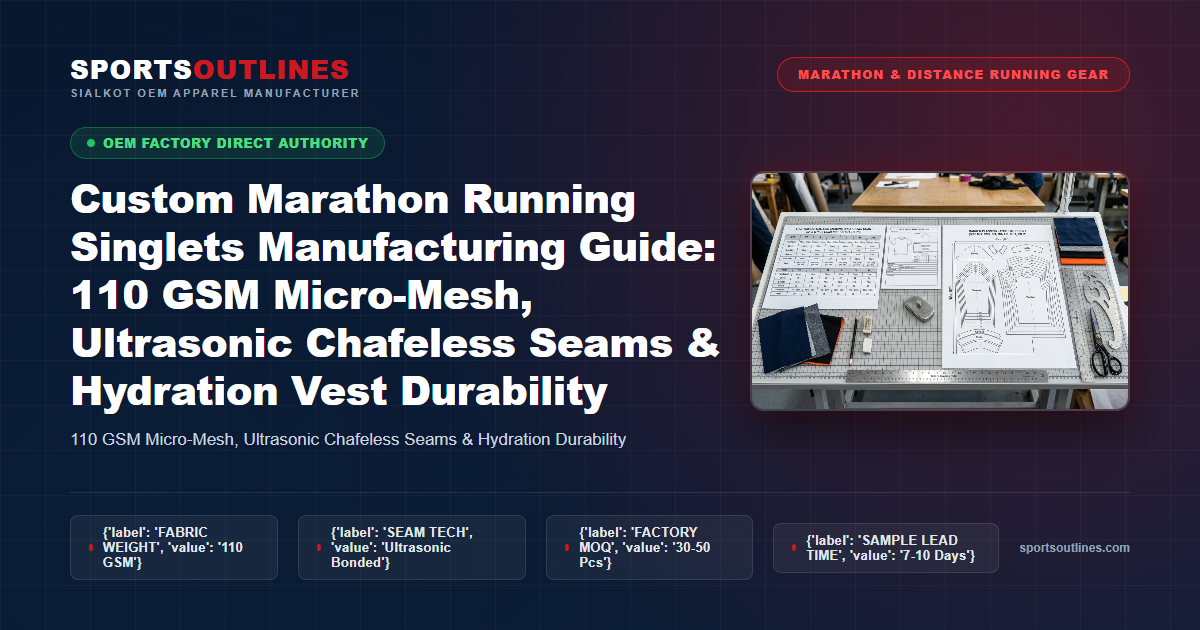
1. Textile Engineering: 110 GSM Micro-Pinhole Mesh & Moisture Dynamics
The primary engineering challenge of distance running apparel is maintaining an ultralight dry feel while moving voluminous sweat away from human skin. In temperatures exceeding 20°C (68°F), an elite marathoner sweats between 1.0 and 2.5 liters per hour. If a singlet absorbs this liquid rather than spreading it across an external evaporation surface, the fabric clings to the chest and creates catastrophic friction.
At Sports Outlines, our distance singlets utilize specialized 105 to 110 GSM micro-pinhole warp-knit mesh engineered from 50-denier micro-filament polyester blended with 10% to 12% fine elastane. Unlike standard circular knit jersey which possesses uniform density that traps air, micro-pinhole mesh incorporates thousands of engineered geometric apertures per square decimeter. These pinholes act as miniature thermal exhaust ports, permitting hot air generated by cardiac exertion to escape instantaneously via convective airflow while letting cool environmental breezes penetrate directly to the runner’s skin.
The fabric is subjected to a proprietary permanent hydrophilic bath during the post-knitting finishing phase. This chemical surface treatment reverses the natural hydrophobic nature of raw polyester, lowering the surface contact angle of water droplets to near zero. When sweat contacts the inner yarn face, capillary suction draws liquid instantaneously through the yarn core to the exterior face, where it disperses across a wide surface area and evaporates within seconds (AATCC 79 test score under 1.5 seconds). Even in 90% relative humidity, our singlets retain less than 8% moisture by dry weight, guaranteeing that the shirt weighs less than 75 grams throughout an entire marathon.
2. Seam Ergonomics: Eliminating Friction, Chafing & Nipple Bleeding
In competitive distance running, the construction of seams is just as critical as fabric weight. Traditional 3-thread overlock seams create a raised, rigid ridge of needle thread and looper thread that presses directly against skin. Under 40,000 arm swings and continuous torso motion, this ridge acts like fine-grit sandpaper, slicing through the epidermal layer of the nipples, armpits, and clavicle bone.
Sports Outlines eliminates running-induced skin trauma through two distinct manufacturing construction methods:
- Ultrasonic Thermo-Bonded Seaming (Tier 1 Elite): The absolute pinnacle of marathon apparel construction. Fabric panels are laser cut with microscopic precision and fused together using ultrasonic acoustic vibrations combined with an ultra-thin 0.05 mm thermoplastic polyurethane (TPU) bonding film. There are zero threads, zero punctures, and zero raised surfaces. The resulting bond is 100% planar, supple, and completely frictionless. Armhole openings and hem borders are finished with folded, heat-bonded elastomeric tape that lies flat against the torso.
- 4-Needle 6-Thread Flatlock with Textured Micro-Yarn (Tier 2 High-Performance): For team budgets requiring high durability and elasticity at a lower unit cost, we utilize precision Yamato and Juki 4-needle 6-thread flatlock machines. Unlike cheap factory flatlock that uses rough nylon monofilament, our machines are threaded with ultra-soft woolly micro-filament polyester looper yarn. The resulting stitch lies completely flush with the fabric surface, creating a smooth ribbon of thread that stretches up to 120% without popping or fraying.
- Forward-Rolled Side Seam Architecture: Traditional side seams run down the mid-axillary line, directly beneath the swinging inner bicep. Our pattern engineers shift the side seams 4.0 cm forward onto the front abdominal plane, completely clearing the arm swing pathway and eliminating arm-to-torso chafing during late-race fatigue.
3. Hydration Vest Durability: Abrasion Resistance & Racerback Patterning
With the explosive global growth of ultramarathons, trail racing, and self-supported marathon training, distance runners frequently wear hydration vests carrying 1.5 to 3.0 liters of fluids, flasks, smartphones, and energy gels. A major flaw of poorly designed ultralight singlets is that the abrasive nylon mesh and elastic piping of hydration packs rapidly abrade the singlet shoulders, chest straps, and lower lumbar region, causing fuzzy pilling and fabric hole formation within two training runs.
To withstand intense pack friction, Sports Outlines incorporates specialized high-tenacity yarn reinforcements across the shoulder yokes and lumbar contact zones. While maintaining a featherweight 110 GSM weight, the fabric’s filament twist count is increased from 18 to 32 twists per inch, resulting in an exceptionally compact yarn structure that scores over 30,000 cycles on the ASTM D4966 Martindale Abrasion Test without fiber breakdown.
Simultaneously, our anatomical racerback design is sculpted to align with standard hydration vest harness geometry. The spine strap of the singlet sits comfortably between the shoulder blades, ensuring that hydration pack shoulder straps rest on fabric rather than bare skin while preventing singlet fabric from bunching into sweaty folds under the harness sternum buckles.
4. Regulatory Compliance: World Athletics Rule 5 Uniform Guidelines
For professional road racing clubs, collegiate programs (NCAA / NAIA / U Sports), and national governing bodies competing under World Athletics sanction, singlets must strictly conform to World Athletics Rule 5 (Apparel and Advertising Regulations). Inadvertent violations can result in immediate athlete disqualification or official warnings.
- Manufacturer Logo Dimensions: Under World Athletics regulations, the manufacturer’s logo or identification mark on the front chest of a competition singlet cannot exceed 30 cm² (4.65 sq. in.) with a maximum height of 5 cm. If placed on the back, it must not exceed 25 cm².
- Club / Corporate Sponsor Displays: A club sponsor logo across the center chest cannot exceed 40 cm² on international road race circuits. We assist brand founders in vector sizing and CAD placement to guarantee 100% mathematical compliance prior to sublimation burning.
- Bib Number Placement Clearances: World Athletics regulations mandate a minimum of 18 cm x 24 cm of unobstructed, contrast-friendly chest and back surface area for competition timing bibs. Our design templates ensure that intricate sublimation patterns, sponsor text, and reflective bands do not interfere with safety pin or magnetic bib clip placement.
- Uniform Team Matching: For relay teams, cross-country squads, and national clubs, World Athletics requires all team members to wear identical colorways, panel layouts, and trim configurations. Our computer-automated dye-sublimation color profiling ensures zero Delta-E color variation across small and large garment sizes.
5. Rigorous Laboratory Testing Standards for Distance Running Apparel
Prior to cutting bulk roll goods, every batch of performance textile at our Sialkot factory undergoes rigorous ISO and ASTM certified laboratory evaluations. We verify tear resistance, moisture dispersion speed, colorfastness against salty sweat, and retroreflective durability under high-temperature washing cycles.
6. Points of Measure (POM) & Ergonomic Size Grading
Pattern grading for distance running singlets requires balancing an aerodynamic, semi-fitted profile with complete diaphragmatic freedom during maximum VO2 max respiration. A singlet that fits too tightly across the lower rib cage restricts lung expansion, while a singlet that hangs too loosely acts like a parachute in headwinds.
The following Points of Measure (POM) chart outlines our standardized adult unisex/men’s competition sizing (XS to 3XL). Custom youth curves (YS to YXL) and women’s specific contoured silhouettes (with higher armholes and sculpted bust darts) are graded with identical millimeter precision:
7. B2B Sourcing Economics: Cost Breakdown, MOQs & Profit Margins
In the performance running market, high-end technical singlets command premium retail prices ranging from $65 to $95 across boutique running brands such as Tracksmith, Satisfy, and Bandit Running. Sourcing directly from our OEM facility in Sialkot allows brand owners to capture remarkable 65% to 75% gross margins while maintaining bespoke customization and low capital risk.
Our flexible production structure offers low factory MOQs starting at 30 to 50 pieces per style/colorway with mixed size breakdowns. To guarantee fit accuracy and print fidelity prior to production runs, we manufacture physical, fully finished pre-production prototype samples for $45 to $85 per singlet delivered via DHL/FedEx within 7 to 10 business days (under our strict zero sample fee refund/credit policy).
8. Private Label Customization: Sublimation, Heat Transfers & Packaging
Creating a boutique distance running brand requires flawless graphic execution, luxury private labeling, and eco-friendly retail packaging. Because marathon singlets must remain virtually weightless, traditional embroidery or thick heavy screen printing are completely prohibited as they create friction contact points against sweaty skin.
Our Sialkot factory provides full-service OEM/ODM private label solutions:
- Digital Dye-Sublimation Printing: Using Japanese Mimaki water-based dye inks, our sublimation process infuses vibrant pigments directly into the polyester polymer chains under 205°C heat. The finished graphic has zero hand feel, zero weight, and 100% unimpeded breathability across all micro-pinholes. Sublimated graphics never fade, peel, or crack, even after 100 industrial wash cycles.
- Zero-Distraction Tagless Heat-Transfer Labels: Every singlet is equipped with an inner back neck transfer detailing brand name, size, fabric composition, and care instructions. We formulate these transfers with ultra-thin, flexible elastomeric inks that leave no perceptible edge against the sensitive skin of the upper cervical spine.
- 360-Degree Retroreflective Heat Seals: High-lux reflective elements are precision positioned along the side vents, lower hem, and back racerback spine, providing 450 cd/lux luminance when illuminated by automobile headlights during night road runs.
- Compostable Eco-Poly Packaging: Finished singlets are individually folded and packaged in 100% biodegradable cornstarch polybags, complete with custom branded hangtags, FSC-certified cardboard backing, and barcode scanning labels ready for immediate retail warehouse fulfillment.
Frequently Asked Technical Questions (FAQs)
1. What is the ideal fabric weight for a competition marathon running singlet?
The optimal weight is 100 to 110 GSM. Anything lighter than 95 GSM lacks the structural integrity required to hold retroreflective transfers and withstand safety pins from race bibs. Anything heavier than 125 GSM traps excessive perspiration and clings heavily to the skin during humid races.
2. How do you prevent runner’s nipple chafing and underarm abrasions?
We eliminate chafing through three engineering measures: using non-abrasive micro-pinhole mesh with low wet cling friction, utilizing ultrasonic thermo-bonded seams or 4-needle 6-thread flatlock stitching with soft textured looper yarn, and relocating the side seams 4 cm forward away from the swinging inner arm path.
3. Can your singlets survive the abrasive friction of trail hydration running vests?
Yes. Our singlets utilize high-tenacity yarn spun with 32 twists per inch, giving them superior tensile strength and abrasion resistance. They achieve over 30,000 rubs on the ASTM D4966 Martindale Abrasion Test, preventing pilling and thinning under hydration harness shoulder and chest straps.
4. What are the World Athletics Rule 5 restrictions for competition singlets?
World Athletics Rule 5 mandates that the manufacturer’s logo on the front cannot exceed 30 cm², club sponsor logos cannot exceed 40 cm², and there must be clear, unobstructed surface area on the front and back for race bib placement. We verify all client artwork against these dimensions prior to production.
5. What is the minimum order quantity (MOQ) for custom marathon singlets?
Our direct factory low MOQ is 30 to 50 pieces per style/colorway. This allows independent running brands, boutique clubs, and charity marathon groups to place specialized orders across mixed adult and youth size curves without holding excess inventory.
6. How much does a physical pre-production sample cost and what is the turnaround?
A physical, fully sublimated prototype sample costs $45 to $85 per singlet depending on whether ultrasonic bonding or flatlock stitching is selected. Samples are produced and delivered to your door via DHL/FedEx in 7 to 10 business days. Under our strict policy, sample fees are non-refundable and not credited toward bulk orders.
7. Can we print full-color photographic gradients across the singlet?
Yes. Our digital sublimation printing utilizes high-resolution Japanese printheads that reproduce complex gradients, continuous tone photographs, and intricate club crests with razor-sharp detail. The ink is molecularly bonded into the polyester fibers, ensuring zero stiff ink residue or pore blockage.
8. What reflective technology is used for night running safety?
We apply micro-glass bead retroreflective heat-seal transfers certified to EN ISO 20471. They provide an intense reflectivity coefficient of 450 cd/(lx·m²), making runners clearly visible from up to 150 meters away under automobile headlights.
9. Do you offer women-specific cuts or only unisex sizing?
We provide both. Our women’s specific marathon patterns feature narrower shoulder straps, slightly raised armholes to prevent sports bra exposure, contoured waist shaping, and an expanded hip sweep to ensure the singlet does not bunch or ride up during stride mechanics.
10. How should sublimated distance running singlets be laundered?
Machine wash inside-out in cold water (30°C / 86°F) on a gentle cycle using mild liquid sports detergent. Do not use fabric softeners or chlorine bleach, as softeners coat hydrophilic yarn channels and impair capillary wicking. Hang dry in shade. Avoid tumble drying or high-temperature ironing to protect reflective heat transfers.
Engineer Your Custom Marathon Running Singlets with Sialkot’s Premier OEM Factory
Whether you are outfitting an international marathon team, launching a boutique technical running label, or producing varsity cross-country uniforms, Sports Outlines delivers 110 GSM micro-pinhole mesh, chafeless bonded construction, and certified World Athletics compliance with low factory MOQs of 30–50 pieces.
Related Technical Manufacturing Guides & Global Sourcing Silos:
- Global Sourcing Hubs: USA Sportswear Factory | Canada Apparel OEM | UK Activewear Sourcing | Australia Athletic Wear
- Product Lines: Custom Sublimated Jerseys | Performance Athletic Wear | Custom Teamwear Sourcing
- Related Racket & Court Guides: Custom Tennis Polos Guide | Custom Squash & Badminton Tees Guide