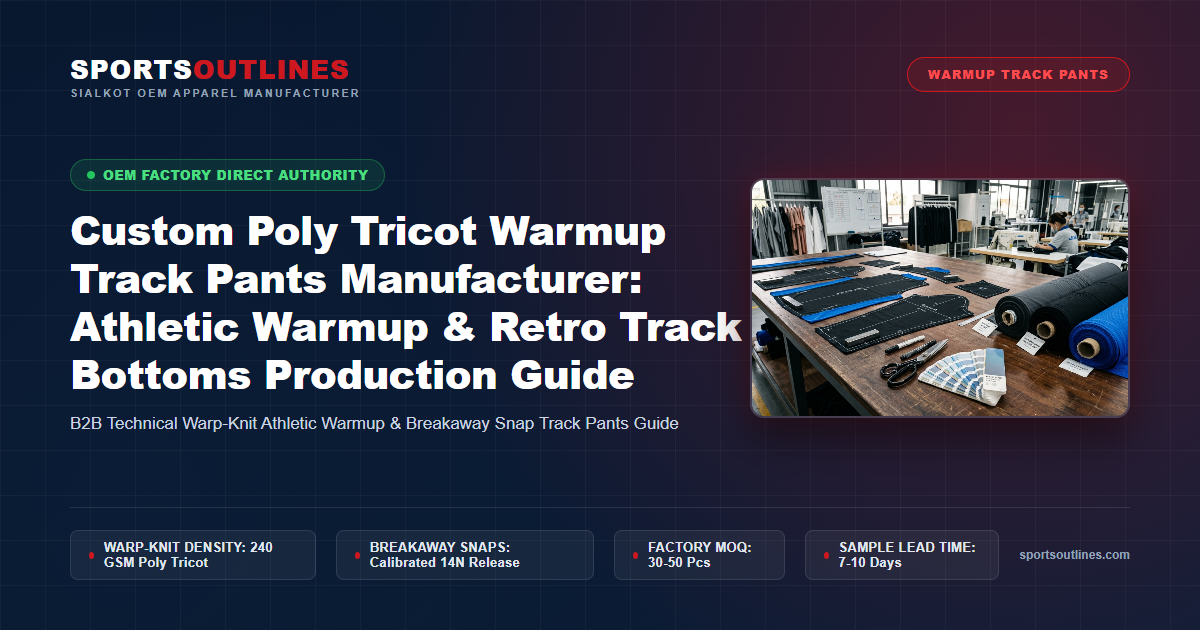
Poly tricot warmup track pants represent one of the most iconic, enduring silhouettes in both competitive athletic teamwear and high-margin retro streetwear. Characterized by its distinctive lustrous outer face, pill-resistant warp-knit construction, and ultra-soft brushed interior backer, polyester tricot provides the definitive balance of drape, durability, and court-ready warmth. From varsity basketball teams needing rapid-removal breakaway tearaway warmups to streetwear labels engineering vintage 90s European soccer tracksuits, technical execution determines commercial viability. As an established custom poly tricot track pants manufacturer located in Sialkot, Pakistan, Sports Outlines delivers precision warp-knit textile manufacturing, intricate cut-and-sew side paneling, heavy-duty snap engineering, and factory-direct agility with minimum order quantities (MOQs) starting at just 30 to 50 pieces per style/colorway.
In this comprehensive technical manufacturing guide, activewear brand owners, private label designers, and teamwear merchandisers will explore the entire production lifecycle of custom poly tricot track bottoms. We examine warp-knit tricot mechanics, compare brushed vs. unbrushed loop backers, analyze cut-and-sew paneling versus jacquard knit side taping, dissect breakaway snap tearaway engineering, review our ISO 2859-1 AQL 2.5 quality control standards, and present transparent production economics supporting exceptional DTC retail margins.
Factory Engineering Summary: Poly Tricot Warmup Track Pants
- Textile Substrate: 220–250 GSM 100% filament warp-knit polyester tricot; smooth semi-dull or high-luster outer face with brushed micro-terry thermal backer.
- Structural Paneling: Precision cut-and-sew contrast outseam stripes, custom yarn-dyed jacquard knit webbings, and retro piping inserts sewn with twin-needle topstitching.
- Breakaway Snap Engineering: High-tenacity PRYM or YKK brass spring-loaded ring snaps (15 mm cap diameter) reinforced with concealed 25 mm polyester herringbone stay-tape to prevent fabric tearing during rapid pull-off.
- Ankle Entry Hardware: 10-inch YKK #3 or #5 coil zippers featuring clean turned-back plackets and self-fabric zipper garages to facilitate swift entry over basketball and soccer footwear.
- Accessible Manufacturing Terms: Low MOQ of 30–50 pieces per colorway with comprehensive size grading (XS to 3XL); physical pre-production prototyping in 7–10 days ($45–$85 per piece, non-refundable).
1. Warp-Knit Tricot Mechanics: Why Polyester Tricot Outperforms Weft Knits for Warmups
To manufacture high-performance warmup pants that maintain their shape after hundreds of hours of team travel and warmups, selecting the correct knit structure is paramount. Traditional casual sweatpants utilize weft-knit French terry or fleece, in which yarns run horizontally across the fabric width. While soft, weft knits suffer from high mechanical snagging, edge curling, bagging at the knees, and significant shrinkage under industrial laundering.
In contrast, our athletic track bottoms are knitted on high-speed Karl Mayer tricot warp-knitting machines. In warp knitting, thousands of individual filament yarns run zigzag patterns lengthwise down the fabric, creating interlocking looped wales that deliver decisive technical advantages:
- Zero Laddering & Run Resistance: Because adjacent wales are interlooped across diagonal yarn guides, a puncture or surface abrasion will not produce running ladders or structural unraveling.
- Exceptional Dimensional Recovery & Knee-Bag Resistance: Warp-knit tricot exhibits rigid structural stability in the length direction while maintaining natural mechanical stretch across the width. This ensures that athletes sitting on benches or performing deep squats will not stretch out unsightly “baggy knees” in the fabric.
- Dual-Face Surface Versatility: The front technical face of the tricot features tightly intermeshed flat stitches that reflect light (producing an authentic retro sheen or a sophisticated matte semi-dull finish), while the reverse face consists of underlaps that can be mechanically brushed to create a soft, insulating micro-fleece nap.
- Hydrophobic Filament Yarn Chemistry: Constructed from 100% continuous filament polyethylene terephthalate (PET), the fibers absorb less than 0.4% moisture by weight. Sweat vapor is wicked away via capillary action along the exterior of the fibers, drying 300% faster than cotton sweats.
| Physical Property | Brushed Backer Poly Tricot | Unbrushed Poly Shiny Tricot | Test Standard |
|---|---|---|---|
| Areal Fabric Density (GSM) | 240 ± 8 GSM | 215 ± 6 GSM | ASTM D3776 |
| Yarn Filament Count | 75D / 72F Draw Textured Yarn (DTY) | 50D / 48F Fully Drawn Yarn (FDY) | ASTM D1059 |
| Surface Luster / Sheen | Semi-Dull / Low Glare Finish | High-Luster Retro Gloss | Visual & 60° Glossmeter |
| Martindale Abrasion Resistance | > 35,000 cycles (No Pilling) | > 40,000 cycles | ISO 12947-2 |
| Tensile Bursting Strength | > 750 kPa | > 720 kPa | ASTM D3786 |
| Laundering Shrinkage (5 Washes) | < 1.5% Length / < 1.0% Width | < 1.2% Length / < 0.8% Width | AATCC 135 |
2. Retro Cut-and-Sew Side Paneling vs. Jacquard Knit Taping
The side outseam is the signature visual focal point of poly tricot track pants. Whether creating heritage sports aesthetics or sharp contemporary streetwear, our factory executes two primary embellishment methods:
Method A: Cut-and-Sew Contrast Color-Blocked Stripes
In this traditional method, the main pant legs are sliced vertically to insert one, two, or three contrasting fabric panels (e.g., white, crimson, or metallic gold stripes running down a black or navy pant). Each panel is individually laser-cut to exact CAD contours, joined via 4-thread overlock safety stitches, and topstitched using 1/4-inch twin-needle chainstitch machines. To enhance dimension, our operators frequently insert rounded piping cords (with 2.0 mm interior cotton filler) along the seam junctions, establishing crisp, elevated visual lines.
Method B: High-Definition Jacquard Knitted Side Webbing
For upscale private label collections requiring repeating logos, monogram motifs, or varsity typography down the legs, we knit continuous 4.0 cm to 6.0 cm jacquard tapes on specialized narrow-fabric looms. Using 50-denier polyester yarns, jacquard webbing yields ultra-crisp typographic resolution that will never fade, crack, or peel like screen printing. The tape is laid directly over the outseam and stitched down along both edges with computerized twin-needle guide attachments, guaranteeing perfectly straight alignment from waist to cuff.
3. Breakaway Tearaway Snap Engineering: Reinforcement & Release Calibration
Breakaway snap pants (also known as tearaway track pants) are a legendary basketball warmup staple that has crossed over into high-fashion streetwear. However, manufacturing tearaway bottoms requires serious mechanical engineering. If snaps are installed directly into poly tricot fabric, the intense shear force of a rapid “tearaway” pull will instantly rip the knit fabric around the metal snap prongs, ruining the garment.
At Sports Outlines, our sample room and production workstations engineer indestructible breakaway snap closures through a strict 4-step protocol:
- Internal Woven Stay-Tape Interlining: Before installing any hardware, we sandwich a continuous 25 mm high-density polyester herringbone webbing inside the folded front and back plackets. The placket edges are sewn with 2-needle lockstitches, encapsulating the webbing completely within the seam.
- PRYM / YKK Spring-Loaded Brass Ring Snaps: We install genuine 15 mm diameter spring-ring press snaps (System S-Spring / Ring-Socket) manufactured from nickel-plated or matte-black enameled brass. Brass hardware will never corrode or rust during washing cycles.
- Pneumatic Die Press Riveting: Each snap set (cap, socket, stud, and post) is crimped using automated pneumatic riveting presses operating at 6.0 bar clamping pressure. The metal prongs penetrate through the outer tricot, the internal woven stay tape, and the inner facing before rolling closed, anchoring the snap directly into the load-bearing webbing.
- Calibrated Release Force (12 to 16 N): The spring tension of the ring socket is precisely calibrated. A pull force of 14 Newtons allows an athlete to grasp the waistband and tear the pant completely open in one fluid motion, while remaining firmly snapped shut during warmup jogging and lateral defensive slides.
| Measurement Point (cm) | XS | S | M (Sample) | L | XL | 2XL | 3XL | Tolerance (±) |
|---|---|---|---|---|---|---|---|---|
| 1/2 Relaxed Waistband | 33.0 | 35.5 | 38.0 | 41.0 | 44.0 | 47.5 | 51.0 | ± 0.8 |
| 1/2 Stretched Waistband | 47.0 | 50.0 | 53.0 | 56.5 | 60.0 | 64.0 | 68.0 | ± 1.0 |
| 1/2 Low Hip (20 cm down) | 48.0 | 50.5 | 53.0 | 56.0 | 59.0 | 62.5 | 66.0 | ± 0.8 |
| 1/2 Thigh Width | 30.0 | 31.5 | 33.0 | 34.8 | 36.5 | 38.5 | 40.5 | ± 0.5 |
| 1/2 Knee Width | 21.0 | 22.0 | 23.0 | 24.2 | 25.5 | 26.8 | 28.0 | ± 0.5 |
| 1/2 Leg Opening (Hem) | 17.5 | 18.0 | 18.5 | 19.2 | 20.0 | 20.8 | 21.5 | ± 0.5 |
| Inseam Length | 76.0 | 77.5 | 79.0 | 80.5 | 81.5 | 82.5 | 83.5 | ± 0.8 |
| Front Rise (incl. waistband) | 27.0 | 28.0 | 29.0 | 30.2 | 31.5 | 32.8 | 34.0 | ± 0.6 |
4. Ankle Zipper Hardware & Elasticized Waistband Workstations
For closed-leg warmup track pants that do not utilize full tearaway snaps, the lower leg must accommodate quick shoe entry. In team locker rooms and sideline benches, athletes cannot afford to unlace bulky high-top sneakers every time they substitute into the game.
Our production lines construct athletic ankle entry systems using professional manufacturing standards:
- 10-Inch YKK #5 Coil Ankle Zippers: We install genuine 10-inch YKK coil zippers along the lower outseam. The coil teeth provide smooth gliding under mud or sweat conditions. Zippers are set with turned-back plackets and an internal 20 mm storm flap, protecting the player’s ankles and socks from metal friction.
- Kansai Special 4-Needle Quilted Elastic Waistband: The waistband features a wide 5.0 cm natural rubber continuous elastic band. Using Kansai Special multi-needle chainstitch machines with synchronized rear pullers, the elastic is quilted directly through the folded tricot fabric with 4 parallel stitch rows. This prevents the elastic from ever twisting, rolling, or folding over inside the waistband during machine washing.
- Continuous Tubular Flat Braided Drawcord with Metal Aglets: Threaded through the center channel, a 12 mm flat braided polyester drawcord provides secure customized fit. Cord exit holes are reinforced with anti-corrosion matte-black brass grommets. Cord ends are capped with custom laser-engraved metal aglets or dipped matte silicone tips.
- Concealed Mesh-Lined Zipper Pockets: Two deep side slash pockets are secured with YKK invisible zippers. To prevent bulky pocket outlines that distort the silhouette, pocket bags are constructed from lightweight, ultra-breathable 140 GSM polyester micro-mesh.
5. Embellishment Technologies: Direct Embroidery vs. Silicone Heat Transfer
Poly tricot’s smooth, non-porous outer face provides an ideal substrate for vibrant, long-lasting branding. In our Sialkot embellishment department, we support four primary decoration techniques tailored to your brand identity:
- Direct Tajima Multi-Head Embroidery: For collegiate, country club, and retro football aesthetics, direct embroidery delivers unmatched heritage prestige. We run 15-needle Tajima electronic embroidery machines using Madeira 100% polyester threads. The underlay density is optimized with tearaway backing to prevent fabric puckering across delicate warp-knit tricot. In addition, our digitizers apply automatic underlay grid tatami stitches that stabilize the tricot grain before executing satin topstitches.
- High-Density 3D Silicone Heat Transfers: For technical modern streetwear, matte 3D silicone heat seals (0.8 mm raised profile) provide a clean, tactile appearance. Applied under pneumatic heat presses at 155°C with 4.0 bar pressure, silicone transfers bond permanently without melting the polyester base fabric. We utilize cross-linking polyurethane melt adhesives that withstand 60°C commercial wash cycles without peeling or micro-cracking.
- Dye-Sublimated Contrast Side Panels: Because poly tricot is 100% polyester, it is exceptionally receptive to high-definition dye sublimation printing. Custom all-over patterns (camo, gradients, geometric retro chevrons) can be sublimated onto the side panels before assembly. Sublimation gasifies disperse dyes deep into the polymer matrix at 205°C, guaranteeing zero hand-feel and 100% fade resistance for the life of the garment. We employ high-grade Italian Kiian digital sublimation inks, achieving deep black densities and vibrant neon spectral fidelity.
- Custom Chenille & Felt Varsity Patches: For retro collections, we produce custom chenille patches with embroidered felt borders, stitched directly to the upper left thigh using heavy-duty satin border stitches. These patches utilize high-pile acrylic moss stitches mounted on dual-layer wool felt backings, recreating authentic vintage collegiate warmup appeal.
- Laser-Etched Metal Hardware & Branded Snap Caps: To cement brand exclusivity, our metal casting workshop stamps custom brand logos and emblems directly onto brass snap caps, zipper pullers, and tubular drawcord aglets, available in electroplated matte black, polished gunmetal, and brushed antique silver.
6. Clean-Room Assembly Machinery & Needle Heat Management
Stitching 100% synthetic polyester tricot at high production velocities (over 4,000 stitches per minute) creates severe thermal friction. The sewing needle can exceed temperatures of 250°C, which instantly melts synthetic polyester yarns, causing microscopic needle holes to fuse and melt into brittle beads that snap under tension.
In our Sialkot factory, our workstations eliminate needle heat defects through four rigorous engineering standards:
- Groz-Beckert Ball-Point Chrome Needles (SES Point): We equip our Juki workstations with fine-gauge Groz-Beckert needles (size 75/11 to 80/12) with light ball points. The rounded tip gently separates the warp-knit wales without puncturing or severing the continuous filament fibers.
- Compressed Air Needle Blowers: Workstations running high-speed multi-needle chainstitches feature automated compressed air nozzles directed at the needle eye. A continuous stream of chilled air cools the needle tip, keeping operating temperatures safely below 140°C.
- Coats Eloflex Elastic Sewing Threads: For seams subjected to high dynamic stretch (crotch seam, waistband join, and calf outseam), we deploy Coats Eloflex threads. This specialized thread offers 50% inherent elongation, preventing skipped stitches and seam popping when athletes jump or stretch.
- Automated Edge Trimming Overlockers: 4-thread overlockers with integrated vacuum suction remove cut-and-sew tricot edge waste instantly, ensuring zero loose synthetic fibers are trapped within seam enclosures.
- Active Thread Tension Monitoring (Juki DDL-9000C Digital Drive): Digital feed drives continuously measure stitch-by-stitch thread tension, automatically relaxing upper looper tension along curved panel transitions to eliminate puckering and ensure perfectly flat, fluid seam lines.
7. Industrial Quality Assurance & Fastness Testing (ISO 2859-1 AQL 2.5)
Every production run of custom poly tricot track pants undergoes exhaustive laboratory testing and visual inspection according to internationally certified AQL 2.5 standards:
- Sublimation & Dye Migration Testing (AATCC 163): When contrasting white side stripes are joined to jet-black or crimson body fabric, dye migration can ruin garments during transit. We bake composite fabric swatches in our incubator oven at 70°C under 5 kg weight for 24 hours. The white panels must exhibit Grade 4.5+ fastness with zero discoloration or color bleed.
- Snap Action & Retention Force Audit (ASTM D4846): Finished breakaway snap pants are clamped in a digital tensile test fixture. Each snap must withstand a minimum perpendicular pull-off force of 120 N without dislodging from the woven stay-tape, while maintaining consistent unfastening tension across all 12 leg snaps.
- Color Fastness to Washing & Perspiration (ISO 105-C06 / ISO 105-E04): Finished samples are subjected to commercial laundering cycles with synthetic perspiration solutions. Fabrics must achieve Grade 4.5+ colorfastness with zero staining on multifiber test swatches.
- Dimensional Stability Audit (AATCC 135): Finished garments undergo five consecutive commercial wash cycles at 60°C. Total dimensional shrinkage along both length and width must remain under 1.5%.
8. Production Economics, Tiered Pricing & Physical Prototyping
Poly tricot warmup bottoms offer some of the most stable, repeatable commercial margins in sports apparel. While collegiate programs, athletic clubs, and streetwear labels retail high-quality warmup track pants between $75 and $115 USD, factory-direct manufacturing costs remain exceptionally advantageous. At Sports Outlines, our low MOQ of strictly 30 to 50 pieces per style/colorway allows emerging brands to launch professional collections without the burden of large capital outlays.
| Production Tier | Order Quantity (Pieces) | FOB Unit Cost (Standard Tricot) | FOB Unit Cost (Breakaway Snaps) | Target DTC Retail Price | Gross Margin (%) |
|---|---|---|---|---|---|
| Low MOQ Launch | 30–50 pieces | $18.50 – $20.80 | $21.50 – $23.80 | $78.00 – $98.00 | 76% – 78% |
| Scale Growth Run | 100–250 pieces | $15.20 – $17.00 | $17.80 – $19.60 | $78.00 – $98.00 | 80% – 82% |
| Team / Club Tier | 500–1,000 pieces | $12.80 – $14.20 | $14.90 – $16.50 | $75.00 – $95.00 | 82% – 84% |
| Enterprise Run | 2,000+ pieces | $10.50 – $11.80 | $12.20 – $13.50 | $70.00 – $90.00 | 85% – 87% |
Prototype Sampling Policy: Before initiating bulk cutting, our master pattern makers build custom physical pre-production prototype samples for $45 to $85 per piece (turnaround time 7 to 10 business days). This sampling cost covers individual CAD pattern tailoring, precision laser cutting, custom machine setup, hardware riveting, and embroidery digitizing. Prototyping fees are strictly non-refundable and do not apply as credits toward future production invoices.
9. How to Launch Your Custom Poly Tricot Line with Sports Outlines
Collaborating directly with our Sialkot factory provides total manufacturing transparency, direct engineering communication, and professional export logistics:
5-Step Production Roadmap
- Design & Silhouette Submission: Send your tech pack, flat sketches, or physical reference samples. Specify fabric finish (brushed vs unbrushed, luster vs matte), side stripe configuration, and snap requirements.
- Physical Prototyping ($45–$85): Our sample room knits, laser-cuts, and constructs your custom prototype within 7–10 days, delivered via express air courier.
- Fit, Snap & Hardware Evaluation: Review sample quality. Test the breakaway snap action, ankle zipper smoothness, waistband tension, and side stripe precision.
- Low MOQ Bulk Production (30–50 pcs): Upon sign-off, we initiate fabric batching, laser cutting, and clean-line assembly. Standard production turnaround is 18–25 business days.
- Global Delivery: We ship DDP (Delivered Duty Paid) via express air (DHL/FedEx) or sea freight directly to your commercial warehouse.
To discover how our warmup bottoms coordinate with our broader athletic wear lines, explore our in-depth manufacturing guides on custom tapered gym joggers manufacturing, review our technical breakdown on custom cargo gym joggers production, or check our international trade capabilities in our Germany sportswear manufacturing export hub. Browse our complete athletic catalog in our custom sportswear category.
Start Your Custom Poly Tricot Track Pants Production
Connect directly with our Sialkot factory engineers to discuss custom warp-knit milling, tearaway snap hardware, and low MOQ production slots.
Chat on WhatsApp (+92 316 7932595)
Request Factory Direct Quote
Frequently Asked Questions (B2B Poly Tricot Warmup FAQ)
What is the minimum order quantity (MOQ) for custom poly tricot warmup pants?
Our factory MOQ starts at strictly 30 to 50 pieces per style/colorway. You can distribute this quantity across standard sizes (XS to 3XL) to test your team or streetwear drop with low capital exposure.
How much does a physical sample prototype cost and what is the turnaround?
Pre-production physical prototype samples cost between $45 and $85 per piece, with a turnaround of 7 to 10 business days. Sample fees cover custom CAD pattern drafting, cutting, hardware riveting, and sample room labor, and are strictly non-refundable without future bulk order credits.
Can you manufacture full breakaway snap pants that won’t rip when torn off?
Yes. We reinforce both outseam plackets with a continuous 25 mm high-density polyester herringbone stay tape before installing brass spring-loaded ring snaps using pneumatic die presses. This anchors the hardware into the webbing, guaranteeing high tearaway durability with zero fabric tearing.
What is the difference between brushed and unbrushed poly tricot?
Brushed poly tricot features a soft, micro-fleece nap on the interior face for insulation and next-to-skin comfort, ideal for cool-weather warmups. Unbrushed poly tricot features flat, slick surfaces on both sides, providing a lighter, breezy hand-feel preferred in warmer indoor courts.
Can you produce custom jacquard side tape with our brand name or logo?
Yes. We weave custom 4.0 cm to 6.0 cm jacquard knit webbing using 50-denier high-definition polyester yarns on narrow-fabric looms, creating permanent high-resolution repeating brand typography or patterns down the outseams.