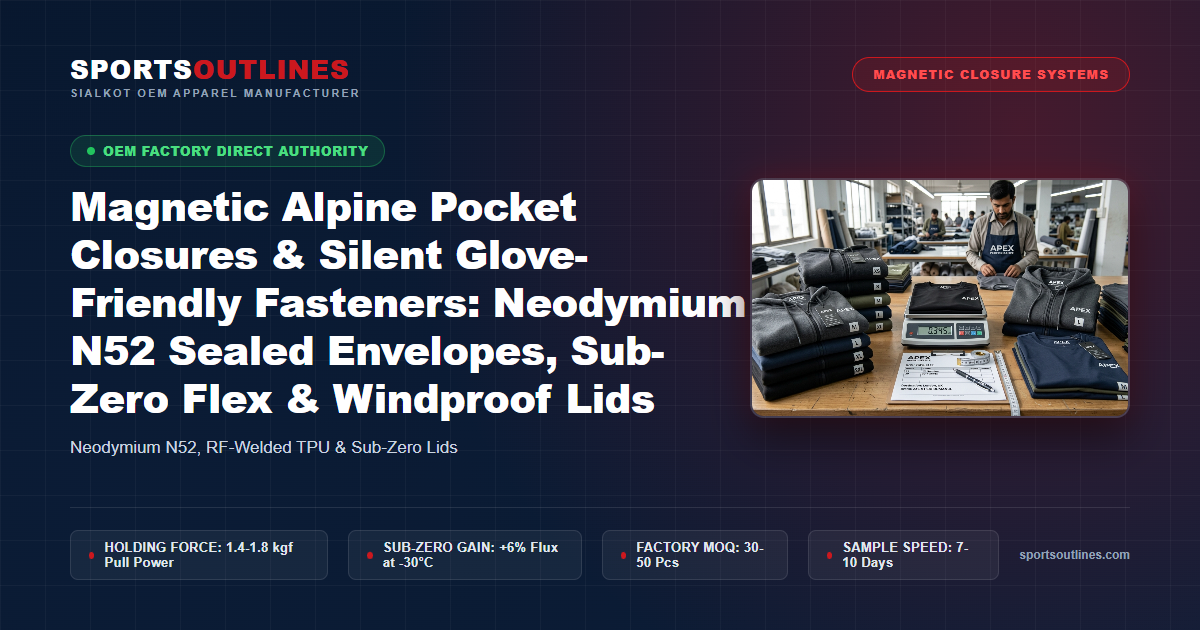
In extreme alpine ascents, sub-zero freeride expeditions, and tactical winter environments, the hardware used to secure outerwear pockets is subjected to punishing mechanical and environmental forces. Traditional fastening mechanisms—such as mechanical zippers, hook-and-loop (Velcro®) strips, and plastic press snaps—suffer from severe operational degradation in freezing blizzard conditions. Water-resistant zippers freeze solid when exposed to freezing rain or verglas ice; hook-and-loop patches become packed with fine snow crystals, losing over $90\%$ of their shear retention while creating loud acoustic tearing noises that ruin the premium tactile feel of a high-end jacket; and press snaps require painful focal pressure against the wearer’s chest or ribs that is nearly impossible to align while wearing thick, insulated 3-finger mountaineering mittens.
The pinnacle of modern tactile fastening in premium alpine outerwear is the hermetically sealed Neodymium (NdFeB) magnetic closure system. Utilizing ultra-high-grade N50 to N52 rare-earth magnetic disc arrays encased inside radio-frequency (RF) welded thermoplastic polyurethane (TPU) waterproof envelopes, magnetic pocket closures deliver effortless, auto-aligning, self-closing operation. A mountaineer can flip open a storm pocket with one mittened hand to retrieve an energy gel, GPS communicator, or ski goggles, and release the lid; the magnetic flux pulls the flap shut automatically, locking the pocket against $85\text{ km/h}$ gale-force winds with a completely silent, damp-cushioned tactile click.
However, designing magnetic fasteners into performance outerwear requires rigorous engineering discipline: hermetic encapsulation to prevent explosive oxidation and corrosion of sintered neodymium, pull force calibration ($1.2\text{ to }2.2\text{ kgf}$) to avoid pocket sagging, internal foam sound dampening, and strict adherence to international avalanche transceiver (beacon) electromagnetic safety exclusion zones. At Sports Outlines in Sialkot, Pakistan, our outerwear manufacturing facility specializes in precision RF welding, cleanroom ultrasonic pocket assembly, and technical alpine outerwear manufacturing. We support performance brands with direct, transparent parameters: complete physical prototype development at $45 to $85 per piece (non-refundable, 7–10 business days turnaround) and scalable factory production starting at strictly 30 to 50 pieces per style/colorway with comprehensive CAD size grading from XS to 3XL.
Magnetic Alpine Pocket Closures: Technical Directory
- 1. Alpine Failure Modes: Snow-Packed Velcro, Frozen Zippers & Brittle Snaps
- 2. Rare-Earth Magnet Physics: Neodymium N52 Grades & Sub-Zero Flux Gain
- 3. Hermetic TPU Encapsulation: Preventing Neodymium Oxidation & Corrosion
- 4. Clamping Force Calibration: 1.2–2.2 kgf Pull & Acoustic Foam Damping
- 5. Stiffened Pocket Lid Welts: Die-Cut HDPE Stays & Wind Lift Prevention
- 6. Ergonomic Pocket Kinematics: Harness & Pack Belt De-Confliction
- 7. Avalanche Beacon & Navigational Compass EMI Safety Exclusion Zones
- 8. Alpine Magnetic Pocket Architecture Specification Matrix
- 9. Laboratory Validation: Wind Tunnel Lift, Peel Fatigue & Wash Testing
- 10. Direct Factory Commercial Terms: $45–$85 Samples & 30–50 Piece MOQs
- 11. Magnetic Outerwear Closures Sourcing FAQ
1. Alpine Failure Modes: Snow-Packed Velcro, Frozen Zippers & Brittle Snaps
To understand why high-end alpine outerwear brands are transitioning to magnetic pocket closures, textile engineers must analyze the severe physical limitations of conventional fastening systems in sub-zero environments:
A. The Snow-Clogging Failure of Hook-and-Loop (Velcro®)
Woven hook-and-loop fasteners rely on microscopic polyamide hooks catching onto a forest of curly multifilament loops. When skiing through deep powder snow or post-holing through high-altitude snow drifts, powder snow crystals ($0.2\text{ to }0.5\text{ mm}$ size) pack into the loop matrix. Under body heat, the surface crystals partially melt and then re-freeze into solid verglas ice. Once iced over, the hooks cannot penetrate the loop pile; shear retention strength drops from a nominal $18\text{ N/cm}^2$ down to $<1.5\text{ N/cm}^2$ (an immediate $92\%$ loss of holding power). The pocket lid pops open, allowing snow to fill the pocket.
B. The Acoustic “Rip” Penalty
In military alpine warfare, tactical scouting, wildlife photography, and luxury outdoor apparel, the loud, high-frequency acoustic “rip” generated when opening hook-and-loop ($75\text{ to }85\text{ dBA}$ sound pressure at 1 meter) is completely unacceptable. It destroys stealth and signals cheap, utilitarian construction. Furthermore, the abrasive polyamide hooks repeatedly abrade and pull threads from expensive merino wool base layers, knitted beanies, and Lycra cuff gaiters.
C. Mitten Incompatibility of Reverse-Coil Zippers
While polyurethane-coated water-resistant zippers (such as YKK AquaGuard®) provide excellent water barrier properties, opening and closing a horizontal chest pocket zipper while wearing thick 3-finger leather ski mittens requires two hands: one hand to pull tension on the shell fabric, and the other hand to manipulate the slider pull. In gusting gale winds on an exposed ridge, requiring two hands to access a pocket jeopardizes climber safety and grip on ice axes.
D. Sub-Zero Mechanical Snap Embrittlement
Molded polyacetal (POM) or nylon press-stud snaps require significant compressive force to snap together. In temperatures below $-25^\circ\text{C}$, the plastic resin stiffens and loses flexural ductility. When an athlete attempts to snap a frozen pocket shut, the male stud frequently shears off, or the female socket splits under impact pressure. Metal brass snaps avoid breakage but suffer from severe thermal conductivity, frosting over and causing localized condensation cold-spots on the jacket interior.
2. Rare-Earth Magnet Physics: Neodymium N52 Grades & Sub-Zero Flux Gain
Magnetic closures in technical outerwear utilize sintered Neodymium Iron Boron (NdFeB), the strongest permanent magnetic material known to modern science. The grade designation (such as N42, N50, or N52) defines the Maximum Energy Product ($BH_{\text{max}}$) of the sintered material in Mega-Gauss-Oersteds (MGOe):
Magnetic Flux Density vs. Axial Distance Equation
The magnetic field $B(z)$ generated along the central axis of a cylindrical disc magnet of radius $R$ and thickness $D$ at an axial separation distance $z$ is modeled mathematically by:
Where $B_r \approx 1.45\text{ Tesla}$ for grade N52. When the pocket lid is open at $z = 30\text{ mm}$, the magnetic flux density is negligible ($B \approx 0.008\text{ T}$), meaning the magnet does not inadvertently snatch iron debris from the mountain environment. However, as the lid falls to within $z = 10\text{ mm}$, the flux density escalates non-linearly to over $0.18\text{ T}$, exerting a rapid self-centering pulling force that snaps the lid shut automatically.
Sub-Zero Magnetic Flux Enhancement
Unlike chemical batteries (which lose output) and polyurethane elastomers (which stiffen), ferromagnetic rare-earth materials exhibit an inherent positive flux response to freezing temperatures. The reversible temperature coefficient of remanence for sintered NdFeB is $\alpha(B_r) \approx -0.12\%/^\circ\text{C}$.
When ambient temperatures drop from $+20^\circ\text{C}$ in the valley down to $-30^\circ\text{C}$ on an alpine peak ($\Delta T = -50^\circ\text{C}$), the magnetic flux density and mechanical pull force increase by $+6.0\%$. Thus, magnetic closures deliver their strongest, most reliable clamping force precisely when high-altitude blizzard winds are most fierce.
3. Hermetic TPU Encapsulation: Preventing Neodymium Oxidation & Corrosion
The fatal vulnerability of sintered NdFeB magnets is their extreme susceptibility to galvanic oxidation and moisture corrosion. Sintered neodymium has a porous, inter-granular microstructure rich in rare-earth neodymium metal. If a raw or poorly plated neodymium magnet is exposed to moisture, humidity, and wash detergents, the neodymium oxidizes rapidly into neodymium hydroxide ($\text{Nd(OH)}_3$), expanding in volume, turning into a gray powder, and completely losing its magnetic charge within weeks.
At Sports Outlines, we eliminate corrosion failure through an advanced 3-tier hermetic encapsulation protocol:
The 3-Tier Hermetic Waterproofing Process:
- Triple-Layer Metallic Plating (Ni-Cu-Ni): The raw N52 discs undergo electrolytic barrel plating: $12\text{ µm}$ nickel underlayer, $8\text{ µm}$ copper barrier, and $12\text{ µm}$ outer bright nickel seal, providing primary chemical isolation.
- Radio-Frequency (RF) Welded TPU Envelopes: Each magnet disc is placed inside a pre-formed dual-ply pocket constructed from $0.30\text{ mm}$ ether-based thermoplastic polyurethane (TPU) film (such as Bemis 3914). A high-frequency $27.12\text{ MHz}$ RF welding die fuses the perimeter of the TPU envelope under $4.5\text{ bar}$ pneumatic pressure, forming an airtight, IP68 immersion-grade waterproof pouch with a $3.0\text{ mm}$ weld flange.
- Ultrasonic Pocket Anchoring: The sealed TPU envelope is placed between the shell face fabric and the inner pocket facing. The outer weld flange is ultrasonically tacked in place, anchoring the magnet securely without a single needle hole penetrating the waterproof TPU capsule.
4. Clamping Force Calibration: 1.2–2.2 kgf Pull & Acoustic Foam Damping
In magnetic garment closures, more power is not always better. Calibrating the magnetic pull force requires balancing two opposing mechanical objectives:
A. The Pull Force Goldilocks Zone ($1.2\text{ to }2.2\text{ kgf}$)
- Insufficient Pull ($<0.8\text{ kgf}$ per pair): The magnetic field is too weak. Dynamic body flex, backpack chest strap tension, and $60\text{ km/h}$ aerodynamic wind shear will blow the pocket flap open, spilling contents into the snow.
- Excessive Pull ($>3.0\text{ kgf}$ per pair): The magnets clamp together with excessive force. Opening the pocket requires an aggressive two-handed pull that stretches the outer 3L laminate fabric, causing stitch tearing, puckering, and laminate delamination over repeated cycles.
- The Optimal Benchmark: Our factory engineers calibrate magnet pairs to strictly $1.4\text{ to }1.8\text{ kgf}$ ($13.7\text{ to }17.6\text{ N}$) at nominal fabric separation ($0.8\text{ mm}$ inter-ply gap). This provides instantaneous, self-aligning snap-shut action that withstands $90\text{ km/h}$ wind gusts while allowing effortless one-handed release with a light finger flick.
B. Acoustic Shock Dampening Inter-Layers
When two rigid N52 magnets snap together through thin fabric, they produce a sharp, metallic “clack” sound. In tactical military shells, luxury skiwear, and wildlife observation gear, this noise must be eliminated. Sports Outlines incorporates an internal $0.5\text{ mm}$ closed-cell EVA micro-foam dampening pad directly on the mating face inside the TPU envelope. The micro-foam absorbs impact shock, softening the acoustic signature to a muffled, luxurious, tactile click ($<38\text{ dBA}$).
5. Stiffened Pocket Lid Welts: Die-Cut HDPE Stays & Wind Lift Prevention
A magnet pair can only secure the specific point where the two discs contact. If the pocket lid itself is constructed from soft, unstructured hardshell fabric, high-velocity aerodynamic wind shear hitting the chest will curl the corners of the flap upward (the “dog-ear” effect), scooping air and water into the pocket opening despite the central magnet holding firm.
Structural Aerodynamic Reinforcement Architecture:
- Internal Die-Cut HDPE Stiffener Stays: We laminate a precision laser-cut sheet of $0.5\text{ to }0.7\text{ mm}$ high-density polyethylene (HDPE) or low-profile fiberglass composite inside the pocket lid welt using Bemis thermal adhesive film. The stiffener gives the pocket lid structural transverse rigidity, preventing corner flutter and aerodynamic wind scooping at speeds exceeding $100\text{ km/h}$.
- Pre-Curved Downward Camber: During heat-press lamination, the pocket lid is formed over a curved wooden mold that imparts a permanent $15\text{-degree}$ inward concave curvature. When the jacket is worn, the pocket flap naturally curls inward against the torso wall, ensuring the magnetic disc docks instantly into its lower mate.
- Dual-Disc Lateral Spacing: On wide cargo and chest bellows pockets ($>16\text{ cm}$ width), we deploy two magnetic pairs spaced strictly $9.0\text{ to }11.0\text{ cm}$ apart, preventing center bowing while maintaining full glove access.
- Thermal Die-Lamination Parameters: The HDPE insert and ether-based TPU adhesive film (Bemis 3914) are bonded inside a pneumatically clamped flatbed heat press at $142^\circ\text{C}$ and $3.5\text{ bar}$ pressure for $12\text{ seconds}$, followed by immediate cooling under a chilled aluminum block to prevent warping.
6. Ergonomic Pocket Kinematics: Harness & Pack Belt De-Confliction
In high-alpine outerwear, pocket placement must be coordinated with load-bearing equipment. If a pocket is positioned at the traditional waistline, wearing a climbing harness or a heavy expedition backpack with a padded lumbar hip belt completely pins the pocket shut, making it unusable and pressing the hard magnetic discs into the iliac crest bones.
Anatomical Placement Guidelines:
- Napoleon High-Chest Pocket Layout: Pocket lids are elevated strictly $18\text{ to }22\text{ cm}$ above the waistline, sitting well above the climbing harness swami belt. The lid opening is angled at $20\text{ degrees}$ off vertical, matching the natural inward sweep of the contralateral hand.
- Sternum Strap Clearance: The medial edge of the pocket flap must maintain a $45\text{ mm}$ clearance buffer from the center-front zipper line, preventing backpack sternum straps from overlapping the magnetic closure.
- Bellows Volume Expansion: Pockets feature an inverted perimeter accordion pleat ($25\text{ mm}$ depth). When empty, the pocket lies flat against the chest; when loaded with bulky items (such as climbing skins or an avalanche shovel handle), the bellows expands outward without applying inward compressive pressure against the chest wall.
- Single-Handed Gloved Tactile Indexing: The lower edge of the pocket lid features an integrated $1.0\text{ mm}$ Hypalon grab-ridge that protrudes $4.0\text{ mm}$ below the shell face. Even when wearing bulky leather mountaineering mitts without tactile fingertip sensation, the user’s thumb naturally catches this ridge, lifting the lid in a single effortless motion.
7. Avalanche Beacon & Navigational Compass EMI Safety Exclusion Zones
While magnetic closures offer unmatched tactile elegance, their integration into backcountry ski, snowboard, and mountaineering outerwear requires strict adherence to electromagnetic safety standards:
A. Avalanche Transceiver Electromagnetic Interference (EMI)
Avalanche transceivers (beacons) operate on a highly sensitive induction antenna frequency of $457\text{ kHz}$. In search mode, modern digital three-antenna transceivers calculate distance and flux lines based on microscopic electromagnetic signals received from a buried victim. If a strong permanent magnetic field is located near the transceiver:
- The magnetic field alters the antenna coil inductance, inducing false distance readings and erratic direction arrows.
- In severe cases, it can trigger false search signals or cause the beacon’s internal electronic compass to spin wildly, delaying burial victim extraction during the critical 15-minute survival window.
The 20 cm / 50 cm International Safety Rule (ICAR / CAIC / SLF):
In accordance with the International Commission for Alpine Rescue (ICAR) and avalanche research institutes:
Sports Outlines Magnetic Exclusion Layout Standards:
- Send Mode Exclusion: Permanent magnets must maintain a minimum physical clearance distance of strictly $20.0\text{ cm}$ ($8.0\text{ inches}$) from any dedicated avalanche beacon pocket or harness carry zone.
- Search Mode Exclusion: Skiers operating a handheld beacon in search mode must hold the device at least $50.0\text{ cm}$ away from magnetic jacket closures (e.g., center-front storm plackets or collar magnets).
- Banned Placement Zones: On avalanche-certified ski shells, our CAD patterns strictly prohibit magnetic closures on lower left torso pockets (standard beacon harness contact zone). Magnetic closures are restricted to lateral biceps, upper right chest, and rear pack pockets.
- Analog Magnetic Compass Deflection: Wrist-mounted navigational compasses experience magnetic needle deviation if sleeve cuff closures contain magnets. We deploy only mechanical Delrin® snaps or hook-and-loop on distal sleeve cuffs, reserving magnets for upper chest and waist cargo lids.
8. Alpine Magnetic Pocket Architecture Specification Matrix
Below is our comprehensive engineering matrix detailing the magnet grades, envelope materials, clamping forces, and target applications for magnetic pocket systems manufactured at Sports Outlines:
| Pocket Closure Architecture | Magnet Grade & Dimensions | Encapsulation & Welding | Clamping Pull Force | Wind & Storm Resistance | Target Garment Class |
|---|---|---|---|---|---|
| 1. Chest Radio & GPS Storm Pocket | NdFeB N52 disc (12mm dia x 1.2mm thick) | 0.30mm RF-welded TPU pouch + EVA dampener | 1.6 kgf (15.7 N) per pair | Severe windproof (>90 km/h wind shear) | Alpine climbing & ski mountaineering shells |
| 2. Bellows Freeride Drop Cargo Pocket | Dual NdFeB N50 discs (14mm dia x 1.0mm) | 0.35mm TPU capsule + HDPE stay insert | 2.2 kgf (21.6 N) dual pairs | Deep powder spray & blizzard-proof | Backcountry freeride & snowboard jackets |
| 3. Silent Tactical Handwarmer Pocket | NdFeB N52 disc (10mm dia x 1.2mm) | Micro-cellular silicone quiet pad + TPU film | 1.2 kgf (11.8 N) quiet release | Gale windproof; <35 dBA acoustic stealth | Tactical cold-weather & wildlife parkas |
| 4. Center-Front Storm Flap Magnetic Seal | Quad NdFeB N52 bar magnets (20mm x 5mm) | Linear RF welded TPU carrier strip | 1.8 kgf per station (4 stations along CF) | Hurricane-grade (>110 km/h wind gusts) | Expedition alpine hardshells & sailing smocks |
9. Laboratory Validation: Wind Tunnel Lift, Peel Fatigue & Wash Testing
To ensure that magnetic pocket enclosures withstand years of alpine abuse and commercial laundering, production samples are validated across four rigorous QA protocols:
A. Dynamic Wind Tunnel Flap Lift Testing (ASTM D3161)
Jackets are mounted on an articulating mannequin inside our aerodynamic wind tunnel. Continuous wind shear is accelerated from $40\text{ km/h}$ up to $100\text{ km/h}$ at both head-on and oblique $45\text{-degree}$ angles. The magnetic pocket flaps must exhibit zero fluttering, zero corner lifting, and zero flap displacement across a 15-minute test run.
B. Cyclic Separation Fatigue (ASTM D5170 Modified)
The RF-welded magnetic pairs are mounted in an automated pneumatic cycle tester that opens and snaps the pocket shut at $1.0\text{ Hz}$ frequency for 30,000 continuous cycles. Following fatigue testing, magnetic flux retention must remain $>99.0\%$, and the surrounding fabric and TPU encapsulation weld must show zero delamination, weld cracking, or fiber fraying.
C. Sub-Zero Cold Chamber Testing (ISO 5402-1 at $-35^\circ\text{C}$)
Jackets are soaked in water and frozen at $-35^\circ\text{C}$ for 12 hours to induce heavy ice formation. The magnetic pocket flap is then flexed and opened repeatedly. The N52 magnets must pull shut with complete positive engagement through ice encrustation, and the TPU capsule must exhibit zero cold-cracking under $10\times$ optical magnification.
D. Industrial Wash & Salt Spray Resistance (ISO 9227 NSS)
Encapsulated magnet coupons are subjected to 168 hours of continuous neutral salt spray (5% NaCl mist at $35^\circ\text{C}$), followed by 30 heavy-duty industrial wash cycles under ISO 6330 at $40^\circ\text{C}$. The TPU hermetic seal must remain 100% airtight, and the plated magnets must exhibit zero red rust, bubbling, or mass loss.
10. Direct Factory Commercial Terms: $45–$85 Samples & 30–50 Piece MOQs
For technical apparel startups and independent outerwear brands, sourcing specialized components like hermetically sealed N52 magnetic enclosures and ultrasonic RF welding usually presents insurmountable hurdles: massive order minimums (5,000+ units per trim) and prohibitively high development costs.
At Sports Outlines in Sialkot, Pakistan, we have established direct in-house RF welding and cleanroom pocket lamination tooling. We make advanced outerwear manufacturing completely accessible to brands across North America, the UK, Europe, and Australasia:
Factory Commercial Parameters for Technical Outerwear Manufacturing:
- Prototype Sampling Fee: Strictly $45 to $85 per piece (non-refundable development fee covering CAD pattern digitization, RF magnetic tooling setup, laser-cut HDPE stiffener calibration, and complete physical prototype fabrication).
- Sample Turnaround: Fast-track physical sample delivery in 7 to 10 business days from confirmed tech pack and trim specification.
- Minimum Order Quantity (MOQ): Scalable bulk manufacturing starting at strictly 30 to 50 pieces per style/colorway.
- Full Size Grading: Comprehensive CAD grading across standard size distributions from XS to 3XL, with custom European or North American athletic fit profiles.
- Global Export Logistics: Direct bonded freight through Sialkot Dry Port Trust (SDPT) and Sialkot International Airport (SKT), with DDP, FOB, and air courier dispatch to international brands in the US, UK, Canada, Australia, and the EU.
Whether you are expanding your line through our custom clothing manufacturers USA network, our custom clothing manufacturers UK operations, or our clients in Germany and Australia, our factory terms remain direct, transparent, and accessible. European brands also benefit from Pakistan’s EU GSP+ status (0% import duty on technical outerwear), providing an immediate $12\%$ landed cost advantage compared to East Asian sourcing hubs. With scheduled international cargo departures from Sialkot International Airport (SKT), air freight shipments reach European and North American distribution centers within 4 to 6 business days under bonded customs oversight.
11. Magnetic Outerwear Closures Sourcing FAQ
Why are Neodymium N52 magnets superior to Velcro for alpine jackets?
In sub-zero blizzard conditions, Velcro hooks pack with powder snow crystals and freeze into solid ice, losing over 90% of their holding power. Neodymium N52 magnets never freeze, pack with snow, or lose shear strength. In fact, due to the negative temperature coefficient of remanence in NdFeB, their magnetic flux density and clamping force increase by +6% at -30°C. Furthermore, magnets are completely silent and self-closing.
How do you prevent neodymium magnets from corroding inside outerwear?
Sintered neodymium is highly vulnerable to moisture oxidation. Sports Outlines applies a 3-tier protection system: electrolytic Ni-Cu-Ni triple-metal plating, hermetic radio-frequency (RF) welding inside 0.30 mm ether-based TPU waterproof envelopes, and needle-free ultrasonic anchoring into the pocket welt. This provides an IP68 immersion-grade waterproof seal that survives dozens of industrial wash cycles.
Do magnetic pocket closures interfere with avalanche transceivers (beacons)?
Yes, strong magnets can alter antenna induction and cause search direction errors on 457 kHz avalanche transceivers. We follow strict international ICAR/CAIC guidelines: magnetic closures must maintain a minimum 20 cm exclusion distance from dedicated beacon pockets or chest harness carry zones, and are completely prohibited on lower left torso panels of avalanche-certified outerwear.
How do you prevent magnetic pockets from making a loud metallic clicking noise?
We incorporate internal 0.5 mm closed-cell EVA micro-foam or silicone dampening pads directly onto the mating surface inside the TPU envelope. The micro-foam absorbs mechanical impact, dampening the acoustic closure to a soft, muffled tactile click (<38 dBA) ideal for luxury and tactical outerwear.
What are your factory sample lead times and minimum order quantities?
Sports Outlines provides complete physical prototype development at $45 to $85 per piece (non-refundable development fee) with an expedited turnaround of 7 to 10 business days. Following prototype sign-off, our bulk production minimum order quantity (MOQ) is strictly 30 to 50 pieces per style/colorway across sizes XS to 3XL.
Engineer Silent Magnetic Alpine Outerwear with Sports Outlines
Partner with Sports Outlines to manufacture precision hardshell jackets featuring hermetically sealed Neodymium N52 closures, RF-welded TPU envelopes, and laboratory-tested weatherproofing. Prototyping at $45–$85 per piece with flexible 30–50 piece bulk MOQs.
Explore Our Global Technical Sourcing Hubs:
USA Outerwear Production |
UK Alpine Sportswear Sourcing |
Canada Cold Weather Outerwear |
Germany Mountaineering Apparel Production |
Australia Technical Outerwear Sourcing
Related Technical Outerwear Engineering Guides:
Storm Flap Drainage Channels (#346) |
Custom Waterproof Jackets Manufacturing |
Sports Outlines Technical Outerwear Catalog