Direct Manufacturer Answer: How to Manufacture Custom Rowing & Crew Unisuits (Zoot Suits)
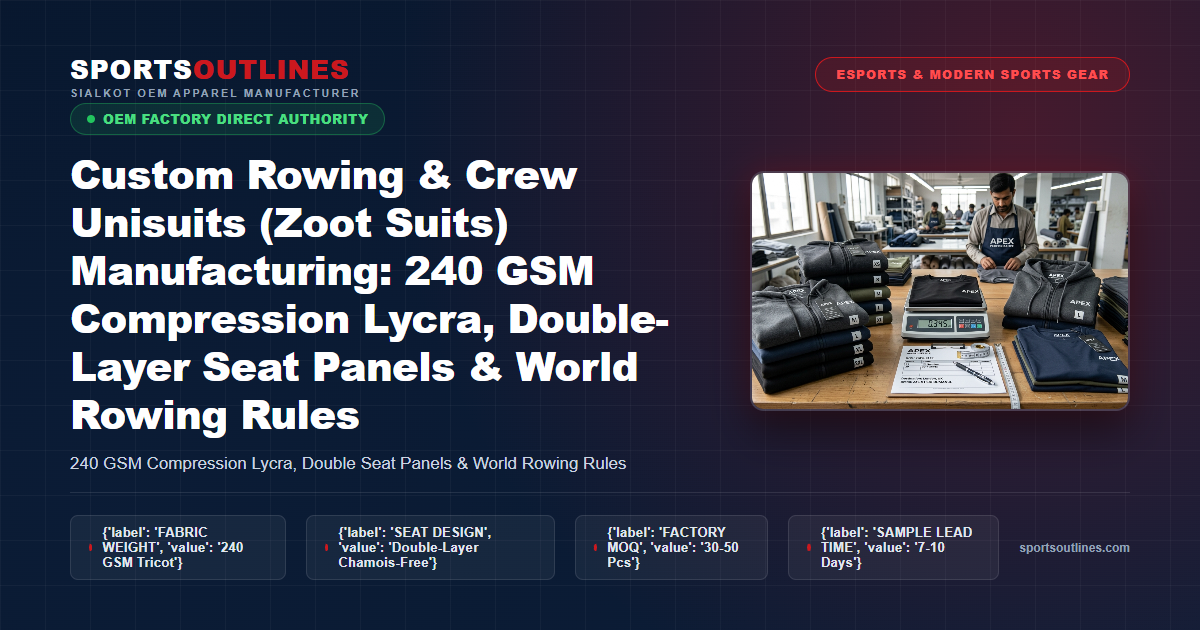
Manufacturing elite collegiate and Olympic-grade rowing unisuits (commonly called zoot suits) requires engineering high-density warp-knit compression textiles tailored for the repetitive sliding-seat rowing stroke. In 2,000-meter regatta sprints, a rower repeats an explosive full-body drive cycle 200 to 260 times at stroke ratings of 34 to 40 SPM: extending the legs, opening the hip angle, and drawing oar handles tightly to the lower ribs. Standard tri-suits or cycling bibs fail rowers completely because thick cycling chamois pads trap water and chafe the perineum on sliding seats, while loose tops catch on oar handles during the finish. Professional rowing unisuits are constructed from 230 to 240 GSM warp-knit high-modulus compression Lycra (80% high-tenacity filament nylon, 20% Lycra elastane) delivering 18–22 mmHg graduated quadricep compression to stabilize muscle oscillation and accelerate venous return. The defining technical design is a seamless double-layer seat panel constructed from friction-resistant, hydrophobic micro-denier fabric that glides effortlessly across carbon fiber and cedar sliding seats without bunched seams or chafing. Construction includes deep scoop racerback armholes preventing oar handle catches at the finish, 50mm laser-cut silicone honeycomb leg gripper bands, flatlock 4-needle 6-thread low-profile seams, and strict compliance with World Rowing (FISA Rule 37) uniform team regulations. Direct factory low MOQ at our Sialkot manufacturing plant starts at 30 to 50 unisuits per crew order with mixed men’s, women’s, and coxswain sizing blocks. Physical pre-production prototype samples cost $45 to $85 per custom piece completed in 7 to 10 business days with strict zero sample credit or refund policies.
- Textile Engineering: 240 GSM warp-knit nylon-Lycra (80/20) with 18–22 mmHg muscle compression.
- Sliding Seat Tech: Seamless double-layer reinforced seat panel eliminating friction sores.
- Stroke Clearance Pattern: Deep scoop racerback cut preventing oar handle snagging at the finish.
- Leg Stability: 50mm laser-cut silicone honeycomb bands preventing thigh riding during slide recovery.
- World Rowing (FISA) Compliance: Rule 37 compliant matching crew designs with national/club colors.
- Graphic Execution: 1440 DPI all-over dye-sublimation with Japanese Kiian inks that stretch without grinning.
- Low Factory MOQ: 30–50 unisuits per club or university crew order with individual seat sizing.
- Physical Prototype Sampling: $45–$85 per custom piece in 7–10 days (strict zero credit/refund policy).
- Direct Sourcing Communication: WhatsApp factory direct at +92 316 7932595 or sportsoutlines.com.
From the historic Head of the Charles Regatta in Boston and the Henley Royal Regatta on the Thames to the Olympic 2,000-meter regatta course, rowing represents one of the most grueling tests of cardiovascular capacity, synchronized team timing, and physical power in sport.
In both sculling (two oars per rower) and sweep rowing (one oar per rower in pairs, fours, and eights), an athlete generates peak power outputs exceeding 600 to 900 watts. During the drive phase, the rower’s quadriceps and glutes drive backward on the sliding seat with immense explosive force, transmitting power through the core to accelerate a fragile carbon racing shell through freezing, choppy river water.
If a rowing team wears substandard apparel, catastrophic technical errors follow. Loose fabric around the ribcage or stomach catches on oar handles during the “finish” (when oar handles are drawn directly against the body before dropping into the lap), causing a disastrous “crab” that stops the boat instantly and can eject a rower into the water. Furthermore, rough seams on the buttock panels rub against the sliding seat 250 times per race, causing bleeding saddle sores and raw skin.
In addition, sanctioned international competition is strictly governed by World Rowing (FISA Rules of Racing: Rule 37). All crew members in an eight or four must wear identical uniform unisuits featuring matching colors, club insignias, and certified blade crests.
For university crew programs, rowing clubs, national federations, sculling schools, and performance aquatic apparel brands across the United States, United Kingdom, Canada, Australia, and Germany, sourcing custom rowing unisuits engineered specifically for sliding-seat biomechanics is essential.
At Sports Outlines in Sialkot, Pakistan, our specialized apparel factory manufactures professional rowing unisuits (zoot suits), splash jackets, and technical pogies for collegiate crews and national squads worldwide. This comprehensive technical guide details 240 GSM warp-knit Lycra physics, sliding-seat double-layer engineering, oar clearance racerback geometries, World Rowing compliance, precision POM grading, and low MOQ factory sourcing.
1. Textile Engineering: 230–240 GSM Warp-Knit Nylon-Lycra & Compression Physics
Rowing places unique demands on compression textiles. In a racing shell, the fabric is exposed to river water splashes, high friction on the wooden or carbon seat, and continuous extreme leg flexion. Cheap weft-knit circular polyesters degrade quickly: when stretched, the white elastane cores show through (known as “fabric grinning”), and the knit loses elastic modulus within weeks of hard ergometer workouts.
At Sports Outlines, we utilize true Warp-Knit Tricot Compression Textiles engineered for high-performance aquatic racing:
A. 240 GSM Warp-Knit High-Modulus Nylon-Lycra (80/20 Blend)
Constructed from 40-denier high-tenacity filament nylon and 20% authentic Lycra elastane, this warp-knit textile interlocking matrix locks yarns in vertical zig-zag chains. Unlike circular knits that stretch uncontrollably, warp knits deliver controlled, graduated compression (18 to 22 mmHg across the thigh). This stabilizes quadricep muscle bellies against high-frequency oscillation during the catch, reducing microscopic muscle fiber micro-tears and attenuating lactic acid build-up over the final 500 meters of a 2,000-meter race.
B. Chlorine, Saltwater & Pilling Resistance (ISO 12945-2)
Rowing unisuits encounter harsh water chemistry—brackish tidal river estuaries, lake algae, and chlorinated indoor training tanks. Our nylon-Lycra yarns are treated with chlorine-resistant elastane stabilizers (Xtra Life Lycra) that prevent fiber degradation and bagging, maintaining Class 4.5+ Martindale abrasion resistance through entire collegiate seasons.
2. Sliding Seat Ergonomics & Seamless Double-Layer Seat Architecture
In rowing, the athlete’s entire body weight is concentrated on two small ischial tuberosities (sitting bones) resting on a hard cedar or carbon fiber seat that rolls back and forth along aluminum slides. During an hour-long row, the rower slides over 2,000 meters backward and forward on the seat.
Standard cycling shorts include thick foam or gel chamois pads. In rowing, chamois pads are a complete disaster: they absorb river water, act like a wet sponge, bunch up in the groin, and create thick friction ridges that rub raw sores into the skin. Conversely, unlined single-layer spandex wears through rapidly, becoming thin and translucent from sliding friction.
Sports Outlines engineers a specialized Seamless Double-Layer Chamois-Free Seat Panel:
- Zero Central Seams: The seat panel is cut as a single continuous contoured oval that completely covers both sitting bones. No vertical center seams or horizontal cut lines run across the contact points.
- Dual-Layer Friction Decoupling: The seat incorporates an outer high-denier abrasion-resistant nylon panel backed by an inner silky poly-spandex slip liner. When the rower slides, the two layers of fabric glide microscopic amounts against each other rather than the fabric dragging across the rower’s skin. This eliminates friction blisters entirely.
- Water-Shedding Hydrophobic Base: The outer seat fabric is treated with a durable hydrophobic finish that causes splashed river water and seat condensation to roll off instantly, keeping the rower’s base dry.
3. Stroke Clearance Pattern: Racerback Armholes & Oar Finish Protection
During the finish phase of the rowing stroke, the legs are flat, the torso leans backward at 25 to 30 degrees, and the oar handles are pulled at maximum velocity directly into the lower ribs and epigastric zone before dropping down and away.
If the unisuit is cut with loose abdominal fabric or standard set-in armholes, two major hazards occur:
- Oar Handle Catch (Catching a Crab): Loose folds of fabric on the chest catch on the rubber oar grips during the finish. The oar gets trapped, levering the boat down and costing the crew multiple boat lengths.
- Scapular Lat Pinching: Standard tank top straps pinch across the rear shoulder blades as the arms pull back, fatiguing the upper back.
At Sports Outlines, our rowing unisuit CAD patterns incorporate:
- Tapered Ergonomic Torso Cut: The upper body is sculpted to sit skin-tight across the abdominal wall without bunching, providing a mirror-smooth surface that oar handles glide past without catching.
- Deep-Scoop Racerback Geometry: The rear straps curve inward between the shoulder blades, freeing the entire scapular arc for complete backward retraction during the finish and forward reach at the catch.
- Low-Profile Bonded Neck & Armhole Binding: Armholes and necklines are bound with ultra-soft 4-way stretch self-fabric binding stitched with flatlock machines, preventing armpit chafing over 20,000 meters of daily training.
4. 50mm Laser-Cut Silicone Honeycomb Leg Gripper Bands
On the recovery phase of the rowing stroke, the knees bend deeply to bring the seat forward to the catch. In basic spandex shorts, this deep knee flexion causes the leg hems to ride up the thigh into the groin, pinching blood flow and creating painful rolled fabric bands.
Sports Outlines integrates 50mm Wide Laser-Cut Silicone Honeycomb Gripper Bands at the thigh hems:
Rather than a tight, constricting elastic band that cuts off circulation (the “sausage leg” effect), we utilize a wide 50mm compression power-band lined with micro-injected silicone honeycomb dots. The silicone adheres gently to the skin, anchoring the leg hem securely 3 inches above the knee throughout the entire sliding stroke cycle without pinching arterial blood flow.
5. World Rowing (FISA) Rule 37 Compliance & Club Identity
In international regattas, uniform regulations are strictly enforced under World Rowing Rules of Racing (Rule 37: Uniforms and Clothing):
- Crew Uniformity: All competitors in a crew (except the coxswain, who may wear specialized protective foul-weather gear) must wear identical uniforms with matching colors and design.
- National & Club Identity: The club blade emblem, national federation tricolor, or varsity crest must be displayed in approved dimensions across the chest.
- Undergarment Rules: If rowers wear technical base layers or long-sleeve sun tops beneath unisuits, all crew members must wear identical colored base layers.
Sports Outlines manufactures unisuits and matching base layers that pass all World Rowing and USRowing line inspections.
6. 1440 DPI Sublimation & High-Elongation Kiian Inks
A common defect in custom rowing unisuits is “sublimation cracking”: when a 240 GSM compression suit is stretched over large athletic thighs and lats, ordinary sublimation inks crack or look washed out.
At Sports Outlines, our digital printing facility deploys Japanese high-definition print engines using Italian Kiian high-elongation disperse dyes:
- Full Elastic Dye Molecular Penetration: Dyes gasify deep into the nylon-polyester core under 210°C calendar pressure. When stretched to 40% elongation, colors remain rich, deep, and fully saturated with zero white grin-through.
- Zero Weight & Hydrodynamic Performance: The graphics have zero physical hand-feel, zero ink crust, and do not absorb surface water.
- Extreme Saltwater & Chlorine Fastness (ISO 105-E01): Tested to Grade 4.5+ fastness, preventing color bleed across bold club diagonals or white chest crests.
7. Laboratory Testing & Quality Control Protocols
Every batch of custom rowing unisuits undergoes rigorous inspection at our Sialkot factory testing facility:
- Sliding Seat Abrasion Resistance (ASTM D4966): Seat panels are tested to 20,000 Martindale cycles to certify that continuous friction on cedar or carbon seats will not cause pilling or thread runs.
- Hydrostatic Water Repellency (AATCC 22): Seat outer fabric is spray tested to confirm rapid water beading.
- Seam Tensile & Burst Testing (ASTM D1683): The flatlock crotch and torso seams must withstand tensile forces exceeding 320 Newtons without thread failure.
- Silicone Honeycomb Adhesion: Leg gripper silicone is evaluated after 20 hot wash cycles to ensure zero delamination from the elastic power-band.
8. Factory Direct Low MOQ & Precision Prototyping Economics
Rowing clubs and collegiate teams typically have boat rosters consisting of 8 to 24 rowers. High factory minimums of 100+ units prevent clubs from updating uniforms. Sports Outlines provides an agile B2B manufacturing solution:
- Low Factory MOQ: Orders start at just 30 to 50 unisuits per crew style/colorway. Within this run, you can mix men’s, women’s, and coxswain sizes freely (XS to 3XL).
- Individual Rower Personalization: We personalize unisuits with rower surnames, seat numbers (e.g., Bow, Stroke, 7-Seat), and varsity boat designations with zero setup penalties.
- Physical Pre-Production Prototyping: We manufacture complete physical prototype samples for $45 to $85 per piece, dispatched via DHL Express in 7 to 10 business days.
- Strict Commercial Invariants: Sports Outlines maintains transparent pricing: we do not offer free CAD tech packs or sample fee refunds/credits against bulk production. Prototyping is an independent precision service.
- Bulk Turnaround: Full crew orders of 30 to 200 unisuits are manufactured and shipped within 18 to 22 business days.
9. 6-Stage Sourcing Roadmap for Rowing Crews & Clubs
10. Frequently Asked Questions (B2B Rowing Unisuits Sourcing)
1. What is the minimum order quantity for custom rowing unisuits?
Our factory low MOQ starts at just 30 to 50 unisuits per crew style/colorway. You can mix men’s, women’s, and coxswain sizing freely within this batch.
2. Why do rowing unisuits use a double-layer seat instead of a cycling chamois?
Cycling chamois pads absorb water like a sponge and chafe on sliding seats. Our seamless double-layer seat panel allows the two fabric layers to slide over each other, eliminating friction blisters without bulk or water retention.
3. Are your rowing unisuits compliant with World Rowing (FISA) Rule 37?
Yes. Our unisuits are manufactured to exact FISA Rule 37 specifications, providing uniform matching designs, blade crest placements, and IOC/club identification for international regattas.
4. What fabric do you recommend for elite rowing unisuits?
We recommend 240 GSM warp-knit nylon-Lycra tricot (80% filament nylon, 20% Lycra). It provides true 18–22 mmHg muscle compression, zero fabric grinning when stretched, and rapid drying.
5. How much does a physical pre-production prototype sample cost?
Physical prototype samples cost $45 to $85 per custom piece depending on custom leg bands and embellishments, dispatched in 7 to 10 business days. Note that sample fees are non-refundable and not credited toward bulk orders.
6. How does the racerback design assist rowers during the stroke?
The deep-scoop racerback straps sit between the shoulder blades, freeing the scapulae for maximum reach forward at the catch and full arm draw backward at the finish without fabric binding.
7. How do the 50mm honeycomb silicone leg grippers work?
Wide 50mm compression power-bands with micro-injected silicone dots distribute holding friction evenly, keeping leg hems anchored during deep slide compression without pinching thigh blood vessels.
8. Can individual rower names and seat positions be printed on unisuits?
Yes. We personalize unisuits with rower surnames, boat seat numbers (e.g., Stroke, Bow, 4-Seat), and varsity boat codes across the rear hip or lower back with zero setup penalties.
9. What is the standard bulk manufacturing turnaround?
Standard bulk manufacturing runs of 30 to 200 unisuits take approximately 18 to 22 business days following sample approval, followed by express air shipping.
10. Can you manufacture matching splash jackets and pogies?
Yes. We manufacture matching DWR waterproof rowing splash jackets with drop tails, thermal fleece-lined pogies (oar mittens), and rowing trou (shorts) for full squad winter training.
Manufacture Custom Rowing Unisuits Direct with Sialkot’s Master Factory
Equip your crew club, collegiate rowing varsity, or national regatta squad with 240 GSM warp-knit compression Lycra, double-layer sliding seat panels, and World Rowing compliant cuts with low factory MOQs of 30–50 pieces.
Related Technical Manufacturing Guides & Global Sourcing Silos:
- Global Sourcing Hubs: USA Sportswear Factory | Canada Apparel OEM | UK Activewear Sourcing | Australia Athletic Wear | Germany Teamwear Factory
- Product Lines: Performance Athletic Wear | Custom Sublimated Jerseys | Custom Teamwear Sourcing
- Sub-Cluster 1.9 Guides: Custom Esports Gaming Jerseys Guide (Blog #101) | Custom Equestrian Sun Shirts Guide (Blog #108)