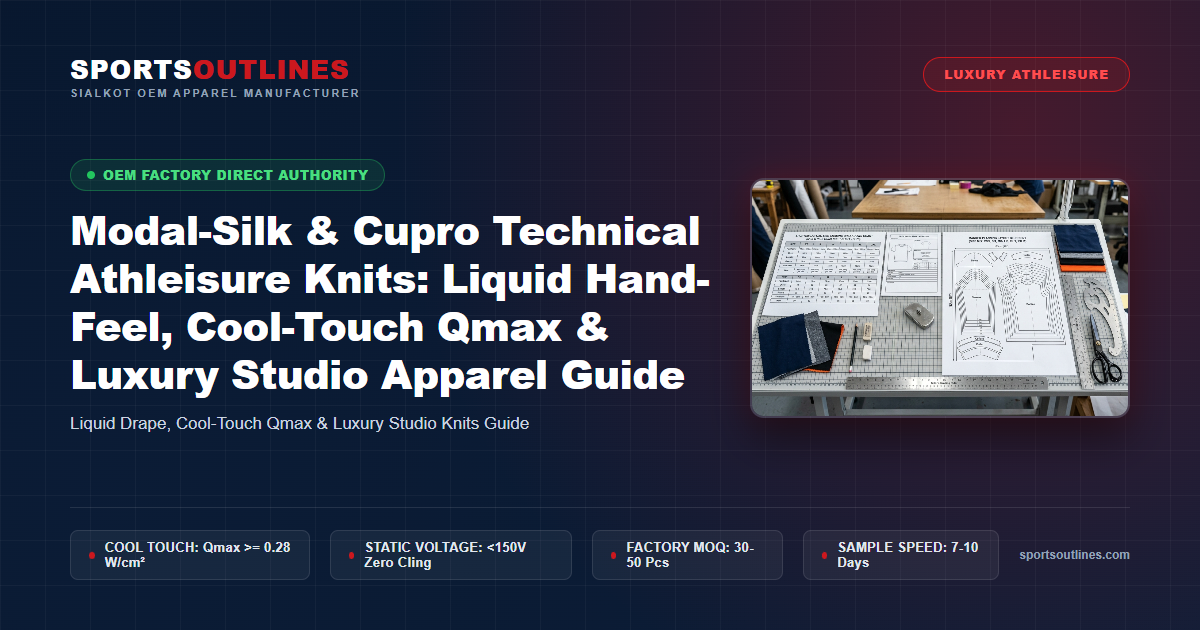
At the apex of the global activewear and athleisure market, luxury studio brands, bespoke Pilates labels, and high-end resort wellness collections are redefining performance apparel. While standard nylon-spandex activewear provides mechanical compression for high-impact workouts, affluent consumers increasingly demand apparel that transcends utilitarian plastic synthetics: garments engineered with an ethereal liquid drape, an instantaneous cool-to-the-touch sensory hand-feel, and complete static electricity immunity. To deliver this pinnacle of sensory luxury, advanced textile engineers combine high-modulus regenerated cellulose with noble animal proteins and recycled cotton linter: modal silk cupro athleisure knits.
This sophisticated tri-blend harnesses three distinct fiber physics paradigms. Cupro (regenerated cuprammonium cellulose produced from pre-consumer cotton linter) provides micro-denier round cross-sections with phenomenal moisture absorption and natural anti-static properties. Mulberry silk (Bombyx mori protein fibroin) introduces a triangular prismatic cross-section that refracts light with liquid pearlescence while providing high tensile strength and natural amino acid skin affinity. Lenzing Modal serves as the structural spine, providing high wet modulus tensile tenacity and elastic loop stability. When intimately blended and knitted on fine-gauge machinery, these fibers create a sensory experience that synthetic polyesters and standard cotton can never replicate.
At Sports Outlines, an agile OEM/ODM custom performance apparel manufacturer based in Sialkot, Pakistan, we specialize in high-precision knitting and assembling luxury technical athleisure. This technical manual provides brand founders, materials engineers, and creative directors with an exhaustive operational guide to modal-silk and cupro performance knits. We explore cotton linter biorefining and silk degumming chemistry, quantify cool-touch thermodynamics (\(Q_{max}\)), dissect static dissipation and triboelectric physics, evaluate optimized blending formulas, solve delicate wet processing challenges, provide full factory FOB cost transparency, and detail our rapid physical prototype sampling program.
1. Agronomy & Fiber Physics: Cupro, Mulberry Silk & Modal Foundations
Engineering high-luxury athleisure knits requires a deep molecular understanding of the three constituent fibers:
- Cupro (Bemberg Cuprammonium Cellulose): Cupro is an upcycled, regenerated cellulosic fiber derived exclusively from cotton linter—the short, silky fibers that adhere to cotton seeds after the long-staple cotton is ginned for spinning. Historically discarded as agricultural waste, cotton linter is dissolved in a cuprammonium solution (copper hydroxide and ammonium hydroxide) and extruded into a water coagulation bath. Because it is regenerated from pure linter cellulose, Cupro possesses a completely smooth, perfectly circular cross-section with a microscopic linear density of 1.1 to 1.3 dtex. It features an exceptionally high moisture regain (11.0% to 12.5%) and an ultra-fine friction coefficient, producing a cool, fluid hand-feel often called “liquid cotton.” Modern Cupro processing operates within a closed-loop chemical system that captures and recovers over 99.8% of copper ions and 99.5% of ammonia, returning purified water back to municipal streams.
- Mulberry Silk (Bombyx mori Fibroin): Mulberry silk is a continuous protein filament produced by the silkworm Bombyx mori. Raw silk consists of two fibroin filaments cemented by an outer coating of sericin gum. Once degummed, fibroin reveals a distinct triangular cross-section with rounded corners (diameter 10 to 13 μm, linear density 1.0 to 1.2 dtex). This triangular prism geometry acts as a natural optical prism, refracting incident light at multiple internal angles to create a deep, luxurious luster rather than the flat shine of synthetic polyester. Chemically, silk fibroin is composed of 18 skin-friendly amino acids (predominantly glycine, alanine, and serine) that share the pH profile of human skin (pH 5.5). Its crystalline antiparallel beta-sheet molecular conformation provides an extraordinary dry tensile tenacity of 3.8 to 4.8 cN/dtex.
- Lenzing Modal (Beechwood Cellulose): Sourced from European beechwood through the closed-loop Edelweiss process, Lenzing Modal contributes structural tensile stability. While pure silk and pure cupro can be delicate in wet states, modal provides a high wet modulus tenacity of 1.9 to 2.4 cN/dtex and a high Degree of Polymerization (DP ≥ 600 to 750), preventing the composite knit from losing structural integrity during energetic yoga flows or laundering. It acts as an intimate blending anchor that binds the slippery cupro and silk fibers into a coherent, durable yarn structure that resists seam slippage and torque.
| Fiber Performance Property | Regenerated Cupro (Linter) | Mulberry Silk Fibroin | Lenzing Modal | Virgin Polyester (PET) |
|---|---|---|---|---|
| Fiber Chemical Class | Regenerated Cellulose (Linter) | Natural Animal Protein (Fibroin) | High Wet Modulus Cellulose | Petroleum Polymer (Polyester) |
| Cross-Sectional Geometry | Circular, Glass-Smooth | Triangular Prism | Uniform Circular / Oval | Circular / Trilobal |
| Standard Moisture Regain (%) | 11.0% – 12.5% | 11.0% – 11.5% | 12.0% – 13.0% | 0.4% – 0.8% (Hydrophobic) |
| Cool-Touch \(Q_{max}\) (W/cm²) | 0.28 – 0.32 (Instant Chill) | 0.25 – 0.28 | 0.24 – 0.26 | 0.11 – 0.14 (Warm / Clammy) |
| Frictional Static Voltage (V) | ≤120 V (Zero Cling) | ≤150 V | ≤180 V | >3,500 V (Violent Cling) |
| Dry Tenacity (cN/dtex) | 2.8 – 3.2 cN/dtex | 3.8 – 4.8 cN/dtex | 3.2 – 3.6 cN/dtex | 5.0 – 6.5 cN/dtex |
2. Liquid Drape Physics & Kawabata Shear Mechanics
In luxury studio activewear, “liquid hand-feel” is not an abstraction—it is a quantifiable physical phenomenon governed by low-stress bending rigidity and shear hysteresis:
- Kawabata Shear Stiffness (\(G\), N/m⋅degree): Measures the ease with which warp and weft yarns slide across one another under angular shear deformation. Standard polyester and heavy cotton knits exhibit high shear stiffness (\(G \ge 1.85\text{ N/m}\cdot\text{deg}\)), causing the fabric to buckle into rigid, sharp folds. Cupro-silk-modal tri-blends register an exceptionally low shear stiffness of \(G = 0.55\) to \(0.75\text{ N/m}\cdot\text{deg}\). This allows the knit to shear and glide effortlessly with the rotational twisting of an athlete’s torso during yoga poses without creating restrictive tension bands.
- Cusick Drape Coefficient (\(F \le 28\%\)): Measured using the Cusick Drape Meter, where a circular fabric specimen is suspended over an unsupporting pedestal. Rigid sportswear fabrics register drape coefficients of 60% to 75% (producing few, stiff folds). Our modal-silk-cupro knits achieve a drape coefficient of 22% to 28%, producing numerous gentle, cascading folds that contour fluidly around the body like liquid mercury.
- Zero Skin Friction Drag (\(MIU \le 0.155\)): Under KES-FB4 friction analysis, the combination of circular cupro and triangular silk filaments produces an ultra-smooth surface with a mean friction coefficient (\(MIU\)) under 0.155. When worn next to the skin, the garment glides across sensory cutaneous receptors without mechanical drag or abrasion.
3. Biophysics of Cool-Touch Sensations: Maximum Heat Flux (\(Q_{max}\))
When an athlete pulls on a modal-silk or cupro garment, they immediately perceive a crisp, refreshing cooling sensation. This physiological response is measured objectively through the maximum instantaneous heat flux density (\(Q_{max}\)) under JIS L 1927 / FTTS-FA-019 standards:
\[ Q_{max} = \frac{\Delta Q}{A \cdot \Delta t} \]
Where \(\Delta Q\) is the thermal energy transferred in calories or watts, \(A\) is the contact area (\(\text{cm}^2\)), and \(\Delta t\) is the contact time interval.
Why does Cupro-Silk-Modal achieve industry-leading \(Q_{max}\) ratings (\(0.26\) to \(0.32\text{ W/cm}^2\)) compared to polyester (0.12 W/cm²)?
- High Effective Thermal Contact Area: Standard spun cotton and textured polyester yarns are covered in microscopic protruding fiber ends that create an insulating micro-air gap between the fabric body and human skin. Because air has an extremely low thermal conductivity (\(k \approx 0.026\text{ W/m}\cdot\text{K}\)), heat cannot escape quickly, resulting in a warm initial hand-feel. In contrast, regenerated cupro and continuous filament silk lie completely flat against the skin, maximizing true solid-to-solid surface contact.
- High Intrinsic Thermal Conductivity of Cellulose & Protein: Cellulosic cupro fibers have a solid thermal conductivity of \(k \approx 0.070\text{ W/m}\cdot\text{K}\)—nearly three times higher than stagnant air. Upon initial physical contact, thermal energy flows rapidly from the warm epidermis (32°C) into the cooler textile matrix (20°C), triggering Ruffini endings and Krause end-bulbs in the dermis to signal instantaneous physiological coolness.
- Sorption Enthalpy & Latent Heat Dissipation: As perspiration vapor begins to generate, the high moisture regain of cupro and silk continuously absorbs moisture without wetting out, using latent heat of vaporization to sustain the cooling effect throughout long studio workouts.
| Textile Substrate | Weight (GSM) | \(Q_{max}\) Value (W/cm²) | Tactile Sensory Classification | Thermal Recovery (s) |
|---|---|---|---|---|
| 70% Modal / 20% Cupro / 10% Silk Jersey | 165 GSM | 0.285 – 0.315 W/cm² | Ultra-Cool Touch (Grade 5) | ≤4.2 seconds |
| 60% Cupro / 35% Modal / 5% Spandex Interlock | 220 GSM | 0.295 – 0.325 W/cm² | Ultra-Cool Touch (Grade 5) | ≤3.8 seconds |
| 100% Combed Compact Cotton Jersey | 165 GSM | 0.145 – 0.165 W/cm² | Neutral / Moderate | ≥8.5 seconds |
| 100% Virgin Polyester Filament Jersey | 160 GSM | 0.115 – 0.135 W/cm² | Warm / Traps Body Heat | ≥12.0 seconds |
4. Static Electricity Dissipation & Anti-Cling Biophysics
A chronic complaint in synthetic activewear is static cling. Synthetic polymers like polyester, nylon, and acrylic reside at opposite extremes of the triboelectric series. When an athlete moves, frictional contact between synthetic garments and car seats, yoga mats, or outerwear creates massive electrostatic surface charges (often exceeding 3,000 to 5,000 Volts). This electrostatic charge causes the fabric to cling awkwardly to the body, crackle when removed, and attract airborne dust, hair, and pet dander.
Modal-silk and cupro knits solve this defect through natural electrostatic dissipation:
- Hydrophilic Moisture Films & Surface Resistivity: Because cupro and silk hold 11.0% to 12.5% equilibrium moisture, their fibers maintain an invisible, monomolecular film of absorbed atmospheric water. Water molecules contain free ions that drastically lower the electrical surface resistivity of the textile from \(10^{14}\ \Omega/\text{sq}\) (in hydrophobic polyester) down to \(10^8\) to \(10^9\ \Omega/\text{sq}\) in cupro-silk blends.
- Electrostatic Half-Decay Time (\(t_{1/2} ≤ 0.2\text{ s}\)): Under JIS L 1094 testing, static charges applied to cupro-silk knits bleed off to zero in less than 0.2 seconds. Friction voltage remains below 120 to 150 Volts, completely preventing static cling, sparking, or lint attraction. The garment floats gracefully over the athlete’s contours without bunching or clinging.
5. Engineered Luxury Athleisure Blend Formulations
Sports Outlines manufactures four core luxury formulations designed for high-end studio performance:
| Studio Garment Category | Engineered Blend Ratio | Yarn Count & Knitting Spec | Target GSM | Key Functional Synergy |
|---|---|---|---|---|
| Ultra-Luxury Studio Tank & Wrap Tee | 70% Modal / 20% Cupro / 10% Mulberry Silk | Ne 50/1s Siro-Compact (32G Single Jersey) | 160 – 175 GSM | Liquid fluid drape, pearlescent luster, instantaneous cool-touch (\(Q_{max} \ge 0.28\)) |
| Liquid Yoga Flow Pant & Wide-Leg Culotte | 60% Cupro / 35% Modal / 5% Creora Spandex | Ne 40/1s Core-Spun (28G Interlock) | 210 – 230 GSM | Substantial weight, zero static cling, squat-proof opacity, 4-way elastic recovery |
| Featherweight Recovery Meditation Tee | 80% MicroModal / 20% Mulberry Silk | Ne 60/1s Siro-Compact (36G Single Jersey) | 140 – 155 GSM | Featherweight breathability, skin-soothing amino acid affinity, zero friction drag |
| Architectural Studio Cardigan & Shrug | 50% Cupro / 45% Organic Cotton / 5% Spandex | Ne 30/1s Plated (24G Milano Rib) | 260 – 280 GSM | Structural knit architecture, cool-touch interior face, crisp exterior rib recovery |
6. Wet Processing, Low-Tension Dyeing & Sericin Degumming
Processing composite knits containing both cellulosic fibers (modal, cupro) and delicate protein filaments (mulberry silk) presents significant wet processing challenges. Protein fibroin is sensitive to strong alkalis, while regenerated cupro requires gentle handling to prevent mechanical abrasion:
- Mild Enzymatic Sericin Degumming: Raw silk contains 20% to 25% sericin gum that must be eliminated to liberate luster and softness. Rather than boiling in harsh sodium carbonate (soda ash), we degum using proteolytic enzymes (papain and alcalase) at pH 7.2 to 7.8 at 55°C. This selectively removes sericin while preserving 100% of the internal fibroin core, holding residual sericin strictly below 0.5%.
- Neutral-to-Mildly Alkaline Reactive Dyeing: We select specialized polyfunctional reactive dyestuffs engineered to fix across both cellulosic hydroxyl groups and protein amino groups at moderate temperatures (50°C to 60°C). Alkali dosing (sodium bicarbonate rather than caustic soda) is precisely controlled to maintain pH between 8.5 and 9.0, preventing alkali hydrolysis of the delicate silk peptide chains.
- Low-Liquor Aerodynamic Jet Dyeing (1:6): To prevent mechanical friction between fabric ropes, dyeing is executed in aerodynamic airflow jet dyeing vessels. The fabric is cushioned on a cushion of pressurized air, eliminating crease marks and surface bruising.
- Tensionless Loop Drying & Felt Compacting: After rinsing and eco-softener application (cationic micro-silicone emulsion), fabrics are dried on continuous tensionless loop dryers. The knit undergoes open-width felt calendar compacting with +18% overfeed to lock residual shrinkage strictly within ±2.0% length and width (AATCC 135).
7. Precision Cut & Sew: Needle Selection & Clean Seam Finishing
Sewing delicate modal-silk and cupro knits requires bespoke CMT craftsmanship:
- Extra-Fine Ballpoint Needles (Groz-Beckert SES Nm 65/9): To prevent fiber severance in micro-denier cupro and silk filaments, operators utilize chrome-plated SES extra-fine ballpoint needles. Needle throat plates are fitted with mirror-polished, fine needle holes (1.2 mm diameter) to prevent fabric flagging into the needle plate.
- Flatlock 4-Needle 6-Thread Construction: Next-to-skin seams are joined on Yamato flatlock machines threaded with 100% continuous micro-filament textured nylon in loopers. Seams provide 125% elastic extension and lie completely flat, eliminating chafing during yoga practice.
- Clean Bonded Edges & Framed Necklines: For ultra-luxury studio tops, Sports Outlines offers ultrasonic bonding and frameless hot-melt thermoplastic polyurethane (TPU) film hemming. Seams are laser-cut and bonded at 145°C, creating an invisible, stitch-free hem that eliminates bulk and rests weightlessly against the skin.
8. Direct Factory Cost Transparency & DTC Profit Architecture
Sourcing custom modal-silk and cupro luxury athleisure directly from Sports Outlines’ manufacturing facility in Sialkot, Pakistan, provides emerging designers with exceptional profitability:
| Production Cost Element | Technical Component Breakdown | Cost (USD) | Share of FOB |
|---|---|---|---|
| Modal-Cupro-Silk Tri-Blend Knit | 165 GSM 70% Modal / 20% Cupro / 10% Mulberry Silk (0.32 kg/garment) | $3.85 – $4.50 | 50% – 52% |
| Enzymatic Degumming & Airflow Dyeing | Proteolytic sericin degumming + bifunctional reactive dye + felt compact | $1.15 – $1.45 | 15% – 16% |
| Precision CMT & Bonded Assembly | Flatlock seaming, ultrasonic bonded hems, frameless neckline finishing | $1.75 – $2.20 | 23% – 24% |
| Luxury Packaging & Brand Trims | Metallic heat-seal logo, satin care tag, custom branded frosted zip bag | $0.65 – $0.85 | 8% – 9% |
| AQL 2.5 Audit & Export Carton Packing | 100% individual quality inspection, silica moisture pack, export carton | $0.30 – $0.40 | 4% – 5% |
| Total Direct FOB Production Cost | Finished luxury technical athleisure studio top | $7.70 – $9.40 | 100% |
In premium luxury athleisure channels (such as Net-a-Porter, Live The Process, and Bandier), silk-blend and cupro studio garments command retail prices between $88.00 and $138.00. At a direct FOB factory cost of $7.70 to $9.40, brand founders secure outstanding gross margins of 89% to 92%, providing robust capital efficiency to scale high-end marketing campaigns.
9. Laboratory Performance Testing & Quality Certifications
Every production lot of modal-silk and cupro apparel manufactured at Sports Outlines undergoes rigorous laboratory certification:
| Testing Standard | Test Parameter | Certified Factory Threshold | Performance Guarantee |
|---|---|---|---|
| JIS L 1927 / FTTS-FA-019 | Warm/cool touch \(Q_{max}\) evaluation | ≥0.26 W/cm² (Ultra-Cool) | Instantaneous tactile skin chill upon contact |
| JIS L 1094 (Method B) | Frictional electrostatic voltage & decay | ≤150 V, \(t_{1/2} ≤ 0.2\text{ s}\) | Complete static immunity, zero garment cling |
| AATCC 135 / ISO 6330 | Dimensional stability after 5x delicate wash cycles | ±2.0% length & width | Permanent shape retention, zero wash distortion |
| ISO 12945-2 (Martindale) | Surface pilling resistance under 9 kPa load | Grade 4.0 at 5,000 rubs | Pill-free surface longevity across repeated wear |
| ISO 105-C06 (A2S) | Colorfastness to delicate home laundering | Grade 4.5 color change & staining | Luminous jewel tones retain vibrant depth |
10. Photostability & Amino Acid UV Stabilization Guide
Mulberry silk contains aromatic amino acids (particularly tyrosine and phenylalanine) that can undergo photo-oxidation and gradual yellowing when exposed to intense solar UV radiation during outdoor wellness retreats. To ensure that white, ivory, and pastel silk-modal garments maintain pristine brilliance across years of wear, Sports Outlines executes advanced UV stabilization:
- Exhaustion of Reactive Triazine UV Absorbers: During the dyebath cycle, we apply reactive triazine-based UV stabilizers (such as Cibafast W). The stabilizer bonds covalently with fibroin amino groups, absorbing ultraviolet photons before they can cleave peptide chains or oxidize tyrosine rings.
- Optical Brightener Compatibility: We formulate with stilbene fluorescent whitening agents specifically stabilized against photo-yellowing under AATCC 16.3 xenon-arc lamp radiation (Grade 4.5 color change after 40 AFUs).
- Antioxidant Vitamin E Finishing (Optional): For hyper-luxury skincare-infused studio lines, we offer microencapsulated natural tocopherol (Vitamin E) finishes that release gradually onto the skin during practice, providing anti-inflammatory cutaneous comfort.
11. Consumer Garment Care & Commercial Laundering Protocols
Because modal-silk and cupro tri-blends incorporate delicate protein fibroin and micro-denier regenerated cellulose, educating end consumers on appropriate garment care is essential for maintaining product longevity and customer satisfaction:
- pH-Neutral Detergent Mandate: Conventional laundry detergents often contain alkaline builders (pH > 9.5) and protease enzymes designed to remove biological stains. However, protease enzymes will actively hydrolyze mulberry silk fibroin, dissolving peptide bonds and causing fiber thinning. Consumers must be advised to use pH-neutral (pH 6.5 to 7.5), enzyme-free delicate liquid detergents.
- Cold Water Gentle Cycle (≤30°C): Elevated water temperatures soften regenerated cellulosic bonds and cause thermal shock in protein filaments. Machine washing on a gentle or hand-wash cycle at 30°C with low spin extraction (≤600 RPM) preserves yarn alignment and prevents rope creasing.
- Flat Air Drying (Zero Tumble Dry): High-heat mechanical tumble drying is strictly contraindicated. Tumble dryer abrasion causes surface pilling and elastane heat degradation. Garments should be reshaped gently while damp and laid flat on a drying rack out of direct sunlight to preserve the liquid silk drape.
- Low-Heat Reverse Steam Ironing: If ironing is required, garments should be ironed on the reverse side using a cool iron setting (≤110°C) with light steam. Direct dry iron contact on the fabric face can glaze silk filaments, destroying their pearlescent prismatic luster.
Manufacture Custom Luxury Studio Athleisure with Sports Outlines
Deliver ethereal liquid drape and cool-touch performance. Sports Outlines offers an agile factory production Minimum Order Quantity (MOQ) of strictly 30 to 50 pieces per style/colorway with complete size grading from XS to 3XL. Experience our modal-silk and cupro luxury knits first-hand with physical prototype samples completed within 7 to 10 business days for $45 to $85 per piece (strictly non-refundable with zero bulk credits, reflecting true labor, yarn setup, and materials allocation).
Explore Related Technical Manufacturing Silos & Fabric Guides
Explore Sports Outlines’ specialized technical manufacturing silos and international sportswear export infrastructure:
- International Export Silos: Discover our dedicated export programs for Custom Sportswear Manufacturer USA, Custom Sportswear Manufacturer UK, Custom Sportswear Manufacturer Australia, Custom Sportswear Manufacturer Canada, and Custom Sportswear Manufacturer Germany.
- Product Category Hubs: Explore our OEM/ODM manufacturing across Custom Sportswear & Activewear, Fitness & Gym Apparel, and Athletic Casual Wear.
- Related Technical Guides: Read our in-depth manufacturing guides on Lenzing Modal vs MicroModal Activewear Guide, TENCEL™ Lyocell & Modal Activewear Blends Guide, and Bamboo Viscose Activewear Textiles Guide.