Direct Manufacturer Answer: How to Manufacture Custom Cricket Sweaters & Tracksuits
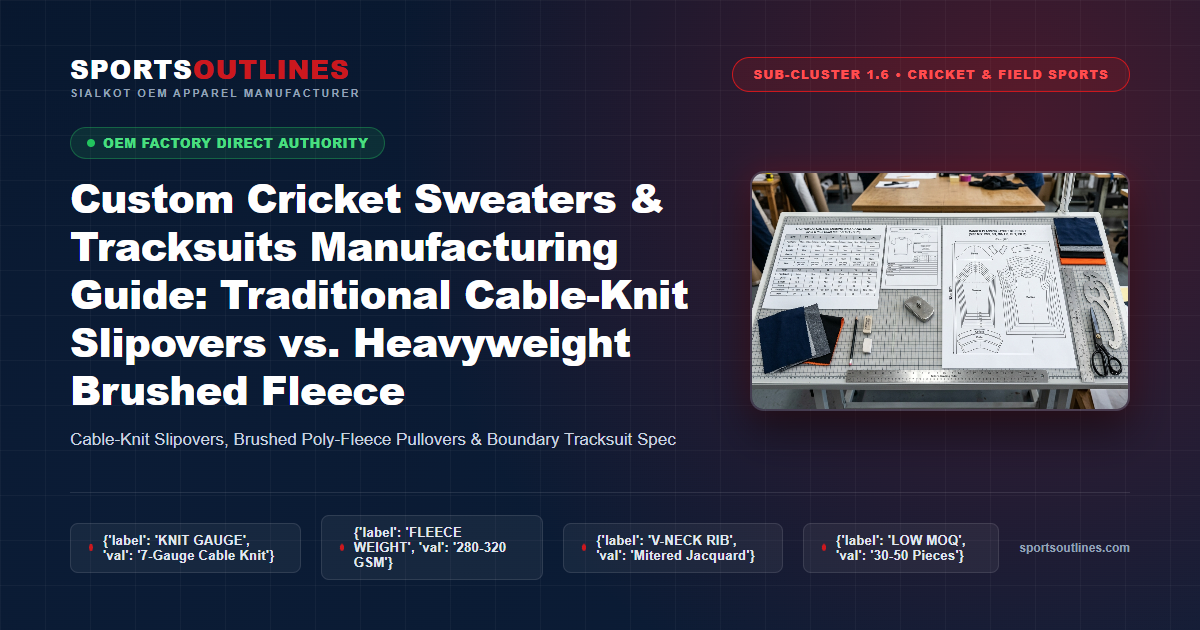
Manufacturing elite custom cricket sweaters and boundary warmup tracksuits requires balancing centuries of traditional English county aesthetics with modern athletic thermal performance. High-performance cricket sweaters are produced in two distinct configurations: Traditional Cable-Knit Jumpers/Slipovers engineered on 7-gauge or 10-gauge flatbed computerized knitting machines using an anti-pilling 50% merino wool / 50% low-pill acrylic blend (or 100% premium acrylic for easy-care club programs) with custom multi-stripe V-neck ribs, and Modern Technical Boundary Warmup Pullovers & Tracksuits constructed from 280 to 320 GSM heavy brushed-back polyester fleece featuring water-repellent DWR shell treatments, quarter-zip storm collars, and raglan shoulder articulation. To guarantee shape retention across grueling multi-day match schedules, necklines, cuffs, and hem waistbands incorporate high-recovery 2×2 elastane-reinforced ribbing tested to withstand 100+ wash cycles without sagging or flaring. Club crests are applied via high-definition 3D direct embroidery (up to 15,000 stitches) or laser-cut felt appliqué with satin perimeter stitching. Factory direct low MOQ at our Sialkot manufacturing facility starts at 30 to 50 pieces per style/colorway with split sizing from Junior YS to Adult 4XL. Custom physical prototype samples are built for $45 to $85 per garment within 7 to 10 business days.
- Yarn & Gauge: 7-Gauge Heavyweight Cable-Knit (50/50 Wool-Acrylic or 100% Anti-Pill Acrylic) or 280–320 GSM Brushed Poly-Fleece.
- Garment Styles: Sleeveless V-Neck Slipovers (Vests), Long-Sleeve Cable Jumpers, Quarter-Zip Boundary Pullovers & Full Warmup Tracksuits.
- Neckband Engineering: Deep V-neck flatbed jacquard ribbing with customized multi-color club accent stripes (3 to 5 stripe variations).
- Thermal & Pill Rating: ISO 12945-2 Martindale Pilling Grade 4.0+ with thermal insulation factor exceeding 0.45 clo.
- Branding Integration: Direct 3D high-density embroidery, vintage felt chenille crests, and sublimated fleece side panels.
- Factory Low MOQ: 30–50 garments per design with mixed youth (YS–YXL) and adult (S–4XL) sizing allocations.
- Physical Prototype Sampling: $45–$85 per custom piece in 7–10 days (strict zero credit/refund policy).
- Direct Factory Communication: WhatsApp factory direct at +92 316 7932595 or sportsoutlines.com.
From early April mornings on chilly English county grounds to crisp autumn afternoon sessions in Melbourne or Christchurch, thermal management is essential to cricket performance. A fielder standing stationary at deep third man or mid-on in 10°C winds can rapidly lose muscular core warmth, increasing the incidence of acute hamstring strains and slowing down explosive sprint reaction times.
Yet, cricket apparel carries deep heritage expectations. Unlike conventional football sweatshirts or basketball hoodies, cricket warmups must honor the prestigious visual codes of the sport: crisp ivory cable knitting, structured V-neck collars featuring authentic club stripe sequences, and clean embroidered heraldry. At the same time, modern T20 and franchise leagues demand contemporary weather-resistant technical fleece tracksuits that shed light rain and provide rapid moisture venting during intensive warmups.
For cricket club committees, private school sports directors, collegiate athletic departments, and boutique cricket brand owners across the United Kingdom, Australia, United States, and Canada, sourcing cricket sweaters through commercial intermediaries often leads to frustration: generic off-the-shelf sweaters with loose acrylic knits that stretch out of shape after two washes, collar ribbing that curls unprofessionally, and minimum order hurdles exceeding 300 pieces per style.
At Sports Outlines in Sialkot, Pakistan, our dedicated knitwear and technical teamwear manufacturing lines produce bespoke cricket sweaters, slipovers, and boundary warmup tracksuits engineered to strict international test-match specifications. This comprehensive technical guide details the mechanical differences between 7-gauge cable knits and 300 GSM technical brushed fleece, yarn composition physics, collar ribbing engineering, embroidery application guidelines, standard points of measure (POM), and factory direct low MOQ production economics.
1. Knitwear Architecture: Traditional Cable-Knit Slipovers vs. Long-Sleeve Jumpers
Traditional cricket knitwear is built upon textured cable patterns that create air-trapping pockets within the textile matrix, insulating the bowler and fielder from cold wind while allowing natural vapor release during active running. In manufacturing, the selection between machine gauge, yarn composition, and garment silhouette dictates both aesthetic elegance and athletic functional life:
Gauge Selection: 7-Gauge Heavyweight vs. 10-Gauge Midweight
The term “gauge” (GG) defines the number of knitting needles per inch across the machine bed. Lower gauge numbers indicate larger needles knitting thicker, bulkier yarns:
- 7-Gauge Heavyweight Cable Knit (Traditional County Standard): Utilizes 2/16s or 2/18s high-bulk folded yarns knitted into prominent 3D cable ropes and honeycomb diamond relief patterns. Weighing between 480 and 580 grams per finished sweater, this construction offers authentic vintage heft, maximum wind insulation, and superior visual presence on the cricket field. It is the premier choice for First-Class clubs, prestigious schools, and traditional collegiate programs.
- 10-Gauge Midweight Knit (Modern Athletic Hybrid): Utilizes finer 2/28s yarns knitting a flatter, more streamlined cable or ribbed structure. Weighing between 320 and 400 grams per garment, this gauge provides a lighter, less restrictive thermal layer preferred by junior cricketers and clubs competing in milder spring or autumn climates where heavyweight knits feel cumbersome.
Yarn Blends: 50/50 Merino Wool-Acrylic vs. 100% Anti-Pill Acrylic
The yarn composition directly influences hand-feel, thermal coefficient, washing durability, and club budget:
Silhouette Engineering: Sleeveless Slipovers (Vests) vs. Full Long-Sleeve Jumpers
A cricket club kit package traditionally orders a split ratio of sleeveless slipovers and long-sleeve jumpers. The sleeveless slipover (vest) represents approximately 65% of total demand because it protects the core thoracic region from chilling winds while leaving the shoulders and arms completely unencumbered for bowling actions, throwing from the boundary, and executing bat swings. The armhole edges are finished with a robust 35 mm tubular ribbed border containing internal elastic thread to prevent gaping around the armpits. The long-sleeve jumper features raglan or modified set-in sleeves with 65 mm elongated 2×2 ribbed cuffs that can be folded back without bunching, keeping wrists warm during long slip-catching vigils.
2. Modern Boundary Warmup Tracksuits: 280–320 GSM Brushed Technical Fleece
Alongside traditional cable knitwear, modern cricket teams utilize high-tech boundary warmup suits for fielding drills, pre-match conditioning, and dugout wear during white-ball and T20 fixtures. These garments replace open yarn loops with engineered knitted fleece textiles designed for maximum weather defense and ergonomic flexibility:
3-End Brushed Micro-Fleece Construction
Our high-performance cricket tracksuit tops are knitted from 280 to 320 GSM 3-end fleece (100% micro-filament polyester or 95% polyester / 5% elastane). The face of the fabric features a smooth, tightly knitted interlock surface treated with a fluorocarbon-free Durable Water Repellent (DWR) finish that beads light drizzle and boundary grass mist. The interior face undergoes mechanical wire-brushing to create a plush, high-pile micro-fleece lining that traps body heat immediately against the player’s undergarments without adding unnecessary weight.
Quarter-Zip Collar & Storm Shield Architecture
For boundary warmups, players require instant ventilation control when transitioning between high-intensity fielding drills and resting in the pavilion. We construct a structured stand-up collar (6.5 cm height) reinforced with internal non-woven interfacing and a heavy-duty YKK #5 reverse-coil nylon quarter-zipper. The zipper includes an internal fabric storm placket and a soft zipper garage at the chin to eliminate neck chafing when fully zipped against biting winds.
Trackpant Lower Assembly: Tapered Leg & Pad-Clearance Ankle Zippers
The matching boundary tracksuit pants feature a contemporary athletic tapered silhouette. To allow batsmen and wicketkeepers to pull warmup pants on or off without removing their spiked cricket boots or bulky batting pads, we integrate 25 cm heavy-duty concealed side ankle zippers protected by inner fabric guards. The waistband utilizes a 50 mm encased high-recovery elastic core paired with an internal flat drawcord and reinforced bar-tacked eyelets.
3. Collar & Trim Engineering: Multi-Stripe Jacquard V-Necks
The visual soul of a traditional cricket sweater is its V-neck collar trim. Club heraldry is expressed through specific yarn color sequences knitted into the neckline, cuffs, and waist ribbing. Misaligned stripe widths or poorly shaped V-neck intersections ruin the aesthetic value of the sweater:
The Mitered V-Neck Center Seam
Generic knitters frequently ruin cricket sweaters by overlapping the two ends of the V-neck rib clumsily or stitching an asymmetrical pleat at the center front. In our workshop, we utilize specialized computer-controlled linking machines that form a clean 45-degree mitered chevron joint at the lowest point of the V-neck. Every colored stripe converges symmetrically at the center point, creating a razor-sharp, bespoke aesthetic that satisfies the most demanding traditional club committees.
4. Branding & Embellishment: 3D Embroidery vs. Laser-Cut Felt Appliqué
Applying intricate club crests onto a heavy 7-gauge cable knit sweater requires specialized embroidery engineering. Because the underlying knit consists of dimensional cable ridges and open valleys, embroidering directly with standard flat settings causes delicate lettering and fine animal mascots to sink into the fabric, distorting the crest:
Direct 3D High-Density Embroidery on Knitwear
To achieve crisp crest definition on cable knits, we apply a multi-layered stabilizer backing:
- Underlay Structural Tatami Grid: Before stitching the visible crest, our Tajima multi-head machines lay down a 120-stitch-per-cm² flat base lattice that bridges the cable gaps and creates a solid, stable foundation.
- Water-Soluble Solvy Film Topping: A micro-thin layer of PVA water-soluble film is clamped over the knit surface. This prevents upper embroidery threads from sinking beneath raised yarn loops. Following embroidery, the film dissolves completely under steam pressing.
- 3D EVA Foam Elevation: For bold club monograms or primary crest outlines, high-density 2.0 mm EVA foam is encapsulated under satin stitch columns, raising the lettering into prominent 3D relief above the sweater face.
Vintage Laser-Cut Wool-Felt Appliqué Badges
For historic clubs and prestigious public schools seeking an authentic heritage appearance, we engineer laser-cut wool-felt crest patches. The club shield is precision cut from 1.5 mm dense melton wool felt in navy, bottle green, or maroon, embroidered with high-density rayon thread, and attached to the left chest of the sweater using a continuous perimeter satin stitch or vintage zig-zag edge stitch. This technique eliminates any puckering on the cable knit and imparts an unmistakable heirloom aesthetic.
Technical Fleece Sublimation & Silicone Heat Transfers
For modern brushed-fleece warmup tracksuits, branding techniques shift toward high-tech performance finishes. Commercial sponsors and squad numbering are applied via matte-finish polyurethane (PU) or 3D molded silicone heat transfers (0.6 mm thickness) pressed at 160°C with 4.5 bar hydraulic pressure. For complex franchise graphics, side torso panels and sleeve stripes are printed via all-over digital dye-sublimation using Japanese UltraChrome DS inks, achieving vibrant gradient patterns that never peel, crack, or fade under heavy laundering.
5. Standard Points of Measure (POM) & Size Grading Matrix
Knitwear sizing must accommodate the cricketer’s underlying match layers. Both slipovers and jumpers are graded with an ergonomic “playing allowance” (+4.0 cm to +6.0 cm chest circumference ease) so players can comfortably wear a base layer and a match polo underneath without feeling constricted. Sizing matrices cover junior academies (YS to YXL) and adult squads (S to 4XL):
6. Laboratory Quality Standards & Physical Testing Matrix
To guarantee that custom cricket knitwear and warmup tracksuits endure multiple competitive seasons without shedding fibers, shrinking, or losing color vibrancy, production lots undergo strict laboratory testing according to international ISO and ASTM standards:
7. B2B Sourcing Economics: Unit Costs, Sampling Rules & Low Factory MOQ
Traditional knitwear mills demand huge minimum orders of 300 to 500 units per colorway due to computerized machine setup times. At Sports Outlines, our agile production cells empower boutique cricket brands, schools, and independent cricket clubs to source bespoke knitwear and tracksuits starting at just 30 to 50 garments per style with split sizing:
Physical Prototype Sampling Policy: $45–$85 in 7–10 Business Days
Before authorizing full team or brand production runs, we manufacture an individual physical prototype sample for your hands-on evaluation. Physical prototype samples cost $45 to $85 per garment or tracksuit set. This fee covers specialized computerized flatbed knitting machine programming, custom jacquard yarn cone warping, embroidery digitizing, laser cutting, and laboratory quality checks over a 7 to 10 business day timeline. We enforce a firm zero-refund and zero-credit policy on all sampling fees. Once approved, the physical prototype serves as the legally binding benchmark for bulk manufacturing.
Pre-Shipment Packaging & Garment Care Labelling
Every completed cricket sweater is conditioned through our high-pressure steam finishing chambers to set cable dimensional geometry and eliminate knitting stress lines. Sweaters are folded over archival acid-free tissue cards, equipped with woven damask brand labels, wash care satin ribbons, and barcoded SKU swing tags, then packed into individual 40-micron resealable frosted polybags. Bulk shipments are consolidated into heavy 5-ply corrugated export cartons with humidity-absorbing desiccant packs, guaranteeing pristine arrival across air-cargo routes to the UK, Australia, South Africa, and North America.
Manufacture Custom Cricket Sweaters & Tracksuits
Equip your cricket club, school, or sportswear brand with authentic 7-gauge cable-knit slipovers, multi-stripe jacquard V-neck collars, or high-performance 300 GSM brushed fleece boundary tracksuits. Direct factory manufacturing in Sialkot, low MOQ of 30–50 pieces, and fast 7–10 days physical sampling.
8. Frequently Asked Questions (FAQ) — Custom Cricket Sweaters Manufacturing
1. What is the difference between a 7-gauge and 10-gauge cricket sweater?
A 7-gauge sweater uses thicker yarns and larger needles to produce a heavy (480–580g) 3D textured cable-knit sweater with maximum warmth and vintage aesthetic. A 10-gauge knit uses finer yarns to create a lighter (320–400g), more flexible midweight sweater ideal for junior players and milder spring conditions.
2. Why choose a wool-acrylic blend over 100% pure wool for club cricket sweaters?
Pure 100% wool shrinks excessively in standard club washers and requires delicate dry-cleaning. A 50% merino wool / 50% high-bulk acrylic blend provides the luxurious hand-feel, breathability, and natural warmth of wool while the acrylic component prevents shrinkage, enhances pilling resistance, and allows machine washing.
3. Can you match our cricket club’s exact heritage stripe colors on the V-neck?
Yes. We match yarn colors against official Pantone Textile (TPX/TCX) codes or physical fabric swatches. We can knit single, dual, or complex 3-to-4 stripe county sequences across the V-neck ribbing, cuffs, and waist hems.
4. How is the V-neck collar assembled to prevent puckering and curling?
Our automated computerized linking machines create a reinforced 45-degree mitered center joint at the base of the V-neck. We knit continuous elastic filaments into the ribbing courses to ensure the collar maintains shape without stretching or curling out over time.
5. What is the minimum order quantity (MOQ) for custom cricket sweaters?
Our factory direct low MOQ is 30 to 50 pieces per style. You can allocate this volume across multiple sizes from Junior YS to Adult 4XL to suit your entire club or academy roster.
6. How much does a physical sample prototype cost, and what is the turnaround time?
A custom physical prototype sample costs $45 to $85 per garment. Turnaround time is 7 to 10 business days for flatbed knitting programming, jacquard collar weaving, and embroidery assembly, followed by 4 to 6 business days for DHL/FedEx air delivery from Sialkot.
7. Can we embroider our club crest directly onto cable-knit sweaters without distortion?
Yes. We apply a structural underlay tatami grid and water-soluble Solvy topping film that prevents fine embroidery stitches from sinking into the cable relief. We also offer vintage laser-cut wool-felt appliqué badges stitched with satin borders.
8. What fabric weight is used for technical boundary warmup tracksuits?
We manufacture technical warmup tracksuits from 280 to 320 GSM 3-end brushed micro-fleece polyester. It features a water-repellent DWR outer finish to resist morning dew and a plush thermal fleece backing.
9. Do the tracksuit bottoms feature zippers for easy removal over cricket boots?
Yes. Our tracksuit pants incorporate 25 cm concealed side ankle zippers with protective inner fabric guards, enabling players to take pants on and off easily over batting pads and spiked cricket boots.
10. Can you produce both sleeveless slipovers and long-sleeve jumpers in one order?
Yes. You can split your 30–50 piece order between sleeveless slipovers and long-sleeve jumpers, sharing the same jacquard V-neck trim and chest crest branding across both garments.
Explore Related Cricket & Teamwear Manufacturing Guides:
Complete your cricket kit program with our technical manufacturing guides on Custom Cricket Whites, Custom T20 Cricket Jerseys, Custom Cricket Trousers, or browse our complete Custom Sportswear Catalog.