Direct Manufacturer Answer: How to Manufacture Custom Table Tennis Match Polos & Team Shirts
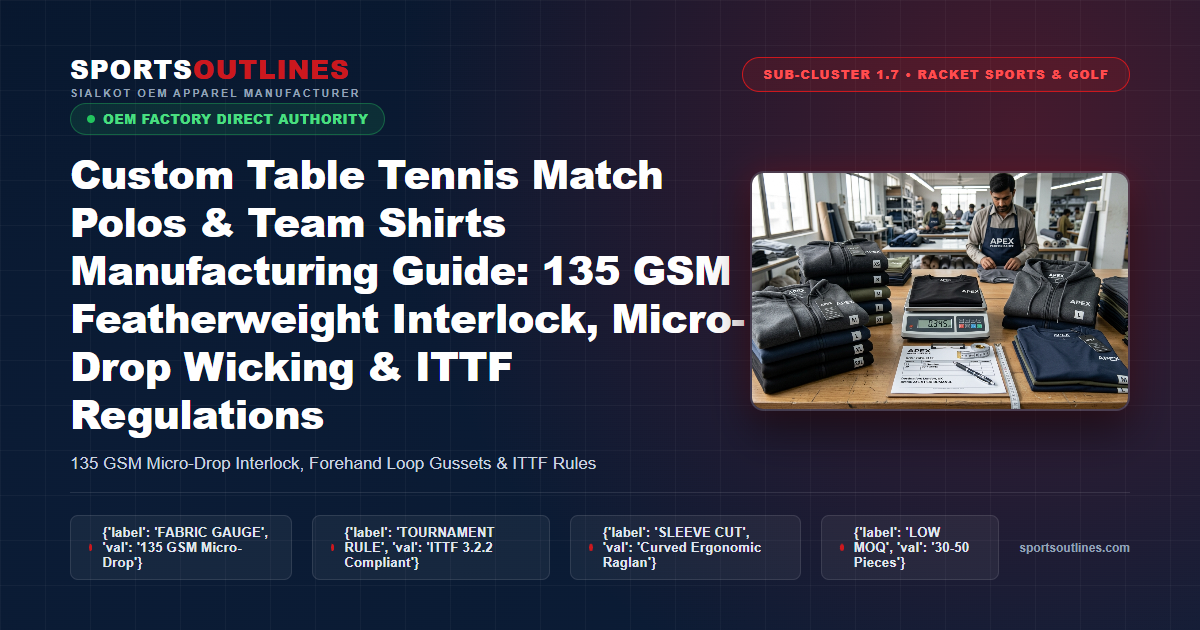
Manufacturing elite custom table tennis match polos and club jerseys requires ultra-featherweight fabric engineering for microsecond reaction loops, frictionless upper-torso mobility during high-torque forehand loops, and rigorous compliance with international federation uniform regulations. Professional table tennis jerseys are constructed from 130 to 140 GSM high-gauge micro-drop needle or pinhole interlock polyester (92% micro-polyester / 8% spandex) with built-in hydrophilic capillary moisture management (AATCC 79 absorbency ≤ 1.2s) and silver-ion antimicrobial odor defense. Because table tennis points feature extreme wrist snaps, forearm rotation, and aggressive crouching, shirts feature anatomical curved raglan sleeves and low-friction flatlocked underarm motion gussets that prevent the collar from choking the throat or pulling the hemline upward. To ensure 100% eligibility under International Table Tennis Federation (ITTF) Regulations 3.2.2, the main body color of the shirt must be clearly different from the official match ball color (white 40+ celluloid/poly ball or optic orange ball). Furthermore, back player lettering, national flags, and sponsor logos must strictly observe ITTF surface area thresholds (front maker logo ≤ 24 cm², front sponsor ≤ 60 cm², back name ≤ 100 cm²). Factory direct low MOQ at our Sialkot facility starts at 30 to 50 pieces per style/colorway with split youth (YS–YXL) and adult (XS–3XL) size curves. Pre-production physical prototype samples cost $45 to $85 per custom polo delivered in 7 to 10 business days.
- Fabric Construction: 135 GSM Featherweight Micro-Drop Needle Interlock with rapid evaporative cooling.
- Torso Biomechanics: Ergonomic curved raglan shoulder cut with 360° low-friction armpit gussets.
- Tournament Eligibility: 100% compliant with ITTF Rule 3.2.2 regarding non-ball contrasting color rules.
- Collar Architecture: Soft-touch micro-rib knit or self-fabric low-profile Mandarin stand collar with zipper placket.
- Embellishment Standards: Non-glare zero-weight digital dye sublimation and matte silicone transfers.
- Factory Direct Low MOQ: 30–50 shirts per team order with mixed adult and junior sizes.
- Physical Prototype Sampling: $45–$85 per custom piece in 7–10 days (strict zero credit/refund policy).
- Direct Sourcing Communication: WhatsApp factory direct at +92 316 7932595 or sportsoutlines.com.
Table tennis is one of the fastest athletic disciplines on the planet. Elite athletes strike 40 mm celluloid and poly balls at speeds reaching 70 mph, generating rotational spin rates exceeding 9,000 revolutions per minute with reaction windows under 200 milliseconds.
In high-level tournament halls where air currents are strictly sealed off by draft shields, ambient humidity climbs rapidly. When club teams purchase generic promo polo blanks or heavy soccer jerseys, the disadvantages are immediate: thick 180 GSM fabrics trap body heat like plastic bags, abrasive set-in shoulder seams create drag across the deltoids during aggressive backhand flicks, and bright white or orange shirt panels trigger instant disqualification by match umpires under ITTF ball-contrast rules.
For national table tennis associations, collegiate club captains, academy directors, and athletic apparel brands in the United States, Canada, the United Kingdom, and Australia, sourcing legitimate competition-ready custom table tennis polos with low factory MOQs is critical.
At Sports Outlines in Sialkot, Pakistan, our dedicated technical apparel facility produces bespoke table tennis match shirts, sublimated team polos, and national squad tracksuits. This technical manufacturing guide breaks down lightweight yarn physics, upper-body spin mechanics, ITTF regulatory standards, Points of Measure (POM), laboratory quality testing, and low MOQ production economics.
1. Textile Engineering: 135 GSM Micro-Drop Interlock vs. Circular Knits
Because table tennis takes place indoors with closed drafts, the body cannot rely on outdoor breezes to evaporate perspiration. The knit structure must actively pump moisture outward:
The Micro-Drop Needle Architecture
Standard activewear knits have uniform stitch densities that trap humid micro-climates against the torso. Our engineered 130 to 140 GSM micro-drop needle interlock alternates dense structural stitch columns with microscopic dropped-loop perforations. This dual-density architecture functions like an array of miniature convection chimneys: heat generated by rapid core rotation rises and vents through the dropped loops, while the high-gauge yarn structure maintains opacity, dimensional stability, and crisp graphic definition.
Capillary Wicking & Dry-Rate Dynamics
Our polyester yarns are extruded with multi-lobed cross sections that generate spontaneous capillary pressure. Perspiration droplets contacting the inner fabric face are drawn along micro-channels to the exterior surface in under 1.2 seconds (AATCC 79 test). Spreading over a wide surface area, moisture evaporates rapidly under the airflow generated by the player’s own explosive arm movements, ensuring the shirt remains featherlight throughout 7-game international matches.
Silver-Ion Antimicrobial Hygiene
In tournament play, athletes compete in 4 to 6 matches a day. Synthetic shirts commonly harbor bacteria that create pungent locker room odors. We treat all table tennis fabrics with a permanent silver-ion nano-polymer finish. Silver ions disrupt the enzymatic metabolism of bacteria (AATCC 100 confirming ≥99.3% reduction), keeping jerseys fresh across full-day weekend tournaments and extending textile longevity.
2. Technical Fabric Comparison for Custom Table Tennis Apparel
The table below compares the four primary textiles engineered in our Sialkot factory for competitive table tennis match uniforms:
3. Biomechanical Upper-Torso Tailoring: The Forehand Loop Motion Arc
A world-class forehand topspin loop requires instantaneous torso coiling, shoulder rotation, and explosive humeral adduction across the chest:
- Curved Anatomical Raglan Sleeve: Set-in sleeves create horizontal seamlines that bind across the anterior deltoid when the arm snaps forward across the body. Our curved raglan sleeve extends directly to the collar base, following the diagonal muscle fibers of the pectoralis major and latissimus dorsi, eliminating resistance during forehand follow-throughs.
- Continuous Underarm Motion Gusset: In backhand flicks and over-the-table banana flicks, the playing elbow elevates rapidly. A diamond-shaped underarm insert isolates sleeve movement from the torso body, allowing the elbow to elevate freely without pulling the shirt untucked.
- Low-Profile Mandarin Collar or 2-Button Micro-Placket: Standard heavy polo collars trap sweat against the neck and brush uncomfortably against the chin during low crouched ready positions. We craft low-profile Mandarin stand collars (2.0 cm height) or flexible micro-ribbed knit collars featuring break-resistant snap fasteners or concealed micro-zippers.
- Side-Seam Split Hem Vents: The lower hem features 3 cm reinforced split vents that allow the bottom of the polo to flare naturally over match shorts during deep lateral lunges.
Because table tennis players adopt a crouched stance with knees bent and chin tucked forward for 90% of match play, standard crewnecks exert backward pressure against the thyroid cartilage. We shape the front neckline with a forward-sloping 12 mm ergonomic dip lined with velvety poly-spandex sweat tape. This anatomical dip relieves throat pressure entirely, allowing uninhibited respiration during prolonged 30-shot rallies.
4. ITTF Tournament Regulations: Rule 3.2.2 Compliance & Advertising Limits
Sanctioned table tennis competitions enforce some of the strictest uniform regulations in global sport:
- The Ball Contrast Rule (ITTF 3.2.2.2): The main color of a shirt must be clearly different from that of the ball in use. Because 98% of international tournaments utilize white plastic 40+ balls, the predominant color of the shirt front cannot be white. If an orange ball is used, the shirt cannot be orange. Our design team pre-screens all custom team submissions to ensure the front and sleeves do not violate contrast requirements.
- Manufacturer Branding Thresholds (ITTF 3.2.5.1): The manufacturer’s logo on the front or side of the shirt cannot exceed 24 cm². We scale all Sports Outlines and private label factory emblems precisely below this limit.
- Commercial Advertisements (ITTF 3.2.5.3): A player’s shirt may carry up to two advertisements on the front (total area ≤ 200 cm²) and two on the sleeves (total area ≤ 100 cm²). Our CAD placement templates ensure sponsor artwork sits within legal boundaries.
- Player Name & Federation Markings (ITTF 3.2.5.4): The player’s name on the back must be positioned between 5 cm and 10 cm below the collar, with letter height between 4 cm and 6 cm, ensuring clear umpire readability from the scorer’s table.
5. Technical Points of Measure (POM) & Size Grading Matrix
To provide an athletic aerodynamic fit that moves synchronously with the player’s torso, our Sialkot factory utilizes the following standardized POM matrix:
6. Laboratory Quality Assurance & Durability Benchmarks
To guarantee that custom table tennis apparel maintains its vibrant colors, featherlight weight, and structural seam integrity, all production runs pass strict laboratory audits:
7. B2B Sourcing Economics: Unit Costs, Margin Analysis & Sampling
For commercial sportswear brand founders, table tennis federations, and academy retail buyers, understanding unit pricing dynamics and gross margin structures is essential:
Physical Prototype Sampling Policy: $45–$85 in 7–10 Business Days
Before placing bulk club or brand orders, we produce a physical prototype sample tailored to your exact tech pack specifications. Physical prototype samples cost $45 to $85 per custom polo. This fee covers digital pattern drafting, micro-drop knitting, collar placket assembly, sublimation transfer, and laboratory antibacterial audits over a 7 to 10 business day turnaround. We maintain a firm zero-refund and zero-credit policy on all sampling fees. Once approved, the physical prototype represents the definitive production benchmark for bulk manufacturing.
Export Finishing & Climate-Sealed Packaging
Every completed shirt passes through automated suction thread-trimming tables and undergoes high-pressure steam tunnel conditioning to relax knit stitches. Polos are folded over moisture-absorbing tissue cards, equipped with custom printed recycled hangtags, and sealed inside 40-micron recyclable frosted zip bags with desiccant silica packets. Bulk orders are packed into 5-ply export master cartons (60 units per carton, under 14 kg gross weight) shipped via express DHL/FedEx air freight to clubs, tournaments, and distribution hubs globally.
8. Eco-Recycled Performance Yarns (rPET) & Sustainable Table Tennis Teamwear
To support environmental sustainability initiatives led by national sports federations, Sports Outlines manufactures custom table tennis match apparel utilizing Global Recycled Standard (GRS) certified 100% recycled polyester (rPET) micro-filaments. Sourced from post-consumer plastic containers, these recycled polymers undergo chemical purification and precision extrusion to match virgin polyester in tensile burst strength, tactile smoothness, and dye saturation.
Choosing rPET knits reduces manufacturing energy consumption by 40% and diverts plastic waste from landfills without sacrificing athletic performance. Each table tennis polo consumes approximately 10 to 12 recycled plastic bottles, giving team directors and private label founders an authentic eco-performance narrative for marketing their collections.
Ultrasonic Welded Seams & Non-Chafing Assembly
For professional athletes who train 6 hours daily, traditional sewing threads can cause friction dermatitis along the upper chest and underarm folds. In our premier performance line, we utilize computerized ultrasonic welding that bonds synthetic textile edges with high-frequency sound waves. The resulting bond is reinforced with thermo-elastic Framis film tape, creating a seam that is 100% threadless, completely flat, and virtually imperceptible against bare skin.
Electrostatic Dissipation & Anti-Cling Yarn Architecture
In dry indoor tournament facilities, rapid torso rubbing against rubber table surrounds often generates static electricity charges exceeding 3,000 volts. Static causes synthetic shirts to cling uncomfortably to the abdomen, restricting sudden explosive lunges. We integrate conductive anti-static carbon-core micro-filaments (Belltron or Negastat) along the side panels and shoulder yokes. These carbon filaments continuously dissipate triboelectric static charges safely into the ambient air, ensuring the shirt maintains an airy, non-clinging drape even under rapid, repetitive looping motions.
Manufacture Custom Table Tennis Polos & Team Shirts
Equip your table tennis club, national squad, or private sportswear label with tournament-grade match shirts engineered in Sialkot. Featuring 135 GSM micro-drop interlock, curved raglan shoulder seams, ITTF-compliant color palettes, and low MOQ of 30–50 pieces with 7–10 days physical sampling.
9. Frequently Asked Questions (FAQ) — Custom Table Tennis Polo Manufacturing
1. Why are white match shirts prohibited in most sanctioned table tennis tournaments?
Under ITTF Rule 3.2.2.2, the main color of the shirt body and sleeves must be clearly different from that of the official match ball. Because most international events use white 40+ celluloid or plastic balls, wearing a white shirt camouflages the ball during spin loops. We produce rich contrast colors like navy, crimson, and black that guarantee full compliance.
2. What makes 135 GSM micro-drop needle interlock ideal for table tennis?
Micro-drop needle interlock combines dense structural knitted columns with microscopic dropped-loop ventilation pores. It allows humid metabolic heat to escape vertically while remaining completely opaque, soft, and featherlight against sweaty skin.
3. What is the minimum order quantity (MOQ) for custom table tennis polos?
Our factory direct low MOQ is 30 to 50 pieces per style/colorway. You can mix common youth (YS to YXL) and adult (XS to 3XL) sizes in a single production order run.
4. How much does a physical sample prototype cost, and what is the turnaround time?
A physical custom prototype sample costs $45 to $85 per piece delivered in 7 to 10 business days. This fee covers pattern grading, micro-drop knitting, collar placket assembly, digital sublimation, and lab testing. We maintain a firm zero-refund and zero-credit policy on all sampling fees.
5. What collar styles do you manufacture for table tennis teamwear?
We offer modern low-profile Mandarin stand collars with concealed quarter-zippers, traditional flat-knit ribbed collars with 2-button plackets, and lightweight self-fabric V-neck bands.
6. How does the raglan sleeve pattern assist forehand topspin mechanics?
Raglan sleeves eliminate rigid top shoulder seams, extending diagonally to the collar base. This matches the anatomical muscle lines of the chest and shoulders, allowing seamless upper-body rotation on high-speed forehand loops.
7. What are the ITTF rules regarding player name printing on the back?
Player names must be printed across the upper back between 5 cm and 10 cm below the collar seam, with letter heights ranging from 4 cm to 6 cm. Our CAD printing files are pre-calibrated to match these exact dimensions.
8. What printing technology is used for complex team gradients and club crests?
We utilize high-definition digital dye sublimation using eco-friendly water-based European inks. Sublimation dyes the synthetic fibers at a molecular level, adding zero weight, zero stiffness, and retaining 100% fabric breathability.
9. How does silver-ion finish prevent bacteria and odor buildup?
Microscopic silver ions embedded in the yarn matrix inhibit bacterial cellular replication (AATCC 100 ≥ 99.3% reduction). This neutralizes odors permanently, keeping athletes feeling clean across back-to-back tournament matches.
10. Can you match table tennis polos with coordinating match shorts and tracksuits?
Yes. We engineer complete team kits, matching Pantone colors, typography, and sponsor logos across polos, 4-way stretch shorts with towel loops, and warmup podium tracksuits.
Explore Related Racket Sports & Teamwear Manufacturing Guides:
Complete your club uniform collection with our factory guides on Custom Squash & Badminton Tees, Custom Pickleball Tops, Custom Tennis Polos, or browse our Full Sportswear Catalog.