Direct Manufacturer Answer: How to Source Custom Tackle Twill Basketball Jerseys Factory Direct
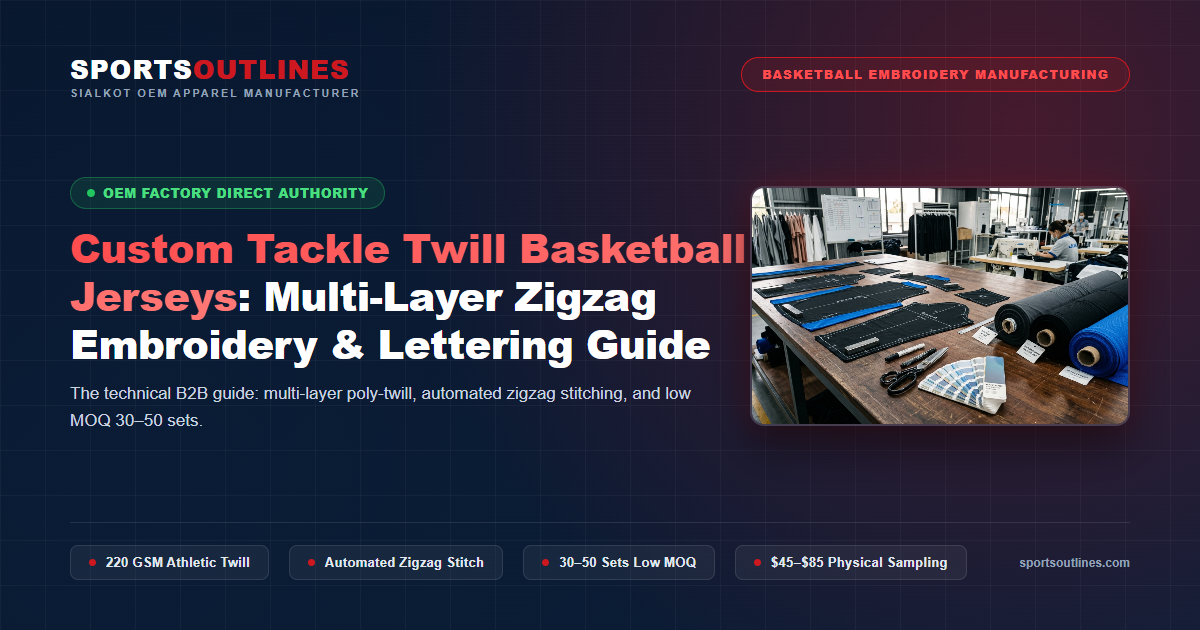
Professional tackle twill basketball jerseys are manufactured using heavyweight 100% woven polyester athletic twill fabric (210–230 GSM) cut with precision CO2 lasers, pre-tacked to 170–190 GSM pro-mesh body panels with high-temperature heat-seal adhesives (150°C), and permanently anchored using computerized high-density zigzag satin border stitching (1,200 to 1,400 stitches per square inch). Multi-layer applications (2-layer or 3-layer lettering) stack contrasting twill hues (e.g., navy lettering with scarlet outline and gold drop shadow) to create the authentic three-dimensional varsity prestige demanded by NCAA Division 1 programs and European professional clubs. Factory direct manufacturing in Sialkot, Pakistan delivers low MOQ starting at 30 to 50 sets (jersey + shorts) across Youth YS to Senior 4XL. Pre-production physical prototype samples cost $45 to $85 per set delivered in 7 to 10 business days.
- Twill Textile: 220 GSM 100% Woven Polyester Twill; zero fraying with laser-sealed edges.
- Stitch Architecture: Tajima computerized multi-head zigzag satin stitch (3.0mm width, 1,200+ stitches/sq in).
- Adhesive Backing: 90-micron thermal hot-melt film preventing bubbling and puckering over laundry cycles.
- Layer Configurations: Single-layer vintage, 2-layer contrast border, and 3-layer dimensional drop shadow.
- Factory Low MOQ: 30–50 complete sets per style/colorway across all sizing curves.
- Physical Prototype Sampling: $45–$85 per set in 7–10 days for twill density and drape verification (no free credits).
- Direct Factory Sourcing: WhatsApp factory direct at +92 316 7932595 or sportsoutlines.com.
In the hierarchy of basketball uniform craftsmanship, nothing conveys tradition, physical prestige, and championship heritage quite like authentic tackle twill embroidery. While dye sublimation has revolutionized lightweight grassroots apparel, the standard for collegiate varsity programs, high-profile prep academies, and professional basketball franchises remains anchored in heavy, dimensional cut twill lettering.
A tackle twill uniform feels different in the athlete’s hands. When a player pulls a heavy twill jersey over their shoulders, the crisp, tactile texture of raised embroidered team scripts and multi-layer stitched back numbers establishes an immediate psychological connection to the sport’s storied history. Under harsh arena lighting and 4K television cameras, the lustrous diagonal weave of athletic twill catches specular highlights with dimensional depth that flat print graphics cannot emulate.
At Sports Outlines in Sialkot, Pakistan, we operate automated laser cutting systems, Tajima multi-head industrial embroidery machines, and dedicated pressing lines specialized in collegiate-grade tackle twill uniforms. This comprehensive technical B2B sourcing guide breaks down twill textile chemistry, laser cut kerf tolerances, zigzag stitch mechanics, unit manufacturing economics, and factory-direct low MOQ sourcing workflows.
1. Anatomy of Tackle Twill: Fabric Construction & Adhesive Backing
Authentic athletic tackle twill is not simple embroidery cloth. It is a specialized industrial textile engineered specifically to withstand violent on-court grabs and repeated high-temperature commercial laundering:
- Woven Polyester Twill Matrix (210–230 GSM): Woven on high-speed rapier looms in a 2/1 or 2/2 diagonal twill pattern from 150-denier high-tenacity continuous-filament polyester yarns. The diagonal twill weave delivers superior tensile tear resistance compared to plain-weave fabrics while creating a subtle diagonal rib texture that reflects arena light.
- Thermo-Fusible Hot-Melt Adhesive Film: The reverse side of the twill fabric is pre-laminated with a 90-to-110 micron layer of ethylene-vinyl acetate (EVA) or polyamide hot-melt adhesive film. When heat-pressed onto the jersey panel at 150°C with 4 bar pressure for 10 seconds, this film fuses the twill flat against the jersey mesh. This prevents the fabric from shifting, skewing, or bunching during subsequent high-speed embroidery.
- Anti-Pucker Heat Setting: The twill undergoes thermal stabilization at 180°C prior to laser cutting. This ensures the twill and the jersey body mesh have identical shrinkage coefficients (less than 1.0%), eliminating the unsightly ‘puckered wave’ effect that ruins cheap team uniforms after the first wash.
2. Laser Cutting Precision: Kerf Tolerances & Edge Polymerization
In early manufacturing eras, tackle twill letters were stamped using steel die blades. Mechanical blade cutting leaves exposed loose polyester yarn ends that unravel after repeated laundry cycles.
At Sports Outlines, our cutting department operates automated CNC dual-head CO2 laser cutters:
- Beam Kerf Width (0.12 mm): The focused infrared laser beam cuts with a kerf tolerance of ±0.1 mm, allowing intricate cursive team script fonts, sharp internal letter cutouts (such as the centers of ‘A’, ‘B’, ‘O’, ‘8’), and jagged mascot claws to be rendered flawlessly.
- Thermal Edge Polymerization: As the 100-watt laser beam cuts through the 100% polyester twill, the concentrated heat instantaneously melts the synthetic fiber filaments along the perimeter cut line. This polymerizes the cut edge into a micro-bead seal that will never fray, even if edge stitches are subjected to friction.
- Multi-Layer Auto-Nesting: Specialized CAD nesting software automatically arranges letter layers—nesting the smaller top layer inside the scrap perimeter of the larger base layer—maximizing twill yardage efficiency and reducing wholesale production costs.
3. Embroidery Stitch Mechanics: Zigzag vs Satin vs Faux-Twill Sublimation
Once the laser-cut twill letters are heat-tacked onto the jersey panel, computerized embroidery machines anchor the perimeter edges permanently:
- Wide Zigzag Stitch (The Collegiate Classic): An alternating diagonal stitch with a calibrated bite width of 2.8 mm to 3.2 mm. One needle penetration punches directly through the twill edge, while the opposite penetration lands just outside on the jersey body mesh. This stitch profile provides high mechanical elasticity, allowing the jersey fabric to stretch during athlete movement without snapping embroidery threads.
- Dense Satin Stitch Border (High-End Pro Standard): An ultra-dense column stitch with zero spacing between thread passes (stitch pitch 0.35 mm to 0.40 mm). This completely encases the twill perimeter in a glossy, solid thread ridge that looks like raised jewelry under television lighting.
- Embroidery Thread Chemistry: We exclusively utilize 40-weight continuous-filament trilobal polyester embroidery threads (Madeira Classic or Isacord). Trilobal polyester delivers superior tensile breaking strength (>1,100 cN) and 100% chlorine fastness compared to delicate rayon threads that break during heavy team laundering.
4. Multi-Layer Stacking: Single-Layer vs 2-Layer vs 3-Layer Drop Shadow
The visual depth of a tackle twill basketball jersey is determined by the number of stacked twill layers:
- Single-Layer Tackle Twill: A single solid color twill letter stitched with matching or contrasting thread. Lightweight, classic, and cost-effective. Excellent for high school varsity and budget collegiate programs.
- 2-Layer Tackle Twill (The Gold Standard): Features a larger base twill layer (the outline) with a slightly smaller top twill layer (the foreground fill) stacked directly on top. Each layer is stitched independently or with a shared satin border. This creates a crisp 2-color border that makes numbers pop against dark jerseys.
- 3-Layer Tackle Twill with Drop Shadow: An intricate configuration consisting of three separate laser-cut twill pieces: an offset shadow layer, a border outline layer, and a top foreground layer. This creates a bold, three-dimensional architectural drop shadow effect that looks extraordinary in championship team portraits.
5. Body Fabric Integration: Heavy Pro Mesh vs Dazzle vs Moisture Management
Tackle twill letters add physical structure and weight. If the base jersey fabric is too thin or flimsy (such as 120 GSM running mesh), the heavy twill numbers will cause the jersey front to sag forward awkwardly and pull at the collar.
At Sports Outlines, tackle twill jerseys are matched with structurally substantial performance textiles:
- 180–190 GSM Pro-Weight Circular Eyelet Mesh: Knitted from heavy 75D/72F micro-polyester yarns with reinforced dimensional stability. The fabric has enough structural stiffness to support a 10-inch double-layer twill number without torso sagging.
- 170 GSM Mock-Mesh Interlock: A closed-face knitted textile with recessed hexagonal dimples. Combines the classic dimpled appearance of mesh with the smooth, high-density stitch stability of interlock.
- Ribbed Knit Collar & Armhole Trims: We finish tackle twill jerseys with heavy 100% polyester 1×1 or 2×2 yarn-dyed rib knit neckbands and armhole trims (600 GSM knit density), matching the traditional weight balance of authentic collegiate game jerseys.
6. Complete Factory Manufacturing Workflow in Sialkot
Manufacturing custom tackle twill jerseys requires tight coordination between digital design, laser cutting, heat pressing, and multi-head embroidery departments:
- Digital Vector Digitizing & Stitch Programming (Day 1): Graphic designers convert client team fonts into embroidery stitch files (.DST format) using Wilcom EmbroideryStudio, calibrating stitch densities, underlay stitches, pull compensation, and needle entry sequences.
- Automated CO2 Laser Cutting (Days 2–3): Rolls of pre-glued athletic twill in specified Pantone colors are precision cut into team names, player numbers, and player nameplates.
- Pneumatic Heat Positioning & Fusing (Days 4–5): Unassembled front and back jersey panels are placed on precision alignment jigs. The laser-cut twill letters are heat-fused onto the mesh panels at 150°C using pneumatic heat presses.
- Tajima Multi-Head Industrial Embroidery (Days 6–9): Panels are hooped into computerized Tajima 20-head embroidery machines. Skilled operators monitor thread tension as automated needles execute high-density zigzag satin border stitching around every letter and number.
- Garment Assembly & Ribbing Attachment (Days 10–12): Embroidered front and back panels are stitched together using 4-thread overlock safety machines, followed by attaching heavy ribbed collar bands and armhole trims.
- Internal Thread Trimming & Backing Cleanup (Day 13): Technicians manually trim jump threads and inspect the reverse side of every embroidery zone, ensuring a clean, smooth interior finish that will not irritate the athlete’s skin.
- AQL 2.5 Quality Inspection & Export Boxing (Day 14): Uniforms are checked under daylight inspection lamps for letter alignment symmetry, stitch tension consistency, and dimensional accuracy before steam pressing, polybagging, and international air shipping.
7. B2B Sourcing Economics: Unit Costs, Low MOQ Tiers & Profit Margins
Tackle twill involves skilled manual and machine embroidery labor. Sports Outlines maintains transparent, highly competitive factory-direct pricing:
Sample Policy Transparency: To evaluate twill fabric drape, laser cut precision, zigzag stitch tension, and embroidery thickness on an actual athlete, Sports Outlines produces physical pre-production prototype samples for $45 to $85 per set (depending on lettering complexity and layer count). Turnaround is 7 to 10 business days. This fee covers single-piece custom laser cutting, specialized digitizing setup, skilled embroidery machine technician labor, and express international air courier delivery. We do not offer free CAD mockups or sample credits on bulk orders, ensuring fair, sustainable, transparent manufacturing costs.
8. Quality Control & Embroidery Testing Protocols
To ensure our tackle twill uniforms withstand violent game play without letter detachment, our quality lab performs rigorous mechanical audits:
- Stitch Adhesion Pull Test (ASTM D1683): The zigzag embroidered border is subjected to 160 N of transverse tensile pull force. There must be zero thread breakage or stitch separation from the jersey mesh.
- Commercial Wash Delamination Test (ISO 6330): Samples undergo 50 wash cycles at 40°C. Zero edge peeling, bubble formation, or thread fraying is permitted.
- Embroidery Tension Symmetry: Inspected under 1,200-lux LED lights to verify that bobbin threads do not show through on the top twill surface and top embroidery threads do not create fabric puckering.
- Colorfastness to Perspiration (AATCC 15): Twill fabrics and embroidery threads must achieve a Grade 4.5+ colorfastness rating, ensuring zero dye bleed onto white contrast panels during intense sweat conditions.
9. Measurement Point Spec Sheet: Sizing Curves & Jersey Dimensions
Below is our standard sizing matrix for custom tackle twill basketball jerseys. All measurements are given in centimeters (tolerance ±1.0 cm):
10. Care & Laundering Protocols for Tackle Twill Jerseys
To preserve the crispness of tackle twill embroidery across multiple competitive seasons, team equipment managers should follow strict laundering rules:
- Turn Jerseys Inside Out: Always invert jerseys prior to washing. This shields the raised twill numbers from surface friction against other garments and the metal wash drum.
- Cold Water Wash (Max 30°C / 85°F): Use mild liquid athletic detergent free of optical brighteners. Never use hot water, which can soften the thermal adhesive backing beneath the twill patches.
- Air Hang Dry (Zero High-Heat Tumble Drying): Hang dry in a well-ventilated area. Commercial dryer heat causes polyester embroidery threads and base twill fabrics to shrink at slightly different rates, resulting in permanent letter puckering.
- Never Iron Directly Over Embroidery: If pressing is necessary, use a cool iron on the reverse face with a damp cotton pressing cloth.
11. Tech Pack Preparation: Bill of Materials (BOM) & Embroidery Callouts
To eliminate sample revision cycles and ensure flawless execution between your design studio and our Sialkot factory floor, teamwear brands should specify an explicit Bill of Materials (BOM) in their tech pack:
- Jersey Body Fabric: 100% Polyester Heavyweight Circular Eyelet Pro-Mesh, 180–190 GSM, anti-microbial sanitized finish, color Pantone callout (PMS Solid Coated).
- Tackle Twill Material Callouts: 100% Woven Polyester Athletic Twill, 220 GSM, specifying layer 1 (outer outline) and layer 2 (inner foreground fill) with exact Pantone color matches.
- Embroidery Stitch Specifications: Tajima computerized zigzag satin stitch with 3.0mm bite width, 40-weight continuous-filament trilobal polyester embroidery thread, callout stitch thread color.
- Hardware & Trims: 100% Polyester 1×1 or 2×2 yarn-dyed knitted ribbing (600 GSM) for V-neck or round neck collars and matching armhole bands.
- Letter & Number Placement Map: Exact Cartesian coordinate dimensions from top shoulder seam for center chest team lettering (arched or straight) and back player numbers (typically 8-inch, 10-inch, or 12-inch heights).
- Labels & Packaging: Woven damask size label and lower left hem jock tag, individually folded with tissue paper and packaged in recyclable polybags.
12. Historic Collegiate Heritage: The Cultural Prestige of Tackle Twill
Tackle twill occupies a unique emotional and cultural space in American sporting tradition. From classic NCAA tournament championship runs to legendary NBA franchises, stitched twill letters represent the highest tier of athletic authenticity:
- The Unmistakable Tactile Weight: When an athlete puts on a genuine tackle twill uniform, the physical weight of embroidered crests serves as an empowering psychological armor. It signals that this is not a casual practice scrimmage, but a high-stakes championship battle.
- Longevity as Cherished Heirlooms: While sublimated jerseys are frequently discarded after a single season, tackle twill varsity uniforms are often framed, preserved in trophy cases, or awarded to graduating seniors as permanent keepsakes of their athletic journey.
- Sourcing Direct for Private-Label Brands: By partnering with Sports Outlines in Sialkot, athletic apparel brands can offer authentic collegiate-grade tackle twill uniforms without paying inflated domestic broker markups, achieving premium commercial positioning and 70%+ gross profit margins.
Explore Related Sialkot Factory Manufacturing Silos:
- Sublimated vs Cut-and-Sew Uniforms Guide — Performance, breathability, and cost analysis.
- Custom Basketball Shorts Manufacturing Guide — Pro mesh, dazzle linings, and 9-inch athletic inseams.
- Custom Basketball Shooting Shirts Guide — Poly-spandex raglan mobility and warm-up tops.
- Sportswear Manufacturer for USA Teams & Brands — Factory direct shipping to North America.
- Contact Sports Outlines Factory — Request a quote or order your physical prototype.
Ready to Manufacture Custom Tackle Twill Basketball Jerseys?
Partner with Sialkot’s dedicated teamwear manufacturer. Enjoy true factory low MOQ of 30–50 sets, premium 220 GSM laser-cut poly-twill, automated Tajima zigzag satin stitching, and swift 7–10 day physical sampling.
Frequently Asked Questions: Sourcing Tackle Twill Basketball Jerseys
What is the difference between tackle twill and standard embroidered patches?
Tackle twill utilizes pre-cut pieces of woven athletic twill fabric that are heat-applied and secured around the edges with zigzag satin stitching. Standard direct embroidery fills the entire shape with continuous thread stitches, making large chest lettering and back numbers excessively heavy and stiff.
What is the factory minimum order quantity (MOQ) for custom tackle twill jerseys?
Our factory direct low MOQ is 30 to 50 sets (jersey + shorts) per style/colorway, allowing scholastic programs, clubs, and apparel brands to order across mixed youth and adult size breakdowns.
How much does a physical sample prototype cost and what is the turnaround time?
A physical prototype sample set costs between $45 and $85, completed in 7 to 10 business days for complete physical evaluation of twill thickness, laser precision, and stitch density before bulk manufacturing.
Why are laser cutters used instead of manual scissors or blades for tackle twill?
Laser cutters achieve 0.1 mm kerf precision for intricate typography while simultaneously melting and polymerizing the synthetic polyester edges. This micro-bead seal guarantees that cut edges will never fray or unravel during play or laundering.
Do tackle twill letters crack or peel after repeated commercial washing?
No. Unlike screen printed inks or vinyl transfers that crack and peel over time, tackle twill is woven polyester mechanically anchored with over 1,200 stitches per square inch. When washed in cold water and air dried, tackle twill retains its integrity for multiple seasons.